

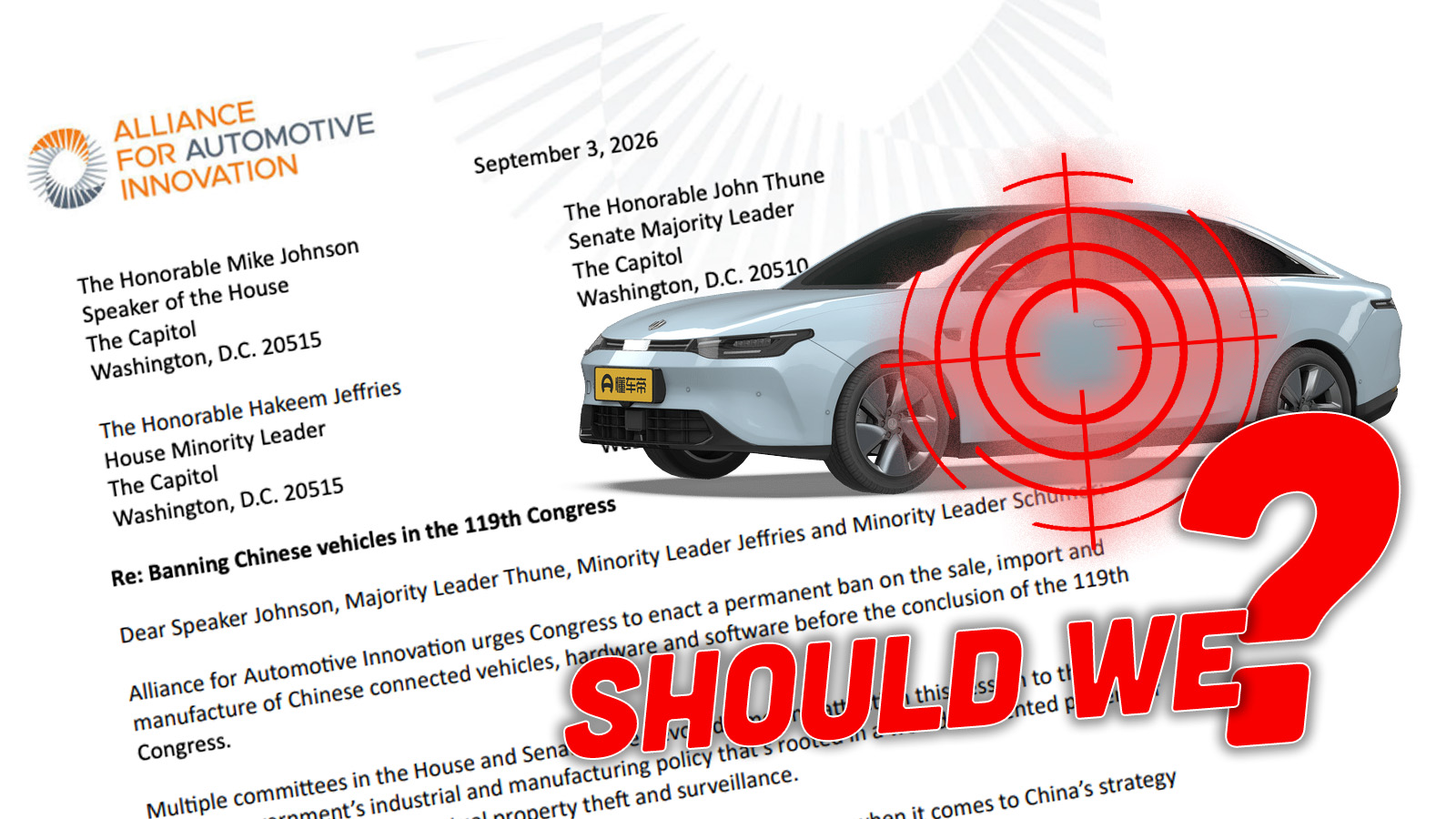
I know people lament that letter writing is dead, but I’m happy to say I don’t think that’s true. I say this because just yesterday the Alliance for Automotive Innovation – a trade group made up of a large number of automakers, including GM, Ford, Ferrari, BMW, Honda, Mercedes-Benz, Nissan, Mazda, McLaren, Toyota, Subaru, hell, even VinFast, among many others – sent a heartfelt, personal letter to congressional leaders asking about enacting a “permanent ban” on Chinese-made “connected” cars in America.
Their argument in the letter is essentially that they believe Chinese carmakers don’t play fair, and are determined to surveil Americans and, when able, steal intellectual property. Here’s what they say in the letter:


“Alliance for Automotive Innovation urges Congress to enact a permanent ban on the sale, import and manufacture of Chinese connected vehicles, hardware and software before the conclusion of the 119th Congress.
Multiple committees in the House and Senate have devoted time and attention this session to the Chinese government’s industrial and manufacturing policy that’s rooted in a well-documented pattern of unfair trade, subsidies, intellectual property theft and surveillance.
This behavior is a feature of the Chinese approach and especially acute when it comes to China’s strategy to dominate global automotive manufacturing and critical supply chains.
Right now, Chinese automakers are dumping subsidized vehicles with connected software and hardware around the world. China is capturing market share in Europe, Australia, Southeast Asia, Mexico and South America with vehicles capable of collecting, processing and transmitting sensitive vehicle and consumer data to the Chinese Communist Party.
This hasn’t happened inside the U.S. yet, but given the scale and urgency of this threat, we urge you to enact a Chinese vehicle, software and hardware ban before adjourning this year and make this policy the law of the land.”
Now, I’m not exactly sure how I feel about all of this; are these genuine concerns, or is this an industry just trying to protect themselves from a lot of significant competition? We’ve seen some impressive new cars coming out of China lately, in pretty much the full spectrum of the market, from the extreme low end to ultra-premium luxury barges, laden with technology. It makes sense that they’d be a bit scared. They should be a bit scared.

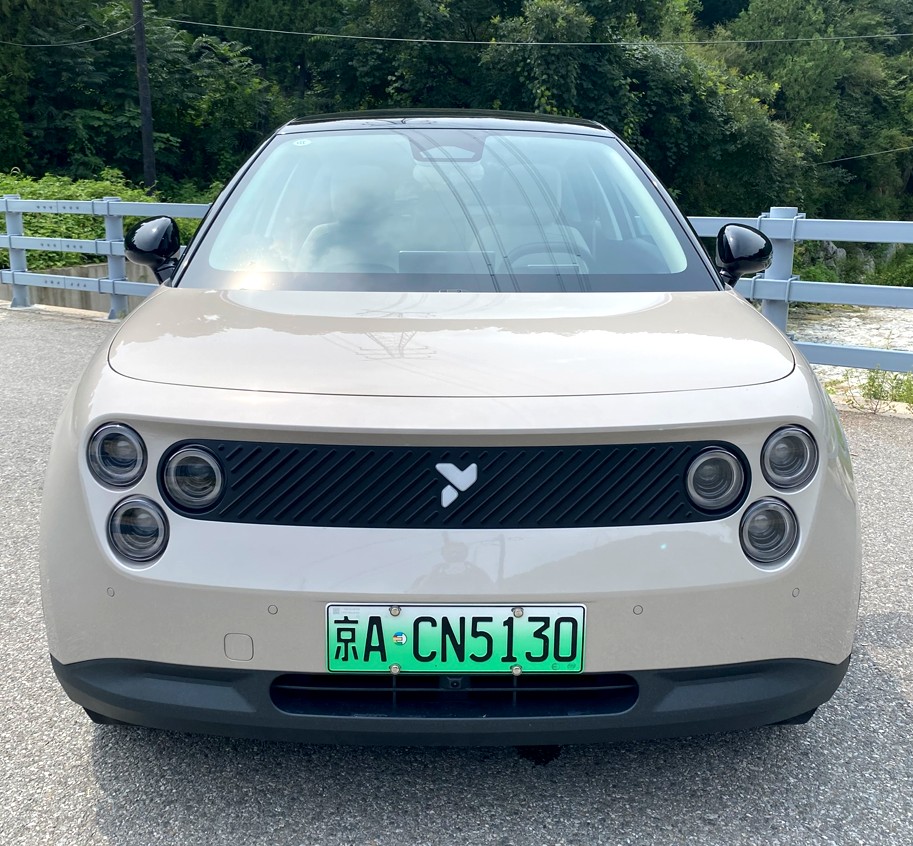
Then again, it’s not like the claims made by the Alliance for Automotive Innovation are all made up; China absolutely has a history of being pretty, let’s say “relaxed” when it comes to intellectual property. That car above there sure looks like another extremely famous car, but did that stop China’s Ora from pretty shamelessly cribbing the design? Not a bit.
And, yes, there is rampant data-gathering and privacy violations with many Chinese cars and how they gather data. Then again, it’s not like other global companies aren’t guilty of this as well, because they absolutely are. I wish this was a China-specific problem. But are Chinese companies sending all that data right to the Communist Party? Maybe? I have no idea. Is it any worse than companies taking data for their own use and using it to track us and sell us even more things and find new ways to monetize our every action? Again, maybe? Maybe no one is an innocent here.
The letter urges that bills like the Connected Vehicle Security Act of 2026 (S. 4429) in the Senate and similar bills in the house be passed before the end of the year. These bills would ban automakers from selling in America if they have over a 15% Chinese ownership stake. This limit would effectively ban the sale of Mercedes-Benz cars in America, for example, as they have a 20% ownership stake from Chinese investors.
So, what do we, as painfully obsessive car geeks, make of all of this? Should the US ban Chinese cars to protect an industry that’s important to America economically and psychologically, or is this just protectionism for American and other global brands that will only end up harming consumers? Are there genuine security concerns? Concerns that are qualitatively different from what other, non-Chinese companies are doing? Is protecting domestic automakers a good idea? Is that protectionism? If so, will we get exciting things, like how Brazil’s protection of their local industry gave us so many weird Volkswagens? Or will we just end up with uncompetitive, boring cars?
I’m not ready to absolutely give an opinion on all this just yet, which is why I’m curious about what all of you – the brightest, best-informed, wittiest, and best-smelling automotive community on the inter-net – has to say about it all.
Let’s figure this out.


All of that is true, about Chinese autos and their practices…
…but…given the current state of the American auto industry and their half-assed attempts at turning out affordable and reliable vehicles, I’d almost say give the Chinese a chance. Might spook the Big Three into actually doing their f***in’ jobs.
This is one of those comment threads where I am confronted with my naivety. I have a 14-year-old LG TV that I watch most of my stuff through via Roku. I read about smart TVs Hoovering up and selling information on what I’m watching. I think, oh, it just “knows” I’m watching whatever is being served to it through and HDMI port. But then, Roku and all the sources I stream through are likely doing the same thing.
I lead a reasonably vanilla life in general and don’t feel targeted. Mainly because I don’t think I am a particularly interesting target.
Protectionism seems like it’s antithetical to pure capitalism. The World (with a capital W) is not a level playing field. And I don’t have a clue as to how to level it.
I am typing this on a Taiwanese-made laptop. I have a Chinese manufactured smart phone in my pocket. The US is hellbent on deporting hard-working people from “shithole” countries. And those people have propped up the consumer class in the US for decades.
Fruit and vegetables are currently rotting on the vine in the US because ICE might show up and arrest everyone working in the fields, orchards and vineyards. The same with slaughterhouses and the meat industry.
A nasty squall line of storms came through SE Texas when I lived there and annihilated a lot of roofs with golf ball + sized hail. The only people I saw up reroofing homes were all Hispanic. Many probably not “legal.” Same as the harvesters and the butchers. Good luck finding white “Amuricans” that are willing to do that work.
The original railroads in the US were largely built by Chinese slaves.
I’m not saying that it’s cool to exploit people, regardless of their ethnicity or origin. But this current era of xenophobia and American exceptionalism is taking the country in a very uncomfortable direction.
Again, I can see the problems, but I don’t have the answers. So, you will never see me running for office.
Uhhh… yes? Because many of them are fully owned by the national CCP, quite a few others are fully owned by State CCPs, and most of the rest are mixed public-private ownership. BYD is one of the few that is “privately” owned in that it trades on public markets like most other automakers, but if believe for a moment that their connectivity data isn’t also passed on to the PLA server, I have a bridge to sell you.
I’m generally against protectionism, as it throws a wet blanket on innovation, but pretending China is a fair market actor ignores the challenge our domestic production faces. A real solution would require threading the needle with targeted trade enforcement to help remove the unfair economic advantage state sponsored Chinese automakers currently enjoy – something I am not sure our legislators could even begin to draft, given their insane levels of dysfunction these days.
The data privacy issue should at least be solvable – mandatory security audits and zero tolerance for data exfiltration.
Maybe if US lawmakers were interested in doing things like passing privacy laws here in the states the surveillance part of this equation would be far less a concern.
As for the Chinese government subsidizing their automakers in order to gain market share . . . That’s a bit harder to solve. And it’s not like they’ll loosen up to welcome non-Chinese automakers in their own market.
Outside of my expertise for sure.
I’m gonna be the grumpy old grandpa here.
If anyone making connected and surveiling cars wants to sell them here – sell the car prewired with all the hardware, and with a blank ECU that knows enough to let it roll off the ship, then leave it to a local entity to fit the rest. The manufacturer can still sell them the blank hardware to program, minus the modems, thank you. They can even overcharge for that.
I do want to see a Huawei phone as a competitor here, but hey – I can live without it if I don’t know what’s baked into the chips. And I can definitely live without Huawei cell towers, thank you very much.
In the grand scheme of the very improbable and in the realm of pure paranoia, I don’t worry that much about a vehicle made by a strategic foe using its cameras on me.
I worry about 10000 or 100000 cars becoming encrypted datacom relays all at once, or catching fire at the same time, or becoming relays, doing their jobs, then catching fire.
Those are not cars anymore. Been a while since a car is more than a car.
Seen enough cctv cameras sold in Eastern Europe phoning back to CC the second they come alive, to be returned to a nonchalant local vendor going “Ah, those be the old ones, they used to do it, here’s an updated one“.
Any thoughts on the repairable phone?
I think it’s called the Fairphone.
Good thing it exists. I’d get one if it ticked enough boxes for me. It doesn’t, as no new phone does.
However from a parano-spy perspective – even if it was flush with ugly stuff – there are too few sold to create critical mass. And it’s unlikely it is.
There was the Anon app however, which – despite its small numbers, hit hard.
A flagship phone however gets sold by the millions. It does matter who makes it (and we’ll agree that perfection doesn’t exist and everybody is guilty of something).
There is android replacement software that shows promise.
A friend that is security conscious because of work has forced many apps off his phone that are alleged to not be removable.
Battery life is longer just from that.
He isn’t using replacement browsers as far as I know.
Many Android phones allow installing Lineage OS (as long as they are fully unlocked and have an unlocked bootloader – which is different from a phone that was unlocked by the operator) which allows you to do plenty of things. It’s a whole little world.
The installation can be a bit scary at first but the instructions are usually plenty good, as long as you use your original cable to do the flash (flashing seems to be extremely sensitive to the cable’s quality, ask me how I know).
It also brings new life to old phones. I have a backup Google Pixel 2XL which has the latest Android thanks to that.
The problem is not there.
It’s that technically, if you’re a foreign entity building phones – you can get something put in the chips themselves that you can’t detect or root out in software no matter what OS you put on it.
As for privacy – going to extremes can be an extreme too.
Imagine you have a phone that is secured to the extreme – no google, no ios, all anonymized and whatnot.
When the guys in the black van analyze the 1000 phones that connected to a cell tower, and can see 999 of them being nicely google or apple trackable and spy-able, and that one phone that is leaving no identifiable data – like a shadow without a person. Which one will they go after ? 🙂
But that’s a whole n’other conversation
It’s recognized that ideal encryption doesn’t appear encrypted.
Protectionism is, broadly speaking, bad. I see no good in this current iteration.
Protectionism is what allowed millions of Thai people in Thailand to have a stable job in the automotive industry.
Without protectionist policies, everybody would be buying imported cars and Japanese manufacturers see no point in opening a MANUFACTURING plant in Thailand. These same plants caused many thousands of supplier companies to feed into the logistics, creating more jobs.
The only thing preventing the North American automotive industry from following the same path as the Australian’s are protectionist policies like the 25-year import rule and chicken tax.
You may not care for our jobs because you don’t work in automotive or you’re a hardcore capitalist, but you cannot say you cars you’re forced to buy nowadays are bad because of lack of competition. There’s already ample competition.
Protectionism is the only reason the Chinese economy exists in any meaningful fashion (this was a smart decision by China), and now that they are trying to eat a market with all of the advantages of protectionism, it’s bad to say “nah, fight fair or GTFO”?
I’ve been amazed by how many Chinese cars are in the uk while here this week. But I struggle to see how their potential surveillance is worse than the current known surveillance we have in the us in new cars and other tech
I think it should be mandated that the consumer can effectively protect their privacy by not allowing ANY upload from the car to the manufacturer unless they choose to do so. Heck, I think that downloads ought to be limited to only those absolutely necessary for safety and meaningful updates. Of course, the whole system of data transfer must be transparent, so that drivers, manufacturers, governments can all be sure about what’s going on and what’s not.
I used Ubuntu Linux for several years a while back and recall that it had a very clear interface for what update downloads the user wanted to receive, and what info of theirs that they wanted to share back with Canonical. I’m not saying it or Ubuntu were perfect of course, just that they seemed to make an effort towards clarity on such things, whereas other OS builders seem to rely on obsfucation (looking at you Microsoft).
A new vehicle NOT being ‘connected’ at all would actually be a positive selling point for me. Yes, that would mean having to install updates manually if one was absolutely necessary (by visiting a dealer or shop or maybe yourself via an SD card or something) but I suspect fewer updates would make for a better ownership experience anyway.
There’s TONS of stories around about how Tesla uses (and abuses) their control over their customer cars’ data, filled with cameras and sensors as they are. It’s literally Orwellian, or at least perverse. There’s no place for even the potential for that abuse in any car I’m going to own and drive.
People who want Chinese EVs over here look at them like a Cell-phone: A new one will come along with new features and I’ll upgrade when that happens. And they pump out new models like crazy. What’s happening is that they aren’t doing enough R&D to increase Q&A.
And there are plenty of information from around the world like Australia and Europe. One person in Australia was paying on a loan for an EV (I think it was a Dolphin) that he hasn’t driven in several months because the cooling system failed and the dealer network was too sparse and they cannot get parts for them. Its so bad that European insurance companies are starting to band Chinese EVs from being covered due to the lack of parts inventory:
https://youtu.be/fedVRHDsFzU?si=eWVcMa81HZkMfzH6
But sure, be wowed by a car door opening with a hand gesture or self-driving feature that slams on the brakes when it sees a billboard ad with a picture of a truck. I’d rather have an EV with a battery pack that lasts longer than a year, or have a parts network that doesn’t suck wind.
Did you know that in an accident, the emphasis on removing badges on a car is more important than the accident itself?
Listen, Autopian, what you are looking at is your Mercedes vs Elkhart, ID.
Bow down to the industry, or report independently. Its gonna suck.
Get clicks, get pressers, bow to your maker.
Or be Mercedes, report the truth, and fingers crossed.
It’s time Americans realize how many good paying jobs Changli has stolen. Even worse, they’re spying on everyone!
“Made in China”
So Alabama, North Carolina, and Germany are now in China?
Really, a ban on cars connected to their manufacturers or governments in general would be fine by me.
The fact is that it’s all about capital, not connections.
I dunno… maybe start at home in the US? Like, erm, by banning Flock cameras? Or is it ok for the police state to spy on its own citizenry (and wives, exes, dumbocrats (../s)?
That said, I too wasn’t sure how I felt about this until Polestar offered a $25k discount and we got ourselves a Polestar 4 for $40K. What I can say is how I feel when I get in that car… the quietest, most comfortable, quick and fun car I’ve had the pleasure of owning. And my wife, 100% ambivalent about any and all cars has now become a Polestar enthusiast… even joined a Polestar 4 FB group.
The ban is inconsistent given the other technology that we allow in our country and how American companies are spying on us without our consent. I’m more concerned about Flock/DOGE/ICE and the immediate impact they can have on the citizenry than I do about my Swedish/Chinese/South Korean Polestar.
Hey Congress, you jackasses, maybe focus on preserving democracy and averting domestic authoritarianism before you worry about other authoritarian regimes. The biggest threat to domestic tranquility is coming from “inside the house”. Maybe grow a pair and make it easier to vote and not harder, and to punish an actual insurrectionist?
Maybe then I’ll worry about Geely knowing that I listened to Songs in the Key of Life and that my wife and I went to the movies… FFS.
I was listening to French songs as you do.
Ran across a song by Joe Dassin clearly based on a very fàmiliar song, but with different lyrics.
duck://player/Lvs2ft6L0JI
Took me a bit to identify as Yellow River by Christie, always an evocative song.
But looking at the lyrics, I found much of it puzzling.
“Put my gun down, the war is won
Fill.my glass high, the time has come
Cannon fire lingers in my mind
I’m so glad I’m still alive”
I always assumed it was about china, because Yellow River, which turns out it is, but as a metaphor.
Yellow River became the border for a war in China and a metaphor for those sort of choices. The song is about being in the center of choices and was inspired by the civil war in America, another economic war.
Part of the song was written as call and response, though that isn’t exploited in the recordings.
Seneca said we are our choices.
If Seneca was here, he would fix the software on these pages!
The original song by Christie
duck://player/N7nwBVPqKLA
(Any time I leave the page, it can vanish)
Fucking musicians, huh? You never know what they’re thinking!
I still love that VW Beetle knock off, where they put the chruch/iron rear lights (1968-1971) shape IN THE FRONT!
– BTW did anyone (Chinese or other) ever make a car with pop-up rear lights?
I think everybody should be able to opt out of any car data collection. I do. But only by driving 35+ year old cars.
Do you mean the Ora Ballet Cat? I drove one during a trip to China. It was great! Basically drives like a Chevy Bolt or Nissan Leaf wearing a VW Old Beetle outfit.
Chinese car owner here. We picked up our Jaecoo J5 EV a couple of weeks ago. It doesn’t have connected services so I guess it wouldn’t fall under the proposed plan here? It does have it in other markets but apparently Jaecoo Omoda haven’t received approval to offer it here yet.
For non-car people it presents incredible value for money. It’s better-equipped than pretty much any non-Chinese car one or two price brackets below. Perceived build quality is very high in the interior, with excellent NVH suppression. My dad commented that it seems quieter than mum’s AU$10k more expensive Kia EV3. Long-term reliability and support is still a question mark, despite the generous 8-year warranty. We bought the car on a 3-year lease for this reason.
Down here in Australia these cars are really shaking up the market, which I think is good even for those who are buying non-Chinese makes. I do suspect the Chinese makes’ price advantage will weaken as they start pivoting to trying to actually make money, however.
The price advantage will also weaken if you have a very good experience in your 3 year lease and then tell people that. The Chinese manufacturers have every incentive to actually provide quality and I’m quite sure they can – the same way they do for Ford with its build in China Lincoln Nautilus and GM with its built in China Buick Envision that both manufacturers tout as having high quality as they keep selling them to US consumers.
I have no issues with my made in China Apple iPhone and HP Laptops. This is like Japan in the 1970s and Korea in the 2000s.
The menu and software on my Chinese Motorola are so arcane it takes a call to the company to access or change anything.
I got it expecting an American phone.
Instead it’s a googly controlled nightmare!
I remember Japan in the 80s when their best work turned into shit.
That’s because Apple and HP are USA based.
Chinese products from China based companies have near-zero post-sales support. Who you going to call? Spare parts, what spare parts?
You can buy Chinese motorcycles online for cheap (copies of Japanese bikes), but there’s zero customer support.
Ok, if that is really the case people will figure it out and if the manufacturers don’t improve they will fail and go away of their own accord. Somewhat similar to Peugeot for example.
There are plenty of instances of people with US made vehicles having absolute crap after-sales support and spare parts not being available for FAR longer than one would consider reasonable. This continues to this day and “lemon laws” are the result of that. China does not have a monopoly on poor service and parts availability.
As I said above, “The Chinese manufacturers have every incentive to actually provide quality and I’m quite sure they can”. If they actually have American dealer principals buy a franchise (and I belive people wil be lining up to invest) and sell the products, those owners will want to see their investment succeed. It’s very different from just buying a Changli or whatever in a crate through Amazon for example. If the manufacturers don’t go the dealer route and set up their own showrooms and service centers like Tesla/Rivian for example there is every incentive to do a good job, why invest money otherwise? Some people here seem to think the Chinese are stupid, they are not.
If the poster that I responded to has a good experience with his 3 year lease of a Chinese vehicle he may well purchase another and may well tell others about it. I scoffed at Hyundai in the mid 1980s. They almost folded. They somehow got their s*^% together and look at them now. Same thing.
Except… China is a geopolitical adversary, and Japan and Korea are allies.
It was not always that way. China is the only one we have of those three that we have NOT fought a war against. Then again, you don’t really think that cars are the ONLY thing we import from China? Gimme a break. The computer you wrote your comment on is likely made in China and we know it’s connected to the internet… Are you ready to stop ALL imports from China, and why wouldn’t you if that’s your stance?
I appreciate the overall situation as you correctly point it out, but I don’t agree with the ‘everything or don’t bother’ sentiment. It has to start somewhere and will take a long time, something that largely hasn’t been allowed in yet seems like a reasonable place to start. Working in the intel field, you wouldn’t bother getting up in the morning seeing what we’re already dealing with, but we should at least put up a good fight.
My opinion is that 99% of this is due to domestic manufacturers (and some foreign transplants that are already well within the fenceline) lobbying the administration due to not wanting to have to compete. I don’t believe the administration itself really cares one way or another. But I also think that those manufacturers maybe need to make a start themselves by not importing cars from China themselves. Are CARS FROM CHINA what is being banned or just Cars From China OWNED BY CHINESE COMPANIES the things being banned? I don’t see much of a difference, especially since the cars are being built by JV’s, i.e. a large foreign ownership component.
I’d be a lot more inclined to agree if I saw much of an effort by those parties (and the administration) to actually provide similar sorts of vehicles at remotely similar price points as what everyone is apparently afraid of. Resting on ones laurels while only providing huge (and protected) trucks, putting out substandard products subject to massive recalls (GM V8, Toyota V6TT, Ford everything), doesn’t make me think the current manufacturers are really any better and charge well more to boot. Of course adding tariffs that penalize the current domestics (Ford/GM/Stellantis) for bringing in vehicles from our immediate neighbors with a large part of domestic content at a higher rate than some Asian and European manufacturers for 100% imported vehicles is just ridiculous and smacks of either incompetence, personality issues, lack of sense, or perhaps all of the above.
The part that hasn’t been mentioned yet is that there is no earthly reason why if we summarily ban all Chinese cars that they couldn’t (and why shouldn’t they) just turn around and say Ford, GM, Tesla, maybe Boeing? Apple? etc, thank you very much but GTFO of our country. That may or may not sting those companies but I have the strong impression that those companies want to have their cake and eat it too.
Chinese car brands shouldn’t be allowed to Amazon.com the US car industry, the second most expensive thing people buy other than homes.
Amazon got its start as an online bookstore that’s business strategy was losing money selling books to drive competitors out of business only to corner the market and then be able to control prices. And look at that success! Do we want to let Chinese car brands in if it’s clear this is what they’re doing? No.
Look at Volkswagen. Direct result of Chinese car brand competition, fair or unfair.
BYD, Xiaomi, Chery, and iCaur all looking interesting, though. Tempting, but the reality is even with all the government subsidization they aren’t that much cheaper than normal cars.
Why can’t we have their fast charging?
Amazon started with books because most of the infrastructure had already been done. All they had to do was build a web page and set up in their garage.
Sears could have killed Amazon the way they dominated everything until they got distracted by being in the real estate business. They were selling Sears branded houses, cars, and just about anything else you can imagine.
FWIW, Amazon sells Chinese houses.
And cars, but not Chinese except for some second hand Buicks.
Sears was killed by internal management, apparently on purpose.
That was after previous management decided to abandon their house brand and catalog business, and go all in on big stores in malls. Eventually all Sears had was real estate. The problem was it was all in malls that were failing because the anchor store (Sears) was failing.
Their finance credit card and insurance business sort of went sideways, they spent over a billion with IBM for prodigy to be the the biggest online service, then ISP before selling it for 200 million. The Prodigy fiasco was awe inspiring in both its stupidity and in the number of companies that tried to imitate it. I got hired to write the style manual for one its competitors and it was so obviously a doomed project
Sears had anandomed their core business of catalog and logistics in 1993 on its one hundredth anniversary, about the same time that Bezos identified it as being the future and started Amazon a year later.
Their professional tool division always looked like a massive asset too.
Selling that looked like arbitrage.
I was buying my AC units from Sears until shipping made it difficult, just a few years ago.
Sears had started selling and installing tires others sold online also.
This seemed to work out for everyone I knew that used it.
Buy across the country, pickup five minutes away.
The stuff Sears sold under its own brands was either top quality made by companies they owned, or private label brands made by manufacturers like Michelin. I was always impressed by their Puch bikes. The amount of value their management destroyed is unbelievable.
Sears notably broke the refrigerator monopoly being the first to offer quality versions they had built themselves.
Now we have companies making freezers and refrigerators affordable that won’t last as long as the box it came in!
When kenmore was Whirlpool and Maytag and sold only at Sears it was great. Now it’s cheap stuff made all over and sold everywhere with lousy parts availability.
Did Sears ever make their own refrigerators? I’m pretty sure not. Coldspot was designed exclusively for Sears by designers like Raymond Lowey who put a Coldspot emblem on a custom car he had built for himself, but Sears didn’t build them, or anything else, in house.
The story I read said they built them.
Could easily mean they created a company or paid an existing company.
The implication was that sears was shut out at that time though.
I can check the make of my 70s double door.
They were selling a lot of high end stuff as sears not that long ago.
I had a fantastic Dometic microwave sold as a sears make.
Had to edit as page keeps jinking up and down until it erases or loads while I’m typing.
I’ve been having that problem on this site when I use my iPhone to write comments, a couple of my epically long comments have returned to the ether.
Frustrating
That’s a bummer. Especially since I almost always find your posts quite thoughtful. I have hit the wrong button on my PC and erased 10 minutes of extended and focused thoughts. I know the pain.
I don’t know the answer but I wonder how they would react to the being treated like our automakers have been treated there.
Make them form partnerships with US automakers where the Chinese automaker is the minority owner and must compete with their partner’s other brands, have them open factories and share sensitive information with those US automakers, etc.
Would they want to come?
This is actually brilliant. Except I think they would totally do it.
Geely will already train other car brand’s engineers and even give car brands their platforms.
We need to learn their vertical integration.
I’m OK with them banning Chinese connected cars. Nothing would stop the automaker from selling an “unconnected” car.
We would be naive to think Chinese companies would not use the data for nefarious purposes at the behest of the CCP. They absolutely have done it before. There was an article posted here by another commenter where the British military was being spied on with their own Chinese sourced equipment.