


With the slowing growth of EV adoption, Honda, like most other automakers (at least outside of China), has necessarily made adjustments to its future product plans. The biggest shift, especially for the North American market, is substantially increasing the deployment of hybrid vehicles across the lineup. Honda recently invited a group of media to attend the Japan Mobility Show and visit its Tochigi proving ground to learn more about what it has cooking and get an early taste, including its next-generation hybrid system.
As it develops its next generation of products, Honda is making some fairly substantive changes to both the platforms and the powertrains. Currently, Honda has two hybrid powertrain variants – one for small cars and one for midsize products. The latter is the system that is available in the US in the Civic, Accord, and CR-V, as well as the new Prelude that is arriving imminently.


So far through October 2025, hybrids represent 48% of all sales of those three models, and they will, of course, be 100% of the Prelude sales.
Honda’s Hybrid Onslaught

I discussed the workings of this system in some depth in my first drive preview of the Prelude, but let me provide a brief recap. Like the systems from Toyota and Ford, the Honda system has two motor-generator units (MGU). One is connected to the 2.0-liter Atkinson cycle four-cylinder and primarily functions as a generator to feed energy to the battery. The other functions as a traction motor to propel the car and regenerate energy during braking.

With 181-hp from the traction MGU (70-hp more than the primary MGU of the Toyota hybrid system) out of a possible 204-hp blended system total, the Honda hybrid system mostly drives vehicles on electricity. In most conditions, the Honda system operates as a series hybrid similar to Nissan’s e-Power system. Only at higher speeds and loads does a clutch engage that connects the engine to the final drive gears to transfer mechanical torque directly to the wheels.

For the next generation of Honda hybrids that are coming later this decade, Honda is revising the overall configuration a bit and adding a third variant for large vehicles like the Odyssey, Pilot, Passport and Ridgeline. The overall functional concept of the system with primarily series hybrid operation remains unchanged for the new hybrid.

The key differentiator is a dual-speed final drive set and a second clutch for both the large-size hybrid and mid-sized SUVs like the CR-V. Like the current system, one ratio is used with the engine driving for cruising at higher speeds, where the mechanical drive is most efficient. The second ratio enables the engine to connect to the wheels for lower speed operation. This all helps to get the optimal driving mode for every speed and load condition. Honda is also adopting silicon carbide switches in the power electronics that handle switching between direct and alternating current. Silicon carbide is as much as 10% more efficient in switching than traditional silicon electronics.

The next-gen hybrid system is also adopting a rear e-axle for all-wheel-drive applications. The current CR-V has a power take-off in the drive unit and drive shaft running to the rear axle. The e-axle configuration allows for more packaging flexibility and a flatter floor in the cabin.

The large platform will be the first to get the next-generation hybrid, with the midsize and small variants following. We don’t know any detailed performance specifications yet, but for large vehicles, Honda is packaging the hybrid with a V6 engine. It’s essentially the same latest-generation dual-overhead cam 3.5-liter V6 found on the current Pilot and Passport, but it will be running on an Atkinson cycle (late intake valve closing) rather than the Otto cycle used for the current production engine. That means it will be significantly more efficient but have less torque and probably less than the current 285 hp, although the electric motors will more than make up for that.

However, since the Honda hybrid is biased toward electric propulsion, the instant torque of the MGU will easily fill in the low-end torque gap of the engine. The dual speeds and dual-clutch setup will make this hybrid system much more amenable to towing, which should make the next round of Pilots, Ridgelines, and Odysseys better suited to this task, especially with the electric drive on the rear axle as well.

A New Way Of Looking At Chassis Design
This new propulsion hardware will be packed into a new body structure as well. This body structure will actually debut before the hybrid as it will be utilized for the new Acura RSX and Honda 0 SUV that debut in 2026 and the 0 Saloon in 2027.

For decades, the conventional wisdom has been that you want the stiffest possible structure to mount the suspension on. The premise is that if the relationship between the corners stays constant, thanks to a stiff structure, the behavior of the wheels relative to each other will be more predictable. In that case, you can actually make the suspension a bit softer to provide ride compliance without sacrificing handling. Honda has flipped the script for its next-generation vehicles.

If you look at a current generation under-body structure before the exterior panels are attached, to the naked eye, it generally looks like it’s just all made of the same steel. But the reality is that there are typically multiple unique materials with different properties incorporated. This multi-material architecture is used to optimize the design between weight, cost, and crash behavior.

For example, the structure that surrounds the passenger compartment needs to be extremely strong to protect the vehicle occupants, so you’ll find ultra-high-strength steels in areas like the pillars and sill panels. But in the front and rear structures, there may be more pliable grades of steel. Sometimes, even within a single frame rail, the strength varies depending on where it’s measured. The frame rails on the Civic have selective heat treatment that makes some portions very strong while other segments are softer. In a crash, this helps control where the energy is transferred – again, to protect occupants.

Honda’s next-generation structure takes this idea to a new level. There are elements where the front and rear structures are attached to the bulkheads of the central passenger cell that are deliberately a bit more flexible to allow some deflection. Picture it as if the front center and rear sections of the car were separate pieces with a pivot between each that allowed some rotation.
The concept is that under lateral load, the front structure twists relative to the cabin. The crossmember keeps the relationship between the front wheels constant, but that deflection allows for increased vertical loading on the outside front tire. Since the friction force between the tire and road is the vertical load times the coefficient of friction, that added load means more grip.
Don’t worry that the car is twisting all over the place as you go around corners; the actual deflection is said to be less than 1 mm. But Honda claims it makes a difference. The rest of the front structure has also been reworked to improve crash performance by forcing the powertrain down and under the floor in a crash. Overall, Honda claims to have taken about 90 kg, or about 200 pounds, out of the structure while improving crash performance and handling.
How Well Does It Work?

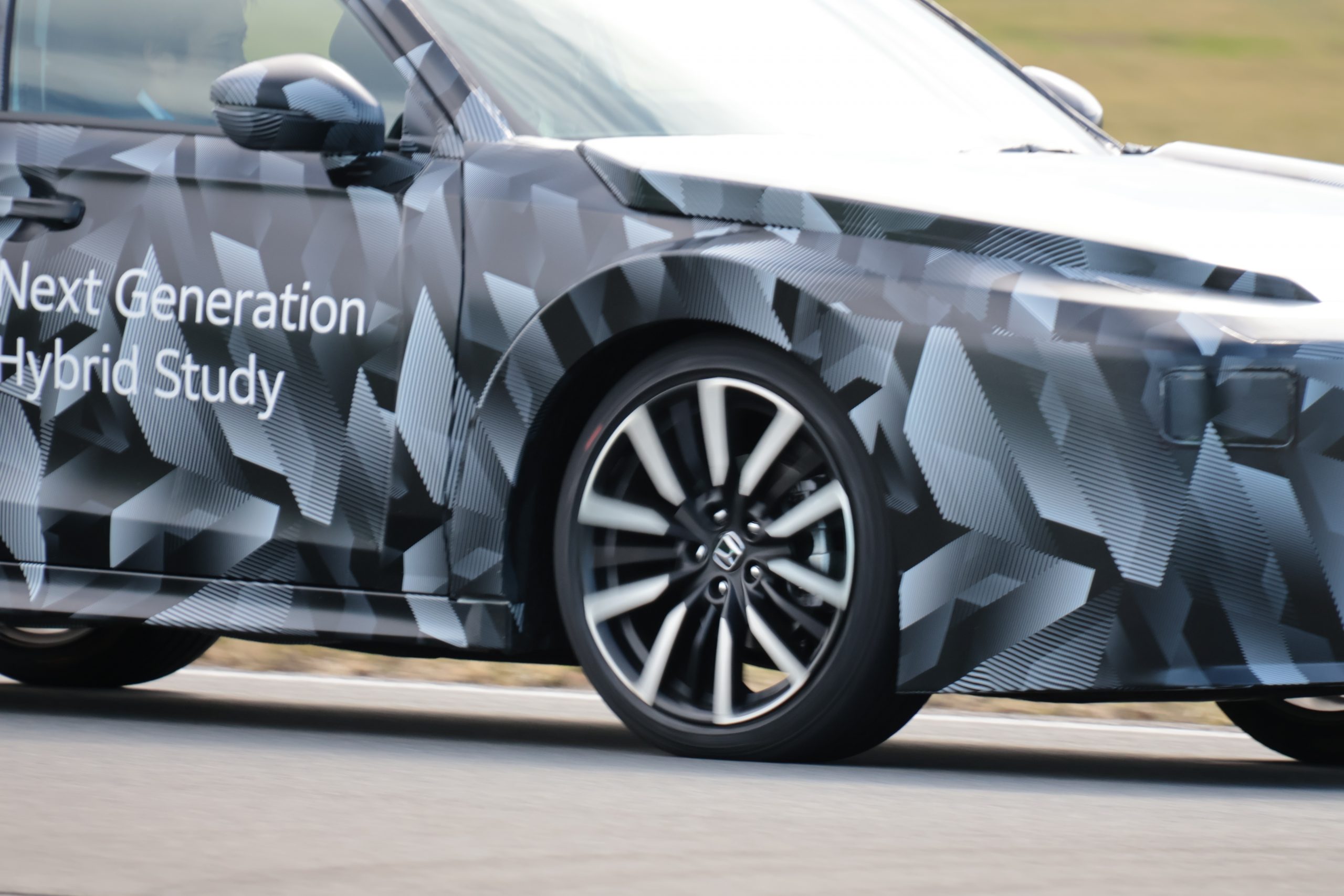
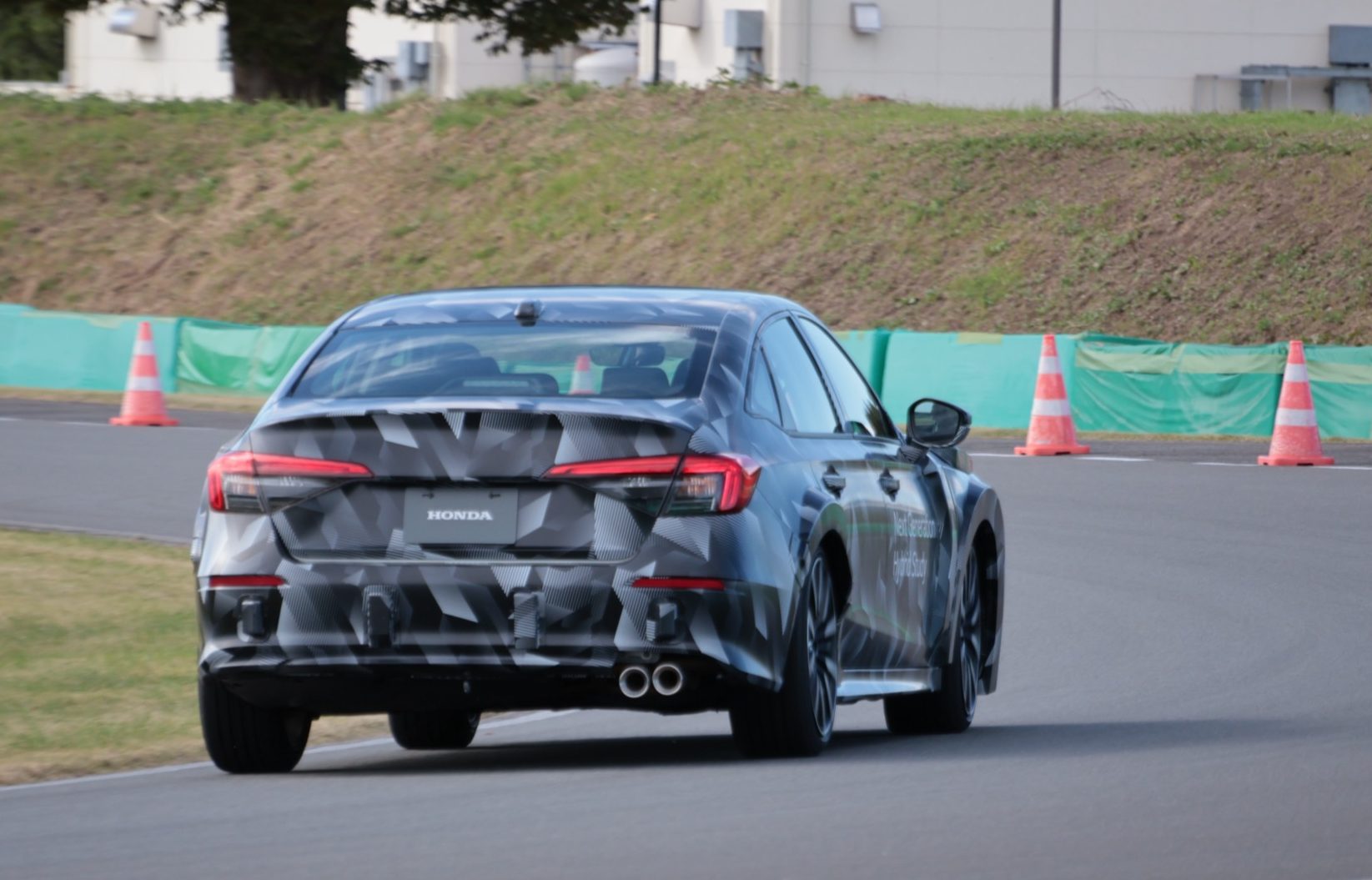
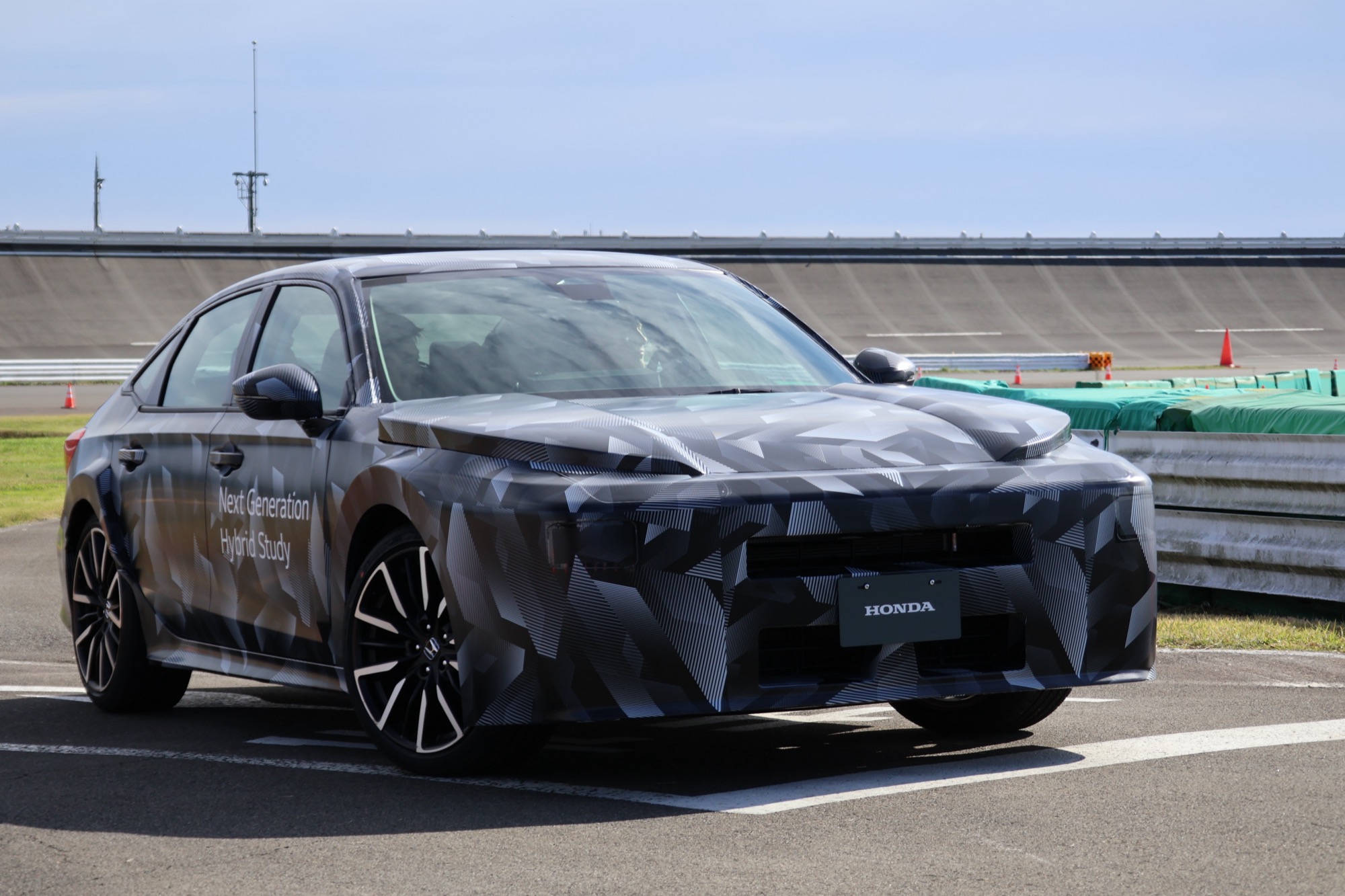
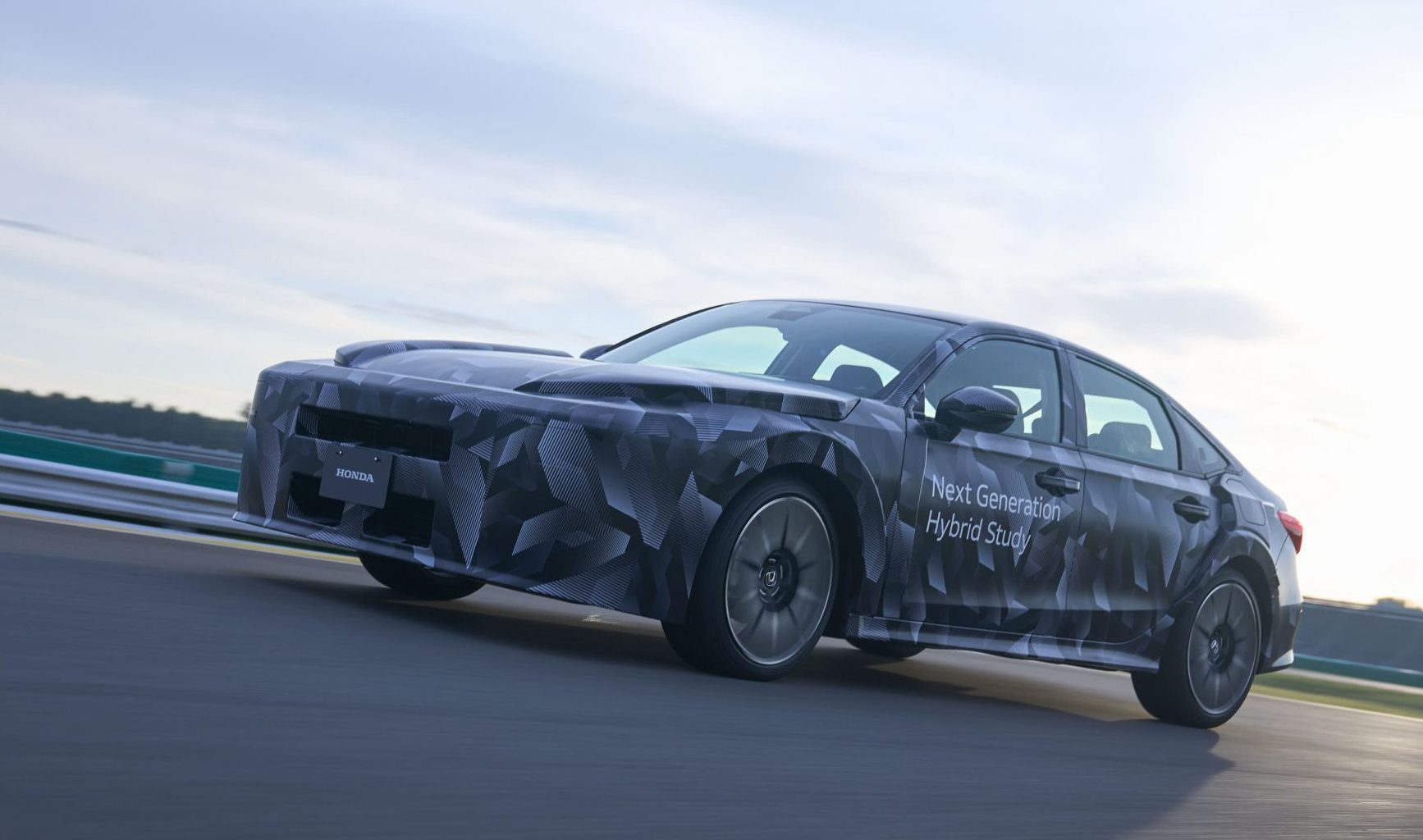
While we were at Honda’s Tochigi proving ground, we were taken out to one of the test tracks where the engineers had a next-generation hybrid development mule. In automotive engineering parlance, a mule is kind of like the equine version; it’s a hybrid of multiple breeds, or in this case, generations of car. The base car was a current 11th-generation Civic sedan. But this mutant had the next-generation front structure and hybrid powertrain. Since this was a mid-size sedan platform, it was equipped with a next-generation four-cylinder engine that should be more fuel efficient than the single-stage hybrid drive unit. All of this was covered in some bodywork that probably (or hopefully!) has little relationship to what future Honda vehicles will look like.
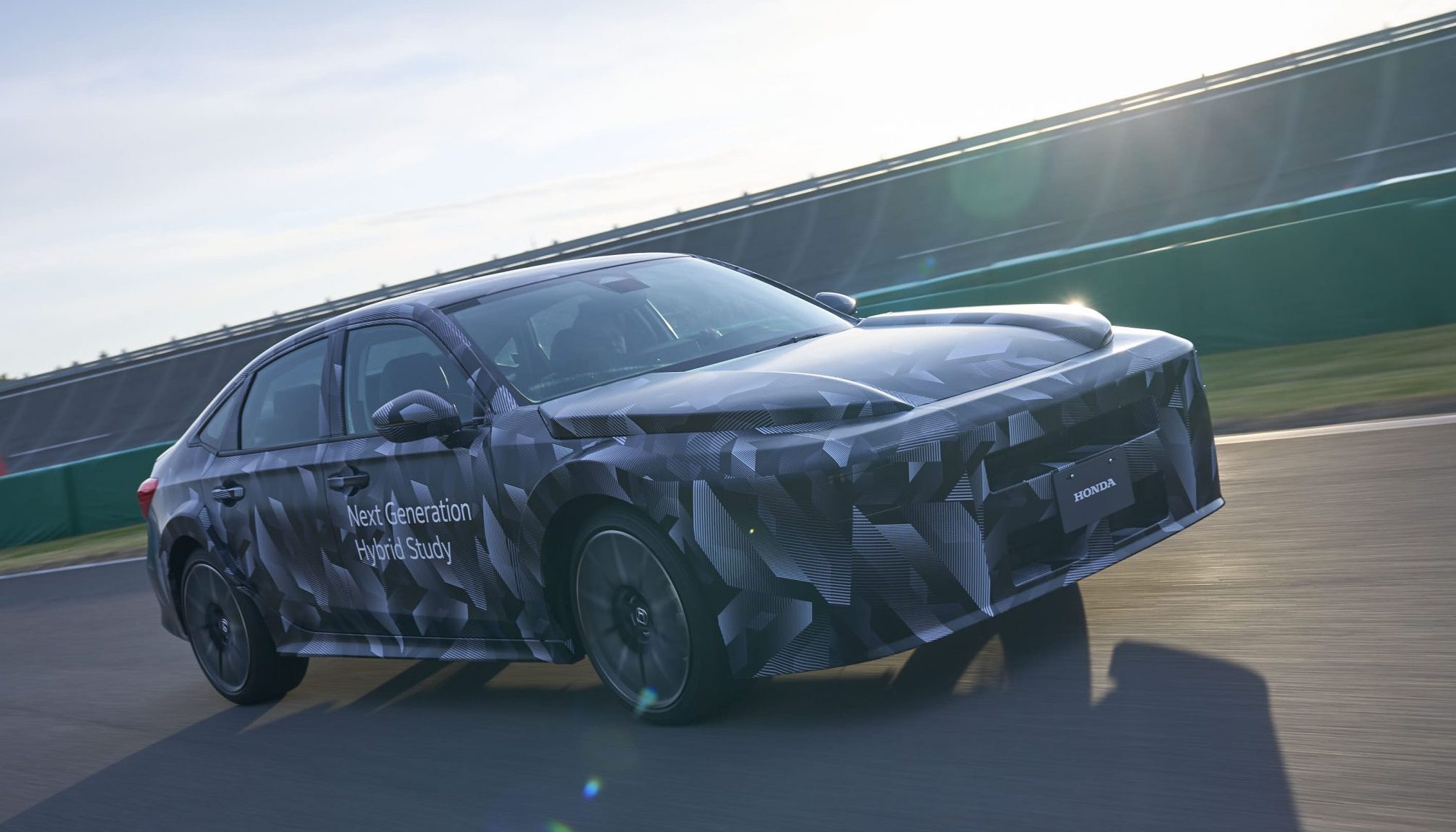
This is a common industry practice to get early development miles on various components and systems months or years before a full prototype vehicle is available. One of my favorite examples of this was a Jeep Wrangler cab with the front end of a Plymouth Prowler welded on that I saw at the Chelsea proving grounds back in the late 1990s when I was still a young engineer.
We got to take a few hot laps in this mule with a Honda engineer riding shotgun. All of the interior was also covered apart from the instrument cluster display, so clearly they’ve been using this for a variety of development testing purposes.

One other detail that Honda shared during our visit to Tochigi is that all future hybrids from the company would include the S+ mode with the simulated manual shifting we experienced on the Prelude. It’s obviously way too early to make any definitive judgments about all the changes Honda has been working on after just a few laps in a development mule.
I can say that based on my experience, automakers don’t go to all the expense and time of constructing these engineering mules if the results of what they want to evaluate aren’t going to be representative of the actual car. That said, the behavior of the mule was, in many ways, very similar to the Prelude. It felt surprisingly quick off the line, not super-speedy like a Hyundai Ioniq 5 N, but swift enough to be very enjoyable, just like the current generation of Honda hybrids.
If there was flex in the chassis, it certainly wasn’t noticeable from the driver’s seat. The steering was just as precise and nicely weighted as it was on the Prelude, and the car was easy to trail brake into corners to maintain a nice neutral stance. It was easy to place the car anywhere on the road, and it responded well to inputs.
The track we were on had some shoulder sections with a variety of rougher pavement surfaces, specifically to check out the chassis composure when the roads are less than ideal. I tried out a few of these, and even cornering on broken pavement, the car maintained its stability. Again, I couldn’t detect any real chassis flex happening or any unpredictable behavior.
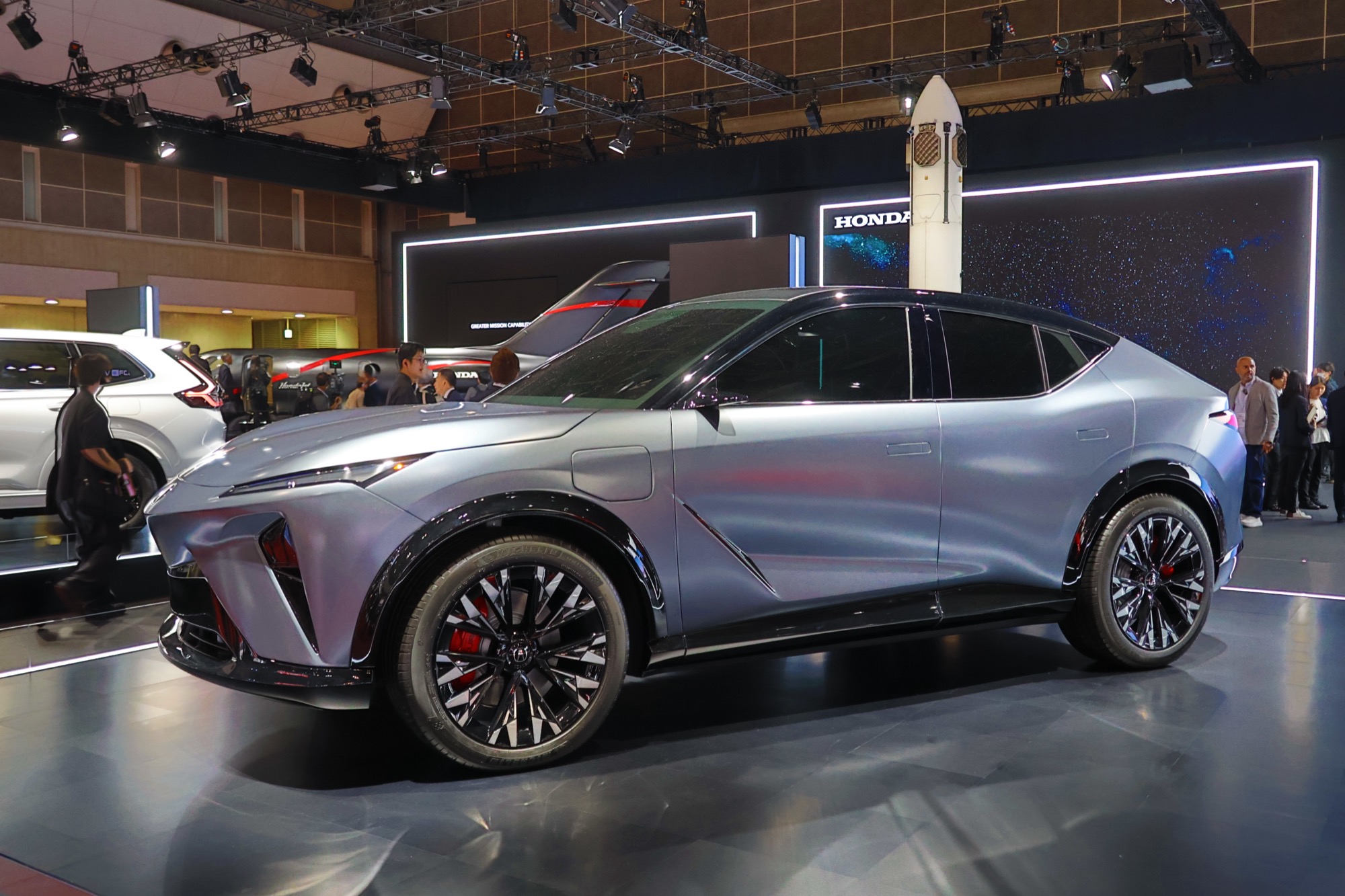
Our first real opportunity to judge how well Honda’s new structural approach works will probably come sometime in 2026 when we drive the RSX and 0 SUV. But in reality, it will take years of abuse to determine if there are any long-term negative effects. As for the next-generation hybrid system, the transitions between the series hybrid and engine drive modes weren’t any more noticeable than they are on the current generation, which is exactly as it should be.
I’m not going to make any formal judgment on the hybrid system performance since we have no idea how much this mule weighed. Honda claims that wide-open throttle acceleration will be improved by 10% compared to the current generation. It did exhibit the same upshift and downshift behavior and engine rev control as the Prelude, which definitely adds to the visceral experience of driving. The large hybrid version with the V6 should be more than capable of providing improved performance compared to the current gas-only versions of these vehicles, especially with the extra power from the electric rear axle, and the fuel efficiency should improve by more than 30%.
While I’m a fan of electric vehicles (I currently own a Kia EV6 AWD), there is definitely a place for hybrid powertrains for many years to come, especially for those who don’t have easy access to home charging. The benefits are genuine and, unlike plug-in hybrids, those benefits even happen for owners who don’t bother to plug in. Honda is making some of the pleasurable to drive hybrids available, and this looks like a potential step forward. The company should be well-positioned to take advantage of the growing popularity of this powertrain type.
Top graphic image: Sam Abuelsamid


That front end looks like a massive bumper body-kit you’d see on a over-done Nissan Skyline 20 years ago, I love it.
I’ve gotten used to the hybrid operation of my Clarity. Artificial shift points are going to feel like a huge step backwards for me, even if they aren’t in normal operation.
Holy crap! I’ve gotten into the TLDR phase of Autopian! I am 4 days behind on the posts. That I try to read every day. Sometimes I manage to catch up on weekends.
I’ll do my best to catch up, But I am currently drowning in content. Maybe you all can slow your roll and have a life.
Getting transferred to night shift temporarily at my job has finally given me the time to catch up on articles, it’s a blessing and a curse!
My natural biorhythm was to work until 2 am or so and sleep until 10 am or so. Life did not always work out that way. But in retirement, I am sort of trending back in that direction.
I keep nursing my 2012 Odyssey in the hopes a hybrid Odyssey is on the horizon. I love my hybrid Accord and would love to see a V6 hybrid system in the Odyssey. Get it out quick, my van isn’t getting any younger and I’m tired of replacing actuators on doors!
“Only at higher speeds and loads does a clutch engage that connects the engine to the final drive gears to transfer mechanical torque directly to the wheels.”
The direct drive on current Honda hybrids is for higher speeds and LOW loads (flat cruising at 40 mph or more). When you punch the gas or start going up a steep hill, the clutch disengages and lets the motor rev for more power.
My dream DD would be a liftback sedan with a PHEV drivetrain + 6MT up front, equally powerful e-axle at the back, and a large battery underneath for >100mi of EV range. Somehow I think Honda would be able to come up with something like that.
I would buy something like that. If I needed to. I have a ’17 Accord V6 with ~70K on the clock and it will probably outlive me. I laugh when I get emails from the dealership it was bought from in SE TX offering “generous” trade-ins on a new one. I guess they haven’t figured out I live back in WA now. And I’m not moving back there anytime soon.
My mind goes immediately to interior material wear and NVH. It sounds like a recipe for a squeaky rattle trap with a headliner hanging down and obscuring the rearview mirror…
Honda’s aren’t really known for squeaky or rattle-y interiors. In fact, it will probably stay squeak free for a good 15+ years (based on personal experiece)
Would be super interested in a deeper dive someday because I’m not sure I fully understand what’s going on here.
Tires indeed generate more lateral force with load, but their effective “friction” (not a great word but gets the point across) decreases. This is fundamentally why lowering your total lateral load transfer generally improves performance – two tires doing 50% of the work is vastly better than one tire doing 100% because that one tire won’t be near 100%.
The way it is described by adding load to the outside tire…all that makes me think is that Honda is intentionally increasing lateral load transfer, which surely can’t be right. And you can’t magically add more total load without mass or downforce. What am I missing here? Is this body structure just providing a new way to tune front/rear lateral load transfer distribution?
I’m with you. Sounds like trying to make a silk purse out of the sow’s ear of weight reduction.
If the cabin is rolling toward the outside of a turn and the front chassis rolls less, it keeps both tires on the road better.
Imagine a car with a twist joint at the firewall. If everything forward was light enough and able to rotate, both tires would remain in contact with the road even if it was a solid axle front end. This is a slight implementation of that idea.
As long as it’s a controlled amount of flex, I’m unconcerned. It’s unconventional, but with today’s computers, shouldn’t be that hard to actually do.
“that deflection allows for increased vertical loading on the outside front tire (…) Since the friction force between the tire and road is the vertical load times the coefficient of friction, that added load means more grip”
Playing with front/rear roll stiffness does nothing for overall load transfer during turns, which is basically determined by mass, CG heigth, and track width.
Deflection of the front suspension mounts would decrease the loading on the outside front tire, as the compliance of the chassis adds to the compliance of the front suspension to reduce the front roll stiffness. This would augment the grip of the front axle at the detriment of the rear axle.
This is similar to what would be achieved with a softer antiroll bar: decreasing roll stiffness on one axle decreases weight transfer on that axle and increases grip on that axle while reducing the grip on the other axle (lateral force is increasing with vertical load, but less than linearly)
Optimizing chassis compliance makes sense in terms of weight savings, as long as it is accounted for in the suspension design and the NVH is kept in check 🙂
I’m with you, I would think you’re trying to decouple roll forces to a degree, by allowing the subframes to maintain a squarer contact patch to the road and allowing the cabin/body structure to have a certain degree of independent roll.
Regardless of the theoretical improvements, I’m having a REAL hard time seeing how the stated flex of 1mm can have any kind of measurable improvement.
I want a production Civic with that hideous big-box front bumper and a V6 stuffed inside.
Glad to see more e-axle AWD cars, not just for engineering reasons but also because they’re great for RWD EV conversions. The Mitsubishi Outlander PHEV e-axle is about the only option out there right now.
Don’t forget about the Hornet/Tonale!
Today I learned! 90kW is not bad.
RAV4, anyone?
Oh yeah, right. Sadly, just 40 or 50kW which is a bit anemic.
Volvo T8 Recharge models rear motor has 60-65kW for the early versions (ERAD1 and ERAD2) and 107kW for the later ones (ERAD3).
Lincoln Corsair PHEV AWD has a 50kW rear motor.
Nice! I wonder how compact those Volvo units are?
I’m confused. Always been a fan of Honda’s hybrid setup but it undeniably suffers at highway speeds compared to Toyota’s power split system due to the clutch lockup not being all that tall. Does this mean that this next gen system will fix that?
It would interesting to know how the current CR-V hybrid with 2-speed lockup is geared.
The Accord hybrid I have turns about 2000 rpm at 60 mph, which I think is fairly tall gearing.
When cruising, the Honda system can’t run at the most efficient RPM, but instead it tries to run the engine at the most efficient *load* and charge the battery with the excess energy. Then, it cycles off the engine and runs as an EV until the battery is depleted, then starts the engine again. The catch is, all this conversion to electricity and storage into a battery wastes a good bit of energy.
It was my understanding that with the current 2-speed lockup in the CR-V, the second one is a “low gear” (1.409) that allows the CR-V to accelerate from a stop when towing up to its max tow weight which would be the equivalent to the Tiguan’s 4th gear in its 8-speed transmission (which I guess isn’t actually all that low).
Anywho, when I said “suffers at highway speeds” I was definitely thinking more like 75-85 mph because that’s at least the speeds I drive when going on long road trips. Here is where in my experience the Honda systems falls behind the Camry’s and Sonata’s. Hoping for big improvements in this next gen system.
I’m glad to hear that Honda is finally going in big on hybrids even as they continue to *not* go big on EVs yet.
I would definitely consider a plug-in hybrid Honda Civic hatchback at some point in the future.
Motorcycle engineering has had to go through a similar development curve. Kevin Cameron’s Top Dead Center books (really, just compiled Cycle World articles) break it down very well.
The bike chassis steadily got stiffer and stiffer from the 50’s through the 80’s, but something wasn’t quite right and chassis design was considered something of a black art. Eventually we learned how to engineer in the right amount of flex, and that black art became a science.
The key fact as to the “why” is that motorcycles lean over. If you hit a bump in the road leaned over at a 45* angle, that suspension is a lot less effective at absorbing bumps than it would be if the bike were upright. So, the frame has to take up some of the flex.
Very right. Although not sure how this translates to cars where you do not have a significant yaw motion that would move the forces out of plane in which the suspension normally works like you would on a motorcycle. I also have a hard believing 1mm of flex is going to make any kind of measurable difference in suspension performance. The engineered crush zones do vibe up a lot more though.
Engineering chassis flex to be advantageous is an interesting idea. I always understood that chassis flex was mostly considered a bad thing because it was unpredictable and thus couldn’t be effectively accounted for in the suspension design. I guess FEA has gotten good enough that we can now understand the full dynamics in advance.
Flex is both a good and bad thing. You want it in some areas and omitted from others. The new thing Honda has the ability to do now is engineering in that flex. The one thing I do wish journalists and common folk to realize though is that within automotive, chassis engineering mostly relates to suspension and powertrain. What this article should be renamed to is body engineering. It’s not a very accurate title but I suppose that’s to satisfy the SEO gods.
Is this Honda’s way to say that a manual equipped hybrid isn’t going to happen?
(not to say the CRZ is a vehicle to copy)
I’m p sure everyone and their mom is saying this
And while we are talking transmissions, can we all safely assume that the lack of mention of a CVT means there is no such contraption in this design?
The current Honda hybrids don’t really have a CVT, either. Honda calls it that because it can function as one, but it really isn’t one.
Do the Honda hybrids even call it a CVT? I thought that was just the Toyotas (eCVT).
The Honda version is just a lock-up clutch anyway, so it isn’t a CVT in any sense.
Stop trying to make a manual hybrid happen Spikedlemon! 😉
Maintaining the manual Trans in vintage ev conversions is actually something I think is realltly fun, even if bc of the torque characteristics of an ev motor you really could simply keep it in 3rd or 4th gear for nearly all driving
It’s wishful thinking but hope they decide to shoehorn that V6 hybrid into the Accord.
Honda’s been killing it lately, and it seems that trend will continue. Hopefully they don’t wreck the interior, because in a few years when it’s time for a new commuter, an even better version of the current Civic hybrid would be at the top of the list.
So it sounds like they are doing a similar, yet less complicated version of what my Chevy Volt has going on.
I think one of the other articles mentioned the Volt quite a bit. (Why did we need multiple articles about this hybrid tech is beyond me)
Counterpoint: I’m here for the tech.