

The Audi R8 is, by far, the best Audi I’ve ever driven. That’s not terribly surprising, seeing as how the one I drove shares a lot of its parts, including its V10 engine, with the Lamborghini Gallardo, and equally excellent vehicle.
I’ve driven a bunch of other Audis, too, but none of them can match the R8. Again, not very surprising, since the R8 is a mid-engine, naturally aspirated supercar with a gated manual transmission—it checks pretty much all the boxes you’d want from a supercar, whereas most other Audis are simply hopped-up versions of pedestrian vehicles.


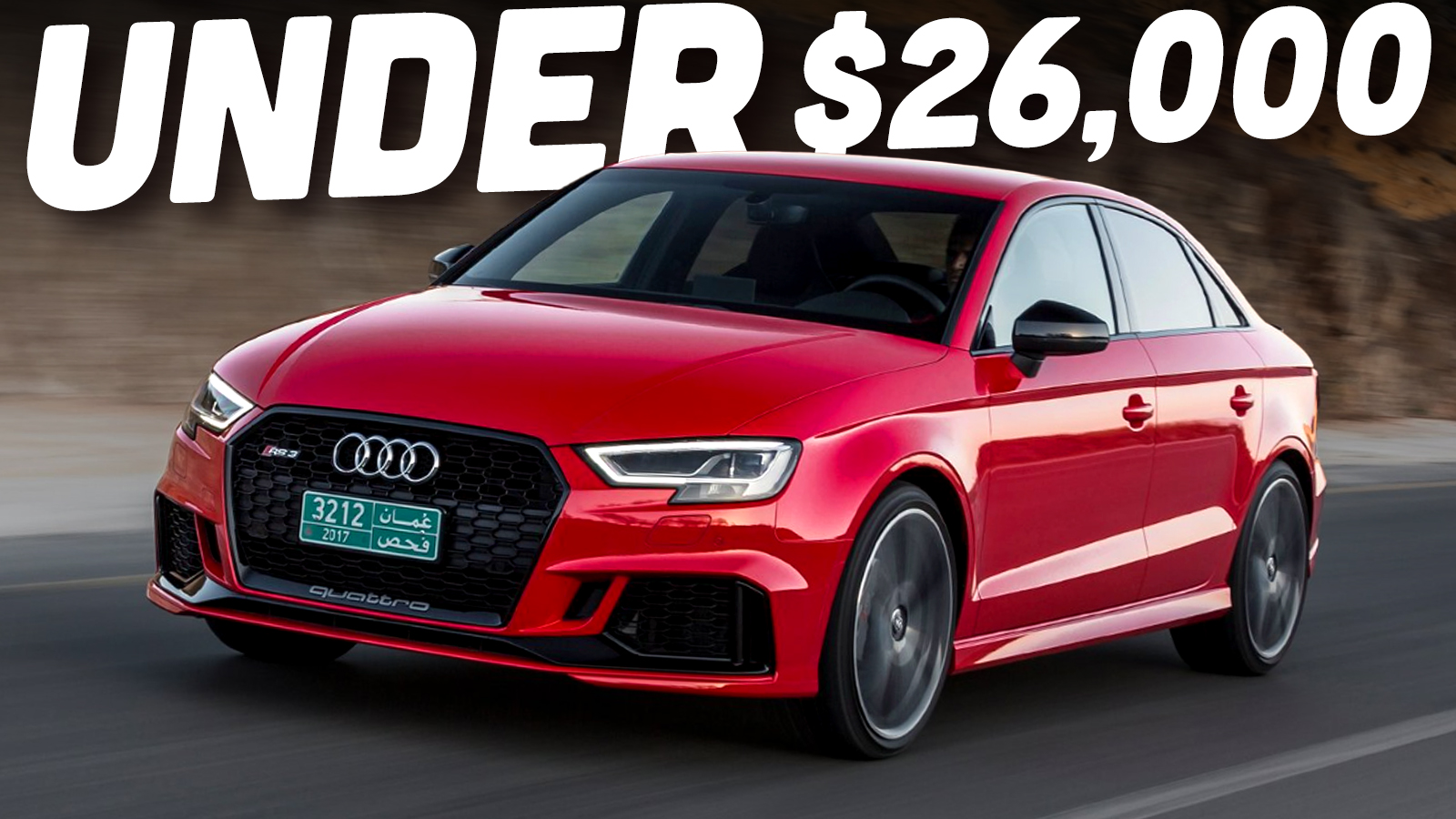
There is one Audi I’ve driven that comes close, though: the modern RS 3. After getting seat time behind several of these cars since its introduction into the U.S. in 2016, I can confidently say it’s the most thrilling car from the brand with more than four seats, thanks to its mix of practicality, weird five-cylinder engine noises, and smaller size.
Now that early examples are nearly 10 years old, there’s no better time to check on prices for used examples. And some of these numbers make second-hand RS 3s incredibly tempting.
Here’s What Made the RS 3 Great
Let’s start with the bones. The RS 3 is, of course, an extension of the A3 sedan, a car based on Volkswagen Group’s widely used MQB platform. This architecture underpins a lot of well-known cars from the conglomorate, including the Mk7 Golf, the Arteon, the Atlas, the Passat, and the A3’s stablemate, the TT coupe.
When it was revealed back in 2016, the RS 3 was priced from $55,450. The car’s main attraction was the 400-horsepower, 2.5-liter turbocharged inline five-cylinder engine. Not only did it make the 3,500-pound sedan a bit of a pocket rocket, but it also emitted the most unique noise in all of the car world.
Those early cars also got a dual-clutch transmission and adaptive suspension as standard. Opt for the Dynamic package, and you also get Pirelli P Zero summer tires for extra grip. Interestingly, cars equipped with that package got slightly wider rubber, but only at the front—presumably to compensate for the 57.7:42.3 weight distribution. There was also a Dynamic Plus package available, which added a stiffer fixed suspension and carbon ceramic brakes up front.

The RS 3 got even better for the 2022 model year when a facelift introduced torque vectoring for the Quattro all-wheel drive system and the rear differential. Depending on the mode, the car could now direct up to 50% of the 369 pound-feet to the rear. The rear differential, meanwhile, could direct 100% percent of the torque it receives to either of the rear wheels, allowing for more balanced cornering and easy sideways action.
We’re Talking New Civic Prices
Those pre-facelift cars, now approaching a decade old, can be had for about as much as a base Honda Civic if you’re willing to put up with a lot of mileage. This one, listed for sale in New York through TrueCar, has 140k on the clock, and it’s listed for just $25,991—less than half its original MSRP. Aside from some aftermarket wheels and a very shiny leather interior, it looks to be in pretty good condition.

If you want something with fewer miles, you’re going to have to spend a bit more. But not that much more. Here’s a clean example with 84,000 miles in Ohio listed for just $31,995. And another, in Washington, for just $34,991. Sadly, most of the cheaper RS 3s are all in bland colors like grey or black; the cheapest one in a real color that I could find for sale is this blue example on Carvana, for $38,990.

Prices get a bit steeper if you want a later, post-facelift car with the fancy torque vectoring features. The cheapest example I could find with no accidents is this 2023 model with over 50,000 miles on the clock, listed for $52,988. Considering a new 2026 model starts at just over $67k, it might be worth it just to spring for a new one, unless you’re really penny-pinching.
By now, you’re probably wondering, if RS 3s are this cheap, then what about its sportier-looking sibling, the TT RS? That car uses the same architecture and has the same drivetrain layout, with the same 400-horsepower inline-five. The cheapest of the last-gen TT RSs I could find online is this model on Cars.com, which is listed for $37.995 with 85k on the clock. So, not nearly as good a deal, but still, that’s only about two grand more than a new GTI. And I know which one I’d rather have.

It’s also worth noting Audi sold a TT RS earlier in the 2010s, with a five-cylinder and a manual gearbox, but it was much rarer, meaning good-quality examples are tough to come by. Even the cheapest one I could find is still more expensive than the cheapest RS 3 I mentioned above.
Top graphic image: Audi


Ok, I am not afraid of German performance cars. I have owned or own C43AMG, E24M6 and an E46. That said, going in, I ask myself:
I get that the RS3 is more extreme than the C43, but 2 & 3 above, along with availability on the secondary market caused me to avoid the RS3. I still think they are awesome, but the imaginary conversation in my head with my wife where I explain the $5K charge to ebay motors for a used transmission was just too painful. FWIW she stopped asking about M6 parts years ago, so she isn’t unreasonable..
There’s no way I am ever going to buy something German without a warranty. Period. Full stop. Been there. Done that. Have the receipts. Or at least most of them. There were a lot.
Re: the RS3, I think I’d get tired of a car that farts anytime it upshifts.
Re: the R8, I really don’t get the attraction of a gated shifter. You don’t see gated shifters in commercial trucks and drivers of those do a lot more shifting than most of us.
I put ~165K miles on a 2001 Jetta TDI 5M and enjoyed it, for the most part. It shifted just fine without a gate. I just think miles spent in a more tightly wound VWAG product is kind of asking for trouble.
There is no world where buying a 140k mile, 7 year old RS3 from a random used car dealer is a good suggestion for anyone
or any used euro performance car without any warranty, unless you are willing to put in repair cost which would be same as the purchase price
Well Brian, Instead of an RS3 with incoming headaches for $26-30k, my son bought a 2005 C6 Corvette with 132,000 miles for $15k. It’s had a clutch position sensor wear out which cost $17.00 for the part. Rear tires were required after summer was over. But 500hp in a car lighter than the RS3 with a straight piped LS2 is pretty fun for half the Audi’s price. It came with the motor already cammed with built heads and all the goodies. So it too has a “unique” noise burbling from the back. You should visit and try it out. Our local mechanic friend also has 2 Audi R8s. One is twin turbos and well over 1000hp. Cars are fun.
I wonder how much the german car problem is down to simple regular maintenance and using proper trained people to service them.
Let’s put it this way: My family had a bunch of VW and knew the excellent independent VW mechanic well. The cars were regularly serviced, and also had stuff that either failed, or needed to be replaced because it was on its way out or causing issues. Coil packs causing misfires, window regulators, exhaust flex pipes that crumbled apart, I could go on. Dreaded lights on the dash were common. We switched to Toyota Tacomas and Hondas and the cars only needed regular service and wear items like brakes and tires. The VW/Audi guy John just recently retired and bought a manual, TTRS. I still stop and talk cars with him sometimes. Great guy. German cars are a nice experience to drive, and my son still drives my late mother’s 2000 Jetta 1.8t. We’ve owned it for 25 years. I am not adding up the receipts that were put into that car though.
$33k to buy, another $20k to keep on the road. And that’s before having to deal with their impenetrable console interface.
Stay away from Audi.
A used steak from Morton’s is now as cheap as Big Mac from McDonalds.
COTD
That’s pretty funny. I don’t know if you’re referring to having made its way through a digestive tract and thus fodder for The Morning Dump or just sitting out too long in a leftovers container.
As a former Audi A3 owner, I will say tread very very carefully here. Like others have said it is been maintained to a T, great records and not hooned (big if) these might be ok with sub 100k mi, more like 50-60k. But the most likely you are entering a world of pain with maint and issues,
Yeah it is a Corolla or Civic money but spring for that Civic Si or maybe higher trim touring new or new ish and while you won’t have the the same driving experience – you also won’t have the hellscape of maint and things going wrong bills.
I swear my A3 had some built in self destruct problem code, it was pretty good the first two years and then just before year three it started really acting up, coming to near end of factory warranty (4/50k) it was just one electrical and fuel system problem after another. Sold it just before bumper to bumper warranty ended and yeah took a bath (50% value of new) but my stress level went way way down so I call that a win… epilogue that car was sold as a CPO with I think another year or two warranty, so I saw more dealer service records on the car fax. Another two more years after that, another owner, no records besides registration and recalls. All records stop in 2016, it was a 2006. Probably scrapped I would guess…
As a 3x Audi owner I can confirm your tales of cautionary considerations. I’ll add a couple friends who also learned from similar experiences.
I feel like going thru the Audi ownership rollercoaster up and down somehow builds character in some weird way…
Not to belabor the point, restate the obvious, beat that poor dead horse, etc… but I just. cannot. imagine. Audis are very nice to be in, and to drive, and they usually look decent too, but Dear Glob Almighty, I can think of few faster ways to develop a peptic ulcer than to buy a late model, high mile, high end Audi, or any German car for that matter. Sure, it’s available for new Civic money now, but the next decade or two will come at the cost of an entire second new Civic, if not more.
I know this is besides the point for some folks: the sturm und drang of those German ponies, and the lovely detents felt when turning knobs, etc… will be enough to justify all of the expense and aggravation to come.
I’ve owned one Audi, one Mercedes, and a bunch of VWs… and that’s probably enough. I’m not swearing that I’m off German cars forever: no, a particularly nice W123 or W124 Benz might eventually tempt me (but nothing more recent than that) though I’m not going out of my way to find one.
Just noting that last year a condo parking neighbor traded a manual A3 sedan for a Civic Sport Touring Hatchback hybrid (which is what I bought, he was the first though). A lot of people would probably rather have the full warranty on a “lesser” car than raw dogging and rolling the dice with a used German sports sedan.
Everyone arguing over the expected reliability of a high performance German sedan with 80k on the clock is missing the bigger picture. None of this matters. $26k is brand new Corolla money and that’s what we should all be driving. Forget the RS3. Forget the Civic. Just buy the Toyota.
You’re missing the point anyone who is looking for a German sports car will NOT want a Toyota, they would settle for a Civic for sure but not a Toyota unless maybe the Supra with the BMW engine. Yes Toyotas are the most reliable but as well as the most mundane vehicles.
It’s important to note that as the owner of two used Audis that defy all known laws of the Autopian comment section, the above was just to mock the general vibe of comments in this genre of article.
Both are parts cars?
“ it also emitted the most unique noise in all of the car world.”
The Wankel rotary has entered the chat.
If this were a hatch, I’d want one so bad. I don’t like sedans tho.
I wonder how many cleared CEL codes that thing has
All of them.
Thanks for keeping my 2013 TTRS value up I guess? Not selling it right now though.
Assume ze service position!
MQB platform, so presumably no service position (which is actually a brilliant solution to maintenance access). But it will find other ways.
The crowd got down like a magikist! – Wesley Willis
And the maintenance & repairs will cost as much as a used Civic
Never buy a cheap expensive car!
This reminds me of an old Jalopnik headline that said something along the lines of “The VW Phaeton is now as cheap as a Nissan Versa”.
Good luck with all that!
My expensive old MBs have been relatively inexpensive to maintain other than an old transmission that needed rebuilt, but that’s kind of expected for old transmissions and always expensive.
MBs (before say 2020) seem to be the exception to the rule. I drive a w212 which I got with over 100k and keep piling the miles on. I’d get another in a heartbeat but also know them quite well.
An Audi with 84K on it? No thanks!
84k Audi miles are basically 150,000 regular miles
84k Audi miles are a miracle.
My mom’s Allroad grenaded itself at 65k, so yes. She also sent me a text of her dash on her 2022 SQ5 the other day and literally EVERY warning light was on. My dad also sprinted to sell his A6 as soon as it hit 60,000 miles. I personally don’t know why they keep signing up for so many headaches but money isn’t really an object for them at this point and they refuse to drive anything that isn’t German…although my old man is an exceedingly frugal guy who’s been running a company successfully for the last 30 years so I know he knows they’re lighting money on fire.
I keep telling them to just lease at this point but the Boomer brain can’t wrap itself around the fact that leasing can be a good deal. BUT YOU DON’T OWN ANYTHING…exactly, do you really want to own a 4 year old Audi that’s freshly off warranty and worth less than half of what you paid for it? I sure as shit don’t….
Wow, that’s impressive dedication to failure.
But anyway, enough about my love life!
Well done
Yeah…. Agreed. I like these cars but for that cash I’d rather buy a mustang Gt 5.0 or Camaro SS etc… more tail out fun, better sound track, and reliability.
Don’t get me wrong. I’ve driven these and they’re great but long run,… I’ll take the stars and strips every day.
North America never got an MQB Passat. Unless Mexico did.
It was the PQ46, a warmed over ancient platform to keep it cheap.
The rest of the world (bar China/USA) had the MQB Passat.
The TTRS is the greatest Golf of all time. With that out of the way…if you go this route do a lot of research. The 5 cylinder is actually fairly reliable by German standards, as is the DSG dual clutch so long as you do your fluid changes. A well cared for example should actually treat you pretty well as long as you do all of the preventative maintenance EXACTLY on schedule.
…the issue here is finding one that was well-cared for. These are incredibly popular with the tooning crowd, and the VAG tooning crowd does shit like chip cars on the dealer lot as soon as the ink is dry. These are capable of making 600+ horsepower with a sub $500 APR tune and nothing else…and people push them over 1,000 horsepower frequently.
The vast majority of them have been ridden hard and put away wet. They’re also very popular with the young affluenza crowd, I remember having a friend (we are no longer friends) who spent daddy’s money on one of these because she’s his most special girlie. She then tuned it before the engine was even broken in and was hitting “go to jail” speeds without even blinking.
…suffice to say, you don’t want to be the second or third owner of one of these unless it’s bone stock and had a squeaky clean maintenance history. Those cars do exist, because these also appeal to high functioning adults who want a fun but uncompromising daily, but you’re going to pay for them.
Because they’re special. These are subtle, comfortable, riotously quick, you can fit 4 adults in them, and when they’re being driven at less than 7.5/10 they more or less behave very inconspicuously. They’re also weirdly efficient? People get 30+ on the highway in them without even trying. It’s hard to find a more perfect daily for less than 75 grand…but as a result they really don’t depreciate all that much.
Honestly if you want one I’d recommend just saving and buying a brand new one. That’s the safest bet and by the time you find a nice enough secondhand one you’re not that far off from new prices anyway. You really, genuinely do not need to mod these either. They are absolute terrors on the track even when they’re bone stock. Hell they keep up with supercars….
Also, something to keep in mind is bigger Audi RS and S models depreciate really hard. You can get a nice used S6, S7, or RS5 for the price of a nice secondhand RS3 or even less if you’re willing to be patient. 20 something me would be very disappointed to read this, but that’s probably the route mid 30s me would go. An S7 for $50,000 is a lot of car…
I came here to say the same thing: Good luck finding a good example for a good price, because most of them have been beaten into the ground by their first or second owner.
I also like your logic – a used S7 is a great way to go if you can afford the purchase price and maintenance. Then again, the RS5 may well be one of the best looking Audis of all time with performance to match…
The same VAG tooner crowd that drives RS3s into the ground fucking HATES that twin turbo V6 too. I’m fairly certain the vast majority of cars with it are just leased by professionals in their 30s and 40s. Most of them don’t have anything of note on their carfaxes and Audi certifies plenty of them…although you’ll pay so much for it that I’m not sure if it’s worth it, since they only give you an extra year of warranty.
Hell if you don’t need the performance of an S6 or S7 you can get the single turbo version of that engine in the regular A6 and A7 and those things depreciate like lead balloons. You can get a really nice used A6 3.0T for like 30-35,000 and a really nice used A7 for 35-40. I’d personally spring for the extra power and prestige of an S model but there are bargains to be had if you don’t feel the need to.
I have looked at a few A7s, but I don’t have the money to roll the dice on Audi reliability. If I did, I think I’d only do it on an S or RS model.
Those cars kinda suck regardless of price. It was an answer to a question nobody asked imho
Took the words around my mouth. A lot of the S and RS cars with some of their owners were driven hard and put away wet,provided that they haven’t been rebuilt after being wrapped around a tree somewhere. Nowadays the prices on some of these cars are insane-owners seem to think their 60-80K mile RS-4s are worth $40-60K!!
This is why though I dearly miss my MK7 GTI Sport, I have not a lot of interest in buying another one. They have all been hooned to DEATH. The hot Audis are just as bad to worse. Even if they had adult owners the first go round, once they get cheap they sure don’t.
Sadly none of those other S and RS models have the 5-cylinder 🙁
Turbo V6s just aren’t as special
just fyi tuning is a car is spelled tuning not like cartoons. Kept thinking of people animating cars while reading your comment lol
That said, I love this engine and the mileage doesn’t scare me. The DSG does tho. If it was a 6spd I think it’d be a good deal. Audis 5 cylinders are generally fantastic and reliable… it’s the vw-fication and cheapening that made them unreliable. My old 95 Audi was built more like a classic benz than anything else.
Oh I know how it’s spelled, I say toon to mock the type of people that ruin good cars like this lol
In a previous article I commented that my biggest fear as a child was volcanoes.
As an adult, spending 26k on a performance Audi with 140k miles on it would have me waking up in a cold sweat, just like Dante’s Peak did back in ’97.
You’re thinking too small, you buy it as the focus of content for your new YouTube channel. Then viewers pay you to fix it everyday!
Don’t know if this is the average but our local Audi dealer has a lime green 2021 TT RS with 18K mi for $62,499. Seems steep to me… How much were these new?
About that much. They’re niche cars that they didn’t make very many of so they never really depreciated. Clarkson also drove one for a challenge on The Grand Tour and was a massive fan so I’d imagine that probably dragged values up a little bit too.
Kept half of its value over 140,000 miles. That’s pretty good retention for a German brand. It also means it is probably a bad value for the next buyer–they are paying a full half of MSRP, but what are the odds of it having half of its functional miles ahead of it? How much additional repair is needed to get the average RS3 to 280,000 miles?
All. All the repair
Are there any of these running around with over 200,000Mi? But then again it seems like a lot of new stuff will have challenges making it 200,000 economically (eg with minimal / no costly repairs, just maint and consumables).
And will it even make it to 280,000 miles without massive amounts (eg far more than vehicles value) repairs or parts replacement? In my head I see this as a 200,000mi vehicle (at best) for people who are not financial masochoists…
Down payment.
You can get a down payment on a used RS3 for the price of a new Civic.
That’s the “Used German Logic” I subscribe to. 🙂
If they had offered this (in the US0 in the traditional wagon/hatch configuration, I might own one by now. The sedan never, ever sat well with me from a daily practicality POV. Like a performance version of the Versa sedan or the Fiesta sedan. Yes, I know this is basically the same size as the earlier B5 A4, everything has just gotten bigger, but still.
That is because you are a smart and wise person. they are special indeed, but not for “civilians.” You can get burned real quick if you don’t know what you’re doing with them.
Dude, same. If this was a hatch… or they offered the 5 cylinder turbo in the A4 Avant…. but alas.