

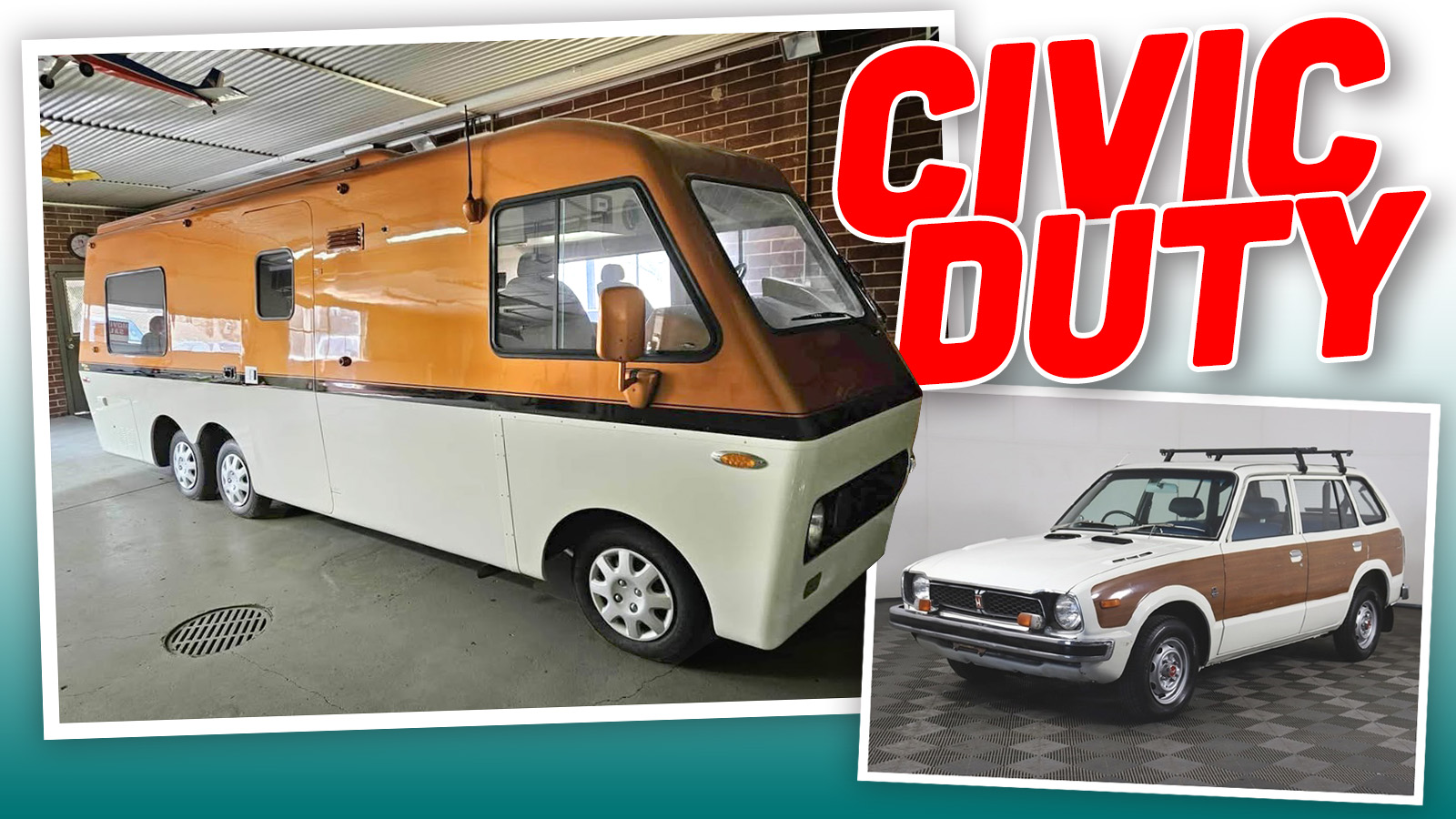
The average factory-built motorhome isn’t exactly a weird or quirky vehicle. For the big brands from Indiana, placing a toilet in a different place is considered weird or innovative. If you’re looking for greater creativity than a different decal package, look no further than the custom-built RV. All it takes is one person with a dream to create something incredible. A perfect example is this “1982 Honda Motor Home” that I found online. Incredibly, this coach started life as a 1977 Honda Civic wagon, and then an ambitious Air Force veteran and aviation geek turned it into a sturdy fiberglass motorhome that was inspired by jets. It looks like it’s built better than something constructed today, and yes, there’s still a classic Civic under there!
I found this motorhome on Facebook and reached out to its current caretaker, Randy Wallick. In our call, I could tell that Randy is so deeply infatuated with this unique motorhome, and he told me that he isn’t interested in selling at all. After all, there’s no chance that he could ever own a motorhome like this ever again if he did sell it.


My biggest question when finding this motorhome was simply “why?” Why would someone go through the work to hack up a Honda Civic to make a tiny motorhome? This was followed up with the next obvious question: what parts of it are still Honda Civic? Randy was able to give me my answers and more, and now this lightweight fiberglass motorhome might be one of my favorite custom coaches yet.
An Inspiring Creator Of Many Vehicles

Randy told me that this motorhome was constructed in 1985 in Indiana by Carl McCain. The story that Randy told me about Carl’s life as an Air Force mechanic, barber, and builder of experimental aircraft matches the obituary that I found of Carl W. “Mack” McCain of Peru, Indiana, who passed in 2019 at 93 years old. That obituary details how Carl was a self-taught engineer and inventor. The motorhome is mentioned, too:
During WWII, Carl served as a crew chief in the Army Air Corp and was stationed in the Philippines. After serving his country, Carl worked in many different capacities throughout his life. For many years, he was a barber who cut hair for local men and children while selling and repairing motorcycles in his shop next door to the barbershop. He also worked in maintenance for Peru Community Schools until his retirement in 1988.
Carl was an inventor and builder of many things, such as motorcycle travel trailers, three wheeled automobiles out of motorcycles, and a full-size RV.
Carl and Faye enjoyed travelling. Over the years, they traveled extensively throughout the U.S., with a good portion being via motorcycle. They made their winter home in Sebring, Florida for over 30 years.
One of his great loves was airplanes, which began when he was a small child. This love led him to build several airplanes, large and small. Carl and Faye travelled often in the Emeraude and Osprey. On a good day, he could always be found at the weed patch or Converse Airport flying his R/C planes.

Carl was reportedly a member of the Academy of Model Aeronautics, the Experimental Aircraft Association, the Converse Flying Eagles R/C club, and others. Aviation was such a huge part of Carl’s life that he didn’t even limit himself to fixed-wing operations and even built his own helicopters.
Carl is survived by a large family who carry on his legacy, and he is remembered by all of the people he met throughout his long life.
The Motorhome

Randy explained that Carl’s inspiration for the motorhome was, perhaps unsurprisingly, aviation. He wanted to build an RV that was lightweight and streamlined, not unlike the experimental aircraft that he built.
The donor vehicle for the motorhome was a 1977 Honda Civic wagon that Carl had in his possession. This wagon was built during the first generation of Honda’s venerable family car, which entered production in 1972. The Honda Civic was a truly revolutionary vehicle that not only got countless people on wheels but also helped define what makes a proper small front-wheel-drive car. It also helped thrust the name “Honda” into the status of a household name in markets like America.

Honda says the Civic was built for the needs of the global market. Prior to the Civic, Honda exported tiny hatches and roadsters that people loved, but didn’t quite hit the standards of places like North America, where the open road was filled with V8-powered land yachts. Honda intended the Civic to be the perfect car to slice through traffic. Development on the Civic started in 1970, and in designing the Civic, Honda’s engineers had to change how they designed cars. They couldn’t think about simply making a bigger car. Instead, they thought about the kind of car that would be deserving of a Honda badge. During development, engineers stressed out over making the Civic light, and found that adopting the principles that led to lighter Japanese fighter aircraft, namely reducing metal thickness in 0.1 mm increments, cut weight out of the car.
Another move to decrease weight while increasing interior volume and vehicle stability was eliminating the rear solid axle that many front-wheel drive cars had back then. The Civic would sport a four-wheel independent suspension thanks to struts on each corner. Another bold move was to ditch the common three-box profile for a two-box trapezoidal shape that didn’t have a defined trunk.

Honda’s sales teams and even buyers didn’t quite understand the styling at first, but eventually, the Civic became not just a hit, but a sort of blueprint. But that wasn’t all. The Civic did so much right. It weighed around 1,323 pounds at its lightest, and the CVCC (Compound Vortex Controlled Combustion) engine that came in 1975 ran so clean that it didn’t need catalytic converters. That 53 HP, 1488cc four-cylinder mill even got 54 miles per gallon on the highway. It was also hard to beat the Civic’s rock-bottom $2,150 price tag.
What I’m getting at here is that the Civic is a weirdly decent platform for a motorhome. Carl’s car was a 1977 Honda Civic CVCC Wagon with a four-speed manual transmission. A ’77 Civic wagon measured 159.4 inches long, weighed 1,980 pounds, and had 60 horsepower and 76 lb-ft of torque on tap.

Carl didn’t use the whole Civic for his motorhome. Instead, the Civic parts that would make it over include the engine, the transmission, the full suspension, and other miscellaneous platform parts. These pieces were joined together using a frame that Carl made himself.
The body of the motorhome is made out of two layers of fiberglass and features foam insulation sandwiched in the middle. The fiberglass forms a sort of monocoque and features a sort of aerodynamic nose, a completely smooth undercarriage, and initially, lightweight acrylic windows. Carl was serious about making his motorhome as lightweight as the Civic was when stock.

One neat feature is the awning, which is electrically powered through a window regulator.
The coach also rides much closer to the ground than a typical motorhome, a benefit of having those Honda Civic bones. Another benefit was that, since the motorhome is front-wheel drive, the coach is able to have a low and flat floor behind the driving cab. In a weird way, it seems like Carl’s motorhome is like what would happen if Honda tried to make its own GMC Motorhome. Yet, all of this was built right there in Carl’s garage in Indiana.

Carl actually used this motorhome as a recreational vehicle, too. He loved traveling across America with his wife, Faye, often astride a motorcycle. Carl even raced motorcycles on the sands of Daytona Beach. Later, after building this coach, Carl and Faye drove the motorhome from Indiana to Florida, where they escaped winter for the season inside the Honda. Then, once the ice melted away, the motorhome would take the couple back to Indiana.
Randy says he picked up the motorhome about 10 to 15 years ago. He watched Carl build the motorhome in the garage, and Carl knew Randy’s family. So, Randy knew that the motorhome was out there in the local area. At the time, the motorhome had sat for several years and was pretty worn out.
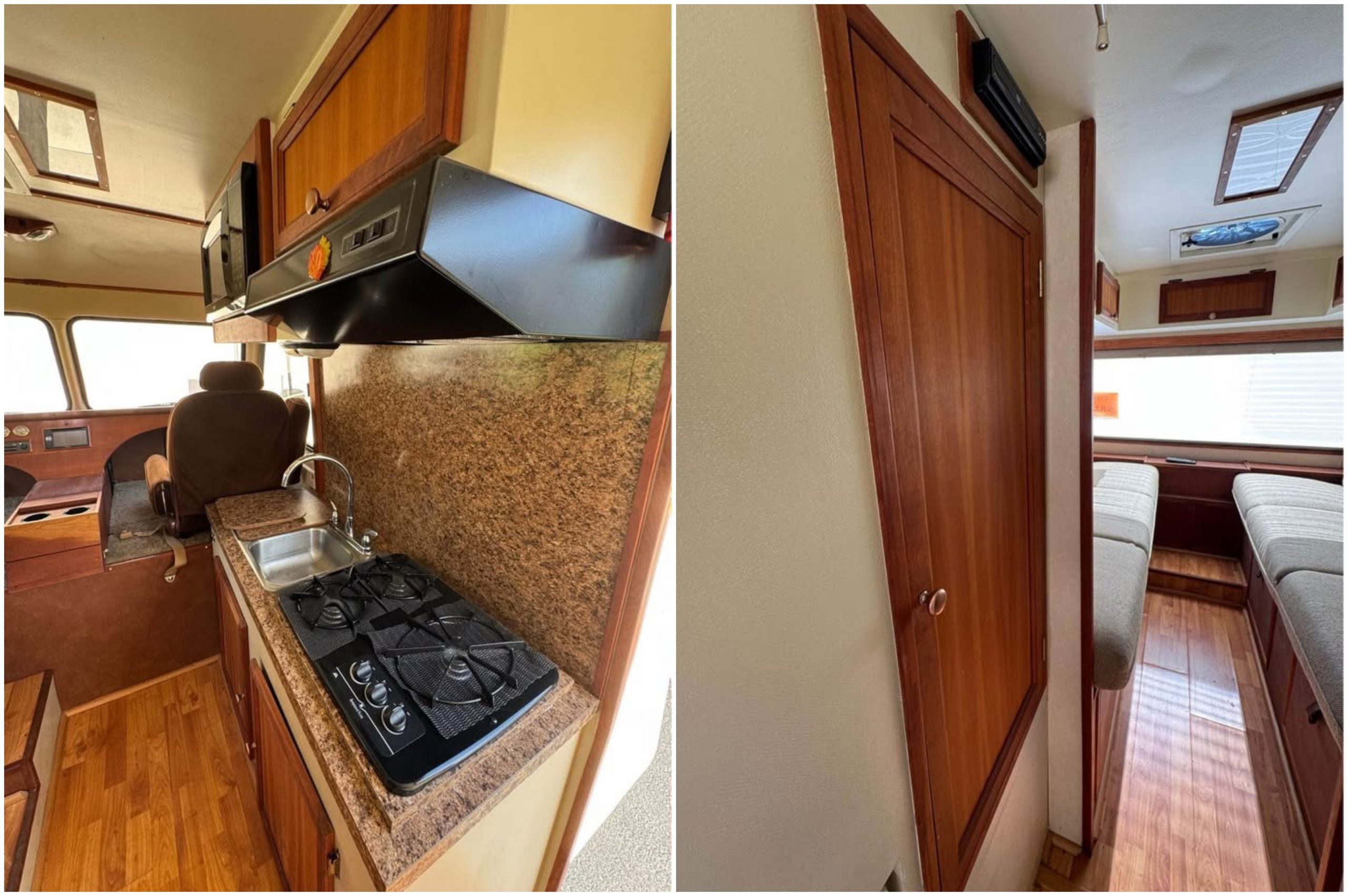
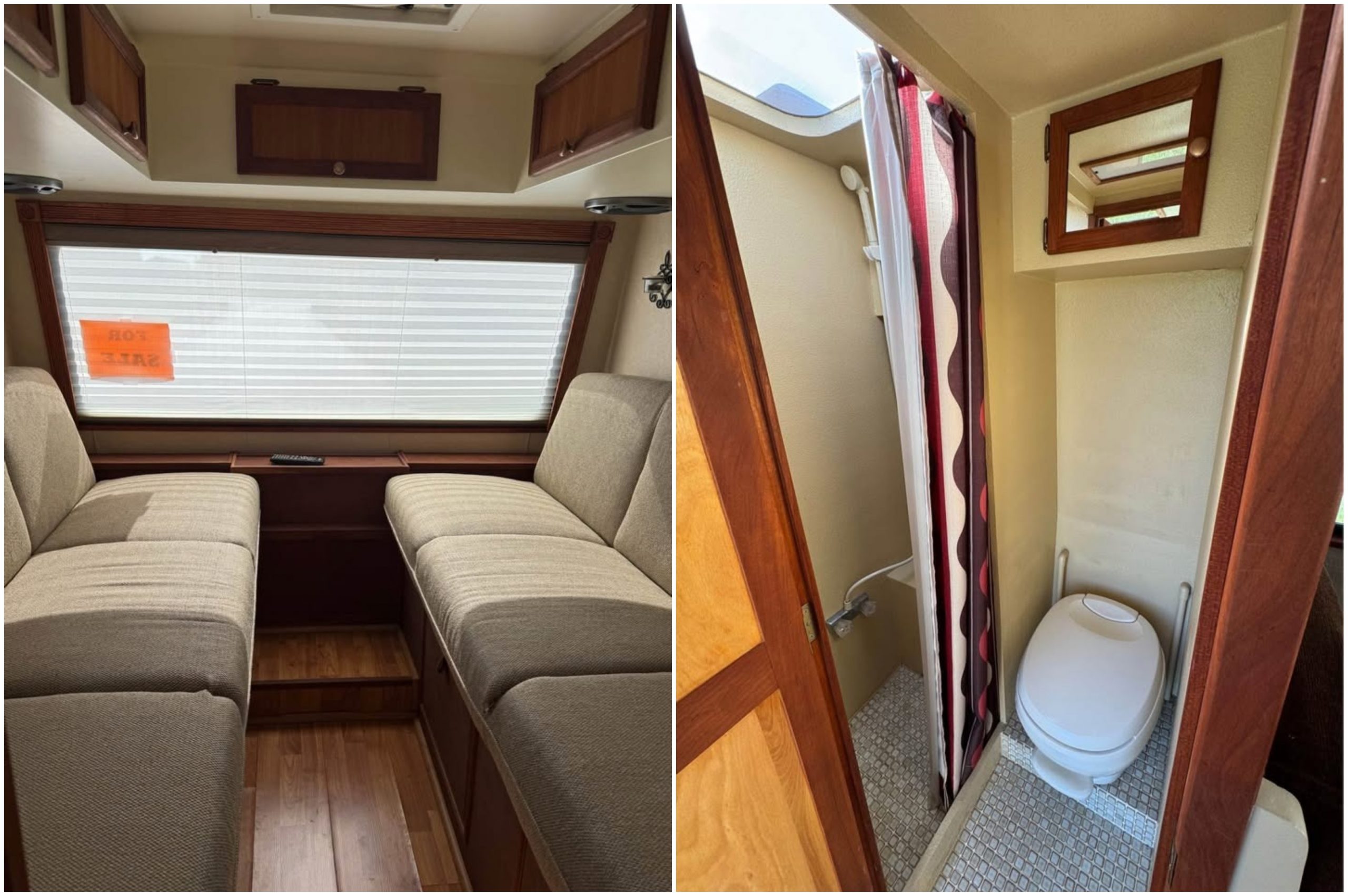
Randy and his wife, Debi, went through the motorhome and gave it a full restoration. This was rather detailed work, too, with Randy telling me that he stripped the old paint off the body using razor blades. The couple added new furniture to the coach, replaced the hazing acrylic windows with glass, and outfitted the motorhome with solid cherry cabinetry. Randy said he built the cabinetry himself. This renovation process took a couple of years.
Randy admits that his changes did weigh the motorhome down, but the motorhome is now modernized, more luxurious, and still usable today, more than 40 years after it was originally built. That’s not an exaggeration. I mean, I recently toured a $1.8 million motorhome that had laminates rather than real wood. As a heartwarming note, Randy says that Carl got to see the renovated coach before his passing and was apparently happy to see his invention was still on the road.
Randy has taken the motorhome out on the open road, but notes that the coach has some limitations. That old-school Honda running gear is still there and working. It cruises at around 60 mph, but doesn’t go much faster. That wasn’t a problem during the time of the “double nickel” 55 mph Interstate speed limit when the motorhome was built, but is properly slow for modern traffic. Today, Randy doesn’t really see this as a motorhome you’d drive across the country, but something you’d take to a regional state park or similar.
Randy and his wife have used the camper countless times over the years. However, as time went on, she wanted something a little bigger and more substantial. Now, they have a travel trailer for most camping outings. Still, Randy doesn’t want to get rid of this small rig. There’s no factory-built on the market that has the story or the quirks of this one. No other motorhome could fill the hole left behind from this one. So, while the motorhome is on Facebook, he doesn’t actually want to sell it. Instead, he wants to keep it in the family for some time longer.
A Motorhome With A Story

Instead of selling the coach to another private owner when Randy is done with it, he wants to send it off to a place where everyone can enjoy Carl’s creativity. He really wanted the motorhome to go to the RV/MH Hall of Fame in Elkhart, but the museum told him it’s short on space. He is currently looking for other museums that might be interested in the motorhome and its story.
That is the beauty of the custom motorhome. These aren’t just rolling hotels to shower in and to sleep in. These RVs have stories to tell, have quirks hidden in plain sight, and are built by people who have inspired perhaps countless others through a lifetime. This motorhome is as much of a camping device as it is a container of memories. I have long thought that the stories of how machines and people are so deeply intertwined are far better than just the story of the machine itself. This motorhome is a perfect example.
In a neat way, by having the motorhome on Facebook, even if it was reluctantly, the story of Carl and his motorhome will now be told to thousands of people and will be available to read for years to come. Maybe, with some luck, you’ll see this motorhome in a museum one day and think, “Oh, I’ve seen this one before!”
Top graphic images: Randy Wallick; Grays.com


It seems like a strange thing to say, but I’m glad this exists!
It’s a fantastic looking rig, honeslty alot better than most, if not all, of the factory rigs of that era. But 55hp? Yikes. They must burn through a clutch ever 1000 miles or so trying to get that thing moving? I hope they ony drive in the plains because a mountain pass would probably be… uh, unadvisable.
He really nailed a timeless design. Plus lightweight composites. At that time boat builders were still pretty heavy making a lightweight composite shell outfitting it the be even close to the same weight as a civic is really doing something. It really deserves to be in a museum and story spread around. Guys like that need to be honored and we need to foster that in to younger generations. Not having ridged thinking along with obviously being very skilled with his hands allowed him to create something timeless and amazing.
“He really wanted the motorhome to go to the RV/MH Hall of Fame in Elkhart, but the museum told him it’s short on space. He is currently looking for other museums that might be interested in the motorhome and its story.”
Calling Jeff Lane…
Henry Ford was big on camping, wasn’t he? It probably couldn’t hurt to give the Henry Ford Museum a call to gauge their interest.
EDIT: And I see now I was a day late with this suggestion. 😀
A beautiful package. One wonders if the market would be there for something similar in size with a modern drivetrain.
Maybe a NISSAN Altima for some big energy in the RV world?
The stories behind the homebuilt RVs are what make these articles great. I recently saw a Vixen in person and they seem like the little bit extra above this home built, or a FWD Winnebago (Le Sharo or Rialta)
A later and larger Honda power pack would solve the performance issues, as long as it fits
I was thinking the same thing. Considering this is all custom, there’s no reason not to just build new panels where needed to make a more suitable drivetrain fit.
This is frankly beautiful.
I’ve been interested in homebrew RVs and skoolies long enough to know that a defining characteristic of rolling your own is the presence of a jank factor, a certain measure of “eh, it’ll do since it’s just for me” attitude.
I don’t see that here. And that is perhaps the most impressive part.
I’d love to know how much it weighs. Foam-core fibreglass can have amazing strenght-to-weight if it’s done well.
A bone stock K24 with a 6speed trans would probably be enough to bring this thing up to modern speed.
I’d love to have this thing!
Even an old D16y8 would double it’s output, lol. I find it really appealing as well, it seems surprisingly well executed.
I want one of those for swapping into a mini
As much as I am a three pedal fanatic, I think I’d rather have an automatic in this thing.
I would probably burn through a clutch just learning to get this thing rolling from a stop.
Honda automatics have a so-so track record. You can always put a heavier clutch in
I’m surprised I had to come this far down the comments to find the obvious solution: K-swap.
Call up the BoostedBoiz!
Honda MR-V.
I think this should be the Autopian staff RV. Then, when not in use, it could go on display at Galpin. That counts as a museum, right?
A vehicle like this belongs at The Henry Ford in Dearborn. Park it by the Tucker and Charles Kuralt’s RV.
Mercedes, thank you for always focusing on not only the vehicles, but the creators and maintainers. While this RV would be a perfectly good article with nothing more than specs, illustrations and descriptions, what sets apart The Autopian and especially your work is your care for the lives of the people around these interesting vehicles. As we’ve all seen, they’re rarely ordinary.
Yes, sounds like quite a guy.
“For many years, he was a barber who cut hair for local men and children while selling and repairing motorcycles in his shop next door to the barbershop.”
He genuinely seems to have done exactly what he wanted to do with his life.
Throw a modern civic turbo 4 pot in there and it’ll definitely speed up.
Shoot, even the Insight 3-cylinder would be a step up. It’d cook the CVT in the first five minutes though.
Is that the hybrid? The battery would be handy as well when plug in shore power wasn’t available. We get Toyota Estima/Previas here in Australia from Japan with Awd and hybrid and I think they could be a good conversion platform.
Yes and no. The original Insight’s HV battery wasn’t much – it was a pack of literally about 150 (I don’t remember exactly) C cell NMH rechargeables. And that was me blue-skying inside the corporate origins. If you wanted to keep it thrifty but give it a serious upgrade, repower it with a 2023 Prius Prime system.. Big power bump and over 13 kW-h of battery capacity.
Certainly a vehicle for the patient. Nice effort, baffling choice of drivetrain. I’d infinitely prefer a Vixen if I wanted a small, fuel-efficient, manual trans RV – and those will keep up with traffic.
I found the main innovation of the original Civics was how fast they dissolved in a Maine winter. They made Fiats seem rust-resistant.
“I found the main innovation of the original Civics was how fast they dissolved in a Maine winter. They made Fiats seem rust-resistant.”
That was a feature, not a bug. They were engineered to keep getting lighter as you owned them.
Very true. Very, very true.
Simplify, and add lightness
The Accord replicated that. Even in down state NY our 77 rusted so fast it could have been Italian
ALL Japanese cars rusted like it was a career in those days.
As the old joke goes – the Italians invented rust, but the Japanese *perfected* it! And the sad part is they STILL rust quite badly, relatively speaking. 10yo Subarus (especially) and Hondas in Maine are usually looking quite poorly, Toyota seems to have it figured out as well as everyone else today though.
As a former VW Scirocco owner I say Karmann invented rust and licensed it to the Italians
Truth!
At least Mazda had
zoom zoomrust rust.Love this build! We had a ’76 Honda Civic wagon during my early-driving years. Great car that we kids were brutal to.
I’m amazed they kept the Civic drivetrain for something this large. I’m further amazed that they claim it can do 60. Craftsmanship looks really impressive for a one-off build though.
I’m not sure I would call that a benefit. This thing looks like it would get hung up coming out of basically any driveway. There’s a good reason they don’t normally build vehicles this long and low.
I would think so, too, but Randy says it gets around just fine. Looks like there’s just enough ground clearance to get by on a paved surface.
…that’s a lotta vehicle for a little Civic drivetrain. And yet it seems to have worked. Leave it to a homebuilder.
I do question the glass windows and cherry cabinetry though. They are nice, but, if ever there was a vehicle where every little bit of extra weight should be avoided whenever possible, this would be it
The glass I agree, but solid wood generally weighs less than a comparable construction of plywood or particleboard, so I doubt that was a big impact unless he really went overboard with it.
Yeah, if he did it in 3/8“ instead of every cabinet-maker’s default 3/4″ then it wouldn’t be that much of a weight penalty.