


There was a time in the distant past when Americans considered the threat of nuclear annihilation to be a more imminent threat. People built fallout shelters, and schools practiced drills, teaching children what to do if bombs fell. On the ground, your only warning might have been the sound of an air-raid siren, and one company built the loudest of them all. During the Cold War, Chrysler built a car-sized air-raid siren so loud that it could be heard from up to 16 miles away. Powering the world’s loudest siren was none other than Chrysler’s iconic Hemi V8.
If you are one of the younger readers of The Autopian, or at the very least, were born after 1991, you didn’t get to experience the tensions of the Cold War. That includes me, as I was born after the fall of the Soviet Union. During the Cold War, which took place in the decades following World War II, nuclear arms proliferated around the world and tensions between the United States and the Soviet Union reached dangerous levels. The effects of the Cold War were felt at home, and American life changed around them.


As the National Humanities Center notes, the Cold War touched every facet of the American condition. Hollywood produced horrific movies that played with fears of nuclear war and unwelcome invaders. Families were told to conform and unite to stand against a common enemy. If you did something that the government could have viewed as “un-American” or Communist, you could have lost your livelihood. One of the most iconic films in history, “Dr. Strangelove, Or, How I Learned To Stop Worrying And Love The Bomb,” was a Cold War flick.

Then there were the even darker parts of American Cold War life, namely, the idea that, at any moment, the bombs could fall. As Business Insider writes, libraries were armed with materials to teach people how to render first aid and how to survive the fallout of a nuclear war. Even the Space Race had a different feel than how many remember it today, as many people back then feared that letting the Soviets get to space and the moon first would give them a militaristic advantage.
Some drastic efforts were taken to do something, anything, to help people in the event that the bombs fell. Some families built bomb shelters, while schools taught children to “Duck and Cover.” We also erected and tested massive air-raid sirens that served as perhaps the last warning a person might get to find cover. Thankfully, the grimmest fears of the Cold War did not become reality, even though there were times when they almost did.
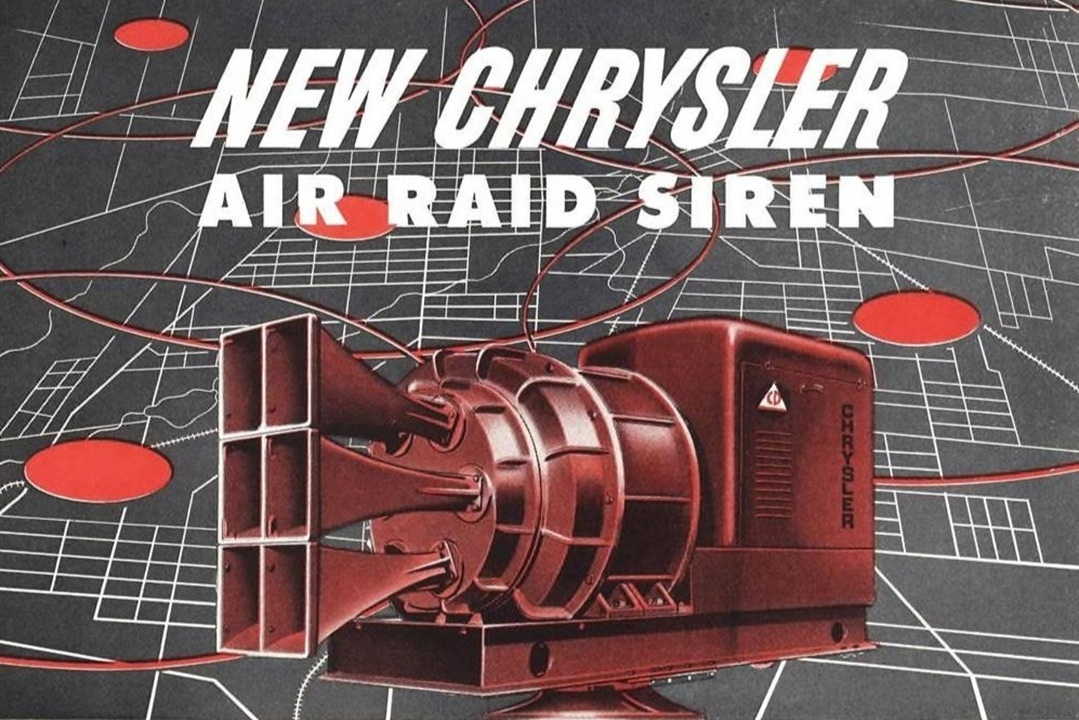
One famous relic of the era was the Chrysler Air Raid Siren. When this Hemi V8 car engine-powered beast entered production, it produced a siren that was as loud as a fighter jet taking off and had the range to travel several miles through rural areas. Today, they’re a weird reminder of what used to be.
Siren Songs
The air-raid siren actually predates the Cold War. Now, we aren’t exactly a siren site, so I’ll keep it short. The inventor of the siren is often credited to Scottish physicist John Robison. This was a simple device that used a wheel-driven stopcock that opened and closed a pneumatic tube. French engineer Baron Charles Cagniard de la Tour invented an improved siren around 1819.
The use of a siren to warn of airborne dangers rose to popularity in 1938 and 1939 when an elaborate network of sirens was constructed around Britain. These sirens were usually mounted on top of buildings or on poles if a suitable building was not available. Notably, at least for our story, was that these particular sirens were electrically powered.

Another way to describe a siren is that it’s an air chopper. The Canadian Civil Defence Museum And Archives describes how a basic electro-mechanical siren works:
An electro-mechanical siren is a fairly simple device. It consists of an electric motor which turns a fan called the “rotor” or “impeller”, spinning inside a slotted drum called the “stator”. The first job of the rotor is as a centrifugal fan. It pulls air into the siren axially through the intake, and blows it out radially through the holes in the stator. The second job of the rotor is to chop the incoming air stream into impulsive bursts. The rotor is segmented by vanes that periodically cover and uncover the holes in the stator. Each time the rotor and stator holes align, a burst of air is forced through. The frequency of these bursts is the pitch of the siren.
[…]
The siren gets its unique tone, or timbre, from the from the shape of the sound wave it produces. The chopping action of the rotor produces a triangular waveform that is rich in both odd and even harmonics. The first few harmonics are especially strong.
A variant of the siren is the so-called supercharged siren, which uses an external air compressor, such as a roots blower, to force air into the rotor. This greatly increases the decibel output of the siren and also allows the sound to travel farther. Typically, these blowers are electrically-driven. One of the earliest supercharged sirens was the famous Federal Signal Corporation Thunderbolt, which entered production in 1952.
Car-Powered Sirens

This supercharged point is important because the Chrysler Air Raid Siren is considered to be a supercharged siren. But a question I’ve long had is how on Earth does a car engine end up powering a siren? As the story goes, in the early stages of World War II, the War Production Board wanted an air-raid siren that could work independently of infrastructure. That way, if the enemy downed the electrical grid before striking with a bomb, civilians could still be warned. But this couldn’t just be any normal siren, either, as the Board wanted this siren to be so loud that it could replace hundreds of tiny electric sirens.
To facilitate this, the E.D. Bullard Company and Chrysler, and then later, Bell Telephone Laboratories, joined forces to create a marvel in siren science.
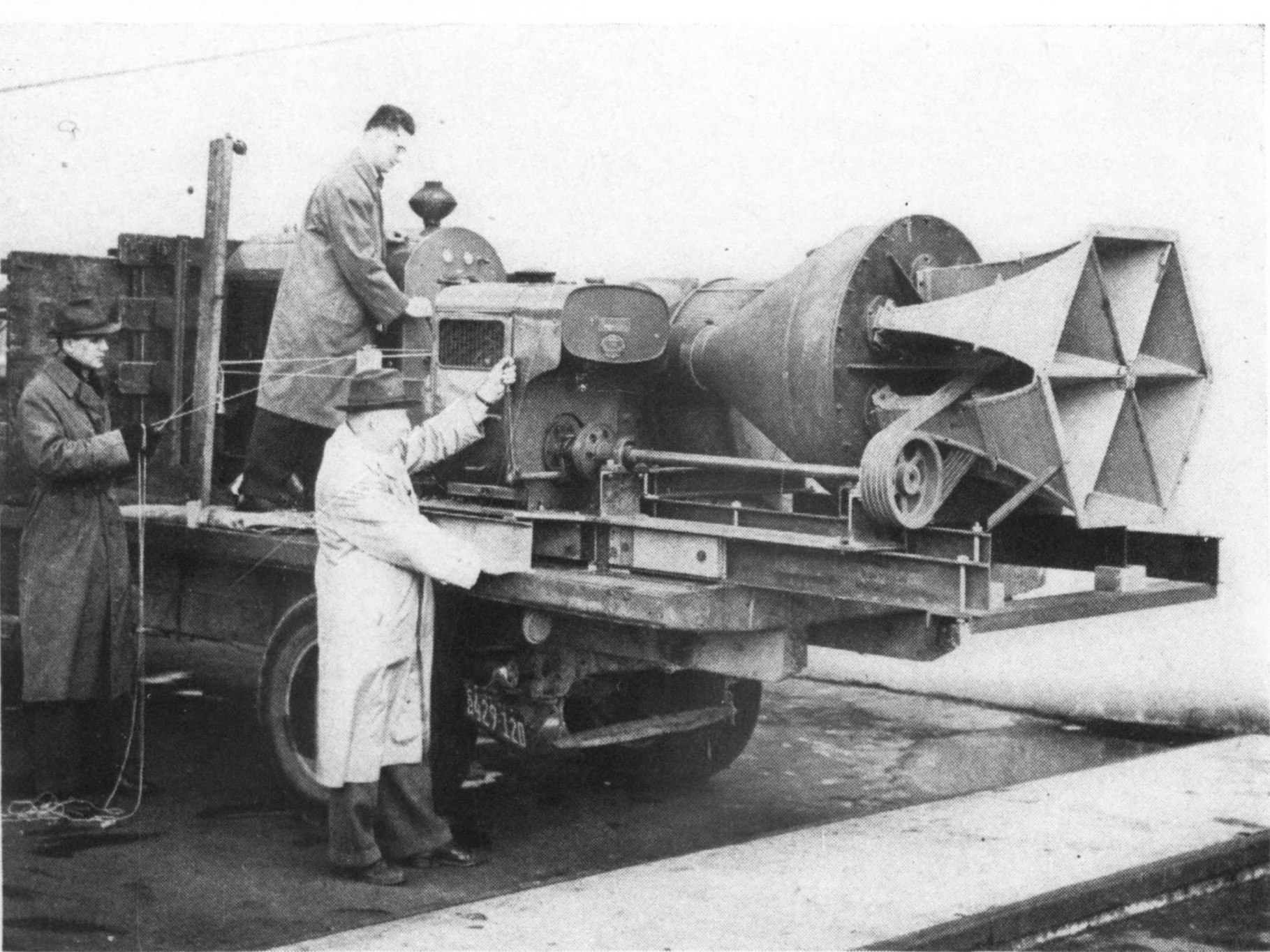
A 1995 issue of Horn & Whistle Magazine explains what happened from there:
Development of the Chrysler siren began around January, 1942, when the E. D. Bullard Co. of San Francisco submitted an engine-driven centrifugal siren to the Chrysler Division to see whether the straight 6-cylinder Chrysler Royal engine could be adapted to it. The output of this siren was inadequate, and it was concluded that improvements would have to be made for it to be useful as an air raid warning signal. Earlier it had been determined that a sound pressure level of 120 to 140 dB at 100 feet was needed for an effective warning. Despite considerable effort, the Bullard-type siren did not attain the necessary output. The problem was still under consideration when the Chrysler Corporation was invited to send representatives to a meeting called by the Office of Civil Defense (OCD) in Washington, DC on February 25, 1942, to inspect a new type of high output siren. This device was the experimental result of new sound-producing principles developed by the Bell Telephone Laboratories under the direction of Dr. Harvey Fletcher. The Bell Labs siren was brilliantly engineered and very powerful, producing a level of 137 dB at 100 feet.
[…]
In the Bell Labs design, the clearance between the rotor and the port faces is only 0.010 to 0.015 inches. If smaller, the chopper might rub against the ports, and if larger, the sound output drops to an unacceptably low level. The experimental Bell Labs siren used a compressor furnished by the American Locomotive Co. This blower was driven by a 95 HP Ford engine and delivered air at 5 PSIG. Tests showed that an additional 20 HP would be required to drive the chopper rotor at 5,000 RPM, and this was provided by a separate 20 HP Wisconsin engine. This siren produced a frequency of 440 Hz when the rotor was driven at 4,400 RPM. A great deal of ingenuity, experimentation, and thought went into the development of the high output Bell Labs siren.

The initial production version of the Bell siren design was called the Chrysler-Bell Victory Siren, and it entered production in 1942. These sirens used a 324 cubic inch Chrysler IND 9 straight-eight, good for 140 HP. The siren produced 137 dB at a frequency of 430 Hz at a distance of just 100 feet. The use of a two-stage compressor eliminated the need for a second engine and compressor. Approximately 120 of these sirens were sold to 28 cities, including Chicago, Detroit, and New York City, for $3,760 a piece.
What’s wild about the Victory Siren is that its operator had to sit on the siren, Slim Pickens-style, as it slowly spun on its turntable. That’s why historical images of the sirens do look pretty silly. Yes, that also meant that in a real emergency, the siren’s operator would get a front row seat to a nuclear apocalypse.

However, the sirens worked. In a 1942 issue of Science News Letter, the sirens were described as being as loud as “1,000 symphonies” playing at the same time, and magazines touted the sirens as being the “loudest sustained sound ever produced by man.” According to Chrysler, the Victory Siren was so loud that a city would have needed to purchase 128 low-powered, typical sirens to equal just one Victory Siren. Of course, Chrysler then noted that, unlike the Victory Siren, those other sirens would stop working as soon as the power goes out.
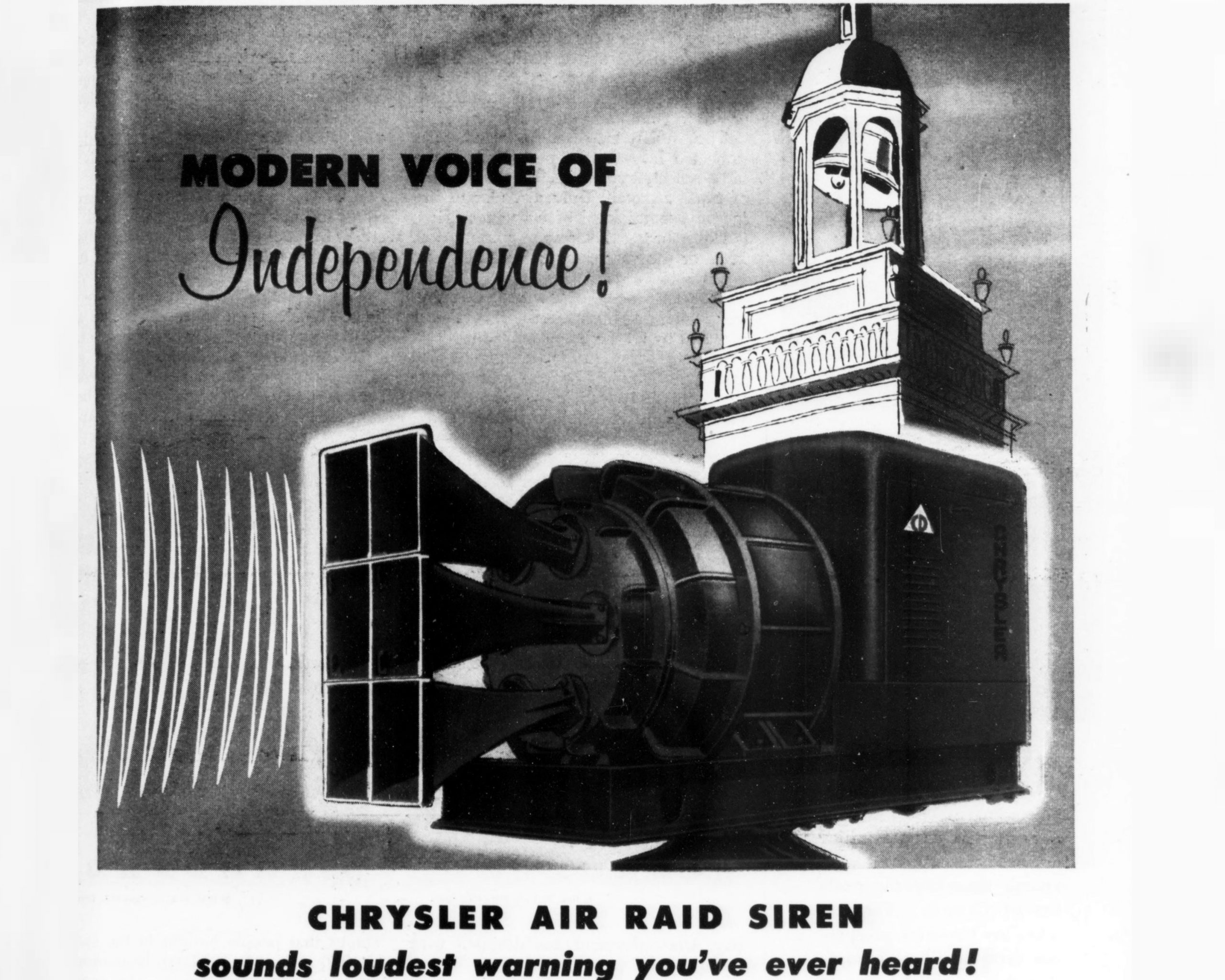
This loudness and the over 10 miles of travel the sound had (given few obstacles) was important, because cities were already very loud. When the siren was tested in New York City, Bell Telephone Laboratories engineers found that the siren blared at 15 dB louder than the background city noise. Thus, the siren was marketed as being able to pierce even the loudest city environments. Soon enough, city dwellers would hear the sounds of air-raid siren tests. I wonder how many of those people knew that the sirens were using car engines?
Given the smashing success of the Victory Siren, Chrysler also made a more compact version of the siren, which used a 236 cubic inch straight-six with 120 HP. This siren, Chrysler said, pushed 300 cubic feet per minute and weighed a svelte 1,600 pounds. Yes, that was considered lightweight because the big straight-eight siren actually weighed more than a ton.

Chrysler did not note a decibel range with this one. Instead, this smaller siren was designed to complement the Victory Siren. Specifically, Chrysler said it was to be deployed in areas where the Victory Siren’s sound wasn’t loud enough.
According to Horn & Whistle, the Victory Siren would get a second iteration. The second version, pictured above, which was renamed to just Chrysler Air Raid Siren, featured the same 137 dB and was powered by the same straight-eight engine, but had a more refined, cleaned-up appearance.
‘That Thing Got A Hemi?’
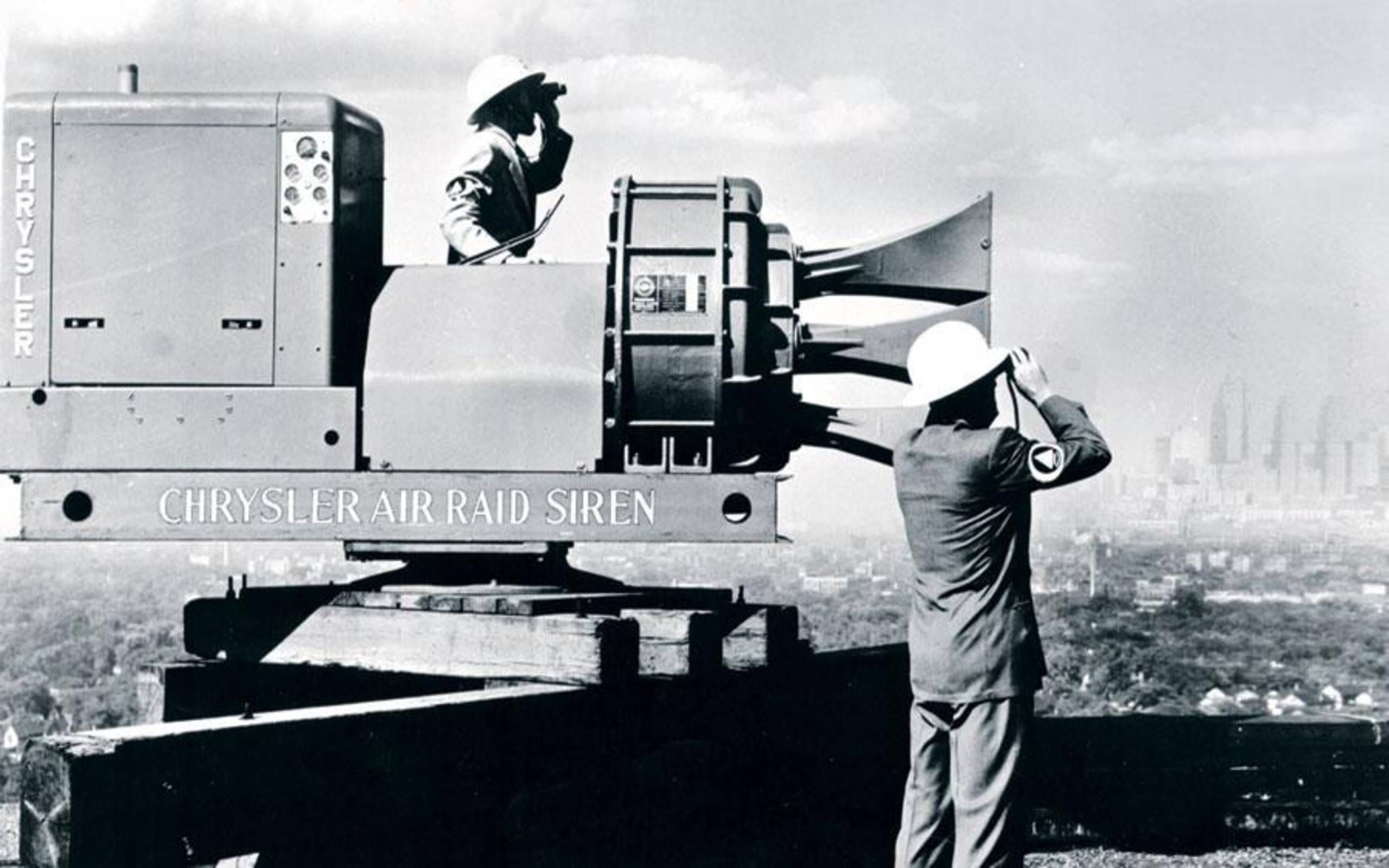
Then came the air raid siren to rule them all. In 1952, Chrysler launched the next generation of the Air Raid Siren, and this one was pretty nuts. From Horn & Whistle:
They were the official Civil Defense sirens used in large U.S. cities and other locations during the Cold War nuclear attack threat era of the 1950’s and 1960’s. They had new three-stage centrifugal blowers to compress the air to 6.95 PSI before it was chopped by the rotor. These sirens were also fitted with Chrysler’s new industrial 331 cu. in. hemi-head 180 HP V-8 gasoline engine. This siren produced an incredible 138 dB at 100 feet, and the frequency was 460 Hz at 4.600 RPM. It could be remotely controlled from inside a building or other location.
All four models had six horn-loaded ports. The three production model Chryslers had engine block heaters and heated battery cases, so that the sirens were ready to run down to -25°F in all weather and climates. Because the sound output was highly directional, they rotated at 1.5 RPM on a belt-driven turntable for full 360° coverage.
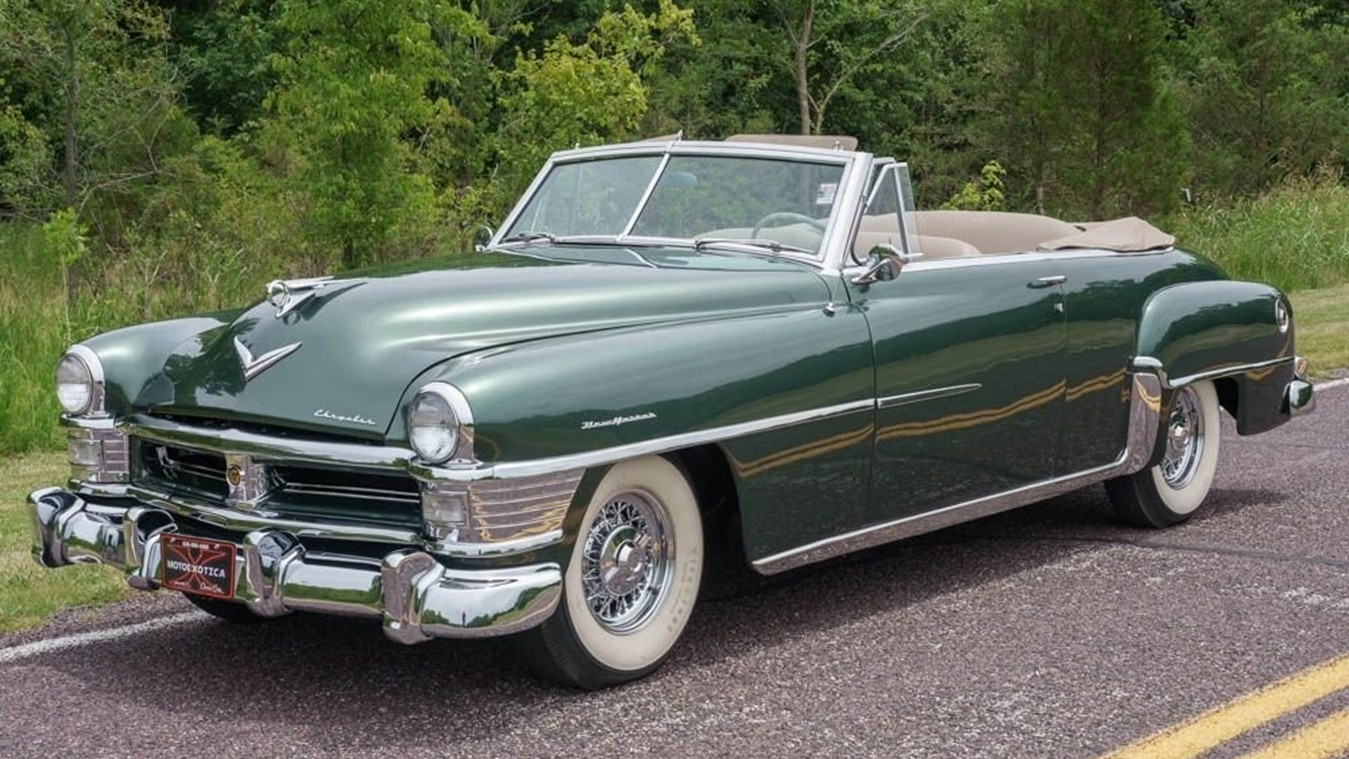

That’s right, the final version of the Chrysler Air Raid Siren was powered by a Hemi, or more specifically, a FirePower Hemi. At the time, this engine would have been found in cars like the Chrysler New Yorker, the Chrysler Saratoga, and the Imperial. The use of a FirePower in cars meant that Chrysler’s big boats had 20 more ponies in the stable than Cadillacs featuring that marque’s 331 cubic inch V8.
What’s so incredible about this siren is its performance. The previous iterations of Chrysler’s siren were already loud, but the Hemi version took it to another level. The Hemi siren was 12 feet long, weighed a whopping three tons, and was 138 dB at 100 feet. That’s about as loud as standing next to a fighter jet as it lights its afterburners. It’s so loud that it will damage your hearing.
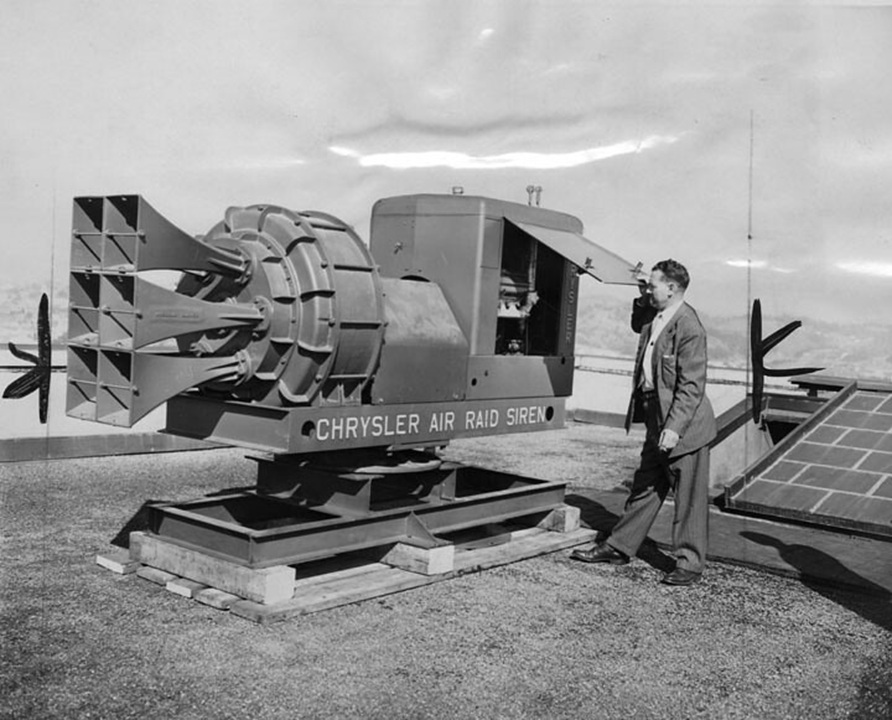
The Chrysler Air Raid Siren had some great travel to it, too. In a rural setting, the siren’s call could travel as far as 16 miles, and it would still be 50 dB, or 10 dB above the expected ambient noise for a rural area. These sirens became the official sirens for the United States Federal Civil Defense Administration, and as a result, 350 examples were built between 1952 and 1957 and were used all over America. All were built in Chrysler’s Marine and Industrial Engine division in Trenton, Michigan.
Pamphlets were passed around instructing people on what to do if they heard a “Take Cover Signal.” If you were at home, you were supposed to go into your fallout shelter. If you didn’t have one, you were to close all windows and doors and take cover in the most central part of your home, or in the basement.
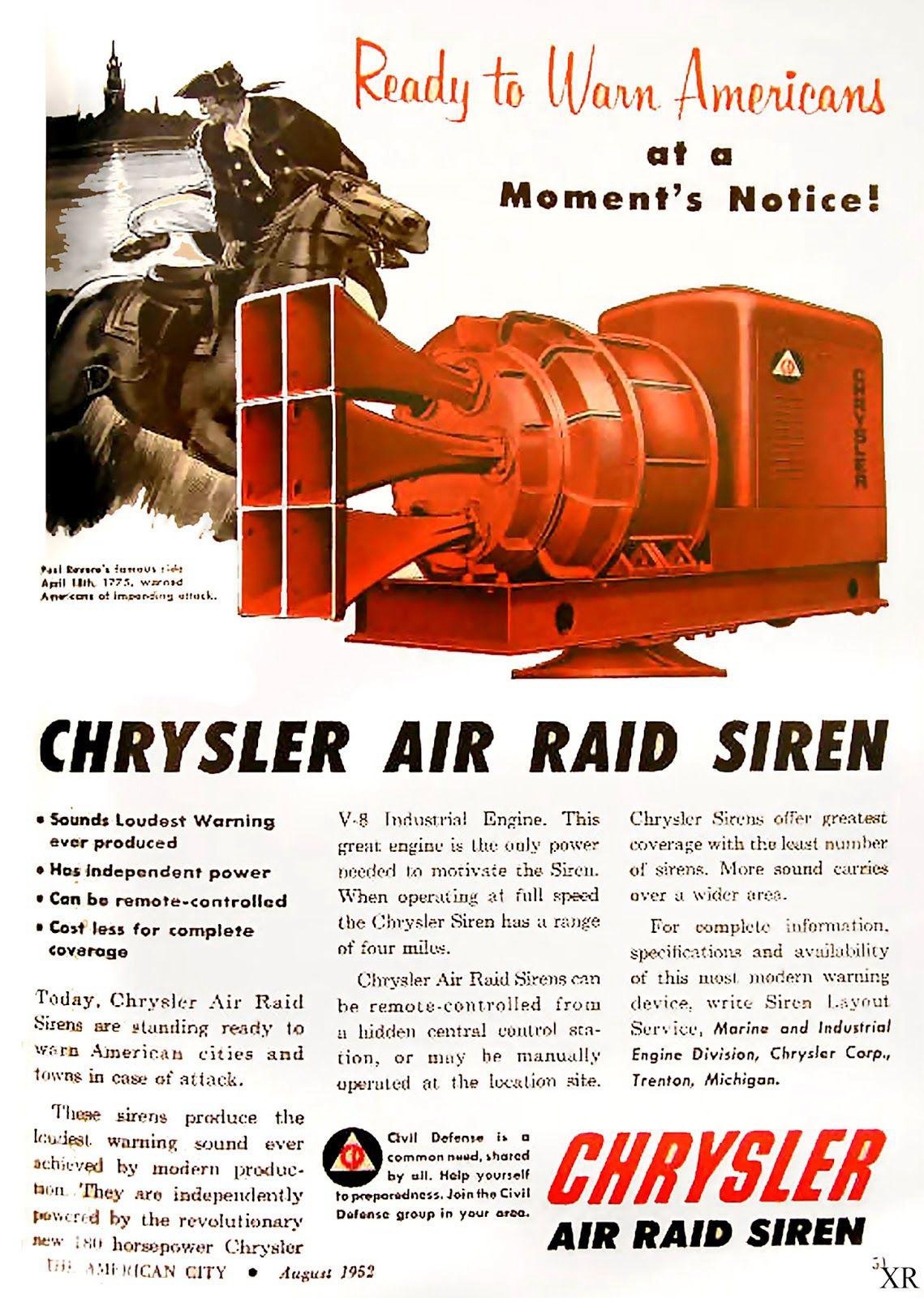
If you were outside, the pamphlet didn’t offer many options and just told you to find cover. Finally, the pamphlet ends by saying that if you see a bright flash of light, you should take cover “instantly.” Thankfully, this time, the operator of a Chrysler Air Raid Siren didn’t have to sacrifice themselves, as the siren could be turned on remotely through a telephone.
As for how to “drive” Chrysler’s Air Raid Siren, that works in a way that you might now expect. First, you’d start your rumbling V8. Once the engine settles into a rhythm, you engage the pulleys, which will then drive the siren as well as the turntable. From there, you just let it rip. The entire siren, engine, fuel tank, operator seat, radiator, and all, was contained on a heavy sled and designed to be placed pretty much wherever it fit, but preferably at the tops of buildings. Here’s a video:
The Chrysler Air Raid Siren is not the only siren in history to be powered by internal combustion. In 1942, there was also the Mobil-Directo Model BN52 and Model BN54, which used Wisconsin VF4 air-cooled V4 engines good for 25 HP.
The Hörmann HLS siren of the mid-1960s used a Farymann G20 diesel engine as its compressor.

There’s even a modern internal combustion siren. Taizhou Lion King Signal produced the Defender, a 130 dB air raid siren powered by a Cummins diesel tuned to 220 HP. This siren was built starting in the 2010s and is still on sale today. Presumably, you can buy one, too, if you have between $200,000 and $300,0000.
Still The Loudest
Some Chrysler sirens were in use until at least the late 1970s. After the Cold War, most Chrysler Air Raid Sirens were disposed of. Some were preserved, and many were abandoned. It’s unclear how many have survived into the modern day. Coincidentally, our pals at Hagerty recently wrote about how a Chrysler Air Raid Siren might end up in New Zealand to be a part of that country’s thriving siren hobbyist scene.
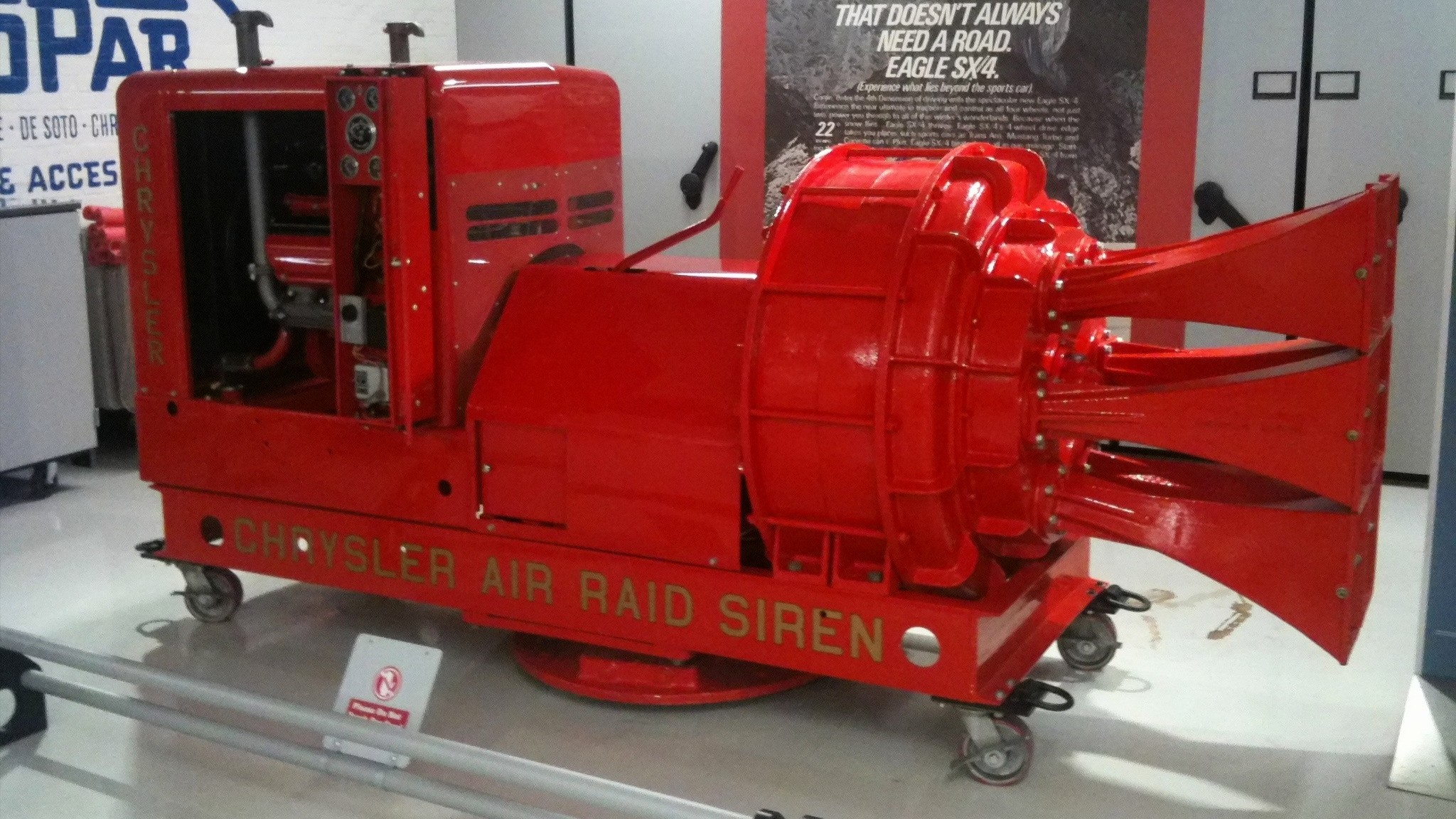
What’s amazing is that the Chrysler Air Raid Siren has held onto its title of being the loudest siren ever since its creation. Today, instead of having one siren to rule them all, alerting duties are handled through systems of smaller, less ridiculous sirens. Sure, a common siren today might have the range of a few miles, but they also don’t weigh three tons or require some poor operator to ride them.
But there was a time when these sirens made total sense. The concern of getting bombed by an enemy was so great that, at least for a blip of time, a viable solution was combining luxury car power with the loudest siren on the planet.
Top photo: Chrysler


This passage “In a 1942 issue of Science News Letter, the sirens were described as being as loud as “1,000 symphonies” playing at the same time, and magazines touted the sirens as being the “loudest sustained sound ever produced by man.”” gets one to wondering about the loudest sounds ever made by a human being without any mechanical aids.
Some older editions of the Guinness Book of World Records had a category for hog calling contests; I do not recall any details about modern winners and their decibel levels but I do remember at least one edition referencing Mills Darden as an especially notable case because he was a farmer, born in North Carolina in 1799 and died in Tennessee in 1857, who was renowned for his gargantuan physical size (7 feet 6 inches tall and just over 1,000 pounds) as well as his immense physical strength and was said to have won hog calling contests with calls that could be heard six miles away.
how a Chrysler Air Raid Siren might end up in New Zealand to be a part of that country’s thriving siren hobbyist scene.
Talk about your niche avocations…
There’s someone who brings one of these on a trailer to the local steam engine & vintage farm equipment show every year, he keeps the engine running much of the time, but the siren itself is sounded infrequently for obvious reasons, it is extremely loud, especially if it catches you unprepared
I grew up in a coal town in PA in the 1980s. I remember they used to use a huge siren to alert the volunteer fire and ambulance companies to an emergency. I don’t know if it was an air raid siren or a siren originally intended to alert the town of an accident at the mine. Either way, I’ve not encountered anything like it since anywhere else I’ve been.
When I was a kid there was a system of sirens that went off when there was a tornado warning. I’ve since left tornado country, but they still use them in at least some areas. Oklahoma City has over 180.
Fascinating. For those younger readers it really was the early 60s and before that experienced the nuclear bomb scare. I was born in 63 and we had none of that are big scare was the disco music, and crappy cars. That being said the clothes were fantastic. We white people could dress like a pimp and we’re not called out for it.
In other news the main reason the Chrysler Air raid siren was really discontinued was people complaining about not being able to hear it over the Hemi V8.
Hey has anyone used the joke about cars in a commercial showing a guy driving a V6 hit themselves on the forehead and complain WOW I could have had a V8?
So many questions and comments!
First, yes—please!—use hearing protection in loud environments whenever possible. I spent my early adult years sitting under a very loud, air-powered siren* while my ambulance drove to the scene of emergencies, without any hearing protection. Now in my 60’s I have tinnitus, a constant ringing tone going off in my head. I have trouble following conversations, and have to use closed captioning when watching video. In a crowded environment, I need hearing aids. Wear your protection, people!
*(Nothing like the monsters described in the article. Our “grinders” were electrically-powered devices similar to the older hand-crank models. They’re a lot louder than modern electronic horns. Once the problem of hearing damage was identified, they got moved to the front bumper of fire and EMS apparatus, but at my company they were right up on the roof, over our heads.)
Second, Horn & Whistle Magazine? Whisky Tango Foxtrot!?
Third, I’m not sure about this but I think there’s a connection; in the small town where I grew up, we had a “noon whistle.” It was obviously a grinder-type whistle on the roof of city hall that blew at exactly noon, if the city clerk was on the ball. It let workers out around town know it was time for lunch break, but also tested the siren every day to make sure it worked.
The volunteer fire department used the siren to get called out for a fire. One, two, or three blasts to let them know what part of town to go looking for smoke in. Of course, they responded to the firehouse first, for the engine and their bunker suits. The practice continued long after the invention of the pager made it unnecessary and redundant, and I always assumed that was because the fire siren did double duty as the town air-raid/nuke siren.
I don’t live in that little town, anymore, and I’ve never heard such a thing in a larger city. But when I visit family, I still hear the old noon whistle go off, triggering much happy nostalgia. If you are a small-towner and a noon whistle still goes off in your little ‘berg, throw me a like and we’ll see who we are.
I’ll second the “protect your hearing” PSA. I’m 48 and have tinnitus and got my first OTC hearing aids last year which are magical devices. (Crazy to flip them on for the first item and hear all the sounds around the house that I couldn’t hear before)
For me it is a combination of shooting in my teens without hearing protection, working in loud manufacturing environments for 30 years, and I’d say being the first generation with earbud headphones even if they were corded. During the summer I mowed grass as a job cutting vacant lots and passed the time by cranking up the tunes over the roar of the tractor and cutting deck. Riding my motorcycle? No earplugs – just pop in those earbuds and crank the tunes. Running a grinder at work – put in the earbuds and crank it up….
Now I tell every new engineer I work with to wear their hearing protection even though it isn’t enforced for white collars workers. Almost none of them listen – just as I didn’t listen to my elders in my youth.
Agreed, protect your hearing and eyesight!
I drove my kids crazy for forcing them to wear “headphones” as they called hearing protection any time any sound was louder than background, even when using the vacuum cleaner. Drum it into them early.
Ah, the magic of dB. Sorry, the extremely confusing magic of dB. Thankfully the Horn and Whistle (a magazine I can’t quite believe existed) quotation clears things up a little bit by specifying how the measurement was taken and what the dB are measuring.
See, a decibel is just a ratio between two numbers, which is useful for measuring things that function logarithmically. The way the math works out, difference of 6dB just means something is double the number of something else.
So it’s important to know that the 138dB level was taken at 100ft, and that the dB in reference here is Sound Pressure Level. 0dB SPL is the lowest threshold of human hearing (averaged among hearing people, I mean.) Now, since sound pressure falls off logarithmically (the ol’ inverse-square law), every doubling of distance is a 6dB decrease. Similarly, every halving of distance is a 6dB increase, since you’re getting closer to the sound source. So at 50 feet, you’d be at 144dB SPL, at 25 you’d be at 150dB SPL, at 12.5 feet you’d have 156dB SPL, and at a lowly six-ish feet, 162dB SPL. The sound of the Atlas V rocket, the loudest human-made sound on Earth, is 138 db SPL at 500m, a bit less than a quarter mile. So standing basically right next to the siren would seem as loud as the rocket that launched the Apollo missions at about 100 feet.
To be even more fun, we have discrete numbers attached to Sound Pressure Level, the Newton per square meter, or the pascal!. 140db SPL is equal to 200pa. Six feet from the siren would be 3200(ish) pascal. That’s .4641 psi, which doesn’t seem like much, but that converts to a wind speed of 160mph. This siren would probably blow you over from several feet away.
Math! (Someone who’s an engineer plz check my work.)
Also, it’s worth noting that 138db SPL will cause immediate permanent hearing damage and it will hurt real bad, but sustained levels between 80 and 90dB SPL will be tolerable but still cause damage over time. Most music industry professionals try to keep listening levels for a concert around 95 at the top end. Wear earplugs when working in loud environments.
Okay massive special interest infodump over.
That being said if you are ever in the UK the Hound and Whistle is an excellent Pub.
A V8 hemi-powered nuclear apocalypse siren is the most American thing ever.
Can you please tell us more about this “thriving siren hobbyist community”?
I know someone that has one.
Car guy so he restored the engine.
I think I’ve heard louder sirens, but they were probably electric.
Lower frequency too I think, which carries farther.
Every place I’ve lived still uses sirens, mostly for storm warnings.
I tried to pick up a siren sold by a town, but missed the owner.
It was a basic tornado/ Russian warning siren designed to sit on top of a power pole.
Came with a warning from the town that sold it about firing it up in their territory.
Three phase, omnidirectional, it was rated at 100 decibels at 100 feet.
Like horns, if you run two identical sirens in the same place, you get a beat that is very distinctive.
Applies to strobes too.
I remember seeing the Air Siren in the basement of the Chrysler Museum. I wonder if its still there.
And sometimes the bombers carried sirens of their own:
https://www.warhistoryonline.com/instant-articles/trumpets-jericho-luftwaffe.html
I was in grade school in New York in the 1970s and we were still doing duck and cover drills, at least in the early grades IIRC. I don’t recall any sirens involved, but do remember seeing the navy and yellow (I think) ‘Air Raid Shelter’ sign on various buildings.
Thanks Mercedes. 🙂
1957 model here. Totally grew up thru the1960’s and early 70’s.
Duck and cover was required as soon as kindergarten, as were movies put out by whoever, telling us how to try to survive if above ground or exposed when the shit hit the fan.
It was an intense campaign, even TV broadcast ‘what to do’ PSAs pretty often.
In our area everyone had a basement, like 80% for sure. But I went into a few shelters as a kid. Most schools were CD rated as shelters for a possible attack.
By about age 10 we began to learn that you probably would not care to be a survivor should hell rain down. But Nam was the big deal then so people’s attentions changed to a large degree.
BTW, I think saw one of these somewhere decades ago. The one in our town, a MPLS suburb would ruin your ears like a Who concert when it went off. It almost created its own wind turbulence, when that sucker went off we would turn on the TV or radio asap, but not panicked at all.
The risk of getting toasted was old news for most by about 1965. About one in ten friends, neighbors worked in the defense industry then.
But then the bastards had to develop SkyNet and everything just turned to total shit.
YMMV.
I lived in Omaha in the 70’s, target city due to the nearby SAC base. Once a month on Saturday they would fire off their ear-splitting air raid sirens. It was the loudest thing I’d ever heard at the time. Now I know why! I bet they had Hemi sirens!
I grew up in the DC suburbs and the air raid sirens were part of the soundtrack of my childhood. They tested them every other Wednesday at 11:00 AM and the sound was haunting. I was never instructed to take cover under my desk, but my elementary school had a fallout shelter under it. This wasn’t that long ago because I’m not old. Also, Horn and Whistle magazine?
A fallout shelter, and all of that preparation, convincing a scared public they’d make it out alive and everything would be great, only to emerge into a world of starvation and cancer, if you were ‘lucky’ enough to live that long.
My wife’s family used to rent a house in East Hampton right next to the American Legion, which had an air raid siren right on the property line about 30 feet from the second-floor bedroom window. Every day at noon it would go off for about 15 seconds. It would take about a minute and a half to actually wind down to silence. Allegedly, this was so that people could set their clocks, if they were a mile or two out to sea. If you zoom in, in 3D view, you can see just how ridiculous it was.
https://maps.app.goo.gl/v19XK4Pp9GfcXNVx7
Of course, everyone was careful not to mention this beforehand to any visitors.
Horn and Whistle Magazine? the thriving siren enthusiast scene in New Zealand? If I hadn’t read the byline I would have been sure that this was a Jason article.
“You got a HEMI in that thing?”
WHAT?
The ultimate American-based irony is calling the warning system to announce being fucked as a “Victory Siren.” That is U.S. thinking in a nutshell.
It was actually comforting to essentially live in the ‘certain death’ zone of a major US city.
That’s what we said in Omaha. At least we knew we’d be among the first to go since it was the site of SAC.
Lived there; late 50s to late 60s. That fatalistic thinking was the order of the day. I don’t remember hearing the sirens on Saturdays but we lived in the Benson neighborhood (miles north of the Airbase).
Now on the west coast, and saw/heard the Hemi siren at the Half Moon Bay Dream Machines a few years ago.
Same…surrounded by various defense contractors in the third most populated city in the country at the time. That haunting sound, every Tuesday, sometime in the late morning. You would stop what you were doing, and think, ‘is it really a test or this is it?’
I was thinking the same thing. “Ah, the sound of victory.”…BOOM.
*announcer voice* If you were diagnosed with permanent hearing loss due to the Chrysler Hemi V8 air-raid siren, you might be entitled to compensation.
I think a visual-based communication method would be better suited to the intended audience.
if you stood inside Big Daddy’s garage next to an old Hemi engine and air raid siren while he blasted it into your faces, you may entitled, I SAY, YOU MAY BE ENTITLED TO…
A very dark period in our history.
A Chrysler air raid siren has been on my “list of things I want for no good reason” for years. Tried building my own foghorn a few years ago — loud low frequency sounds take an enormous amount of power.
I don’t know if I can make it to New Zealand, maybe Wisconsin though?
https://www.sirencon.com/
“Tried building my own foghorn a few years ago — loud low frequency sounds take an enormous amount of power.”
I happened to be on the Queen Mary in Long Beach when an announement warned the tour guests of an impending demonstration of the foghorn. At that moment I was just below it. I couldn’t resist the temptation to stay put.
A few minutes later I FELT that power…
same experience in NYC early 1960s. That ship was so cool on the inside.
it was awe inspiring to me. They even had a Rolls Royce dealer onboard with a car, actually on display several decks below the main deck. Very cool.
The ships horns were awesome.
You might want to look at the French research into low frequency whistles or horns.
Any efficient devices draw a lot of power, especially rotary sirens.
You may find the French devices described as sirens, but I think that was in error.
There are serious collectors of fog horns and an active market.
For vehicle horns, check out Buell.
Yes I went down a diaphone rabbit hole alright.
I think the definition of siren they were operating from was “moving air interrupted by a rotary valve”
The main thing is that getting a low frequency sine wave is moving a lot of air.
With the big federal siren I was going to buy, I found out how much torque is required for an efficient one.
It’s equivalent to the load on a boat engine.
I had an old dc police siren and blew fuses when I first hooked it up.
I also had a matched pair of small, but very effective, ac sirens federal made.
I was trying to get parts for a smith and Wesson siren I had, that federal now owns the division.
They were more interested in discounting some new stuff, as they are doing literally nothing with that company they bought!
Organ pipe design may be relevant, as may long tube bass vents.
The French when they did their research in ultra low frequency may have known more about design than anyone else.
I think they were making them from plywood.
When I was at CalArts in the early 80s someone had donated the pipes from a theater pipe organ. Some students would mount groups of pipes on the roof of a station wagon and drive up and down I5.
They would work out a waveform on the Buchla and try make the sound with the organ pipes.
I wonder what the people who heard it thought was going on
Wonderful stuff!
None of the pyrotechnics artists I know have built a full range flame speaker so far, but they are functional.
I’ve heard one of them built an organ that way though.
I have a few of those Tesla coil speaker kits that I filled out an order of op amps on Alibaba with a couple of years ago to get cheap shipping. Never got around to putting any together.
That would be interesting.
I have been on location with the leading Tesla coil guy on the west coast and even in the same camp in the desert once, but still managed to miss seeing his rig in operation somehow!
He puts volunteers in a Faraday suit!
If there was *A PRIVATE MESSAGING SYSTEM* here, I’d send you one
I’m on discord at times, but not sure I’ve enabled that.
I had trouble logging in
V8 powered air siren? What’s next, V8 powered blenders and/or rocking chairs?
There was a blender hooked up to a 2 stroke weed eater engine a few years back for fixing margaritas where there was no power.
All I could visualize was a rainbow colored premix slick floating on top of the drink
There’s a restored air raid siren that goes off every Friday at noon in Holyoke, MA. It’s pretty impressive.
I think you could get away with a V6 for those applications.
In a similar vane, check out Danley Sound Labs. They build weaponized infrasound devices into shipping containers for the army. Sound waves are super interesting.
Also, the Cold War is still very much on going unfortunately.
Ah yes, the infamous “shit cannon”. I remember learning about that device many years ago when I was still in the military. Crowd control by inducing loss of bowel control (among other effects). A messy, but effective and non-lethal solution.
You mean this thing?
“The Matterhorn Subwoofer had multiple challenges. It had to produce a very low distortion sine wave, anywhere between 15Hz and 20Hz and to do it on a 24/7 duty cycle. It also had to be omni-directional, able to change frequency quickly and fit within and a standard shipping container. The really hard part was that it had to do all this at a minimum of 94dB and ideally 104dB at 250 Meters!”
https://www.danleysoundlabs.com/the-matterhorn/
Nope, I mean the weaponized version of the subwoofer: https://www.slashgear.com/1388271/military-police-lrad-sound-cannon/
That’s not an infrasound subwoofer though, that’s an ear shattering piezoelectric midrange speaker. It’s also way smaller than a shipping container which I assume acts as the resonance chamber.
I don’t think such an infrasonic device could be used in the manner shown in the video. The lower the sound’s frequency the less directional the sound is and the easier it carries over distance (which is why elephants use infrasonic to communicate over long distances and why foghorns use low bass) At infrasonic frequencies I doubt the sound could be directed much if at all.
Additionally such low frequencies are felt more than heard (e.g. “crowd control by inducing loss of bowel control”), hence I think the security forces would end up shitting their pants just as much as the protesters. As would bystanders, reporters and people in the area just going about their day. Not good for public relations. And there could (hypothetically) be a risk of setting up a resonance in nearby structures which could bring them down:
https://discover.hubpages.com/education/Infrasound-Weapons-Silent-But-Deadly
I doubt anyone wants that.
If I had to guess what such a device could be used for I’d say not crowd control but enhanced interrogations. Place the subject inside and turn it on for a few minutes. If the shipping container is sealed, coated with acoustic dampening material and on dampening pads interrogators outside will be affected much less than the interogee(s) inside. Unpleasant but it should leave no permanent damage that might be used as evidence against the interrogators later in the courts of public opinion.
Of course this is pure speculation on my part.
oops – That’s what I get for replying from my cell phone during my grandson’s football game in bright sunlight – sorry about that. That article does mention infrasonic weapons, but mostly focuses on sonic weapons (LRAD). This article dives more into the infrasonic weapons: https://hearinghealthmatters.org/hearing-international/2023/sonic-warfare-noise-as-a-weapon/
These were researched for awhile back in the 90’s and the mess that resulted, along with the difficulty in focusing the low-frequency sound and ending up with unintended collateral effects kind of made the infrasonic cannon an impractical weapon for crowd control. I can’t find much publicly available information but I read some white papers on it when I was in the Air Force.
South park did an episode on it:
https://en.m.wikipedia.org/wiki/World_Wide_Recorder_Concert
“On the night before the concert, the boys want to find a way to get back at the New York kids, and when Cartman succeeds in his efforts to discover the legendary “brown noise”, a sound made with the recorder that causes the listener to lose control of their bowels and “crap their pants”
And of course the wiki article:
https://en.m.wikipedia.org/wiki/Brown_note
Which contains the sum of my personal knowledge of the subject.
I do recall hearing something on the radio about 20 years ago regarding an experimental sonic billboard in Times Square. It used highly focused sound to project whispered ads onto pedestrians walking the street below. Great! I thought, now someone already suffering from schizophrenia gets actual voices in their heads
Ah, found it:
DECEMBER 10, 2007
A&E’s Manhattan billboard ‘whispers’ at passersby with the Audio Spotlight®
WATERTOWN, Mass. – In the sea of billboards and advertising that is Manhattan, it is becoming increasingly difficult to send a message to the public. Businesses seeking to cut through the confusion and reach their customers need to stimulate more than just the eye to be effective. BlueBlastMedia’s JP Freeley is doing just that by reviving the traditional billboard and incorporating sound with the Audio Spotlight system. Mounted above the billboard, the system projects an isolated beam of sound down onto a targeted area of the sidewalk – from seven stories up! People who pass by the billboard are startled and entertained by the sudden message, and their attention is drawn directly to the billboard itself. Meanwhile, quiet is preserved for all of the neighbors.
The sound of a women’s voice whispers, “Who’s there? Who’s There? …It’s not your imagination.” The chilling message draws your attention to a billboard for A&E’s television series “Paranormal State,” a show featuring real life mysteries of cases that include poltergeists, ghosts, and hauntings”
https://www.holosonics.com/pr-dec-10-2007
Truly evil.
Bass can be quite directional.
I believe it is definitely heard down to a certain frequency, as distortion is clearly distinguished.
Bass spans 60-250 Hz so you are probably correct, at least for the upper end of that range. Deep bass, from 20-60Hz is going to be much less directional and infrasonic (everything below 20Hz) is going to be very hard to pin down.
It’s difficult to control, but that’s not the same as being non directional.
Bass being too directional is a common problem with speakers.
Some speaker designs have exploited this for reinforcement at distance.
I had a JBL like that and off axis bass was so bad, I sold it.
Bass is very efficiently reflected, granted you have an adequate surface.
Again there’s BASS and there’s infrasonic. The former is somewhat focusable at the higher range, the other, well good luck:
“Bass frequencies have very long wavelengths which make it difficult to control the direction they travel. For a loudspeaker to have moderate control of directivity at 40Hz would require a physical size greater than 18 feet (6m) square. To maintain any directional control at 100Hz requires a size in excess of 6 feet (2m) square. Even at 500Hz, a loudspeaker has to be over 3 feet (1m) square.”
https://www.mcsquared.com/classic/speakers1.htm
You might be able to control it somewhat outdoors by taking advantage of walls or other large solid objects but in the open air you’ll need an impractically large speaker setup for anything under mid bass.
I agree control is difficult, but much of the bass rules I was taught in acoustic engineering has been incorrect in the real world.
Look at bass dispersion patterns on even a basic 18″ driver on a box.
Typically rapid drop off past a 90 degree cone pattern.
I have no need for directional bass myself, but venue designers do.
As for infrasound, I’ve had no need to test range once I passed 2000 sq inches of cone surface, so I’ve never tested the lower range of my hearing vs that sensed by proprioceptors, but I can tell when the lower range has a cutoff, common with certain designs esp horns.
I once had an original Altec 0, a full range bass W used in early theaters.
I never had the chance to test it though.
The mouth was very large and it used a 15 inch driver from the factory, with internal reflectors to channel higher frequencies through the cabinet.
Well since were swapping stories I once had a ported JBL THX Pro 18″ sub, creatively salvaged from a derelict movie theatre, probably the precursor to the one shown in this pic (the upright one in the back):
https://skyfiaudio.com/cdn/shop/products/jbl-3-1-professional-theater-speaker-system-18-subwoofer-thx-certified-speakers-992.jpg?v=1673953937
I was not the one whom had *salvaged* it originally but I did save it from the trash when it was abandoned by the person who did.
I replaced the crumbling surround and being an idiot I shoved it into the back of my XJ and hooked it up to a bridged Alpine amp of some wattage ( I forget the exact rating). It wasn’t huge but it was clean.
I shortly thereafter lost my taste for deep bass.
Our local speaker guy had some ultra efficient Altecs stolen from his house.
The imbeciles hooked them up to a big crappy amp and instantly blew them out.
Took them into his shop where he stalled them until the police showed up.
A lot of my older drivers are well past 100 db at 1 watt.
He’s a big advocate for Focals, by the way.
Best car stuff I have now is a pair of Kef Kar speakers.
I spent some time talking to Dr Klipsch.
Should have gone to visit.
Met a local guy with a 175 K rms car system.
He said it was the best non factory build out there.
When he retired it, his fallback system is still better than most people will ever have.
We used to do concert setups with 1000 watts or so.
You probably know this, but Clapton started the loudness crap, yet when he set up amp walls, he was only plugged into one.
They rented the extras locally.
Even showco has used dummy cabinets, no drivers.
The rest of my car setup was Boston Acoustic Pro component speakers with Alpine amps and head unit. IIRC I have over the years heard mixed things about Focals, some folks loving them, others finding them harsh. I’ve never heard a set myself though. Honestly these days I doubt I could appreciate them if I did.
I still have an ads plate amp.
Some of the new stuff is fully tunable in the box for frequency curves and timing delay.
Some alpine is too.
Good stuff!
My favorite speaker Cabinet was an old Altec Voice Of The Theater A7.
Mono of course. Someone had donated it to a boarding school I was attending. A 100 watt amp and that A7 was something else. A friend would put on a recording of thunderstorm sound effects, and the local tennis courts would clear out. Listened to a lot of Roxy Music that never sounded better.
Later I moved to NYC and became very fond of Richard Long‘s sound installations in various venues that sort of spoiled me. The bass cabs alone were bigger than a small house, with 30 square foot openings for the horns alone with 4 in the room.
Nice.
I wish I had seen that!
Here’s a picture of one, it’s about 20 feet tall, https://www.pinterest.com/pin/861524603702333168/
And a diagram of how they were used down the page here
https://insheepsclothinghifi.com/a-look-inside-the-hi-fi-equipment-behind-paradise-garage/
They were used for live performances too, although once the guitarist for (I think) Pylon was louder than a pair of them playing through a Fender Twin Reverb.
Admittedly a Fender Twin can seem to bend the laws of physics.
I’m still a fan of BGWs.
That big stack looks very familiar.
It wasn’t that long ago that I rode through the Sierras in the cargo box of a truck carrying what was claimed to be the cleanest sound system in LA, and may still be. Check response to older comments here.
“Look at bass dispersion patterns on even a basic 18″ driver on a box.”
I kind of did. The link I used had real world data of the directivity data of varying frequencies:
“View an animated directivity balloon of a real full range packaged array type loudspeaker, measured on one octave centres. Note how the coverage pattern changes, narrowing from near omnidirectional at 125Hz to a much narrower pattern at 8kHz.”
The lowest frequency 125 Hz has a directivity of 1.8dB
The only other data I can find regarding the sound pattern of an 18″ sub is this 18″ triaxial setup:
https://duckduckgo.com/?q=subwoofer+directivity+18%22&ia=images&iax=images&iai=https%3A%2F%2Fen.toutlehautparleur.com%2Fmedia%2Fcatalog%2Fproduct%2Fsup_products%2Fbc%2Fgraphiques_3%2F18HTX100-8%2B8%2B8.gif
(Sorry for the size of the link. Its the best I could do).
https://en.toutlehautparleur.com/triaxial-speaker-b-c-speakers-18htx100-8-8-8-ohm-18-inch.html
As you can see the frequencies have a difference front to back of roughly 6dB for every doubling; 500 Hz has 12dB, 1kHz 18dB, 2kHz is off, I dunno why, maybe an artifact of the setup? Crossover maybe? but 4 kHz resumes the trend at 30 dB and 8kHz at 36 dB.
Extrapolating the low end and halving the frequencies one might expect 250Hz to have a difference of 6 dB and anything at or below 125 Hz to be effectively omnidirectional, at least for this single 18″ driver setup. A multi 18″ speaker setup with adequate spacing between the speakers might extend that lower frequency directivity but I think its going to need quite a lot of spacing at infrasonic.
I had an array of bass drivers with my ribbons, which in theory have an ultra wide horizontal dispersion with narrow vertical dispersion.
Placement is very sensitive though.
I’m only concerned with flat bass and widest dispersion for myself.
I’m much more interested in proper acoustic treatment once I reach a certain level of quality.
I would have to build a room or walls from scratch here, but I would do it if I have to.
I prefer the Italian opera hall acoustics best.
Live materials with as varied a surface as possible, they used plaster and concrete, which I’ve done, but steel and hardwood are also options I would use.
I lean toward companies with a serious engineering approach, as anyone relying on their data for venues has serious protests if they aren’t accurate.
I lean toward infinite baffle or extremely long vents lately too.
Though my best cabinets were 800s with a peculiar open compact design with some serious directionality, they made up for that by being little affected by placement.
I will probably use multiple 18″s.
My friend built front facing Focals with venting through a bass horn built into the outer cabinet.
There are different grades of auto Focals.
The home and studio equipment may be very different.
My experience is limited with them.
He also likes an Italian make.
Mostly he has used the American brand horns, as I have also.
The last venue I worked on, someone showed up with very heavy compact equipment.
Very expensive, I’m told and easily the heaviest I’ve ever worked with.
We ended up using a diesel forklift to place. them.
Superb sound quality.
My theory is ferrocement boxes, but I never found out.
They had closed the company by then.
Some of my HS friends’ parents had some very nice audio setups in the 80’s. Acoustat, Ohm Walsh, Sonus, Bang&Olfson with Marantz, HH Scott, Fisher, B&O, Yamaha etc receivers and amps from when they made the good stuff.
Of course we didn’t listen to Italian opera on those. And when the time came for us to kit out our own apartments and dorms with audio it was usually some cheap garbage with the biggest, brightest graphic EQ possible. Kind of a pity but you don’t want to have anything nice in a dorm room.
I have one of those very nice receivers (HH Scott 348B from 1965) given to me by a friend whose parents passed away and who didn’t want it. The Scott had been unused on a shelf for decades so as you’d expect there was a fair bit of corrosion adding snap, crackle and pop to the sound but other than that it was in excellent shape. A round of DeOxit cleared up the corrosion, some Howards wax oil brought the deep shine back to the walnut cabinet and it looks and sounds as great now as it did then.
Nice find.
I found two separate early Klipschorns with the complex curved wood midrange horn.
Works of art.
Klipsch was making their own wood then.
By 1960, they had changed to metal or fibreglass horns for cost reasons.
I’m not a big opera fan, but its the right acoustic ideal. The deep plaster decoration was the working part of the halls.
Massive reflection in all directions, with a rapid drop off.
Kills standing waves too.
Helps to start with plaster walls.
Full range bass WILL alter your musical tastes.
My first memories of the music of Bach was listening to my grandfather playing a real pipe organ (not an electronic one) in his 12th century church. So I get what you’re saying and agree completely.
Real pipe organs are incredible.
I was shocked by how little bass is on most rock recordings.
Vocals and acoustic strings are very different with that lower register.
Jazz records of any type tend to be recorded with no bass filter.
I have mostly had horn drivers, so very low distortion.
I was taught that the relatively heavy cones on bass drivers don’t matter because bass distortion isn’t that audible.
This is absolutely untrue.
When I got speakers that are accurate to 10 hertz, the lack of distortion was immediately obvious, and revelatory.
It’s always been recognized that the urge for volume is caused by a craving to hear nuance.
That is usually the missing bass.
Not only did I find low distortion bass dramatic, but with flat response, I found I had no need for volume, and tended to turn volume even lower, which lowered distortion even more.
I found myself listening at just audible levels without missing anything.
The closest thing to any easy way to do this is with good large drivers, or multiples, in excellent cabinets or with very low frequency venting, like with long tubes or ducts.
My best speakers had the lower crossover at 100 hz.
I have space limitations here, so may have to use 18″ drivers in compact boxes.
It’s worth it though.
I’ve heard the Lrad was quickly obsolete.
Extremely directional though
this. they just retired the official name. but the war continues.
“ Coincidentally, our pals at Hagerty recently wrote about how a Chrysler Air Raid Siren might end up in New Zealand to be a part of that country’s thriving siren hobbyist scene.”
Wait, WHAT?! I think you buried the lede.