


There’s a fascinating phenomenon happening in commercial aviation, and it’s that flights are getting diverted because passengers are accidentally dropping their laptops. These computers end up in spaces that are not reachable by flight crews, and so the planes turn around out of an abundance of caution. Another one of these events happened just two weeks ago. But what’s going on here? How are passengers somehow dropping laptops from their seats and into voids? The reason why actually makes a ton of sense.
On Thursday, January 22, 2026, United Airlines flight UA748, a Boeing 767-300 with registration N668UA, departed Washington Dulles at around 5:45 pm, bound for Geneva, Switzerland. The flight was supposed to take around seven hours, but unfortunately, the flight never made more than an hour of progress. A passenger accidentally dropped their laptop through a crack in the cabin floor, rendering the device inaccessible. The flight diverted over Maine and then landed at Newark Liberty International Airport a little after 8 pm.


This incident is the third to occur aboard a United Airlines flight since October 2025. All three incidents involved a Boeing 767 widebody airliner, and all three incidents involved a business class passenger inexplicably losing their laptop into the “cargo hold” (it’s not the actual cargo hold, but that’s how it’s been reported) by dropping it into a gap between their seat and the wall. At first, nobody was quite sure how this was possible. However, we finally have an explanation for how it’s possible for someone to drop a laptop into a void aboard a plane, and it actually makes sense.
Fires Are A Big Deal
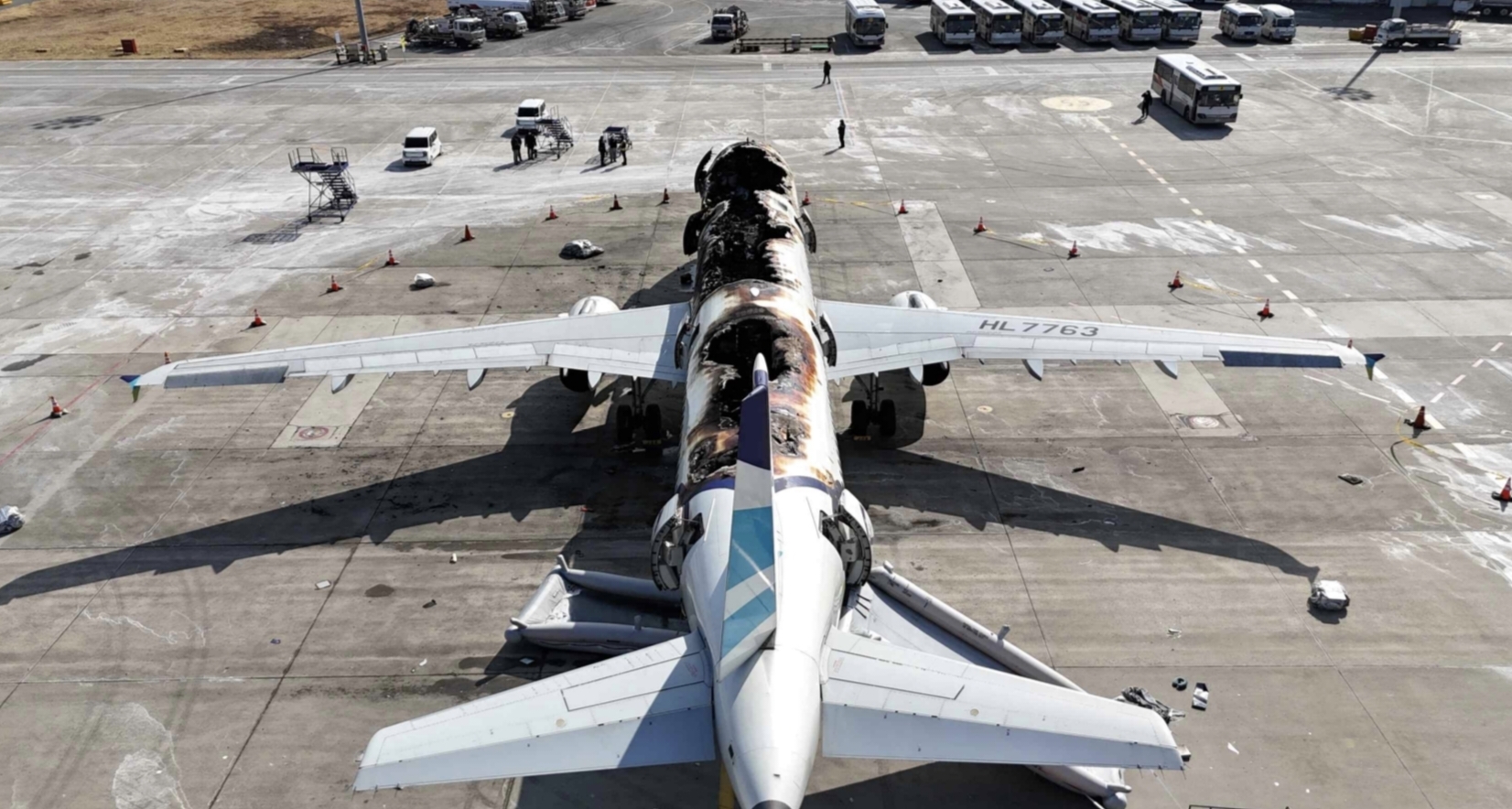
The subject of devices with lithium batteries and commercial aircraft is a serious one. According to the UL Standards & Engagement, statistics from 2024 suggest that there are, on average, two battery thermal runaway events reported onboard a commercial aircraft each week. According to ABC 7 News Amarillo, that represents an increase of 388 percent since 2015.
Fires, in general, can quickly impact the safety of a flight. According to the UK Civil Aviation Authority, on average, flight crews have only 19 minutes to get an aircraft on the ground before an uncontrolled fire becomes non-survivable. Pilots, regardless of whether their steed is a tiny Cessna 172 like the one I fly, or a gargantuan Airbus A380, treat fires with the utmost importance. There are checklists to follow and actions you’re expected to follow through with.
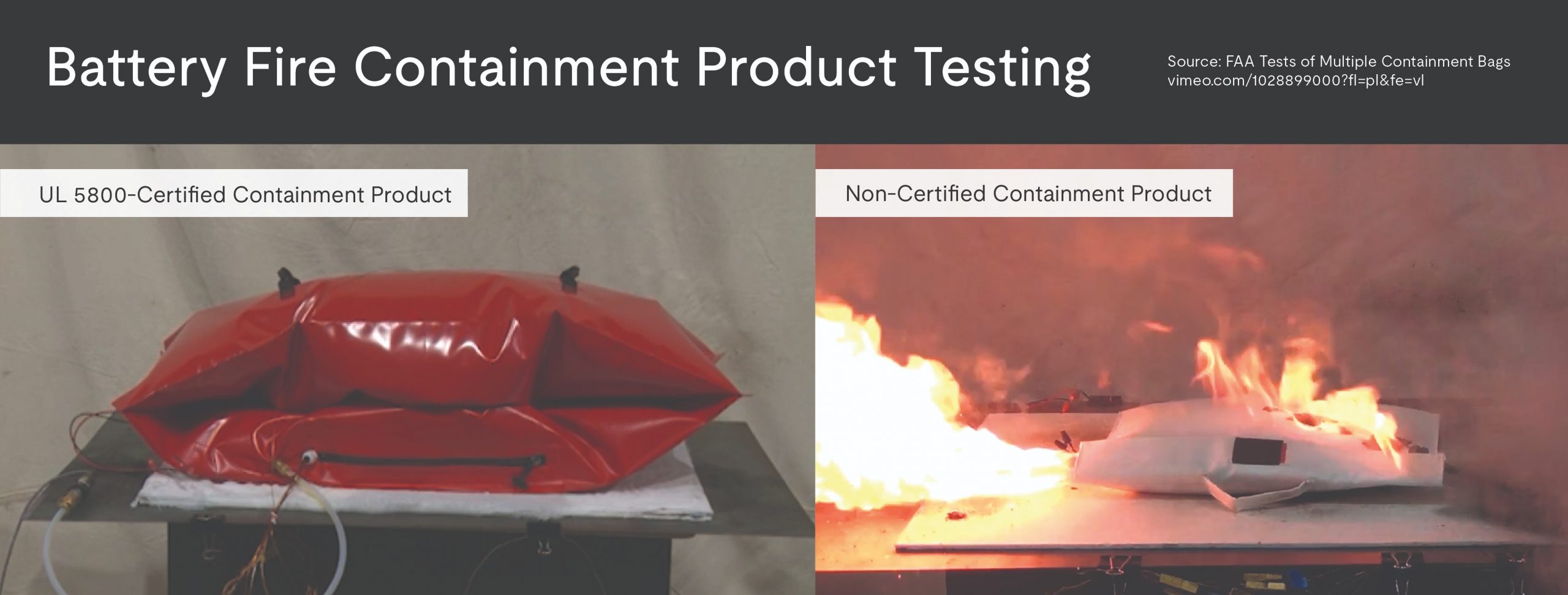
Thankfully, the airline industry is remarkably safe, and while phone batteries, power banks, and vapes going poof is a concern, the trained flight crews aboard these planes have tools to extinguish these fires and get the aircraft on the ground as soon as possible. These crews will extinguish flames from the battery and then place the device into a fire containment bag or a metal trashcan that’s filled with water. Even in one of the worst battery fire incidents in recent memory, Air Busan Flight 391 from January 28, 2025, everyone got off the plane alive, though the plane itself was a total loss. That’s how amazingly safe aviation is.
Unfortunately, the crews can only take control of a situation involving a lithium battery when they have access to that battery. So, if a passenger manages to drop a device into a place that cannot be reached, it’s logical to divert that flight even though the device is most likely just fine. If that device were to get crushed, overheated, or otherwise harmed, pilots don’t want to have a fire burning in a place that can’t be accessed. So, flight crews err on the side of safety and get on the ground.
This is where recent events aboard three United Airlines flights come in.
Passengers Keep Losing Their Laptops In A Weird Place

On Wednesday, October 15, 2025, United Airlines flight UA126, which was operated by Boeing 767-400ER, registration N76054, attempted to fly from Washington Dulles to Rome Fiumicino. The flight took off normally at 10:22 pm, and then, less than an hour into the flight and while on a climb to 31,000 feet, the pilots radioed to air traffic control about a weird problem. Somehow, a passenger was using their laptop, dropped it, and the laptop inexplicably disappeared under the cabin floor.
The ATC audio from that flight is embedded below, where even the pilot on the call seems to express some amazement at what happened:
The ATC also expressed their bewilderment, saying “[T]hat’s a new debrief story, I’ve never heard anything like that before.”
The aircraft landed at Washington Dulles at 12:35 pm, aircraft maintenance removed the laptop, and then the flight took off around three hours later, landing in Rome at 5:26 pm without incident. At the time, I reached out to United Airlines, asking about how this could have happened. The airline never returned my requests for comment. Not even aviation blogs could explain exactly what happened at the time.

Then, it happened again. On November 19, 2025, United Airlines flight UA925, another flight that was operated by a Boeing 767 widebody, had to be diverted because of a laptop somehow falling into a void just above, but not in the cargo hold. That aircraft departed London Heathrow bound for Washington Dulles, but had to divert to Dublin Airport. The aircraft spent a few hours on the ground in Dublin before it was cleared to fly to Washington.
Now, it’s happened for a third time. United Airlines flight UA748 played out just like the other two flights. A transatlantic flight being flown by a Boeing 767 took off without an issue. Then, a passenger in United Polaris Business Class dropped their laptop into a crack between their seat and the wall panel. That laptop then disappeared into the crack, rendering it inaccessible to anyone on the aircraft. Just like in every other instance, the flight diverted, this time to Newark Liberty International Airport, so the laptop could be safely removed.
But how is this happening? How are people in the passenger cabin somehow losing laptops into the area below the passenger cabin?
The Shadow Realm Laptops Disappear Into

We finally have some clarity about how these events happen. The United Polaris Business Class cabin on a Boeing 767 has a weird quirk. There is a small gap between the seat and the sidewall of the aircraft interior. In that gap sits a vent designed to equalize the pressure between the passenger cabin and a cargo hold. This gap is filled with a piece of foam, while the vent has a grate on it. Apparently, some passengers have been using the piece of foam as a place to stow their laptops.
Unfortunately, as at least three passengers have now found out the hard way, it’s possible for a laptop to slip past the foam. Then, if the vent’s grate is not installed or is otherwise knocked out of the way, the laptop can slide into a sort of pit that sits between the cabin floor and a cargo hold. Here’s what the bottom portion of a Polaris seat looks like on a Boeing 767:
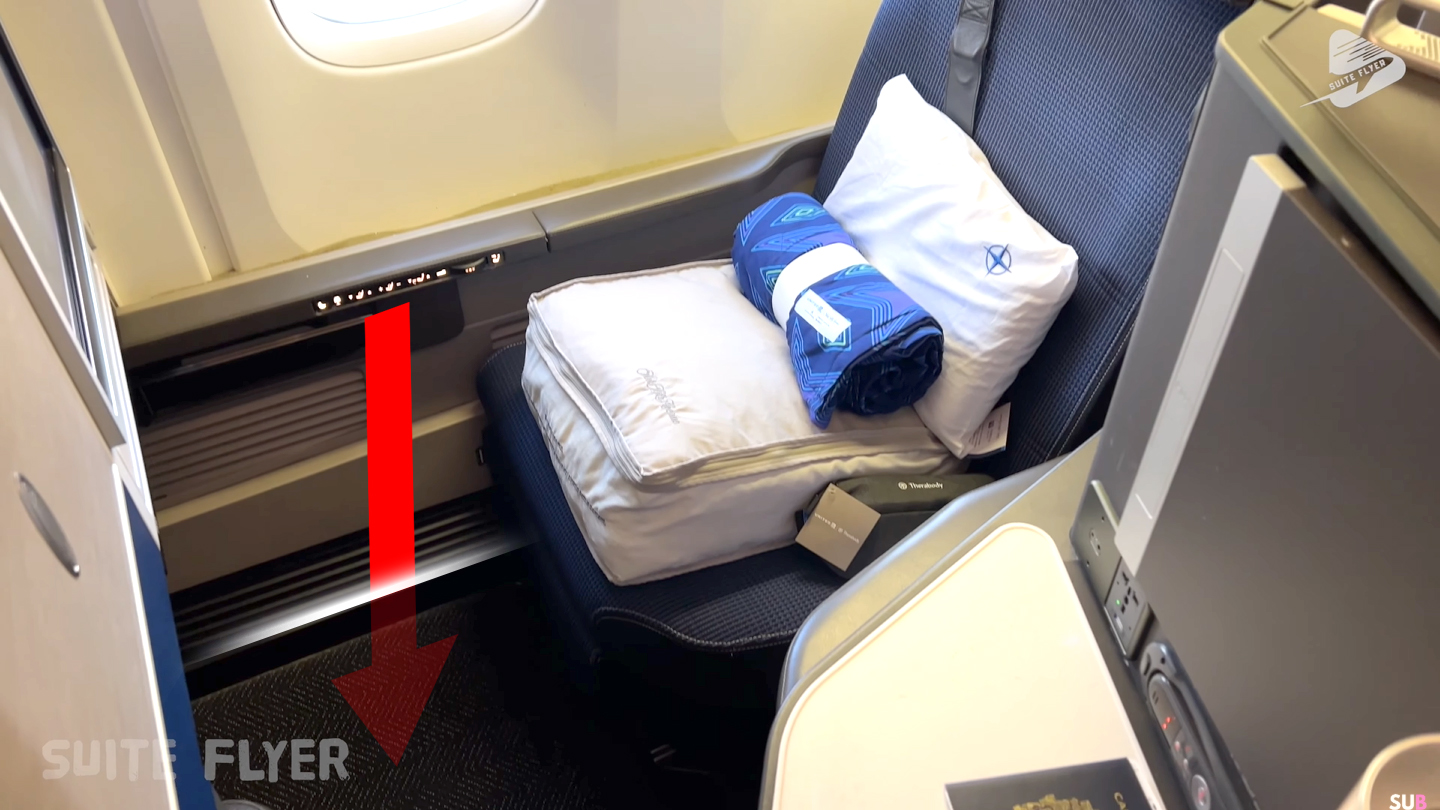
This is a problem because this area is not accessible to the crew, and as the pilot noted in the ATC call from the October incident, the area is not covered by fire suppression equipment. If the laptop were to get crushed or overheated, the crew can’t reach the battery.
Depending on the aircraft type and where the device got stuck, the device might require the aircraft maintenance crew to remove seats and possibly even a wall panel to get to the lost device. Thankfully, as I noted above, the retrieval process and the inspection afterwards usually take only a few hours, so this is a cause for a delay rather than a full flight cancellation, but it’s still an involved and expensive process for the airline. This video tours the tiny sort of studio that you get on United Polaris Business Class on a Boeing 767:
Because of this, United flight crews have reportedly been asking Polaris Business Class passengers to refrain from using the foam blocks beside their seats as shelves.
What’s also interesting is that these three incidents may not be the first time this has happened. United Airlines customers on Reddit claim there have been times in the past when this has happened, and that does make sense. The Polaris interiors have been around for a while. United isn’t alone here. Last year, an Air France Boeing 777 had to divert when a passenger dropped their phone, and it couldn’t be found anywhere in the passenger cabin.
Sadly, even after three of these events happening, we don’t have images of what the side of the Polaris seat or what the pit under the cabin floor looks like.
Flying Remains One Of The Safest Way To Get Around

It’s unclear what United may end up doing to reduce the occurrence of this issue. The good news is that, again, this sort of event is incredibly rare and is unlikely to be anything more than an inconvenience.
There are roughly 45,000 flights per day in America, and in these recent months, only one United flight in October, November, and January had a reported issue with a device falling into an inaccessible crevice. Even the statistic of two battery thermal runaway events a week makes these incidents rather rare compared to the sheer number of flights every single day. That’s great! It’s just another example of how safe flying is, and a great example of how seriously issues are taken in commercial aviation, even if the incident rate is low.
But the next time you’re flying on any aircraft from any airline, think twice before setting your laptop down, make sure it’s not going to get crushed by your seat, or possibly fall into a crack. If anything, you don’t want to be the person to delay a flight for hours. Otherwise, don’t be afraid to thank your flight crews; they’re a huge reason why flying commercial remains one of the safest ways to travel!
Top graphic image: Acroterion – CC BY-SA 4.0


Oof. Bad cabin design there! If it looks like you might be able to store stuff there people are going to try it. I’ve found that even new premium cabins (from my limited but non-zero experience) tend to really forget that a large percentage of people have laptops and might want to have them accessible right after take off, not only when they are allowed to get into the overhead bins. One thing typically lost with these “lie flat” seats is any sort of meaningful “under the seat” storage so it’s very common to just find a spot to tuck your laptop or small carryon even though it says “no carry on storage” or “shoes and bedding only” in that cubby.
Anyway, related but less extreme anecdote: back in 2019 my parents flew in a biz class for a milestone anniversary vacation and my dad lost his phone between the seat and its shell, crushed it pretty good playing with the recline, but was able to retrive it and the cabin crew determined the battery hadn’t been punctured or anything so didn’t have to turn the flight around or anything fortunately!
This problem can best be represented by two songs:
‘Into the Unknown’ and ‘She’s a Little Runaway’
I’ve seen the MacBook air and other ultraslim slippery laptops fall and break in such strange ways. They have gotten so thin and slippery I’m not surprised especially they way plane interiors are installed. People loose things in them all the time some of untied and sw 737 I’ve seen huge panel gaps low heard FA talk about how things end up in there. Laptop battery just too big of a risk. It’s probably normal just an airline claim for a lost item if it has some value or out of luck.
I dropped my glasses on a flight recently due to the tight spaces between the seats we nearly needed a gymnast to retrieve them, the flight attendants said to leave the flight and then contact them in 24 hours, I pointed out that would not work as I had a connector and am nearly blind without them ( I do travel with a spare ) was able to get a kid a couple of rows back to get them no thanks to the crew
This is just proof that flying is unnatural and we should stick to stuff from “the good old days” like horses and sailboats!!!
/jk
You do NOT want to drop your laptop into the bilge, or into whatever the horse equivalent may be.
First class problems
Yes, I’ve been flying United, usually window, and I’ve never seen this gap. Haven’t flown Polaris in some time though.
In a warped case of universal serendipity, “Into the Void” was playing in my office when I came across this article.
https://www.youtube.com/watch?v=xx6IwshTL6M
I am curious how Airbus, Embraer and Bombardier handle the pressurization equalization needs. It also seems a bit ironic that travelers in one the less cramped sections of the cabin are the ones who can’t figure a safe place to stow their laptops.
There have to be a lot of better ideas than big gaps between the seats and the cabin walls, that are only covered with a grate and/or foam. Any gap you give people in mass transit will soon be filled with random items.
Those vents aren’t open during normal operation, they are for decompression events only to prevent the cabin floor from collapsing. They’re standard on pretty much all airliners, and you’ll see the design on Airbus, Embraer, bombardier, etc.
Panel gaps big enough to swallow a laptop? And people complain about Teslas…
I want to blame the designers, I really do, but as St. Douglas Adams famously remarked, a common mistake that people make when trying to design something completely foolproof is to underestimate the ingenuity of complete fools.
That said, the design isn’t all that “grate” either.
If you idiot proof something, it works until they build a better idiot.
I maintain that the majority of the blame for this is on the people who designed the cabin and seats. People need a place to put their laptops where they aren’t vulnerable to spills and are out of the way. The cabin designers should have anticipated this.
My wife and I had something similar happen to us on a Lufthansa flight from Denver to Barcelona. We were flying business class on some sort of giant Airbus. The seats were side-by-side but very roomy. They had numerous video demonstrations about how you weren’t supposed to stuff your phone or tablet down inside the seats – well duh, of course we wouldn’t do that!
So we get airborne and we’re getting all settled in. Let’s see, where are the outlets for the phone charging cables? Oh, here they are, underneath the armrest. Oh, and look, there’s a nice flat little shelf on which to place your phone while it’s charging – how thoughtful! So we plug our phones in and place them on these handy little shelves. Later on, after dinner, we decide to get some shut-eye, so we lean our seats back and voila! The phones immediately fall off the shelves and down under the seats. I was able to reach mine, but my wife’s phone was too far down so we called the flight attendants. They had to literally dismantle her seat in order to retrieve the phone and they lectured us about how we shouldn’t have put the phones there in the first place.
That’s just poor design. If you don’t want people to put their phones in a specific location, don’t put the charging port and a seemingly designed for the purpose shelf in that location!
This is a three part problem:
Re: safer battery tech this is an oldie but goodie: https://xkcd.com/651/
(The mouse-over text points out that a laptop battery contains approximately the same amount of stored energy as a hand grenade.)
If it’s Boeing I’m not going.
McDonnel did a number on Boeing. From a very successful company to the garbage operation it is today.
Fair, but the 757 and 767 were developed long before the merger and are excellent aircraft.
In fairness, this seems to be more of an interior design problem than a Boeing problem. I have no problem flying any commercial airliner. I’m pretty sure I have a greater chance of crashing the Cessna!
IDK, looking at that video there seems to be lots of places to put a laptop than down some random nook (or is it a cranny?). This falls firmly into “unforeseeable misuse”. That is from a design and safety standpoint the evaluation never imagined a passenger would be so lazy (or malicious) as to drop the laptop in this location.
The void, she hungers
For laptops!
Something similar haul happened a few hours into a 13 hour international flight right in front of me. Except it was a phone.
She was being extremely rude to her traveling party pretty much the entire flight to until then so I guess she kinda had it coming lol.
What a stupid seat design.
Clearly this is now an issue, so a redesign ought to be looked at.
I work in the aircraft biz, with many years in interiors. The FAR’s have a concept of “ease of search” rule where it should be impossible to hide something behind a panel, especially the size of a laptop.
This is a certification requirement. If this issue has not yet been resolved, I question the FAA, again.
I have had projects stopped dead in their tracks due to an “ease of search” failure.
Here is the regulation for the curious: https://www.ecfr.gov/current/title-14/part-25/section-25.795#p-25.795(c)(3)
It should be the universal standard, but in my experience there’s a lot of sub-par STC house interior designs that somehow are getting a pass on this. Not sure if they’re just shopping for the right DER/CVE or what, but there’s a huge difference in ease of search/design for security standards even for the same airline. First example that jumps to mind is British Airways 777 vs 787 biz class interiors. Same seats and cabin design, but the 777 is a STC mod and has the crappy grey foam seals on the sidewalls with all of the huge voids talked about in the article whereas the 787s are an OEM mod with nicely contoured bulb seals.
This sounds like a maintenance issue. There should be a grate installed that makes it impossible for a laptop to slip into this void, but it appears that it is frequently not installed or displaced.
I question whether the installation of the grate is missed because it isn’t visible to a visual inspection, and the inspection procedures do not currently mandate checking it after maintenance. More concerningly, it may be that the grates are intentionally not installed to save maintenance time and improve availability. Given that this happens a lot on the high-utilization and relatively old UA 767 transatlantic fleet…
Cool, thanks for sharing…”Least risk bomb location. An airplane must be designed with a designated location where a bomb or other explosive device could be placed to best protect flight-critical structures and systems from damage in the case of detonation.” I would have never guessed this was a thing!
How about tossing it out the window?
As an outsider it does seem bizarre that it’s acceptable for such a place to exist at all.
Ha, a lil’ bit of spray foam insulation ought to do the trick in fixing the gap problem à la Crosscabs https://www.theautopian.com/this-picture-of-a-nissan-crosscab-repaired-with-spray-foam-insulation-is-a-terrifying-warning/
I jest, obviously, but it’s as good a time as any for a PSA: spray foam insulation is combustible AF even when cured.
Last year (or was it two years ago??) during that massive polar vortex my clothes dryer stopped working & when I repaired it I figured that while I had the dryer out I might as well use some spray foam insulation to seal around the vent going outside. Then I read the fine print which was tiny at old-Guinness-book-of-world-records-levels on the spray can & noted the warnings about exposure to open flames and the disconcertingly low maximum temperatures recommended (between 180 and 240 degrees Fahrenheit, IIRC) so I went outside with a nickel-sized bit of completely cured spray foam to test with a lighter. Yeah, it immediately went POOOOF in a small but impressive fireball.
So, not wanting to take any chances with my clothes dryer, even though it’s electric and not gas-fired, I went and scraped out every last bit of spray foam insulation which was not fun on a single-digit-temperature (Fahrenheit!) day though I at least did have some nice apricity thanks to the sun being out in full force. Then I acquired an insulated vent hose assembly and installed that so Robert was your parent’s sibling.
Since then, I’ve avoided using spray foam insulation in any applications that might even be adjacent to the aforementioned temperature ranges as well as open flames.
Yeah, the more you know…
I didn’t realize it was particularly flammable, but that’s good to know!
It also explains why they make a specific kind to seal gaps between floors in houses to close the path to fires. I figured it was just more resistant to fire. The red color obviously helps inspectors see it’s the right kind but that’s apparently more critical than I thought.
I did the same thing as you a few years ago. But I didn’t read the fine print…welp guess I got myself a project for this long weekend.
Yeah, welcome to the club and hope all goes well!!
I used a variety of methods starting with pulling the biggest chunks off with my hands and then using various wood/plastic paint scraping tools and brass-bristle wire brushes (since the wall was cinder block and brick so steel scrapers and steel-bristle wire brushes kept sparking, egad, and some of the foam wasn’t completely cured so even more volatile…)
Oof good to know, the prior owner(s) of our house were far too handy with spray foam, including I believe sealing our dryer vent hose 😐
> apricity
You learned me a word. Thanks!
> Robert was your parent’s sibling.
Thanks for not letting me the only person using that silly phrase.
De nada! 🙂
It’s funny because I’d used that silly phrase numerous times in the past and then recently within a short period of time a YouTuber (Blondihacks, a Canadian machinist who has a great and highly entertaining and informative YT channel) and Jason Torchinsky himself here used the same phrase which was indeed kind of gratifying, lol. Yeah, a case of either convergent evolution or GMTA…
A former colleague used to say “great minds think like mine,” which is pretty funny. He was an arrogant self-important twat, though, and I’m not certain he was being facetious.
Dammit Mercedes, stop posting plane bait for me! So fun fact, I’ve personally had to re-engineer this exact stupid feature on multiple airplanes. A few points:
The void laptops keep falling into is not a cargo area, it’s just an inaccessible gap between the outer shell of the seat pod and the sidewall of the aircraft. The cargo area on the plane is sealed to ensure smoke can’t get out to the cabin in the event of a fire, and to let the halon fire suppression system work properly.
If a laptop did fall into the void and catch fire, it would be unpleasant to the passengers and maybe cause some issues with those with respiratory issues, but wouldn’t crash the plane. Everything used in the cabin is both fireproof and self-extinguishing, and rated for far worse fires than you can get out of a single laptop. Also, the pilots have their own independent oxygen supply that lasts for hours, so they would be fine to land the plane.
This issue is the direct result of a difference in rigor between STC (supplemental type certificate) mod houses, and OEM (ie Airbus, Boeing, Embraer) level engineering. When an airline is looking to upgrade/redesign their interiors, they can either go with an external STC house, which is usually faster and cheaper, but not as detailed and can lead to substantial issues down the line like your article details, or they can have the OEM do it properly for what is usually a lot more money, and slightly more time. The use of a simple foam seal to block off the gap is a quick and easy solution, but leads to the lost laptop phenomenon, especially as the foam ages and deteriorates. The proper way to close out this gap is with a bulb seal mounted on a metal seal retainer putting the bulb into compression. Done right, with a seal that matches the sidewall contour (which is data the OEM has but an STC house might not) it’s pretty much impossible to get anything into the gap, even a knife blade. I happen to know for a fact that both Airbus and Boeing will not sign off on a foam seal being acceptable for installations like this, for exactly the issues mentioned, but STC houses generally aren’t held to the same standard despite the fact that they are supposed to be under both FAA and EASA rules.
Side tangent: this gap lead to one of my favorite work moments- not only is the gap an issue for fires, it’s also an issue for security because someone could stash a bomb or weapon there and it wouldn’t be easily detectable. We were working on installing a new airliner interior in a certain state known for it’s cowboy attitudes, and this gap issue came up. Some management types were in favor of the ghetto foam seal fix, while the engineers on-site felt differently. The engineer who actually had to sign for the FAA certification package proved his point running to his truck parked just outside of the hangar, coming back with a full duffel bag, and telling us to look the other way for 30 seconds. Then he asked management how many hijackers did they think he could arm just with the contents of the sidewall gap that he had half a minute of unsupervised access to. Four Glocks and two AR-15s later the message got across.
I don’t care if it’s too long to quote. COTD
I love how all of our readers are experts in something! Looks like a miscommunication happened in editing. It’s been reported that the laptops fell into the cargo hold, but it’s my understanding that it’s a void between the cabin and the hold that isn’t easily accessible. I’ll add a clarification there.
Also, should we ever get around to posting COTDs again (I think the post scheduler keeps forgetting), you’ll be featured in it! 🙂
This is peak Autopian commentary. Thanks for the insight.
That is an excellent story! I love hearing insider stuff like that.
In regards to your third paragraph saying a laptop fire probably wouldn’t be that bad for the passengers, can you offer insight into how the incident pictured in the article of the burned-out cabin happened? That still looks pretty scary to me…
That particular incident was allegedly caused by a power bank battery going up in flames inside of an overhead bin.
The investigation is still ongoing, so disclaimer: this is pure, uninformed speculation with no basis in anything other than 5 minutes of googling. But my best guess would be burning power bank in the overhead compartment ignites all of the other luggage around it, and basically burns up the length of the aircraft like a fuse. Regulations only apply to equipment installed in the aircraft, luggage is plenty flammable.
“The engineer who actually had to sign for the FAA certification package proved his point running to his truck parked just outside of the hangar, coming back with a full duffel bag, and telling us to look the other way for 30 seconds. Four Glocks and two AR-15s later the message got across.”
I love this story! I guess my two questions regarding this were, A-you can drive onto a federal facility with all that, and B-someone carries all that in their truck on a regular basis?
In Texas, they call that “everyday carry”
A- Not a federal facility, privately owned maintenance hangar adjacent to an airport. Not even a security gate as it wasn’t connected to the terminal.
B- that was just the stuff that he could fit in the void, didn’t include the shotguns or hunting rifles.
Brilliant! I love this level of nerdom. Congrats, uncle Wuffles Cookie!
This right here is exactly why this is the best comment section on the internet.
Is this, like the unintended accelleration cases, unique to Boeing and not happening on Airbus or CRJs?
Or is this a United problem, with the fitting of their fancy Polaris-class seating pods?
i thought they mentioned an air france flight too.
Air France was just a phone, not a laptop.
You can blame Boeing for many things, but not this. They supply the airframe. The interior is up to the airline (using certified suppliers and installers of course). There are some other airlines using the same business class seats. Wonder how they dealt with the void.
This is why I only travel with a Compaq Portable. That bastard’s not going anywhere.
I keep a tower in my carry on. CRT monitor is my Personal Item.
Aahh, the good ole suitcase PC. That’s what got me through college so many years ago.
You joke (maybe?) but I did a year abroad graduate program with a guy who really did bring a gaming PC in a suitcase.
He did not finish the program.
The Compaq “suitcase” portable PC was definitely not joke. Before LCD screens were commonly used for laptops, Compaq’s portable PC was about the only choice for an all-in-one portable PC. But it was in no way, shape, or form a laptop, unless maybe if you are the size of Andre the Giant. It was literally the size of check-in luggage.
I was in college in the eighties, so this was easier to move in/out of dorms than a full-fledged desktop. LCD laptops may have been available then, but their prices were way out of my budget.
O wow. I had no idea this was a thing. Also, wikipedia says it cost the equivalent of $9,400. I can’t imagine what a “real” laptop would have been.
Once in Hollywood/Studio City I saw a guy at a Starbucks with a PC tower, monitor, full-sized keyboard, and mouse jerry-rigged onto a shopping handcart, typing away. Probably a screenwriter.
I keep a pool noodle or a piece of pipe wrap between the seat and the console of my car. It would be an easy fix except for the certification,
Is it all laptops, no tablets or anything? Are that many airline passengers trying to convince others that they’re writers??
Do coffee shops ever have a similar problem, laptops getting lodged in the HVAC vents or something?
Some folks claim to have lost their phones in the void. But, apparently, these last three instances involved laptops!
I imagine phones are light enough that they wouldn’t fall through the foam as easily.
The phones are a whole different issue since these motorized flatbeds could easily chomp through them (and their batteries). Hence all the warnings about how if you lose your phone in the seat, do nothing other than call an FA.
It’s business class so it just makes sense that people would be using laptops for, you know, work, that is, business, and not for posing as writers…
They’re useful, you can write letters and make graphs and flow charts. Also, if you have a modem, you can plug it into the telephone jack at the hotel and acess sports scores and stock quotes
Access sports scores, stock quotes AND spread disinformation to millions of unsuspecting fellow citizens!
Lol, I find it delightfully bizarre that your mind goes to “pretend writers” and not “corporate middle management.”
I travel first class when I can afford it,which is surprisingly often given the time- and money-saving perks, and write code during flights (and in the lounge, which also saves me $40 on food and drink). It’s a complete non-starter in standard.
Some first-class passengers actually do cool stuff for a living!
There’s an abundance of flat space to put a laptop in that seat and yet we are going with wedging it between wall panels as the logical location? It’s no wonder is both irregular and not something designers thought of.
I would think that the old “if there is a hole, some guy will try and put something inappropriate into that hole” would apply.
Some biz class seats have a nice pocket right in that spot that’s designed to hold things like literature or a laptop (although, can’t leave it there for takeoff or landing.) So I’m not surprised folks who are maybe used to flying in J a bunch put stuff there without thinking.
Especially on United Polaris, they tend to have two pillows, a duvet and an amenity kit at your seat at boarding. Add a backpack and jacket and it takes quite a bit of juggling to get everything settled. I can fully understand someone placing a laptop against the sidewall of the plane on what seems like it should be a solid out of the way ledge.
That’s a failure of imagination. Millions (tens of millions?) of passengers are going to sit in these seats. They are designed to survive bizarre behavior (standing on the armrests, etc).