


The logistics companies of the world are always looking for a quicker, more efficient way to move cargo around the planet. Armadas of cargo ships, trains, freighter aircraft, semi-trucks, delivery trucks, and cargo vans work in a delicate dance to keep the world of trade and commerce moving. But what if there were an even better option? One company thinks the future of cargo movement is not any of the vehicles that are currently out there, but a giant airship. The Aeros Aeroscraft is a humongous airship measuring at least 555 feet in length with a cargo hold roughly twice the size of that of a Boeing 747-800. Its mission? Work as a gigantic flying warehouse that floats over Los Angeles. Yes, this thing is serious.
As far as inventor Igor Pasternak is concerned, the world of transportation is due for a change. In his eyes, planes pollute the planet and require long runways, semi-trucks clog up the roads, ocean-going vessels are slow, and shipping in itself could be much faster. All forms of transportation, Pasternak says on his website, are confined by something, be it roads, ports, terminals, traffic, rails, or airports.


To Igor Pasternak, the solution to these problems is a vehicle that doesn’t need a runway, isn’t tethered to a rail, doesn’t have to follow a road, and doesn’t require complex infrastructure. His idea calls for a giant airship as the solution to modern logistics. These airships, which Pasternak is calling Aeroscraft, are supposed to be used to deliver humanitarian relief, wind turbines, and, oh yeah, Pasternak sees one that could be used to hover over Los Angeles to function as a floating warehouse. Pasternak says he plans on testing this concept later this year.
Three Decades Of Airships
Normally, crazy ideas like these are the work of startup companies founded by ambitious dreamers. Los Angeles-based Worldwide Aeros Corporation has actually been around for 30 years and produces airships right now. But, Aeros founder Igor Pasternak is trying to cook up something much bigger than any mere airship.
Pasternak provides this story on Aeros’ website:
In 1987, in the city of Lviv, Ukraine, a team of engineers began researching and developing the concept of a heavy-lift airship. Aeros emerged as the first private aerospace and engineering company permitted under Gorbachev’s Perestroika reforms. It designed and produced aerostat systems for advertising and industrial applications.
In 1995, Aeros designed and manufactured its first airship – the Aeros 50 – in California, and began the sales of airship models Aeros 50 and Aeros 40A for advertising and broadcasting applications.
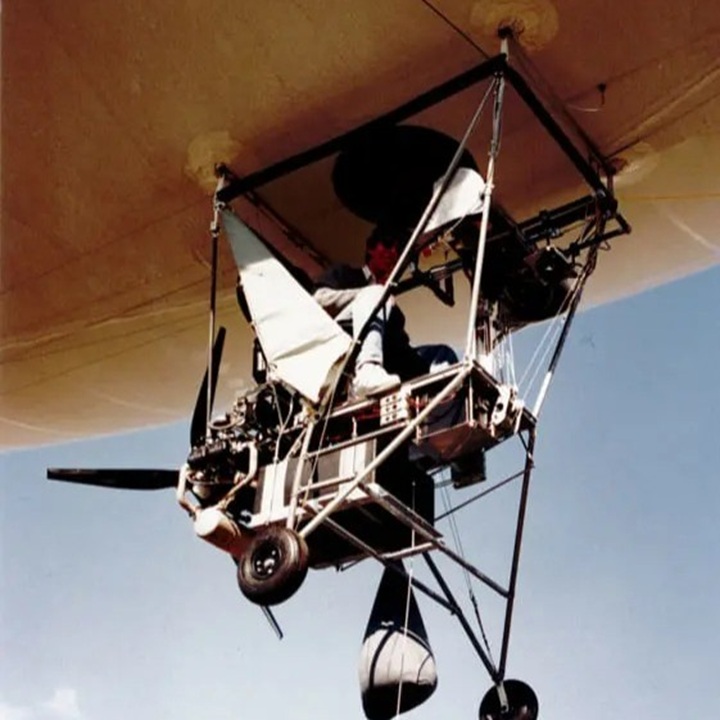
One of the biggest milestones noted by Aeros was the launch of its 40B ‘Sky Dragon’ airship, which was certified by the Federal Aviation Administration in 2000. The 40B also received certification in Europe, and Aeros says it sold the airships all over the world. The company says that the 40B ‘Sky Dragon’ is important because it was the first airship with a fly-by-wire system and an automated pressure management system.
Along with airships, Aeros has produced tethered balloons, the latter of which was found to be appealing to the United States military. Aeros provided 25 tethered balloons and airships to the military for surveillance use during the Afghanistan and Iraq campaigns in the 2000s.
The current airship sold by Aeros is the 40E ‘Sky Dragon’, which entered production in 2014. The Sky Dragon is a non-rigid design with an envelope containing 113,000 cubic feet of volume and a gondola with seating for a pilot plus six passengers. Power comes from a pair of Lycoming AEIO-320-D 5.2-liter air-cooled flat fours good for 160 HP each. Like Goodyear’s blimps, the Aeros Sky Dragon has thrust vectoring for improved maneuverability.
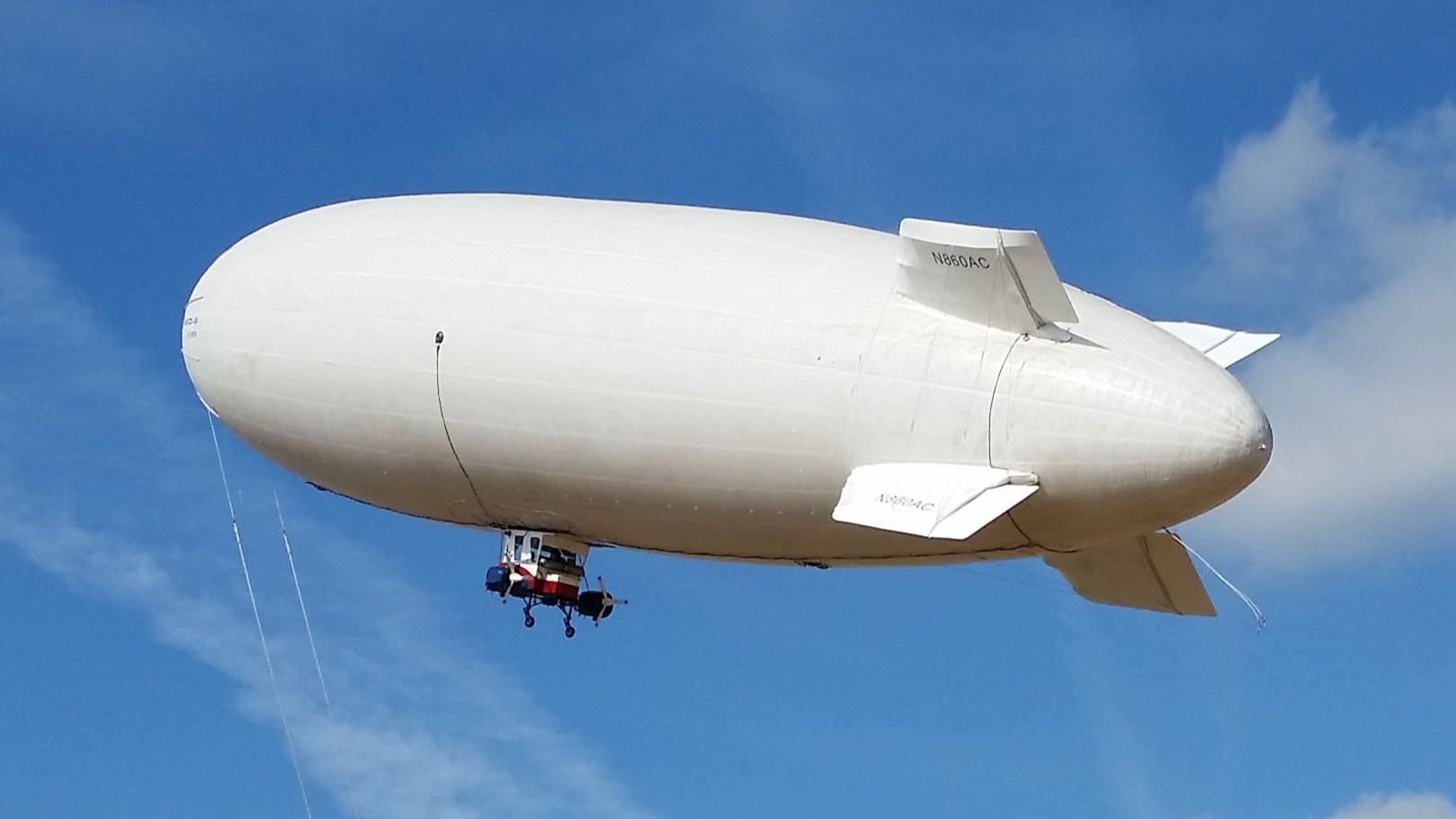
What’s interesting is that the Sky Dragon is not advertised as being for commercial or marketing purposes, which is how Goodyear uses its blimps. Instead, the Sky Dragon is pitched as a “game-changing” and “liberating” airship for maritime patrol, port security, border security, surveillance, and intelligence.
According to The New Yorker, this marketing was intentional. Aeros originally pitched its blimps for advertising use, and then the September 11, 2001 attacks happened. The aftermath of the attacks pushed Pasternak to use his blimps for surveillance rather than advertising. Reportedly, Aeros has built at least nine of these blimps since 2014, so they are real and are being flown around.
The main project of Aeros is far more ambitious.
Heavy Lift Airships

Early in the life of Aeros, Igor Pasternak embarked on a project to more or less reinvent the airship.
A typical airship is loaded up with so much helium that it weighs less than air. One primary reason why these airships don’t just float away has a lot to do with ballast. As I explained in my Goodyear Blimp story, airship operators will weigh their craft down with heavy blocks of material or water. The weight of fuel and passengers also counts as ballast. Operators can add ballast or release lifting gases to reduce buoyancy, and drop ballast to increase buoyancy. Airships are then operated at slightly heavier than air.
Pasternak’s patented idea eliminates the concept of ballast entirely. He calls it the variable buoyancy airship, or more specifically, the Aeroscraft. Here’s how it works, from Aeros:
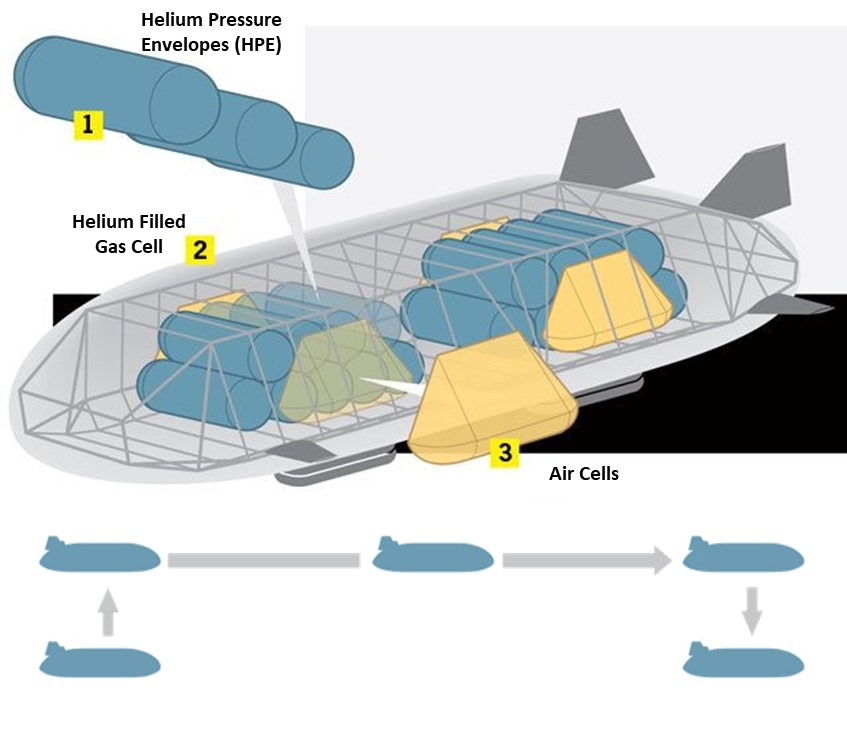
The Control-Of-Static-Heaviness (COSH) system compresses non-flammable helium into the helium pressure envelopes to allow the vehicle to manage buoyant lift similar to the submarine’s ballast management underwater. COSH allows the Aeroscraft to act as a “flying submarine.”
– The biggest obstacle that airships face when tackling the cargo function is their inability to control buoyancy. The requirement for ballast exchange, ground infrastructure, and need for runways significantly limited the usefulness of traditional airships for cargo applications.
– The COSH technology eliminates these requirements and the Aeroscraft is the only airship with hover capabilities making it possible to offload at unimproved landing sites with minimal infrastructure.
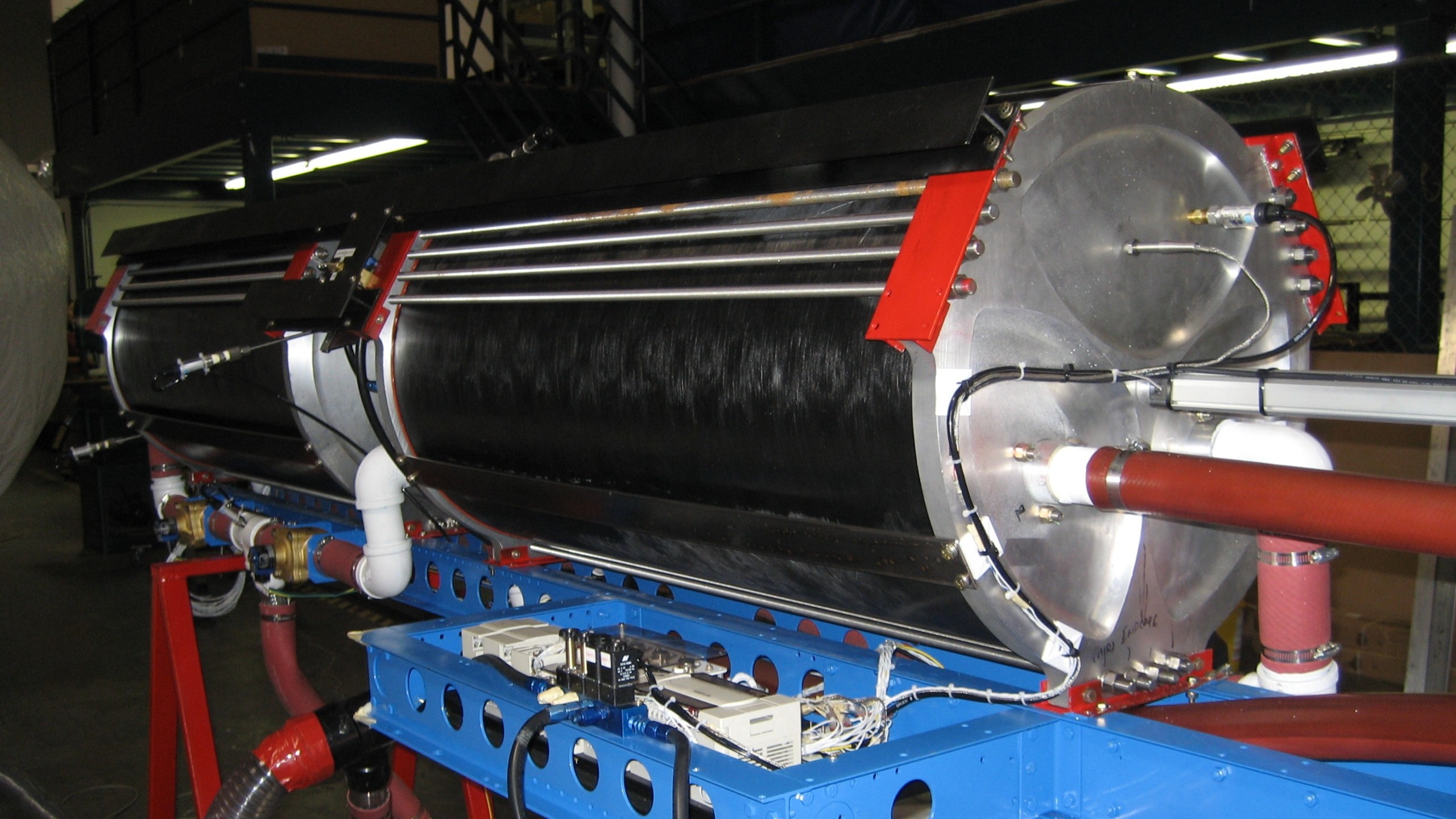
Aeros doesn’t exactly make this clear, but by compressing helium into pressure vessels, the Aeros COSH system increases the density of the gas, therefore making it weigh heavier than air. This has the same effect of adding ballast, but without actually adding ballast.
This technology is wrapped into a rigid airship frame, which means that the shape of the airship is held by an internal superstructure rather than the envelope. From Aeros:
The Aeroscraft has a rigid design and is not dependent on gas pressure made from advanced composite materials, a carbon-fiber geodesic space frame. reduction of the weight without the loss of strength; reduced manufacturing and operation cost, high damage tolerance, and drag reduction.
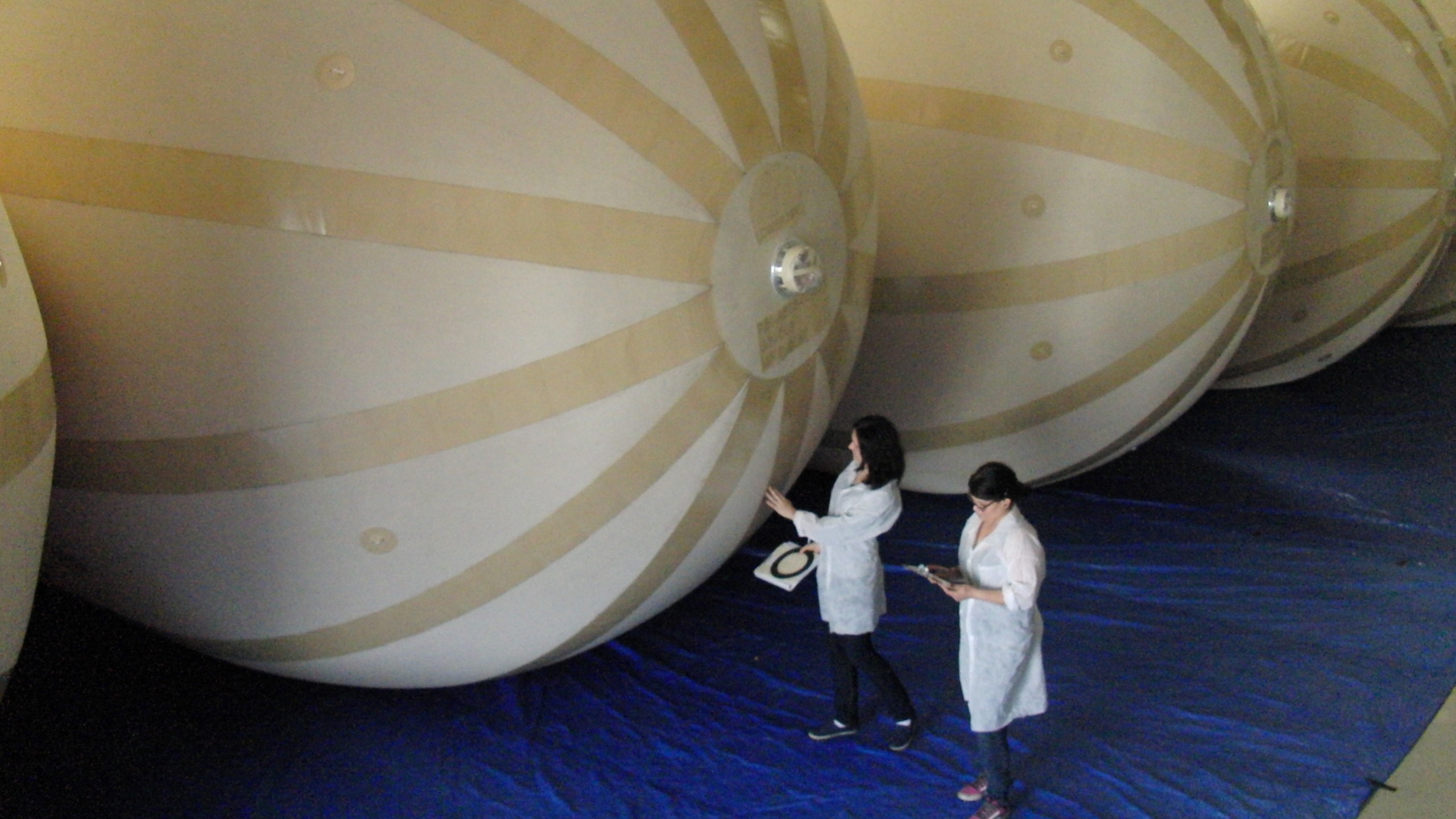
In 2005, Aeros and Lockheed Martin were contracted by the Defense Advanced Research Projects Agency (DARPA) for Project Walrus, which sought to develop a wild heavy-lift hybrid airship capable of traveling 12,000 nautical miles while carrying up to 1,000 tons of cargo. Aeros was granted a $3,267,000 contract under Phase 1 of the project, and in 2006, demonstrated that its COSH concept actually worked in a ground-based test. The project would lose most of its funding that year, but the military was still interested in what Aeros was working on. In 2008, Aeros attached a prototype COSH system to a Sky Dragon blimp and successfully demonstrated COSH in flight.
Before I continue, concept imagery for Project Walrus is just as silly as you’d expect.

Part of the reason why airships fell out of favor with the military in the mid-20th century was that they were so huge and so slow compared to jet aircraft. It’s unclear how an airship from Project Walrus, which would have been so huge it would have been able to swallow Lockheed C-130 Hercules aircraft, would have solved that problem.
Anyway, the Pentagon was so impressed with the tech demonstrated by Aeros that, even though Project Walrus was cancelled in 2010, the U.S. government still pumped money into Aeros. As Aviation Week reported in 2012, in 2010, Aeros pitched what was more or less the Aeroscraft to the Defense Department. Aeros said that it would build a demonstrator and that, in theory, the airship could be quickly evolved into an airship capable of carrying the same payload that a Boeing C-17 Globemaster can carry, but do so with VTOL capability and variable buoyancy.
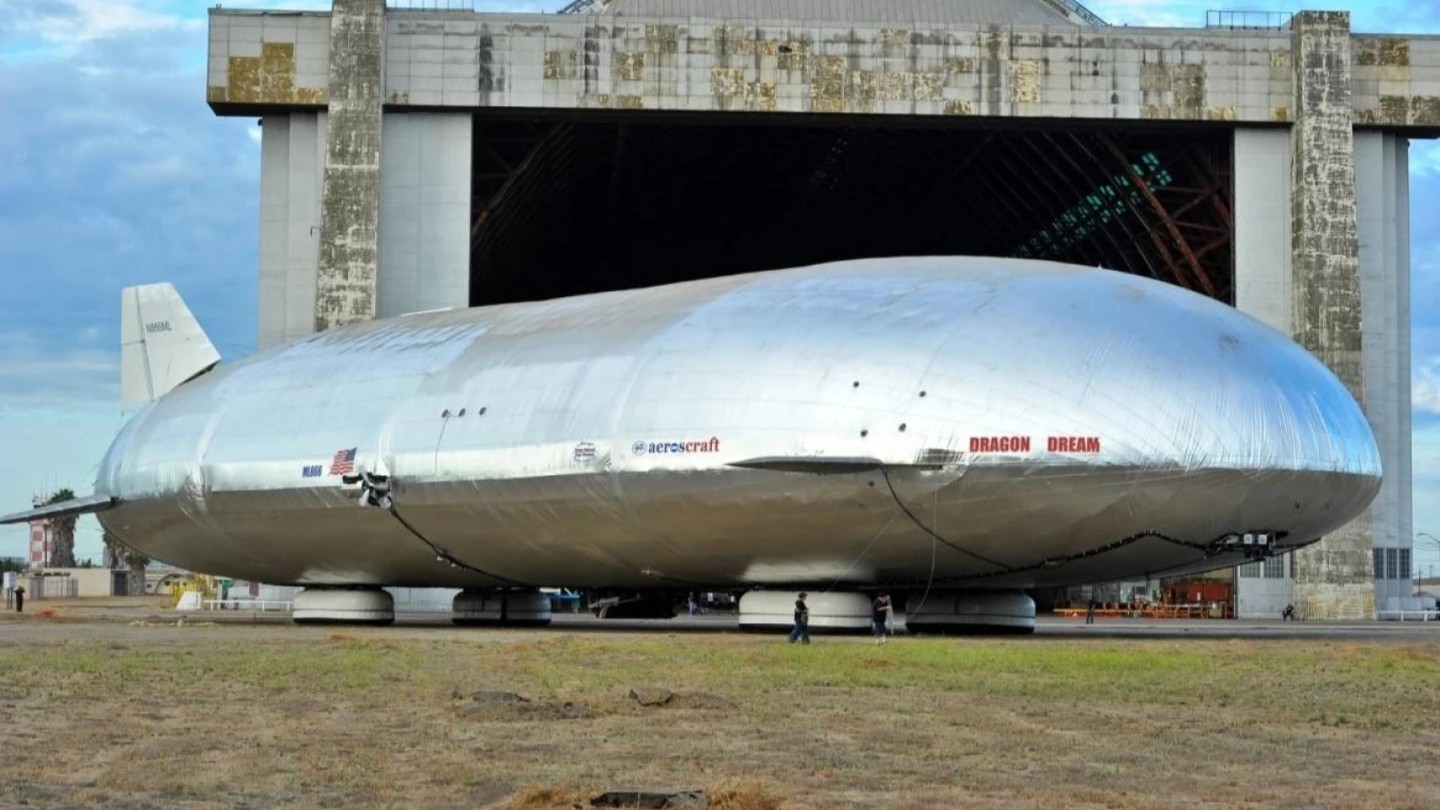
This new airship was called the Pelican, and the Pentagon believed in it so much that it funded the project to the tune of $50 million.
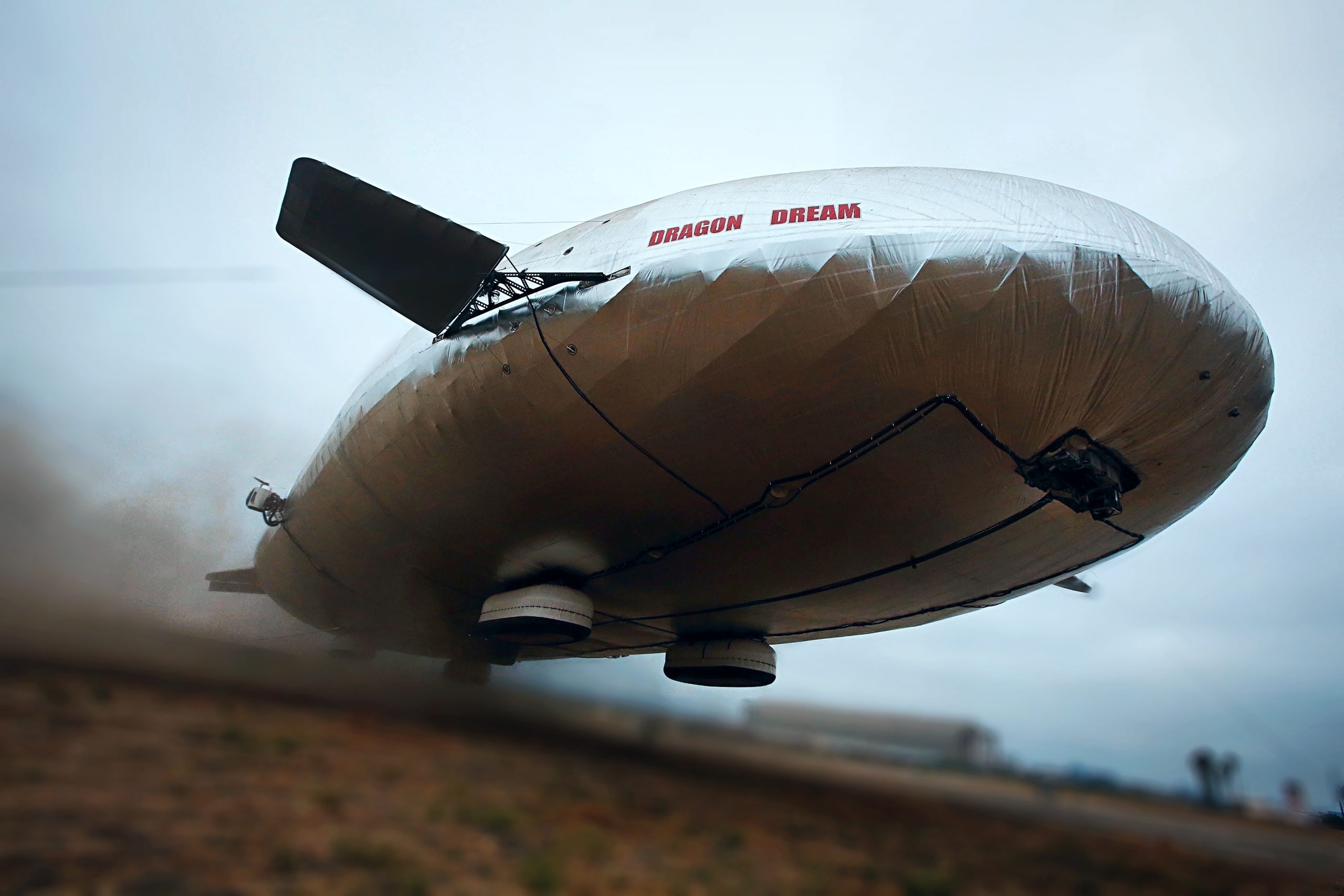
In 2013, Aeros had done it again. The Pelican, now called the ‘Dragon Dream’ took its first flight. This airship, which was a prototype for the Aeroscraft, measured 266 feet long and 97 feet wide. Power came from a triplet of Lycoming AEIO-540 SER 8.9-liter flat-six engines, which made 260 HP each. The envelope had a volume of 600,000 cubic feet, and the airship had a gross weight of 36,000 pounds.
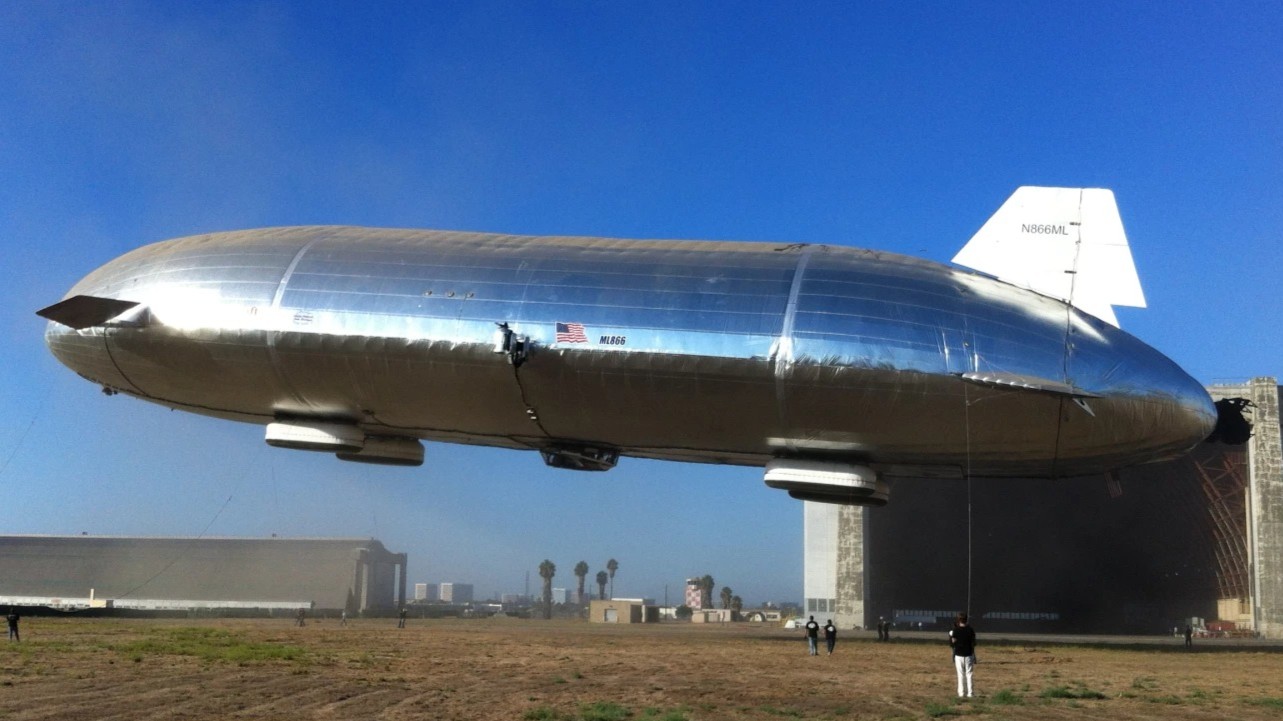
Sadly, the Dragon Dream was deregistered in 2014, and then the airship was badly damaged in a hangar collapse in 2015. But that hasn’t stopped Aeros from dreaming big.
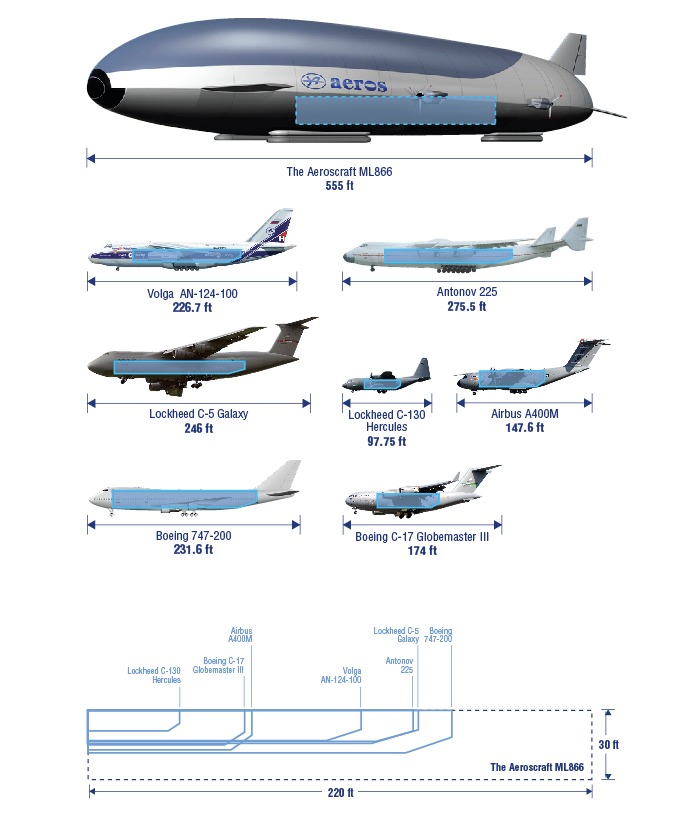
Aeros says that the Dragon Dream was a half-scale functional demonstrator of its planned production Aeroscraft, which is honestly pretty absurd. The Dragon Dream was already 16 feet longer than a Boeing 747-800, but the production version, the Aeroscraft Model ML866, is supposed to measure 555 feet long, or 305 feet longer than the aforementioned 747-800.

This beast, Aeros says, will be able to carry a payload of 66 metric tons, cruise at 120 mph, cover a distance of 3,100 miles on a single fueling, and hold 8,800 square feet of cargo. That’s roughly twice as much cargo as the largest Boeing 747 freighters.
That’s insane enough, but Aeros wants to make an even bigger version called the Aeroscraft Model ML888, which would measure 770 feet long, carry a payload of 244 metric tons, fly 6,200 miles, and hold a ridiculous 23,180 cubic feet of cargo in its hold. The Aeroscraft is expected to fly up to 10,000 feet.

As crazy as all of this sounds, it’s actually not that far off from what has been done before. Hindenburg-class airships were 803 feet long and carried 242,200 pounds of people and cargo. What would be interesting to see is the claimed 537,927-pound payload of the ML888.
This time, Aeros isn’t pitching its Aeroscraft as a military craft, but the ultimate solution for logistics. In Aeros’ eyes, the Aeroscraft can carry a crazy amount of humanitarian aid after a natural disaster, be used to airlift the world’s largest wind turbine blades to wind farms, and provide a solution to any logistics operation that is apparently hamstrung by relying on trucks, trains, ships, and fixed-wing aircraft.
In other words, Aeros sees the Aeroscraft fulfilling a similar role that Radia wants to use for its WindRunner aircraft, but this one is supposed to be a ridiculously huge airship rather than a comically long fixed-wing plane.
The Flying Amazon Fulfillment Center
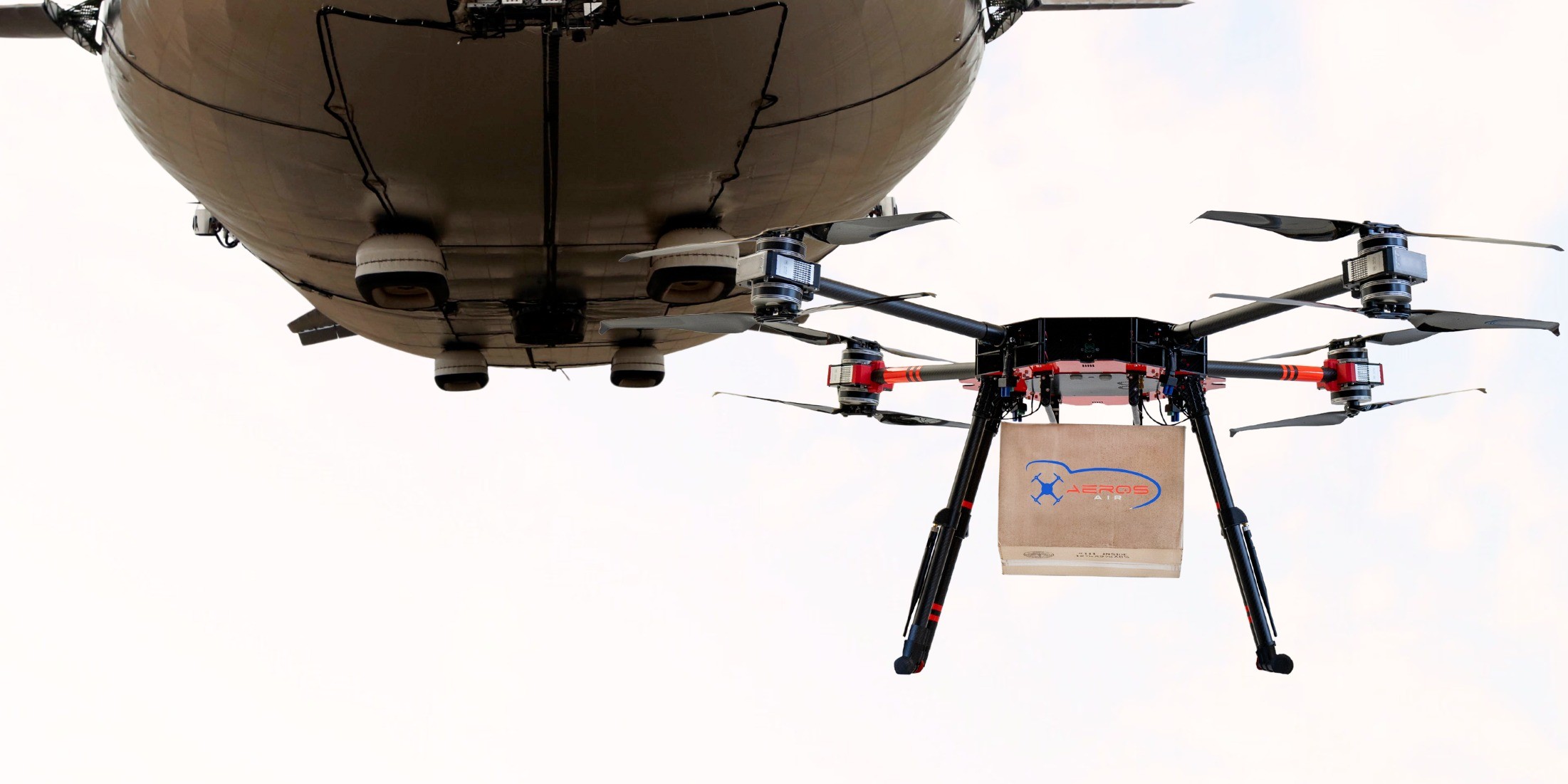
If this isn’t weird enough for you yet, it gets weirder. Not content with trying to reinvent shipping, Aeros wants to disrupt warehousing, too. Aeros has partnered up with a producer of cargo drones. Why? Aeroscraft wants to create what it calls an Airborne Warehouse and Airborne Fulfillment Center.
I’ll just hand Aeros the mic here:
60-MINUTE DELIVERY
Our airships navigate directly from the warehouse to the delivery area, with drones delivering packages straight to the customer’s front door, bypassing traffic congestion and difficult terrain. This provides unmatched speed and efficiency that no one else can match.66% REDUCTION IN YOUR SHIPPING COSTS
Your customers will enjoy lower prices compared to your competitors, thanks to our unprecedented operational efficiency. The ML806 airship and drone system can deliver 4,000 consolidated packages per hour, significantly reducing shipping costs.YOUR COMMITMENT TO SUSTAINABILITY
Your customers will be pleased to know that our airships and cargo drones are electric and produce zero emissions. One ML806 system removes 110 delivery vans from the road, reducing 4,535,000 lbs of CO2 emissions annually.

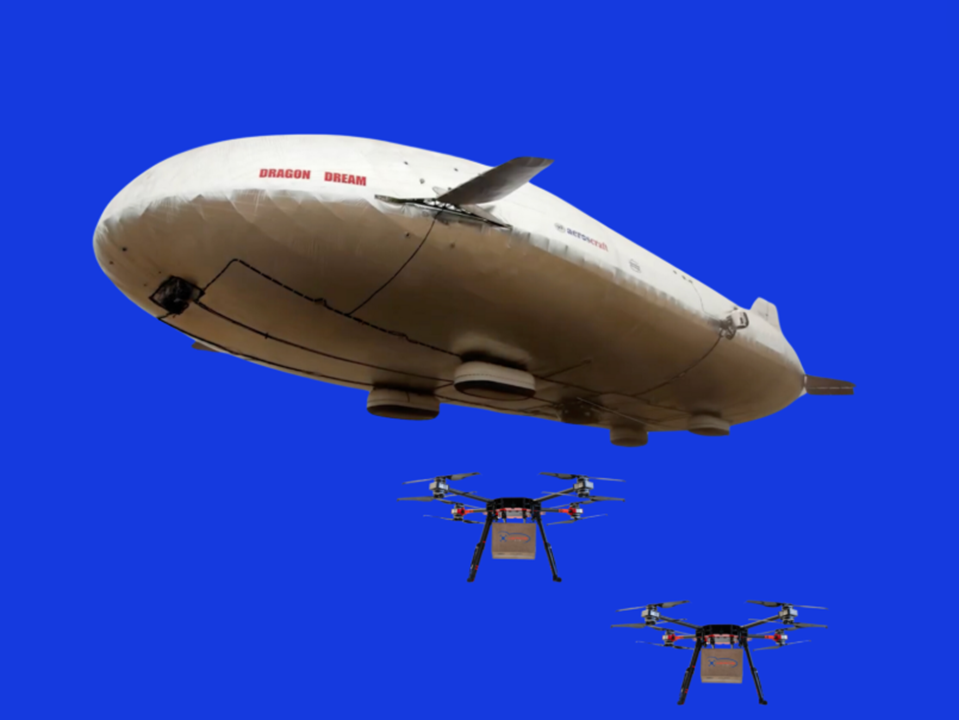
Aeros wants this to work exactly how you’re picturing it. An Aeroscraft airship will float above Los Angeles, and thousands of drones would be flying into and out of its hold. In essence, this airship will basically be a flying Amazon-style warehouse.
Aeros hopes to launch a pilot program this year. The demonstrator will be an Aeros Sky Dragon surveillance airship, which will have a 1,980-pound payload. Drones will then fly into and out of the Sky Dragon, delivering packages around a small part of Los Angeles.
The idea here is really just to prove that a floating warehouse is a viable concept. Then, Aeros plans on launching what it calls the Aeroscraft ML806, a 262-foot-long airship with a 10 metric ton payload. This airship will have a crew of five — two pilots, a drone pilot, a supervisor, and a loadmaster — and Aeros expects to have three of them in production by 2027.

One of the problems that Aeros may face is the fact that, while the Aeroscraft is expected to hover at 1,200 feet above ground level, drones aren’t allowed to fly higher than 400 feet. According to a recent report by FlightGlobal, Pasternak is in talks with the FAA, and the FAA apparently supports this flying warehouse deal.
There are some big questions that remain. Will Aeroscraft be able to make an airship as large as it says it can? Is there a market for a long-range aircraft that can fly at only 120 mph? Do people want a warehouse flying over their heads with lots of drones buzzing in and out of it?
That speed factor alone has me scratching my head. Aeros is pitching its Aeroscraft airships as being able to deliver aid and other time-sensitive cargo. Sure, these aircraft won’t need infrastructure like an airport and can land and take off vertically, which means that they can deliver cargo directly to the ground after a disaster. However, given the airship’s slow cruising speed, it might still be faster to use a jet, anyway.
But these questions are still pretty far out. Aeros needs a lot of money to make this happen. The company plans to raise an undisclosed amount of money through a Regulation A public offering, which has a limit of $75 million. According to a press release published last month, Aeros has also signed a “Memorandum of Understanding with a major global institutional investor.” The details of this, including the identity of the investor, are not available. Aeros also says that it has “signed a multi-million-dollar agreement to initiate commercial parcel delivery using our AFC platform,” but again, no further details have been made public. For now, Aeros has a link on its website to reserve shares in the company.
It’s hard to say if Aeros will be able to pull this off. To his credit, Igor Pasternak has been working on this technology for the better part of 30 years, and I admire his commitment to his dream. Even if he just builds the small 10-ton airship, that would be pretty awesome to witness. Either way, it’s so cool to see airships trying to find some way to work in the modern day.


“Do people want a warehouse flying over their heads with lots of drones buzzing in and out of it?”
No. No they do not.
The humanity!
While more compact to compress the helium containers, but without knowing what the excess volume might be, I was thinking compressed air could be used to fill bags for ballast. I also wonder why air ships don’t make more use of thrust for vertical stability. Is it the limited capability of the thrust even on something that could be kept nearly neutrally buoyant (this is in general, not something of the proposed scale here) or that it would just be less efficient? Not that it really matters, as this thing’s never going to be made as it still suffers from air ship vulnerability to weather at a minimum.
Appreciate your perspective. Our COSH system differs from traditional compressed-air or ballast-bag methods in that it adjusts buoyancy directly through the helium envelopes. This allows precise, fully reversible control of lift without occupying hull volume with separate bags.
For control authority, we do employ a vectored-thrust system that enables 9-axis maneuverability, supporting helicopter-like vertical takeoff/landing, forward propulsion, and ground taxiing. Combined with a rigid structure and modern flight control, the design is resilient in weather, with operational capability comparable to helicopters (acknowledging that, as with all aircraft, conditions set the limits).
Thanks for the reply! I can see the advantages of directly working on the helium, but would think sealing the cylinders with the moving pistons must be a technical/cost/maintenance challenge with helium’s propensity to leak, though it seems like you’ve solved that well enough to make it viable.
I don’t know much about airships, so thrust vectoring is probably something that has been done for a while, but I inferred from my limited reading about other airships that it wasn’t effective enough to counter strong weather events due to the constant mention of that being an issue.
I hope it does work out as, among other uses, these could be a great alternative to inefficient and sometimes complicated multimode transport of large items to remote locations.
For the best, highest use of an airship, see the 1930 movie “Madam Satan”, in which a wild Roaring 20’s costume party is held aboard a tethered blimp. It’s a pre-code film. so the costumes are pretty… interesting.
To be an insufferable pedant, the airships Aeros has delivered so far are all blimps, but the Goodyear Blimps are not actually blimps at all, as the current fleet is Zeppelin semi-rigid airships. This giant Aeroscraft proposal will be a fully rigid airship, really the first since the 1930s, if built, which it probably won’t be, as there’s been a long series of similar failed proposals going back decades
You’re right, of course, and I do point that out in my Goodyear Blimp article. Goodyear knows that its airships aren’t real blimps anymore, but it still markets them under the name “Goodyear Blimp.” But I suppose that makes sense, the Goodyear Blimp is a big brand name, and I suppose Goodyear is not in a rush to change it anytime soon.
Yeah, its a brand name at this point, or, almost an artifact title, if you will.
Although semi-rigid airships are way cooler than blimps, but maybe that’s just me
Yes, Aeros has an excellent track record of building and delivering blimps, and that experience gives us a strong advantage in developing the rigid Aeroscraft. Unlike past “paper” proposals, the Aeroscraft’s core technologies have already been proven through a built and flown prototype, and we’re now advancing toward commercialization. You can learn more at aeroscraft.com
Los Angeles is going to look like the dystopian nightmare of District 9’s Johannesburg.
Pretty sure this same idea gets floated every 5 years for the last 50 or so, and nothing comes of it. I would love it if it became a reality, but I’m not holding my breath.
Yep, the inventor guy is trying to stoke up the hype machine again to get a VC funding round approved. If this concept had really been promising, the DOD wouldn’t have given up on it and let the hangar fall in on the prototype. I don’t know what the fatal flaw in this idea is (probably foul weather capability as many have suggested) but it must be fairly bad, else it would have happened by now.
That’s probably why the inventor has ditched pitching this thing for the military and instead has settled on a flying AI-enabled (barf) warehouse.
Come to think of it, this whole thing could be framed as being somewhat tragic. Pasternak’s tech seems to work, but it’s reinventing a vehicle with limited practicality in the modern day. It would be like if someone invented a new kind of ocean liner today.
I feel like this concept could work, but if weather capability is the problem, they should lean hard into finding the solution to that – give it monster thrust and demonstrate station-keeping in 50 knot winds, maybe. Or lean into the boyant/lifting body combo and demonstrate that you could fly it at 70,000 feet to get above the weather when it comes. But trying to sweep those issues under the rug and instead yell ‘Drone Delivery! AI! Blockchain! NFT!’ in an attempt to get some more money to do (effectively) the exact same thing over again isn’t the way.
The hangar collapse was an accident in a World War II–era Navy structure, and by that time our prototype had already completed successful flight tests that validated all of the core technologies. Those achievements were recognized by the U.S. military and Congress, and we remain closely connected with the defense community today.
With its rigid design and advanced control systems, the Aeroscraft can operate in conditions where helicopters can. Cargo airships have long been seen as a promising solution, and Aeros is one of the few actually moving the concept toward commercialization. If you’d like to see how the military truly views the potential of this technology, you can watch experts share their perspectives in the video section at https://aeroscraft.com/media-news-new
Yes, airship concepts have been proposed many times before. What makes the Aeroscraft different is that its core technologies have already been proven with a built and flown prototype, and recognized by both the military and Congress as a breakthrough in logistics. We’re now advancing it toward commercialization, and if you’d like to follow along, you can sign up for our newsletter at aeroscraft.com
I thought there was a helium shortage?
Exactly. I love the idea of lighter-than-air travel, but given the non-renewable nature of helium and it’s importance in applications like MRI units, the viability of fleets of giant airships seems limited.
There’s hydrogen, but there’s also memory of the Hindenburg.
There absolutely is. It’s in very finite supply here on our third rock from the sun. Using it in this manner is criminally wasteful, as it has very critical uses in the medical industry and some key technology areas, all essential for maintaining our current modern standard of living.
Not that this isn’t a stupid idea, it is and I agree with others this is a vaporware investment scam, most He used in Semiconductor or medial use is liquid, at a 750/1 ratio to gaseous He. This one airship used the same initial He as 10 MRI machines, not factoring maintenance and repairs of either.
Is it criminally wasteful? It seems the idea is that it isn’t wasteful at all, as the airship doesn’t vent, or “waste” the He, like say balloons do. If the idea is ecologically sound, this might be a good balance. Like I say, it’s probably a grift, however as someone in Semiconductor, I have a very hard time pinpointing the overwhelming human uplifting done by my industry.
There’s an easy solution to this. Get nuclear fusion working, and you’ll have all the helium you could ever want! Airships for everybody! The clean energy thing is just a bonus.
What’s the output of He from a scale fusion reactor though? I mean anything to sell investment in the technology, but I’m not sure He production can be factored into the ROI.
There was for a time, but that passed. Uranium and Thorium decay into helium, thereby providing a replacement source. I think the surge in MRI machines caused a shortage which eventually eased.
Puts me in mind of the Blade Runner blimp scene…
My favorite blimp scenes are the ones in “View To A Kill”
Archer Skytanic: https://youtu.be/4Y-kVB_i6Ok?si=TvLWNif-0hKPemq7
Oh the humanity
Sure. Start out with blimps, but then it becomes the Backstreet Boys and running from the law.
Dude fell in love with the movie “Storks”.
The problem with this is the same problems the huge airships the Germans made in the 1930’s: They are VERY prone to crashing in bad weather. You get something this large and even a decent gust of wind is enough to blow them off course.
Looking at the design images, it appears that the cross-section is essentially a flattened ellipse instead of a cylinder. It should present a smaller surface area to crosswinds, which would make it fare better than prior airships in that one respect.
But I’d like to know how it would deal with strong turbulence — updrafts and downdrafts can hazardous to fixed-wing aircraft, and we seem to be having more and more notable incidences of particularly strong turbulence causing injuries aboard commercial flights when they’re not detected in time to re-route. That would probably be catastrophic for an airship.
We have excellent weather forecasting now, and real time Doppler radar to see issues, unless Trump dismantles NOAA and the National Weather Service further.
The other issue that comes to mind is lightning. What would a strike to the surface do to the integrity of the airship? It would certainly blow an instant hole in it, and you can’t really ground a moving object to Terra Firma.
Avoiding inclement weather is fine, but there is also dry lightning and the summer monsoons in the Southwest, which are less predictable than normal weather systems.
A vaguely similar thing was tried in Germany in the late 90s and early 00s (Cargolifter). It failed. Not so much technically but primarily financially.
At least you got a neat indoor tropical park out of it
I have never been there, although it’s not very far from me, but I have heard decidedly mixed result.
For anyone to get a better understanding of airships and their downfall (pun intended) one should read “His Majesty’s Airship”
Because these
inventorsvaporware purveyors never account for changes in air currents, weather, etc and how they affect stability, buoyancy and propulsion.“Part of the reason why airships fell out of favor with the military in the mid-20th century was that they were so huge and so slow compared to jet aircraft”
Another part was airships like this are TERRIBLE at dealing with bad weather. If it were to break it’s moorings in a storm it would be an immense hazard to air traffic and to anything below it. I can’t imagine it would fly well anywhere near the intense churn of a major wildfire so I dunno how useful it will be in that scenario either.
There’s also the issue of trying to park the thing. LA parking is hard enough.
I chuckled at that mock up of an airship in a warzone for another reason: bullets make big ballon pop, no?
Except this is a Zeppelin, not a blimp. The balloons are inside and they don’t pop, they just leak.
I think they get sold as something that is basically set it and forget it, but they actually need a lot to deal with everything going on in the air.
There was the infamous JLENS screwup just 10 years ago.
https://en.m.wikipedia.org/wiki/JLENS
It wasn’t actually brought down directly by bad weather, but what happened is that the complexity of the systems needed to keep it stable caused a failure thet led to the tether snapping and getting dragged for 100 miles and taking down power lines. It could have been a lot worse.
I’ve wondered for years if something like this could be used for launching satellites. As in, sling a small rocket under it, go up to 10k feet, and light that candle!
My understanding of rocket launches is pretty limited, but I have read that liftoff is when things are most likely to go wrong. If it’s already two miles up, all it has to do then is fly. If it does go wrong, no ground infrastructure will get damaged.
Also, starting 2 miles up would mean it would need a lot less fuel, so the rocket could be significantly smaller. Could maybe even be single stage. A lot less complex and explodey.
Now everyone can tell me why I’m an idiot.
Or you could just launch the rockets from a mountaintop.
Heinlein had envisioned essentially huge railgun up the side of Pike’s Peak.
Saddam Hussein had a similar idea:
https://en.m.wikipedia.org/wiki/Project_Babylon
Heinlein’s was for near earth obrit or lunar colony supply launches. In golden age sci-fi anything was possible.
Anything still is possible. Just not as probable.
Except maybe horny Martians invading the Earth in search of women. Or horny Earth nerds finding a habitable Venus full of beautiful, also horny and strangely desperate, cosmetically blind women.
It’s almost like you’re implying Heinlein was always horny.. I mean he was, just making sure I’m following..
So, Earth girls are easy?
(I’m only replying so I can see if this discussion goes further)
Unfortunately not. If they were Earth nerds wouldn’t need to go to Venus.
Yeah, but mountaintops tend to be remote and difficult to get to. With an airship, you build your rocket someplace convenient, then take it up high with the flick of a switch.
True but a mountain top doesn’t crash.
More seriously though 10’000 ft isn’t much of a height difference and 120 MPH not much of a head start speedwise. That may not be worth the trouble or the risk of damaging the fragile skin with the rocket exhaust, especially when a repurposed, surplus jetliner can launch from 40’000 and 3-4x the starting speed and has already been proven to be up to the task.
Didn’t the ‘Goblin’ launch from a B29/B50? And Yeager’s X1.
Yes they did. They weren’t orbital craft though.
Weather patterns are typically highly variable around mountains, and even in clear weather often have unpredictable wind shear, etc. Probably not a great option.
Probably not.
Or from the underwing of an airplane, like that one company does.
Yeah – Let’s launch rockets from something flammable and unstable – then watch the fireball come crashing down from 2 miles up!
Bet you could sell some tickets for that! But more likely, it would just happen somewhere a falling fireball wouldn’t hurt much.
Uh, better look at your chemistry book again, helium is neither flammable nor unstable. Quite the opposite. The German zeppelins used hydrogen which is highly flammable. Plus, they were covered in a highly flammable coating to make the skin airtight.
Stuff is generally flammable when the back end of a rocket engine is pointed at it.
JET FUEL CAN”T MELT STEEL!!!!! /s
Helium supply is the biggie, I’m gald to this plan does not ‘vent’ it traditionally.
This particular design utilizes helium (a mistake) which is not flammable. You’re thinking of hydrogen. That’s one up on the Periodic Table.
A car/boat/plane with no fuel on board is still flammable.
Are you just here to make life difficult for everyone else with ridiculous posts?
Are you as obtuse and cranky in real life as you are here?
Not an idiot at all! But – it turns out getting high up enough is the “easy” part for rockets. The hard part is getting up to speed, since you need to be going mach 24-ish to cancel out gravity and stay in orbit, which is where the vast majority of your fuel needs come from. There are a few aircraft-launched rockets, but they’ve never been very successful and the main selling point is just that the plane can fly above weather to eliminate launch delays.
Air launch is one of those concepts that sounds like a great idea, until you consider the alternative solution – just make the fuel tanks on your rocket a little tiny bit bigger. The operational challenges air launch brings with it just aren’t worth the trade for a bit more fuel and dry mass on the rocket stage least sensitive to those things.
With a ground-based lift-off, you can usually cancel a launch right up to ignition without typically damaging the payload or launchpad.
If you’re dropping it like a bomb and something in the ignition sequence goes wrong, there’s not a lot you can do to save the launch vehicle, and you have precious little time to do it before gravity introduces the vehicle to the earth’s surface at a high velocity.
You could engineer some payload jettison system that fires the payload away from the launch vehicle and lowers it on parachutes, something that a lot of launch vehicles can do today, but again, you’re racing against time.
First I imagine the amount of thrust a rocket needs to begin lifting off. Then I consider that thrust bearing downward on an airship that relies on a delicate balance of buoyancy to stay aloft. After that I wonder how something that’s essentially a diaphanous gas bag would fare amid the giant fireball of a rocket launch. These would be concerns to address.
“Emmigrate to the off-world colonies. They need you on the off-world colonies.”
Just needs a big Geisha on the side…
I just keep picturing Archer when he was on the blimp. “Hello, airplanes? It’s blimps. You win. laughs Blimps are terrible!”.
I’d be curious to know if this would be a cost-effective way to avoid maritime conflict zones. You could avoid the Straits of Hormuz with these without going all the way around Africa to do it. I don’t imagine it would be a complete replacement but it could mitigate a certain percentage of the risk.
Big floating target in the sky?
Fun times!
With this surface area, load it with some flexible solar panels, switch some of those engines to electric, and it could theoretically stay afloat indefinitely (until the system has leaked enough helium to no longer be light enough to float)
Much as I’d love airships to be more common, the complete failure of every airship venture since the Graf Zeppelin, doesn’t inspire me with confidence.
Maybe if it was like Concorde, and had a couple of national governments behind it to foot the R&D bills, it might reach production.
The Goodyear airships have been successful enough at what they do.
Still gets me — aircraft engines. The “small” four cylinder one is 5.2 litres and makes just 160 HP. My 19 year old car has a diesel motor 2.2 litres large and it makes 170HP!
Then the larger one is six cylinders, 8.9 litres and makes a whopping 260 HP.
These are figures from before WW2 for car engines…
Not as if they are super economical or something, little Cesna 172s, struggle to get much more than 4 miles to the gallon, (25 litres per 100 km, roughly) going at around 200 kph…
I too have always been curious by aircraft piston engines that are always so large and yet make so little horsepower, while costing around the price of a average home just for the engine.
It’s a matter of peak vs. constant power, and needing to output that power consistently without failure.
A 3.9L flat four out of a DA20 Katana only makes like 120-130hp, but it does so in a predictable fashion for hours on end. (Although it burns 100LL avgas, yikes.) Cars experience a lot more load variance than aircraft and they don’t need to output their peak power for more than a few moments at a time, so the engines can be tuned for higher peak output.
Because their max engine speed is limited by the propeller. You don’t want to drive the tips of the prop past the speed of sound if you want any efficiency at all (and it makes an unholy racket). And you need a bigger prop the more power you’re making, so as power goes up, engine speed has to go *down*, so engine displacement gets big, fast.
You can technically put a reduction gearbox between the engine and prop, but they are a point of failure you can avoid with a direct-drive prop, and so most airplanes don’t use them. They are starting to see some use with Rotax powered planes, one of the reasons the Rotax engines are more power dense.
There are also issues with continuous vs. intermittent ratings, air cooling, etc., but it is really the fact that peak power has to occur in the 2000-3000 RPM range for most aircraft that drives the power vs. displacement relationship.
Except for Rotax, all Lycoming/Continental piston aircraft engine designs are basically unchanged since before WW2.
People joke that they’re 1930s tractor engines, and that isn’t far from the truth.
The engines have all sorts of ‘old’ features like fixed timing, direct drive, air cooled, magnetos, manual mixture control, sometimes carburetors, etc. But they can cruise at 90% power all day long.
Your math is also off on the mileage figures. A 180hp Cessna 172 will burn ~10gph at a cruise speed of ~120mph. 12mpg isn’t great but on less draggy airframes, the mpg can get much better. My plane cruises at about 150mph and is only slightly less draggy than a 172 and I get 20mpg lean of peak. Something slick like a Diamond or Cirrus will do much better.
Huge sense of dystopia kicked in. I’m reading this article about this miraculous machine that can deliver wind turbine blade, provide humanitarian relief just about anywhere, and its being used to drop ship someone’s shipment of Axe Body spray. Another moment where someone with power and ability could be creating a heroic moment, and instead opts for capitalism and consumerism.
My dystopian thoughts were that they might as well paint target circles all over it. Especially when it’s full of goodies.
Why steal packages off a porch, when you can just net a drone?
Just wait until it appears over a ‘suthern state.
Yeah. I love airships so much, but the “flying amazon fulfillment center” is pretty yikes.
Who’s paying for all the continued development if not capitalism? FEMA? If the tech were to be successful, it could easily be used to do both things. Develop sophisticated tech to drop amazon packages, that tech can also be used to drop 10 lb supply boxes to stranded people individually during emergencies. But without the money from commerce, that tech is never going to be developed.
The humanitarian aid argument is a good one. The how can we avoid paying human workers while doing something “disruptive” and showy to get venture capital, not so much.
Ernest Cline was pretty on target with this one.