

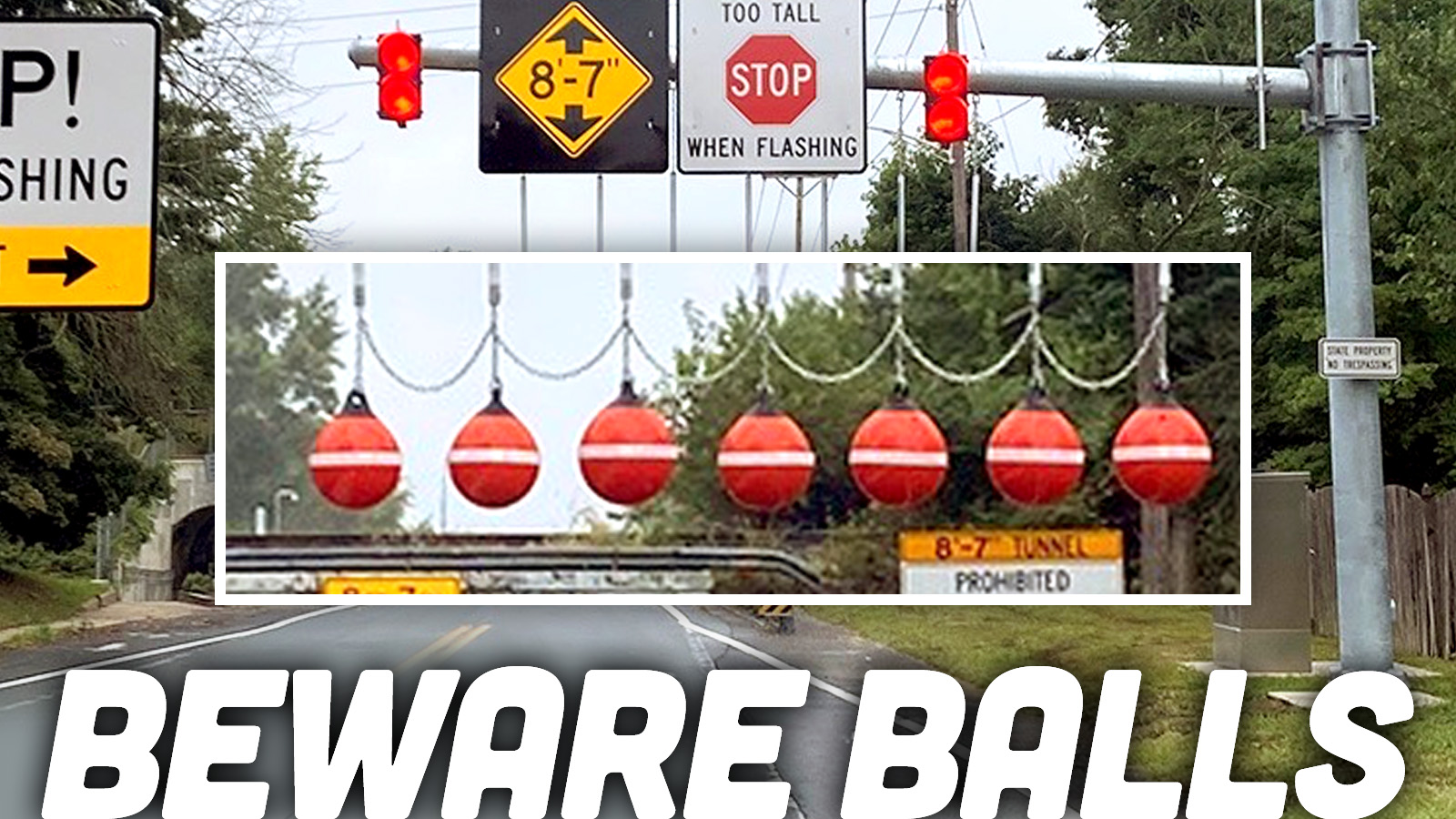
One of the most hilarious auto-related Internet sensations is watching a big truck attempting to fit under a low bridge. It always ends poorly for the truck, usually with a large chunk munched off the top by the bridge. While it’s fun to watch, trucks crashing into low rail bridges is a serious problem, as not only do the trucks get damaged, but traffic has to halt on the road and on the rails as the accident is cleared up and the bridge is inspected. Ideally, these crashes just wouldn’t happen at all, but too many drivers keep messing up. For the past few years, the state of Delaware might have found the best solution yet by placing giant plastic balls before a bridge. Here’s how so-called “Clanker Balls” have saved both trucks and bridges from hits.
America’s roads are full of bridges that offer varying levels of clearance underneath. If you’re driving down the Interstate Highway System, you can usually expect 16 feet of clearance between the pavement and a bridge. This number reduces to about 14 feet in some urban areas. These clearances generally work because the typical tractor-trailer sits at 13 feet, six inches high.


However, the bridges found on local roads may vary. Many of the old rail bridges peppering America’s secondary roads offer far less than 14 feet of clearance because they were built before modern standards. The most infamous bridge is the Norfolk Southern–Gregson Street Overpass in Durham, North Carolina, which is also known as the “11-foot-8+8 Bridge” or the “Can Opener Bridge.” This bridge, which isn’t even the lowest that you’d find in America, attained its infamy because an office worker near the bridge pointed some cameras at the bridge for all to watch. Take a look!
When Old Infrastructure Meets Modern Traffic
These many low bridges across America cause headaches for trucks on the road because their drivers have to route around them, hopefully not causing any other problems in the process. If the drivers ignore warnings or don’t realize how tall their trucks are, they may end up clogging both road traffic and rail traffic after slamming into a bridge. These bridges sometimes need to be repaired after a hit from a truck. One crash can cause a ripple effect on a particularly busy rail line as trains have to stop.
In a perfect world, these accidents wouldn’t happen. The approaches for these bridges have yellow signs that clearly call out their low height. A trucker should also always know how tall their vehicle is. However, signs are only effective if drivers look at them. Likewise, the signs aren’t any help if the driver doesn’t realize how tall their vehicle is, as might be the case for someone driving a rental truck or someone towing a fifth-wheel camper.

Sadly, the solution isn’t as simple as you’d think. These bridges often cannot be raised easily, and roadbeds sometimes cannot be lowered easily. Raising a rail bridge would require a reconfiguration of the rail grade approaching and departing the bridge. The bridge would then be rebuilt, causing delays or full stops on the rail line for potentially months. Of course, this would cost the bridge’s owner, usually the railroad, millions of dollars.
Lowering the roadbed might be difficult due to any infrastructure that may be under the road. Of course, this would also take time and cost a town a ton of cash. Even when the infamous Can Opener Bridge was raised, it was increased only eight inches to 12 feet, four inches, so it still messes up trucks.
Convincing Big Trucks To Stop
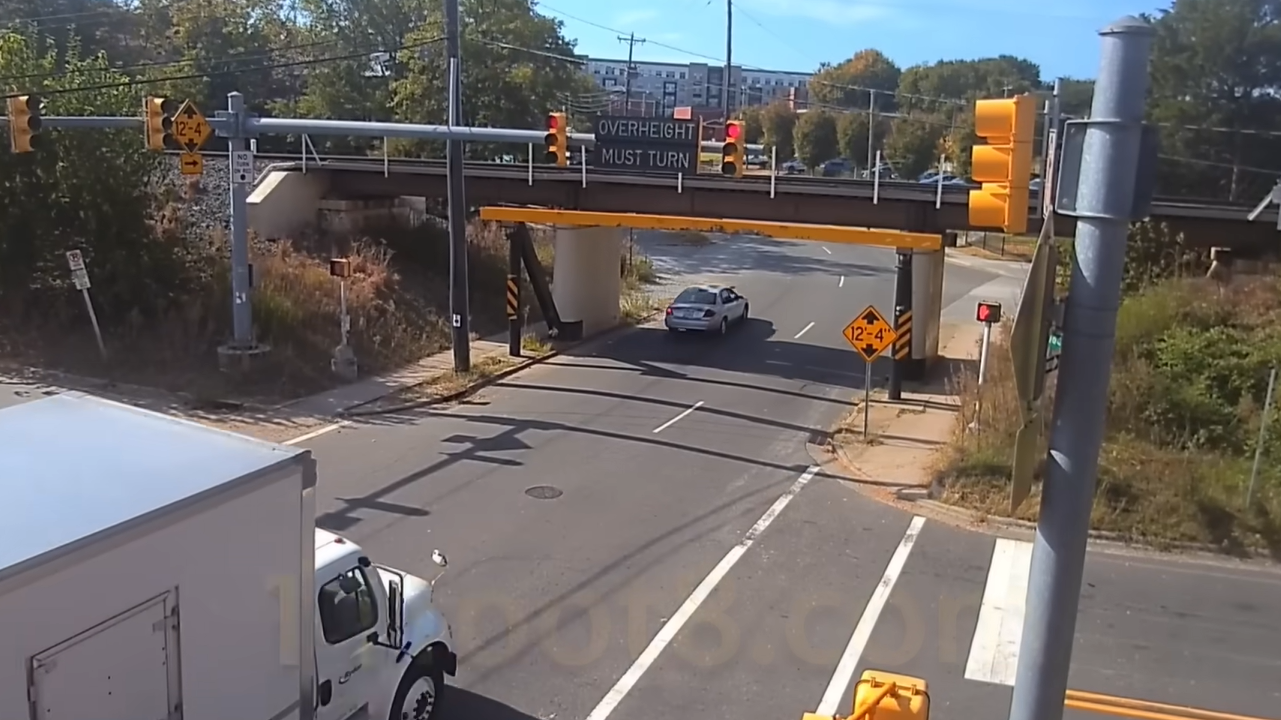
The alternative is to develop a solution to stop trucks from slamming into the bridge in the first place. At the Can Opener Bridge, for example, a sensor placed a half-block from the bridge detects when a truck is too tall, and then triggers an LED board to flash in an attempt to warn the driver. The traffic light in the intersection before the bridge also automatically turns to red. In theory, a driver approaching the bridge has 50 seconds to react before hitting the bridge, and there are warnings all over during the approach.
Yet, drivers still ignore all of the warnings, run the red light, and let the Can Opener Bridge slice their trucks open. Since drivers still can’t get the message, the North Carolina Railroad Company has a heavy steel crash beam that munches up the trucks so the bridge doesn’t get damaged.
The state of Delaware has taken a different approach. There is an infamous train trestle in Newark, Delaware, along Casho Mill Road.
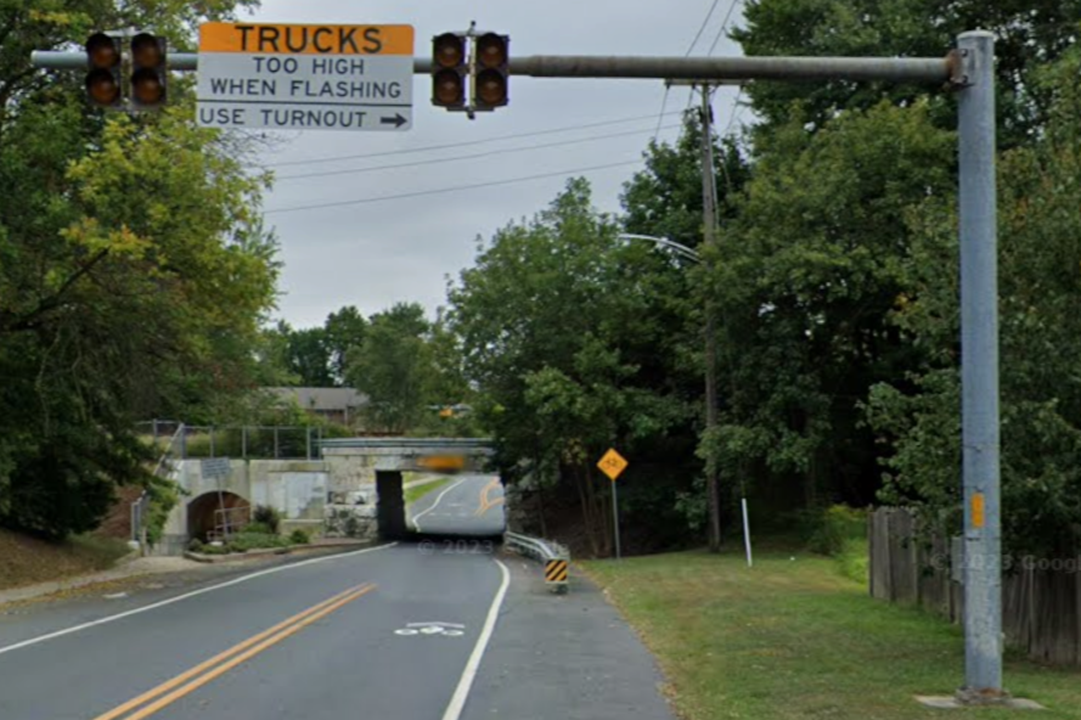
This bridge, which has been around since the late 19th century, originally offered 11 feet, one inch of clearance. In the modern era, the bridge offers only eight feet, seven inches of clearance. This bridge makes the Can Opener Bridge seem roomy in comparison. The Casho Mill Road bridge is so short that it can easily trim off the tops of camper vans and lifted SUVs, forget about any sort of commercial vehicle.
As such, this bridge, which is just one of many short bridges in Delaware, has been beaten up by tall trucks throughout its long life. Mark Luszcz, the Delaware Department of Transportation’s Deputy Director for Operations & Support, published a presentation where he even found a news report from the 1970s about the bridge eating a truck.

Between 2005 and 2022, the Delaware Department of Transportation says, 78 vehicles crashed into the bridge. Eight of those crashes happened in 2021 alone, with another six crashes occurring in 2022.
The state has been trying to curb the crashes, with most methods being unsuccessful. In 2003, the state installed a set of lights that flash and are accompanied by a sign that says “Vehicle Exceeds Tunnel Height When Flashing”. Drivers ignored both. In 2017, the sign next to the lights was updated to say “TRUCKS – Too High When Flashing – Use Turnout”. Another sign was added to the bridge height marker that said: “Your Truck WILL NOT FIT”. Again, drivers ignored the lights and signs, just like they do with the bridge in North Carolina.
Delaware’s Big Orange Balls

In 2018, CSX Transportation had become tired of trucks running into its bridge. So, it petitioned the Delaware Department of Transportation to close the under-grade crossing and then to fill the hole in so that no vehicle may ever crash into the rail bridge again. This lit a fire under Newark and Delaware state officials to try to fix the issue.
In 2019, the Delaware General Assembly proposed a solution. What if Delaware started using an over-height vehicle warning system? Such systems were already in place at the NYC Port Authority and parts of Pennsylvania and New Jersey. These systems were simple, too, utilizing a set of metal cans dangling from an overhead beam. If an over-height truck approached a low bridge, it would slam into the metal cans long before hitting the bridge, and its drivers would be alerted, alarmed, and come to a stop.
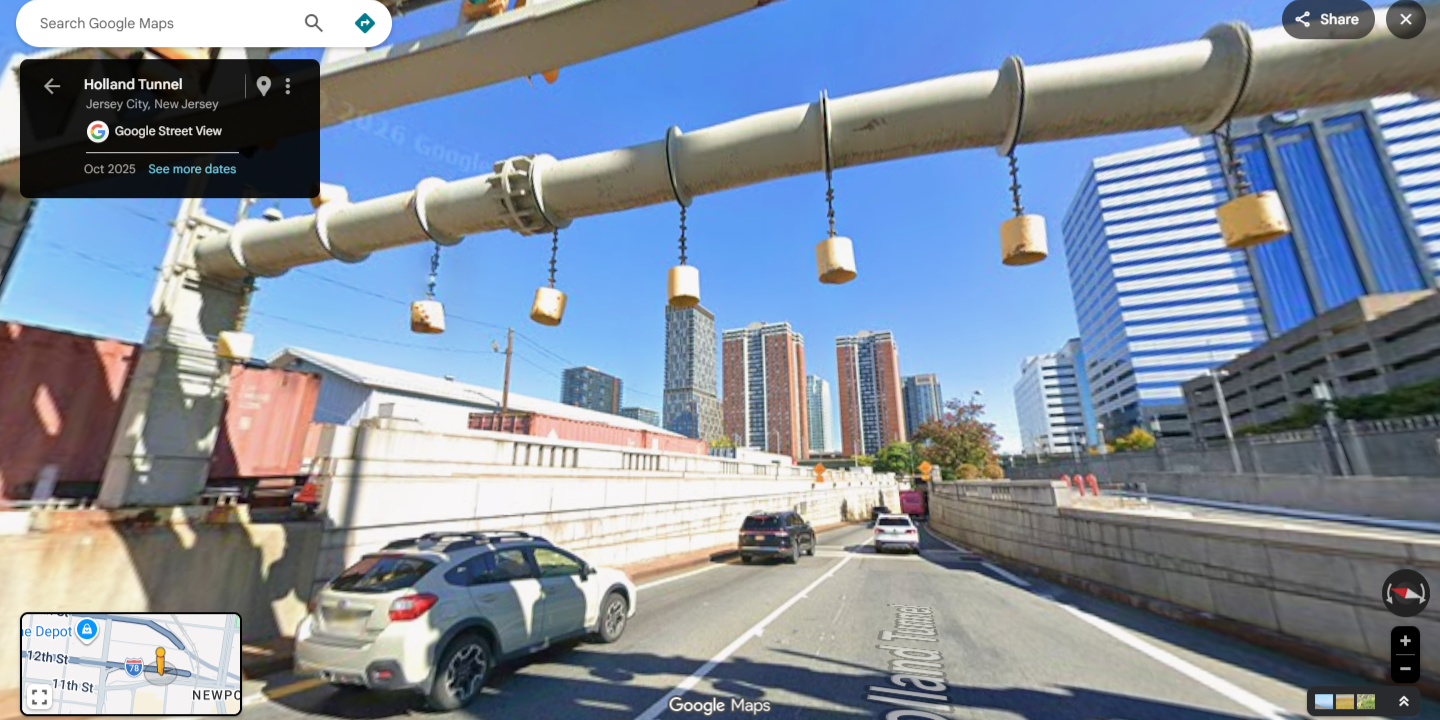
In 2021, the State of Delaware, DelDOT, and the City of Newark penned an agreement to install so-called “clankers” at the Casho Mill Road bridge.
Delaware’s interpretation was a bit different than what engineers found at the NYC Port Authority and elsewhere. Engineers had found that the metal cans of those over height vehicle vehicle warning systems weren’t very loud. They also didn’t look particularly appealing. The solution? They grabbed a bunch of Taylor Made Tuff End vinyl boat fenders.

Apparently, the sound created from hitting a bunch of boat fenders sounds more like a loud boom than a clank, but the nickname “clankers” stuck, anyway. The existing signage and lights were retained as well.
Whitman, Requardt & Associates, LLP, the engineers behind the project, added an additional sign that’s not only so huge that you basically can’t miss it, but also says in bold letters that if you don’t stop, your truck will go “kaboom”.
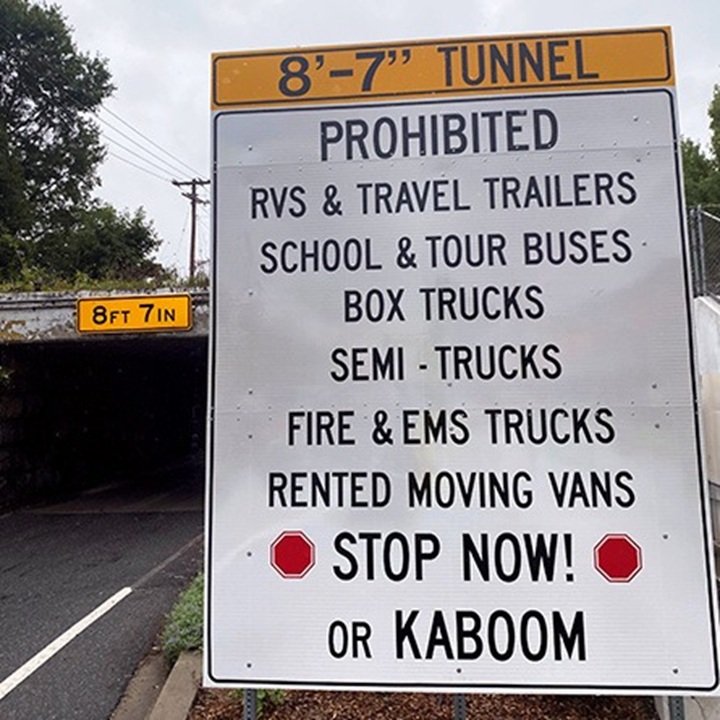
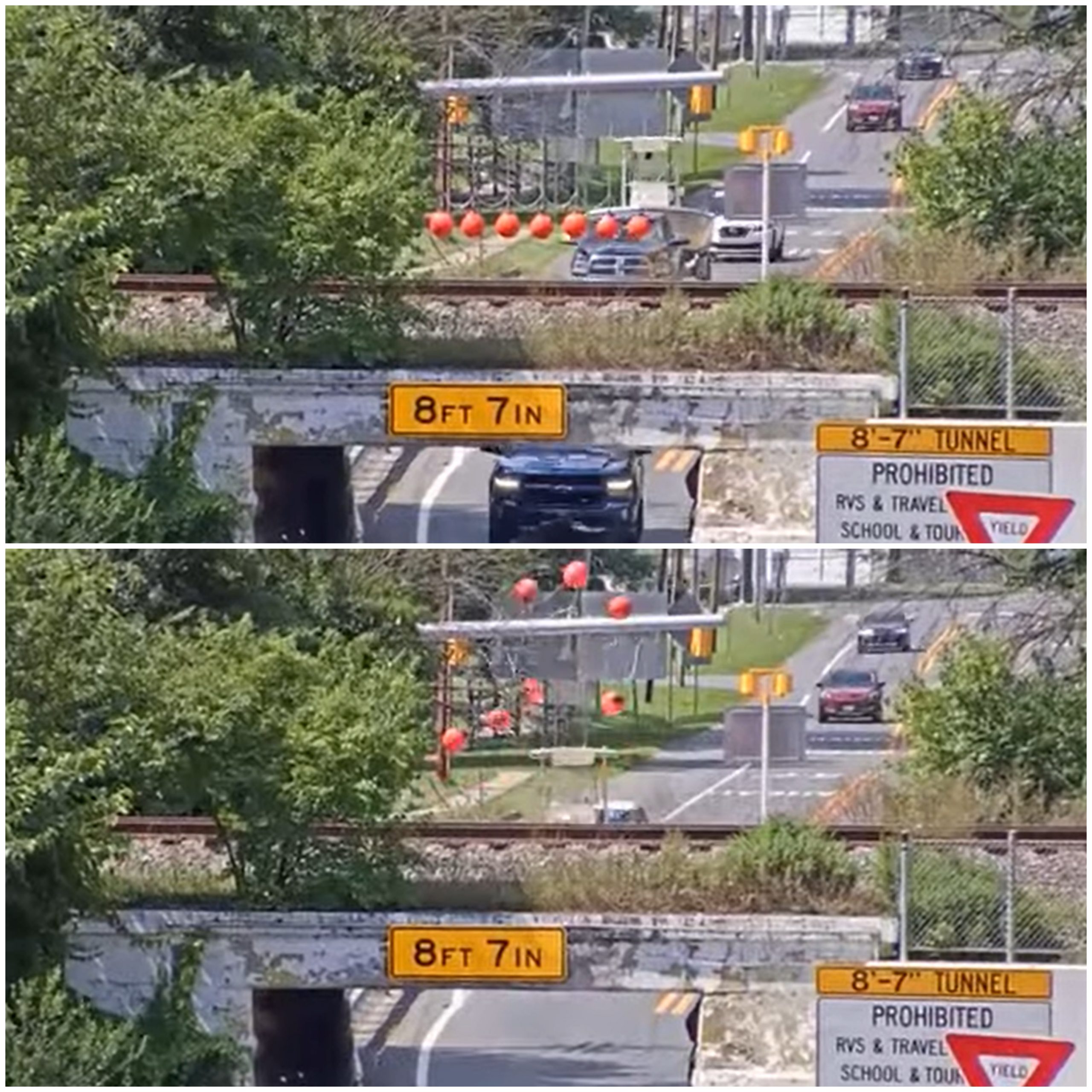
Add it all up, and there’s a lot of drama when a truck hits the clankers. The boat fenders make a loud boom and bounce all over the place while connected to their chains. Usually, the driver of the truck is snapped out of whatever daze or distraction they’re in and slams on the brakes. Then they see the sign warning of impending doom and decide not to press forward.
DelDOT admits that the signage and hanging boat fenders are not Manual on Uniform Traffic Control Devices-compliant. However, the state, the city, and residents do not care because the clankers have been super effective. In 2023, there were zero reported crashes at the bridge; the first time such has been recorded since 2005.
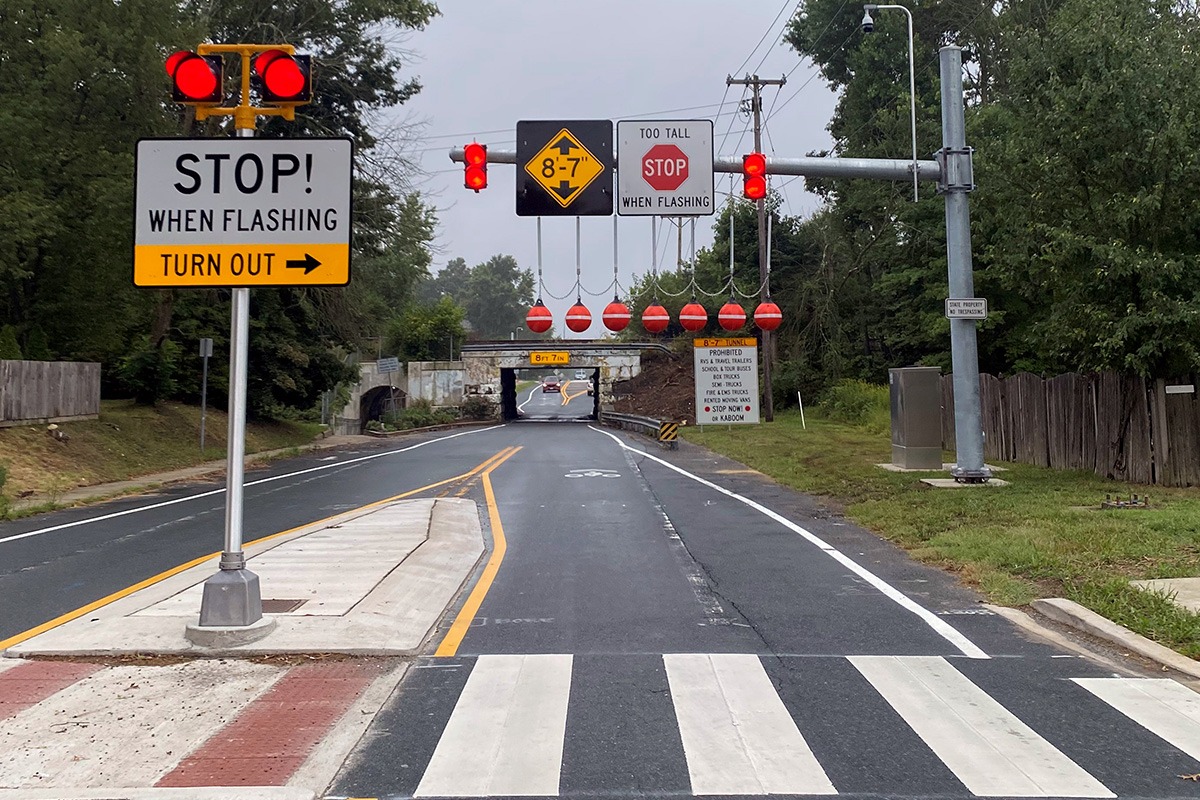
The state, city, and locals have also had some great fun with the clankers. People have decorated their homes with clanker replicas during the holidays, fire departments have hung clankers from their trucks during parades, and there’s even a satirical Facebook page that publishes funny posts around the clankers. Weirdly, these boat fenders hanging from a metal bar have become a bit of an in-joke in Delaware.
As NBC10 Philadelphia reports, other clankers have been installed in Milford, Newport, near Delaware Park, and on Chapel Street. DelDOT says that while the clankers have been amazingly effective, they haven’t been perfect. In more recent times, DelDOT has discovered that some trucks hit the clankers, come to a stop, but then continue forward, hitting the bridge. The state believes that the majority of these few remaining incidents may be college students driving rental moving trucks and not understanding what the clankers mean.
Still, the clankers have been so good at their jobs that officials in California, Ohio, and other states have been reaching out to DelDOT to see if they can rig up their own version of the system.
So, if you happen to drive through one of these states and see what looks like a bunch of plastic balls hanging down from a traffic light, now you know why. Those are just simple boat fenders, and they’re there to stop truckers from blowing up their load onto a train bridge. If you’re driving a truck of some kind and you hear a loud boom just before going under a bridge, it’ll probably be wise to turn around. If you don’t, you might just turn your rig into a convertible.
Topshot graphic image: WRA, LLP


someone send this article to syracuse, ny. the ononadoga lake railroad overpass gets hit several times a month. even has its’ own wiki page. Onondaga Lake Parkway Bridge – Wikipedia
My town desperately needs something like this. Somehow, in a city of 300,000, we have had two highway overpasses and one rail overpass hit by trucks hauling excavators in the last 3 weeks. This immediately gets the overpass shut down, or at least reduced to a single lane of traffic until they can do a full engineering assessment to be sure it’s safe. Combine those three with a major bridge at reduced capacity because someone started a fire under it that melted sewer lines, and it’s been a commuting headache.
The first hit was truly impressive. The guy hit it hard enough that the trackhoe he was carry was ripped off of its tracks, leaving the tracks still chained down to the flatbed. I have to give him credit for a great tiedown job. That load was secure.
Finishes tying, says to self “good job, now nothing can knock this thing off the flatbed!”
What if they installed railroad crossing gates that lowered when a too-tall truck approached, and refused to raise until they turned?
We have a 2-way, hairpin-turn freeway off-ramp in my town. It is clearly marked as “No trucks”, but people just blindly follow Nav. They really mess up the guardrail running their trailers over the inside curve. It still lasts longer than the outer guardrail, which gets hit every few weeks. I think people try to pass on the dedicated on-off ramp lane and are surprised to see a barrier in front of them.
A question from a land where still days are few and far between: How do those fenders hold up to say, 30mph winds?
“In more recent times, DelDOT has discovered that some trucks hit the clankers, come to a stop, but then continue forward, hitting the bridge. ”
Jackasses who deserve to have their drivers licenses taken away and be forced to go through the hoops new drivers need to go through to get their license back.
AC/DC playing through my head all day, thanks.
I love seeing how they gradually attempted to simplify the wording on the sign. I do something similar at work…the big, wordy justification for why something needs to be done a certain way goes into the report; a trimmed-down version of the justification is pasted into the part’s record in the computer system; and a [hopefully] easy to understand statement accompanied by lots of BOLD letters and asterisks goes into the procedure used for the part.
Inevitably, someone still won’t be able to figure it out and I’ll have to read one of the statements aloud, explaining it as I go.
In college I lived one block to the north on the other side of that bridge!
Had to look this one up on Google Maps. Even the Google Street View car decided not to chance that underpass.
Reminds me of the time when I entered a parking garage with a tall closed trailer. I hit the warning bar with the spoiler on back of the trailer and proceeded down.
When I had to exit the garage, I lowered the tire pressure and pulled the trailer by hand trough the garage. I had to lift the front to avoid the spoiler hitting sprinklers, pipes and sound proofing.
I hope the garage guy’s got it on tape and show it at 2x speed with Benny Hill music playing for the X-mas party.
AC/DC must be so proud.
Another step of racing to the bottom while simultaneously making cities already way uglier than they are.
Idk, it may not be winning any points in classical aesthetics, but I think it’s kind of fun.
Over here (DK) we just have dangling steel chains: They make weird/loud noises when hitting the roof of your truck, and are more UV/weather durable. Looks a little less festive though 😉
Same here in the UK, It must make on hell of a noise when you hit them.
#lifegoals 😀
https://youtu.be/FXeae4LfgZ0
Geoff Peterson, Skeleton Robot Truck Driver: “balls.”
Those look like what they put on the restroom key at the Rite Aid.
Well, it doesn’t help that in some states they measure the height from the ground, and in others they do it from the center of the axle, and in some cases you have to cross from one state to the other several times per day.
America in a nutshell. states cant even agree on how to measure how tall a truck is
How dare you, Sir!
We follow the dream !!!
We don’t do big balls but we do have chains to warn of a low bridge near me.
Must be a horrible noise if you go under them.
https://maps.app.goo.gl/ojvKtquUaehZsGK36
Our region has a pretty notorious one, the Glenridge Road bridge in Glenville, NY. It’s 10′-11″ and it’s takes out trucks regularly. They’ve tried a million things, nothing seems to work. It’s already been hit a few times this year.
Sounds like we need some big balls.
Looking at these the sound ingrained into my brain of hitting one is the sound of a dodgeball hitting a small child at Mach Fuck.
Don’t forget the squeaking of sneakers on the gym floor!
If you can dodge a truck, you can dodge a ball.
It took some big balls to solve this problem.
After they’re hit, do they turn blue?
I think they turn blue if they have seen no action for a long time