

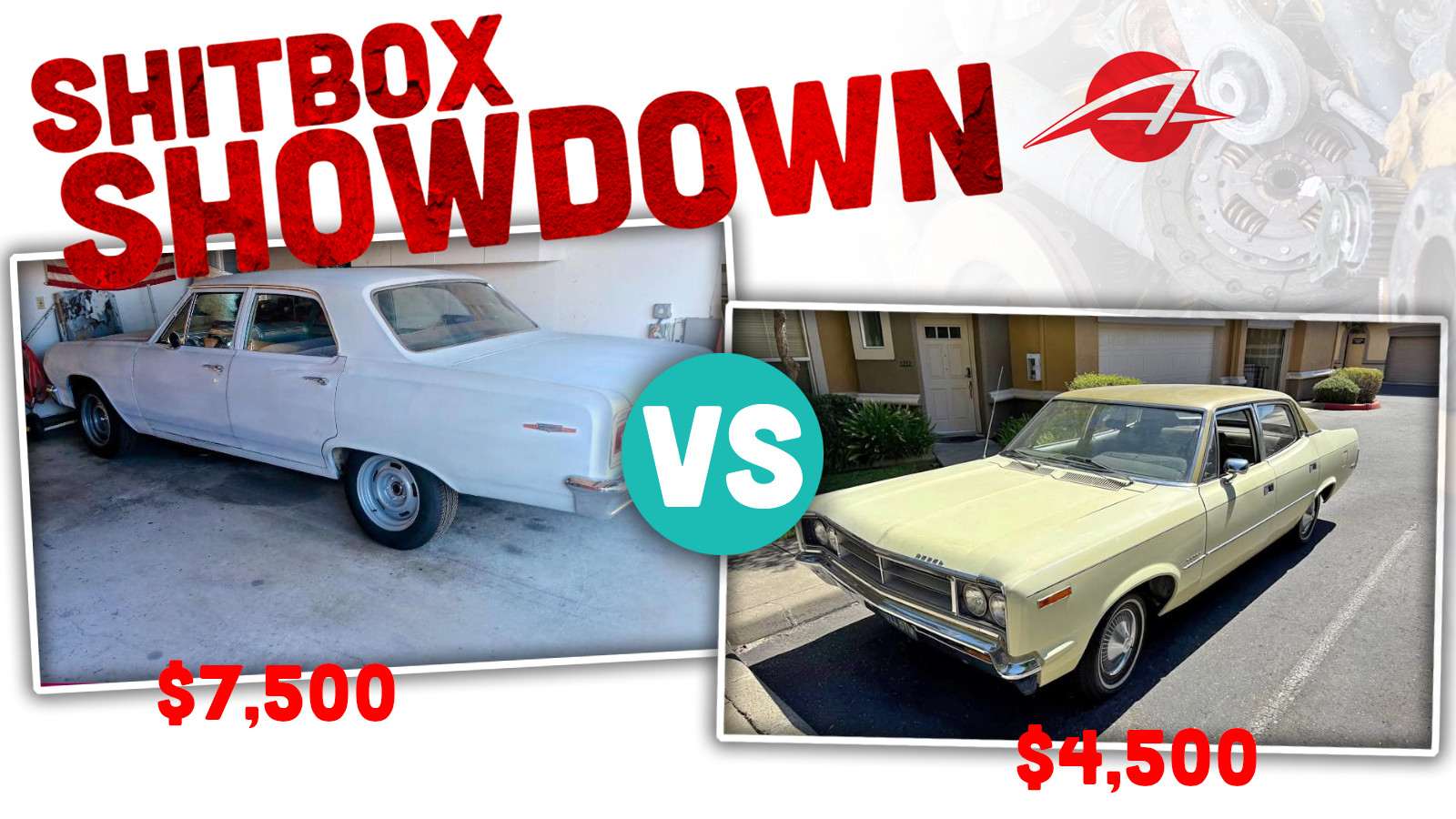
Cars come in all shapes and sizes, and that’s good, because so do people’s tastes. And often, you can get the same car in a few different versions, to make it even closer to what you really want. For some people, not even that goes far enough, and for them, there is the aftermarket. Today, we’re going to look at a couple of old American intermediate four-door sedans. One is as it left the factory, and the other has been jazzed up quite a bit.
We had another blowout yesterday; the Volvo 940 absolutely wiped the floor with that old Peugeot. Many of you confessed an appreciation for the Peugeot, but found the Volvo just too much of a draw. Peugeot being an orphan brand in the US didn’t help its case either, because parts could be hard to come by.


That Volvo is an awfully nice car, and it looks like a good deal, but it doesn’t do anything for me. The Peugeot, on the other hand, calls to me like a siren. Would I end up regretting it? Maybe, but I can’t resist. Someone said you could probably sell the wheels for the asking price of the Peugeot. Sounds like a deal to me.

When I was younger, I had a lot of friends who liked to modify cars. I never really got into it myself, after a few disappointing experiments, but I did help out with a few projects. Out goes the old perfectly-running six-cylinder, in goes a V8 of questionable quality, covered in chrome bric-a-brac. Scruffy interior parts are ignored, but shiny new wheels and tires worth more than the car get bolted on. And whole cases of spray cans of gray primer get applied over old faded paint.
The results of these endeavors was sometimes a lot of fun, but honestly, I never understood what was wrong with the cars in their original condition. I guess I’d rather maintain something and enjoy it as-is than put in a ton of effort to make it go a little faster. But I don’t hold anything against anyone who feels the need for speed. Today, we’ve got one car that has been hopped-up, and one that’s factory stock, so the choice is yours.
1965 Chevrolet Chevelle 300 – $7,500

Engine/drivetrain: 350 cubic inch OHV V8, four-speed manual, RWD
Location: Menifee, CA
Odometer reading: 99,000 miles
Operational status: Runs and drives well
American cars got a lot bigger over the course of the 1950s. Too big, in the eyes of some buyers, who embraced the smaller offerings from Nash, as well as imports like Volkswagen. The Big Three responded with small cars of their own, and those sold well, but there was space in the market for something in between. Ford was the first to offer an intermediate-sized car, the Fairlane, but Chevy wasn’t far behind with the Chevelle. This 1965 Chevelle is a base 300 model, which probably came originally with a four- or six-cylinder engine. It’s got a bit more than that now.

GM cars of this era are a lot like Lego sets: everything fits everything. You can mix and match parts to your heart’s content to get just the car you want. This Chevelle is now powered by a 350 cubic inch small-block V8, backed by a four-speed manual. It has a Positraction rear end, a quick-ratio steering box from a Trans Am, and power brakes with a disc conversion in the front. The whole suspension has been rebuilt, too. It “runs and drives and stops just fine,” according to the seller, and I bet it moves.

The interior doesn’t look bad, but it’s unfinished. It needs a new headliner, but the seller is including one. I can’t tell if the seat upholstery is original or if it has been redone, but it’s in nice shape. The blue sparkly steering wheel and shift knob are a choice, but they’re easy enough to change if you don’t like them.

It’s all in primer outside, “ready for paint” according to the seller, but all the trim has been reinstalled, so I have a feeling they meant to leave it like this. Painting cars isn’t cheap, but personally, I think it’s worth it in this case. Why put all that work into the mechanics, and then leave it looking like a high school kid’s car?
1970 AMC Rebel – $4,500

Engine/drivetrain: 232 cubic inch OHV inline 6, three-speed automatic, RWD
Location: Folsom, CA
Odometer reading: 305,000 miles
Operational status: Runs and drives well, but needs a little tinkering
American Motors made its name building small and simple cars. But as the muscle car wars of the 1960s heated up, AMC wanted to shed its fuddy-duddy image and join in on the fun. Thus, in 1967, its Rambler Classic line was replaced with the Rebel, which was available with increasingly large V8 engines and increasingly flashy graphics. But most Rebels were more like this one: a simple, plain, no-nonsense four-door sedan.

This Rebel eschews V8 power in favor of AMC’s legendary inline six, displacing 232 cubic inches and making 145 horsepower by the old SAE gross measurement. It has a three-speed column-shifted automatic. This combination has served it well; its odometer has gone around three whole times, and it comes with service records going all the way back. It runs well, but the seller says it stalls on hard acceleration until it warms up, and it can run a little hot in stop-and-go traffic. The stalling issue is probably related to the choke, and the hot running could be a sticking thermostat. Both are easy fixes. It also has a small transmission fluid leak, which, if it’s not too serious, could probably just be lived with.

It’s very original inside, in an ugly but endearing shade of green. The upholstery is torn in a couple of places, and the dashboard top has some cracks, but it looks honest. The speedometer doesn’t work properly; it sits at 60 when the car is standing still and goes up from there. If you can’t do the math on the fly, better get a GPS speedometer.

It’s incredibly clean and original outside, with all four hubcaps even still present. It doesn’t have any rust, either. The seller says the left front fender was replaced at some point, but you sure can’t tell.
So many old cars from the 1960s and ’70s have been modified in some way that it’s almost cooler to see one that’s totally stock, at least to me. But a well-done project like that Chevelle is impressive, too. It all depends on your tastes. So what will it be: the modified Chevy, or the survivor AMC?




My early childhood transportation was a Rebel station wagon. Nope. Can’t do it. Don’t want to go back there.
Of course I don’t really want the Chevelle either. It’s a little too similar to the Rebel.
Time to get a therapist on speed dial.
The AMC is nice, but if I bought it I would want to fit a 4 speed and a V8 anyway so the Chevelle seems like a no-brainer. Plus as other people mentioned, getting parts for it would be much easier.
Going to go for the Chevelle today and say something I normally abhor:
“It’s a better investment.”
I’m very fond of AMC, and that Rebel is the more honest car here. And in 2026, the novelty of seeing something you never see is palpable. But there is a problem.
It’s buried in the text of the post, actually.
You see, while the primer-patina of the Chevy makes it look “like a high school kids’ car,” the AMC, even with a “Rebel” badge, cannot shake the reality that it was definitely what the uptight, authoritarian Principal would have driven.
AMC sedans were square-ass cars for square-ass people. Look, there’s even an interior refuse bag hanging from one of the knobs.
This is the kind of car that the church parking lot would just be THICK with for the early mass. They clogged the roads during the unofficial Senior Driving Hours of 9-11:30 am; when school was in session and commutes were over – prime time to get to the pharmacy, the cardiologist, and the donut shop for a glazed stick and some glowing chatter about Reagan.
I like that the AMC is a time capsule, but think about what it’s actually taking you back to.
I’ll take the someone-else’s-project Chevelle today. That car can be rebuilt from the Summit website. Besides, a case of Plasti-Dip, well, Hyper Dip will see it colored once again.
I like them both, but I’ll have the spicy Chevelle crew cab. First order of business, swap out the single pot of death for a proper dic brake dual circuit master cylinder. Second order of business, a case of rattle cans. Third order of business, drive.
Four on the floor? Say no more!
I’m going to revel in the Chevelle, the AMC is just a Rebel without a Cause.
The Chevelle is the better car and a wiser purchase, but the Rebel is more my style. It’s another one of those old lumps of American iron that makes me think of The Dude. It has major slacker vibes but it gets the job done. Besides, if I need to get somewhere in a hurry I have another car for that.
I get a bad feeling about the Chevy, like there might be something radioactive in the trunk… besides, I grew up driving AMC, so it’s the Rebel for me. Now c’mon, “let’s go do some crimes… [like] get some sushi and not pay”
I want the Chevy, but the AMC is in much better condition. Then again, I could pick my color….
I actually picked the Chevy, surprised myself
Primer isn’t meant to be a long term surface coat, if you leave it too long it starts to oxidize and will need to be removed and replaced with fresh primer before you can paint over it. That, plus the evident scuffs under the door where they have scratched away the primer with their feet getting in/out of the car tags this as needing much more than just paint to get it right.
I’m going with the Rebel, at half the price, and none of the tomfoolery it’ll be the cruiser for me. I’d treat it like Christine, non-sensible backwards restoration over time. Once it idles and cools properly, I’d address the trans leak; then turn my attention to upgrading the brakes and suspension so it’s safer to drive in modern traffic. In 10 years or so I might have a nice warm weather cruiser, it’ll never be fast, and that’s OK.
I’ll take the AMC. It’s fast sitting still. When the baseline is 60 mph, you’re definitely going to win any drag races.
I will save some money on the AMC today, I am sure it would cost about $3k to drop in a v8 and perform the same updates as the Chevelle, and I doubt it would be worth $7,500 when you were done, but I would rather do the work myself and I don’t do paint (although I am curious to try it!). I will take the Rebel for its originality and tinker with it for a few years.
Depends on the V8. If you’re keeping it period-correct with an AMC V8, prepare to spend.
A lot.
Like more than MoPar money, which is also a lot.
A cheap LS swap is, of course, eminently possible, but it’s never JUST the engine/trans. And by the time you’re done, you still have a car that smells like lemon drops, mothballs, and gasoline when left in the hot sun.
There’s an important distinction here though. I really appreciate seeing stock cars, but I’d rather own and drive one that has been modernized. Not necessarily just sticking a big honkin’ V8 in it, but modern suspension, brakes, etc make these old cars so much mroe livable and usable.
Chevelle. I like a lot of AMCs, but despite the charmingly originality, this one checks all the wrong aesthetic boxes, especially the interior. But I do really like the sparkly blue of the Chevy, and the simplicity of the SBC.
Maybe I’m just in a mood, but neither do anything for me. If the Culvers tag was 66, then maybe.
Chevelle does not have discs since it’s still a single pot master cylinder. What else is the seller not being truthful about?
I’ll take what looks to be an original paint car over one in primer any day. It’s easy to mark the AMC more fun to drive and you’d have the only one at Cars and Coffee.
It could have discs, with the wrong master cylinder installed. Plenty of people are that dumb. It must stop absolutely awful.
The AMC Rebel goes perfectly with my new Easter bonnet. How could I resist? All the better if the long-awaited ButterBurger and frozen custard go with the car (eventually).
Voted for the AMC but why is there a Culver’s drive-thru tag on the dash? Inquiring minds want to know…
Much as I’m a sucker for Chevy’s mid-60s sparkly swimming pool blue interior, today’s an AMC day.
Chevelle. Parts to fix and upgrade are exponentially easier to find and cheaper. You could spend the $3k price difference on making the AMC nicer, and it probably still wouldn’t be worth as much as the Chevy.