

The strange quirk of the last few years is that a certain segment of the population switched from viewing hybrids as a culture war byproduct and focused their ire, instead, on electric cars. As hybrids have gained mainstream acceptance, there’s a vocal minority of EV owners who are now the ones denigrating the technology.
There’s new data out showing that hybrids remain a decent gateway to electrification and a great one to hybrids. Electric car owners are still most likely to buy another EV, but if they go back to something with a gasoline engine, it’s less likely to be a hybrid.


Some of this might be a cost issue, and Canada is likely to be a test of what Chinese automakers might do to our market in that regard. Currently, there’s one automaker seriously looking to build in Canada, but how serious is now a question. Also at question is how long Honda’s CEO is going to make it, given his bad bet on EVs.
The Morning Dump is a daily news roundup and not a chance for me to exercise my personal grievances. Today will be an exception, because automaker Nissan is putting forth a new luxury experience with the dastardly Tennessee Titans, and I can’t not remark on it.
EV Owners Mostly Want EVs, Except When They Don’t
I enjoy looking at the return-to-market (RTM) data from S&P Global Mobility, which tracks what consumers end up buying when they got back into the market. Overall, loyalty has been trending slightly downwards in the last year. This is especially true for luxury brands, which now lose more customers than they get back.
What I’m more interested in, today, is how EV owners and hybrid owners act when they go back to buy another car. The chart below is a little fuzzy, but you can get a sense of what’s happening.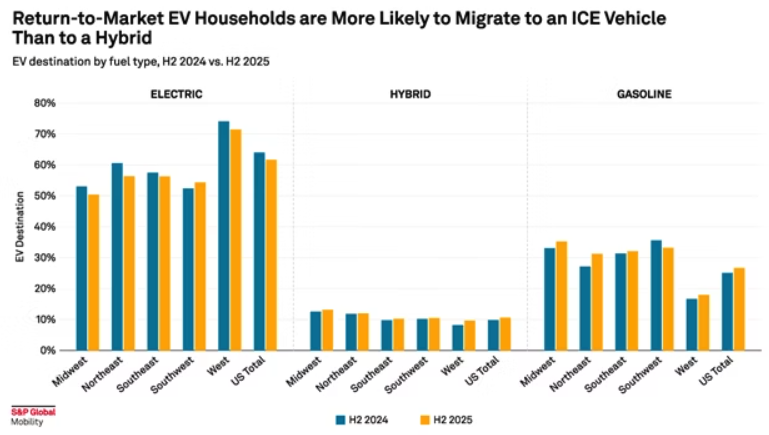
Overall, EV owners grab another EV when they go to market, although the number that did drop in the second half of 2025, even with the large number of EV purchases pulled forward. Where did those buyers go? About 10% went to hybrids, although a bigger and growing chunk ended up in a gas-powered vehicle.
Because these consumers already have an electric car in their garage, a lot of what is happening here might reflect a lack of hybrid or electric options in certain segments. If you’ve got a Tesla and want an electric minivan or sports car, your choices are somewhat limited.
What about hybrid owners?
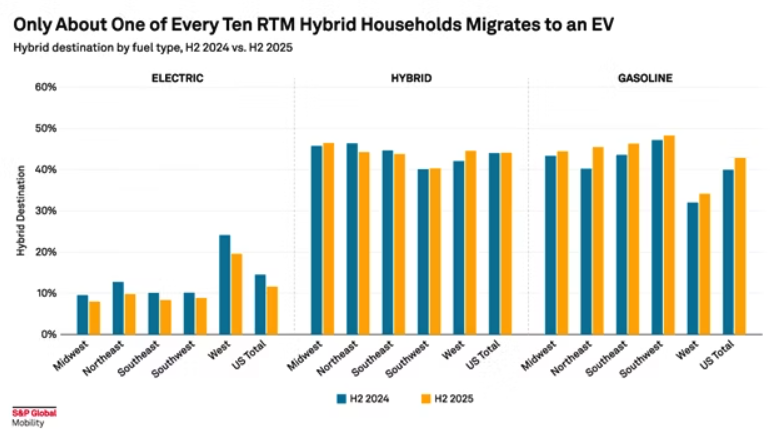
While it’s come down a lot in the last half of 2025, hybrid owners are actually a little more likely to buy an EV next than an EV owner is to buy a hybrid. Loyalty to hybrids as a power source is lower than EV loyalty, with fewer than 45% of hybrid owners getting a traditional gas-powered vehicle next.
With a softening of the electric car market after the cancellation, this data suggests that perhaps expanding into areas that aren’t well-served by the market could get returning customers. It also shows that, while EV owners are probably replacing their EVs with other EVs, buyers seem to like to have a non-EV vehicle as their second car.
Canada Rejects Knockdown Kits From Stellantis

One of the hallmarks of Stellantis is that it seems to always be working an angle, sometimes at its own peril. Leapmotor is a good example of this. The JV that Stellantis has with the Chinese automaker is expanding to new markets, and this has included sending production overseas. Sort of.
In Europe, Leapmotor tried to take advantage of subsidies for electric cars by building cars in its Tychy, Poland plant. Not full automotive production, but production using knockdown kits. This means most of the cars were manufactured in China with the last step of assembly in Poland. Doing this doesn’t create a ton of jobs as the supply chain stays in China, and European governments eventually said “non” to those subsidies. Leapmotor abandoned Poland when this happened.
I mentioned last week that Stellantis was looking at local production in a plant in Canada that the company took Canadian subsidies for and then abandoned for south of the border. With Canada and China cozying up, this makes a sort of sense. However, Stellantis is trying to avoid having to pay back its subsidy on the cheap by proposing knockdown kits for Canada.
Canada’s response, via Bloomberg, isn’t exactly positive:
“We can’t bring cars in a kit to Canada,” Joly told reporters in Vancouver on Thursday. “It needs to support the local supply chain.”
[…]
Joly said she would only support the return of production at the Stellantis plant if it was backed by both the Ontario government and Unifor, and laid out other criteria for the plant’s future.
“Conditions for workers need to be good, and actually the same as they were and even better,” Joly said.
While some of this is economic, it’s also probably political. If the United States and Canada make up and the US asks Canada to knock it off with this Leapmotor thing, I bet the Canadian government listens. A factory building cars from knockdown kits is way less of an investment.
Honda Exec Asks ‘Why Did We Stop Developing Engines?’

Honda’s plan to electrify in the United States has been mostly a disaster, costing the company billions of dollars. A lot of this was the work of current CEO Toshihiro Mibe. Given the loss of all that money, there’s some grumbling in the local Japanese press that maybe Mibe’s days are numbered.
There’s a big feature in Nikkei Gendai (translated) about what they say is the growing dissatisfaction with Mibe, and it includes some strong recriminations:
[D]iscontent is swirling within the company because of Mr. Mibe’s slow decision-making and the growing distrust stemming from his past statements. One executive commented:
“The president said, ‘There’s no need to develop gasoline engines anymore,’ which caused talented engineers to quit. However, now that the EV market is looking uncertain, he’s going back on his word, saying, ‘Why did we stop developing engines?’ and trying to escape responsibility for his own misjudgment.”
Another executive pointed out, “Toyota responded quickly, for example by postponing the construction of a new battery plant for EVs, but Honda was slow to make a decision. This impairment loss and strategic review should have been done a year ago.”
Honda is a great company in a bad spot. Will the board kick Mibe to the curb in the middle of a crisis? That’s the question.
The Deep Offensiveness Of The ‘Nissan 1960 Club’

Growing up, Houston had a football team called the Oilers. With their Columbia blue-and-red uniforms, they were a big part of my youth. That was before the villainous owner Bud Adams decided to relocate the team to Tennessee in order to get a fancy new stadium that Houston was reluctant to build for him.
It was a terrible betrayal, and I’ll never forgive the Titans for it, so when I saw this render from Nissan, I grew angry. Here’s what this is supposed to be:
As the new Nissan Stadium nears its February 2027 completion date, the Tennessee Titans and Nissan officially introduce and share renderings of one of its premium clubs – the Nissan 1960 Club. Named for the year Bud Adams founded the franchise and Nissan Motor Corporation was established in the United States, the club features nods to the storied history of both organizations.
That’s cool about Nissan. I like Nissan. I will celebrate more than 60 years of Nissan in the United States. The Titans are dead to me, though.
What I’m Listening To While Writing TMD
In honor of Houston, here’s Don Julian & The Larks with “Super Slick.”
The Big Question
Could you live with two EVs?
Top graphic images: Tesla; Mazda


We’ve got 3 cars at the moment, so yes, I could swap two of them for EVs and still have an ICE car for the road trips. Not gonna happen, and I would have to figure out how to charge at home, but mostly there isn’t an EV that could replace my Eunos, the Rav4 was Grandma’s, and that will not leave my ownership as long as it runs, so then that leaves the Sienna which is needed for long road trips, so guess I’m sticking with what I’ve got.
Now if I had to make moves to EVs, I would be seeking 2 that don’t exist for real yet. The Aptera would replace my Eunos because it’s weird and wild enough that I could see myself enjoying the hell out of that, and the Slate fastback would replace the Rav4, and we’d keep the van. Like I said, not happening, but I could make it work.
Tell me more about this Eunos!
1996 BRG Eunos Roadster. It’s basically just a RHD Miata, but it’s so much fun! DT signed off on me showing it off here and showing the differences between the UDSM Miata but then I got distracted and never finished putting it together. I need to revisit that.
I did go digging through Search to see if I’d missed one of your articles on it. That’s a fun car to be sure, was hoping it was a Eunos Cosmo though 😉
No, I did show it off here: https://www.theautopian.com/an-old-olds-sister-subarus-and-japan-defeats-england-members-rides/ since Sid is local to me, but that’s the only time I’ve shown it off here. That was before I put a new top on it too.
Those badges are neat, also the wipers being reversed (which makes since because RHD) is just off enough to make me look closer.
Other differences that stand out to me:
The orange circular side reflector, and the chrome door handle. I don’t know Miata’s well enough to say definitively but don’t recall seeing those before. BRG with a tan top just looks so right this car.
Hmm, could I live with two EVs?
The Ram SBRC is now 12 years old and I put a whopping 358 miles on it last year. It’s been 100% trouble free from day one. Might as well keep it until the sun burns out. Paid $22.5k out the door for it with only 7 miles showing. Long paid off.
The wife’s Challenger is now 9 years old. Under warranty an oil leak and the infotainment system were fixed/replaced. Been fine otherwise. It’s got 44k on it and she doesn’t like the new Charger, or Stang, so I guess it’s sticking around. It’s our “family car” as well. Paid $29.5 OTD and she factory ordered it. Long paid off.
They’ll be prying the key fob out of my cold dead hand to my 23′ Miata. It was stupid pricy at $38.9 OTD but:
1. Who cares?
2. What else are we gonna do with the money, leave it to the kids??!!
3. The dealer threw in a lifetime powertrain warranty.
4. It’s a freakin’ Miata!
While an EV would work fine for us given our limited driving, there’s no real point at this time.
I concur. You two are driving about 5,000 milers per year. You get to drive whatever you want. An EV would be wasted on you, because it only saves gas when it’s driving.
Yeah, we don’t drive much. My commute is 6 miles round trip, all done with the Miata.
Wife works from home.
Commuting sucks, this is the way to go.
We live in a small town and everything and everyone is five minutes away or less.
We could keep these cars for decades, which we have done before.
That would be a very reasonable choice, economically and ecologically.
Another consideration is there really aren’t any remotely decent E-REVs available right now. If something like the Mazda 6E sedan and 60 SUV were an option for US buyers, I suspect they would be a very popular choice. (All electric drive = instant torque and power at all times + smallish battery for maybe 80-100 miles before the ICE kicks in. Perfect for local drives AND road trips)
The upcoming SCOUT E-REV looks interesting but
And should have mentioned EREVs with smallish batteries should be able to get a ~80 mile recharge overnight with a common 120v outlet. No need to deal with adding 240v outlet unless you want to. Makes EREVs even more practical.
Plus Scout is owned by VW so you know they’ll find a way to fuck it up
In the rural south where I live, owning an EV as your primary (or only) car is still untenable. An almost total lack of charging options means you would need to charge at home and thus be range-limited to the distance of half (or less) of a full charge. Until that changes, a significant portion of the population will never even consider an EV. This is where hybrids make more sense for most folks.
Yeah, I’m in the midwest and it’s just not feasible for me. Ranges have improved to numbers I am pretty comfortable with. But charging is just not good enough yet.
And for people who want to argue that, I don’t consider using a charger behind a random Meijers or in a Panera parking lot as “good enough.” I’ll get an EV when the charging infrastructure starts to resemble the current gas/diesel infrastructure.
This might be the problem: you have no idea how you will use the charging infrastructure until you live with an EV, but people won’t buy EVs until they feel the infrastructure is there. Everyone has a different use case, however the general pattern is most people (with home and/or work charging), charge exclusively there, save for a few road trips a year. I agree hanging out in a Walmart parking lot isn’t ideal, but that happens 3-4 times a year for me and I think for most.
I’m about two years in to driving an EV and I have used a public charger twice. One of those was just to make sure I had everything set up properly.
If you had a gasoline IV that could drip a quart of gas into the tank for every hour you have it parked, you’d be shocked how little you would need to stop at a gas station.
Yeah I remember when I got my Leaf I was SO excited to drive 15 miles to the Nissan dealership to experience fast charging. I then realized what I was doing was dumb. Didn’t use fast charging again in the 5 yrs I had the car
That’s a good point. I mentioned this below, but I work from home and drive across the state to the office a couple times a month. So my use case for refueling is unusual. Usually I leave home around 5am and get gas an hour later as a way to perk up. On the way home, I am one of those crazy people who refuses to stop unless it is absolutely necessary (I miss my kids and my brain turns a 5-minute stop into a catastrophe).
In my case, it would HAVE to be public charging, because I live in an apartment. My landlords are fairly open-minded, so I could see them being willing to install a charger, but we also have street parking only. Would my small city give them a hard time? I just don’t know.
I do think though that part of the issue is enough people aren’t willing to try to solve problems like this, not yet anyway.
It’s not a problem until there are a bunch of street-parked EVs that can’t charge. But people won’t buy EVs without a place to charge at home.
This isn’t going to come up on a small city’s radar as a problem.
Yeah – the existing townhouses/apartments/etc. with no charging remains a problem. The actual charging equipment isn’t cheap but it’s not terribly expensive. However, all the construction / digging up the ground / pouring concrete pads / laying conduit / repaving / etc. is expensive.
Exactly this.
I just drove through a part of my city last week that I haven’t been in for years. I looked at what was lining the main drag, and saw a weird gas station. Turns out, it wasn’t a gas station at all, but a charging station! This part of the country is fairly red outside of the cities, but even within the city/metro, this is a first that I’ve seen a charging station built like a gas station.
If I’m starting to see that near me, there is some momentum to the charging infrastructure being built out!
That’s awesome!
I’m curious why you would want to replicate the gas station model instead of placing chargers near places that people are more likely to spend 30 minutes.
I don’t DC charge my EV much but when I do the last place I want to spend 30 minutes is at a gas station. A restaurant or coffee shop is a much more pleasant place to take a break on a trip.
I’ll also say that there is a lot of EV charging out there that people that don’t drive EV never notice specifically because chargers aren’t on busy street corners or interstate exits like gas stations.
I think in a situation in which you need “fuel”, you ideally want to go to a place whose purpose is to provide you fuel. I’m probably at a 99.9% success rate for being able to get gas at a gas station without it being a big time suck on my day. The last thing you want to do is drive to where you think there might be fuel, and find either a bank of broken chargers, a bank of occupied chargers, or… simply no chargers. Again, YMMV, but around here, public charging is pretty shit. I’m sure most places are better than here for charging, and I understand I’m in the minority.
As for road trips, I don’t particularly want to go on wild goose chases off the interstate for charging. I need fuel, and I need to get back on the road. How nice the stop is, is sort of irrelevant.
Yes, YMMV.
If I’m on a longer trip I need to both eat and fuel. I’d prefer to combine those activities and I’m not a fan of gas station food.
Apps take the “wild goose chase” out of charging. I have yet to find the mythical bank of broken chargers I hear about on the internet. I’m still at 100% for show up, charge, leave. I’ve found the occasional broken charger but just moved to another.
Considering the convenience of home charging for 90% – 95% of needs I’m not going to stress about getting a bite to eat when charging on a longer trip. I also don’t do the marathon drives now that I’m in a different point of life and actually have vacation days. Either the trip is the point or I’m flying.
Yeah the main argument is that in reality, you shouldn’t really be charging in public that often anyway. Which I do understand. The apps I understand are helpful, according to EV owners I know. As for the broken chargers they’re just a reality of an area with very very very low EV adoption. There’s a bunch that seem to have nobody maintaining them.
And yeah, the calculus of road tripping changes dramatically with a decent vacation policy. My wife and I don’t exactly have a tremendous amount of vacation, we have two young kids, so unfortunately vacations and such involve a lot of “optimization” (flying a family of 4 anywhere from a smaller non-hub airport is… expensive). Which sucks, but the alternative is to not go anywhere.
That is to say under different conditions, EV road tripping doesn’t really seem that bad, they just don’t seem to be accommodating for my very specific set of parameters.
Yes, EVs don’t work for everyone or every use case. Given the choice between road tripping an EV and a ICE and I’d take the ICE (and do). That said, “fueling” an EV away from home is simply different than with a gas car. It takes longer so the model that works for gas doesn’t necessarily work for an EV.
In my experience most of the old and broken chargers are AC Level 2. People either got an incentive to put them in and did so to try to win some business with free charging or they are paid chargers from awhile ago and the economics simply do not work. I would never pay 3x to 4x more per kWh for slow AC charging.
That’s a fair question. I would charge mostly at home. I work from home but have to drive 2-3 hours (each way) a couple times a month. So almost every time I get gas it is on a mini road trip, and I’m looking for the most convenient place to stop. But I realize that is not a common set up!
The charging station industry is learning from this.
Some public fast chargers are being installed at or near gas stations. Others are being installed at places one might want to stop anyway (Five Guys/In-N-Out/Whataburger/Starbucks) on a road trip. Some charging networks (e.g. IONNA) blur the two.
Yeah this is the issue I tend to have. Most of the local chargers are located in places I simply don’t want to spend any amount of time. The only legitimate charging station is a bank of Tesla chargers in the parking lot of what I would call a nearly dead mall. And the non-Tesla ones are always broken. Also, a lot of our medium length trips involve driving into places that are “overwhelmingly rural”, lol. Add in a winter that seemingly never ends and it’s tough to get on board.
I get that a lot of folks live in places where the infrastructure is wayyyyyy better, and I’d bet that we’ll eventually get there too. We’re just not there yet.
Time to push your local do-nothings for real change, eh?
Not sure how the question was framed, but as the owner of a perfectly great EV (’24 Ioniq 6 AWD limited ~4.5 secs 0-60!) – IF I was in the market for another vehicle to ADD to the fleet, I’d look for a pickup especially for it’s towing and hauling capabilities – something to COMPLIMENT our EV, not replace it and not duplicate it. Or perhaps a fun little 2-seat convertible sports car with a proper manual transmission to scratch that itch carving through the twisties. Not a hybrid there either. So my answer would be most likely an ICE too. Doesn’t mean I wouldn’t get another EV – but only if I needed to replace the one we have.
That said, I actually have a 25′ Maverick AWD Hybrid with 4K towing AND a 91 lovely near-mint British Racing Green Miata with a 5 speed sitting in the stable.
I consider all of my itches scratched. 🙂
This right here. EV for commuting duties, truck to do truck stuff, fun gas car.
Living the dream
I suspect this is why the numbers look the way they do. People buying a pickup/sports car/ van to supplement the EV.
You sure can write things up about statistics however the heck you want.
Wrote a book with all the other ways of spinning these data.
Deleted it.
EV owners are likely to very likely to buy another EV next, depending on region.
Some buy hybrids or gas cars for reasons.
I think a lot of two and two+ car households want at least one gas car whether because it is a toy, it is to pull toys, for size, or, of course, for maximum flexibility.
Agreed. I always hate when owners shift locations just for a new stadium. My Niner’s just did it, and I don’t even like Levi’s stadium. It’s even worse when they leave the city, such as the poor Raiders, Chargers, Rams..whelp I guess this is a Southern California issue primarily, now that we step back and look at this.
Billionaires asking the municipality to publicly fund their stadiums doesn’t sit right with me. It’s annoying when they hold everyone hostage by threatening to relocate if they don’t get their way.
Here in DC vital social programs are being cut because the local government decided to hand over more than a BILLION taxpayer dollars to help finance a new Commanders stadium for a billionaire freakazoid owner. They ousted one of the worst owners in the history of professional sports, had a single good season that was a complete and utter fluke, took a boatload of public money after said season, and now it’s apparent that the new owner is just another run of the mill billionaire lizard meatriding Trump.
I hate this shit. No public money should be spent on stadiums when the owners are as wealthy as they are now. It’s a gigantic scam and the billionaire class is already bending us over enough….
But, but, but…jobs and stuff?
The wealth will TRICKLE DOWN!
If you limit your view to football, sure it’s just Southern California, but let’s always remember the Jazz, named after a style of music, who moved from New Orleans to Utah, where they don’t allow music.
At least they kept the name so everyone can remember what they did. Most names are too generic for it to be so obvious.
Back to southern California, who can forget the Los Angeles Lakers?
Ha 🙂 similar minds!
LA Lakers anyone? (Formerly from MN)
Or the Dodgers (famously formerly from Brooklyn)
Or the “Dallas” Stars (hockey) formerly from MN
Everybody kept stealing MN teams!
I Know! And the Stars had the tamerity to Win the Cup right after they moved too!
Also the Lakers were a high performing team when they left MN as well!
Now (on mens side) the last championship was the 1991 Twins
Sports fans in Memphis mostly hate the Titans too. They played in the city 1 year while they were waiting to move to Nashville and trashed talked the city then wondered why no one showed up at their games. The Titans are dead to me soo as my ICON might suggest.
Moving from the Titans to the Saints? Woof. That’s like trading the flu for strep throat. You’re a real one though, that’s for sure.
Grew up in NOLA so always been a saints fan – can’t beat the Drew Breeze Super Bowl so been sticking with them through the hood and bad. This year should be better than the last.
In that area, the saints border on religion (pun intended). Like with many religions, they don’t have to be good to have loyal followers.
Give us the Lakers back and we’ll start feeling sorry for SoCal!
I don’t live in LA, but please take the Lakers regardless.
I still haven’t forgiven the NBA, The Sonics or Howard Schultz. Haven’t seen an NBA game in ~18 years. Fuck the NBA.
We’re a 2 Outback family of three and big old dog (so probably just 3 in the next couple years), ’18 and ’19. Both fully paid off, etc etc. The plan is to drive them until they kick the bucket, although I do have the itch to get something new (mainly for what I’m guessing are purely mid-life crisis type reasons, looking at you Land Cruiser). I would probably look at something like the Slate for around town/mulch hauler/deer hauler/80 mile commute 2x/days a week if it was affordable, and just plug it in at home.
We have two EVs for a family of six. Both of us drive 90-120mi/day. Our gas powered car just sits in the driveway. I really don’t agree with the EREV idea that David pushes here
Wow, that is a shitload of daily driving.
What don’t you agree with? I’m not really “pushing” for anything — when I talk about EREVs I more or less just state the obvious; that EREVs are more palatable to more people than EVs. That they can be cheaper than EVs. That they can be more environmentally friendly, etc. But I’m ears!
I don’t agree that they are the future like the article states. I do believe that the points you make are logical, but disagree with the conclusion. I live with 4 kids and two huge commutes so this isn’t extrapolating too much.
The inconvenience of a 240mi range is about zero for our use, and we drive a ton. $2k for a level 2 at home is plenty for us.
Didn’t intend any negative connotation to “pushing”
It’s all good. I agree with you! But if there’s anything I’ve learned covering this industry, it’s that people are not rational. People have been buying cars for edge-cases since the beginning of time. They buy 911s for the one time a decade they hit a track. They buy Wranglers for the one time a decade they go offroad. They buy trucks for the one time every couple of years they tow a light load.
I’m actually trying to convince my wife to trade her Lexus RX for an RZ, which offers MAYBE 200 miles of range in optimal conditions. Totally enough for us. Does she wish it had a gas range extender? Yes. Will she probably be realize it’s entirely fine without one given our use case? I’m sure of it.
We are highly irrational buyers but point taken. RZ is attractive and a great RX replacement
People buy vehicles for edge cases, but the non-Chinese EREVs proposed by RAM and Scout etc are going to be ridiculously expensive lifestyle trucks. The complexity, cost and “good at everything” qualities of EREVs make sense for the luxury market, but not really elsewhere. I do foresee a market for EREV HD pickups and medium duty commercial vehicles. Regular people who tow a few times a year are probably better off buy a compact/midsize EV crossover and a cheaper ICE pickup truck.
The economy is contracting, and new EV battery tech is right around the corner. I think EREVs likely missed their chance to ever dominate the market.
I think it’s time to stop treating EREV tech as some sort of forbidden fruit, and consider the simple economics of such an expensive, complicated, redundant approach to powering a vehicle.
You say that, but how many EREVs are on the road in the US?
We had the i3 that I know you are a fan of but wasn’t exactly a hit. Then there were a couple for CA compliance and Scout if they’re delivering them yet.
Fisker got a lot of talk about their Karma, but it didn’t lead to anything on a larger scale.
Chevy Volt is the most successful, with ~160k sold over eight model years. If not for GM’s huge investment (and the public’s huge investment because GM is ‘too big to fail’) in that car, those numbers would have had it cancelled very quickly.
The power of choice. It’s not an either/or. David is right: there is a gap in the market that EREVs could fill for some customers. I think of it in terms of pickups: the 1/2 ton gas pickup is great for many customers; however, some need (and pay for) the 3/4 ton with the diesel and upgraded transmission.
We have everything from an Ioniq5 BEV to a ’43 Willys MB in the garage. We do road trip the Ioniq5 on 600 mile round-trips. With three kids, the Ioniq is done charging before all of us get through the washroom/get drinks.
We have been waiting for years for an off-road capable PHEV SUV to replace our AWD (non-plug in) hybrid eight passenger station wagon. We go deep off the grid (old fire / logging roads with a few water crossings); with a set of very aggressive all-terrains, the hybrid wagon does quite well. It just sucks to drive. A Grand Cherokee L PHEV/EREV would be ideal. Looks like we will wait for the Scout Traveller with the front bench.
That is a lot of driving. I actually love the idea of an EREV, one vehicle for both daily driving and overlanding/camping/tourism trips.
I currently live with zero EVs. I could certainly live with one in the house, as long as the range is reasonable. A second one used to be a solid “probably” because we mostly flew places when we traveled, but lately we’ve done the type of driving that I wouldn’t want to do in an EV (12+ hours each way, children in the car). So for now, the answer is “not at the moment”. The problem is that life changes periodically, and if we bought an EV as our most recent car purchase we’d be a bit stuck.
Hey, it’s me! I have an EV and I’m looking for a pure ICE car to be my second car! The reason is use case. I have my EV to be a reliable, low-cost, low maintenance daily driver. My second car is going to be a cross-country cruiser and fun to drive manual toy.
Looking at used BRZ/FRS/GT86, pony cars and Beetle R-line convertibles. It’ll be lucky to see 4-5k miles a year. The deciding factor is a manual transmission which isn’t available in hybrids or EVs
I concur. Mechanical and aural engagement, or even a convertible, just aren’t in the EV space yet.
To that point, I would consider a motorcycle that covers all those bases better than any of the options you listed. I just can’t justify how unsafe it would be without a group of others doing the same.
A motorcycle would be cool but this 2nd car has to hold luggage and passengers as my daughter and I travel from Ohio to Colorado to see my mom. Ideal car would be a C7 Corvette but that’s out of my budget ATM
TBQ: Sure, provided they’re the right two EVs. I need one of them to have decent range and an 800V architecture for long trips. I need the other to be able to do truck stuff like hauling lumber, dirt, bikes, kayaks, and the occasional light towing job. That one can charge slower and have a shorter range since it’s going to stay in the metro area and level 2 charge nearly all of the time. Right now, I’m a 3 car household – one small city EV for 90% of everything (commuting, errands, etc.), a 20 year old truck for truck things, and a big, comfy sedan thing for road trips.
I traded my daily driver Tesla for a new Jeep last week, so I am a former EV owner who went back to only having ICE vehicles.
For me, it had nothing to do with ICE vs electric. It was a matter of wanting a very specific vehicle that was only available as ICE (although, I should add I really wanted a manual transmission daily driver again, so while fuel type didn’t matter, the number of pedals mattered a lot). I would have considered an EV Wrangler if one were available, though (I wasn’t interested in a 4xe as those only come in 4 doors, have limited EV range, and appear to have significant reliability issues).
I am genuinely curious how I will tolerate daily driving an ICE vehicle again. I have said on numerous occasions that EVs are more convenient as daily drivers than ICE vehicles. After daily driving EVs for 7 years I am not used to regularly stopping at gas stations. Plus, fuel costs will increase from $0.04 per mile to around $0.23 per mile (or more depending on how the Iran fiasco goes), which is something I can afford but is not trivial.
So for me, the better question is not can I live with two EVs, but can I tolerate living with only ICE vehicles after years of EV ownership. I don’t know the answer to that yet.
Bingo. Some folks always have the exact same type of car their whole lives. Some folks really like to switch it up!
I couldn’t live with 2 EVs. I have no convenient public charging near me. My work has already set a hard rule of no free electricity. I could live with one EV though and one Hybrid, but that would mean selling my fun car as I can’t street park and only have 2 parking spaces
I could handle 1 EV for local use, but a 2nd probably wouldn’t work. Even with higher ranges, a lot of the western US is vacant, and I can’t imagine scheduling trips through WY or MT looking for chargers. It’s tricky enough calculating mpg and distance to the next gas station.
100% true. Once I drove 96 miles in WY without seeing a gas station.
I live with 2 EVs now. One is purchased and one is Leased. It meets our needs perfectly.
the lease is up in 1.5 years and quite honestly there is not a new EV I would get at this time. it’s not that I don’t want another EV, but nothing looks appealing. I hope that changes when the lease is up. it may come down to the best deal out there whatever engine type.
Yeah. I am pretty mad about my options when the lease on my EV is up. I don’t really want a crossover, and that seems to be pretty much all that’s going to be available. Bleh. I’ll probably have to go pretty far afield to find an Ioniq 6 or an Audi etron GT.
I live with 2 EVs now, both Kia Niros, both leases, one up in July one in 1.5 years. Both teenagers are learning to drive so we now need 3 vehicles. I can home charge on a Lvl2. I think the plan for the summer is one used EV (like an old Bolt) and one hybrid, PHEV or ICE older … wagon? Something safe, AWD and can hold a lot to let the teens use daily and then for road tripping and hauling. I’ve been obsessing over exactly what to do, takes up a considerable amount of my spare mind.
I could live with 2 EV’s if I also had at least one gas/hybrid vehicle. I have no place to conveniently charge.
And if I have a gas vehicle, why have 2 electrics? Just more to maintain and not fun like a weekend Miata or offroader.
We will unfortunately need two new cars in the next 5 years and as of now our plan is for my wife to get a hybrid family hauler (probably whatever Highlander or Grand Highlander we can get the best deal on) that we will use for road trips/visiting her family that lives 5ish hours away and for me to get a Rivian R2 that’ll probably stay within a few hours of DC but can still make the trip to her family without much trouble.
Between now and then I could be convinced to maybe get a hybrid instead, as the new Forester Wilderness hybrid is mighty appealing to me…but we’re not buying any daily that isn’t electrified in one way or another again. I’m going to hopefully be in the position to buy a pure ICE weekend car in 10ish years, but who knows.
There are levels of survival we are prepared to accept.
Willing to bet a good chunk of these EV-to-gas cases are people who bought them without the first thought about how to charge them. Expecting an EV to be like a gas car experience where they just pull up to a fast charger and then ending up disappointed because that is arguably the worst and most expensive way to use an EV.
I agree.
And also this isn’t necessarily EV replaced by gas – it’s EV households buying their next car. So some will be a replacement for the EV that makes them an EV household but since around 60% of households with cars have two or more of them, many of these are the other car.
I think you’re on to something with the limited EV options. I have an EV, but with my kid about to move out I don’t really need a crossover/ I now have the option to have a 2 door again. EVs in the US are pretty much a few sizes of the same car, or huge trucks.
I could live with 2 EVs if one was small for around town and one was big for road trips and there were charging stations at most rest stops/just off highway stations.
I’m very much a small-car person, but needs to fit the rest of the family.
All the mainstream EVs have more than enough range for my normal day-to-day, and chargers available for longer trips in major areas – if I have to take a 30m break every few hours to recharge the car: my bladder would be aligned with that.
They are very sparse in WI, MN, ND, SD, IA, etc. where I road trip. I am ok with the same 1/2 hr break every 2-3 hours if I could find a charger.
Our 1st family ev road trip was last Thanksgiving from MN (twin cities) to St. Louis.
The trip down from a recharging perspective was kind of frustrating as we ran in to a GM rapid charger in southern MN that wasn’t working.
Then again in a trip diversion near Iowa City
The trip from St. Louis back to MN was much much better. For the trip back we relied on Tesla chargers which were very reliable and all were working.
This was with a 26′ Equinox EV, so stopping to charge was roughly every 240 miles, so 1x every 3.5(ish) hours, which was a good point to stretch, pee and grab maybe a snack/drink
I do the TC to St L. about once a year, that is go to know.
Sure, but I think I’m more likely to live with one EV as my only vehicle than 2 EVs.
I think your suggestion that the rate of EV owners buying gassers is due to certain classes of vehicle being less likely to be electrified makes sense. I had assumed a lot of EV owners just wanted a gasser for ease of refueling, but I would expect a higher percentage of hybrids if that’s the only concern.
Yeah, that must be what is contributing to the data. People weren’t asked “would you replace your EV with a non-hybrid”, but rather they were asked “what car/truck are you looking to buy next” and the answers were “silverado” or “Pacifica” or “Bronco”
There’s no excuse for a global leader, be it a CEO or president, to publicly try to shift blame for their own decision.
It’s not just bad optics & fuels resentment: it leads to a deep distrust in decisions they make.
I could live with 2 EVs, if I had 3 or more cars. Not as my only transportation though.