

The strange quirk of the last few years is that a certain segment of the population switched from viewing hybrids as a culture war byproduct and focused their ire, instead, on electric cars. As hybrids have gained mainstream acceptance, there’s a vocal minority of EV owners who are now the ones denigrating the technology.
There’s new data out showing that hybrids remain a decent gateway to electrification and a great one to hybrids. Electric car owners are still most likely to buy another EV, but if they go back to something with a gasoline engine, it’s less likely to be a hybrid.


Some of this might be a cost issue, and Canada is likely to be a test of what Chinese automakers might do to our market in that regard. Currently, there’s one automaker seriously looking to build in Canada, but how serious is now a question. Also at question is how long Honda’s CEO is going to make it, given his bad bet on EVs.
The Morning Dump is a daily news roundup and not a chance for me to exercise my personal grievances. Today will be an exception, because automaker Nissan is putting forth a new luxury experience with the dastardly Tennessee Titans, and I can’t not remark on it.
EV Owners Mostly Want EVs, Except When They Don’t
I enjoy looking at the return-to-market (RTM) data from S&P Global Mobility, which tracks what consumers end up buying when they got back into the market. Overall, loyalty has been trending slightly downwards in the last year. This is especially true for luxury brands, which now lose more customers than they get back.
What I’m more interested in, today, is how EV owners and hybrid owners act when they go back to buy another car. The chart below is a little fuzzy, but you can get a sense of what’s happening.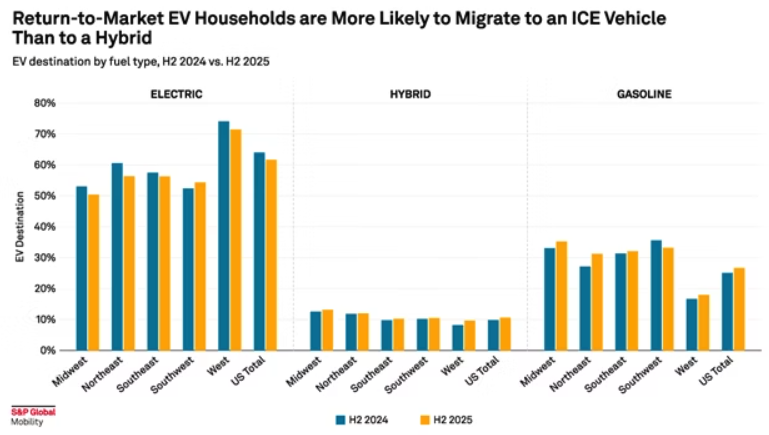
Overall, EV owners grab another EV when they go to market, although the number that did drop in the second half of 2025, even with the large number of EV purchases pulled forward. Where did those buyers go? About 10% went to hybrids, although a bigger and growing chunk ended up in a gas-powered vehicle.
Because these consumers already have an electric car in their garage, a lot of what is happening here might reflect a lack of hybrid or electric options in certain segments. If you’ve got a Tesla and want an electric minivan or sports car, your choices are somewhat limited.
What about hybrid owners?
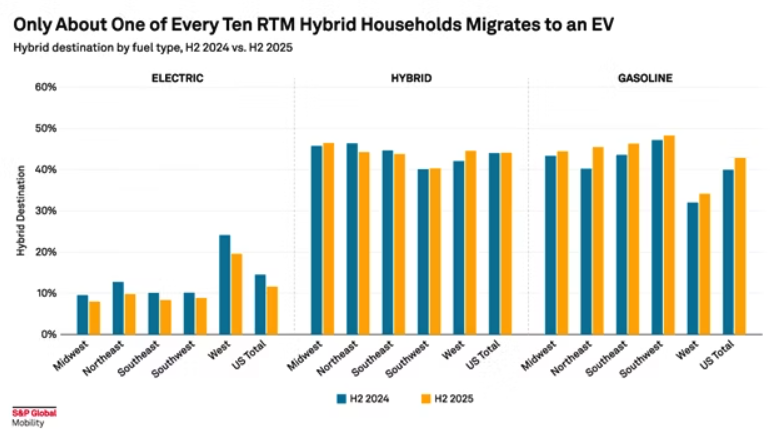
While it’s come down a lot in the last half of 2025, hybrid owners are actually a little more likely to buy an EV next than an EV owner is to buy a hybrid. Loyalty to hybrids as a power source is lower than EV loyalty, with fewer than 45% of hybrid owners getting a traditional gas-powered vehicle next.
With a softening of the electric car market after the cancellation, this data suggests that perhaps expanding into areas that aren’t well-served by the market could get returning customers. It also shows that, while EV owners are probably replacing their EVs with other EVs, buyers seem to like to have a non-EV vehicle as their second car.
Canada Rejects Knockdown Kits From Stellantis
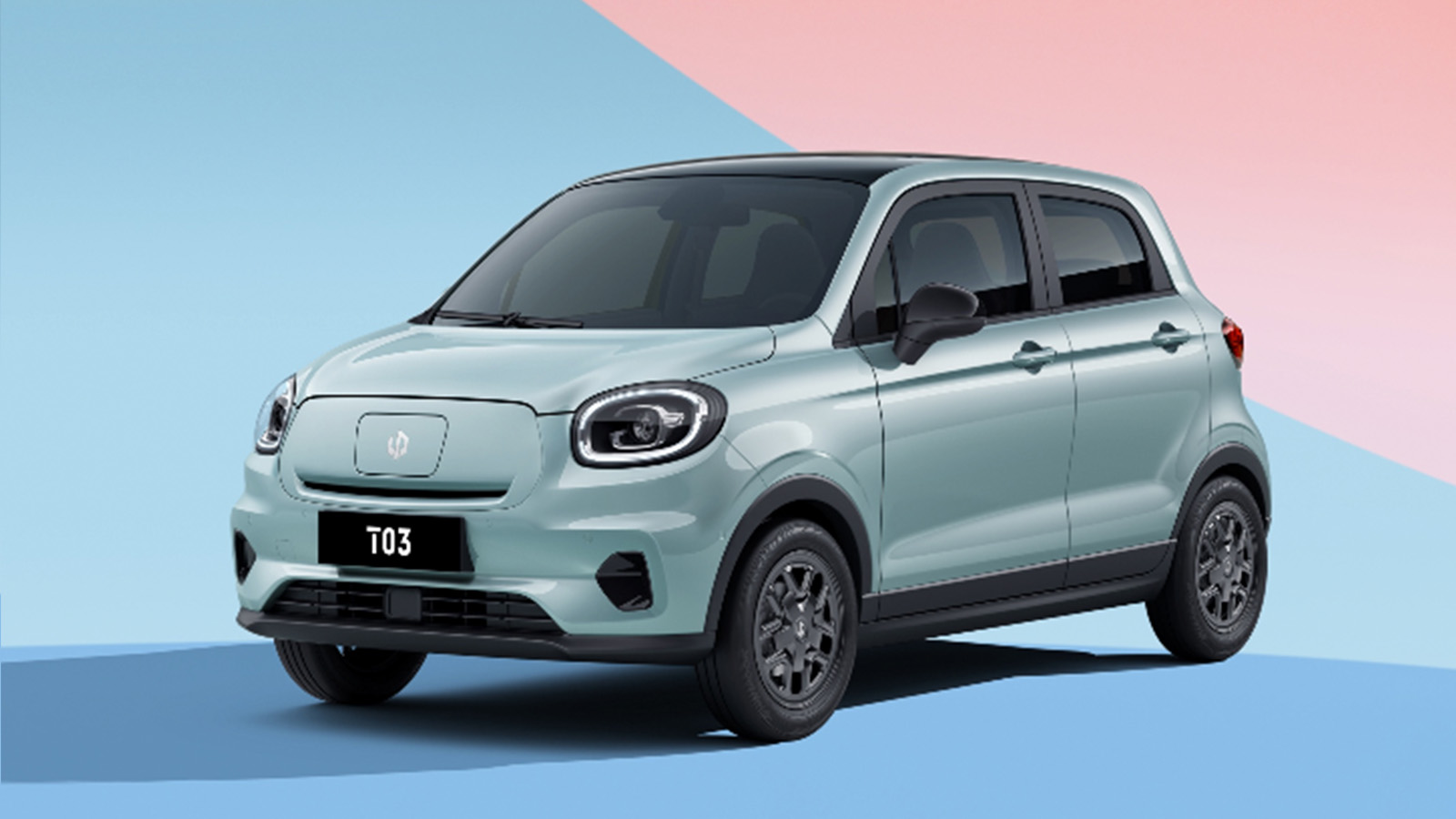
One of the hallmarks of Stellantis is that it seems to always be working an angle, sometimes at its own peril. Leapmotor is a good example of this. The JV that Stellantis has with the Chinese automaker is expanding to new markets, and this has included sending production overseas. Sort of.
In Europe, Leapmotor tried to take advantage of subsidies for electric cars by building cars in its Tychy, Poland plant. Not full automotive production, but production using knockdown kits. This means most of the cars were manufactured in China with the last step of assembly in Poland. Doing this doesn’t create a ton of jobs as the supply chain stays in China, and European governments eventually said “non” to those subsidies. Leapmotor abandoned Poland when this happened.
I mentioned last week that Stellantis was looking at local production in a plant in Canada that the company took Canadian subsidies for and then abandoned for south of the border. With Canada and China cozying up, this makes a sort of sense. However, Stellantis is trying to avoid having to pay back its subsidy on the cheap by proposing knockdown kits for Canada.
Canada’s response, via Bloomberg, isn’t exactly positive:
“We can’t bring cars in a kit to Canada,” Joly told reporters in Vancouver on Thursday. “It needs to support the local supply chain.”
[…]
Joly said she would only support the return of production at the Stellantis plant if it was backed by both the Ontario government and Unifor, and laid out other criteria for the plant’s future.
“Conditions for workers need to be good, and actually the same as they were and even better,” Joly said.
While some of this is economic, it’s also probably political. If the United States and Canada make up and the US asks Canada to knock it off with this Leapmotor thing, I bet the Canadian government listens. A factory building cars from knockdown kits is way less of an investment.
Honda Exec Asks ‘Why Did We Stop Developing Engines?’

Honda’s plan to electrify in the United States has been mostly a disaster, costing the company billions of dollars. A lot of this was the work of current CEO Toshihiro Mibe. Given the loss of all that money, there’s some grumbling in the local Japanese press that maybe Mibe’s days are numbered.
There’s a big feature in Nikkei Gendai (translated) about what they say is the growing dissatisfaction with Mibe, and it includes some strong recriminations:
[D]iscontent is swirling within the company because of Mr. Mibe’s slow decision-making and the growing distrust stemming from his past statements. One executive commented:
“The president said, ‘There’s no need to develop gasoline engines anymore,’ which caused talented engineers to quit. However, now that the EV market is looking uncertain, he’s going back on his word, saying, ‘Why did we stop developing engines?’ and trying to escape responsibility for his own misjudgment.”
Another executive pointed out, “Toyota responded quickly, for example by postponing the construction of a new battery plant for EVs, but Honda was slow to make a decision. This impairment loss and strategic review should have been done a year ago.”
Honda is a great company in a bad spot. Will the board kick Mibe to the curb in the middle of a crisis? That’s the question.
The Deep Offensiveness Of The ‘Nissan 1960 Club’

Growing up, Houston had a football team called the Oilers. With their Columbia blue-and-red uniforms, they were a big part of my youth. That was before the villainous owner Bud Adams decided to relocate the team to Tennessee in order to get a fancy new stadium that Houston was reluctant to build for him.
It was a terrible betrayal, and I’ll never forgive the Titans for it, so when I saw this render from Nissan, I grew angry. Here’s what this is supposed to be:
As the new Nissan Stadium nears its February 2027 completion date, the Tennessee Titans and Nissan officially introduce and share renderings of one of its premium clubs – the Nissan 1960 Club. Named for the year Bud Adams founded the franchise and Nissan Motor Corporation was established in the United States, the club features nods to the storied history of both organizations.
That’s cool about Nissan. I like Nissan. I will celebrate more than 60 years of Nissan in the United States. The Titans are dead to me, though.
What I’m Listening To While Writing TMD
In honor of Houston, here’s Don Julian & The Larks with “Super Slick.”
The Big Question
Could you live with two EVs?
Top graphic images: Tesla; Mazda


I mean, I probably could live with two. Which two would they be? I have no clue. I already don’t need much more than a Leaf or Bolt.
I can imagine almost anything. However, we have 3 ICE vehicles, 4 if you count the Fun Car, and all of them are paid for and old enough to have cheap insurance.
We are a used car family, and I don’t know if used EV’s (like, a decade old) are a good way to spend my money. Maybe they will be by the time I need a new car.
Adding 1 EV is a possibility if/when the 2010 Camry dies, but that could be a decade.
Adding a second EV might happen soon after that, but no automaker should hold their breath for me to buy new.
Meanwhile this ICE driver with 4 cars has been thinking about the Slate truck since your article, and might replace the Crosstrek with one.
Could I? I guess, but I wouldn’t want to. I’d rather have one EV and one ICE. But even then, most of the current crop of EVs suck (form factor/price/ugly/interiors) so it’s not like I’m particularly interested in even buying one.
Automakers, it doesn’t seem that hard? Much like hybrids, just jam the shit into a car that looks you know, like what cars usually look like? How about a Honda Civic? But it’s an EV. Or an Odyssey? But it’s an EV. This just doesn’t seem that hard.
My garage has too many motorcycles and tools/workbenches/shelves to support one EV let alone two. Now an electric bike has my interest piqued, until I look at prices. And range. I could definitely commute on one, but no way I’m doing a ride in the mountains, and they are too pricey to just pick one up as a 4th bike.
I don’t really care that the Houston football team moved to Nashville, but the Oilers name and records should’ve stayed in Houston. I remember a year or two ago watching a Titans vs Texans game and the fucking Titans were dressed up like the Houston Oilers! Not only did it kind of break my brain, but I found the whole charade offensive somehow. Also “Texans” is a really dumb name.
Houton Hurricanes is way better and besides the alliteration way more powerful and appropriate to the location. Also where is Tennessee again?
Could I live with two EVs? Yeah, probably.
Would I want to? No, for two simple reasons.
But if the Autopian Dot Com editors wanted to, say, give my family two EVs to drive for a year, I’d happily write up our experience.
Congrats! You get a G-Wiz and a Ssanyong Rodius with 5000 AA batteries.
Nooooooooooo!
I don’t even own one EV – my commute is by train, driving is minimal and mostly for pleasure. The primary use case for EVs is commuting, it seems to me.
Sure. We did for 4 years. We were always able to get where we needed to go without any difficulty as we aren’t road trip people and tend to fly places for vacations / longer trips. Never had any problems in winter with cold temps and snow either.
We had two EV chargers installed in the garage: one is hardwired with a 60A breaker, and the other is a NEMA 14-50 outlet with a 50A breaker, so I can unplug it and use the outlet for high powered garage tools like a welder or a whole bunch of power tools at the same time.
My wife wanted to upgrade her Leaf to something with 7 seats and more cargo. She doesn’t like the Korean makes which dominate the 7-seat family EVs these days, and she was ambivalent about requiring a BEV powertrain, so we got a Mazda CX-90 PHEV on the amazing lease deals Mazda was doing right before the EV credits expired. The lease will tide us over for a few years when we might buy a used Rivian, a new Scout (assuming they make it to market), look at the newer Toyota options just coming out, or just buy the Mazda outright.
I know electricity rates will eventually be climbing more with the Iran conflict, but those lag quite a bit behind gas pump prices, so for now we’re still sitting pretty not buying gas (my wife’s normal driving is well within the EV range of her Mazda).
I think an EREV is the sweet spot for electrification. I wish the Mazda was a bit more EV-biased than it is, or had a 50/50 hybrid setting that allowed more gradual battery drain, but it’s still impressive that a large, fairly modestly priced, 7-seat SUV gets 50mpg combined with 25miles of EV-only range.
Big Question:
There is a side quest question. I have a classic “2 car” garage. This means I can fit A car, a work bench and storage in it. I could easily run 240V there and charge an EV.
However, to fit TWO cars in my garage, I would have to move my workbench, clean up a lot of crap and Bo and Luke Duke my way into both cars, because the doors won’t open with two cars in the same garage. E.g. not going to happen.
Which gets to the side quest. A lot of Americans struggle with figuring out how to charge an EV. How many more are going to struggle to charge 2?
As someone with 2 EV chargers in their garage, owning your own house and having a 200A panel are basically the minimum requirements.
Starting with a newer 2-car garage house with modern 200A service, adding two chargers really wasn’t a big deal at all and was maybe $2000 total (including the chargers themselves).
It would have been basically impossible if we were renting though, and would have been MUCH more expensive if we had to upgrade our entire electrical panel.
Very few people actually need to charge TWO EVs EVERY NIGHT if they are modern ones with decent range. This is a common misconception from people who don’t even have ONE yet.
You don’t need to charge both cars every day. My wife and I did fine sharing a charger until we got the second one installed. I could probably get by with just level 1 charging but my wife needs level 2.
A hybrid is still fundamentally a gasoline / ICE vehicle. I think it’s time to stop mentally lumping hybrids in with EVs, and simply think of them as the ultimate evolution of the ICE automobile that they are. A hybrid system is simply the most efficient “transmission” that can be paired with a ICE to turn gasoline into forward momentum- No more, no less.
End of the day, hybrids (Even PHEVs) still need oil changes and trips to the gas station. If you already own an EV, why stress about the exact MPG of your second car? Especially if it doesn’t really change the use case?
I foresee EV car/CUV for commuting + gasoline pickup truck for long trips/utility becoming the preferred two-car solution in our area of rural Ontario.
I could see owning 2 EVs eventually, but that is probably 5 years out.
Yes, this! We have one EV and two hybrids, and I consider the hybrids to be ICE vehicles, with the regular maintenance required. The EV is in a different category with virtually no maintenance. Same with a PHEV: you still gotta change that oil. The EV lifestyle feels like a fundamentally different one to me, and one that I want to expand with another (used) EV in a couple years when we can hand a hybrid off to a teenager.
I could live with two EVs. One EV has been trouble free so far. If the numbers make sense, I’d buy another.
I’m also open to any other propulsion system (other than hydrogen) if it makes sense. The EV is a commuter car. It’s an appliance obtained entirely because it met my requirements and fit the budget. I will probably make a decision based on the same stuff next time.
Unless the manual transmission comes back into these types of car, I consider almost everything out there today to be equivalent. Soul-less wheeled boxes in various shades of gray.
Yes, but we’re outliers given that we own four vehicles.
I have a confession and possibly need an intervention. I have compulsive thoughts about buying an near-dead but otherwise sound Leaf for small money and swapping in a 50 or 60 kWh Chinese battery. The Autopian editors may have started these compulsive thoughts. I may need help.
Let me help: Do iiiiitttttt
Please use a chainsaw, like the staff would do.
TBQ: Sure, but it would be redundant. I’m the only driver in my household, and having two EVs seems like a great way to waste 40-90K depending on what they were.
Could I replace my two Civics (combined purchase price, well under 20K) with one EV? Sure, if the price ever gets right. I hear the Polestar 2 is right around that number. I don’t drive a tone, so I could get away with a standard 120V slow charger, but I enjoy driving the Si a LOT, and the Lx costs me like $120/year in insurance, and less than $500 in fuel.
I’d like one EV and one EREV. Take the EREV when you’re not sure of the charging situation.
My household isn’t ready to go full EV for two main reasons: it takes time to add at-home charging to a condo and nobody sells a good EV or EREV minivan in the US yet
Could I live with 2 EVs? Mostly, but I probably wouldn’t want to 100%.
I’ve long said that, with the current state of EV & Charging Network build-out, the vast majority of 2 car households in the US could swap in one EV and not notice an appreciable difference in their day-to-day lives. (Cost has been the thing I can’t overcome otherwise)
My wife and I could absolutely deal with 2 EVs day-to-day; she works from home, and I’m a whole 6 miles away from my office. Even when I have to make the trek to the main office, it’s only 90 miles one way, so I could be covered. The issue, like so many, is road tripping. We take a few shorter weekend trips every year, and while there’s enough charging infrastructure around me, it’s only on the main roads, and not off the beaten path, which is where we end up a fair amount. It makes it just uncomfortable enough that I can’t commit.
Next up when there’s a need is probably going to be an EV and PHEV. That would get the vast majority of our needs done on electric motivation alone, and leaves us the flexibility to do anything else.
I have two sides on this. A rational and an emotional side. This weekend was a trip to a town about 120 miles away for a trip to a pick a part. Total distance, in theory of 240 miles We used an ICE minivan for the adventure. Now for the story.
We got about 80 miles down the road and found some puppies. My wife runs an animal rescue, so we returned home, settled the puppies and restarted the trip. So, 240 miles became 400 miles of driving as a result.
Realistically:
So my rational side thinks “I could do an ID Buzz, even with this massive curveball” and the savings of not having to worry about being out of gas locally would more than offset the weird road trip problem.
However, my emotional side thinks “Remember that day with all the random driving and we got puppies?” and completely forget all the local rushes to a local gas station for a top off while running late. Because it was weird, and it was strange and it was a rare event. (Plus Puppies.)
So, most likely my next set of cars will most likely be an EV and a non-EV. Because although my rational side is strong (my career proves that), I cannot completely ignore my emotional side.
This is a great perspective, and one I need to remember down the road. Of course my first thought is “you won’t be late if you can get your wife to just plug the car in every time she’s home.” Then I think about my wife, and remember that can be easier said than done!
Seriously, there is some work to retrain your self and your habits for an EV, but if you and your family (you in a royal sense here) can commit to that bit of training, EVs shouldn’t be that difficult to live with. However, just like you, I can only commit to one full EV at this point in my life and the EV’s evolution.
Hooray for puppies and animal rescue!
It’s been quite a while, but we’ve rescued a cat in the middle of a road trip at least once or twice.
We rescued a baby goat in the middle of the road once. No trip with my wife is boring
For Matt, It’s the Titans, for me, the Rams. And the now-AZ Cardinals. STL just can’t hold onto a team. At least Bears fans may be about to learn how the other end of 55 feels if, on the off-chance, Indiana gets its way.
What’s funny in all the hand-wringing about the Bears is that Hammond is closer to Soldier Field than Arlington Heights is.
It’s all those beautiful Tax Dollars going across state lines though. Will anyone think of the state pension fund-err, Children! I mean Children. In school. That that could help fund.
A grey-haired, Japanese CEO is too slow to make decisions? In other news, the sky is still blue.
BQ: having 2 EV’s + ebike is basically the longer term hope for our vehicles, if/when there is a decent way to convert the old Jeep to electric, and a few more charging stations are build in remote towns near 4wd roads for the couple times a year the Jeep is driven more than 30 miles from home.
I also grew up in Houston and am still salty about my Oilers becoming the Tennessee Traitors…I mean Titans, I guess.
Tennessean here: be glad to send the ‘Titans’ back to Texas since we’re now helping pay for their 2nd new stadium…the 1st one wasn’t paid for yet (although the Adams Family is graciously supposed to pay that off as part of the deal (con)).
Wonder if the new stadium will have any charging stations?
I could. Although the next vehicle will likely be either ICE or hybrid since nobody makes an EV convertible yet. Maybe an R2 will scratch the itch with the roll-down rear window. Test driving one would be necessary. Maybe a Scout, assuming they’re not canceled at the last second by a money-starved VAG. Otherwise a Wrangler is likely.
Could we live with two EVs? Yeah, do I want too? no
Answer to the big question: No.
Headline Edit: Electric Car Owners’ Next Vehicle Purchase Likely Another EV, Followed By Gasoline and Hybrid Options
You are right, and the headline up there now is BS.
The proposed change makes it clearer, but the headline is not BS. They say the same thing.
As a former PHEV owner I went back to gas only because of my poor experience. I considered an Accord or Camry Hybrid, but my preference was to either get an Accord 2.0T or a Lexus ES350- proven tech. I wonder if EV owners who had bad experiences end up thinking the same way?
Out of the 3 cars in our house I could see us eventually going EV for one, Hybrid for one, and leaving just the Miata as the only full gas car.
I haven’t personally met any EV owner who had a bad experience explicitly because of the drivetrain (the brand and/or service might have been a problem, but not because it was an EV).
In our case those, we went from EV to PHEV just because we needed a bigger vehicle and there weren’t many 7 seat EVs out there to choose from (that we could afford anyway). Having the gas engine has been a nice backup plan for longer drives, but the lack of BEV options in the segment was the main reason we switched.
Brand absolutely can be the problem, but I think it can make some people less likely to take a second chance on the powertrain, just in case it wasn’t just the brand.