

The strange quirk of the last few years is that a certain segment of the population switched from viewing hybrids as a culture war byproduct and focused their ire, instead, on electric cars. As hybrids have gained mainstream acceptance, there’s a vocal minority of EV owners who are now the ones denigrating the technology.
There’s new data out showing that hybrids remain a decent gateway to electrification and a great one to hybrids. Electric car owners are still most likely to buy another EV, but if they go back to something with a gasoline engine, it’s less likely to be a hybrid.


Some of this might be a cost issue, and Canada is likely to be a test of what Chinese automakers might do to our market in that regard. Currently, there’s one automaker seriously looking to build in Canada, but how serious is now a question. Also at question is how long Honda’s CEO is going to make it, given his bad bet on EVs.
The Morning Dump is a daily news roundup and not a chance for me to exercise my personal grievances. Today will be an exception, because automaker Nissan is putting forth a new luxury experience with the dastardly Tennessee Titans, and I can’t not remark on it.
EV Owners Mostly Want EVs, Except When They Don’t
I enjoy looking at the return-to-market (RTM) data from S&P Global Mobility, which tracks what consumers end up buying when they got back into the market. Overall, loyalty has been trending slightly downwards in the last year. This is especially true for luxury brands, which now lose more customers than they get back.
What I’m more interested in, today, is how EV owners and hybrid owners act when they go back to buy another car. The chart below is a little fuzzy, but you can get a sense of what’s happening.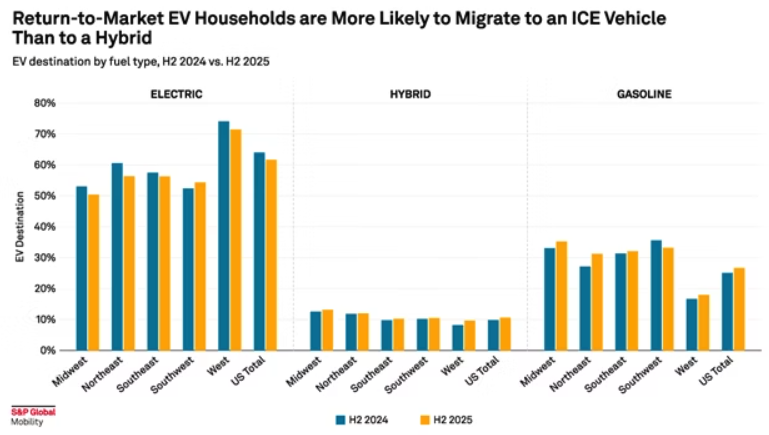
Overall, EV owners grab another EV when they go to market, although the number that did drop in the second half of 2025, even with the large number of EV purchases pulled forward. Where did those buyers go? About 10% went to hybrids, although a bigger and growing chunk ended up in a gas-powered vehicle.
Because these consumers already have an electric car in their garage, a lot of what is happening here might reflect a lack of hybrid or electric options in certain segments. If you’ve got a Tesla and want an electric minivan or sports car, your choices are somewhat limited.
What about hybrid owners?
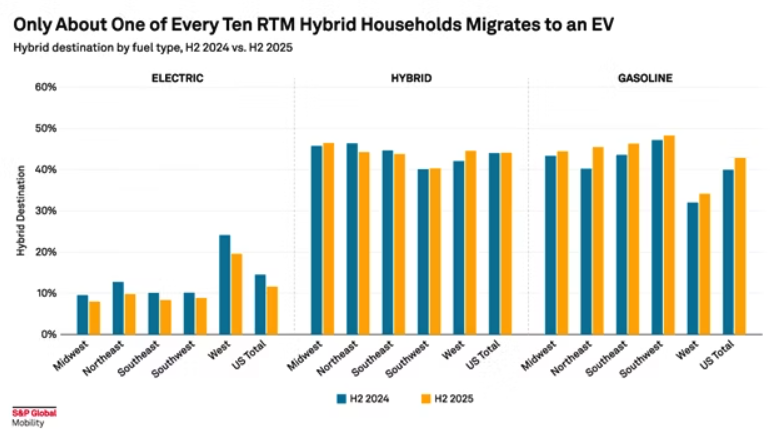
While it’s come down a lot in the last half of 2025, hybrid owners are actually a little more likely to buy an EV next than an EV owner is to buy a hybrid. Loyalty to hybrids as a power source is lower than EV loyalty, with fewer than 45% of hybrid owners getting a traditional gas-powered vehicle next.
With a softening of the electric car market after the cancellation, this data suggests that perhaps expanding into areas that aren’t well-served by the market could get returning customers. It also shows that, while EV owners are probably replacing their EVs with other EVs, buyers seem to like to have a non-EV vehicle as their second car.
Canada Rejects Knockdown Kits From Stellantis
One of the hallmarks of Stellantis is that it seems to always be working an angle, sometimes at its own peril. Leapmotor is a good example of this. The JV that Stellantis has with the Chinese automaker is expanding to new markets, and this has included sending production overseas. Sort of.
In Europe, Leapmotor tried to take advantage of subsidies for electric cars by building cars in its Tychy, Poland plant. Not full automotive production, but production using knockdown kits. This means most of the cars were manufactured in China with the last step of assembly in Poland. Doing this doesn’t create a ton of jobs as the supply chain stays in China, and European governments eventually said “non” to those subsidies. Leapmotor abandoned Poland when this happened.
I mentioned last week that Stellantis was looking at local production in a plant in Canada that the company took Canadian subsidies for and then abandoned for south of the border. With Canada and China cozying up, this makes a sort of sense. However, Stellantis is trying to avoid having to pay back its subsidy on the cheap by proposing knockdown kits for Canada.
Canada’s response, via Bloomberg, isn’t exactly positive:
“We can’t bring cars in a kit to Canada,” Joly told reporters in Vancouver on Thursday. “It needs to support the local supply chain.”
[…]
Joly said she would only support the return of production at the Stellantis plant if it was backed by both the Ontario government and Unifor, and laid out other criteria for the plant’s future.
“Conditions for workers need to be good, and actually the same as they were and even better,” Joly said.
While some of this is economic, it’s also probably political. If the United States and Canada make up and the US asks Canada to knock it off with this Leapmotor thing, I bet the Canadian government listens. A factory building cars from knockdown kits is way less of an investment.
Honda Exec Asks ‘Why Did We Stop Developing Engines?’

Honda’s plan to electrify in the United States has been mostly a disaster, costing the company billions of dollars. A lot of this was the work of current CEO Toshihiro Mibe. Given the loss of all that money, there’s some grumbling in the local Japanese press that maybe Mibe’s days are numbered.
There’s a big feature in Nikkei Gendai (translated) about what they say is the growing dissatisfaction with Mibe, and it includes some strong recriminations:
[D]iscontent is swirling within the company because of Mr. Mibe’s slow decision-making and the growing distrust stemming from his past statements. One executive commented:
“The president said, ‘There’s no need to develop gasoline engines anymore,’ which caused talented engineers to quit. However, now that the EV market is looking uncertain, he’s going back on his word, saying, ‘Why did we stop developing engines?’ and trying to escape responsibility for his own misjudgment.”
Another executive pointed out, “Toyota responded quickly, for example by postponing the construction of a new battery plant for EVs, but Honda was slow to make a decision. This impairment loss and strategic review should have been done a year ago.”
Honda is a great company in a bad spot. Will the board kick Mibe to the curb in the middle of a crisis? That’s the question.
The Deep Offensiveness Of The ‘Nissan 1960 Club’

Growing up, Houston had a football team called the Oilers. With their Columbia blue-and-red uniforms, they were a big part of my youth. That was before the villainous owner Bud Adams decided to relocate the team to Tennessee in order to get a fancy new stadium that Houston was reluctant to build for him.
It was a terrible betrayal, and I’ll never forgive the Titans for it, so when I saw this render from Nissan, I grew angry. Here’s what this is supposed to be:
As the new Nissan Stadium nears its February 2027 completion date, the Tennessee Titans and Nissan officially introduce and share renderings of one of its premium clubs – the Nissan 1960 Club. Named for the year Bud Adams founded the franchise and Nissan Motor Corporation was established in the United States, the club features nods to the storied history of both organizations.
That’s cool about Nissan. I like Nissan. I will celebrate more than 60 years of Nissan in the United States. The Titans are dead to me, though.
What I’m Listening To While Writing TMD
In honor of Houston, here’s Don Julian & The Larks with “Super Slick.”
The Big Question
Could you live with two EVs?
Top graphic images: Tesla; Mazda


The EV to gas data doesn’t surprise me. I haven’t bought an EV yet, but when I do, it’s likely to be the “do everything” daily.
Any other car I purchase (or keep) would purely be for weekend fun – which will likely be a gas car.
Once you’ve made the leap to an EV, a hybrid is just a weird halfway compromise. None of the refinement of an EV, none of the fun of a performance gas car.
If you haven’t yet made the EV leap, a hybrid makes sense as a do-it-all.
Personally I’m a fan of pairing an EV with a hybrid. We have done that in the past and the reason for the hybrid over a pure ICE is fuel economy. Hard to go back to getting 30 mpg or less. (I actually did that because my wife wanted a wagon but it irrationally hurts seeing the mpg display say 28 mpg)
Hybrids are also getting more performance. The current 2025 Civic hybrid is faster 0-60 than a 2025 Civic Si and more horsepower than a 1985 Mustang 5.0.
A hybrid Sienna makes a great family hauler for road trips.
Maybe the reasoning is that the gas car is for road trips/towing and that is the scenario where hybrids offer the smallest advantage.
The Toyota Sienna from 2019 got 19/27 while the hybrid from 2026 got 35/35 that’s a 45% increase for city driving but only a 22% increase for highway. If the cost is higher for hybrids that might dissuade some.
Most families I know with 2 cars use both cars for daily commuting. For example my wife is still commuting 45 miles a day / 4 days per week in the Acura in addition to us using it for longer trips. For my commute and anything around town or regional trips we take the Bolt.
You are correct that the upfront cost of a hybrid dissuades many people from picking a hybrid but that is because the typical buyer only thinks about purchase price not overall cost of ownership. The fact that the ICE Corolla is still sold and accounts for 80% of sales speaks to that.
Yes.
Have a Leaf for the city/commuter, and an R2 on order to replace my wife’s 5th gen 4 runner. Cheap PNW hydroelectric power is the best. Soon, the only gas I’ll be buying will be going in the 911.
We are currently a 1 EV, 1 PHEV family. The PHEV is off lease soon so we need to figure out our next move.
We are currently thinking hybrid (crown signia) as that just affords us max flexibility. The Toyota drivetrain is so efficient that PHEV doesn’t make much sense.
Sorry. I can’t live with just EVs. I need to escape hurricanes.
Try a helicopter or a fixed wing private airplane. They are way faster, you could easily outrun a hurricane.
Too manhy trees and powerlines for takeoff.
We’re a two-EV household: Chevy Bolt (with replaced battery) for daily commuting and errands. AWD EV6 for commuting, road trips and skiing. LA -> Mammoth is two stops due to elevation gain, but the EV6 charges fast and the 800v charging infrastructure is solid (and getting even better with the Rivian network opening up). Coming back only need one stop since its all downhill.
Living in CA I pretty much have no range anxiety any more. There are plenty of charging stations pretty much everywhere, and with both Rivian and Tesla networks now open its just getting better.
I expect to remain eternally salty about John Fisher moving the Athletics from Oakland to Las Vegas via Sacramento. Boo hiss to billionaire owners hitting up taxpayers for stadium building.
I could see possibly living with 2 EVs and renting a hybrid for road trips. But we’re cheap, so probably will hang onto our CNG and ICE vehicles (one each) until they’re ready to croak. Next likely car will be Hybrid, not EV, as we street park. And in about a couple years from now, I hope to be retired and no longer need to commute which is one of the places that EVs shine.
Mark Davis and the Raiders, Joe Lacob and the Warriors. The city where I was born in the 60’s and grew up in during the 70’s, when those teams were all dominant and champions, Day on the green concerts, what a time and place to be young back then…
Grrrrrr!!! 🙁
Yeah, I wasn’t happy when Mount Davis was added to the Oakland Coliseum. Though I did sit there a few times for baseball games. And then the Raiders moved (again) anyway!
Have had many a fun concert experience there at the Oakland Coliseum too!
It’s a travesty how all the major teams have left Oakland. Here’s hoping teams like the B-Ballers (Pioneer League baseball) and Roots (USL Championship soccer) get some life back into the local Oakland sports scene!
I want to see a member’s ride story about your CNG car.
It’s honestly not very exciting, even to me, it’s just a white 2012 Honda Civic. Makes for a fine commuter car though! Honda did these from ~1998 to 2015, they were nearly all fleet cars. From the outside, it looks just like any other Civic except for the “CNG” sticker on the back. Very clean burning.engine. Fueling stations have never been all that plentiful though and a couple I used occasionally have shut down in the last year. So it’s only a useful vehicle in certain areas, luckily I live in one (San Francisco Bay Area). It doesn’t make for a good road trip car outside of a few areas. Fuel costs vary wildly, even in our area, by up to $2 per GGE (Gallon of Gasoline Equivalent) from ~ $3.70/GGE to $5.70/GGE. For now, it’s cheaper than gasoline (which is ~$6/gallon and climbing!), it’s been both way cheaper than gas and somewhat more. I get typical Civic MPG numbers, low 30s per tank with stop and go in the morning commute, more like mid to upper 30s back when I could use the carpool lane in the morning.
Started buying these just over 10 years ago with help from a friend who had one and helped me get a car that could use the carpool lane after my blue 1993 Honda Del Sol was stolen and stripped. Still miss that car!
The article could have been summed up at the second sentence:
…there’s a vocal minority of EV owners who are now the ones denigrating the technology.
Emphasis on ‘vocal minority’.
Given enough money, I could technically live with 2 EVs.
The daily errand car became a Bolt EV recently.
But for towing a camper longer distances with an EV, I still have some doubts.
A Silverado EV Max Range could probably do it but that’s like a $90k truck.
It’s an order of magnitude cheaper to keep the old V8 gas SUV around for long road trips and towing stuff, so I would probably never get a return on such a big investment.
Use the right tool for the right job, I guess.
We have 2 evs (a model y and a leaf) and an older pickup. the y does most of the miles, longer commute, lots of 100-200 mile day trips and most road trips. The leaf does town errands, lots of short trips but not many miles. The pickup does house projects, tows the camper and can handle forest roads but only gets used when needed. With $6/gallon gas and cheap electricity in the PNW this is pretty optimized for total cost and covering every use case. The cost of fast charging the tesla is cheaper than gas for the truck most of the time and way cheaper when travelling into canada where gas is more expensive and electrons are cheaper.
We could cover the truck + leaf with one electric or EREV truck but the cost doesn’t even pencil out when they are worth like $12k combined.
All this recrimination about ‘bad bets on EVs’ etc… seems a bit silly IMO. Do people seriously think we’re going to find and recover oil from the moon, or from Mars, so we can keep burning it forever no matter what happens to the climate? X years from now, the vast majority of vehicles will be EVs. I don’t doubt this.
For the automotive industry, which tends to think in quarterly returns for shareholders (for the most part) the long term thinking needed to assess the gradual and irreversible trending of EVs is difficult. It’s harder still when the second-biggest auto market in the world (the U.S.) is currently in a period of regulation reversal and exploitative cronyism. As American de/regulation, incentives, tax breaks, neutering of consumer protection and environmental protection proceeds apace, American auto makers will build and market accordingly, which will of course render them even less competitive worldwide than they already are.
It’s a madhouse I tell you… a madhouse!
The big Orange guy says all that oil from Iran will make gasoline free of charge.
I think he’s lying, again.
As much as I like to hate the chasing of quarterly profits from companies I don’t think that applies here. These car companies planned the roll out of EV’s over years as evidenced by EV goals they stated, or by Honda stopping ICE development.
The world (not just the US) was not ready for whatever level of EV governments/predictors said they would. It will fix itself over time 2035 was too ambitious. 2050 I could see a solid majority being EV’s especially if solid state batteries pan out.
Its gonna be ok.
I could do an EV and an EREV, but there are basically no EREVs on the market currently.
I could have 2 evs but fall back on other vehicles quite often for specific use cases. Evs are great for around town. Maybe you can road trip if not hauling anything it might be more expensive then you think to fast chage. Hybrid and phev has been the sweet spot for me. And I can see why erev and phev are wanted.
Bev should be stupid cheap and used like a 90s econo box. The leafs I have were the closest thing to econo box bev I could find but are an ok place to be. I’ve had a few compliance bev that I got cheap and they might fit that bill even more but can come with parts headaches.
I could probably retire my gen4 ram to mainly farm duty and do ok with a Silverado ev but I’ve experienced towing with them I don’t feel like unhooking a trailer every time I need to fast change because someone is in the pull though if it exists and a fill up looking like $5 or $6 a gal diesel always.
Every study has a bias I’m not sure what this one is biased toward but the only trend I think is completely accurate is people in the west thinking about a non ev because evs were trust on them. Maybe the idea that hybrids are overly complicated you hear alot in various communities.
The CEO of an automaker like Honda making a bet on EVs is entirely forgivable. The CEO of a consumer electronics company like Sony doing it is flat out grounds for dismissal.
“return-to-market (RTM) data from S&P Global Mobility,”
I look at that chart and what I see is 60% of BEV owners are gonna get another BEV. So how do they conclude that BEV owners are more likely to get an ICE vehicle?
What the chart is telling me doesn’t seem match the words in that study.
And there is some really weird shit in this. Why do they hide the corporation names, model names and trim names?
Something is fishy with this study.
AAAAND… I’ve seen a number of other studies that say the opposite thing… that once the switch to a BEV is made, the BEV owner RARELY goes back to an ICE vehicle… like with this report
https://electrek.co/2026/02/18/once-you-go-ev-you-dont-go-back-96-of-owners-agree/
“Could you live with two EVs?”
I definitely can. Mind you my ‘fleet’ consists of just one plug-in hybrid… and some bicycles.
But my next vehicle is very likely to be a BEV of some sort.
Thank you! A misleading study has led to a misleading article.
The data doesn’t show they’re more likely to get a gas vehicle than another EV. The data shows that apart from another EV, they’re more likely to go for gas than hybrid.
The headline of this article is technically true – but also misleading.
My wife and I are three years into owning just EVs. We live in the Midwest and haven’t had any issues finding charging when we travel. Overall, it’s been great not worrying about going to gas stations or oil changes
Yep, already do. Made the jump to 2 last fall, after having one EV for 4 years. It’s pretty awesome for most of our year.
Only time I’m regretting it is planning our long road trip to Wyoming (from eastern Iowa). We’ll probably borrow my sister-in-law’s Honda Pilot for that.
3rd car is a NB Miata so I can feel something.
I am a 1-car household, so 2 EV would be ridiculous. And I can’t even have 1, because my living situation does not allow at-home charging. I understand there are EV owners who can’t charge at home, but from what I understand, charging exclusively at public chargers roughly doubles the cost to “fill up” vs. home charging.
Absolutely. I already have one and it is fantastic, overall. I’ve done enough driving and road tripping that range and charging anxiety isn’t a thing anymore. It is a hoot drive.
The only real problem would be what to get. I already have the absurdly (ludicrously, even) fast sedan covered. I don’t care for CUVs or SUVs and have no use at this time for a pickup. I real sports car would be nice but I don’t want to get rid of the one I have.
I’d love a second EV. Since getting an EV I am now profoundly irritated at having to gas up. But for our purposes it makes more economic (and environmental) sense for our second vehicle to be an non-hybrid ICE vehicle as we just won’t put a lot of miles on it–you recover the greater monetary and emissions outlay of an electrified vehicle only if you’re driving it a fair amount. Others have mentioned the “niche use case” explanation which is probably a big part of EV owners not wanting hybrids, but the “we just need a cheap commuter/beater and don’t want a used Leaf” explanation might be a factor too. These two explanations overlap quite a bit, too.
We could solidly make a R1S and Mach-E work for 98% of our daily activities. I’d need to upgrade the electrical service at my house to go up to a 200 amp panel. I could actually see a used and decently depreciated Mach-E making its way home. While I love the R1S and enjoy how it drives, there are many more things in my life that I would rather spend that amount of monthly income on.
I have a single car garage so having 2 EV’s isn’t an option. I have my charger all installed pre-emptively when I redid the power panel to 200 amp. That said I am driving my X3 for another 3 years before I leap to an EV. An EV will fit my use case for 95% of my driving – for the times I need longer distance I can rent a car. It doesn’t make any sense right now with an almost paid for car to spend more when there will be much more desirable (non-Tesla) options in 3 years. Scout looks fun to me…
We have two EVs using a one car garage and it’s not an issue. The main (wife’s) one parks in there all the time and gets the level 2 charger. The other one that gets driven usually 30-40 miles a day parks outside and charges via the 110 while parked outside which replenishes it overnight if needed
But neither one is plugged in every night anyway. If the outside one needs a faster charge it can swap spots with the main one for a night or a weekend day.
Both have good range, neither is an old EV “compliance” car with a tiny battery.
Living in Arizona I’d not want to set a car outside to bake and rot in the sun – personal preference, not that I can’t swap cars but being single and needing just one car I can’t imagine juggling 2.
Oh, I got the strong impression you already had two cars but couldn’t work out the charging situation for two EVs. It sounds more like that you don’t 2 want of ANYTHING due to your reason, nothing to do if it’s an EV or not.
Yea I just have to plan for replacement down the road – but it will be an EV. 🙂 Cheers!
When could you not find the time to schedule your domestic charging? It’s no different than “Are you using the shower in the next hour?”
I don’t need 2 cars so it’s a moot point.
Probably.
I’d need a third and possibly fourth car, though.
Next car is a PHEV
Are those charts charting replacement vehicles or simply the next car bought? Cuz, maybe that EV stays in the family while the next car replaces a prior one.
Honda put way too much trust in GM to make a decent enough EV to put the Honda name on.
This is likely most of it but I think some of it is due to the capability gap that is completely unrelated to the drivetrain.
You want an EV without electric door handles? Good Luck.
You want a pickup available in more than one body, bed, and interior seating configuration? Hybrid and EVs are out of the running.
Want a pickup with a bed cap? EVs are out of the running currently unless you want the low range non pass through version of the Silverado EV.
I love EVs, but if automakers don’t make an EV in the configuration I need then I’m going hybrid next, and if automakers don’t make a hybrid in the configuration I need then I’m going ICE next.
The Truck I got on order should do it all (beside be maneuverable and compact but life is full of compromise), so hopefully it’ll last me long enough till another EV I want come out in the market and is available in a configuration I want (6 seat non-rambox Ram 1500 REV PLZ).
Living with 2 EVS, I hear you can get a sweet deal on Fisker Oceans these days. One to drive and one for parts.
I could own 2 EVs. On for the spouse, and one for me. I only drive stick though, so someone would need to get on building that.
Yeah, maybe they’ll make an EV that uses a tiller to turn, as well. And it can be a steam hybrid.
There’s no reason for an EV to use a manual transmission. Electric motors only need one gear.
Need and want are different things. Needing gears might not be necessary with an EV, but maybe it would be more fun or more engaging. A steam hybrid generator might work great too. Maybe a tiller as well. Not everything has to be homogonous and the same to get the same job done. We have maybe different flavors of ice cream for a reason.
https://discoverlexus.com/stories/lexus-ae86-bev-concept
Wow a steam hybrid sounds awesome. It could be a series hybrid where the steam engine just charges the batteries.
No wait for the boiler to warm up, the batteries are ready to go, same for smaller trips. And it would be great in emergencies, you can burn pretty much anything and you have a tank of mostly potable water ready to go.