

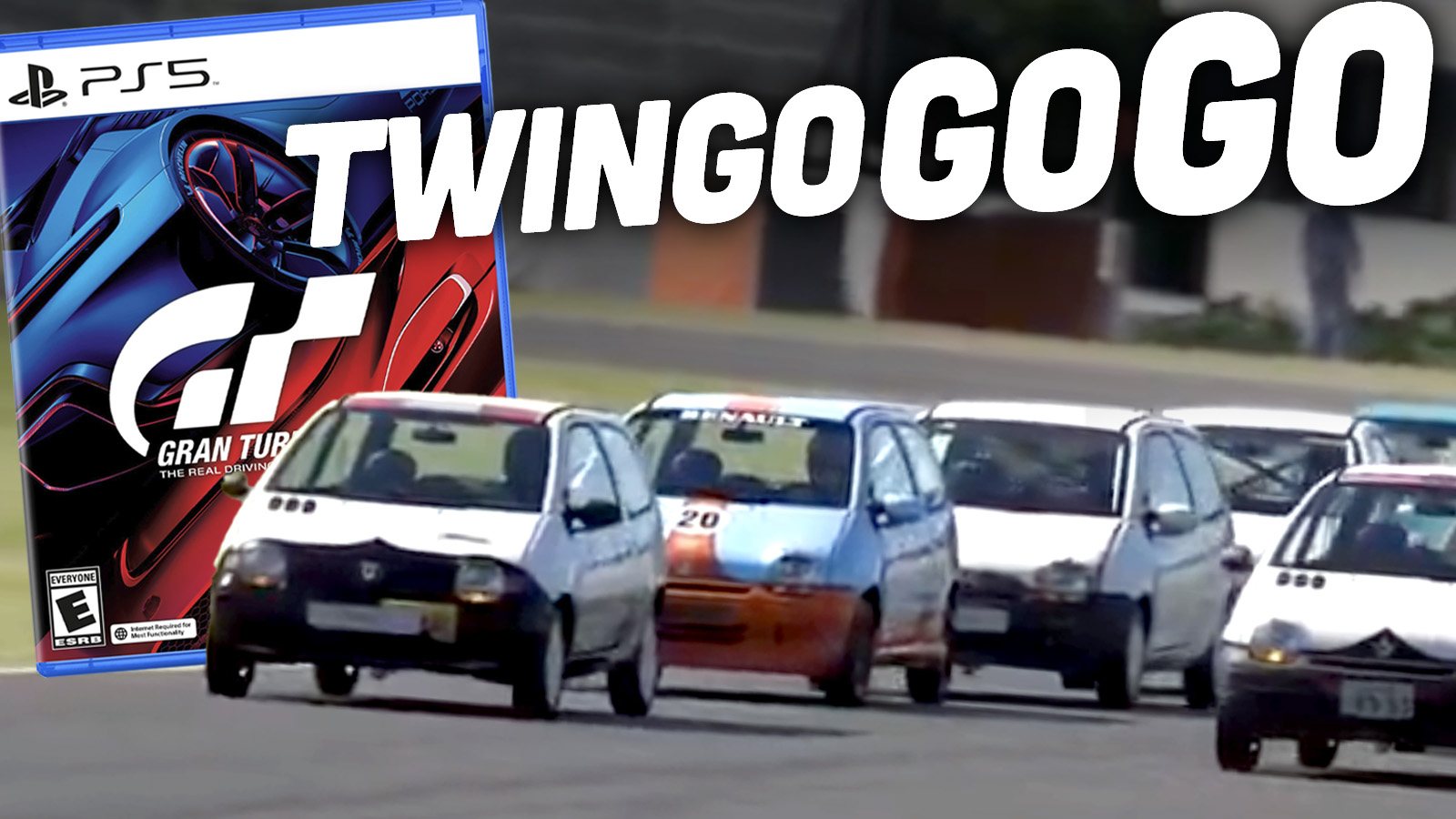
Gran Turismo 7’s most recent game update brought along the usual mixed batch of three new vehicles for players to drive. The 1,286hp Yangwang U9 marked the second-ever Chinese car to appear in the series and the little brother of the car that holds multiple speed records, while the ultra-rare Porsche 911 Turbo S Leichtbau is a pumped-up, lightweight version of the 964-generation model made in a run of only 80 examples. Yet both of these thoroughly worthy additions to a game which features track racing at its heart were eclipsed in fans’ hearts by a thirty-plus-year old, 54hp box that used to be almost everywhere in its native France.
Meet the Renault Twingo I, the latest example of developer Polyphony Digital’s unique approach to driving games.


While others are falling over themselves to include the latest and greatest supercars (okay, the U9 fits that bill too) and every iteration of GT3 and Le Mans Hypercar models, the Japanese studio is filling in automotive history and celebrating humble models like the Twingo which sold more than two million examples over its first generation’s decade and a half on sale.
C’est mieux que la F1 ❤️ pic.twitter.com/cWsqfnjoV7
— Hoonited ???????? (@hoonited) April 26, 2026
The timing could scarcely be better, as Renault is resurrecting the name for a fourth run right now – for a compact EV based on the same platform as the Renault 4, 5, and Nissan Micra – but the original was something of a mold-breaker when revealed back in 1992.
Presented at the Paris Motor Show, the Twingo came from the pen of Renault’s design chief Patrick Le Quement – who had the Ford Sierra in his portfolio at the time, and would go on to create the Renault Avantime – and was the epitome of form over function. The tiny car was about as basic as it got, and packed with space- and cost-saving measures that included things like routing the radio aerial through the driver’s side door mirror.
That didn’t mean it was simple or boring though. The Twingo featured innovative, and rather brightly colored, seating that included a sliding rear bench to increase trunk space or offer more legroom for the brave rear-seat passengers. In a pinch, all of the seats could fold completely flat to create a double bed and not just in case you fell asleep as the 1.2-liter four-cylinder dragged the car to 60mph in a sedate 14 seconds.

Offered for just 55,000 French Francs (around $10,000) and originally only available in four bright colors, the Twingo was a hit in its home nation thanks to its chic, cross-sectional appeal which meant it was just as likely to be driven by French dignitaries – and it was – as by students. If you spent any time at all in France in the mid-’90s, you could barely turn a corner anywhere without seeing one. Perhaps somewhat unexpectedly it was also a bit of a success in Japan ,too.
Following Renault’s alliance with Nissan in 1999, the Twingo was sold directly through Nissan “Red Stage” dealerships in Japan. It achieved a devout cult following in the nation, despite being notably larger than the country’s own small keijidosha (or “kei car”) offerings and not benefitting from the same tax breaks – and being inconveniently left-hand drive, even if this did add to the cachet. Indeed, like the sibling Kangoo which has annual jamboree gatherings in Japan and was added to GT7 in 2025, it’s actually more of a surprise that it hadn’t been added to a Gran Turismo game before now.
とてもかわいいパレードランを
見てくれい……か わ い い#GT7 #TWINGO pic.twitter.com/tPl4hvknRV
— 和奏 水速 / てへてな@ゆっくり推し活者 (@TTmotors_miha) April 25, 2026
That cult following was on the edge of becoming broader this weekend too, until boring bureaucrats got in the way. A team of German madmen had sourced a Twingo chassis and, on the understanding it would be able to take part, modified it for a run in the 2026 Nurburgring 24 Hours. Rauh Racing, clearly hoping to put the Twingo into the same fan-favorite underdog bracket as the Dacia Logan and Opel Manta Foxtail, had official certification from the DMSB after inspection of “Project TwinGOAT” for the SP3 class, only to have the rug seemingly pulled on entry to the race due to apparent safety concerns over closing speeds on the circuit with the GT3 cars. The Logan however still raced.

Thankfully, the car’s inclusion in Gran Turismo 7 allows millions of players to right that wrong, with the help of Rauh Racing which has uploaded its official decals to the game. It took about 15 minutes for the first TwinGOAT replica liveries to appear in-game, and while it’s hilarious to drive around the ‘Ring already Polyphony Digital also dropped in a K24 engine swap from a 400hp tuned Civic right away, so you could lay down some serious lap times.

This coming weekend sees the first live event in the reorganized 2026 Gran Turismo World Series, with the events usually being used to promote upcoming game content. What, one wonders, is up Polyphony Digital’s crazy sleeve for the next update?


I don’t play videogames (anymore) but this makes me desire GT7.
I also desire a new Twingo EV, but there’s even less chance I’ll have one of those.
How long until there is a Gerard Pique livery?
I still play GT7 on occasion. The lack of real single player progression is annoying so I mostly fart around making unsuitable cars race LeMans. New electric whatever? Pass. Another 911? Sure I’ll buy it I have tons of cash. But the Twingo? Hell yes. So much fun.
Wait, they sold LHD Twingos in Japan??? That has to be the weirdest tidbit in this article; they had no reason to do so, as it was sold as RHD in the UK. Maybe they wanted to make sure is was seen as just a novelty directed at car people, as to not cannibalise on other Nissan offerings.
EDIT: nvm, the 1st gen Twingo was not, in fact, sold as RHD in the UK; the ones that ended up there are all LHD imports.
The inverse law of racing in games: the less suitable the car, the better the racing.
I enjoy more those bread and butter cars than the 1000hp Gran Turismo vision things.
The Forza Horizon games usually have a good selection of shitboxes*, but no Twingo yet.
*(a term of endearment as far as I’m concerned)
Being in Japan, the latest game has some good ones. The Montero (Pajero?) diesel especially, though randomly there’s a stock ’85 F-150 as well.
Yeah, that’d be a carry-over from FH5 (Mexico). Don’t get me wrong, they have the model already, they may as well use it, but I think they have gotten a little lazy about catering the vehicle selection to the setting. There’s a surprising depth to Mexico’s car scene, and (IMHO) they barely scratched the surface. I hope they’re doing better with Japan.
I’ve actually found quite a dearth of shitboxes in FH6. Most of the small little economy cars are the highest trim models. The Subaru Vivio is a nice touch though, and I’m pleasantly surprised the Honda City is not the Turbo II version.
It needs a F4RT swap.
My bodyshop owner’s wife had one of the last 1st gens (with the clear turn signals), Initiale version. Leather, AC, power everything – an absolute gem. She loved it for the time she had it.
Then it went to the dealership for some small warranty recall and burned to a crisp along the whole delarship lot when the yearly Christmas car burning in Hautepierre kicked in.
I’ve never heard of you before, Your not one of them AI are you?
Oh dang, you caught me. Meep morp.
I knew it, this is why Autopian has horrible cotomer sevis
It’s a terrible legacy to bear, it surely is.
Someone used GT7 to get a Takumi in a Twingo against Keisuke, but sadly the video creator has deleted the post so I cannot link it. It was glorious though. They even posted instructions on how to set two cars up to race each other like that.
There is a video on YT of a dude driving Tsukuba on GT7 in the Twingo. Guy did the lap in 57.064 seconds driving in reverse.
A couple of months ago I saw a Renault Twingo and a Mercury Grand Marquis parked next to each other in a Tokyo parking garage. Not what I expected to see.
That would be worth taking a picture of!
Indeed it was!
I wish there was a better/easier way to share my photos here than uploading on imgur.
Thank you for sharing! 🙂
This delights me but does not surprise me. The juxtapositions of cars in Tokyo are like no other. All cars are immaculate of course. Unless it’s been dumped in a carpark for 20 years.
Osaka’s car scene blew my mind too. I randomly stumbled into a group of Japanese “Cholos” eating tacos next to their lowrider trucks, then walked around the corner and saw a legit street racing crew with heavily modified Civics.
I have always wanted one in a bright color with the Lego interior. Twingo content is not helping me avoid this itch.
I immediately engine-swapped mine with the RCR Garage Civic’s K24A.
It is absolutely hilarious.
Fine choice for such a lightweight shitbox.
A K24 tuned to about 300 horsepower also goes well in a 1st gen Honda Insight, a swap people have done in real life. Still gets 50+ mpg highway like that thanks to the aero. The next logical step would be to find a way to convert that into AWD.
One of the most enjoyable cars to drive. It feels completely out of control while being perfectly controllable. Been pushing to have a swapped, max tune one in our weekly time trials in one of my Discord servers.