

A car’s alignment is vastly more important than most people realize. An improperly aligned suspension can lead to poor or unpredictable handling, as well as uneven or exaggerated tire wear. A good alignment, on the other hand, can make your car better to drive and even slightly more efficient.
Performing an alignment isn’t exactly easy. You could do it in your driveway, but you need specialized tools and a good sense of how they work to execute it properly. It involves taking lots of measurements, loosening bolts, making minute adjustments, then making even more measurements. Most shops use expensive, laser-based machines to take measurements and determine which adjustments should be made. The Autopian has a whole explainer on it, and I highly recommend reading it if you have the time.


People don’t adjust their suspension alignment just to ensure their car drives straight. Some people change it to enhance performance, angling their wheels and tires to generate more grip through corners. Instead of having to get under the car and loosen some bolts manually, Ferrari has come up with a way to realign a car’s front wheels electronically, on the fly.
The Magic Of Camber
To understand why Ferrari has come up with this idea, you have to understand what camber is and how it affects a car’s handling characteristics. Basically, camber is the angle of the wheel when looking at a car from head-on. Here’s a simple diagram showing the differences between zero camber, positive camber, and negative camber:

On most commuter cars, the goal is to have close to zero camber, where the wheel sits nearly perpendicular to the road, as that promotes even tire wear. But on sporty cars, you’ll find that some negative camber—where the top of the tire is tipped inward towards the car—has been added. This allows more of the outside tire’s contact patch to touch the road during high-speed cornering, when the car is leaning one way or the other. And the more surface area the tire has to work with, the better it’ll perform.
So why not just run as much negative camber as required for peak performance? Well, if you have excessive camber, your tires will wear unevenly, especially if you’re not spending all of your time on a race track. So most road-going sports cars run a compromised camber angle that delivers some additional cornering ability, but not so much that the inside of the tire will wear out prematurely.
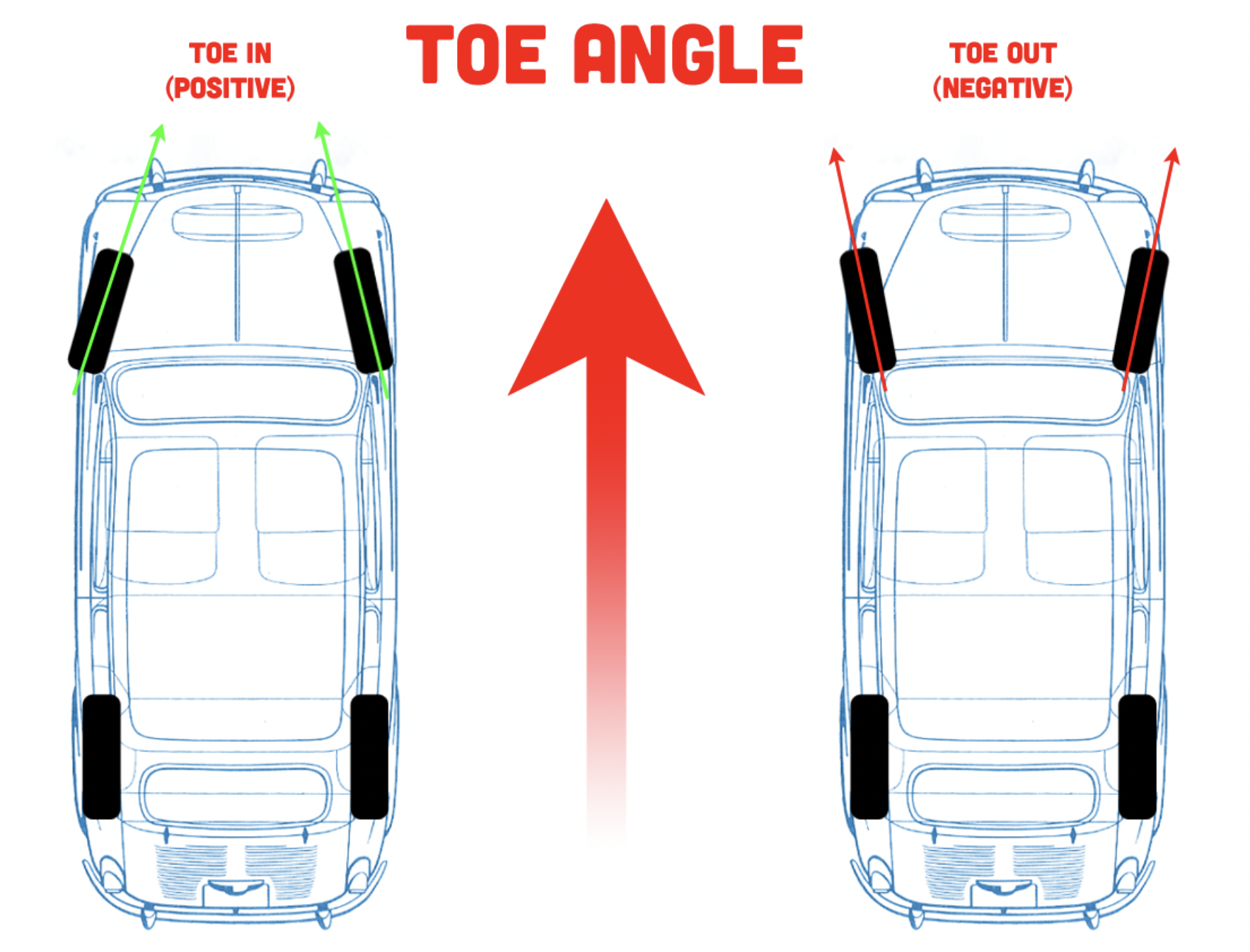
While we’re on the subject, it’s also worth talking about toe angle. This is the angle of the front wheels when viewed from above. Like camber, most cars will have a close-to-zero toe angle dialed in to ensure stability and normal tire wear. But sports cars might have some negative toe—where the wheels are angled slightly outward from the car’s bodyline—dialed in. Having tires that are already always kinda turned promotes better handling and response. But again, having too much will wear your tires quickly, so road cars usually only get a tiny bit.
Ferrari’s Solution
Ferrari’s idea, laid out in a patent application filed with the United States Patent and Trademark Office (USPTO), aims to eliminate these compromises. Most cars use cam bolts—bolts with built-in off-center washers—and threaded links to adjust the position of suspension arms, which means making changes involves lifting the car and getting under it with hand tools.
Instead, Ferrari wants to replace the manually adjustable hardware with an electronic actuator at one end of the arm. In this case, this would allow the arm to telescope inward or outward to adjust camber and/or toe on the fly, without ever having to get out of the car. From the patent:
[A] possible active variation of the camber angle is to provide a camber tie rod connected, on one side, to the chassis and, on the other side, to an arm connected to the wheel, wherein this camber tie rod is also of the telescopic type. The operation of this camber tie-rod is managed by a special electronic control. Based on this prior art, the aim of the present invention is to make available an innovative active camber unit capable of changing not only the camber angle but also the toe-in angle.
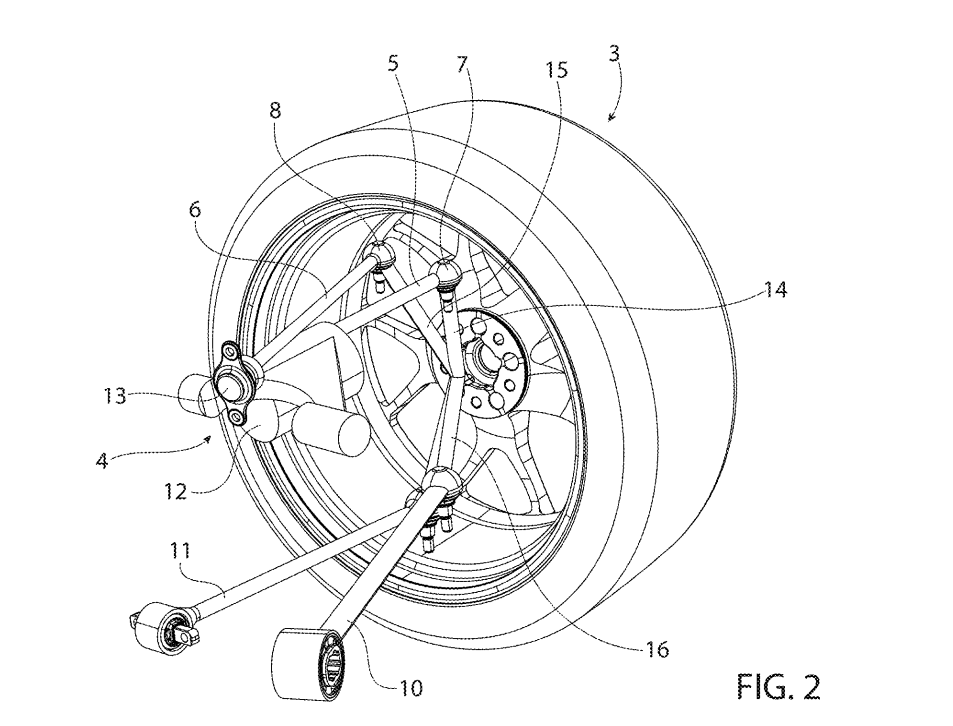
Basically, this electronically controlled camber rod (or “tie rod” to use Ferrari’s term) would move on command, shortening itself to add camber or lengthening itself to remove camber. In Ferrari’s idea, the camber rod also acts as a toe adjustment rod, “because as the camber angle changes, it also imposes a toe-in angle on the wheel,” according to the patent, thanks to the angle at which the rod moves in accordance with the other control arms holding the wheel assembly to the car.
Basically, as the camber rod moves out, a fixed rod, labeled “13” in the above, will effectively “pull” one side of the tire in, adding toe angle. The company even included a few diagrams showing how, when camber is adjusted, the toe angle also changes. Figure 5 shows the normal setting, while figures 6 and 7 show the tire’s resulting toe angle when camber rod is adjusted in or out.

While adding an electronic actuator to a suspension is certainly more complicated than some bolts and threaded rods, it unlocks some pretty obvious advantages. In the case of a sports car like a Ferrari, it could mean easy adjustments between a road-going alignment setup that prioritizes stability and even tire wear and a track-ready alignment that dials up negative camber and toe for more capable handling.
Previously, you would’ve had to perform a manual suspension adjustment or simply run the compromised factory alignment setup. But a car with this tech, changing those things would, theoretically, be as easy as pushing a button on the steering wheel or dashboard. This way, you could drive to the race track with a standard road car alignment, switch drive modes, and hit the track with a far more aggressive camber and toe setup. Then, once you’re done lapping, you simply go back into normal mode and drive home, without having to stress that you’re putting uneven wear on your tires.
Depending on the amount of adjustment in this system, this sort of electronic adjustment could also be used to correct small changes to the alignment that happen over time, as the car is misaligned through aggressive driving or hitting potholes. If anything, it could make the lives of Ferrari technicians slightly easier.
This is just a patent application, of course, so there’s no telling when or if Ferrari will ever add it to a production car. Still, I think it’s pretty neat. What do you think? Is this something Ferrari should pursue? Or is it just another piece of unneeded complexity? Let me know in the comments.
Top graphic images: Ferrari


I can see how this would be useful if you had a car that you wanted to drive to a track day, do a few laps, then drive home in the same car.
I’m not sure how much it would help in a Ferrari’s natural habitat, ie a climate controlled garage.
I just saw this yesterday…looks like Mercedes (F1 team, not the writer) thought that thought before.
https://www.instagram.com/reel/DWj8m5TDlHm/?igsh=MTd0cGpydWtrZTRkNw==
There is a company called doftek that does this already. Theirs is an active system that compenates while you drive, even mid corner. So wheel alignment settings are optimised realtime, this saves fuel and tire wear for the 99.999% of the time that ferrari’s are not cornering flat out.
Quite possibly the coolest looking rim ever seen in a patent application.
I’m having a hard time picturing how all of that connects to an actual hub that’s also carrying a massive brake disc and caliper.
Connects the same as any other hub, all new components are chassis side not hub side.
Yeah it just seems they eat up the space. But it’s just a patent application so I don’t think they’re going for exact accuracy of how it’d be integrated.
Alignments are a very misunderstood and underappreciated art. I’m glad I’ve had the opportunity and circumstances to be able to experiment quite a bit. (Maybe 300ish tires in the last 15 years)
From what I’ve learned is that most people’s opinions of alignment priorities and outcomes are ass-backwards. If I could rank them first to last it’d be toe, then caster, and far in last place is camber. I’d like to challenge people to try about 0.5 to 1.0 degrees of toe out in the front, half that toed in at the rear, and as close to 6 degrees of caster as possible. Camber you just adjust based on how your tires wear but always bias it towards less when possible as it significantly affects braking performance.
Obviously the suspension geometry plays a big role as all of the above change throughout your suspensions travel, but try this out on your track car / gran turismo / asset corsa…
1 degree is a whole lot of toe, do you mean 0.050-0.100 degree out?
No, actually. 1 degree on an 18″ rim is only 0.2″ difference from the front lip of the wheel to the back one. For the track cars I like to go for a 6mm (0.6-0.7 degrees maybe?) difference in the front and a 3mm difference in the rears. There’s a lot of sidewall that has to deform just from the weight of the car, so this is almost meaningless and on track rarely are you loading up both tires evenly. On my street cars I do half that but keep caster as close to 6 as I can and given my tire choices, not actually needing to drive anywhere for real life, I’m OK with a tire lasting only 10K instead of the expected 15K you’d get out of it as it’ll age out before I’m done with it anyways.
Oh, shit… I just realized that when I did my sines and tangents I added up the total difference between the wheels, not the angle of each one independently.
So yeah, you’re right, 1 degree is too much, but around 0.5 to 0.2 degrees of toe out in the front to make the car livelier, and a little bit less of toe in at the rear to keep it controllable goes a long way.
300 sets of tires I guess.
6 tires per race on average, 4 races a year typically, another 4 tires used up in testing / bad moments, etc. Do this for 15 years and it math’s out to 420, and I think I’m very efficient with my tire choices and lifespans compared to many others.
For a stable car I would recommend close to neutral with slight 0.05- 0.08 toe IN in front, slightly more toe in in the rear, and 0.3-0.4 degrees more caster on the left front.
You know when you hit a big bump, for the sake of argument, let’s say a ripple strip on a race track and you get a big kick back through the steering rack? The amount of weight and complexity that would need to be added into this system to stop that happening with camber would be silly.
Plus, isn’t this adding a substantial amount of sprung mass?
Rorschach> This $10,000 feature will help a tiny amount. Next, eager for an update on the Range Rover as I need an older one but an afraid of di$a$ter.
If they can afford a Ferrari they can afford someone to align it before and after track day.
What could possibly go wrong.
Suspension adjustments should be set right and then everything screwed down tight so it can’t move. Having dynamic adjustments like this…that just seems like a Really Bad Idea. I mean yeah, it SOUNDS good…but implementing it in any sort of reliable fashion doesn’t seem feasible.
Don’t disagree, but active suspension that adapts to road surfaces has been used successfully for a long time, I see this as an evolution of that, add in some sensors, shake on some ai, and have a full active geometry that learns and adapts to your driving in real time. I’m not advocating for this mind you… Just where I could see that going.
Yeah, but the existing active suspensions have simply been managing up-and-down movement in reaction to the road surfaces…just changing the way it’s already moving, not messing with the whole front-end geometry on the fly. What happens if the computer glitches at 80mph (or faster), or the doubtlessly complicated mechanicals fail or wear out at 80mph? It won’t be fun for anybody. I mean, just having worn-out tie-rod ends or ball joints is bad enough for a car’s handling. They’d better put some damn good failsafes in place.
This is the next logical step to all of the various geometry changing suspension arrangements. Surprised nobody has done it before.
While I had no concept of how it would work or anything, I too am surprised because I thought this existed already – and possibly it does but in a different form?
If Ferrari goes through with this, I predict it will be a new failure point on Ferraris that will be horrifically expensive to fix.
And when it fails, it’s going to happen SPECTACULARLY.
Oh you KNOW this is going to break early and often and cost the absolute Earth to fix.
Well Ferrari just removed you from their approved customer list. Good luck ever trying to visit a showroom now.
“Good luck ever trying to visit a showroom now.”
I’ll just wear a disguise…
https://images.halloweencostumes.com/products/14767/1-1/mens-groucho-marx-glasses-upd2.jpg
Until it breaks, or gets turned off because you violated Ferrari copywrite 🙂
I love the idea of fully adaptive electronic suspension, and have a long standing background process in my brain* trying to iterate on a spinal based fully independent suspension system with nearly infinite variability based on available wheel travel, I like adding near actuators to this, and if you move to cantilevered in-board control arms and dampers, you can make them smaller with more degrees of adjustability.
*I’m ADD AF, this is one of the ways I help stay on task, and it gives me a sense of accomplishment even if I never get to build the damn thing.
What do you want to bet it will end up behind a pay wall?
I can see where this could be useful in an F1 car – where time, points and alignment are crucial to earning that million dollar prize money.
But in the real world? For what’s probably going to be more or less a garage queen?
Nah.
You have to justify that gazillion dollar price tag somehow. The “Brand” and a coat of red paint only get you so far with the billionaire set.
I think their sales figures disagree; the Brand and red paint go very far. Branded crap accounts for nearly half of their revenue, and that’s despite the company being a bunch of pricks. Oh wait no, that might actually help them.
Their sales are famously “rather less than we could build”. It’s very much artificial scarcity to keep the prices high. But it’s to a large extent the tech that drives the demand.
Being pricks is *absolutely* part of the appeal. It’s a very exclusive club. If you just want an expensive fast car Lamborghini will just sell you one without 99% of the bullshit.
In an F1 car, I wonder how much weight this mechanism would add.
The bigger question is do the rules allow it? Or do they allow it for the moment… There is a *hilarious* series of YouTube shorts about F1 rules and bending thereof.
At this point, aren’t the cars pretty much ballasted up to the minimum weight anyway?
Well, if you could replace the ballast with something USEFUL, that’s something to consider.
No doubt. But F1 has a habit of swinging the ban hammer at this sort of thing after many millions are spent getting it to work. They are really down on “active” bits these days to “improve the racing”.
Personally, I think there should be a minimum weight and a maximum engine displacement, maybe a requirement for four wheels, require them to use the same gas and tires, and that is IT for rules. Imagine the spectacle (and probably carnage too)? I really don’t care that some slightly less rich billionaires will have to spend more to compete with the more rich ones.
Yes – F1 now have have active aero front and rear as part of the new formula for this year as well as active hybrid systems….
…so if it’s not actually spelled out that the suspension can’t have this – there’s nothing to make it “illegal”
It’s might not be illegal right now – but it can be illegal anytime FIA feels like making it illegal.
You could say that as a whole about most of their cars. But this is the way tech should trickle down, start with low volume and be cutting edge and if it looks promising it’ll make its way down to luxury cars and if promising still maybe down to regular cars.
The entire car is useless features and performance that will almost never be used. What’s one more?
I just want to say I really appreciate the quality of the diagrams Ferrari used. Sometimes patent filings have pretty low res or low detail drawings for any element without a notation marking. But that coilover is looking pretty good even though it’s just along for the ride!
It sounds like they have two alignment positions in mind for each car, and variations of this geometry could enable almost any reasonable pairing of camber/toe settings.
I imagine in practice, it’ll be tuned so toe changes by a 10th or so of camber, meaning 1-2 degrees of camber change and 0.1-0.2 degrees of toe.
Is this the result of modern cars having enough electrical power to actually run such equipment?
For example, I know that Porsche’s new active ride suspension is only possible because of the battery capacity of its PHEV models. The technology had technically been around since the 90’s but the power supply was an issue.
I wonder if this is another car tech that was technically invented decades ago had no way to be implemented.
That sounds likely. It probably would have been prohibitively heavy in older vehicles, where it might require the addition of sensors, controllers and power supply units, but now it can be operated by the existing on-board computer and powered by the existing high-voltage battery.
I didn’t dive any deeper than what’s presented in this article but this doesn’t seem to be a very high tech thing, it appears to be rather simple in design and components (not implying simple as in easy to manufacture or implement, but rather comprised of known understood components like motors, springs, rods, etc). It does seem quite cleaver in how they’re doing it (even conceptually). As long as we’re talking in “static” terms of like you adjust this before a race and those settings stay consistent throughout the time it remains in that mode, I don’t think this is a particularly heavy or power hungry system, and also pretty resilient if it works how I think it does with double threaded rods- in that if the motor fails the suspension would just stay in that mode and not affect the functioning of the suspension in any way. I also do not belive the motor is part of the sprung mass- it doesn’t need to be, and in the patent drawing there isn’t anything indicating that. That end of adjusting rod is the chassis location which is fixed and I belive that’s where the motor would be mounted and power is conveyed through a gear meshed with the rod, the motor would probably be as small as a wiper motor I’d imagine.
Now if it were active, ie reading sensors and adjusting real time, I feel like my analysis goes out the window and it could be a power hungry very heavy system, but I imagine that would be an ultimate end goal to this tech if developed.