

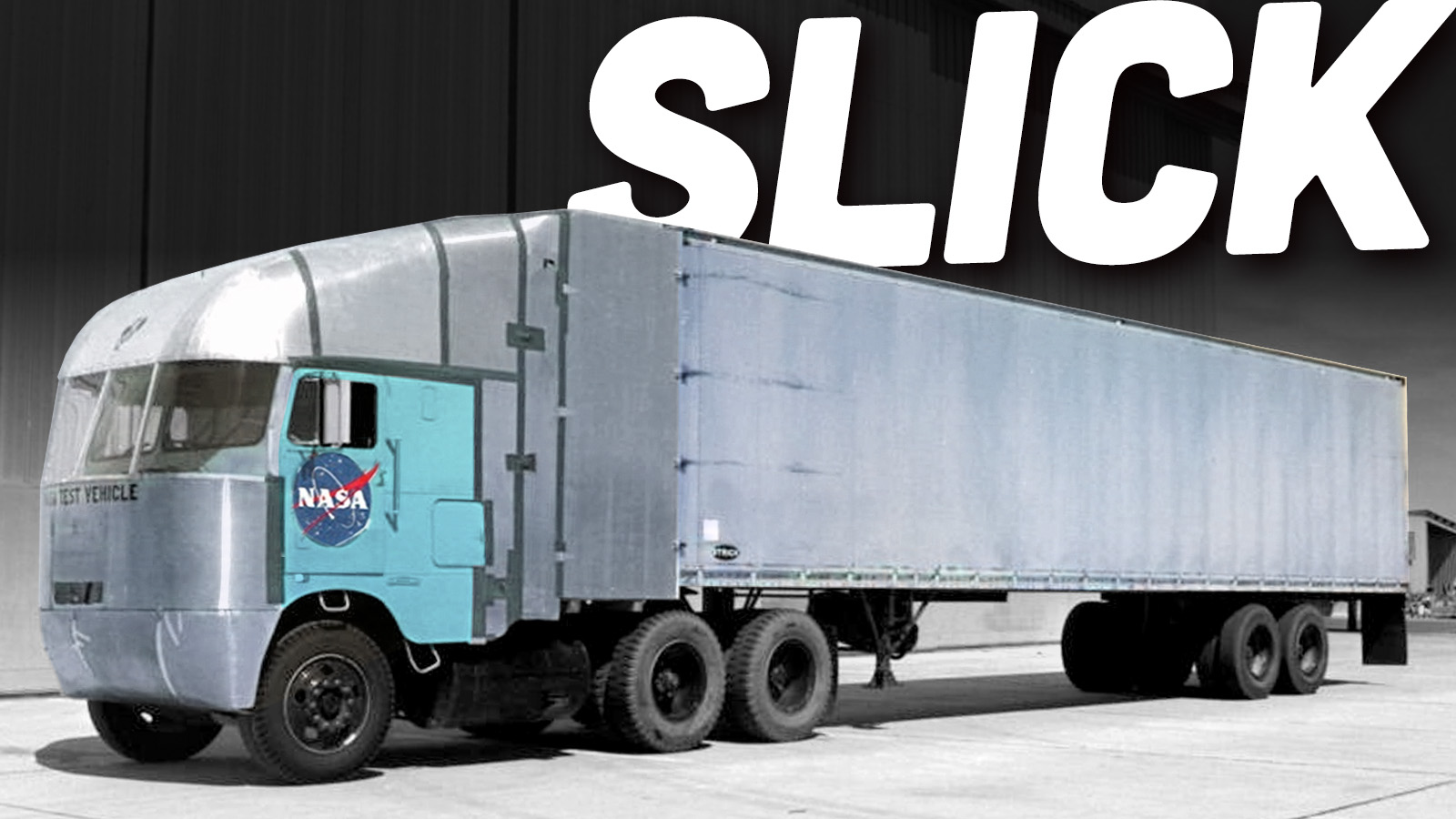
Aerodynamics are a vitally important part of semi-tractor design today. A truck that slides through the air more easily can get better fuel economy or squeeze a little more range out of its batteries. That, in turn, helps operators keep more money in their pockets. But it wasn’t always this way. In decades past, fuel was cheap, and trucks had about the same aero as the Sears Tower. In the 1970s, an engineer at NASA noticed that trucks had terrible aero, and embarked on a journey that would change truck design forever. All of it started with a bicycle ride.
While the National Aeronautics and Space Administration (NASA) takes credit for all of the modern era’s aerodynamic semi-trucks, it was hardly the only organization that thought that trucks could greatly benefit from streamlining. NASA wasn’t the first to build an aerodynamic truck, either. However, NASA had the scientific and research prowess that some individual inventors and truck manufacturers did not.


The trucks of the vast majority of the 20th century were different rigs from the ones that we see on the road today. For most of the century, semi-trailer combinations were highly limited in both weight and length, leading to the iconic cabover semi dominating the road. These trucks were unapologetically blocky, and their shapes had more in common with cinder blocks than anything even remotely aerodynamic.

As you’d reasonably expect, these trucks also had a voracious thirst for fuel. It was common for the big rigs of much of the 20th century to score only five miles per gallon. However, this worked out because fuel was cheap.
The affordability of fuel is part of what shaped truck design. Prior to the 1970s, a great concern among truckers and semi-tractor designers was not increasing fuel economy, but maximizing the size of their loads. If a semi-tractor were just a little smaller or a little lighter, an operator could fit just a little more in the trailer, and thus bring home a little more money.
That’s not to say there weren’t aerodynamic semis before the 1970s. One famous example of semi-truck streamlining is the Paymaster, which was designed by self-taught engineer Dean Hobbensiefken. While fuel was cheap back then, Hobbensiefken, who was an owner-operator, thought that he could bring home more money if his truck was less expensive to operate. Specifically, he thought there was no good reason for trucks to get such poor fuel economy, and he sought to make a truck that was 40 percent more efficient than the blocky cabovers of the ’60s.
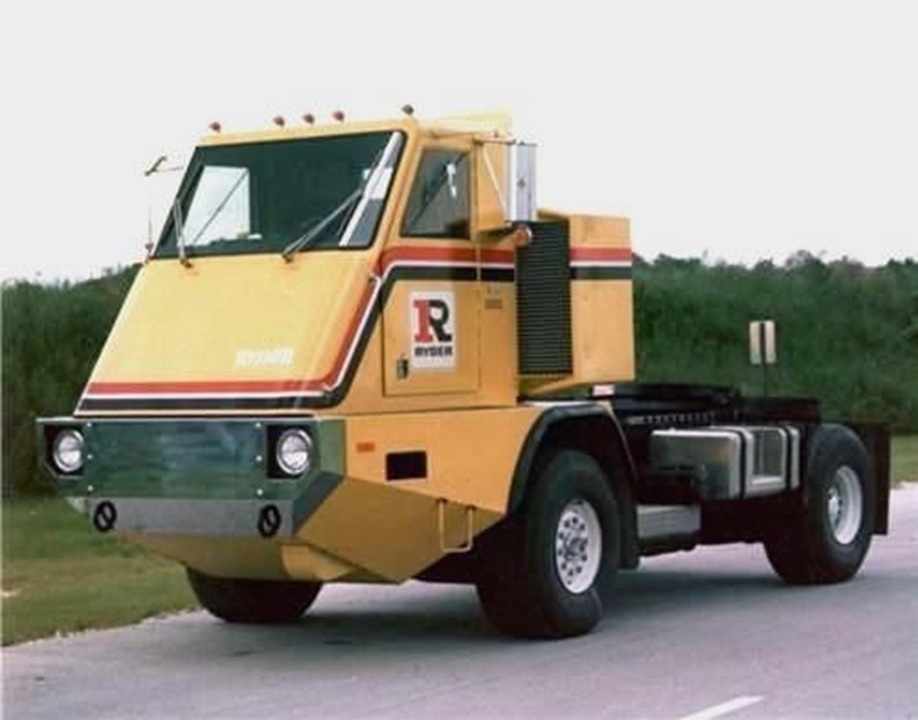
In the 1950s, Trailmobile and the University of Maryland developed the aerodynamic roof fairings that most trucks have today. So it wasn’t as if aero developments did not exist. However, they weren’t a persistent priority of the trucking industry.
Everything changed with the infamous oil crisis of 1973. If fuel shortages weren’t hard enough to deal with, the fuel that was available quickly skyrocketed in price. America scrambled to compensate, launching downsized, more efficient cars. In 1974, the federal government slowed everyone down with a 55 mph national speed limit designed in part to save precious fuel.
The trucking industry is especially sensitive to sharp changes in fuel prices. Paying more for fuel means that operators and trucking companies end up pocketing less money after loads are delivered. Independent owner-operators who get paid per load tend to have less negotiating power. Meanwhile, small carriers might not have the ability to weather the storm, resulting in their unfortunate closures. Eventually, trucking companies and operators have to raise prices, and eventually, the crunch is felt by the consumer at the end.
According to a 2008 U.S. Energy Information Administration report, the average price of diesel was $0.36 per gallon in 1978, rising by well more than double to $0.97 by 1981. But there was an unfortunate twist in that diesel prices rose high and then stayed high. This was part of what killed GM’s diesel passenger car program. Diesel engines were more expensive than their gasoline counterparts and ran on significantly more expensive fuel on top of that.
Of course, the trucking industry didn’t have the luxury of going back to gasoline. Diesel engines ruled trucking. So, it had to adapt. If the cost to fuel a truck couldn’t be changed, maybe the truck itself needed to change. The multiple oil crises sparked a new sort of race in America to build the truck of the future. One of the largest contributors to this future was none other than NASA.
A Project Almost Started By Accident
As NASA writes, its entry into the truck aerodynamics race was almost accidental in nature. In 1973, Edwin J. Saltzman, an engineer at NASA’s Dryden Flight Research Center in California (now the Neil A. Armstrong Flight Research Center), was riding his bicycle to work one morning. A truck blew by Saltzman, and NASA wrote what happened next:
Bicyclists, motorcyclists, and even pedestrians feel a push and pull of air as large trucks pass. The larger a vehicle is and the faster it moves, the more air it pushes ahead. For a large truck, this can mean a particularly large surface moving a large quantity of air at a high velocity—its blunt face acting like a fast-moving bulldozer, creating a zone of high pressure. The displaced air must go somewhere, spilling around the cab into swirling vortices. The air traveling along the side moves unevenly, adhering and breaking away, and sometimes dissipating into the surrounding air. At the end of the cab or trailer, the opposite effect of the high-pressure zone at the front develops; the airflow is confronted with an abrupt turn that it cannot negotiate, and a low-pressure zone develops.
The high pressure up front, the turbid air alongside and under the vehicle, and the low pressure at the back all combine to generate considerable aerodynamic drag. A study published in Automotive Engineering in August 1975 found that a tractor trailer unit moving at 55 miles per hour displaced as much as 18 tons of air for every mile traveled. In such cases, roughly half of the truck’s horsepower is needed just to overcome aerodynamic drag.
[…]
As a tractor trailer overtook him, he first felt the bow wave of air pushing him slightly away from the road and toward the sagebrush; as the truck swept past, its wake had the opposite effect, drawing him toward the road and even causing both rider and bicycle to lean toward the lane.
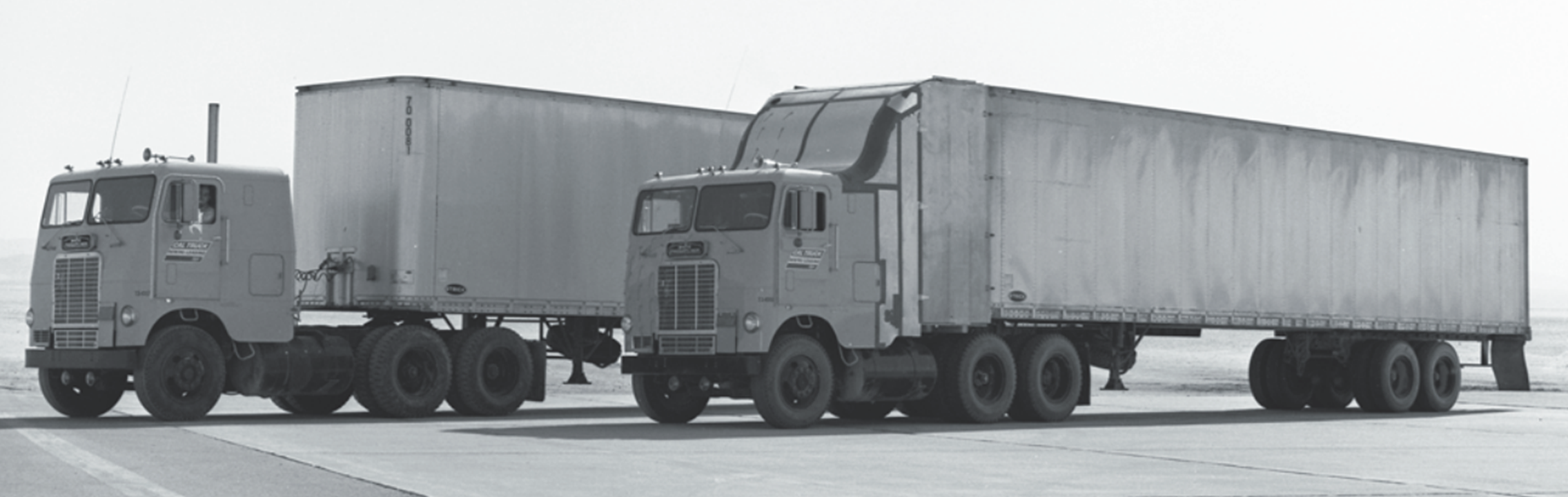
After this event, Saltzman wondered about how that bow wave and the trailing vacuum could be mitigated. Not only would mitigating these effects be safer for pedestrians and cyclists, but it would also allow trucks to slip through the air rather than beating it into submission. This, in turn, would lead to better fuel economy.
While Saltzman and the crew at Dryden were not truck designers, they were well-versed in the aerodynamics of aircraft and had even contributed to early space shuttle designs. They would decide to fix semi-trucks by designing them to flow through the air like planes.
The ‘Shoebox’ Demonstration Van
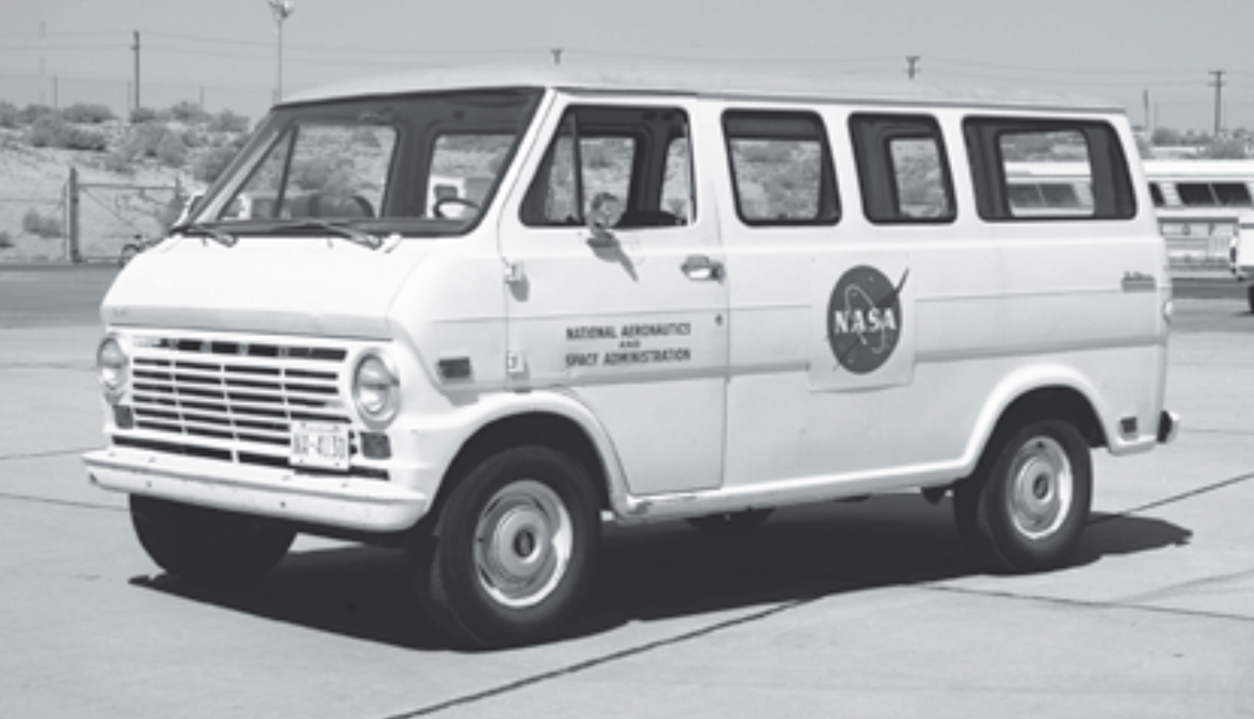
According to NASA, the team at Dryden didn’t have adequate funding to purchase, lease, or rent a vehicle for testing. However, Dryden did have a second-generation Ford Econoline sitting around that had been used for mail deliveries.
NASA Dryden engineers began outfitting the van with an external structure to improve its aerodynamics. NASA was specifically looking to make vehicles slip through the air without compromising interior volume.
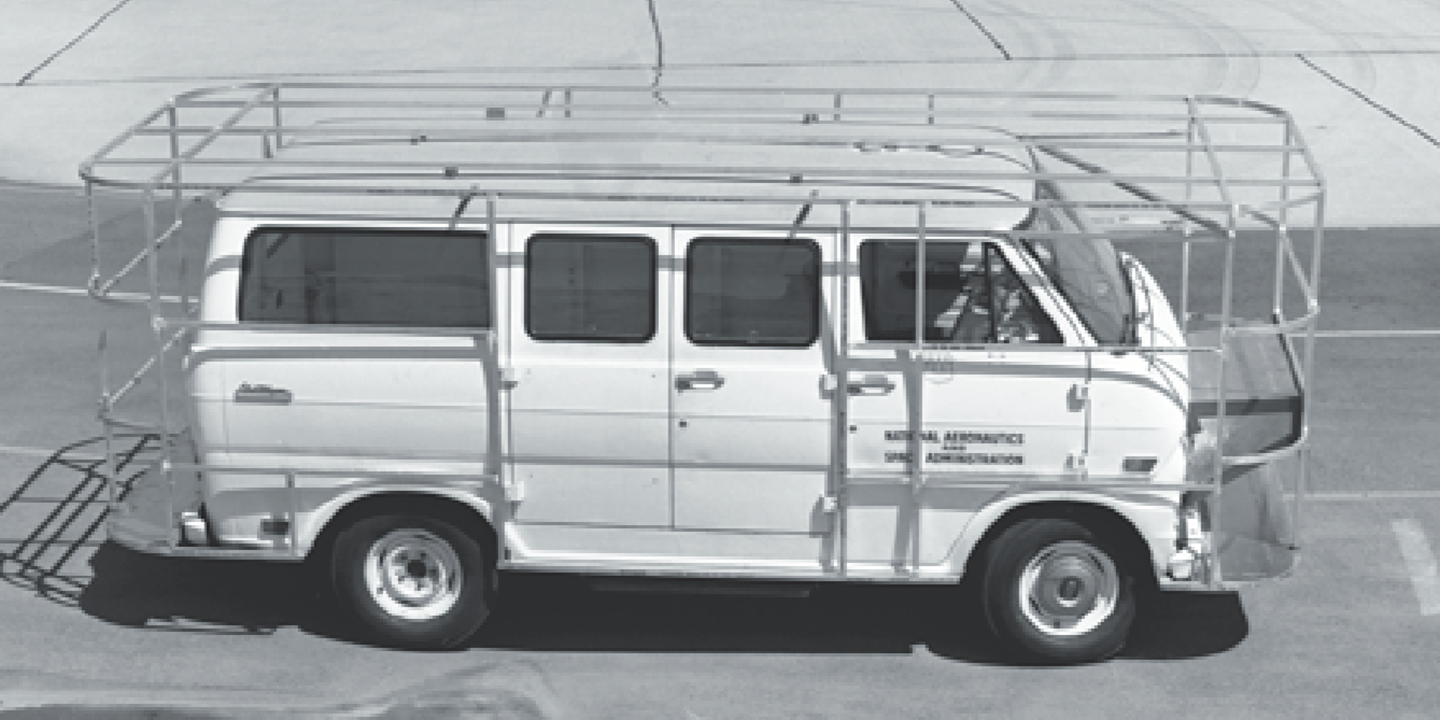
Drag was determined through numerous “coast-down” tests, which involve accelerating a vehicle to a speed, shifting the vehicle into neutral, and measuring deceleration parameters. Coast-down tests also revealed mechanical drag, too.

In 1974, before the Dryden team even produced their first report on the van, the U.S. Department of Transportation took note that NASA was now studying commercial vehicle aero and decided it wanted in. The feds would fund NASA’s research, and in return, NASA would also study the various semi-truck aftermarket devices that promised to aid fuel efficiency.
DOT noted that, following the oil crisis of 1973, the truck aftermarket was flooded with devices that were unproven and had only a modest take rate among truckers. NASA’s work would determine which ones were legitimate.
NASA continues:
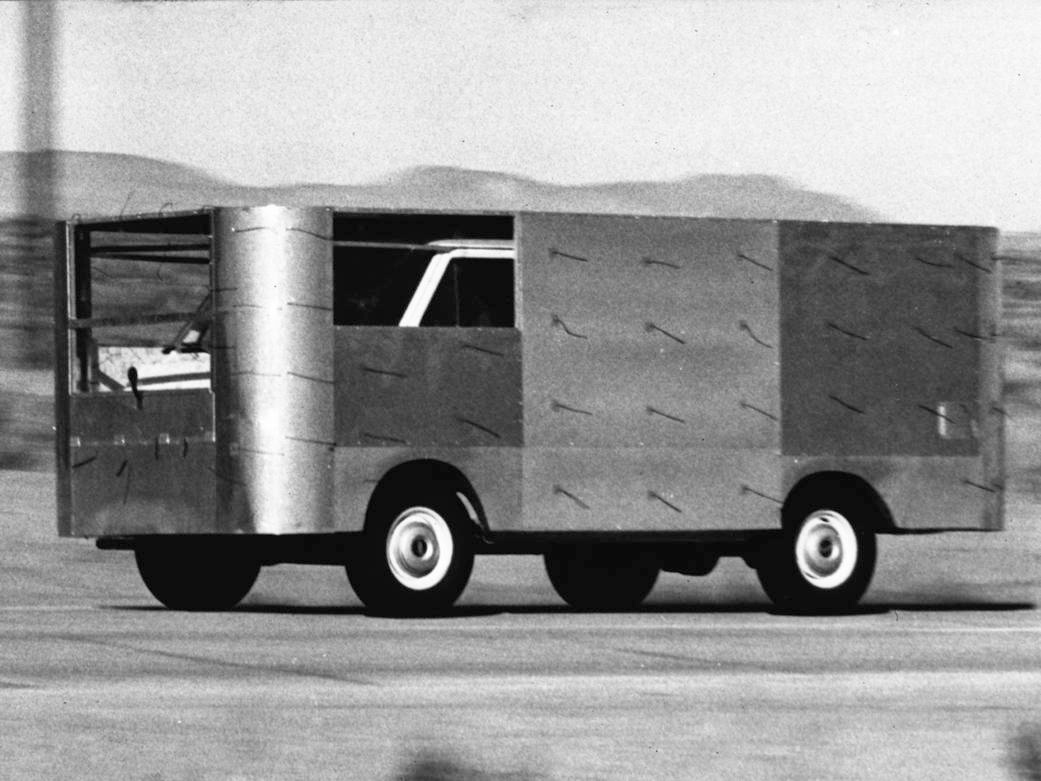
Mechanics attached an external frame which was then covered with sheet aluminum to give the van flat sides all around and 90-degree angles at all corners. The vehicle looked like an aluminum shoebox on wheels, simulating the cruder motor homes of the period. The Dryden engineers measured the vehicle’s baseline drag and then set about modifying the shape of the van: First rounding the front vertical corners, then the bottom and top edges of the front, then the edges of the aft end, and finally sealing the entire underbody of the van including the wheel wells, with tests run after each modification. Rounding all four front edges yielded a 52-percent drag reduction, while sealing the bottom of the vehicle gained another 7 percent. The engineers estimated the potential gain in fuel economy to be between 15 and 25 percent at highway speeds.
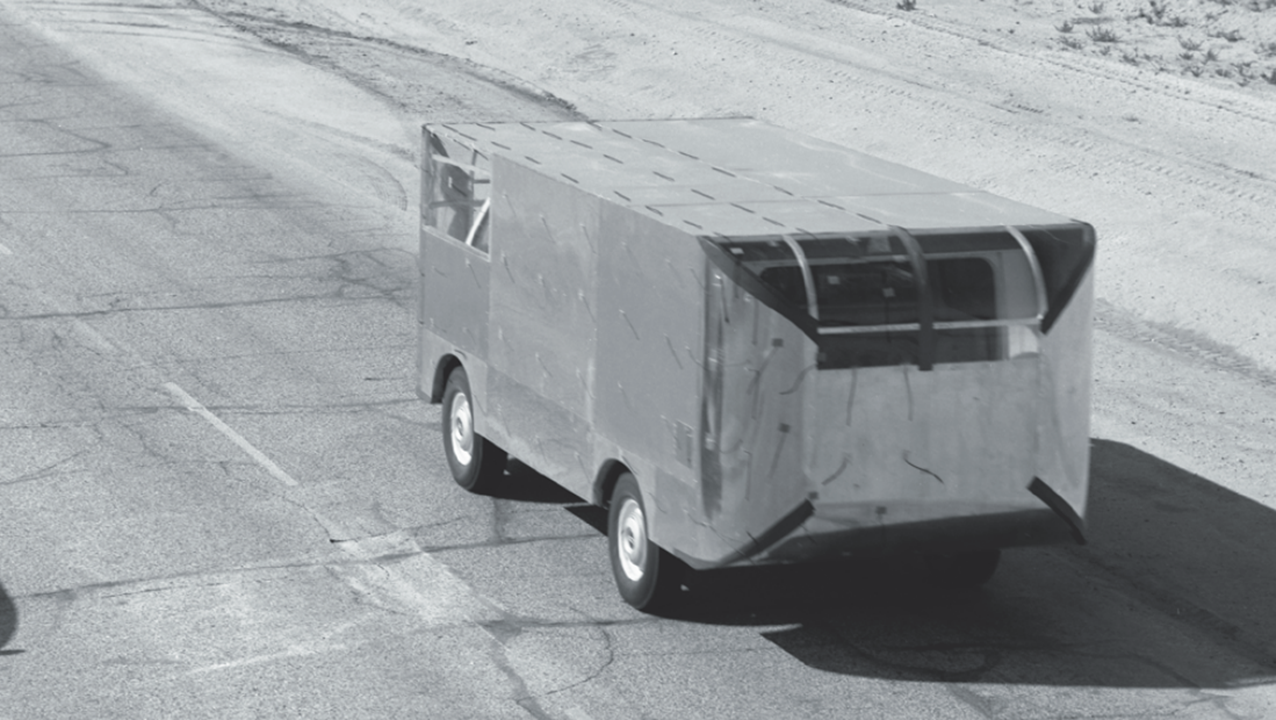
The Econoline with 90-degree corners returned a drag coefficient of 0.89. In rounding out the corners and giving the van a boattail, NASA got the van to slip through the air with a drag coefficient of 0.242. In addition to rounding out every surface of the van, NASA also had to enclose the entire underbody of the van to achieve Cd 0.242.
Assisting NASA in its testing were felt strings attached to the van, which gave researchers visual cues of what the wind was doing. The coast-down tests weren’t the only weapon in the NASA arsenal, either, as researchers also had access to wind tunnel testing to further validate their tests.
The Aftermarket Tried To Make Big Rigs Smoother
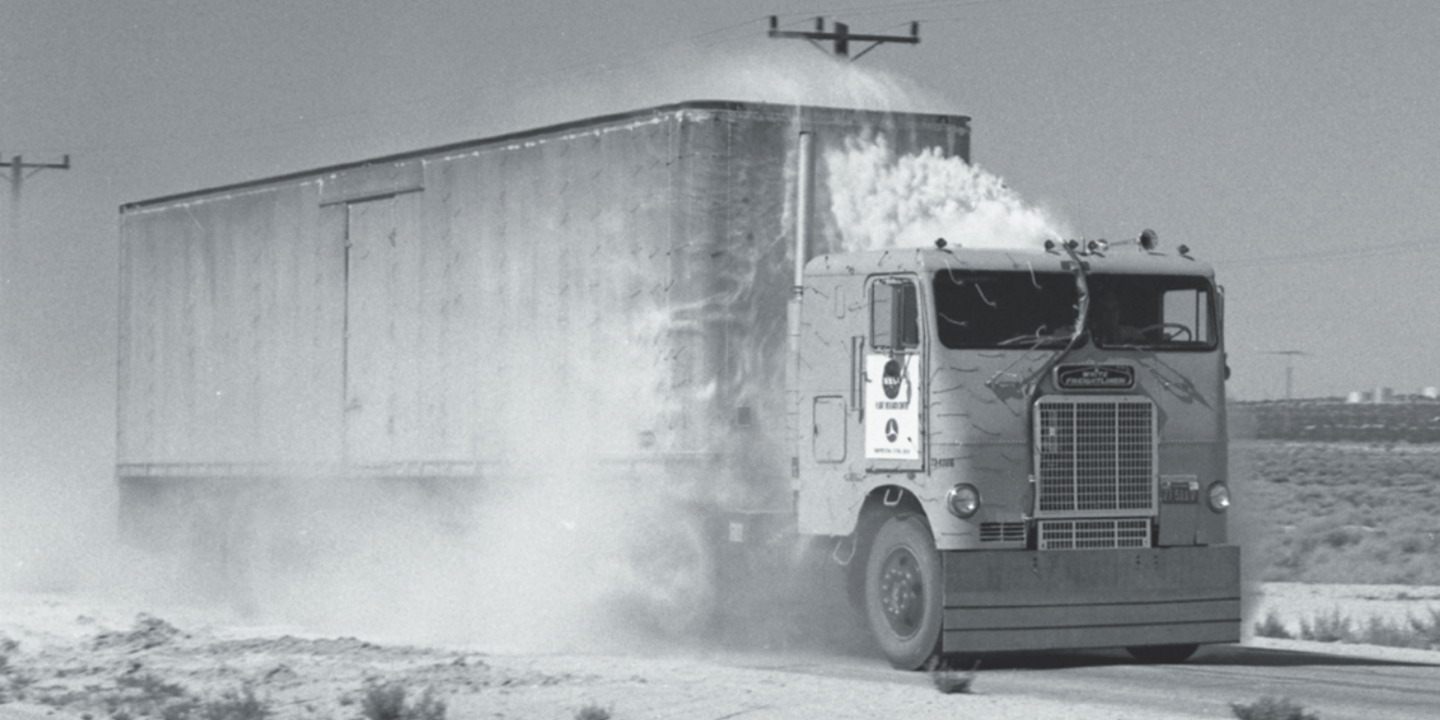
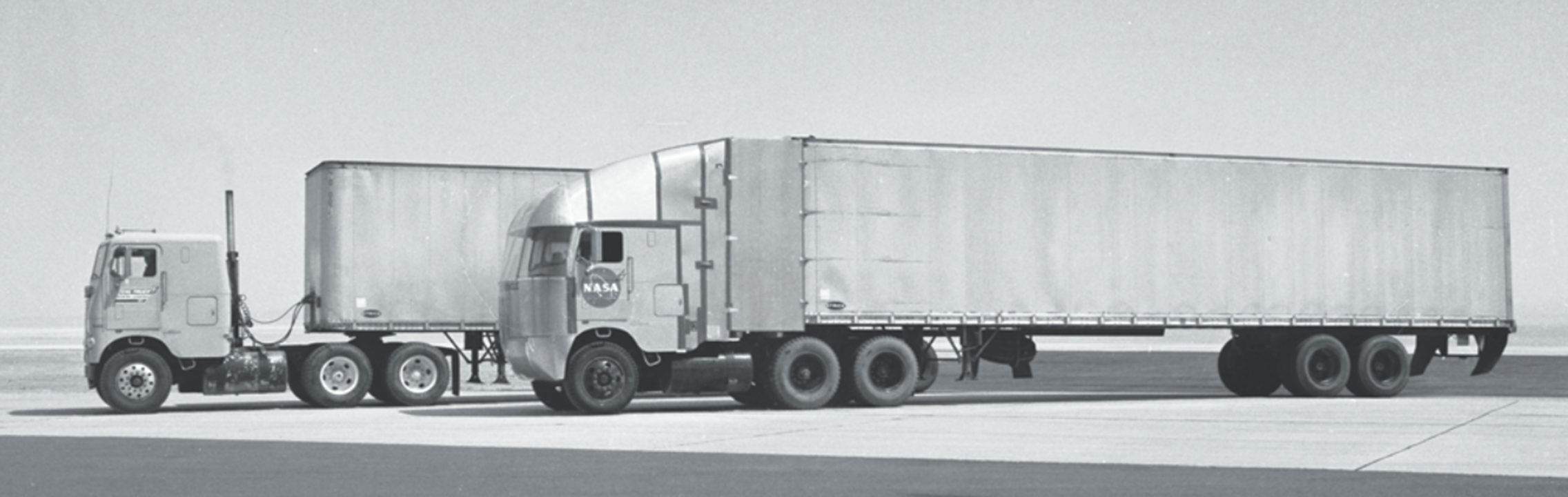
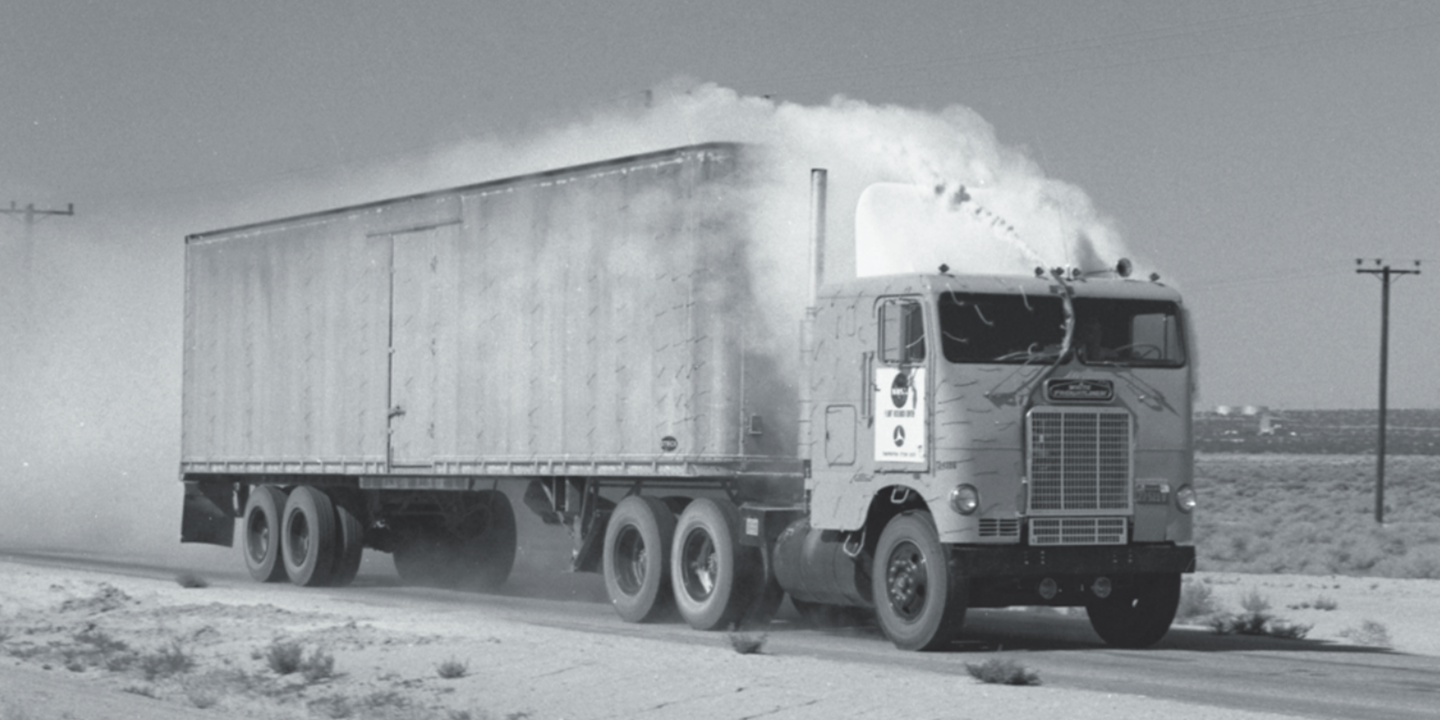
When the van’s tests had proven to be a smashing success, the DOT wanted more. NASA Dryden would come into possession of a White Freightliner that would run on the highway as a baseline rig. A second White Freightliner of the same model was then leased from a trucking company, and this rig would become a testbed.
DOT wanted NASA to test five aftermarket devices.
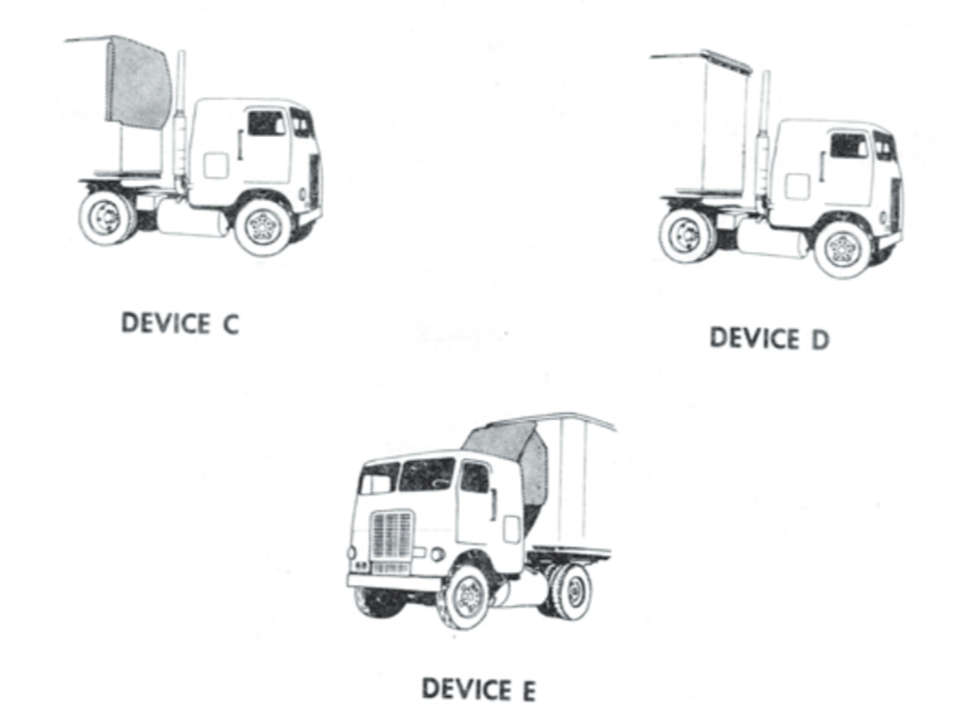
The one at the top left of the image is the Rudkin-Wylie Airshield, a roof-mounted air dam that had been in production for six years and had sold 24,000 units by the time NASA tested it in late 1974. The Airshield featured the air dam, plus a device called the Vortex Stabilizer that filled some of the gap between the tractor and the trailer.
On the bottom left is the FitzGerald Nose Cone. This was developed in 1965 when Joseph FitzGerald worked for a refrigeration unit producer and suggested that moving the evaporator to the front of the trailer would allow for more interior space. In doing so, FitzGerald accidentally discovered that the trailer became more aerodynamic. In 1973, he started marketing a frontal nose cone for trailers.
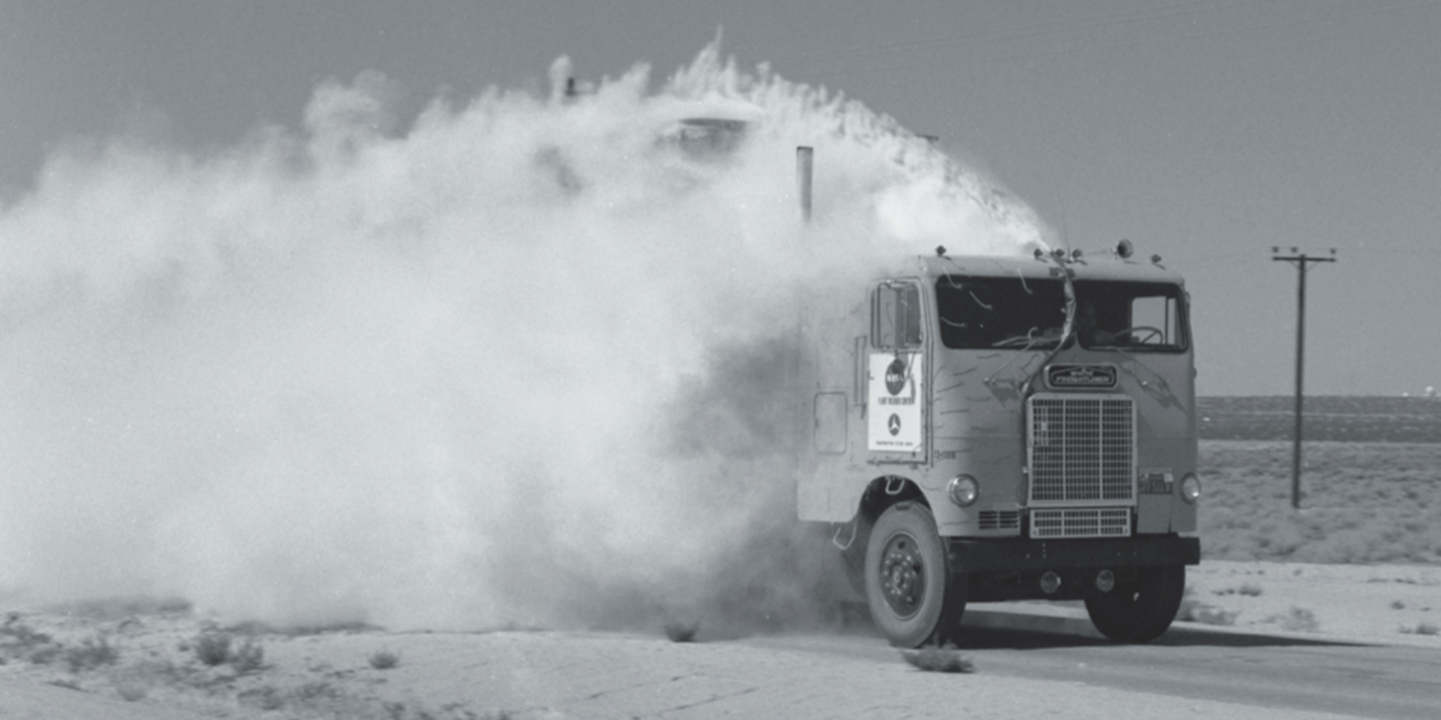
The other three devices were all air dams of different shapes, two that mounted on the truck, and one that mounted onto the roof of the trailer. NASA first set a baseline with a totally stock truck, achieving a coefficient of drag of 1.06. Then, researchers tested each of the five aftermarket devices.
The Airshield reduced drag by two to four percent. Meanwhile, the flap at the front edge of the trailer reduced drag by two to three percent. NASA also found that simply moving the trailer closer to the back of the cab resulted in a drag reduction of seven percent.
Device E, the Aero Van Aerovane, not only deflected air but also closed the gap between truck and trailer. The result was an impressive 19 percent decrease in drag.
Out on the road, the Airshield netted a 10 percent reduction in fuel consumption while the Aerovane came in a close second with a 9.3 percent fuel consumption reduction. NASA had proven that each of the five aftermarket accessories really did decrease drag, but not all accessories were equal.
NASA Builds A Soap Bar Truck
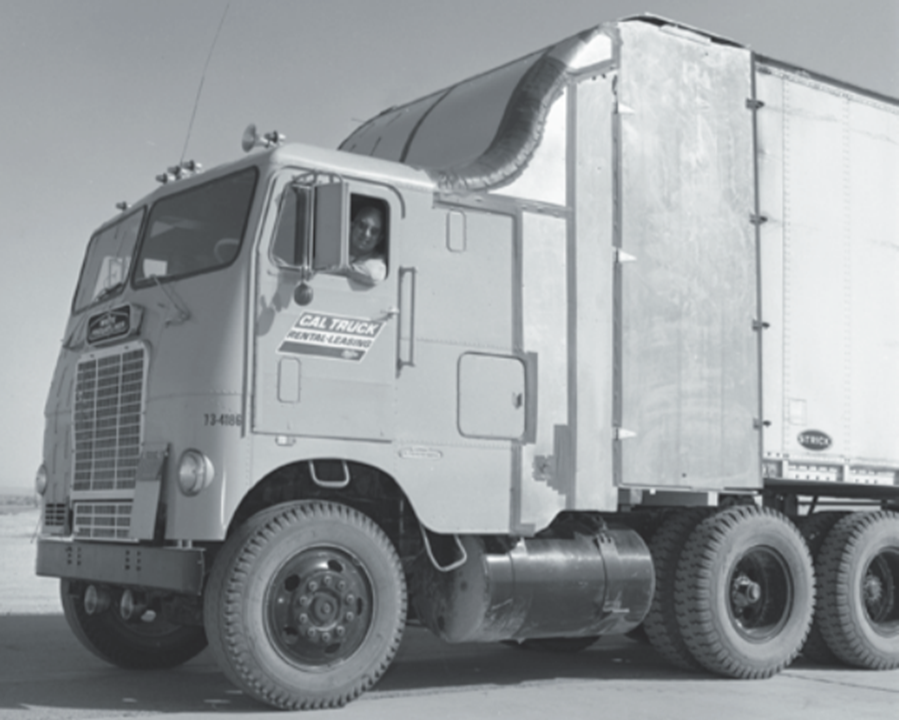
Once the researchers at Dryden tested the aftermarket devices, they turned back to the truck and decided to make their own streamliner. The first idea was to just replicate the best ideas from the aftermarket devices, but take them to the extreme. The result was the so-called “Bat Truck,” which looked like it should slip through the air better, but actually yielded little improvement.
Eventually, the engineers went back to the drawing board and decided to flip the script. What if, instead of trying to add wind deflectors to a square truck, the whole truck itself were rounded?
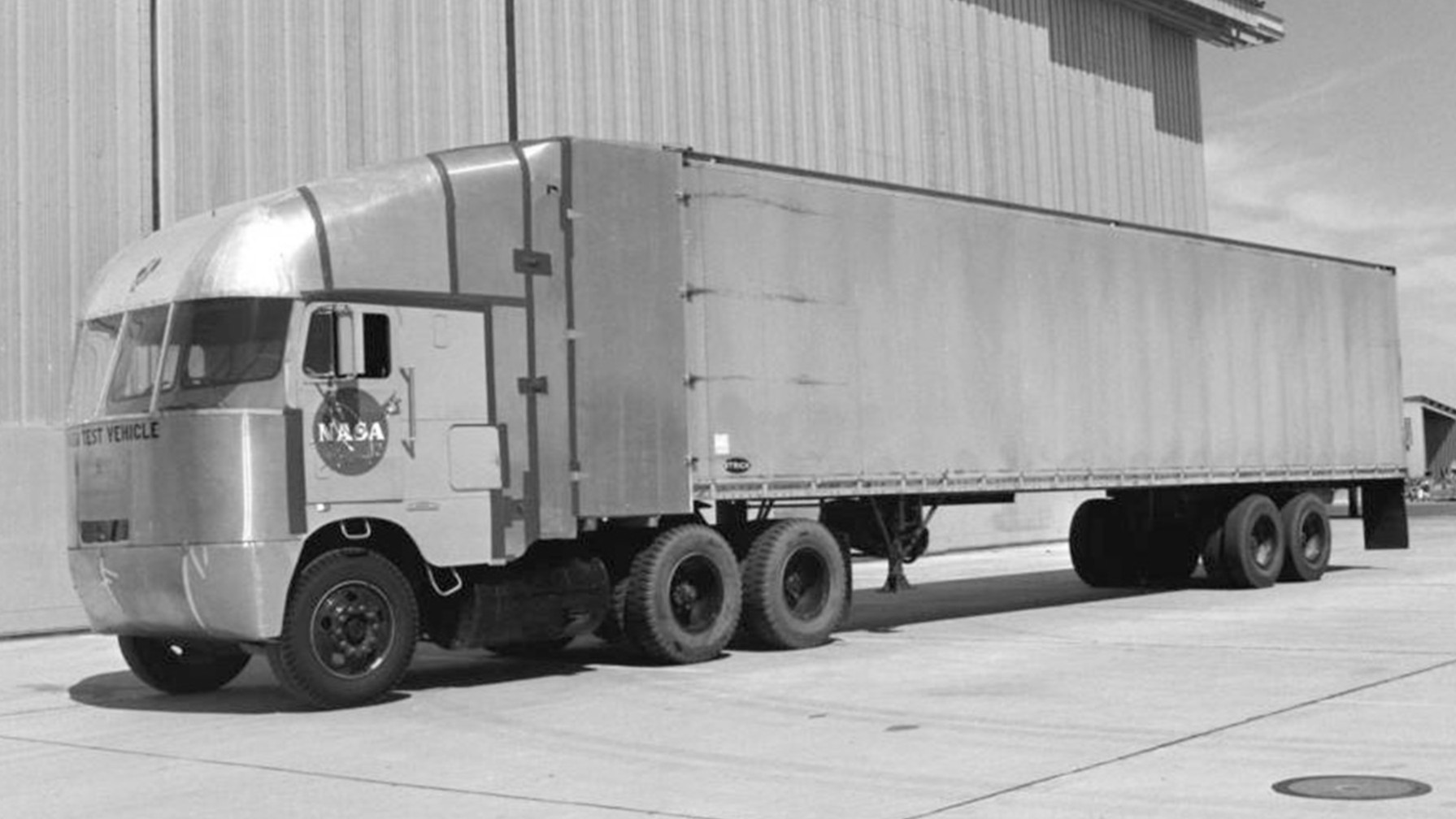
NASA continues:
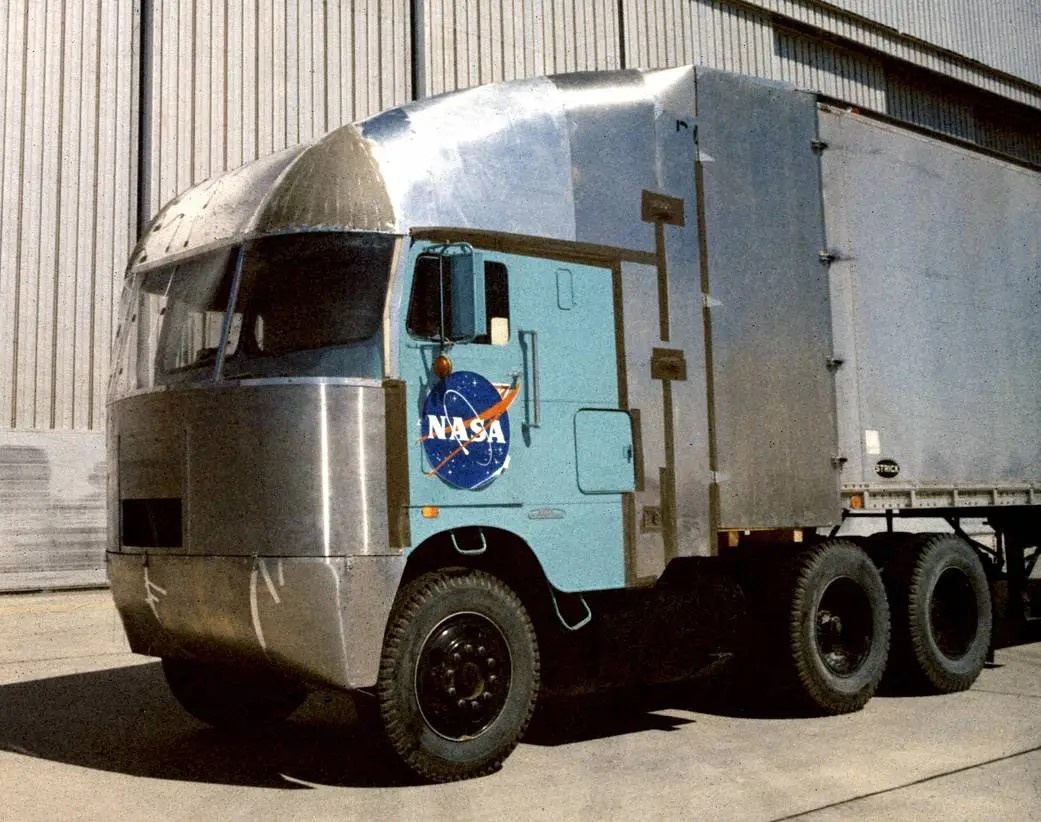
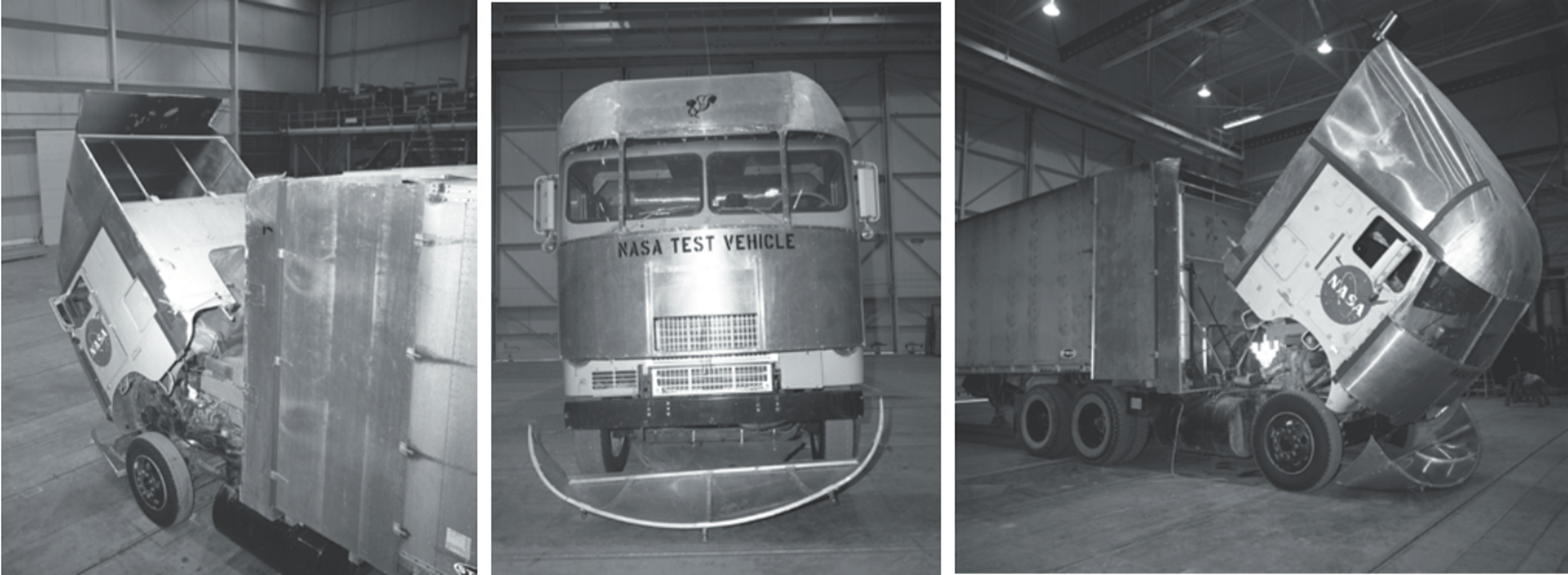
During the following decade, Dryden researchers conducted numerous tests to determine which adjustments in the shape of trucks reduced aerodynamic drag and improved efficiency. The team leased and modified a cab over engine (COE) tractor trailer, the dominant cab design of the time, from a Southern California firm. Modifications included rounding the corners and edges of the box-shaped cab with sheet metal, placing a smooth fairing on the cab’s roof, and extending the sides back to the trailer.
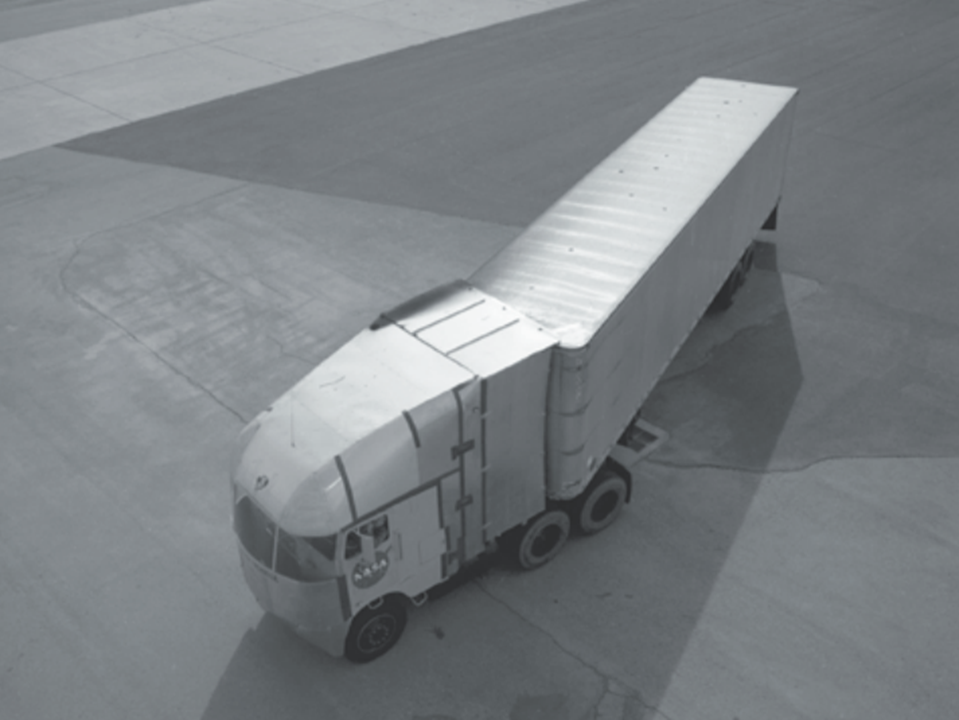
Rounding the vertical corners on the front and rear of the cab reduced drag by 40 percent while decreasing internal volume by only 1.3 percent. Likewise, rounding the vertical and horizontal corners cut drag by 54 percent, with a 3-percent loss of internal volume. Closing the gap between the cab and the trailer realized a significant reduction in drag and 20 to 25 percent less fuel consumption. A second group of tests added a faired underbody and a boat tail, the latter feature resulting in drag reduction of about 15 percent. Assuming annual mileage of 100,000 driven by an independent trucker, these drag reductions would translate to fuel savings of as much as 6,829 gallons per year.
In creating a truck that looked like a soap bar, NASA’s engineers made a cabover truck that consumed 25 percent less fuel than a typical cabover in calm winds. This truck had 37 percent less drag than the stock one at 55 mph and required 40 HP less to maintain 55 mph. NASA would come to the conclusion that some engineers in the trucking industry did, and that it was possible for a production semi-tractor to achieve a coefficient of drag of 0.25. It was an incredible accomplishment, yet not everyone was pleased.
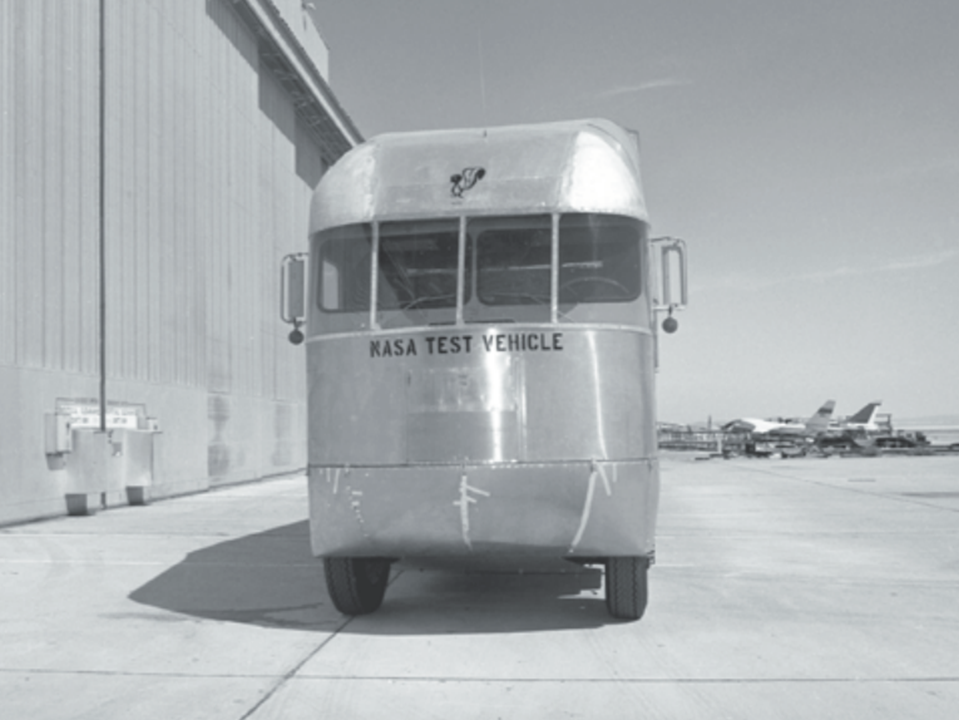
As NASA writes, at times during the Dryden crew’s research, NASA and the trucking industry questioned if it was appropriate for America’s space agency to be spending oodles of cash on semi-truck aerodynamics.
NASA’s Impact On Trucking
However, the findings were eventually too hard to ignore. If you wanted better fuel economy out of a truck, you had to make it slicker. NASA says its work led to real advancements in the trucking industry:
Streamlined cabs and fairings are now a common sight on our highways, and the once-prominent cab-over design has been abandoned in virtually all applications except small-capacity urban-oriented trucks where length remains a premium. The modifications tried by the engineers at Dryden were adopted by the truck manufacturers, as the same principles the NASA engineers demonstrated with COE trucks applied to conventionals. In addition, the cargo boxes of most delivery trucks today have rounded corners and edges, a direct application of the research conducted at Dryden on the “shoebox.”
Today’s trailers, on the other hand, are little changed from the last few decades. For livestock haulers, a key factor is that individual farmers have been the predominant owners of trailers, and these owners are difficult to convince about the costs of redesign versus the savings of superior aerodynamics. However, more and more livestock trailers are sporting boat-tail designs that ease the flow of air past the end of the trailer and minimize the low-pressure wake. Conventional trailer manufacturers have resisted change more so than others, in part because the aft end of such a trailer needs to be easy to manipulate at loading docks, where the optimal shape for superior aerodynamics—the boat tail—is impractical.
Likewise, the gap between the cab and the trailer can create a significant amount of drag as air swirls in the space between. Two conventional means to address this issue are problematic: Adding side extenders (to decrease the exposed gap) is expensive and might impede maneuverability; moving the fifth wheel forward (to shorten the gap) places more weight on the steering axle—which is legally regulated and limited—and reduces maneuverability while increasing driver effort and wear on steering tires and steering gear.
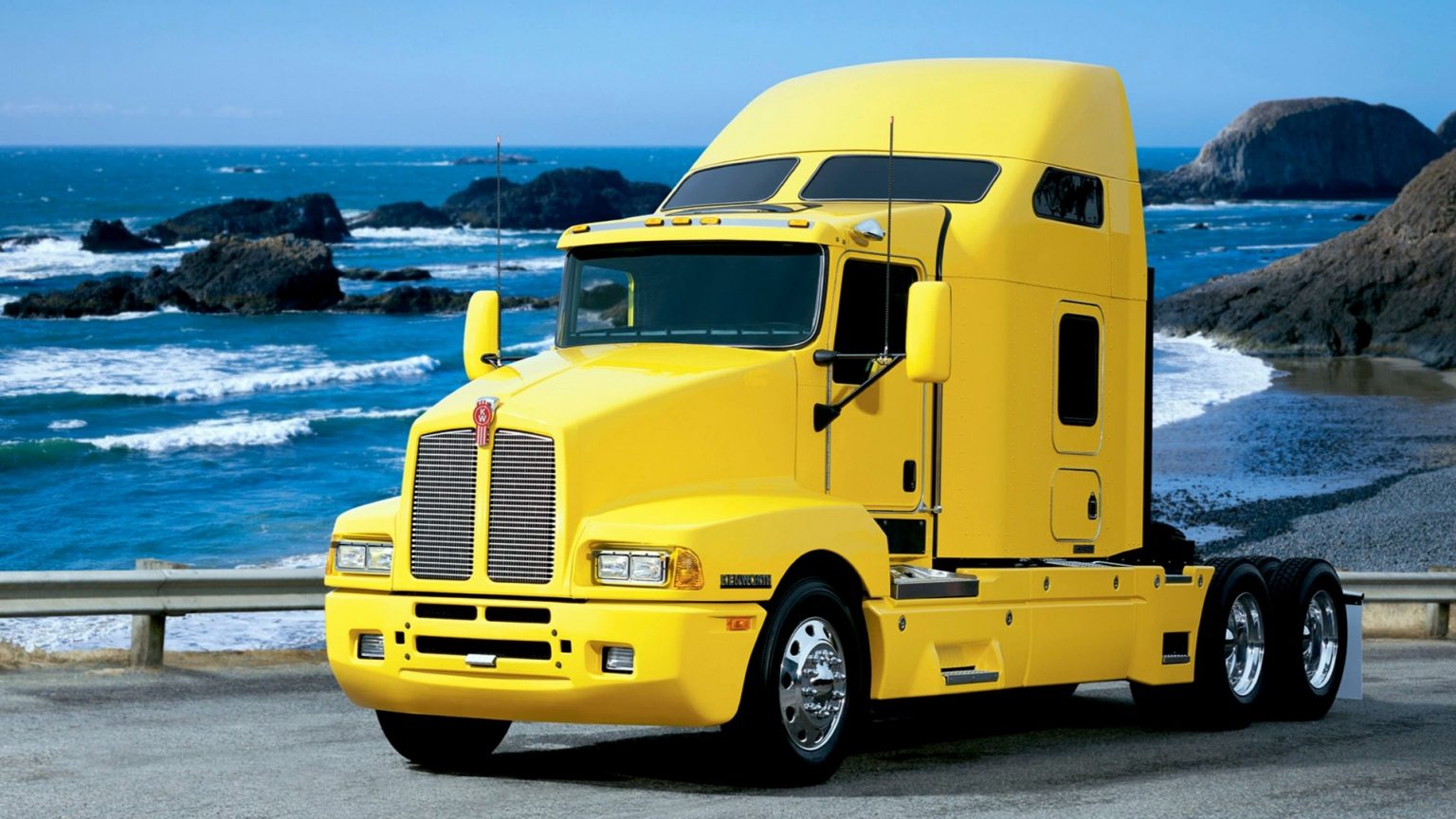
In 1984, Kenworth launched the T600, the truck that it says was the first to be designed from the ground up to be aerodynamic. NASA’s aerodynamic truck research would continue into the modern day, and engineers have even tested devices that are still in use today, like vortex generators. Trailers even have boattail-style attachments, too. For its part, NASA says that its research is a large part of why trucks have undergone an aerodynamics revolution.
As NASA prepares to get humans back onto the moon, this story is an awesome reflection that NASA doesn’t just make the dreams of reaching space possible. NASA researchers have made a positive impact on our daily lives, right down to the millions of trucks that keep America moving. Focusing truck design on aero helped pull the trucking industry through the dark 1970s, and today, aero remains vitally important.
It’s wild to think that all of this started when a truck blew by an engineer riding a bicycle. So, the next time you can order a cheap product or not get your socks knocked off by a moving truck, thank Edwin J. Saltzman and his team. By turning trucks into weird bars of soap, they made a lasting impact on history.
Top graphic image: NASA


Love this article thanks Mercedes.
If I was a 1970s trucker I’d want that NASA soap bar cab.
While I happen to think it looks better, it could look like a pig having relations with a rat & I wouldn’t care if it cut fuel costs by 25%
Being green (as in economics) is precisely why aero ev trucks are going to take over. Freight is a business the less you need to spend to move the goods the more money you make…
I look at the cab and see The Rocketeer.
I enjoyed this article.
Due to their laden mass, tractor-trailers will see comparatively less efficiency gains from this degree of drag reduction than passenger cars will. All of that mass still has to be lugged around, and rolling resistance is the dominant drag force for these vehicles for the majority of their operation whether you reduce aero drag to that degree or not.
With passenger cars that weigh considerably less and have proportionally less rolling resistance than tractor trailers, the results of drag reduction are greatly more stark. For passenger cars, at and above 30 mph or so, drag force tends to dominate all of the other loads.
Yet even then, drag reduction still made a very significant difference on semi trucks’ fuel economy. It really shouldn’t have taken NASA to prove it, but I’m glad they did.
With the most slippery aero possible on a semi truck, coupled with a diesel-electric hybrid drive system using a more modestly-sized engine and a 50-ish kWh battery, I think at highway speeds on flat ground that 20 mpg may be possible for a fully loaded commercial rig. The trailer would have to be designed to match the truck, as Luigi Colani’s designs did, but if some standard practical shape could be agreed upon as an industry standard after rigorous wind tunnel testing, we could nearly cut aero drag out as a load entirely for these vehicles.
“For passenger cars, at and above 30 mph or so, drag force tends to dominate all of the other loads.”
No, this number is waaay low. Even taking an absurdly lightweight car like the 1st-gen Insight and underestimating rolling drag using a constant-value model (no dependency on speed), aerodynamic drag does not predominate until 40 mph. For most cars today, aero drag doesn’t predominate until 50+ mph.
You can get a simple estimate of rolling resistance coefficient on your own car using a garage test I developed last summer when I was bored: https://www.amateuraerodynamics.com/2025/07/how-to-estimate-your-cars-coefficient.html
Plug in the numbers for your own car and you can estimate drag fractions at any speed and see where the crossover point is.
Crr of modern tires tends to be below 0.01. Some options on the market are as low as 0.005. You list 0.01-0.02. That’s still in the ballpark.
But it also depends on how rolling resistance is counted. Some estimates include non-tire resistance into rolling resistance as well(wheel bearing drag, brake drag, ect). I like to split these things out separately from tire rolling resistance by itself. That will create a discrepancy.
However you wish to measure it, the point about large trucks not being as impacted by aero drag reduction as passenger cars still stands.
Cool site.
At the other extreme, my velomobile’s tire rolling resistance and aero drag equal out around 15 mph. I did some coast down experiments to determine these parameters. But that vehicle, laden with me in it, has a weight around 250 lbs going down the road and tires with a Crr value around 0.007.
Because if there was one thing Nasa did in the previous century, it was not use a lot of fuel… 😀
Got those guys up there (and most of them back), very cool, so totally worth it 🙂
–And again, like that rocket train the other day, the “slap a mask on it” Rocketeer solution, simple and seems to work. Good thinking.
Now, if I can just use this to get my motorhome over 10mpg…
A Cd value under 0.30 is easy to get without wind tunnel access if you study airflow around bluff bodies and take advantage of what is publicly available to re-shape the body accordingly.
As long as the projected area / frontal surface of the motorhome stays as big as a house, even a slightly lower cd value will only help little.
And from my experience of working within a windtunnel as engineer for several years: It is not that easy. Sometimes, solutions that look like they could improve flow and reduce resistance, don’t work at all or even worsen the situation.
While I have no experience with a wind tunnel, I have used tuft testing for various DIY aeromods on my vehicles, built my own body shells, and understand that it’s not at all intuitive or straightforward. I’m sure you’re well aware that subtle changes to shapes/angles/surfaces can also have massive impacts on airflow.
Car manufacturers have made streamlined boxes. The Scion xB has a 0.32 Cd, for instance. The recent Mini Cooper, a 0.28. Mercedes Sprinter, a 0.33. Older RVs tend to have Cd values closer to 0.5-0.6.
It’s unfortunate that designs tend to be compromised in the direction of extra added drag purely for either marketing or aesthetic purposes. With enough effort, getting a box into the low 0.2 Cd range isn’t out of the realm of possibility.
“And from my experience of working within a windtunnel as engineer for several years: It is not that easy.”
This is correct. Like you, I’m an engineer with wind tunnel experience. And like Toecutter, my first introduction to aerodynamics was through Ecomodder. The difference is, I went back to school and got a degree in aerospace engineering, figuring out along the way how much of what I had believed before was just wrong.
It is possible to take your car or motorhome or whatever and measurably reduce its aerodynamic drag but it is not easy. And it is next to impossible if you do it simply by eyeballing modifications or guessing without measuring anything.
Well, there is always the Fuel Shark. Could get that RV up to 18mpg in just seconds.
I’m just trying to get my Excursion over 10mpg.
Hunting down the cause of massive fuel consumption on a truck that otherwise runs perfect is an exercise in frustration.
While I often seen trailers with folding boattails, I don’t think I have ever seen one deployed. Invariably they are folded flat.
I see them deployed all the time on the I-5. I wonder if they tend to get set up at highway stops or ‘when you think about it’ more than being done religiously at the loading dock.
This is slick
Nice write up. It’s not rocket science. I’d argue that trucks from 20s-40s were more aero than the idiotic bricks that came after, and anyone involved in soapbox derby knew better. Biomimicry is where to study. Dugout canoes were common sense from pre-history.
Quite sure some people didn’t react favorably to this new fangled look. Same people that have any aversion to any change, especially positive change.
Thank you for helping highlight some of the great things that that comes with having an organization, such as NASA, funded.