

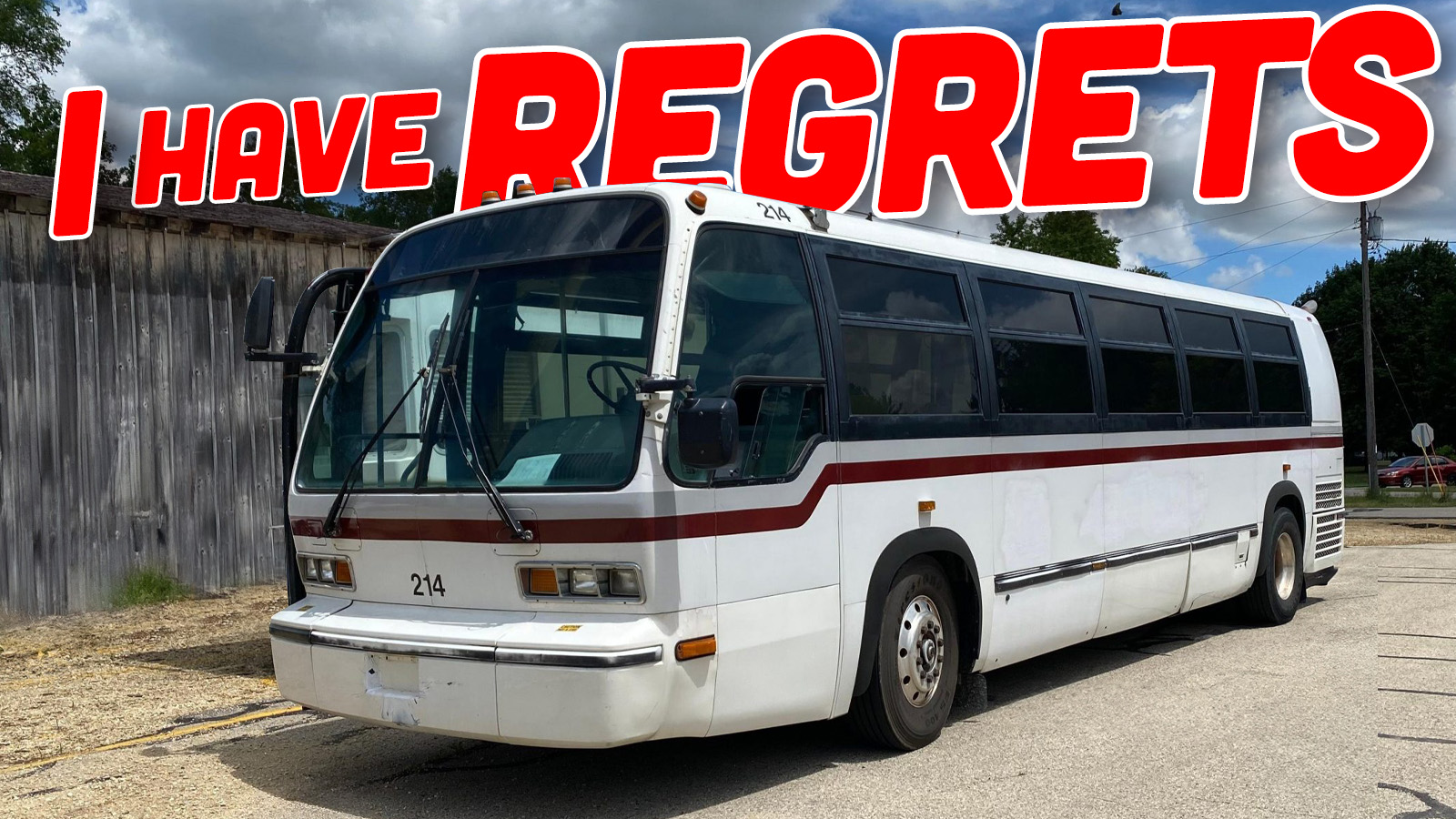
Time does a lot to a person. You get older, usually more experienced, and hopefully a little wiser. You learn your limits and your skills. Mistakes you made in the past are finally laid bare. My biggest automotive mistake was blindly following my childhood dream and buying a cheap variant of the iconic GMC RTS-II transit bus. I was perhaps the happiest person in the world five years ago, but today, I must admit defeat. I should never have purchased this bus, and now I must send it to a new home before it’s too late.
I suppose I’ve never been a typical car enthusiast. When I was a teen, my classmates talked about Ford Mustangs, Chevy Camaros, and the Ferrari of the week. I talked about Smart Fortwos, cargo vans, and buses. Some of my fondest memories in school were listening to the growl of the big block V8 that powered the GMC school buses I rode in, and the International DT466E engines that powered those buses I rode in. When I was in fifth grade and was given an exercise to make an imaginary budget, I imagined myself owning a Ford F-350, not because it was a pickup truck, but because it was yellow and had a large diesel engine.


In 2021, I achieved what was a childhood dream. For as long as I could remember, I adored the domineering transit buses of General Motors, particularly the New Look and the RTS-II. I loved the genuine innovation baked into these buses, and thought they were the coolest-looking transit vehicles in the world. So, when an opportunity to buy an RTS derivative for only $5,500 presented itself in 2021, I took it. I went in without a real plan. I just wanted the bus.

Now, I have it. I had some fun with my bus, and it was the member of the fleet that I was the most attached to that wasn’t a Smart, Saturn Sky, or Suzuki RE-5. But the fear that was at the back of my mind became reality. I was ill-equipped to take care of this bus from the start. I remain in that position today. It’s taken a long time, but I must admit defeat and let go before it’s too late. So, I’m saying goodbye to the bus that I probably shouldn’t have bought in the first place.
How I Got GM’s Legendary Bus
I’ve written about the history of the RTS pretty extensively. Click here for some history. Otherwise, I’m going to skip to how I even got an RTS.
My love for transit buses was an extension of my love for school buses. I’ve always lived in places with lousy public transit, so I never took an RTS-II while it was still in service. Instead, I discovered the RTS-II through books and video media. Kid me thought school buses were awesome, but transit buses? I thought those were the apex of buses. At the top of my list was the New Look, possibly from watching Speed, and tied with that was the RTS-II, the bus of the future.

As luck, or fate, would have it, one of the last operators of the RTS series was Texas A&M University (TAMU). The university runs a transit system that it calls Aggie Spirit, and something that’s pretty neat about Aggie Spirit is that the bus drivers are students. TAMU offers paid training for a commercial license, and then you get to drive TAMU buses, hauling other students along the line. I am one of the only non-TAMU alumni members of a TAMU bus driver group, and I love it because the bus operators are so tight-knit. These lovely people found camaraderie in driving big buses.
TAMU’s bus fleet was also unique in that it used to be full of Nova Bus RTS-06-series units. However, by 2020, the youngest of these buses was 18 years old. TAMU began auctioning these buses off on GovDeals, and soon enough, the buses began spreading out all over Texas. Many of those who bought the old buses were the students who drove them when they were in school. Sadly, I didn’t know about the auctions until after I bought my bus.
Anyway, I saw my bus for sale on Facebook for the princely sum of $6,000. I negotiated the guy, a former TAMU student, down to $5,500. Then, Sheryl and I piled into her Chevy HHR and sped 1,200 miles south to a location just outside of Austin.
A Dream Made Reality

My heart raced when I saw my bus for the first time. So many thoughts were going through my mind. A part of me wanted to back out at the last second. This was crazy! It’s one thing to buy a cheap diesel Volkswagen Jetta in Wisconsin; it’s an entirely different game to buy an entire 35-foot transit bus. Deep down, I knew I had no business buying this bus. I didn’t have a CDL, I had to convince Liberty Mutual to insure the thing, and my license plate was a paper temporary plate I got from the state of Vermont after I pinky-swore the bus was totally an RV. I hadn’t even driven a transit bus at that point in my life.
But that childhood dream powered through my doubts. I gave the seller his cash, hopped in the Recaro air seat, switched on the air-conditioner, and hit the road. I was in love. I quickly discovered that, due to its cab-forward design, my bus turned on a dime compared to a school bus. Between the air seat and the air suspension, it was supremely comfortable, too. The air conditioner is the best I’ve experienced in a vehicle to date. The air was so strong that it frosted my windows over on a hot Texas day that was well over 100 degrees. I had to open the windows to keep myself from freezing. I even saw my breath!
My bus is powered by a Detroit Diesel Series 50, a massive 8.5-liter turbocharged four-cylinder making at least 250 horsepower, and it’s paired with a five-speed ZF 5HP592C automatic. But the coolest part may have been the top speed. Many transit buses are geared to go no faster than 45 mph or 55 mph. However, TAMU used these buses on higher speed services, so the Aggie Novas cruised at highway speed without breaking a sweat.
Immediate Cracks

I wrote about my experience driving the bus 1,200 miles home for Jalopnik back in 2021. Honestly, the red flags appeared immediately. From that piece:
Unfortunately, not all appears to be well with this unit. Only a few miles into our drive home and the low oil pressure alarm started blaring at about 70 mph. That was odd, as the seller never mentioned anything about low oil pressure and even showed that it passed an independent inspection.
It was 98 degrees in Austin that day, so we thought that maybe the heat was too much for the speed I wanted to go. To make matters worse, the ECU’s programming shuts the engine down if it reads low oil pressure for too long. The bus stranded itself and blocked traffic for a while. I later discovered an engine overrule switch that overrides the engine protection system and keeps the engine running.
Sadly, I’d spend much of the trip hitting that button as the oil pressure warning would come on at completely random times, but only at speeds above 60 mph, and temperature didn’t really matter.

My bus is a thing of mystery. I was told by TAMU drivers that the buses are electronically limited to 62 mph. Yet, mine hits 70 mph just fine before hitting the limiter. Sometimes, I saw a GPS-claimed 75 mph (70 mph indicated) before the limiter kicked in. Nobody could explain why my bus was much faster than it should have been. One of my good friends is a heavy diesel mechanic, and his best guess is that, at some point in the past, the ECU was replaced with one that wasn’t meant for my bus.
TAMU’s maintenance department was kind and sent me the entire service history for the bus. It was over 900 pages long and featured entries including several transmission overheating events, an engine overhaul, air suspension replacement, and a million other things. For over five years, I never really figured out why my bus was so fast, and just considered the extra speed as a nice perk.

As for the oil pressure warning indication, I did find out the sensor was bad. But I had never pressure-tested the bus, so I didn’t know how much oil pressure the engine actually makes. There was enough pressure for a cross-country road trip, but I don’t know the actual number. Maybe I was too scared to find out.
What I can say is that oil analysis showed a shocking amount of lead, but no other wear metals in the coach’s oil. I would later join a Facebook chat that just so happened to have the previous owner of my bus in it. The chat’s records indicated that the bus was giving low-pressure warnings for almost a year before I bought it, and the warnings were one of the motivating factors for TAMU to dump the bus. The previous owner knew about the issue because, as the chat logs showed, it worried him when he owned the bus. He never disclosed the issue to me.
But again, I was so deeply in love with my bus that I ignored the red flags. I didn’t even ask the guy why he hid the oil issue from me. To paraphrase the show BoJack Horseman, “When you look at a bus through rose-colored glasses, all the red flags just look like flags.”
My Dream Meets Reality

But things were good for a while. I initially bought the bus for an RV conversion. But then I figured out that I don’t have the skill or the time to build my own RV. The dirty secret is that a decent DIY RV conversion could take you half of a decade, and that’s if you’re investing all of your free time into it. I also learned that my bus was sort of a rare-ish piece of history. Most RTS end up scrapped or turned into an RV, so I had an opportunity to preserve one as it was in service in 2020.
So, I did that. I didn’t change a thing. Instead, I sometimes drove the bus to the beach and back, sort of treating it like it was a Corvette. Amusingly, if I happened to stop the bus at a light that was beside a bus stop, sometimes people would try to board. It’s weird because the Illinois Pace bus system uses vastly different, much newer buses with a very blue paint scheme. I’m not sure why folks thought I was a bus that was in service.

My dream finally met reality in roughly 2022 when law enforcement kindly suggested that having a Vermont license plate and an Illinois address wasn’t kosher in this state, and should a cop think something was a bit too goofy, they could order the bus impounded. Sure, I might be able to get the citations dismissed, but I would still be on the hook for the towing and storage fees, which wouldn’t be cheap for such a huge vehicle.
Until summer 2023, Vermont registered any bus as an RV without proof of a conversion, and happily sent the license plates anywhere in America. The so-called “Vermont Registration Loophole” was a lifeline for people who bought old school buses to turn into RVs, but needed to legally drive them home from the auction or from the seller. Then, you just turned the Vermont registration into your DMV and got a shiny RV plate from your home state. This didn’t work for me because by the time I tried to do this, the secret about the Vermont loophole was out.
Illinois requires a moderate RV conversion before issuing similar plates. I also needed a license in the correct weight class. Illinois is not like many states in that an RV plate is a loophole out of weight class requirements. While Illinois doesn’t require you to get a CDL to drive an RV, it does require you to upgrade your license’s class. In my case, I’d need a Class B.

Truth be told, I always knew this was the risk with going all in on Vermont. Yes, Vermont was willing to mail license plates and registration to anyone living in any part of America, but your mileage always varied. You might get away with a Vermont plate on a Toyota Corolla, but a big white old transit bus sort of sticks out. But again, rosy shades.
So, I parked the bus until I could figure out my next steps. Obviously, I needed to fix the license issue. I don’t have any local friends with a Class B or better who could drive the bus to the testing station. But also, I needed it to be registered in Illinois, too, which was another can of worms. Ultimately, I just kept kicking the can down the road. Other things kept taking priority, from work to dealing with what was then my wife’s cancer diagnosis.
Way In Over My Head

Then, I realized that just taking care of the bus was darn near impossible for a single person. Unlike the transit bus, my school bus felt like a pickup truck that was scaled up by a factor of five. It had somewhat pickup-like hydraulic brakes, a big ol’ pickup-like alternator, leaf springs, and an engine and transmission that could be serviced by one person with an adjustable hammer. Working on the school bus felt like working on a pickup, only everything was bigger. Even parts weren’t that expensive. It even took two cheap car batteries from Walmart.
The transit bus, on the other hand, is like working on a space shuttle. For starters, there is no key. The bus is technically always active, and you start it by turning a dial and flicking a switch. Because of this, the bus will drain its batteries after only a week of sitting unless you disconnect the batteries. The bus has a tray of batteries that, combined, weigh more than I do, and a pair of compatible batteries costs more than $1,000.

The bus is computerized, and all warning indication is done through lights, a beeper, and a buzzer. If I want to check diagnostic codes, I have to put in a darned Konami Code to enter diagnostic mode and then count each beep to determine the check engine code.
Then there’s everything else, from the air brakes and air suspension to the jungle in the engine bay. This bus is too much for one person to handle. I’ve been told that transit operators tend to have crews for this, and those folks have education and certification, so they know what they’re doing. I’m one person working outside in gravel. Don’t even ask about any parts, as parts are both hard to find and are often ludicrously expensive. Heavy diesel mechanics aren’t cheap, either.

I didn’t even get around to replacing this deteriorated baggage door hinge. The 5-foot section of rubber alone was $55. GM made its hinges entirely out of rubber, and over time, this rubber becomes as hard as a rock, ultimately causing a baggage door failure. Replacing the rubber hinge involves chiseling and grinding the old rubber out, and then fighting to fit the new rubber into place. You might wonder why I haven’t shown pictures of the battery tray, and honestly, it’s because I don’t trust that the hinge rubber will hold together.
It has taken me two, maybe three years to admit this, but this bus is way beyond my pay grade. I was in over my head years ago, but I was too stubborn and too in love to admit it. Honestly, this seems to be the curse of any coach bus or transit bus that falls into private hands. Many private owners figure out the hard way that these beautiful buses are a full-time commitment. It really takes watching only one Bus Grease Monkey video to figure that one out.
Time To Pass On My Dream

So, I have to admit defeat and rehome the bus. I took terrible care of this thing, and it needs a better home than the one I can provide. It’s taken me a long time to get here, but it is the correct conclusion. Technically, I should have never purchased the bus in the first place. Now, I fear that I reached this conclusion too late. But I guess, at least, it didn’t take me decades to get to this point.
I am offering the bus entirely for free to any museum that wants it. I have already contacted the Illinois Railway Museum and the Midwest Bus Museum. IRM’s bus department doesn’t have the resources to take on my bus right now, and MBM hasn’t responded to my inquiry yet. The bus is a piece of history that deserves to be preserved.

However, I won’t lie, my bus is not a perfect candidate. It hasn’t been started in a couple of years. So, right off the bat, it’s going to need new batteries. Then, who knows what the condition of the air system will be once the bus is running. That assumes it even starts. Then, that unresolved issue with the oil pressure warning indication remains. The bus also had a knack for blowing a lot of black smoke when under load. What I’m saying is that the bus has over 400,000 miles, and it’s probably pretty tired.
My hope is that there is a museum that’s somewhere, anywhere, that wants a free bus to add to their collection. I’d rather see this bus saved as a time capsule than turned into scrap. I’d also give the bus to a collector for free. But if all else fails, I suppose I’ll toss it to the unwashed masses of Facebook Marketplace and see what happens.

Despite the top graphic, I don’t think I regret buying the bus, though I’m convinced that I shouldn’t have bought it. But I did, and I had a thrilling time with the bus while the good times lasted. I drove it basically across the country, narrowly missed a tornado, and provided a guiding light for travelers stuck in a torrential downpour. The bus put smiles on people’s faces, and driving the bus gave me some of the last trips I took with my beloved late chihuahua, Malört (above).
I get to keep the photos and all of those memories for as long as I remember them. I also get to say that I owned my dream transit bus. I mean, how many regular people can say they’ve ever owned a whole operational city bus? But I am not the person to own this bus. I got to live my dream, now I must let go. If you know of anyone or any museum that might want my bus, comment them down below, or have them email me at mercedes@theautopian.com.
All photos by Mercedes Streeter
Top graphic image: Mercedes Streeter





I thought about building an RV out of a bus, but drivetrain repairs are incredibly expensive, from reading other people, building an RV is a year of full-time work, 3y part time, with more skills than I have. I don’t have the time. I have a GMC Motorhome, and those are great, and vastly cheaper to fix. I do sometimes think I want a box truck for the stealth urban camping ability, and how hard could the basics of plumbing and such really be? ????
I don’t know how successful you will be contacting a museum. Museums have the same issues that a private owner does: buses take up a lot of space, and still require some level of care. Since most museums rely on volunteers to take care of their assets, there is limited time and resources.
Maintaining an unusual vehicle, along with all of the extra headaches is not easy even if you have resources to assist you. Your experience is not unique; less than 10% of buses bought to convert actually get completed, and I would guess that number is actually a lot lower. Of the ~46 RTS buses that TAMU sold off, there are about 5 that I am aware of in use, and I believe mine is the only “completed” conversion.
Having worked at ZF in their transit bus transmission engineering division for the last 15 years (we’re actually based in the Chicago suburbs) this doesn’t surprise me. Most transit buses are beat to hell by the time they get resold. Most of them generally get scrapped. And depending on the manufacturer, the engineering/design of the overall bus is not always the best.
Would be a cool auxiliary dwelling unit, doesn’t need to run for that! I wonder if my wife would let me park a bus in the backyard?
I realize it’s nowhere near you, but see if the Pacific Bus Museum in Fremont, CA has any interest in it. They have both school buses and transit buses (mostly local in origin) and I’m not sure if they have an RTS-II in their collection.
I waited until reading all the way through to comment and I’m glad I did because I would have said learning something should not be a regret (even if you are out $5500+..) but you reached that conclusion yourself!
Also Malört is such a good name for a chihuahua
There are companies that keep fleets of period specific vehicles for movie, television, cable productions. They might take it for parts, or as a prop for street scenes.
Yeah when you bought it, I was wondering if the dream would turn into a nightmare.
Just the fact that buses like this have air brakes and air suspension means that in these two areas alone requires a skillset very different from the typical consumer-grade vehicle.
Had a lot of experience with oddball vehicles, but never this:
Our neighbor in Manhattan had to sell their Town Car because people kept getting in and telling him where they were going.
I thought about stripping an RV to refurbish it once. Then I did a search and found out how many ‘stripped for refurbishment’ were for sale because it is much harder than people think.
In the grand scheme, $5k isn’t that big of a loss. At least you realized a dream even if it wasn’t what you had hoped.
Mercedes, I’m surprised you haven’t discussed these buses the CTA used to use on certain express routes, like the 147 Outer Drive Express.
https://www.chicagobus.org/buses/7300
In the late 70’s UMASS used these busses, they must have been some of the first. Miss Mercedes, you lived a childhood dream and drove a bus like few ever get to do. Hopefully those memories help with the regret.
As someone with a long time spoon in the public education world I can affirm that school buses are nothing but trouble.
Endless, non-stop, constant, painful, expensive, trouble.
Don’t matter one wit how old or new or is, even our brand spanking new ones are expensive money pits.
(Though the old Crown buses were somewhat better)
And the electric ones, which by the way cost nearly half a million big ones to deliver real world range of 85 miles, are a giant black hole in the maintenance budget.
I’m always amazed at people who buy a retired schoolie to RV convert and live in. We can barely keep the things on the road with a fully equipped repair depot.
EH, I think the drivetrain is a big part of this. but when RV’s are often nearly 6 figures used the 3K used school bus with a 7.3 Powerstroke seems like a viable alternative, especially since you get to use the parts you might want style and usefulness wise. They also for whatever reasons seem to be more water tight than the newer RV’s so that is a positive, at least until the new AC unit or roof vent you buy starts to leak.
The biggest issue seems to be the idea of buy and we will figure out storage from there. That and fuel system maintenance. Even the Diesels don’t like to sit very long with old fuel and those busses hold 60-100 gallons of Diesel. so even though Fuel Economy is terrible, burning threw 100 gallons of diesel can be daunting when a trip ends and leaving a tank mostly empty is worse in some ways since it leaves an air gap for condensation to build up.
I’ve been driving school buses for 3 years. They’re getting worse! I traded in a 12-year-old International for a brand-new Blue Bird this September. I want my International back. It was more comfortable, more reliable, and easier to drive. The BB had 200 miles on it when I got it- it threw a low oil pressure warning and died before I got out of the parking lot. School buses are nightmare machines.
Yup! We’ve had the same experiences, breakdowns before even entering service! Much of it is due to the emissions systems on the diesels, waits as long as six months for an emission part are common, but the CNG and electrics are also unreliable.
And the class D electrics have no underneath storage! So they are town shuttles only, useless for field trips as we can’t send the food ice chests. As soon as they run their morning routes they have to plugged back in for the rest of the day to do the afternoon and after school routes. Half baked they are.
As for water leaks, the new buses do that as well. One example was a brand new 22′ electric class D, over $400k worth of shiny, that after the first rainstorm had water on the seats and down the dash.
The old Internationals did ride well.
What makes an old school bus an iffy buy is that by the time it’s retired we’ve wrung every last drop of useful life out of it. A 900 page maintenance log is normal.
The bus Mercedes bought was probably retired for the oil pressure issue. At that age and mileage the school was done pouring money into it. The PO didn’t disclose because he knew it meant the bus was unsellable.
I applaud Mercedes for following a childhood dream, after all that’s what the money is for, right, to give us meaningful experiences. The bus is scrap now, and you’ll get something for it at the metal salvage yard. Keep a piece for memories.
I rode these busses when they came out in the early 80s. The drivers loved them for their air ride seats and ease of turning. But riding as a passenger was rough the seats were molded plastic. I like the sleek design. Made Omnitrans the inland San Bernardino County transit authority look up and coming.
You might try NATMUS in Auburn and the AACA Museum in Hershey. Good decisions hurt sometimes—hope you can find a good home for the big guy.
Oops, the AACA Museum has rebranded as America’s Transportation Experience.
On Detroits of that era, you could usually adjust the speed governor easily using the DDEC maintenance software. We used to bump them up sometimes for road tests.
Unfortunately, your bus is likely too far gone to be worth restoring at this point, but its great that you got have some fun with it and live out an automotive childhood dream.
I had a huge realization about cars a few years back. I had always wanted an old VW Beetle. I was always looking for them on craigslist, thinking about how I’d paint it, what motor, etc. Then a coworker bought one and he let me drive it around. It was… underwhelming.
I think I confuse wanting to own the car with wanting to drive the car.
Like me and the Beetle, I think a fun 2-hour drive of that bus around Austin might have just done the trick.
This is very true, sometimes it a case of “don’t meet your heroes”, other times it’s unrealistic expectations.
I almost bought a GM CUCV pickup a couple years ago, but then talked myself out of it when I realized I’d likely hate driving it. But man, I really wanted to be able to call that thing mine.
It’s a cool memory and experience! Sorry you’re having to part with it, but it’s great you at least had the opportunity to own it and went for it!
It’s when I read articles such as this that I realize there are car people, and then there are car people on a whole other level.
Forget the regrets, you got to live a childhood dream of incredible magnitude for $5,500! I know a few folks that have spent well in excess of that amount trying to do the same thing with a Disney trip. Gimme a pair of Bojack’s flag-colored glasses – I’d rather have the bus.
Disney’s internal bus system uses a fleet of something like 500 buses. You can ride the system all day everyday for free.
Personally, I would choose Disney.
My family went on a big Disney World trip a couple of years ago. Everyone got tons of Disney gear and souvenirs. I’m not at all a Disney person, so I got nothing. That was until I learned the gift shops have scale versions of the WDW Transportation buses and monorails. I went home with a scale model bus. 🙂
Nice! I totally collect those Disney die cast bus models as well. I look through countless gift shops when I’m there with my kids, but those die cast buses are usually the only souvenir I want to take home. They are a great compliment to the Hot Wheels collection too.
UC Davis has a similar transit program called “Unitrans.” The drivers are also all students. The big difference is that they started with Red London double-decker buses. That required some pruning of trees along the routes they ran. They still have three of the old-style double-deckers. One has been converted to run on LNG. They are slowly modernizing their fleet.
There was a joke I heard on the campus radio station many years ago… What do you get when you cross a Unitrans bus with a telephone pole?
Your last paycheck.
The good news is a decent amount of the new fleet are also double deckers. Popular outing for families with young kids and, even when they have the top deck blocked off, they know to open it before you even have to ask.