

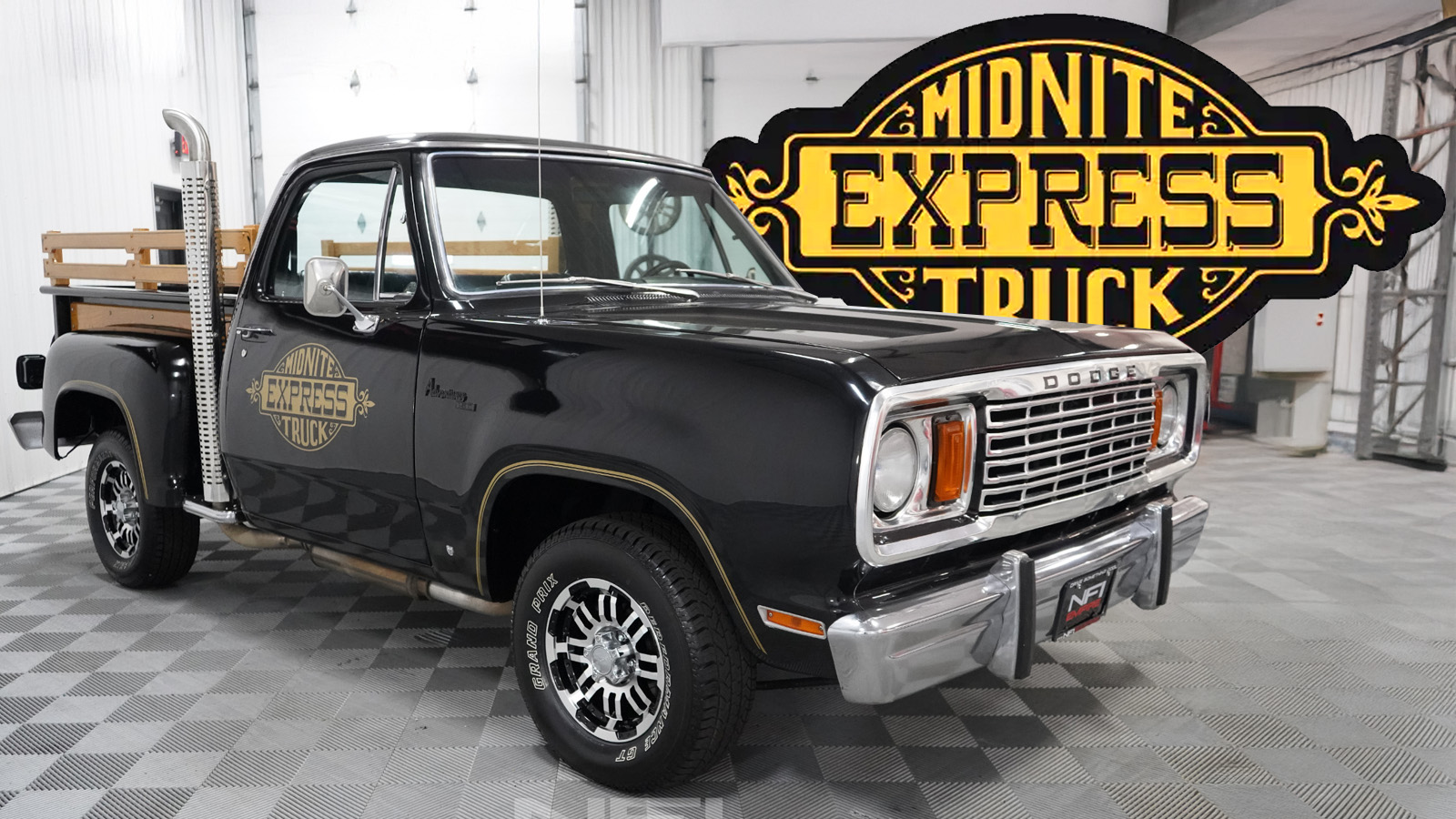
One of the most famous trucks to wear a Dodge badge is the Li’l Red Express Truck. The lore of the Li’l Red Express was almost as good as the truck itself, as the Li’l Red Express was technically the fastest car in America thanks a quirk in emissions regulations. But there was another Dodge truck in the 1970s that was known for its brutal speed and seductive looks: the Dodge Midnite Express Truck, a rare dealer-built, single-year hot rod special that strapped 440 cubic-inch firepower to a pitch-black pickup.
The back half of the 1970s was a rough time for American muscle cars. The muscle era peaked in 1970 with incredible machines that pumped out mind-boggling claimed horsepower numbers. Then insurance rates on muscle cars became unsustainably high, emissions regulations landed multiple gut punches, horsepower ratings changed from gross to net, and the industry saw a renewed focus on safety and the environment. The muscle car craze came crashing down, and the oil crisis of 1973 and a struggling economy only made things worse.


Automakers who tried to keep muscle car fever going started producing smaller cars with frankly embarrassing power numbers and goofy bumpers that made the cars look like they just left the dentist with braces. Things were so dire that, by 1975, even the legendary Chevrolet Corvette had fallen far. That year, the same year when catalytic converters went mainstream, the hottest engine available made only 205 HP, and the Corvette became more grand tourer than sports car. Even pony cars suffered, as Ford fans had to do with the Mustang II.

Much of this was caused by the fact that automakers hadn’t exactly figured out how to build big engines that made muscle-level power while also remaining compliant with emissions. Large V8s were still offered, but were choked for power. If you wanted speed, your best bet was probably a motorcycle, as those were starting to get wicked fast – though they had their own silly problem in that many of them were faster than their frames, brakes, and suspensions could handle.
There was a light at the end of the tunnel, and it came from an unlikely source. If you read the emissions regulations closely back in those days, you might have noticed that vehicles with a gross weight rating of more than 6,000 pounds didn’t fall under heavy government scrutiny. A heavy vehicle was allowed to run without a catalytic converter. Amazingly, this exception wasn’t really exploited to its fullest until Chrysler engineer Tom Hoover discovered it. Alright, so if Dodge couldn’t build a fast muscle car, what if it just turned a truck into a muscle car?

The Dodge Li’l Red Express figured out a way around the emissions problem, and ended up becoming America’s fastest car in the process. From Jason Torchinsky:
The Li’l Red Express truck was, really, a muscle car wearing a pickup truck costume. And it really was a costume, with fireapple-red paint, real wood panels on the bed, and ornate gold striping and lettering, giving the thing a look something like a demented, useless fire engine. And, of course, there were the massive chrome exhaust stacks. It was overdone, somewhat cartoony, but a hell of a lot of fun.
The truck used a version of Chrysler’s 360 (5.9-liter) police interceptor V8 engine making a respectable 225 horsepower, with a four-barrel carburetor, Hemi-style headers leading to those bonkers vertical exhaust pipes, and driving the rear wheels through a three-speed 727 Torqueflight transmission.
For some perspective, a 1978 Chevrolet Camaro Z28 made only 160 horsepower, a ’78 Ford Mustang Cobra II made a grimace-inducing 88 horsepower (okay, to be fair the 302 V8 made 139 hp), and a Dodge Charger, with a similar V8 and transmission to the Li’l Red Express, made only 140 horsepower. Unsurprisingly, when Car and Driver tested the Li’l Red Express in November of 1977, they found it to be the fastest vehicle from 0-100 MPH, stomping the competition which included a Corvette, Trans Am, Porsche 924, Saab Turbo, and a Thunderbird.
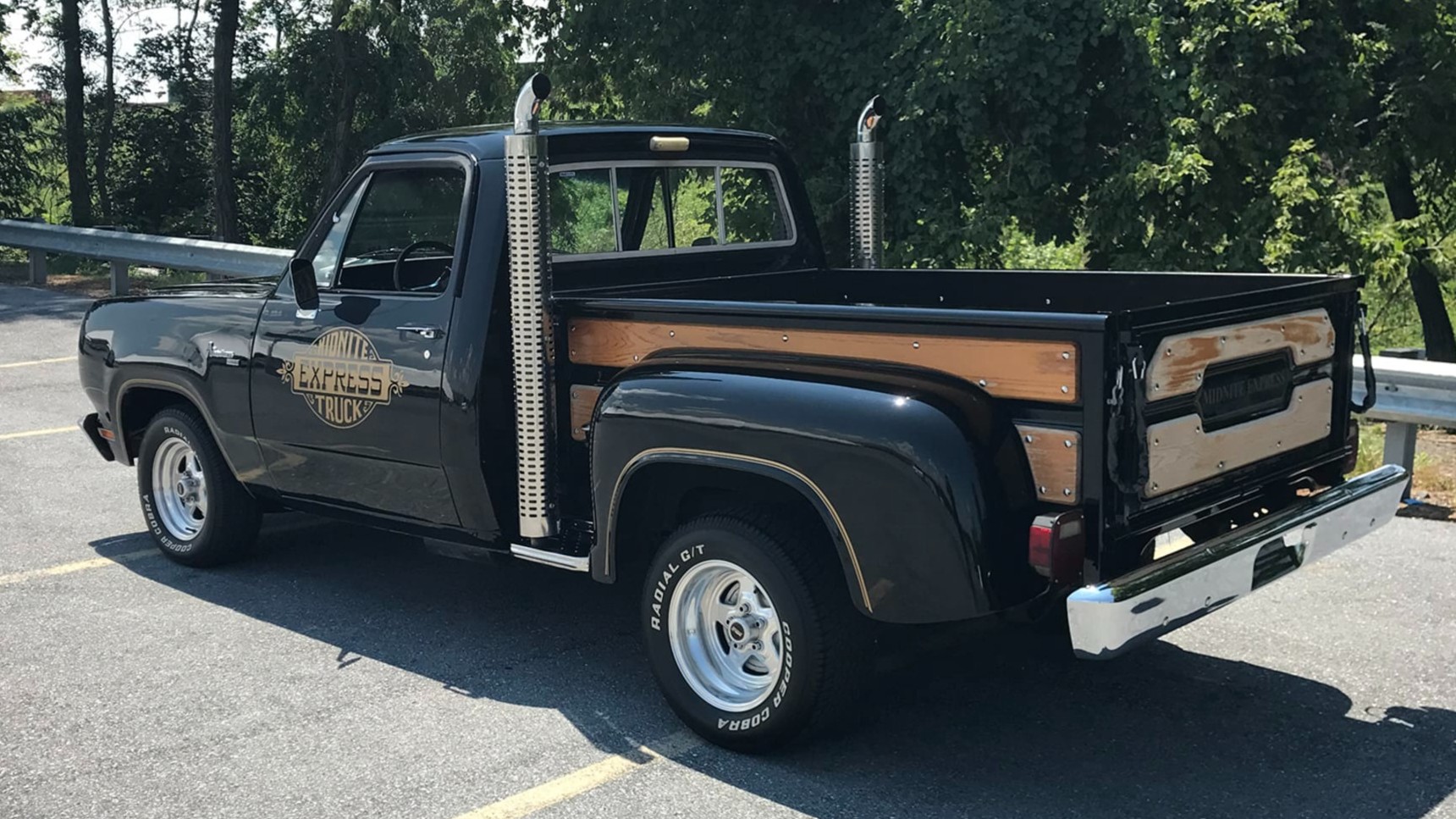
But what if you weren’t into the color red? Or, what if you thought 360 cubic inches of V8 weren’t enough to guzzle fuel and the money out of your wallet? Well, Dodge dealers had just the thing with the Midnite Express.
It’s hard to piece together the exact origins of the Midnite Express. I found only a single magazine article ever published about it, and there are more myths and rumors than there are hard facts.

The story often repeated by random people on Facebook and by publications like HotCars is that the Li’l Red Express Truck couldn’t be sold in California, Florida, Maryland, Oregon, or Washington state due to noise regulations. As a response, dealerships in these states that wanted to sell Li’l Red Express Trucks created the Midnite Express, a truck that was just as fast as a Li’l Red Express, but since it used a 440 V8 and not a 360 V8, it was compliant with noise regulations. The rumors then say that the Midnite Express was a Li’l Red Express that was repainted from red to black before being repowered.
The High-Performance King
There is not a single solid source for that story. It is true that the Li’l Red Express was too loud for certain jurisdictions, but I found no confirmation that noise regulations were the impetus for the Midnite Express.
That said, the story that can be confirmed might actually be better than the rumors. The Midnite Express was actually a product of a dealership known affectionately as Mr. Norm’s. This dealer, officially Grand-Spaulding Dodge in Chicago, was known for making the hot rod variants of Dodges that the automaker did not.
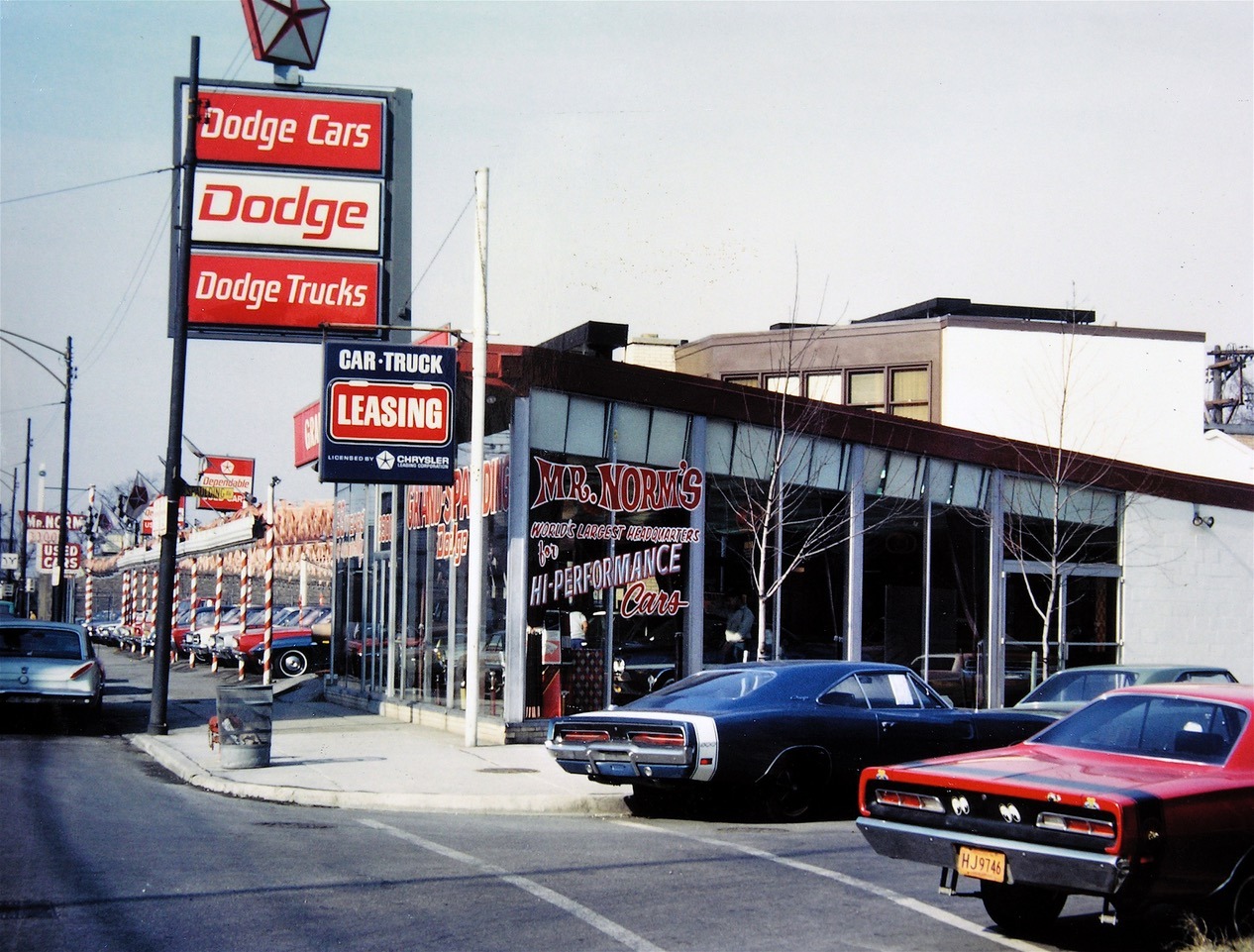
Norm “Mr. Norm” Kraus passed in 2021, but his legacy lives on as a company with his name. That company, Mr. Norm’s, tells his story:
1948:
Norm Kraus began his automotive career selling used cars with brother Len from a gas station their father Harvey owned, located at the corner of Grand and Spaulding in Chicago.1951:
The business flourished and the lot next to the service station on Grand Avenue was purchased and converted into a used car lot, using the service station as a facility to do repairs.1956:
Noticing interest in stick shift and performance type cars, they focused on purchasing these types of vehicles for resale. It was at this time that the famous appellation “Mr Norm” first appeared, due to a space limitation in a newspaper ad. The name stuck and Norm Kraus became “Mr. Norm.”1962:
After several years of solicitation by the local Dodge sales rep, the decision was made to become a new car dealer and Grand Spaulding Dodge opened in the Fall of that year, named for the corner on which it was located. The focus of the dealership was high performance. Many industry professionals predicted lackluster success at best.1963:
A new Grand Spaulding Dodge showroom and service department was built to accommodate the new business. Tying in the performance theme that was established from the onset, the “Mr. Norm’s Sport Club” was started and the relationship with youthful performance purchasers was further developed. The first Clayton Chassis Dynamometer was installed in the service department and the dealership began selling “Mr. Norm’s” racing apparel.1964:
Norm formed the first Grand Spaulding Dodge racing team comprised of two cars, a Max Wedge and a Hemi Ram. Meanwhile, sales of new Dodges doubled over the previous year, a phenomenon that would continue for the next seven years! The first of many “Mr. Norm’s” Sport Club social/dances with The Buckingham’s as feature music group took place at the dealership. The service department was enlarged to double the original size to handle ever-increasing demands based on sales of Hemi Rams and Max Wedges. Mr Norm’s radio commercials began on rock channel WLS in Chicago, one of the most powerful AM radio station in the US, and were heard around the country.
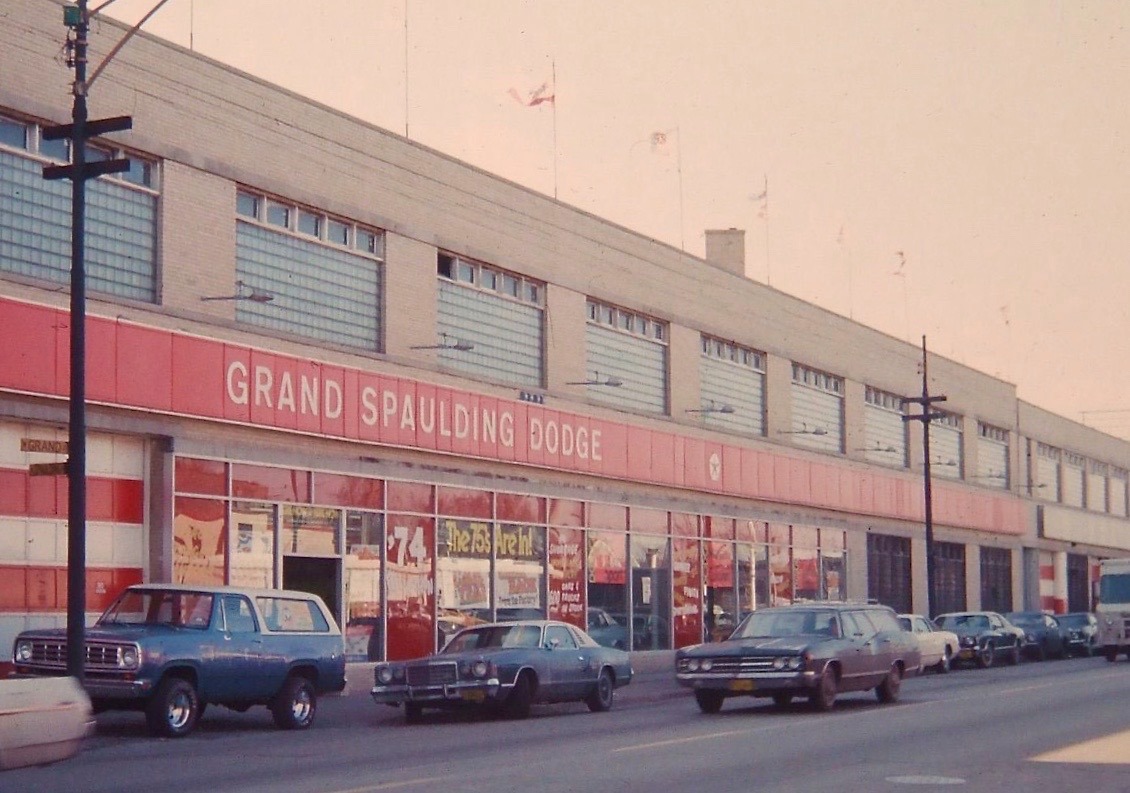
Mr. Norm was known best for hopping up anything with a Dodge badge. From Hemmings:
As one of the first dealers to install a dynamometer, Grand Spaulding was able to properly tune their customers’ cars, which were notoriously detuned from the factory. “The first 383 we put on our dyno registered 180hp,” says Norm. “I said, ‘What the hell is going on here? Let’s set it up and see what she’ll do.’” With a little work, they were able to get that 383 to make a reliable 325hp. Norm made a quick decision. “That’s gonna be done on every car that goes out. Every high-performance customer is going to get a free dyno tune. When we sold a high-performance car, we had the car dyno’ed right in front of the customer.”
When a minor sponsorship one weekend turned into five sales by Wednesday, on Thursday Norm was ready to go racing. Not wanting to compete against his customers, he decided to build a match-race car. “Our first 1964 supercharged car,” Norm says, “became one of the first Funny Cars in the country, because when we went out racing, we were running against all the gassers and the rails. There weren’t any other Funny Cars to run.” A 1965 ex-factory lightweight car allowed them to run well into the eights when the competition was in the nines, putting Mr. Norm on the map nationwide.
With their booming performance business, Grand Spaulding was selling cars and parts all over the country. People from as far away as Alaska came to buy Mopars. Such was Norm’s influence, he could single-handedly get Chrysler to produce a new model. When Chrysler said that a big-block Dart was impossible, Norm had his top mechanic stuff a 383 into one and he drove it to Detroit to prove it could be done; thus was born the Dart GTS. The following year, he asked Chrysler to build him a 440 Dart. They built 50 for him, which he was easily able to sell as the Dart GSS, for Grand Spaulding Sport.

One of Mr. Norm’s most famous cars was the 1972 Dodge Demon GSS. This wild machine sported a 340 cubic inch V8 that pumped out an honest 360 HP thanks to a Paxton centrifugal supercharger. Grand-Spaulding Dodge even had solutions for the high insurance rates of the 1970s, and created the Dodge Demon 340 Six Pack in 1971. This ride had 300 horses on tap, making it a legitimate muscle car. But your insurance agent had no idea it was any different from any other Dodge 340.
Grand-Spaulding was also an expert in advertising. The dealership advertised on Chicago’s WLS AM radio station. The ads talked about how Mr. Norm’s cars were dyno-tuned and that Mr. Norm was known in the Mopar world as being the “High-Performance Car King.” WLS had a 50,000-watt signal that allowed the station to be heard all over America at nighttime. Print ads appeared in all sorts of national enthusiast magazines.

Mr. Norm would become so well-known in the world of Mopar that, by 1974, Grand-Spaulding Dodge would become the largest-volume Dodge dealer in the world. Basically, if you wanted a fast Dodge, Chicago was the place to be. He would even find clever ways around the fallout of the death of the muscle car in the 1970s. When monstrous power fell out of favor, Mr. Norm pivoted to building custom conversion vans.
Later, Mr. Norm would provide hopped-up cars to the Illinois State Police, the Chicago Police Department, and any other Illinois entity that wanted hot Dodges. It’s said that many of the cars that appeared in the iconic Blues Brothers film were originally sold by Grand-Spaulding Dodge.
Mr. Norm sold his ownership in Grand-Spaulding Dodge in 1977. The dealership was still known as Mr. Norm’s Grand-Spaulding Dodge, but it’s unclear how much, if at all, Mr. Norm was still involved in the dealership’s operations.
The Midnite Express
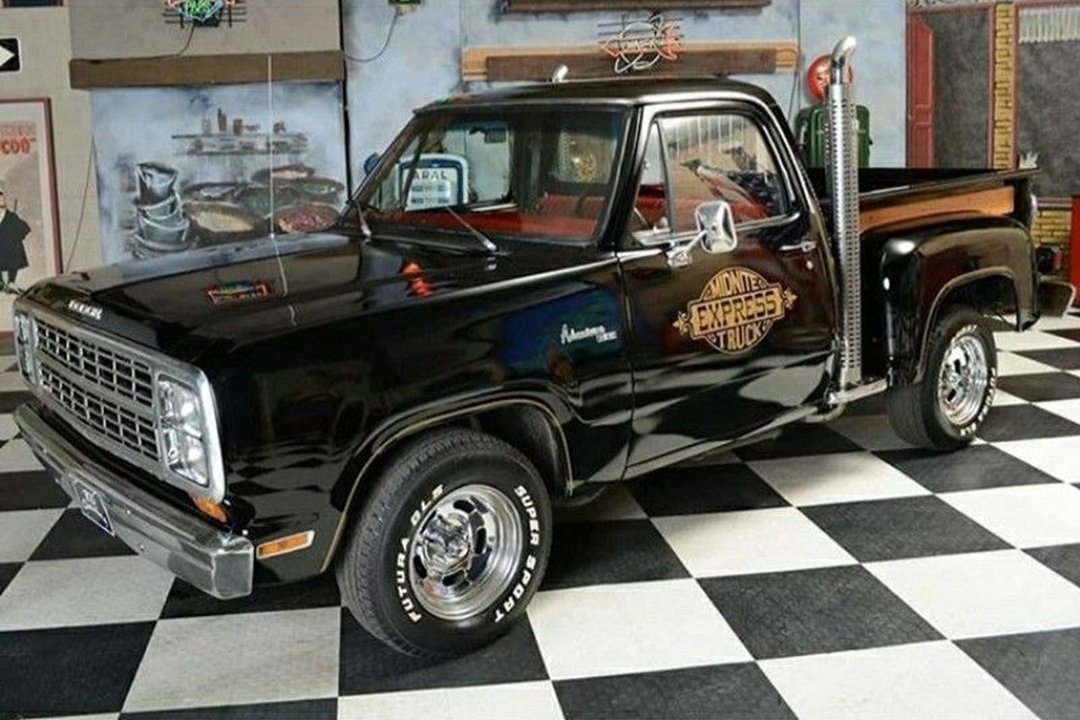
What is known is that, in 1978, the dealership began building what was called the Midnite Express Truck. The Midnite Express was not a Li’l Red Express as has been reported elsewhere, but actually started life as a Dodge Warlock. The Warlock, which was sold beginning in 1976 as part of Dodge’s Adult Toys marketing push, was a short-wheelbase sport truck. The Warlock was a D-series pickup that was supposed to be a bit of a custom truck from the factory, and was meant more for fun than work.
A Warlock was distinguished by its gold pinstripes, solid oak sideboards, chrome running boards, gold wheels, and gold ‘Warlock’ decal. The Warlock was purely a cosmetic package, and you were able to option it with any engine that was available to the D series. That meant anything from the 225 cubic inch Slant Six to the 400 cubic inch big-block wedge. The Warlock was also able to be had with a glass sunroof and four-wheel drive. Allegedly, less than a dozen Warlocks even came with the meaty 440 V8.
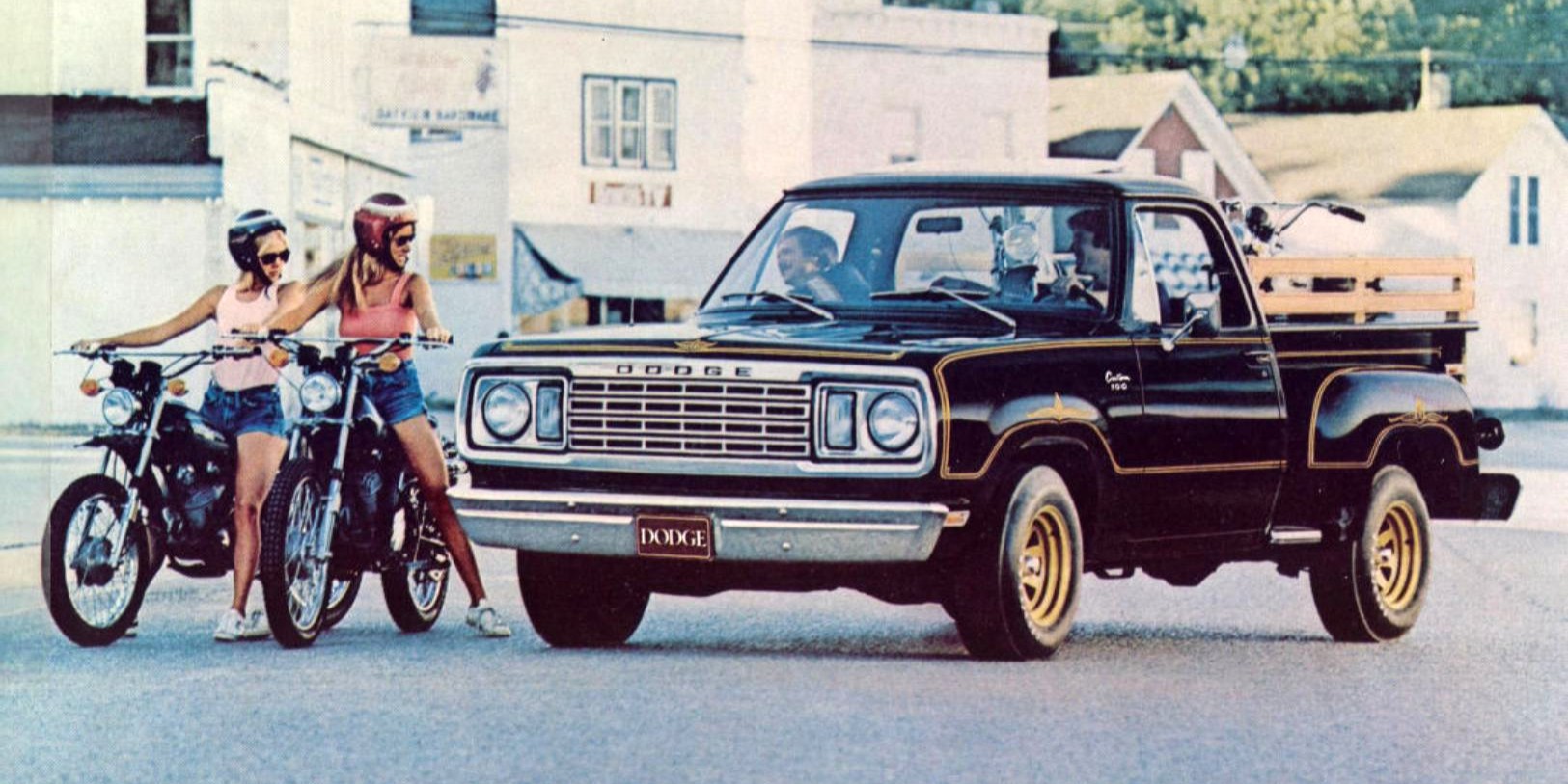
Each Midnite Express started as a Warlock. Then, it was painted in Black Sunfire Metallic and given gold accents. From there, Grand-Spaulding fitted the trucks with the stacks and sideboards from the Li’l Red Express, then dropped a 440 cubic inch V8 under the hood. These trucks are finished off with a Li’l Red Express-style decal that says ‘Midnite Express Truck.’ I do mean “Midnite” here and not “Midnight.” The truck is often misspelled as the “Midnight Express,” even by car media.
The 440 cubic inch V8 was paired with a TorqueFlite 727 automatic. According to John C. Roberts, a co-founder of the National Association of Li’l Red Express Truck Owners, the mill in the Midnite Express did make more power than the 225 HP 360 V8 in the Li’l Red Express. However, since this engine was also much heavier, the Midnite Express wasn’t meaningfully faster. But it was really good at converting tires into smoke.

Either way, the Midnite Express was distributed to any dealer that wanted to sell it. While the Midnite Express was not an official build, Dodge reportedly did at least give the truck its blessing.
Now, here’s where things get weird. Roberts and some Dodge truck historians say that the Midnite Express was sold for only one year, 1978. Yet, the Internet has quite a lot of Midnite Express trucks that claim to be from 1977, 1979, 1980, or 1984. Many of the sellers of these trucks are honest when they say that they have a tribute, not a real Midnite Express Truck.
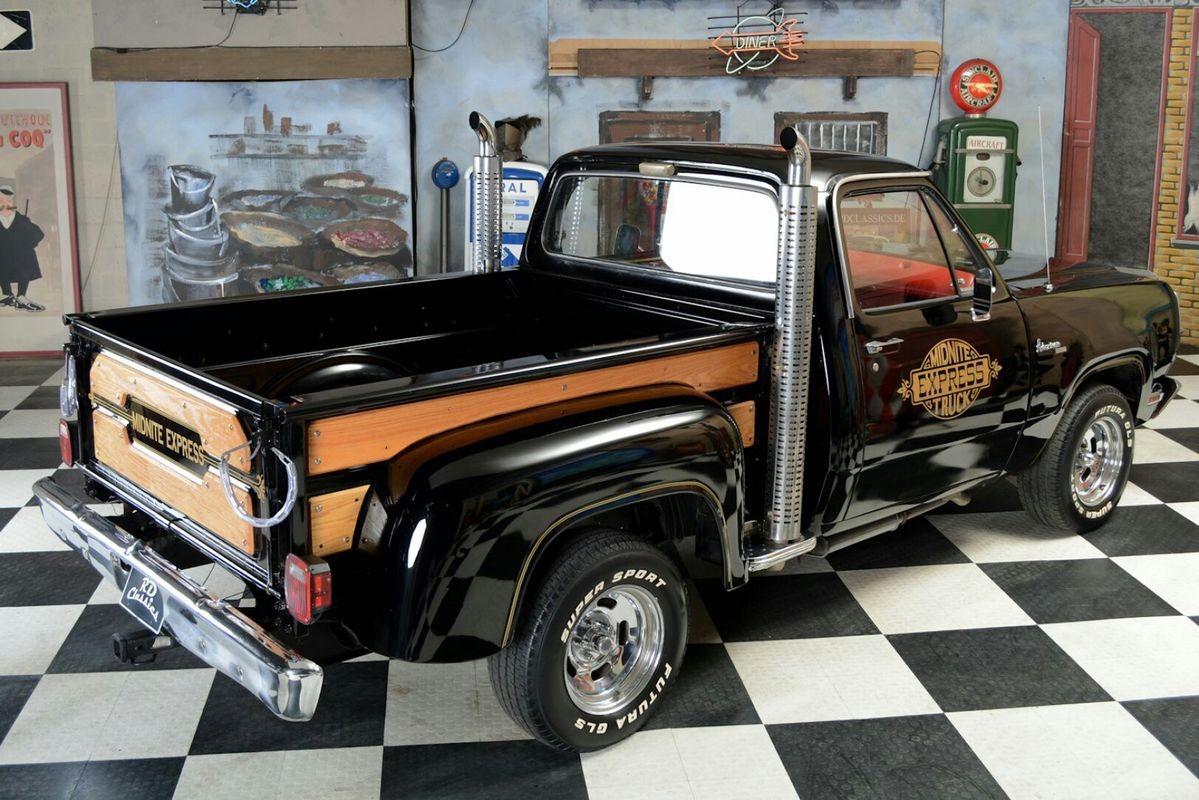
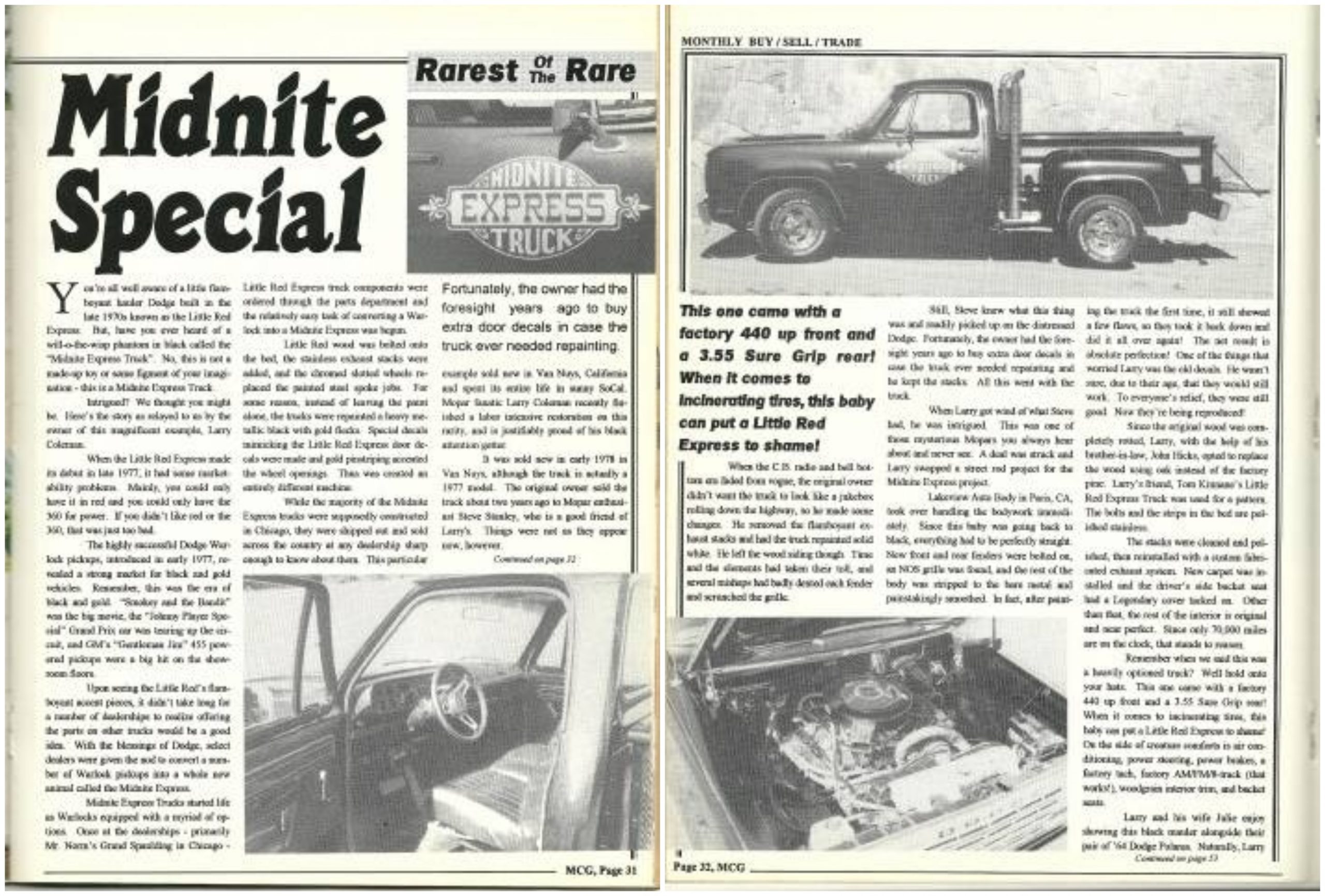
Clone Midnite Express Trucks are everywhere. The one article I could find on the Midnite Express was published by the Mopar Collector’s Guide in September 1996. The truck featured in that article was said to be a 1977. That alone should disqualify it from being a real Midnite Express, but there was also the fact that it had a bed from a 1979 D series, taillights from a 1979 truck, reverse lights from a 1977 truck, and seat headrests, which weren’t available in any D series in the 1970s.
It’s pretty wild that the truck featured in a prominent Mopar magazine might have been a clone, but that just illustrates how there are so many Midnite clones out there. Sadly, the only way to confirm if a 1978 Midnite Express is also not a clone would be to see if the seller has the original dealer documentation. It wasn’t like the truck got a special VIN or other permanent part to identify it.
Sadly, it’s not even known how many real Midnite Express Trucks were built. Grand-Spaulding’s records were destroyed in a fire, and it’s not even known whether the dealership even kept production records for the Midnite Express. Mr. Norm’s website doesn’t mention the trucks, either, but that’s not surprising since the Midnite Express happened after Mr. Norm sold his stake in the dealership.
A Real Grail
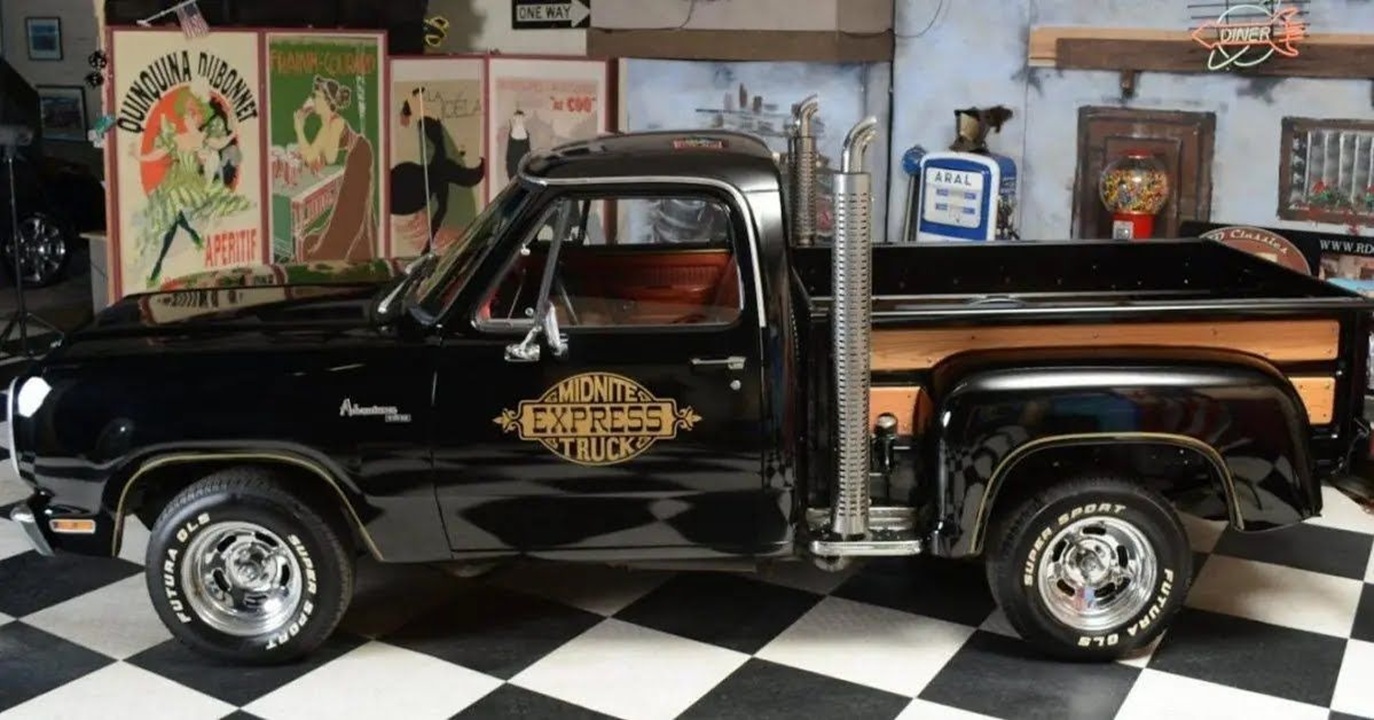
How rare are these trucks? All of the photos in this story are of tribute trucks. I found photos of what could be original trucks, but due to image rights restrictions, I could not publish them. I found no real Midnite Express trucks at Mecum or Bring a Trailer. Because of this, I don’t even have comps for you.
The Midnite Express Truck might be one of the rarest classic pickup trucks in the world. These things might as well not exist, and there might be more clones than real ones. Certainly, there appear to be more myths and legends about these trucks than facts, too.
If anything, that might make the Midnite Express even more fascinating. It’s a truck that almost doesn’t exist, and wasn’t even all that much different than a Li’l Red Express in the first place. But it was also a truck that was so cool that people kept making clones of it. I love dealer specials like this. Apparently, for some people, 360 cubic inches weren’t enough, and that’s hilarious.
Top graphic image: NFI Empire



Cool writeup! I saw one of these a number of years ago at a car show. After reading this I’m sure it was a tribute. At any rate, it rattled The Old Man’s memory enough to tell me another of his “one that got away” Mopar stories.
Apparently, he had the chance between a used Warlock in great condition and a brand new no-frills black Dodge pickup at the same dealership in ’79. Cue up the “chose poorly” .gif. He just had to have that single-digit odometer reading and went with the plain-jane model, but later wished that he had just brought home the Warlock.
Not that it mattered much. In ’83 he became smitten with the Ramchargers and special ordered a new red one of those with 4wd, a 318 w/4brl, and a 4-on-the-floor with granny-low. I thought it needed dual exhaust and some 4442 stickers on it.
Thanks for the memories. I live 750 miles from Chicago but after the sun went down we picked up WLS clear as a bell. Our nights were complete when we lost the signal at sunrise. Despite my usual tastes I love these right down to the silly graphics and silly stacks. I would tell Mom and Dad that if they couldn’t accept her then they couldn’t accept me.
Don’t forget, this is why Custom Vans were popular too. Since it was based on a truck chassis you could get the Big-Blocks stuffed into SWB vans…
PEDANT ALERT
It’s not a L’il Red Express, it’s a Li’l Red Express–apostrophe after the “i” (see the door of the example in the photo and the quoted text).
END PEDANT ALERT
This is excellent pedantry…
At least it wasn’t referred to as a 78′ or 79′, which is incredibly & depressingly common. Commenters here certainly aren’t immune to doing so.
Dag nabbit! I’ll fix that! Thank you local area pedant! Somehow we all missed that.
That dealership sounds like a treasure.
A Midnite with the 440, sunroof, and 4WD would be an awesome vehicle.
I was a huge fan of The Warlock when I was a kid, more so than the lil Red version. I’m pretty sure I built the 1/25 MPC model kit… which I just discovered is still available.
I love all the wacky stuff that dealers did in the 60’s and 70’s. I used to see the LRT’s around fairly often when I was a kid, I thought they were the coolest things. Never saw a black one though. GM and Ford dealers also did some cool stuff, but maybe not as wild as this.
Fun fact, Ram still makes the Warlock. It started with the Ram Classic as an appearance package, and on the later model Rams it’s basically a budget Rebel, it has all the same offroad gear, but in a base model “Tradesman” package.
I just bought one a few weeks ago, hence the username. They only come in crewcab shortbed, and for 2026 all 3 engines are available, with the 3.6 as base. Mine has the 3.0 Hurricane. Included in the package is 1″ lift, 33″ Duratracs on black wheels, rear locking diff, whatever their version of Crawl Control is called, full steel skid plates, dual exhaust outlets, and a 7″ screen between analog speedo and tach gauges.
Mine is Forged Blue, which changes depending on the color. There’s a “WARLOCK” decal on the rear quarters, but it’s tough to see due to the dark color (I’m fine with that). With the blacked-out trim and wheels it’s a damn good-looking truck, I’ve gotten lots of compliments on it.
I only have 1300 miles on it so far, but I friggin love this truck. SO nice to drive, much smoother and quicker than my old 4Runner, while getting about the same mpg.
-Mike B
“Apparently, for some people, 360 cubic inches weren’t enough, and that’s hilarious.” To some of us raised on late 60s-early 70s muscle cars, a 360 is a mid-sized engine. My V8 head canon:
I still die a little when I think about my current car having only 181 CID. Since I don’t think in metric, “3.0 liter” doesn’t sound as bad. At least as long as I don’t think about the T/A 6.6 I used to have…
Objectively my Stratus is faster in every measure than my old Pontiac, but it does not sound as good or invoke the same primal emotions.
I can agree with your head-cannon, but then I get reminded that a “huge” Ford 460 in 1978 would pump out less than 150 horses…
I was a teenager in the 90’s, and to me any V8 under 350 was “small”. Learning the first SBC was only a 265 blew my mind.
For me when I was growing up:
-over 400 – huge
-300-400 – big
-150-300 – medium
-100-150 – small
-under 100 – tiny.
I was born in 1973… so just as the downsizing was getting started.
And my earliest car memories are from the late 1970s… right around when the downsized GM B-Bodies came out.
Also up here in Canada where things like gasoline are more expensive, the largest engines never sold as well as in the USA.
I grew up with imports, the biggest engine my parents owned was a 3 liter (180 ci) 6 in our Volvo and most of our cars were smaller. It’s only later in life that I have a V8 and at 330 CI a 5.4 Triton is on the small side. Then again our other car has 1.4 liter engine.
I think some asterisks for engines that punched above their displacements:
Cevy 327
Ford 289 HiPo ,and Boss 302
Even if I had Jay Leno money, I would rather have “clones” of these, Shelby Cobras, Mustang Boss 429, etc., because then I wouldn’t mind driving the things and reducing their “value.”
If I had Jay Leno money not only would they be clones but they’d have modern emissions too. The classic car experience is a lot more fun without the stink of unburned hydrocarbons.
Except the exhaust smell is part of the experience. Since anything made in that era is so far behind in so many ways; the loose suspension, the smell, the roughness of idle, etc are all a huge part of what made them feel fast and fun.
An occasional whiff on startup? Sure. That’s expected of a well tuned classic.
A constant, splitting hydrocarbon headache? No thanks!
Jay Leno has Jay Leno money and he drives all of his genuine articles in LA traffic because that’s what he bought them for
Now this is journalism. Well done.
I recall my 9 year old self seeing one of these for the first time in a Red & White supermarket in South Carolina. Left quite an impression on me. 48 years later not quite so much but still cool.
Inthe late 80s, in the Navy, my friend had a 79 Lil Red Express. I told him if he ever decided to sell it I want to be first in line. Sometime later someone else offered to trade him a Saab convertible, I was not happy. Until that guy saw me in the galley and casually mentioned the Saab dropping its transmission. I almost ran to find my friend.
I paid him over installments weekly, especially during Desert Storm at sea with nothing to spend $$ on. When we got back in July 91 it was all mine. I loved that thing, even if it had a few small issues (wood needed refinish, some rust under the bed rails, paint oxidized and could use new decals).
In 1997 I was desperate for cash & sold it to my inlaw’s thinking I would buy it back when I could. The next year I mentioned it to the (ex)wife & she told me they sold it when their renters in MA were late with their payment… Ugh.
Every once in awhile I see one for sale & think about it but now they’re WAY more $$$ than what I sold mine for, and often in worse shape. TIL a Midnite Express exsited.
It should be pointed out that the 0-100-0 tests that the Express aced in the 1977 test was an ancillary test for a top speed competition with a bunch of cars with the widest ass gears you could get with them.
The Trans Am that came in second overall, for example, was specifically chosen by the Pontiac engineer who brought the car with a 3 speed and gearing so low it couldn’t spin the tires on a launch; because that was the transmission Pontiac had available as an option for the car with ratios suitable for a top speed test.
I would literally donate money to replace the wheels on the truck in the OP.
We need ASPCA-style campaigns to save classics from ugly diamond-cut alloys.
I can picture it now. “Your donation of $2,000 can provide classic cars with the American Racing Torq Thrusts, dog dish hubcaps, and steelies they need.”
Cragars, everbody gets Cragars.
Cragars or 5-slots. Torq Thrusts are soooooo overdone these days.
Cue Sarah McLachlan…
Sally Strothers…
For less than the cost of a cup of coffee each day, you can give these cars the life they deserve. Won’t you think of these poor cars in need of hope and care.
Maybe I’ve missed the explanation for this, or maybe I’m bad at math.
The emissions exemption is for vehicles with a >6000 lb. GVWR.
A half-ton, short bed truck of this era weighed ~3500 lbs.
To get past the 6000 GVW, this truck should have a 2500 lb. payload capacity. That’s a lot for a “half ton” pickup.
To make this legitimately work, either these trucks had ridiculously stiff springs, or Dodge flat-out lied about the GVW. Which is it?
They had ridiculously stiff springs. I got a chance to drive and ride in a legit L’il Red Express years ago, and it rode like the axle was bolted straight to the frame out back.
Porque no los dos?
The Lil Red, C10 Big 10, and GMC Heavy Half all had massive leaf springs.
My Big 10 had a 9 leaf pack vs a standard truck’s 5 leaf pack.
It was also the era when Ford started building the F150 alongside the F100, for similar reasons.
Most companies offer high capacity work trucks even if they aren’t marketed to the general public.
GM had a five ton pickup for fleet sales with a four speed and big block in a short bed version.
Sounded awful, had a bare steel.interior, but once I hammered it in ultra low first gear and it reverted to NASCAR mode.
Option books commonly vary between dealers, so you had to search to find all options possible.
Some were clearly offered for people intending to immediately modify.
The dodge dart was available in 1974 with a four speed and 340 engines up.
Not sure how far the sizes went.
I was talking to someone today with a 74 Corvette that had clearly been street raced.
Had a costly clutch setup in it and a T10 geared for speed.
Not sure what engine tune it has.
Dad had a ’77 F-250 Ranger back in the day. RWD. I have some pictures of him wedging a 460 Lincoln into it. I have no idea how fast a stock F-250 was back in those days, but as a kid I remember that truck MOVING.
i also remember just how many concrete blocks and buckets of bolts and etc. we’d have to load in it each winter to keep the back end planted in the snow.
My parents had (and still have) a ’78 F-250 with a 400 and a four-speed.
I never did anything stupid in that truck, with the exception of shutting down a kid with a Z26 V6 five-speed Baretta one day after school…he thought a 20 year old truck couldn’t possibly be fast.
Good HS friend had 70s Chevy crew cab/long bed with low gear for towing horse trailers. And a 454/4bbl. He would surprise many a cars light to light. Up to 45-50 mph…
Dad bought a ’77 Suburban, 454 4bbl, TH400, 2wd for his employer at the time. Still claims it could beat most muscle cars off the line. Likely tow pack rear gears.
If ya’ll haven’t read this awesome C&D article, “Flat Out In Ohio“, you absolutely need to do so as soon as possible. Pitting a bunch of malaise era vehicles (including a Lil’ Red Experss) to a test track in Ohio to see who could double the 55 mile an our speed limit is such a great read…especially the side-bar how they manage to eek out the ultimate top speed out of a Thunderbird with a 400 and 2.50 rear gears is awesome.
The prose dedicated to the Lil’ Red Express blasting it’s way through the wind to make it to 110 is also epic.
That is peak C&D indeed. Car & Driver was such an awesome magazine back in the day.
I remember when they won Honda’s fuel-economy challenge for the Insight’s debut by building a plywood box on the back of a truck and driving the Insight with its nose tucked into the box. IIRC they eked out 150mpg at the cost of near death by tailgating.
Then there was the time they did a Detroit to New York race between a 1913 Ford Model T and a 2015 Tesla Model S. Truly epic…
https://www.caranddriver.com/features/a15112705/2013-tesla-model-s-vs-1915-ford-model-t-race-of-the-centuries-feature/
This is the article that Torch references in his quote.
My first thought was that it’s a mashup of a Warlock and a Lil Red Express, and turns out I was right.
I like dealer specials like this. Check the right option boxes, custom paint and stickers, sell a handful to the public with a wink and a grin. Your Yenkos, etc.