

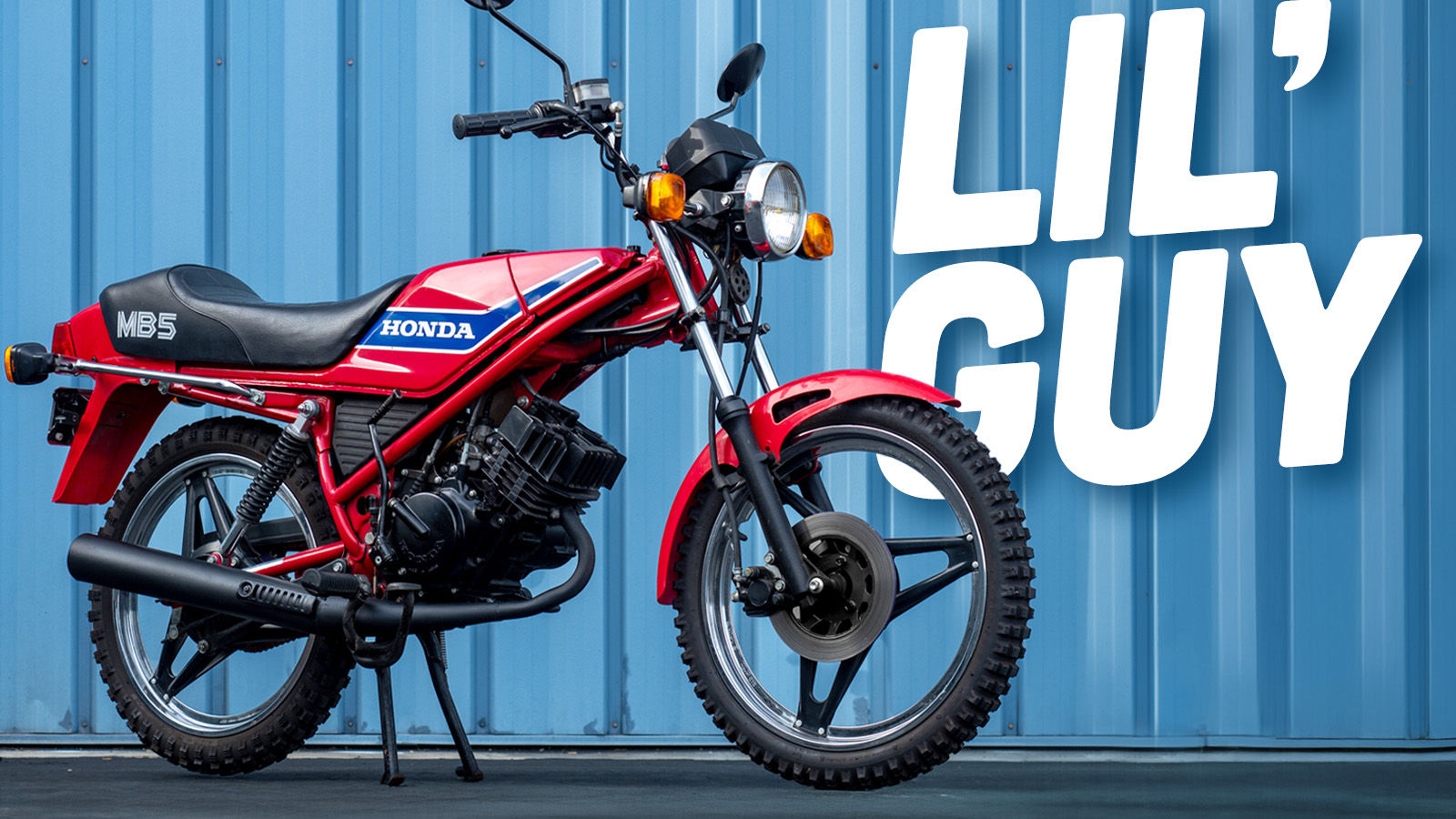
The small-bore motorcycle is a deeply underrated way to get around. It’s so fun to take a motorcycle that has practically no power and wring it out to its fullest potential, knowing you’ll never reach speeds that would have you spending a night in the slammer. In 1982, Honda sold one of the ultimate motorcycles for this philosophy. The MB5, which sold for only a single year in America, was a 50cc wonder that had only seven ponies in the stable, revved to 10,500 RPM, and you could ride it like an absolute maniac and probably never get a speeding ticket.
America has gone through a bit of a small-bore revolution in recent years. Many riders are ignoring the rolling La-Z-Boys of Milwaukee and the sofas of Spirit Lake for smaller, more affordable fare. A Honda Grom packs only 9.7 horsepower in the 124.9cc single under its tank, and the little bike makes every single one work as you have more fun going only 55 mph than you would on a much more powerful bike going 155 mph. These are motorcycles that you do all kinds of stunts on and even drag a knee around corners on without finding yourself on the wrong side of the law.


That’s just the Grom. There’s a whole world of fun, tiny motorcycles out there. The CFMoto Papio SS looks like a racing motorcycle, but barely exceeds 60 mph. The Honda Trail125 gets you off the beaten path without too much complexity. The Honda Navi is the most accessible motorcycle on the new market. If you ride across the street, there’s Royal Enfield, which has nothing but affordable bikes with killer style, bold colors, and real metal, many of which have small engines. Even Triumph has gotten into the small engine game.

All of these machines offer some surprising thrill without an intimidating package. Any rider of any skill level could enjoy these motorcycles. Use them to ride to work, use them to ride through the country, or use them to work on the farm. Go ahead, bang off every gear and redline the engine to your heart’s content. Just swing a leg over the seat, point the bars in a direction, and have fun.
If you’re looking for a great example of the “slow car fast” philosophy, but applied to motorcycles, Honda had just the thing, but only in 1981 for the 1982 model year for Americans. The Honda MB5 had an engine so small that, depending on the state, you didn’t even need a proper motorcycle endorsement for it. Yet, it was basically a scaled-down race replica that was way faster than it looked.
The Sport Moped
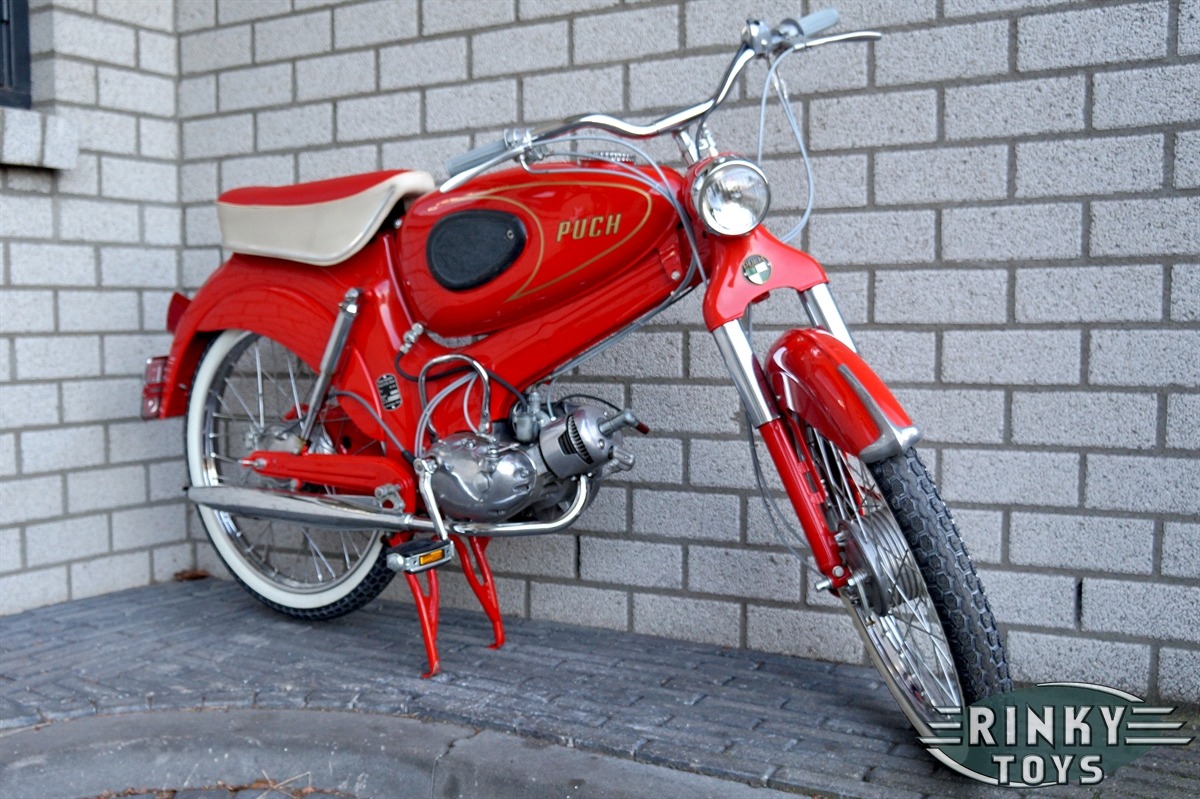
The Honda MB5 existed in a sort of weird category called the sport moped. In 1972, the United Kingdom limited 16-year-olds from riding motorcycles with more than 50cc of displacement until they turned 17 years old. In theory, this meant that teens would have to ride slower, safer step-through style mopeds until the government believed they were old enough to handle more muscle.
You’d think that this wasn’t that big of a deal. However, teenagers were a sizable slice of motorcycle sales back then. This led to an era where manufacturers took the friendly moped and souped it up. The sports moped resembled a larger race replica and even went faster than a standard moped, but fit neatly in the letter of the law, but not really the spirit of it.
The market was flooded with all kinds of 50cc steeds from Gilera and Puch to Suzuki and Garelli. Honda was at a disadvantage here at first.
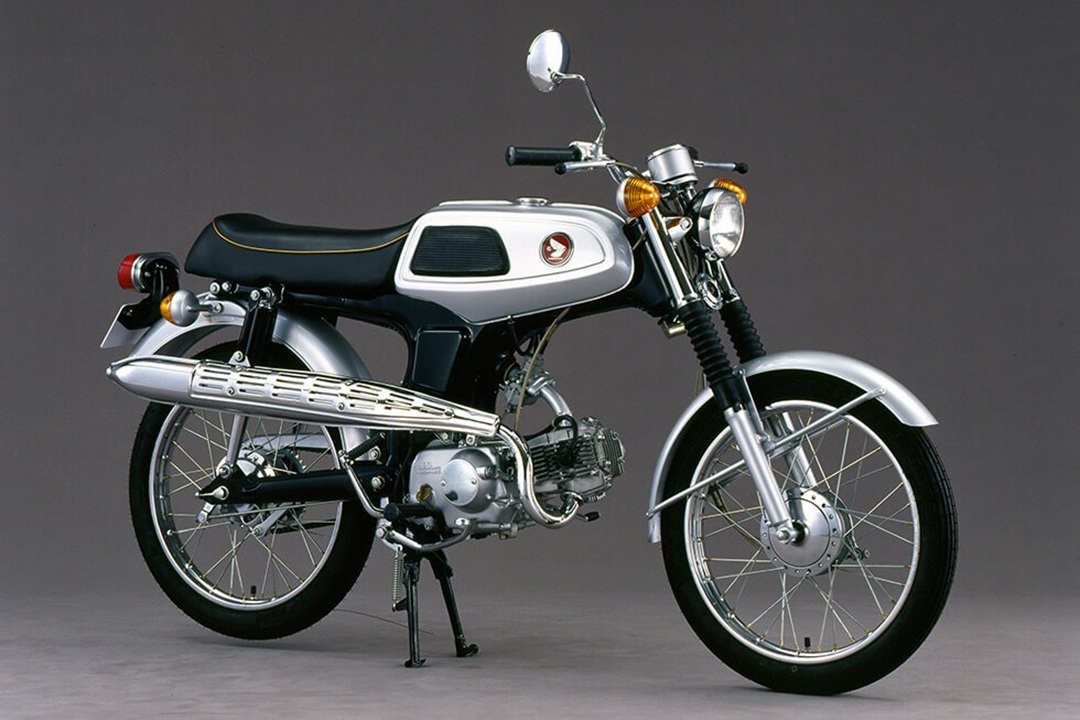
The two-stroke engine ruled the 50cc space thanks to its ability to crank out a relative mountain of power for a given displacement. However, historically, Honda was married to the four-stroke engine. A Garelli Rekord made around 6.5 horsepower while a Yamaha FS1-E had 4.8 ponies in its stable. Honda? At the time, it wanted 16-year-olds to ride the SS50 (above), which had all of 2.5 ponies to its name. 1977 would bring another change, as the government limited 50cc bikes to 30 mph.
Honda Goes Two-Stroke
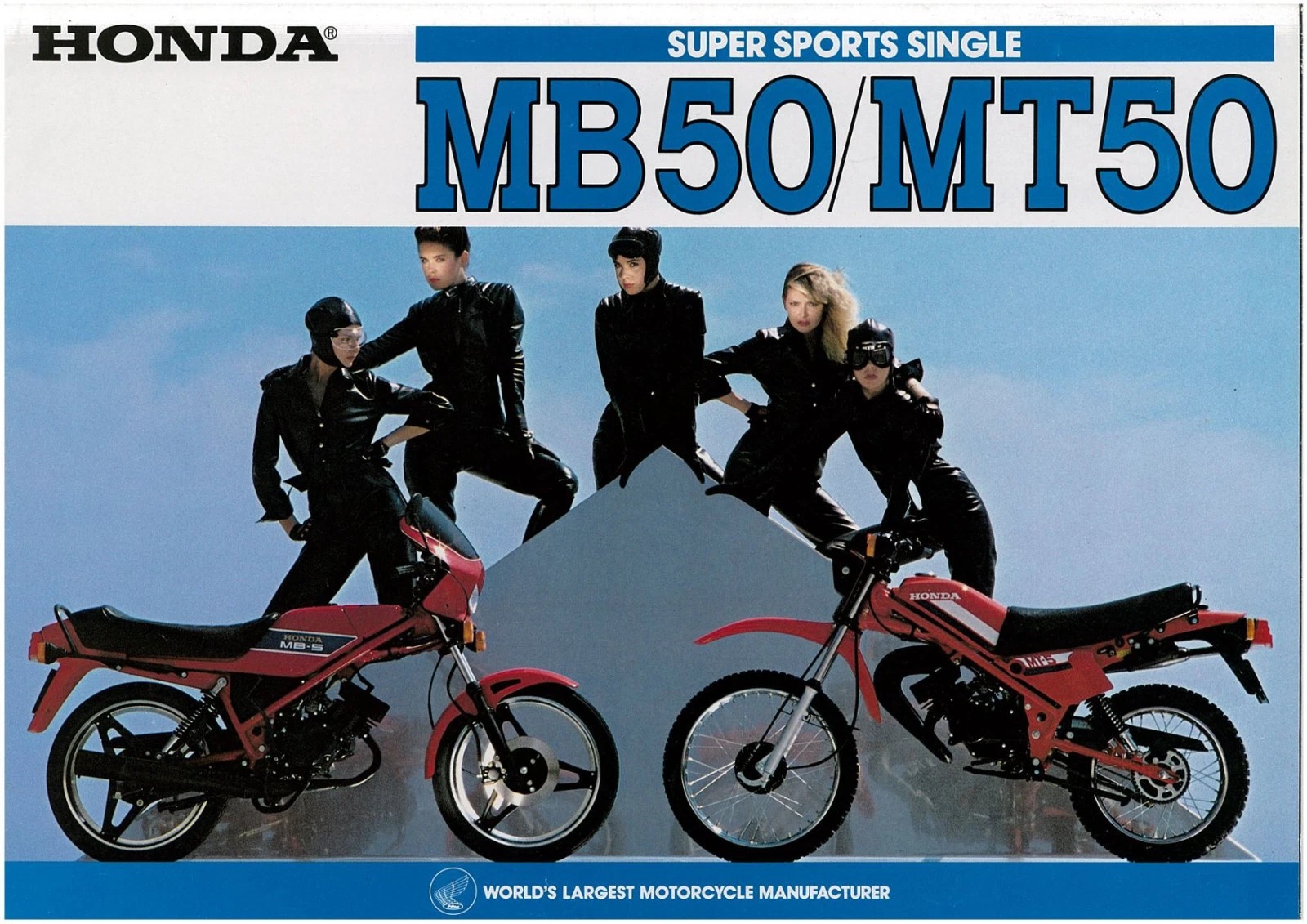
Honda’s response was to embrace the two-stroke principle, but do it Honda style. Big Red launched the reed-valve two-stroke MT50 and MB50, the former an off-road scrambler moped, while the MB50 was a sports moped. Classic Motorbikes explains the meat and potatoes:
The M series could have been a stroke of genius from a production point of view at least, if only Honda had chosen to use the same chassis and components for both machines, but looking in detail reveals the MT and MB are actually quite different in every respect. A good example of this is the main frame, each model is similar looking from the outside but, once stripped of their bodywork, the two machines are actually completely different. It’s the same story with the fuel capacity, the MB has a larger range, 9litres compared to the MT’s 6.8, with the former machines tank running right under the seat to provide the extra space. This area under the seat on the MT is home to the 1.5 litre two stroke oil tank while strangely the MB, has the smaller oil tank at 1.1ltrs and situated right up front near the head stock.
In typical Honda style, the MT and MB engines were complex, overly so in many eyes. The engine features a balance shaft, driven from the large straight cut primary gear on the clutch basket. This wasn’t a direct drive either, but rather via an idler gear mounted on the casing, adding weight and power sapping complexity in the process. The use of potentially noisy, straight cut gears, was a relatively good one, as the usual helical primary gears do eat up even more power and, with a mere 2.55 BHP to play with, all attempts at saving even the smallest part of a horse power were most welcome. The noise issue was addressed with a complex anti backlash arrangement on the idler gears. The balancer shaft also spins above the 5-speed gearbox helping to spray the lubricant over the gear wheels as it dampens out the vibes.
Owners of the Honda MT soon came in for a shock when it came to unrestricting the engine to liberate a bit more power. This practice was commonplace among ‘ped owners and, although dealers may have been reluctant to get involved, the knowledge was freely available, as were a host of go faster parts. Unfortunately the Honda was not a simple machine to do this sort of work to, whereas the majority of 50s are held back by a restriction in the exhaust, the MT suffered a more complete method, with the carburettor, barrel, exhaust and even the CDI ignition all being used to downsize the power output and keep it within the letter or the UK learner law. This meant in effect that there was little that could be done, save for importing parts from countries that didn’t have such restrictive laws, which, being a time well before global trade, the internet etc, was simply not possible.
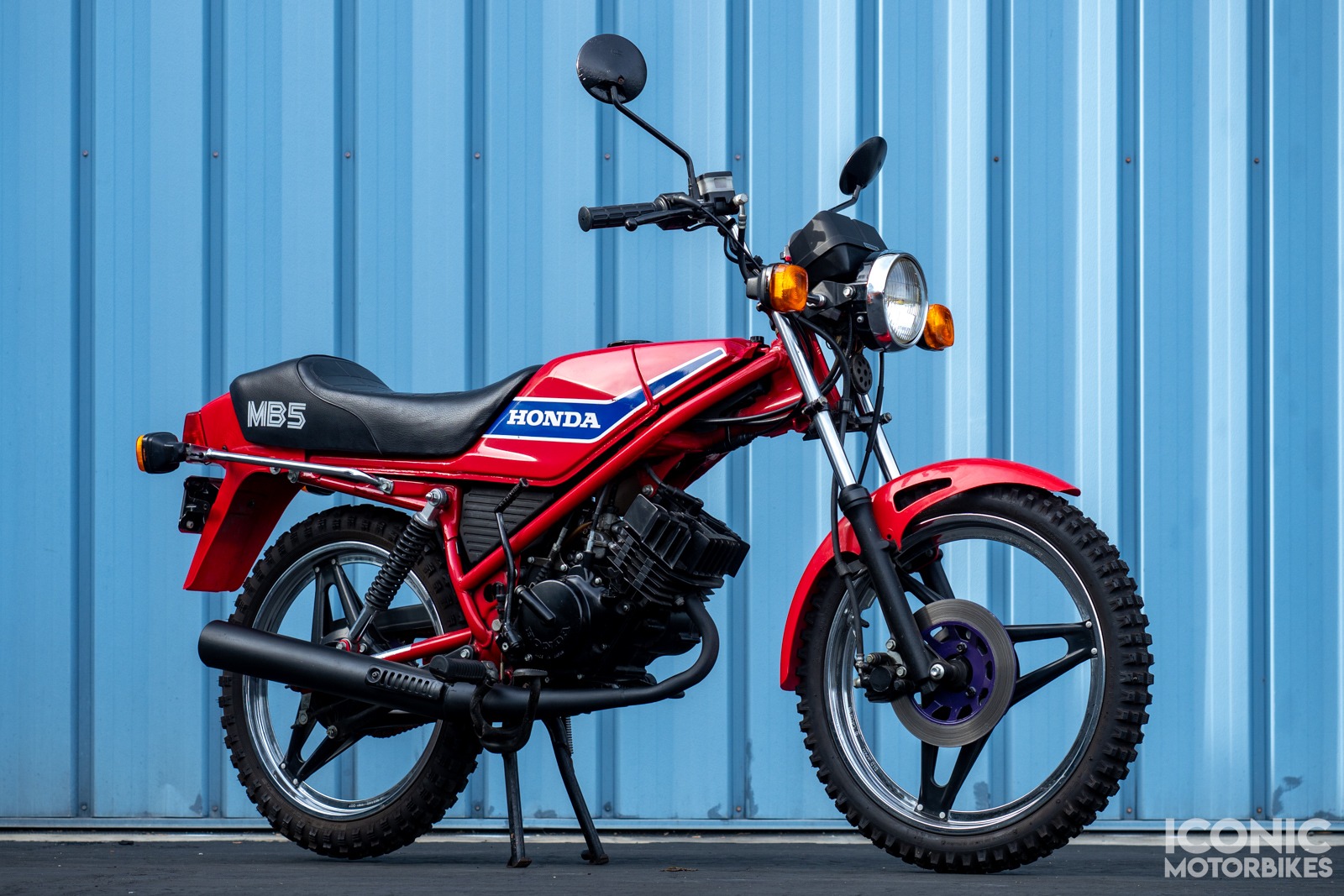
The MB50 was the road-going sporty derivative of the series. It was distributed in the UK from 1979 to 1981, while sales soldiered on to 1988 in other parts of Europe. For just a single model year, 1982, the MB50 made it across the pond to North America, where it was named the MB5.
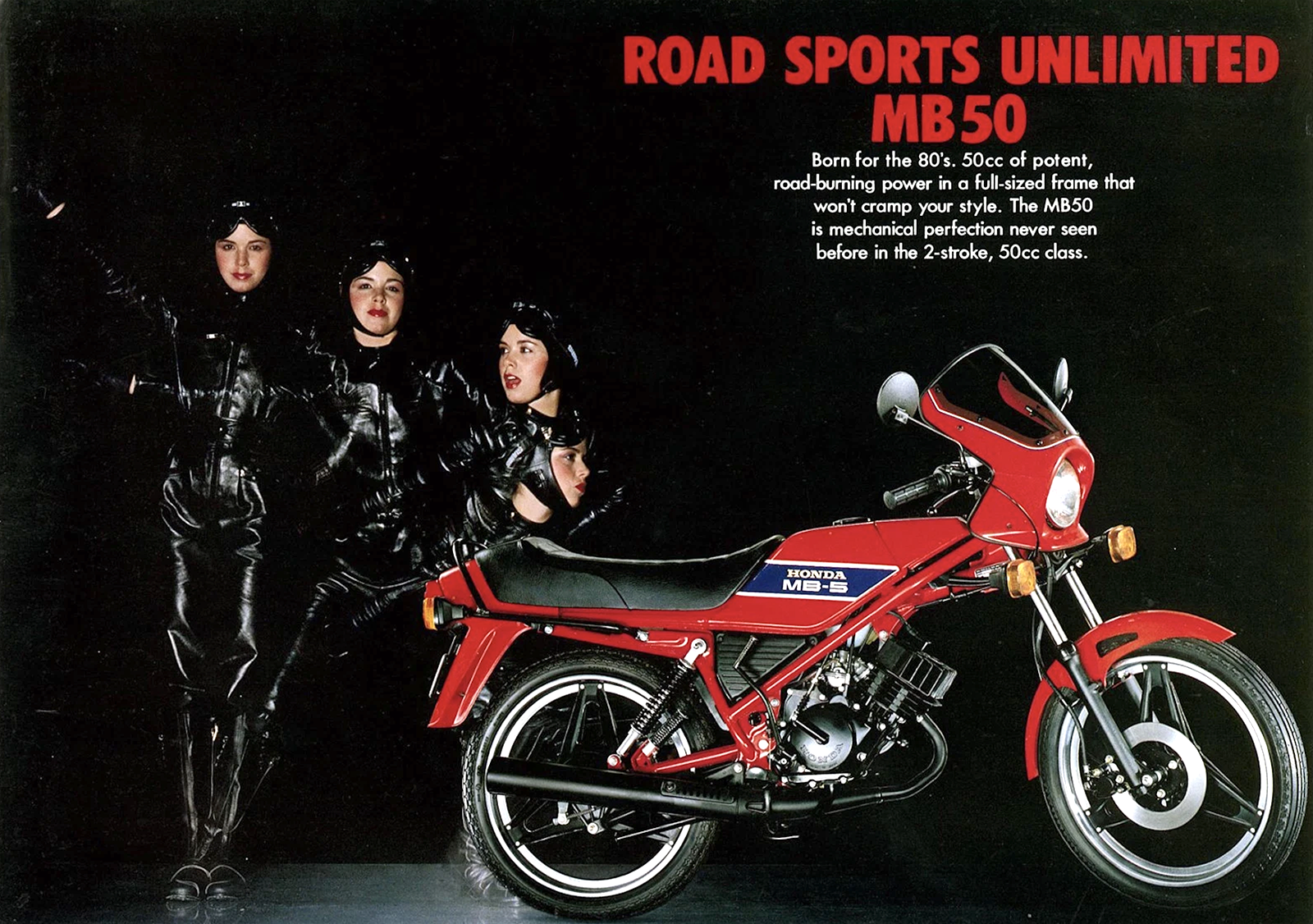
Honda marketed the MB5 as being a full-size bike, but with a teacup of an engine, perfect for a teenager. It was a simple unit, too, featuring a 66-watt alternator and a kickstarter. However, reportedly, you didn’t even need to use the kickstarter because, if your MB5 was tuned well enough, it would practically start on its own once you got it off the center stand. It was pretty light, too, at 198 pounds wet.

If you were lucky enough to live in a country with looser rules on 50cc bikes, the MB50 and MB5 were a properly silly machine. Without the aforementioned restrictions in place, the 49cc engine in the MB5 made an impressive 7 horsepower. In 1982, motorcycle legend Craig Vetter challenged the writers of Cycle World to a motorcycle fuel economy challenge. The magazine’s choice was a Honda C70 Passport and the new MB5. Cycle World details more about the MB5:
The MB5 is an all-new addition to the Honda line, offering many features normally found only on larger, more expensive sport bikes. It has a 50cc piston-port two-stroke engine with a 10,500 rpm redline and a gear driven counterbalancer to reduce engine vibration. It has automatic oil injection from a tank hidden under a cover that appears to be the front of the gas tank, as well as breakerless CDI ignition. Other features not usually lavished on 50s are complete instrumentation, hydraulic front disc brake, ComStar wheels and a full tubular steel frame done in an X configuration.
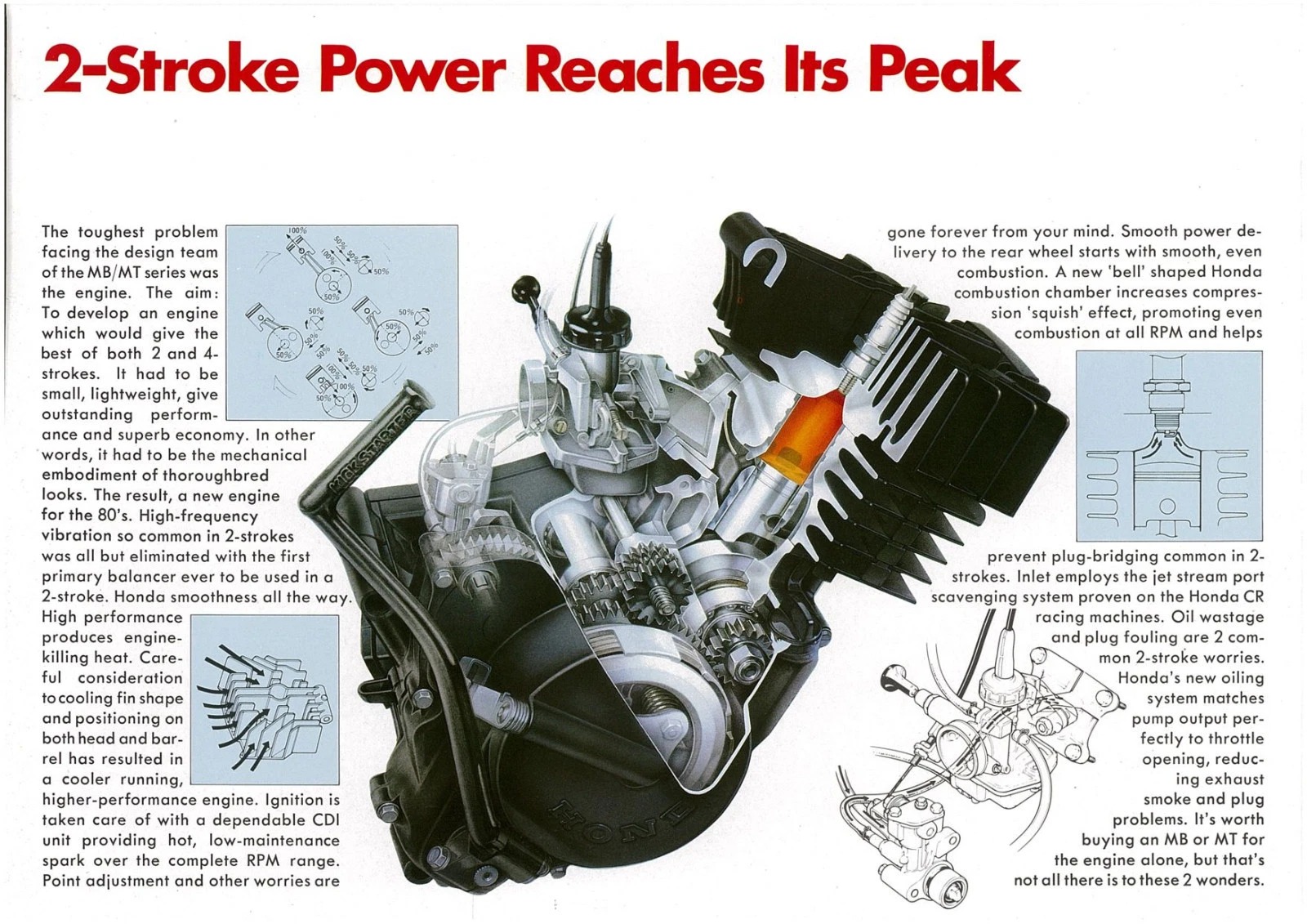
The engine, particularly the cylinder head, has huge cooling fins on it, the kind more commonly found on competition dirt machines. Unlike the swing-axle Passport, it also has real hydraulic telescopic front forks, with 4.9 in. of travel. The gas tank holds 2.4 gal., compared with the Passport’s 1.1 gal. Honda’s literature lists the MB5 as weighing 8 lb. less than the Passport dry, but the extra oil and fuel in the MB5 even the score. Our scales had the MB5 at 198 lb. with half a tank of gas and the Passport tipping 190 lb. Suffice it to say that neither bike demands brutal strength to muscle around the garage. After climbing off a GS1100 with a fairing you feel like you’re handling a cardboard cutout of a motorcycle.
The 10,500 rpm redline is a clue to the MB5’s power curve; 39mm pistons don’t make horsepower by loafing around, they have to get up and move. In the MB5’s case that movement makes itself known as something resembling forward thrust at around 8000 rpm and pushes out a nice little burst of power right up to redline. Getting off the line with any alacrity demands a big handful of revs and a coordinated slippage of the clutch. Once the bike is under way the five-speed close-ratio transmission allows you to keep the engine riled up and churning it out. You can cruise along easily below 8000 rpm, however, as long as no sudden acceleration is called for.
Cycle World‘s story is fantastic, and I highly recommend reading further than the snippet I cut out. Editor Allan Girdler, who didn’t like the baby Hondas because they reminded him of scooters and mopeds, had Peter Egan and Managing Editor Steve Kimball ride to the challenge and back. That meant 700 miles of riding on a pair of Hondas that didn’t even have big enough engines to legally ride on the freeway.
One of my favorite notes in that article explained how, even though Peter and Steve rode around at only 45 mph, they were still passing drivers in lumbering V8 sedans who were going even slower. Apparently, it took them riding the tiny Hondas to realize just how slow some people actually drove back then.
The MB5’s Feats
The results of the fuel economy challenge were impressive. The MB5 averaged 139 mpg while the Passport returned an astonishing 198 mpg. Even when ridden at wide open throttle all day, the MB5 returned 81 mpg, and the Passport got 102 mpg.
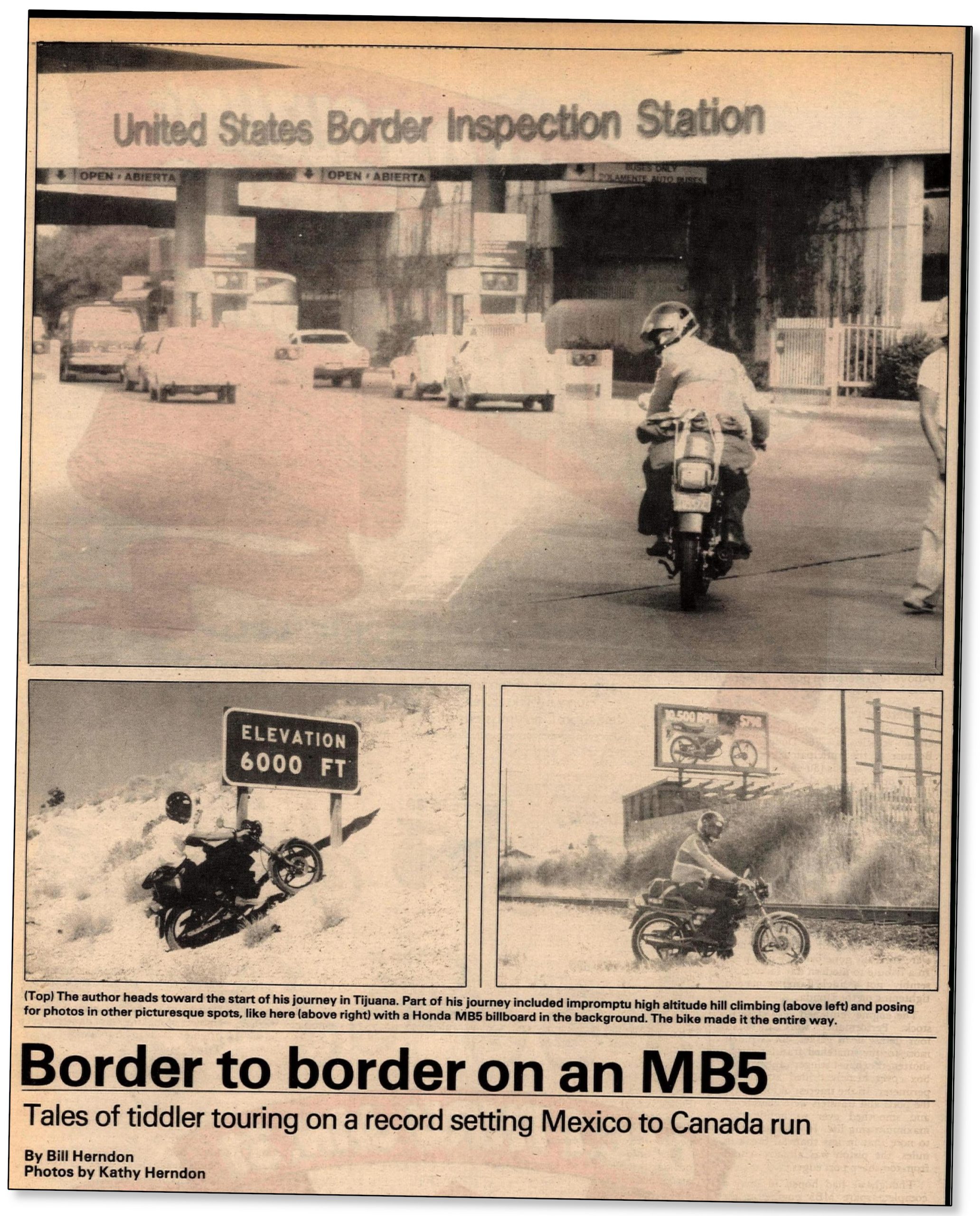
The MB5 scored some impressive feats before Cycle World even did the fuel economy challenge. In January 1982, Bill Herndon wrote about riding an MB5 some 1,500 miles from Mexico to Canada in eight days.
The MB5 experienced no flat tires and needed only two spark plugs to complete the journey. Bill wanted a spare engine just in case, but since the MB5 was so new, American Honda didn’t have any. Yet, a spare wasn’t needed. Bill rode the MB5 at full throttle for basically the whole trip, and the bike held together. Amusingly, he even figured out a hack to get around the fact that the MB5 didn’t have a big enough engine for the interstate, and attached some flat black cans to the bike to make it look like it had a bigger engine. According to Cycle News, Bill achieved the feat of being the first recorded person to successfully ride a 50cc motorcycle solo across the continental United States.
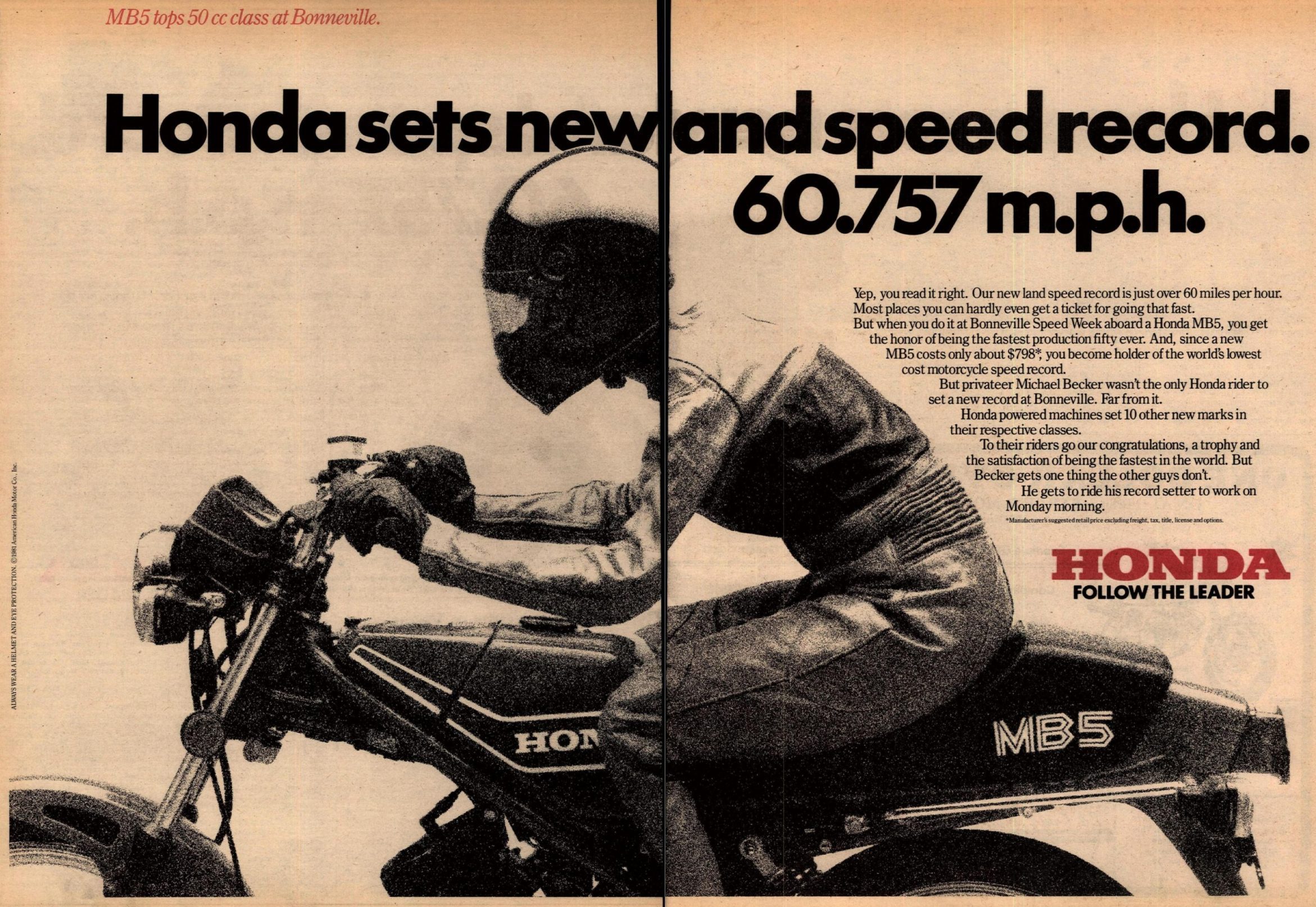
Then there was the story of Michael Becker, who took an MB5 to 60.757 mph at Bonneville Speed Week in 1981, setting a new 50cc speed record.
Cycle World was impressed with the MB5, considering its limitations. In his review, Peter admitted that the magazine believed the MB5 rode the fine line between toy and legitimate transportation. In the end, Cycle World would conclude that the MB5 could be used for real transportation, but it was more for around town than the crazy 700-mile journey that Peter and Steve took Honda’s 1980s mini motorcycles on. The MB5 was even affordable at only $798 ($2,752 in 2026), though probably out of reach for many teens at the time.
The MB5 Was In A Tough Spot
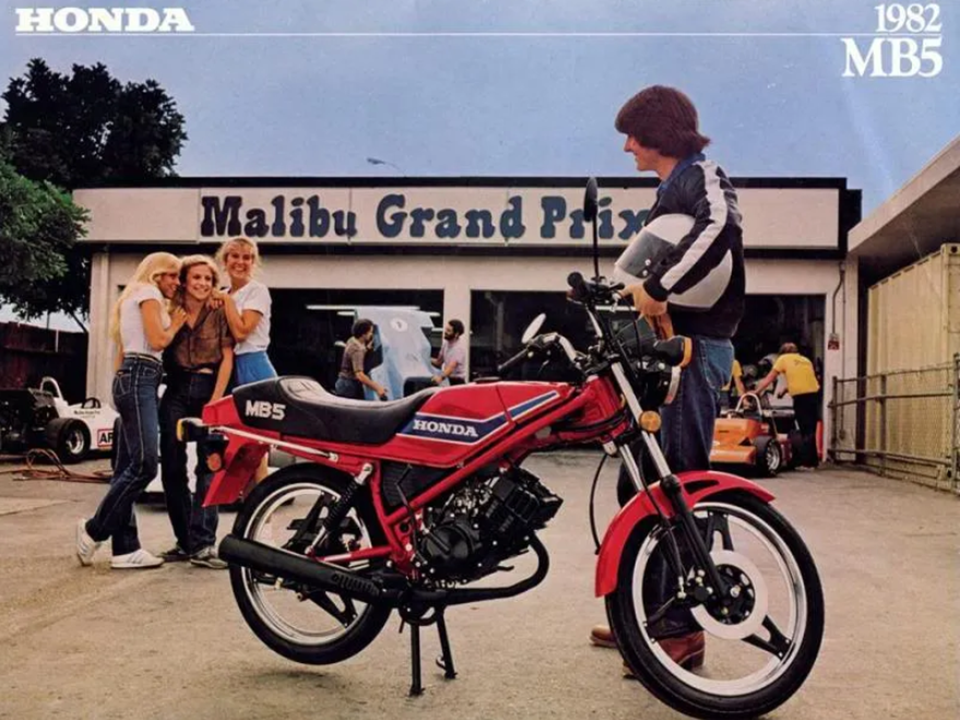
Unfortunately, the MB5 never really found a footing in the American motorcycle market. As Motorcyclist magazine writes, power-hungry American motorcycle buyers largely skipped the baby Honda. A large part of it was due to American licensing schemes. Here in America, you can buy a literbike immediately after getting your motorcycle endorsement. Another problem was the MB5’s design. It was a “noped” in that it didn’t have a set of pedals that could propel it. The bike also had a five-speed transmission. To some states, the MB5 wasn’t a moped, but a motorcycle.
Basically, if you wanted a true moped, there were cheaper options. If you wanted a more traditional motorcycle, there were faster options. The MB5 sort of sat in between. The sports moped made sense in Europe due to regulations, but was more of a niche here in America.

The awesome thing is that while the MB5 might have failed to capture a market, riders of the modern day are rediscovering Honda’s little forgotten sports moped. There are folks out there who restore and modify MB5s. They’ve gotten a sort of second life as a lightweight, offbeat way to get around. It’s almost like a Honda Grom before there was a Honda Grom.
It’s not known how many MB5s Honda sold in America, but given the fact that it’s a one-year model and is 44 years old, it’s considered to be rare. That said, this isn’t a situation where rare equates to value, as it’s easy to find a running example for $1,500, maybe less.
The Honda MB5 was a fascinating experiment for American Honda. It was a bike that worked overseas and sort of slotted between two different types of two-wheeler in America. It was fast for a 50cc, and big enough for an adult rider. But in America, it was a one-year wonder. But for some, that might be a good thing. If you’re looking for a sort of weird, tiny, high-revving bike and don’t want the same thing as everyone else, maybe check your local classifieds and see if there’s a cheap MB5 in your future.
Top graphic image: Iconic Motorbike Auctions


MB5 is a great bike. But they are pretty dang heavy for the size, those comstar wheels didn’t help. They are pretty slow unless you slip the clutch and rev it way out, which makes it more fun anyway. I rode mine 200 miles one day to Richmond just to see if I could, that was not a fun ride but it did it no problem. Oh also the gas tanks had a very bad habit of rusting out quite badly. Very hard to find one with a clean gas tank these days, and in tact oil tank cover
Can we get an article on the Kawasaki AR80? Also imported around ’82, very few remaining. Much lighter than the MB5 and doesn’t have the low end struggles, also a 6th gear! Supposedly AR50s were also imported but it’s hard to find real info
Peter Egan is a fantastic writer. If you’re at all interested in motorcycles and riding, I encourage you to read his stuff.
Fun fact: the engine from the same-vintage Honda CR80 motocross bike will bolt fairly easily into the MB5 frame, giving the pilot several more horsepower. This was a reasonably common swap in California *mumble* years ago.
Honestly, I want to buy one just for those 3 spoke wheels.
An MB5 was my first motorcycle! My dad found a leftover one at a dealership in Odessa, TX. It was seriously discounted because they couldn’t get rid of it. He brought it home and let 12 year old me putt around the alleys around our house. I had a lot of trouble with the clutch on it, though. You really had to rev it to get going without stalling, but if you revved it and let the clutch out too quickly, it would wheelie.
At least it did with skinny, 12 year old me on it. Wheelied it straight into a dumpster once.
When I got old enough to get a motorcycle license, he sold it and bought me a KZ440 LTD. Also a great bike.
I’m currently de-cruiser-fying a 440LTD 🙂