


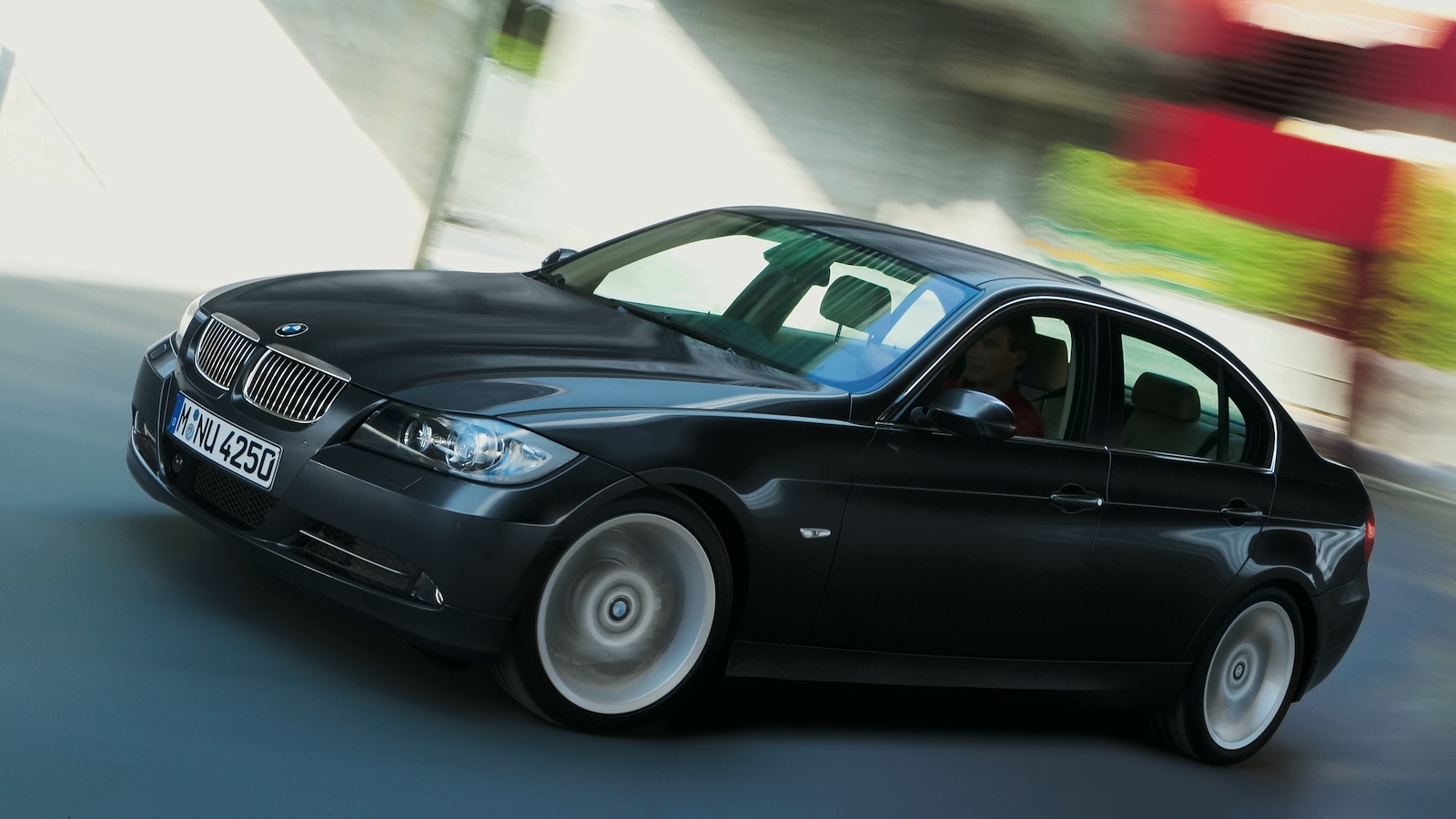
By now, it feels safe to say that the traditional compact sports sedan is on the decline. First Saab disappeared, then Volvo pulled out, then Infiniti, now the Cadillac CT4 is in its last days. For quick daily-driver duties, an EV or a hot crossover seems to be the ticket these days, but what if you’re all about engagement and sitting low to the ground? Where did it all peak? Allow me to present the one-year-only-in-America 2006 BMW 330i.
The E90 3 Series as a whole is a solid contender for a title. Not only is the 3 Series the archetypal compact sports sedan, but the E90 was the last generation to get hydraulic power steering with actual feedback, it solved several pain points of prior models, including the E46’s tendency to tear its rear subframe mounting points, and it ushered in a new era of turbocharged speed. However, there’s one particular model that sits at the apex of enjoyability, and it wasn’t sold on this side of the Atlantic for long.


While most North American enthusiasts will be familiar with this generation of 3 Series being offered in 328i, 335i, 335d, and—in Canada—323i trims locally, 2006 was a little bit different. The twin-turbocharged N54 straight-six wasn’t ready yet, so BMW offered two versions of the then-new E90 3 Series. I owned a 325i for a few years, and it was great. Essentially a detuned 328i, it featured a rock-solid three-liter naturally aspirated straight-six making 215 horsepower. However, the 330i was the model to have, and it’s an underrated proposition on the used market.
The E90 330i sold in North America starts with BMW’s famously stout N52 straight-six, then gives it a three-stage intake manifold with electronically controlled flaps to vary the runner length. This fancy bit of kit cranked the output of the aluminum-and-magnesium motor to 255 horsepower at 6,600 RPM and 220 lb.-ft. of torque at 2,750 RPM, gains of 40 horsepower and 35 lb.-ft. over the 325i. Of equal importance, the moment of peak power occurred some 350 RPM closer to the redline, while the moment of peak torque remained unchanged. The end result was a noticeably broader powerband that paired proper low-end grunt with decent top-end pull.

However, BMW didn’t just stop at the intake manifold and ECU calibration. It also changed the manual transmission. The 325i and subsequent 328is came with the Getrag GS6-17BG, while the 330i featured a ZF-built GS6-37BZ. Not only did the larger-case ZF-built transmission feature a higher maximum torque capacity, but it also gained a larger clutch disc and came with fractionally shorter ratios in first through third. Granted, it did come paired with a 3.15:1 final drive ratio compared to the 325i’s 3.23:1 final drive ratio, but that did provide a slight benefit of reduced cruising RPMs.

Perhaps unsurprisingly, the difference in straight-line performance was immediately noticeable. When Car And Driver tested the 2006 330i, it ran from zero to 60 mph in 5.6 seconds, or half a second quicker than the 325i. That advantage narrowed to three-tenths of a second through the quarter-mile with the 330i completing the run in 14.4 seconds, but it maintained a four-MPH advantage over the 330i. Arguably more remarkable is the way the EPA fuel economy ratings for stick-shift models of the 325i and 330i are identical. Talk about having your cake and eating it too.
Of course, straight-line performance was only one way in which the 330i had an edge over the 325i. While the 325i and early 328i models featured 11.8-inch discs all the way around (later 328is would upgrade to 12.3-inch front discs), the 330i got 13-inch front discs and 13.2-inch rear discs. The calipers were slightly different, the CV axles on the 330i were beefier, the exhaust sang a slightly different tune thanks to a unique muffler, and the optional sport package gained slightly larger 18-inch wheels. Small tweaks, but circling back to Car and Driver testing, the magazine’s long-term 330i clung to the skidpad at 0.89 g and stopped from 70 MPH in 154 feet versus a press fleet 325i’s figures of 0.87 g and 161 feet. Not bad. Not bad at all, although figures alone don’t capture just how effusive the praise towards the 330i was.

After returning its long-termer, Motor Trend wrote, “By now our 330i is gone, no doubt snapped up by some lucky “pre-owned” customer. We feel its absence, but in its wake now lies an even greater appreciation for one of our all-time favorite cars, the propeller-badged 3.” When Car and Driver wrapped up its long-term test, it ran the conclusion with the headline “Go Ahead, Call Us Biased” and photoshopped the sedan atop a literal pedestal before running the following:
Despite the 3.0-liter six-cylinder engine’s 6600-rpm power peak, it produced strong thrust across the rev range, reducing the need to row its smooth and precise gearbox. The steering feel was excellent, and the car responded to inputs eagerly, accurately, and naturally. And the chassis was always eager to be leaned on, delivering its tenacious grip with steady balance and great stability.
None of this surprised us, given the 3-series’ legendary sports-sedan status. But what astonished just about everyone who drove the car was its comfort and usability as an everyday driver. “The car absorbs bumps and expansion joints yet never pitches or rolls much,” observed former associate technical editor Robin Warner. After a 1300-mile round trip from Ann Arbor to Virginia International Raceway, I noted that the BMW’s “uncanny combination of control and compliance takes the fatigue out of driving this car.”
Twenty years on, the E90 3 Series has proven every bit as good as reviews of the time claimed, with the 330i adding another feather to its cap that you normally don’t see from the marque. Despite being the highest-output naturally aspirated straight-six model of its generation, it also enjoys a track record of remarkably solid reliability. A number of examples are still humming along with more than 300,000 miles on their original powertrains, and failure points remain mercifully few. The electric water pump will expire at some point, the oil filter housing gasket will eventually need changing, you may need to change a VANOS solenoid or two, which takes all of about 20 minutes, the intake flaps may gunge up, but cheap refurbishment kits are available, and there’s a $20 cooling flange on the front of the engine that goes brittle with time. Aside from that, you’re basically just looking at doing normal old car maintenance. A valve cover gasket here, spark plugs there, an oil pan gasket eventually. Nothing too complex or expensive, which feels strange to say about a BMW.

So, if you’re looking for what might be the ultimate turn-key daily driver under $10,000, hunt around for a stick-shift 2006 BMW 330i. Preferably with the sport pack, so you get a fantastic pair of front seats with adjustable bolsters and thigh support. This one-year-only special added a lot more than just a fancy intake manifold, and it blends modern rigidity and convenience with old-school feedback in an irresistible way.
Top graphic image: BMW




Those 3 stage intake manifolds are gold for people with 128i’s