

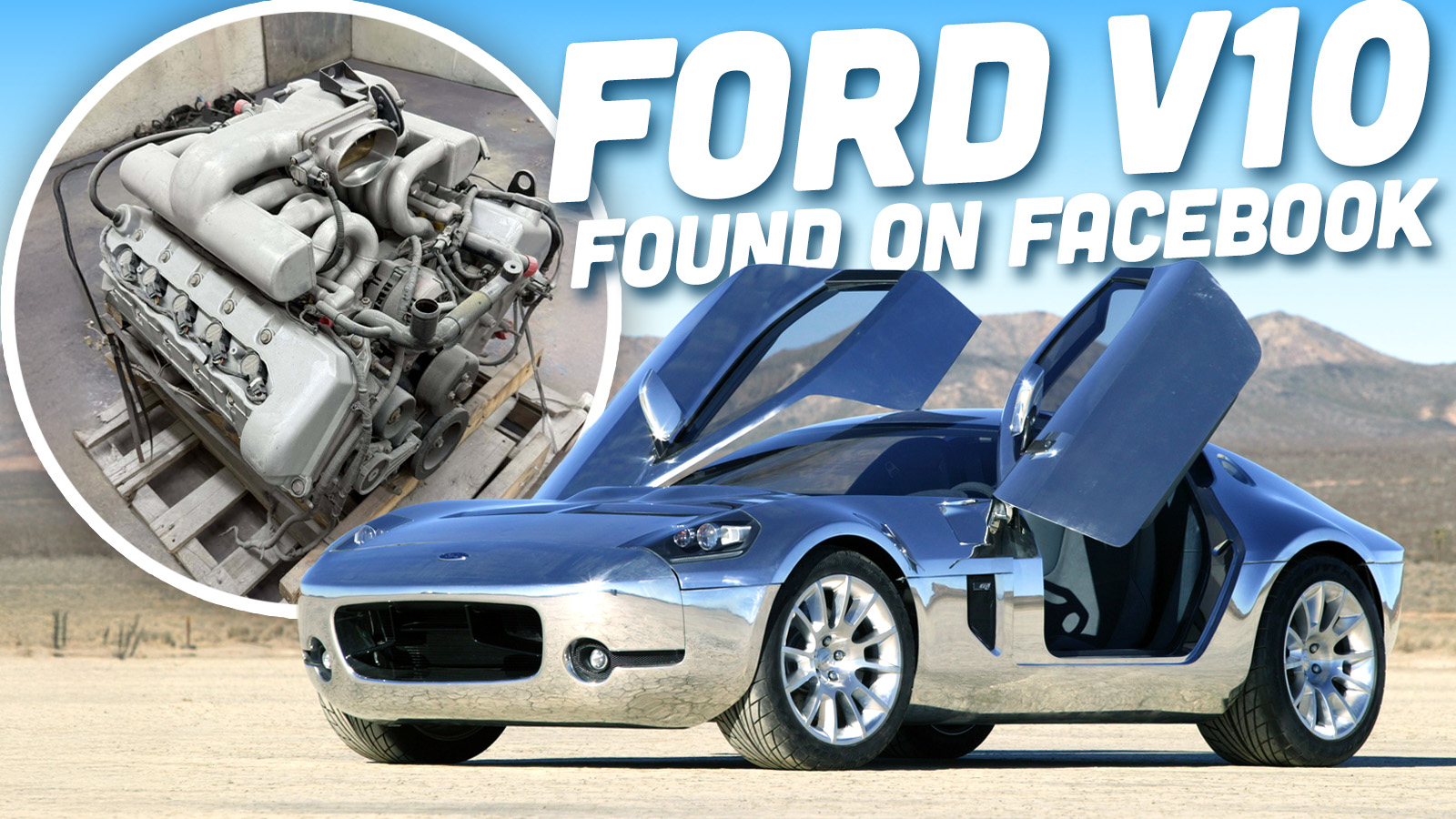
Ford is well-known for its line of incredible V8 engines, but once upon a time, it nearly started using V10s in its performance vehicles. In the early 2000s, a secret prototype engine from a small division in Ford spawned one of the coolest engines to come from the brand, even if it only appeared in a handful of concept cars.
You might be familiar with Ford’s “Triton” V10, a 6.8-liter workhorse with single overhead cams designed for truck use, including towing and hauling. While some believe Ford’s mythical dual-overhead cam V10 engine used the Triton as a base, that’s simply not true. While the V10 was an inspiration for the project, these prototype engines didn’t share a block structure.


Despite the cool noises and notable advantages over comparably sized V10s, Ford never put the engine into production. Reportedly, just four prototypes were built, making them basically unobtainium. Yet somehow, there’s a guy on Facebook claiming to be selling one right now.
The Origins Of The DOHC V10
Ford’s hot V10 can be traced back to the turn of the century, when the company was first coming up with ideas for powering its then-new supercar, the GT. If you’re familiar with that car, you’ll know it eventually ended up with a supercharged V8 mounted behind the cabin. But at one point, management was considering up to four different types of powertrains. I’ll let Ford engineer Chris Theodore explain. From an excerpt from his book, published in Hemmings:
Back in the early days of the Ford GT, I called together guys from the Petunia skunkworks, SVT, Ford Racing, and Advanced Powertrain to discuss engine alternatives. There were four factions: One wanted a small displacement high-revving motor like a Ferrari V-8; another wanted twin turbos; a third pushed for a supercharged Mod V-8, like in the SVT Lightning; and I had suggested a large displacement V-10. I could see a horsepower war brewing, and a V-10 would allow us to supercharge or turbocharge it in the years ahead. The naturally-aspirated version would also be lighter and permit a lower center of gravity (Cg) than a supercharged V-8.
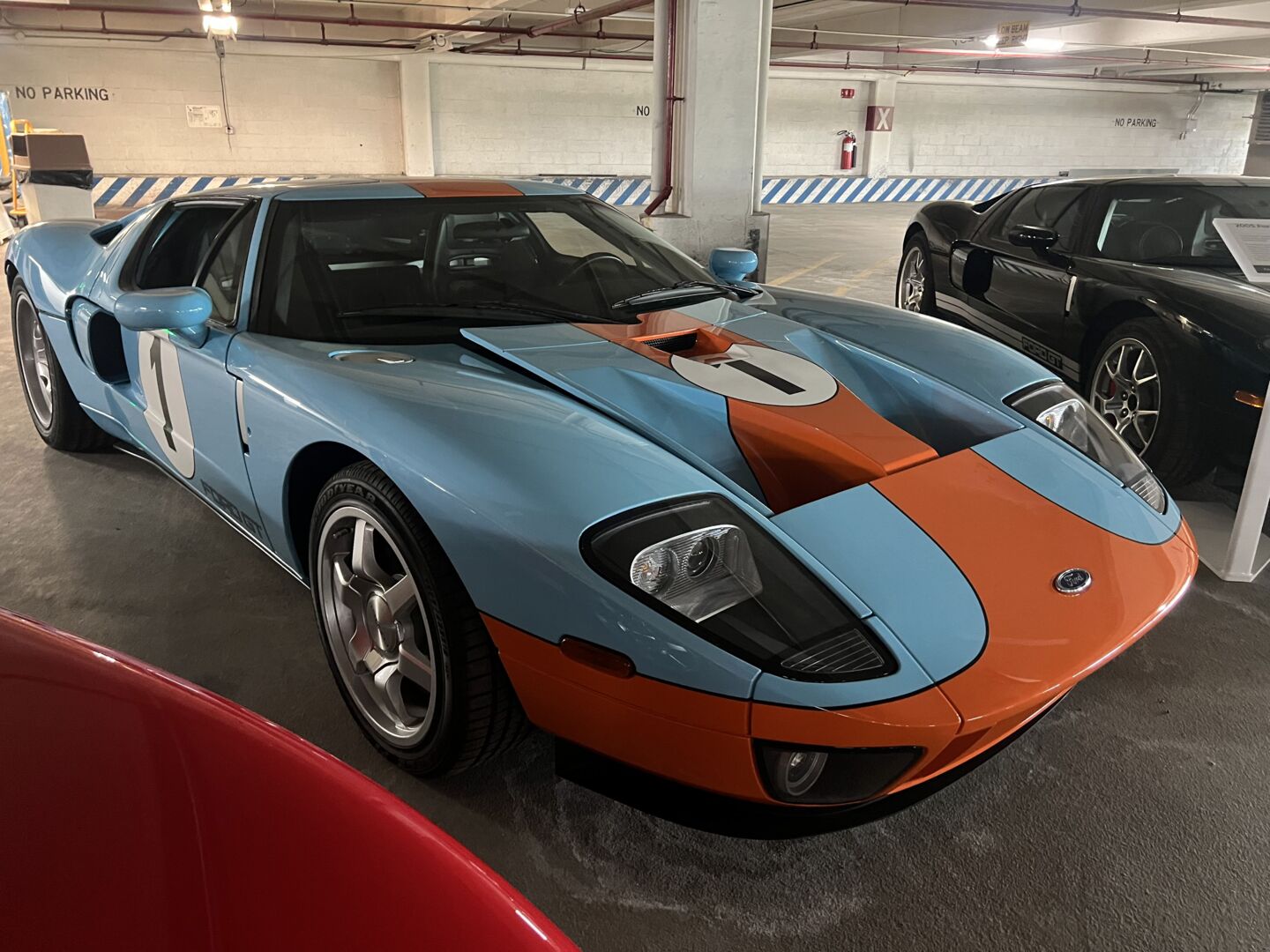
The high-revving engine option was put to rest when I told the guys we needed at least 500 horsepower and 500 lb/ft of torque. Turbocharging would have been a thermal challenge to execute in a mid-engine car in such a short time frame. Finally, Coletti convinced me that the only way Petunia could meet its timing objective was if we used the Lightning motors as surrogates in the Ford GT “workhorse” vehicles. Meanwhile, unbeknownst to me, the Advanced Powertrain team went off and built a V-10.
This V10 was not sanctioned by any upper management, according to Kevin Byrd, an engineer on the Advanced Powertrain team who spoke with Hot Rod back in 2018:
“We did the V10 to inspire the company to get into the supercar segment, to compete with the Viper and Corvette,” said Byrd, Research and Advanced Engines, Technical expert for engine architecture and design concepts and Supervisor for CAD and CAE. “Another part of the company was doing the Ford GT, but it was not publicized, even within the company at the time. We hoped the two [V10 and Ford GT] could merge.”
[…]
“We really didn’t have budget to do a project like this,” he added. “It was a grass-roots deal, and it came from the bottom up, not the top down.” If you recall, Ford didn’t have a supercar like the Dodge Viper, and in order to build one, Byrd and the team recognized that Ford would first need a supercar engine, so they set out to create something one.
The Advanced Powertrain team considered using the normal Triton V10 as a base, but its 5.4-liter deck height meant it was too tall to fit under the hood of a New Edge Mustang, the car they planned to use as a mule to test the powertrain. Instead, the team used the SVT Cobra’s 4.6-liter, all-aluminum V8 as a base, adding two extra cylinders. The head design, similarly, used DOHC units from the Cobra R, according to Hot Rod, with Cobra R cams.

The result was a 5.8-liter—or 351 cubic inch—engine that, according to MotorTrend, made 426 horsepower and 400 pound-feet of torque on its first run of a dyno.
Where Did These Engines Go?
As I mentioned earlier, the Advanced Powertrain folks decided that a New Edge Mustang was the ideal testbed to showcase the V10’s advantages. The car was a silver model that, aside from a humorous “Boss 351” badge on the rear trunklid, looked totally stock on the outside. It was only when you either popped the hood or cracked the throttle that you could tell something was different. I’ve probably watched this 18-year-old YouTube video showing the car doing a burnout a few dozen times over the course of my life:
Proud of their creation, the Advanced Powertrain department went straight to Theodore to see what he thought. By the time the V10 was ready, the GT project was already too far along. But the V10 wasn’t going to die quietly. From that Hemmings excerpt:
Greg Coleman and Kevin Byrd called me one day and asked if I wanted to take a ride in a hot Mustang. Of course I did, not suspecting what was under the hood. Performance was phenomenal, but it was too late to disrupt the Ford GT program, even though the V-10 engine would have fit. Mays and I decided to put it in the 2003 “427” sedan concept – we fibbed a bit about displacement! I called Greg and said we needed another V-10. “Just write the check for the parts!” he replied.
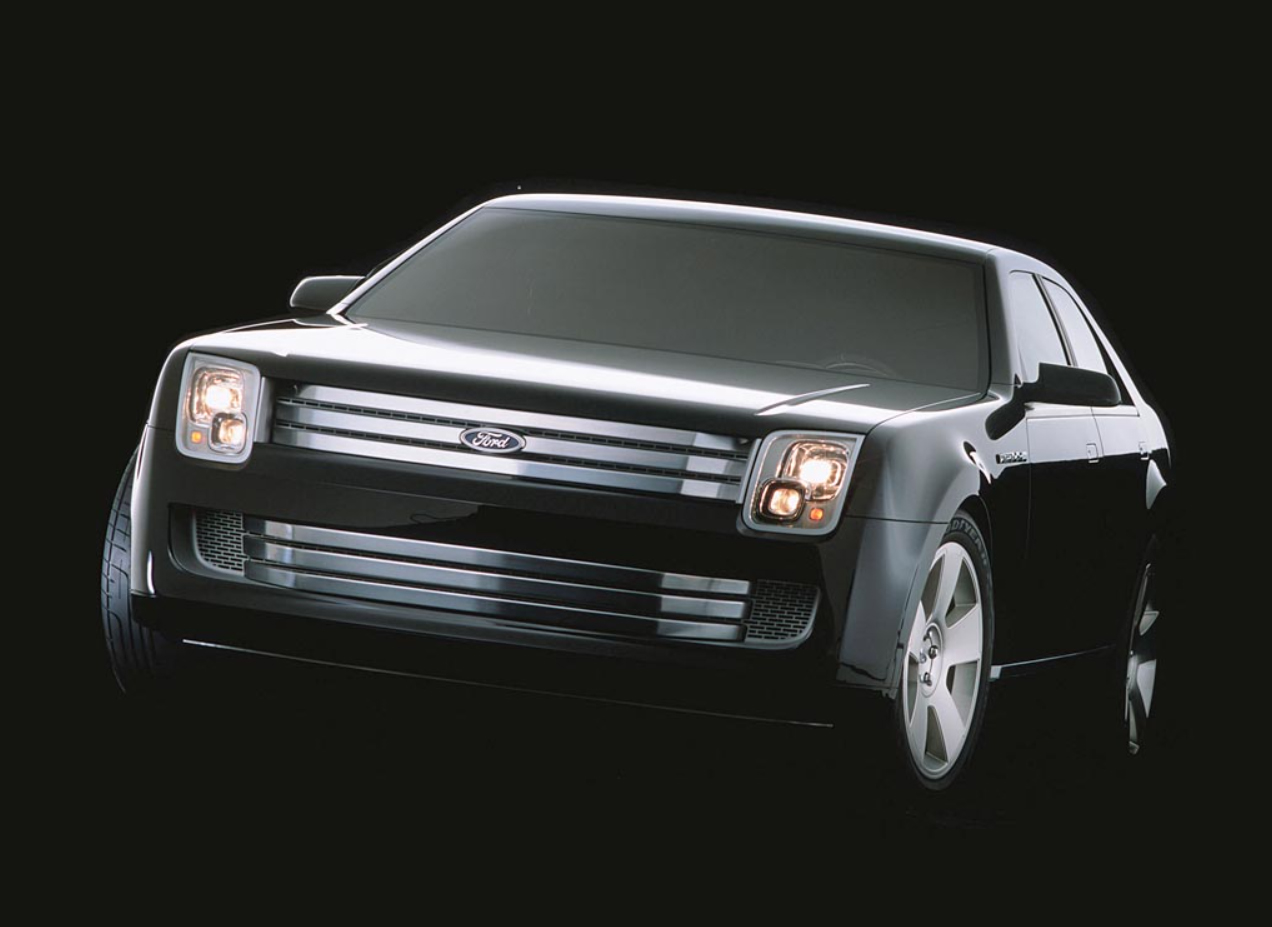
The 427 concept was first shown in 2003, and looked like a cross between the first-generation Ford Fusion (which hadn’t yet debuted) and a Bentley Continental Flying Spur. It had a stately shape and wore an all-black paint job, with its massive hood hiding that experimental V10 underneath.

The next car to get a prototype V10 was the last true Shelby Cobra, a concept vehicle built in 2004 as a feasibility study. Matt did a deep dive on this car a few years back after it was purchased by Autopian co-founder Beau Boeckmann; I highly recommend reading it. While the original engine was 5.8 liters, and the 427 concept got a 7.0-liter version, this one was limited to 6.5 liters, making 605 horsepower.

The final car to get a racy Ford V10 was the Shelby GR-1 concept, a sort of modern take on the Daytona, aimed directly at the likes of the Dodge Viper. It was first shown to the public at the 2005 North American International Auto Show in Detroit as a fully functional prototype. The version of this V10 displaced 6.4 liters, and made 597 horsepower.
This Engine For Sale
While browsing Facebook this morning, I came across a post by Dan Schoneck, co-founder of Schoneck Composites, a Minnesota-based fabrication shop that specializes in production body panels for Mustang drag cars. The post lists four engines for sale, one of which, according to him, is a dual-overhead cam Ford V10 with a custom Roush intake.
Seeing as how just four of these hot V10s were reported to have been built, and all four made their way into concept cars, it’s unclear where and when Schoneck got hold of this engine. The V10 Mustang test mule, the 427 concept, and the GR-1 concept are all currently sitting in Ford’s Heritage Vault in Michigan (another GR-1 was sold at auction back in 2011, but it was a design buck with no drivetrain or interior, so it never had an engine to begin with). Meanwhile, the Cobra concept from ’04 is in Beau’s collection. So theoretically, all four engines are accounted for.

It’s very possible Ford built more of these V10s for testing or other purposes, and this is one of them. Schoneck claims his engine displaces 6.8 liters, which is more than any of the previously known prototype engines. When I reached out to him, he told me only that he purchased the engine off Facebook Marketplace, and didn’t ask the previous owner where they got it from. I’ve also reached out to Ford to see if the company can provide any more details.
While it seems unlikely, it’s also possible this is a custom engine built by someone outside Ford. Those who spend a lot of time on the internet will know of the Build It Yourself YouTube channel, a team of two engineers who decided to build a dual-overhead cam Ford V10 of their own and swap it into a modern Lincoln Continental. Here’s a video of that car ripping a burnout:
Original or not, a Ford Modular V10 with dual-overhead cams is still a unicorn. Going by the singular photo, this one looks to be in complete condition and ready to swap into a project of your choosing (so long as there isn’t a hole in the block on the other side). With an asking price of around one 2026 Mazda MX-5 Miata Club ($35,000), it’s certainly not cheap. Nonetheless, that’s a relatively low price to pay for a truly rare piece of Ford engine history.
Top graphic images: Ford; Dan Schoneck on Facebook


It’s a triton engine, it’s built very similar as the one on YouTube, although it predates it by quite a few years.
If it actually does displace 6.8l then it could be a custom build off the truck V10 block, which is also a 6.8l
I have a friend that’s been working on building up an Australian Falcon XB. Just sent the link as a ‘you know…’
“The high-revving engine option was put to rest when I told the guys we needed at least 500 horsepower and 500 lb/ft of torque. Turbocharging would have been a thermal challenge to execute in a mid-engine car in such a short time frame.”
Why would a big, honkin’ 500+ HP DOHC V10 be less of a challenge to shoehorn in than a smaller turbo engine? I doubt its any more efficient at converting gasoline into power nor less bulky.
The turbo would have presumably needed a large intercooler (and an additional low-temp radiator at the front, if said intercooler was a water-cooled design), along with the associated plumbing to run from the front of the car to the engine compartment in the rear.
I dunno if a separate radiator is going to offer much more than just having the intercooler and turbo on the same system unless they need a different type of coolant.
If I did not live in Smogcheck-afornia (and won a lottery) I would want this for my first-generation Maverick.
I wonder if that would fit in the new Shelby Cobra MkV, which can swallow a Godzilla.
So this may be total nonsense, but I have heard multiple times that it is a thing so who knows. I have heard that in the 90s they were considering doing a special Boss Mustang with one of the very early V10s in a SN95. Supposedly they built 10 prototypes with Larry Shinoda being involved but then decided they were too uncontrollable/unbalanced on the street to be sold so the project was discontinued. The story was always that 9 were confirmed destroyed, but the 10th disappeared from the facility and was never accounted for. I had also heard people say it was somewhere in the mountains of NC and had been driven on occasion on the Tail of the Dragon and some local events.
I can not find anything online about that, but I heard it from enough different people that it makes me wonder.
if Mustang even guys thought that was too unctontrollable/unbalanced can you imagine all the “car meets leaving” shorts we missed out….
I think this would be a great fit for a mid-60s Falcon Sprint (shell).
But the “hey, that got a truck engine?” joke would never have died. Viper owners, amirite!?
People still say that about the 5.4L that the Ford GT did get lol
I haven’t even read the whole thing, I just got to:
“Guy on Facebook claiming” something? I am shocked, absolutely shocked I tell you!
this would be nice in a beat up Ford Windstar sleeper. jut to tease all those mustang guys
An Aerostar would be better, even sleepier and already RWD or AWD. No one would expect speed from something which originally had a 3.Slow shoved under the hood/dash!
If historical significance is your justification to ask $35,000 for an engine, people are going to want some sort of verification. “I bought it from Facebook Marketplace and I don’t know where it came from” doesn’t cut it when you’re demanding such a premium.
I’ve got a bottle French wine to sell them next.
Can I do it through Craigslist or does it have to be through Facebook to be legit?
it’s kind of funny how craigslist went from the butt of jokes, the bottom of the barrel for classifieds and absolutely packed with sketchy people and scams, to now sort of the “more legitimate” option since FB Marketplace has managed to sink even lower into the cesspool.
CL starting to charge $5 for vehicle ads and implementing some tougher anti-spam measures did seem to clear out the scammers/spammers virtually overnight and they all went to FB. I don’t swap cars/bikes nearly as often as I used to but the last few transactions via CL were totally smooth sailing. Meanwhile FB marketplace usually wants to make you just throw the thing in the trash than continue dealing with people who want your $50 item for a denny’s gift card with $17 on it, some used kids shoes, and can you deliver it like 45 minutes away but only between 1:45 and 2:30 please?
Oh, I feel that. I’m trying to liquidate a bunch of stuff I no longer need since consolidating garages, and after dealing with people who don’t understand that “I’m unavailable this afternoon” means I cannot, in fact, meet them at 4, I just want to throw it all in a dumpster and be done with it.
Le Shatoh Fronsay!? That’s top shelf! What a bargain.
If he moved the listing to EBay, do you think they’d be game to sponsor another build? 😉
Ok, find an EcoBoost Ford Flex, gut and modify it so it can now be RWD, put the V10 in there and back it up with a TR6060, keep the exterior of the Flex mostly stock except for some slightly meatier wheels, tires and brakes then proceed to stunt on the unsuspecting fools.
Do it, Beau, you know you want to.
The Flex/MKT already could be had in AWD, so dedicating to RWD isn’t really much of a lift.
Well it they are transverse FWD based AWD vs longitudinal RWD based AWD, so it would still be quite the undertaking.
Don’t worry, I got $500 million from The Morning Shift tariff refund. We got this.
They really should have put this in the Ford GT. Chris Theodore was absolutely correct and Ford would have had a new hi-performance end to build from for the next 10-15 years
I’d love to see a deep-dive on the GR-1 sometime. Also, Beau still owns the Cobra concept? I thought he was selling it back when its deep dive was written.
BIY has quickly become one of my favorite channels with how in depth the V10 build was.
I’m most amused by the intake plenum that’s seems to be derived from the old Windsor 302 design in the Fox Mustang GT
When I saw the post this morning, all sorts of alarm bells and red flags lit up the dashboard of my brain.
Yes, very cool motors, but ‘it fell off the back of a truck’ is a far better answer to ‘how did you get these?’ than ‘I bought it on FB marketplace’.
Guy has like what, $70k (ask) of motors for sale?
<insert Philip_J_Fry_hmmm.gif>
I’ve been staring at that provided engine picture for many minutes. I don’t see any exposed cam gears on the head, that could tell me if it’s a SOHC or DOHC engine. Would it be proper to call an engine that only had one camshaft per bank of pistons a DOHC? I don’t think so.
The hump at the lower front edge of the valve cover is a dead giveaway that there’s two gears jammed up in there. Otherwise it’d be the same height as the rest of the cover immediately behind it.
I wanna see someone cram it into a Viper and make purists REALLY mad.
Sadly there’s almost no chance it fits. The Viper V10 is extremely compact for what it is and the Hellcat doesn’t even fit in the chassis, let alone a DOHC V10.
Damn. I guess I’ll just convince them to toss it in my excursion instead.
Put it in a Fiesta… you won’t want a hood on there anyways.
1st gen Fiesta, please. Barring that cram one into an Aspire.
Would it really be feasible to cram one into an Aspire or would it be better to just mount the engine to a stand and run the Aspire into it fast enough to “stick”?