

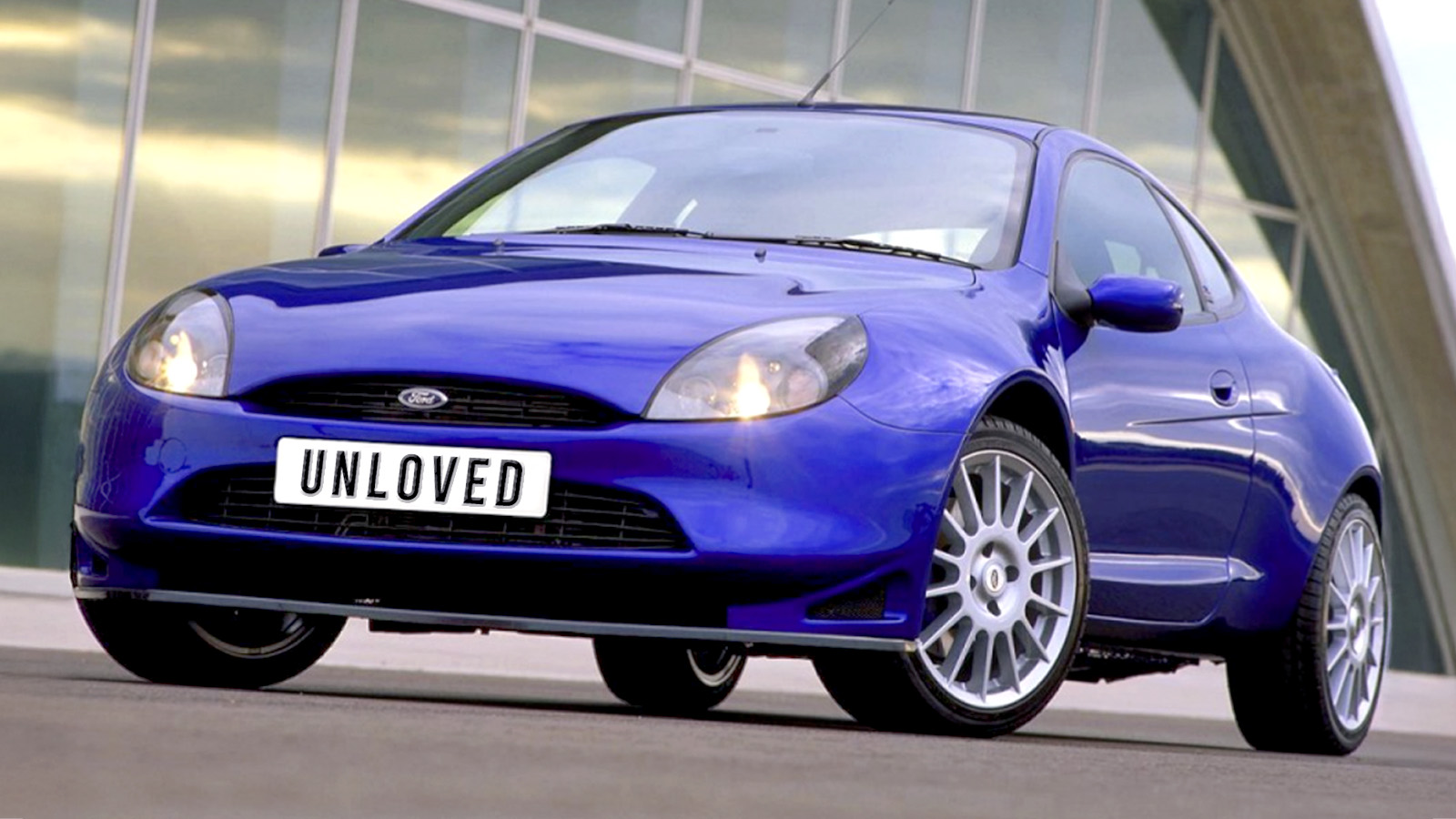
If you search up the term “Ford Puma,” you’ll be greeted with reviews for a small, sort of charming small crossover sold in Europe. But the Puma wasn’t always a crossover. Once upon a time, it was a legit compact coupe-hatchback thing that ruled the small, fun car segment in the region throughout the late ’90s and early 2000s.
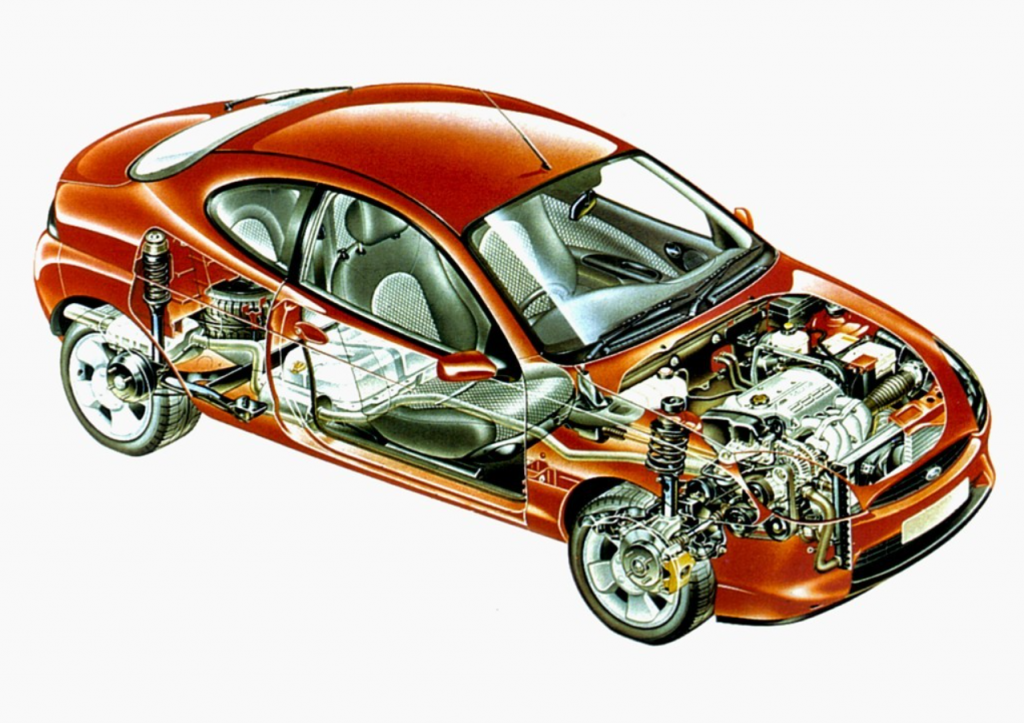
Based on the Mk. IV Fiesta hatchback, the Puma got sleeker lines, a few suspension upgrades, and a 1.7-liter version of the Fiesta’s Zetec-SE inline-four cylinder engine, making 123 horsepower. It was designed to attract a younger audience, according to Autoevolution, and thanks to a starting price the equivalent of about $18,000, it saw a good deal of success before its discontinuation in 2003.


What the Puma didn’t have was real sports car cred. Sure, it looked the part, but it was basically a Fiesta underneath. Ford decided to rectify this problem in 1999, two years into the Puma’s production, by showing off a concept called the ST160, with a bunch of visual and mechanical upgrades. That led to a production car called the Ford Racing Puma, one of the weirdest, least successful sports cars from the Blue Oval.
From Sporty To Sportier
From the get-go, Ford marketed the Puma as a car designed for thrills. If the speedy looks weren’t enough to convince buyers, the company also put together this weird advertisement that featured a CGI’d Steve McQueen driving a Puma around the streets of San Francisco (a market where the Puma was never sold), a callback to McQueen’s 1968 movie Bullitt. At the end of the ad, he even parks it next to a Mustang to really drive the point home that these two cars are definitely on the same level:
True gearheads knew this wasn’t the case, obviously, and so did Ford. So for the 1999 Geneva Motor Show, it put together the Puma ST160 concept. On the outside, it was everything the Puma was, plus more, with a widebody kit that increased track width without ruining the car’s excellent lines. That track width was filled out with a set of gorgeous 17-inch Speedline multi-spoke alloy wheels.

The changes weren’t just visual. The ST160 used the standard Puma’s 1.7-liter Zetec SE engine, upfitted with new camshafts, a new intake manifold, and a new exhaust system with a new, high-flow catalytic converter. Combined, the upgrades unlocked an additional 37 horsepower, for a new total of 160 horses.

The five-speed manual from the standard Puma was carried over, but it was equipped with a limited-slip differential to help put the extra power down to the front wheels. It also got a handful of suspension changes, upgraded brakes, and blue Sparco bucket seats to accompany the new looks.
Public reaction to the ST160 was positive enough that Ford greenlit a production version, simply called the Racing Puma.
A Puma That Delivers On Its Looks
The Racing Puma was essentially the ST160 concept come to life, looking nearly identical and sporting many of the same upgrades. Like the concept, it got a widebody kit with aluminum fenders up front and steel pieces on the rear that altered the car’s overall stance, along with those multi-spoke wheels and an overhauled suspension. They shrouded high-end brakes from Alcon.

All Racing Pumas were finished in the same color: Ford Racing Blue. And all of them got Alcantara-coated Sparco seats with Ford Racing logos embossed into the backrest. There was also blue Alcantara on the steering wheel and the door trim. The five-speed manual returned, but the limited-slip differential was relegated to the option list, rather than being made standard.

The Racing Puma’s drivetrain was a point of drama when it was new. According to Octane Magazine, the car was supposed to get a turbocharged version of that Zetec four-cylinder making over 180 horsepower, but “spiraling development costs” forced Ford to stick with the naturally aspirated version first developed for the ST160. That means buyers had to settle for a 1.7-liter engine with a new air intake, more aggressive cams, and a new exhaust, with a rated power output of 153 horsepower. That’s 30 more than the standard Puma, but a far cry from what was originally promised.

The Racing Puma also wasn’t built by Ford. The cars were shipped from the Puma’s normal production facility in Cologne to the United Kingdom to be fitted with all of the upgrades by Tickford, the same UK engineering and production firm that helped build the Ford Sierra RS500 and the legendary RS200.
The press launch for the Racing Puma leaned into that original San Francisco advert, and took place in the same city, and even had a track component (Ford doesn’t say in the above video which track it went to, but if I had to guess by the scenery, it was probably at Thunderhill).
The Public Wasn’t Exactly Enthused
These days, if Ford were to make a high-strung compact coupe that looked as cool as the Racing Puma, it’d sell out instantly. But exactly the opposite happened in 2000, when the car went on sale. The combination of the missing turbocharger and the exorbitant price was, according to Top Gear, the reason for its downfall.
Ford planned to make 1,000, cut that to 500, then still had to sell some of those internally to make sure every Racing Puma found a home. The reason? A £23,000 asking price. That would seem extortionate for a 153bhp hot hatch now, never mind in 1999. Especially when a 30bhp-lighter Puma 1.7 sold for ten grand less.
Half of those original 1,000 Racing Pumas planned for production were earmarked for Ford of Germany, which canceled its entire order before production kicked off, according to Octane. The remaining 500 were all right-hand drive models sold in the United Kingdom. As Octane points out, the Racing Puma was a tough sell when you could buy a turbocharged, all-wheel drive Subaru Impreza with more horsepower for less money.

Fast-forward to 2026, though, and the Racing Puma has finally begun to attain collectible status thanks to its rarity and true enthusiast-minded upgrades. With just 500 units built, it’s actually one of the rarest Fords out there, with Racing variants demanding several times the price of normal Pumas in similar condition.
The Puma’s Fatal Flaw, Amplified
The normal Puma, as cool as it is, isn’t perfect. The little front-drive coupe is well-known for its rust issues, which can be found in places like the metal around the rear wheels, the side sills, and the floor pan. If you find it before it spreads, it’s easy to nip it in the bud. The problem with the Racing Puma is that its upgrades make rust much harder to spot.
You see, instead of cutting out the original fenders and quarter panels and replacing them with the new widebody units, Tickford kinda just glued the new panels on top of the old panels, which were left in place. This meant the original panels in the rear would begin to rust out, and because they were totally covered, owners wouldn’t see what was going on until the rust got really bad.
One owner, who documented the full restoration of their Racing Puma on Facebook, published photos of the rear fender area showing just how bad the rust had gotten underneath that grafted-on panel (you can even see remnants of the original glue that Tickford used):
Yikes. That’s not great, but it’s not even the worst section of rust documented on this car. That goes to the side sills, which look to have fully crumbled to bits in some places:
That’s pretty catastrophic, to the point where even I, a person who routinely buys rusty cars, would probably avoid it, even if it were priced low enough to be a good deal. You’d think that with this sort of rust being pretty common, pristine examples would be obscenely expensive. And you’d be right … but only in the context of used Puma prices.
Mint Examples Aren’t Insane Money In The Grand Scheme Of Things

Let me give you some context. Ford sold well over 100,000 Pumas during the car’s original six-year production run, so they’re pretty common. That means even clean, low-mileage examples like this 2001, silver-painted car with just 29,000 miles on the clock can be had for just £5,999 (around $8,200 at current exchange rates).

Compared to regular Pumas, then, Racing Pumas in similar condition are pretty pricey. The one shown here, listed for sale on UK car sale site Pistonheads, has just 58,000 miles on the clock and was just treated to a respray in the original Ford Racing Blue. It looks absolutely immaculate, and it’s up for sale for £24,950 (around $34,000). The only other example listed on Pistonheads has even fewer miles, but the seller is asking just £19,950 (around $27,000) because rust issues are starting to show themselves at the rear quarters and side sills.

So, Ford Racing Pumas (abbreviated to FRPs by the owner community) are vastly more expensive than regular Pumas, which makes sense given their upgrades and rarity. But compared to other fast Fords of the ’90s and 2000s, they represent a bit of a bargain. Escort RS Cosworths sell for double the prices of these Pumas, while the later, weirdo five-cylinder Focus RS hatchbacks are all more expensive by at least a few thousand pounds.
One day, collectors will come around to the Racing Puma. Despite its flaws, it’s simply too cool to ignore. Time has allowed the car to ascend above the baggage of comparison it was plagued with when new, allowing enthusiasts to appreciate it for what it is: The coolest version of Ford’s coolest compact coupe. Just make sure to check for rust before pulling the trigger.
Top graphic image: Ford


“You see, instead of cutting out the original fenders and quarter panels and replacing them with the new widebody units, Tickford kinda just glued the new panels on top of the old panels, which were left in place.”
this is probably the most “american-manufacturer in the 2000s” sentence i’ve ever read
The design of these is so exciting it made me Puma pants!
…Not really, but I do admire the design. “New Edge” went away too soon.
I dunno, I reckon in anything bar a straight line the Puma would probably be faster. They’re only slightly down on power compared to a 1968 Mustang, but they’re lighter, and can turn corners and stop. None of which are strong points for 1960’s muscle cars.
I know of this car from the knockoff in Midnight Club 2. Gotta listen to some Felix da Housecat now
Isn’t this also the Ford Ka?
Would have done better in Boston (and Australia)
No, the Ka was a different small car based on a Fiesta chassis.
I love these little guys. And I really hope they don’t ever come to the attention of collectors so regular enthusiasts can continue to afford and enjoy them.
Am I the only one noticing that it looks like an RX-8 in the back, and a mashup of a Ford Focus and an Audi TT in the front?
It’s much more of a shortened US-market Mercury Cougar from the same time period.
They also sold that as the 1998-2002 Ford Cougar.
I worked in Koln at Ford during the Puma’s hey days designing Mondeos. I had a standard 1.7 Puma as a company car and it was a bomb. I never had to brake coming up to roundabouts, it would whip around them like a go cart. The FRP was really a lovely car for the time. They made the body panels from soft tooling which wore out after the 500 initial run and had to retool for another “Limited Edition”. Good times in Europe at the time.
Ford of Europe/UK had some seriously cool cars on offer back then. Which of course, we never got in the States. But Ford USA would sell you a Mazda-based (anal) Probe. Sigh.
Even the base Pumas were fantastic cars. That platform was stellar.