

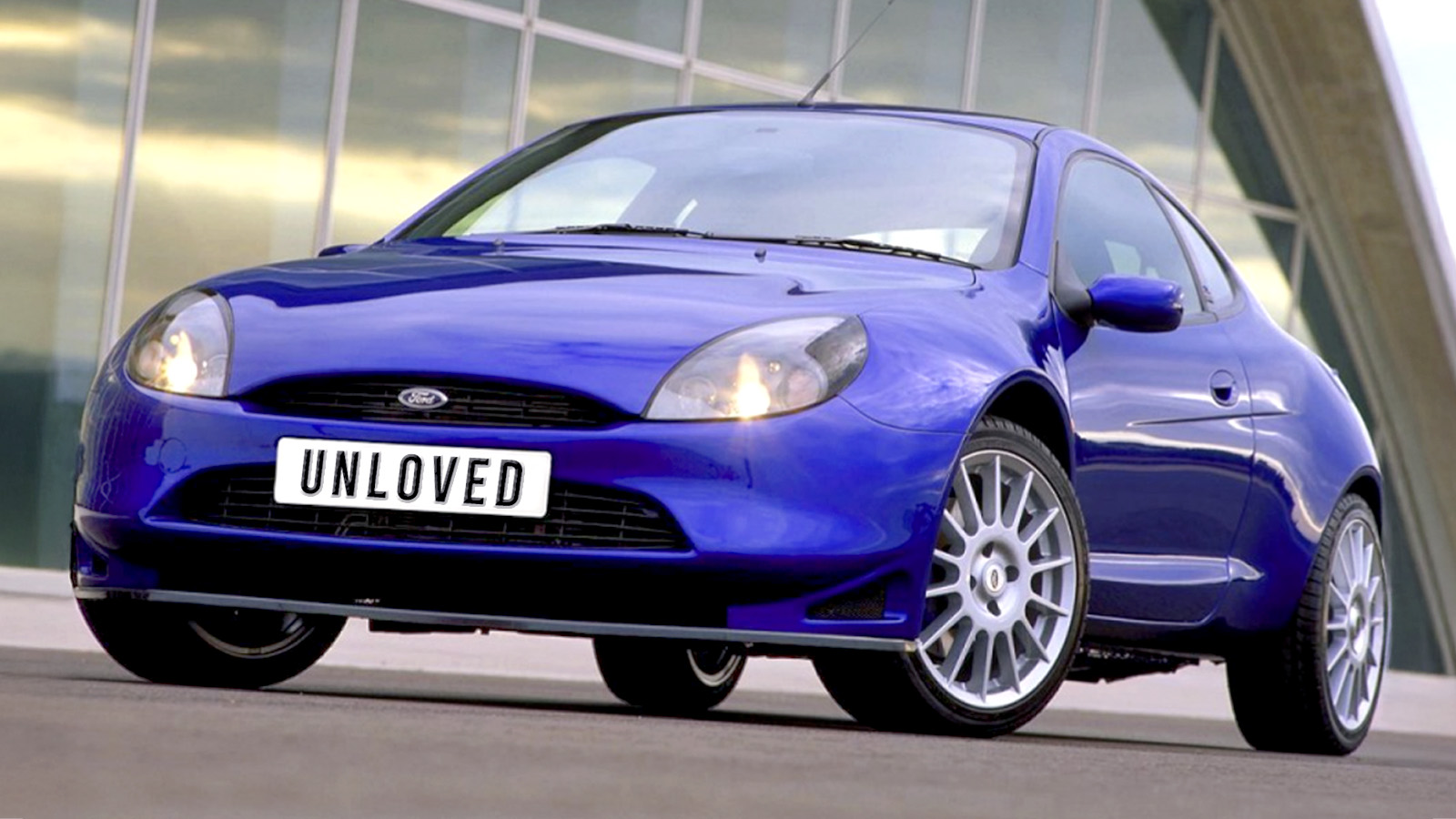
If you search up the term “Ford Puma,” you’ll be greeted with reviews for a small, sort of charming small crossover sold in Europe. But the Puma wasn’t always a crossover. Once upon a time, it was a legit compact coupe-hatchback thing that ruled the small, fun car segment in the region throughout the late ’90s and early 2000s.
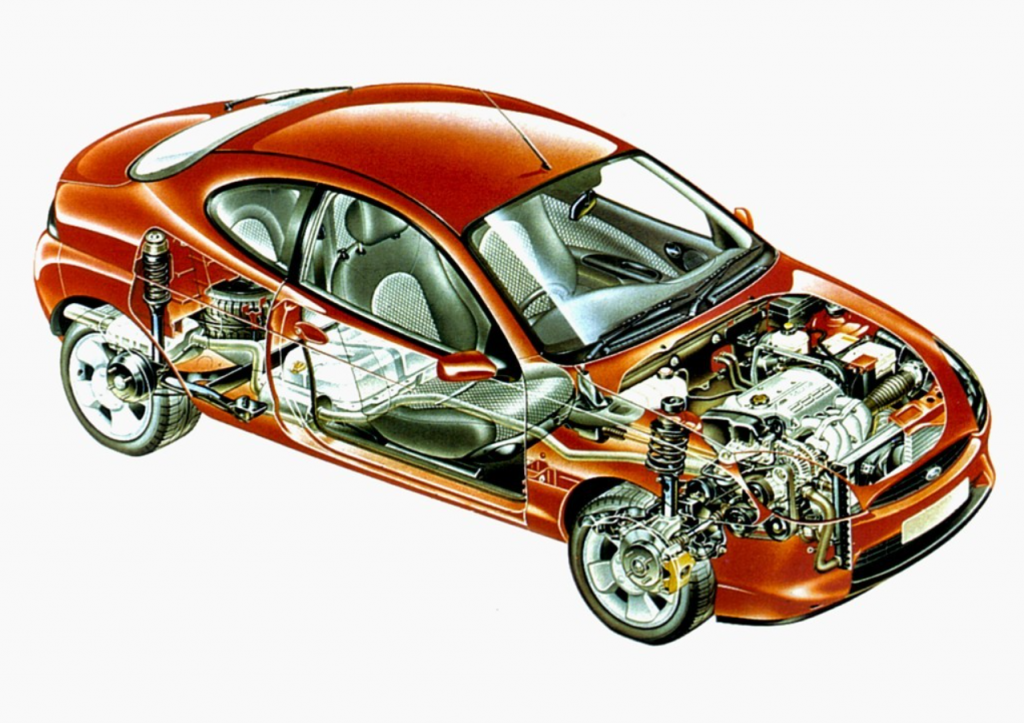
Based on the Mk. IV Fiesta hatchback, the Puma got sleeker lines, a few suspension upgrades, and a 1.7-liter version of the Fiesta’s Zetec-SE inline-four cylinder engine, making 123 horsepower. It was designed to attract a younger audience, according to Autoevolution, and thanks to a starting price the equivalent of about $18,000, it saw a good deal of success before its discontinuation in 2003.


What the Puma didn’t have was real sports car cred. Sure, it looked the part, but it was basically a Fiesta underneath. Ford decided to rectify this problem in 1999, two years into the Puma’s production, by showing off a concept called the ST160, with a bunch of visual and mechanical upgrades. That led to a production car called the Ford Racing Puma, one of the weirdest, least successful sports cars from the Blue Oval.
From Sporty To Sportier
From the get-go, Ford marketed the Puma as a car designed for thrills. If the speedy looks weren’t enough to convince buyers, the company also put together this weird advertisement that featured a CGI’d Steve McQueen driving a Puma around the streets of San Francisco (a market where the Puma was never sold), a callback to McQueen’s 1968 movie Bullitt. At the end of the ad, he even parks it next to a Mustang to really drive the point home that these two cars are definitely on the same level:
True gearheads knew this wasn’t the case, obviously, and so did Ford. So for the 1999 Geneva Motor Show, it put together the Puma ST160 concept. On the outside, it was everything the Puma was, plus more, with a widebody kit that increased track width without ruining the car’s excellent lines. That track width was filled out with a set of gorgeous 17-inch Speedline multi-spoke alloy wheels.

The changes weren’t just visual. The ST160 used the standard Puma’s 1.7-liter Zetec SE engine, upfitted with new camshafts, a new intake manifold, and a new exhaust system with a new, high-flow catalytic converter. Combined, the upgrades unlocked an additional 37 horsepower, for a new total of 160 horses.

The five-speed manual from the standard Puma was carried over, but it was equipped with a limited-slip differential to help put the extra power down to the front wheels. It also got a handful of suspension changes, upgraded brakes, and blue Sparco bucket seats to accompany the new looks.
Public reaction to the ST160 was positive enough that Ford greenlit a production version, simply called the Racing Puma.
A Puma That Delivers On Its Looks
The Racing Puma was essentially the ST160 concept come to life, looking nearly identical and sporting many of the same upgrades. Like the concept, it got a widebody kit with aluminum fenders up front and steel pieces on the rear that altered the car’s overall stance, along with those multi-spoke wheels and an overhauled suspension. They shrouded high-end brakes from Alcon.

All Racing Pumas were finished in the same color: Ford Racing Blue. And all of them got Alcantara-coated Sparco seats with Ford Racing logos embossed into the backrest. There was also blue Alcantara on the steering wheel and the door trim. The five-speed manual returned, but the limited-slip differential was relegated to the option list, rather than being made standard.

The Racing Puma’s drivetrain was a point of drama when it was new. According to Octane Magazine, the car was supposed to get a turbocharged version of that Zetec four-cylinder making over 180 horsepower, but “spiraling development costs” forced Ford to stick with the naturally aspirated version first developed for the ST160. That means buyers had to settle for a 1.7-liter engine with a new air intake, more aggressive cams, and a new exhaust, with a rated power output of 153 horsepower. That’s 30 more than the standard Puma, but a far cry from what was originally promised.

The Racing Puma also wasn’t built by Ford. The cars were shipped from the Puma’s normal production facility in Cologne to the United Kingdom to be fitted with all of the upgrades by Tickford, the same UK engineering and production firm that helped build the Ford Sierra RS500 and the legendary RS200.
The press launch for the Racing Puma leaned into that original San Francisco advert, and took place in the same city, and even had a track component (Ford doesn’t say in the above video which track it went to, but if I had to guess by the scenery, it was probably at Thunderhill).
The Public Wasn’t Exactly Enthused
These days, if Ford were to make a high-strung compact coupe that looked as cool as the Racing Puma, it’d sell out instantly. But exactly the opposite happened in 2000, when the car went on sale. The combination of the missing turbocharger and the exorbitant price was, according to Top Gear, the reason for its downfall.
Ford planned to make 1,000, cut that to 500, then still had to sell some of those internally to make sure every Racing Puma found a home. The reason? A £23,000 asking price. That would seem extortionate for a 153bhp hot hatch now, never mind in 1999. Especially when a 30bhp-lighter Puma 1.7 sold for ten grand less.
Half of those original 1,000 Racing Pumas planned for production were earmarked for Ford of Germany, which canceled its entire order before production kicked off, according to Octane. The remaining 500 were all right-hand drive models sold in the United Kingdom. As Octane points out, the Racing Puma was a tough sell when you could buy a turbocharged, all-wheel drive Subaru Impreza with more horsepower for less money.

Fast-forward to 2026, though, and the Racing Puma has finally begun to attain collectible status thanks to its rarity and true enthusiast-minded upgrades. With just 500 units built, it’s actually one of the rarest Fords out there, with Racing variants demanding several times the price of normal Pumas in similar condition.
The Puma’s Fatal Flaw, Amplified
The normal Puma, as cool as it is, isn’t perfect. The little front-drive coupe is well-known for its rust issues, which can be found in places like the metal around the rear wheels, the side sills, and the floor pan. If you find it before it spreads, it’s easy to nip it in the bud. The problem with the Racing Puma is that its upgrades make rust much harder to spot.
You see, instead of cutting out the original fenders and quarter panels and replacing them with the new widebody units, Tickford kinda just glued the new panels on top of the old panels, which were left in place. This meant the original panels in the rear would begin to rust out, and because they were totally covered, owners wouldn’t see what was going on until the rust got really bad.
One owner, who documented the full restoration of their Racing Puma on Facebook, published photos of the rear fender area showing just how bad the rust had gotten underneath that grafted-on panel (you can even see remnants of the original glue that Tickford used):
Yikes. That’s not great, but it’s not even the worst section of rust documented on this car. That goes to the side sills, which look to have fully crumbled to bits in some places:
That’s pretty catastrophic, to the point where even I, a person who routinely buys rusty cars, would probably avoid it, even if it were priced low enough to be a good deal. You’d think that with this sort of rust being pretty common, pristine examples would be obscenely expensive. And you’d be right … but only in the context of used Puma prices.
Mint Examples Aren’t Insane Money In The Grand Scheme Of Things

Let me give you some context. Ford sold well over 100,000 Pumas during the car’s original six-year production run, so they’re pretty common. That means even clean, low-mileage examples like this 2001, silver-painted car with just 29,000 miles on the clock can be had for just £5,999 (around $8,200 at current exchange rates).

Compared to regular Pumas, then, Racing Pumas in similar condition are pretty pricey. The one shown here, listed for sale on UK car sale site Pistonheads, has just 58,000 miles on the clock and was just treated to a respray in the original Ford Racing Blue. It looks absolutely immaculate, and it’s up for sale for £24,950 (around $34,000). The only other example listed on Pistonheads has even fewer miles, but the seller is asking just £19,950 (around $27,000) because rust issues are starting to show themselves at the rear quarters and side sills.

So, Ford Racing Pumas (abbreviated to FRPs by the owner community) are vastly more expensive than regular Pumas, which makes sense given their upgrades and rarity. But compared to other fast Fords of the ’90s and 2000s, they represent a bit of a bargain. Escort RS Cosworths sell for double the prices of these Pumas, while the later, weirdo five-cylinder Focus RS hatchbacks are all more expensive by at least a few thousand pounds.
One day, collectors will come around to the Racing Puma. Despite its flaws, it’s simply too cool to ignore. Time has allowed the car to ascend above the baggage of comparison it was plagued with when new, allowing enthusiasts to appreciate it for what it is: The coolest version of Ford’s coolest compact coupe. Just make sure to check for rust before pulling the trigger.
Top graphic image: Ford


Drawing at the well. Rusting in the dealership? In Europe they had far better sports cars that rusted out earlier why is this POS given a great car that sucks?
I’m getting “Honey… I shrank the TT” vibes. Pity about the rust.
Or buy a last generation Mercury Cougar which looks just about the same, is a little bigger and has IMO better proportions. It comes with a stick and a sweet V6 and can be upgraded with all the SVT Contour bits. and they are dirt cheap.
I had a 99 Cougar V6 and it was a fantastic car. Really sporty and drove great. I regret getting rid of it.
That is a great point – the Cougar is a much bigger car than the Puma, and was priced substantially higher when new. They’re both great value now and if you can find an unmolested Cougar today (stop sniggering in the back) it’s probably an insane bargain.
Built in Flat Rock by people who used to crush rocks. I’ve seen both cars side by side, the edge design of the Cougar hasn’t held up well…but the build quality I’m sure overshadows that problem.
I put 100,000 trouble free miles on mine without so much as a TPS warning. But we all know that fords of that era were ALL so great. The Build quality of the contour wasn’t that great either but it was well loved. As far as the styling I don’t agree it is either more of less favorable when compared to the Puma. I believe that both cars look better then most of what is coming out today especially when you compare it to the new Prelude which I think looks terrible. I like the sharp edges of the Cougar and the Puma and I think the bigger profile of the Cougar looks less cartooney then the Puma. At least the stock car. the Puma Racer looks better with the flared wheel wells. But then you are paying 30,000 for an underpowered right hand drive car (at least in the US that is a bummer for me anyhow) while for less then 10 grand I can get the best Cougar left and still have a few grand for the performance upgrades from the SVT countor bin.
I remember a meeting with the Flat Rock Plant manager who was begging us to come up with something they could do to save the Cougar Production. They were willing to try new body colours, interior fabrics, anything. I honestly felt sad coming out of that meeting because I knew peoples lives would be effected. Not the highlight of my career.
That’s sad. It was a good car and I think was marketed wrong. It was really a 3rd Generation Ford Probe and if they would have gone a more sporty route it would been a better Ford sports Coupe/GT then a miss-branded scaled down/ FWD cougar. As I mentioned before the DuraTec V6 was a fantastic engine and the Chassis was very well dialed in as it came from the Mondeo in europe. Mine handled like a dream. They could have come out with a GT version with a more peppy engine. Lost opportunity for Ford at a time when they could have used some more traffic at their showrooms.
That’s a pity. I adored the final-gen Cougar (admittedly before driving one). They were doing a lot of things right (the Zn versions especially seemed exciting), but having it under the Mercury banner didn’t do them many favors. The sales folk used to selling elderly folk their last Grand Marquis didn’t really know how to handle enthusiastic young drivers who were cross-shopping the Cougar with the RSX/Integra, Eclipse, Celica, etc.
I always appreciated the looks of that generation Cougar, but the market for 2-door cars was cratering across the entire industry.
This is like suggesting someone who wanted an original Honda Insight nowadays might as well buy an Accord Coupe instead. A 30 inch difference in overall length is not “a little bigger.”
Ok so I have to give it to you. I did the math and 28 inches is a much bigger difference than I thought. But since we aren’t cross shopping a hybrid vs a ICE car then I don’t think that’s a fair comparison. More like cross shopping a Fit VS a Accord coupe. Still, I would rather have the space and the power at a lower cost.
I remember the Puma being well reviewed as drivers when new with prices for the ST160 being the big gripe with that one. I think the Puma was the most successful use of Ford’s design language of the time and I test drove a Cougar because it was the closest thing to a Puma in the States.
I could have sworn there was a competitor to this car called the Vauxhall Adidas
And don’t forget the VW Converse
No one keeps a grudge like German companies run by disgruntled brothers – like Puma/Adidas (Adolf and Rudolf Dassler) and Trader Joe’s/Aldi (Karl and Theo Albrecht).
Don’t forget the cousins that ran Porsche.
I had a Puma, two in fact. They smelled like feet.
I’ll bet Tickford didn’t try slapping on fenders with som glue when they were building Rolls Royces and Aston Martins.
They used Grey Poupon.
I remember this car existing, primarily because I recall clones of the FRP wheels popping up for the Ford Focus, and 20-something years ago I really wanted a set for my 2001 Focus.
Too bad to hear about the rust, because I do think the FRP has aged pretty well and looks fun.
The new wings were made in the same factory (I think the same presses) that produced the Boulton Paul Defiant fighter and (at the same time as the Puma wings) produced flight control systems for aircraft.
Hey, my Ford is rusting from the inside out too!
Ford should bring this back as a sub-Mustang offering, maybe even rwd as a true GR86/Miata fighter.
Yes, I’m still salty about the Solstice/Sky only getting one generation, why do you ask?
Such a neat little car, had the privilege of caring for one stateside a few years – while the rust was beyond my ability to fix (and why I no longer have it), was a neat little thing, a shame Ford used the worst possible metal imaginable to find with no real rustproofing.
I thought you were legally obligated to mention Richard Parry-Jones in anything regarding a late 90’s/early 2000’s UK Ford, but that might only be for British writers.
Is he in the Epstein files?
What a great looking, sporty, small car that I knew nothing about until now, so thanks Brian. 🙂 And yes, 25ish years ago, $23K feels like an awful lot. But those lines, and in that color, what a nice little car. I also dig the Ford Ka(s) …IMO, that period of Ford design was really effective at giving attainable/mass-market economy cars some visual flair.
Sorry we never got any of these in the states. I test drove and liked the Kona edition of the early Focus hatch, which is about as close to the Puma we got (though I suspect it was a fair bit heavier). It came in this quite nice metallic/not too saturated brown. 🙂
don’t forge the bike tire tread side molding
I clearly remember that and it seemed very practical. 🙂
Hmm, this or a StreetKa/SportKa?
All of the above.
Grif: I think it looks more like a puma.
Sarge: What in Sam Hell is a puma?
Simmons: Uh, you mean like the shoe company?
Grif: No, like a puma. It’s a big cat, like a lion.
Sarge: You’re making that up.
Grif: I’m telling you, it’s a real animal!
I think it looks like a warthog.
QUIT MAKING UP ANIMALS!
And also, “That’s not a target. That’s Church!”
“Hey, Simmons: What’s the name of that Mexican lizard? Eats all the goats?”
“Uh, that would be the Chupacabra, sir.”
“Hey Grif! Chupa-thingy! How ’bout that?!”
Also Caboose’s “Don’t ever go backwards” is a good life motto.
I drove this Puma version (and the standard one) a lot on race tracks in Sweden (Mantorp Park & Anderstorp) when they were new. Few, if any, cars from these years are as entertaining and exact in the reactions. It had better lap times than a Porsche 968.
I think it looks great, but I somehow don’t remember this one. If it had fewer issues, I don’t see why it couldn’t have done well against the Miata in the market for a super small, fun, affordable car.
A Puma? Won’t someone tell Ford to stop making up animals?
Oh, crap. I didn’t spot this when I came in to make the same joke. Kudos, person of fine taste.
We’re all cut from the same cloth. Except Tex, she’s a wildcard. I heard she beat someone to death with their own skull.
That doesn’t seem physically possible.
That’s exactly what Jimmy kept screaming!
Damnit Brian. This post made me think it was already Ford Friday. It’s not even Pontiac Pthursday. Instead it’s only Toyota Tuesday.
Just damn.
.
..
…
….
8====
====0
IIRC the engine was heavily worked over by Yamaha in a similar way to the Taurus SHO motor. They share a basic floorpan with the Mk4 Fiesta and the original Ka, and while they all drive well, they rust more ferociously than any car I have ever seen.
Rear wheel arches are especially problematic, and until fairly recently replacement panels weren’t available. The next best option was to use sections from a Peugeot 206 front wing to replace them.
It was indeed a Yamaha joint.
I just gotta say I’ve always thought this car was pretty great looking, and it’s aged very well.
Agreed, this a great design.
However, for the Racing version, I can’t believe they didn’t include a basket handle rear wing! I’d graft one on from an Eclipse without a second thought.
Honestly, a lot of Ford’s styling from the era has held up pretty well – Cougar, Ka, Mk1 Focus
The ovoid shape of the rear window is quite reminiscent of the rear window from the third gen Taurus. It didn’t look good on either car. Glad that Ford got away from that.
Or our stateside version (kinda) of it, the ZX2.
It looks like someone stepped on a Ford Ka.
I was thinking ” this looks like the Ka”
same designer, Chris Svenson. RIP
The first time I ever saw one in the wild I had just moved to Italy after selling my Ka 1.6. It was impossible to convince my ex that they were basically the same car underneath. I have an irrational love to both of these cars.
They’re like baby last-gen Cougars. So cute!
Puma and Cougar more or less refer to the same animal, and both cars were contemporaries in Europe, sold at the same time.
…also, is there any animal with more generally accepted names than the Cougar/Mountain Lion/Puma?
They can be called ‘catamount’ as well, and strictly speaking the panther is the same animal.
Not to be confused with catamites
I was aware Ford was heavy into feline nameplates but I didn’t realize how much.
Bobcat / Lynx were used for Mercury nameplates and they are about the same animal.
And the last Diesel they used on Light Duty trucks (still being used overseas) is called Lyon. I guess they only missed Tiger to not be associated with the Tigershark engine made by Stellantis.
there was also a Cougar El Gato concept car
“Puma and Cougar more or less refer to the same animal”
But not the same shoes!!!
https://cougarshoes.com/
https://us.puma.com/us/en
Except better proportions. Would have been perfect for WRC
You say that…there was an F2 kitcar / super 2000 version of this that slotted below the AWD Gr. A cars.
The regular Puma seems like the kind of quirky car that would be a good import candidate under the 25 yr rule, yet anyone hardly ever mentions
after I wrote this I went straight to a bunch of european used car sites to see how much they cost (they are very cheap)
They aren’t wildly expensive, but they’re very expensive indeed considering the build quality. Fords of that era in the UK were nice enough for their target market when new, but, as the rust problems mentioned in the article hint at, really weren’t built to last.
Unlike better candidates for a modern classic purchase, where you put the money and effort in once to do the deferred maintenance, bring things up to scratch, and then get a fixed car that only needs basic maintenance and care to stay good, with a Ford you’ll go to all that trouble and expense in order to get a car that still needs regular, expensive repairs. While there might be some aftermarket upgrades to fix some things, you can never do anything about stuff like suspension geometry that eats wheel bearings.
I routinely go to Pistonheads and Autotrader UK, hit the sliders to sub 6k GBP, manual transmission and older than 2002 and see what titillates the senses.
You might also find Vauxhall/Opel Tigras. Same segment sporty coupe, but IMHO it looks a bit more polarizing than the Puma
That is putting it politely – the Mk1 Tigra looked OK from behind but from every other angle? Woof