


Cars are, in case you hadn’t noticed, complicated. So many moving bits and wires and flaps and things that make sparks and things that are not supposed to make sparks and valves that spray fluids and hoses and clamps and you get where I’m going here. There are an awful lot of moving parts involved in the process of taking dead dinosaur juice and converting that, chemically and mechanically, into a spinning shaft that will then, in turn, spin some wheels.
Even dirt-simple cars like my Citroën 2CV are at least a little complicated! Cars may be the most complex mechanical machines we interact with and use on a daily basis, so it’s worth thinking about how people learn how these things work. For most of us, it’s just been exploration and trial-and-error tinkering, but there are people who are trained in these dark arts, and I recently happened to see something about a teaching tool for such people, and I was fascinated.


Essentially, it’s just a simple single-cylinder four-stroke engine. But it has a transparent cylinder. And that makes it fascinating. Have you seen these before? Check out the Megatech Mark III Transparent Combustion Engine:
Pretty amazing, right? What’s even more remarkable and took me a second to realize is that this engine is unlubricated; in order for that cylinder to remain clear and easy to see through, it can’t be covered with a film of oil. And the fuels need to be low-carbon fuels that won’t leave soot on that glass, too, rendering it opaque and filthy.

So how the hell do they do that? How do they make an engine that doesn’t have to be lubricated? Well, we can get some clues from their 1977 patent abstract:
An operative internal combustion engine is transparent for demonstration of internal combustion engine principles. A transparent cylinder houses a noncontacting piston, a combustion chamber being sealed by means such as protruding annular teflon rings seated in an annular groove of the piston or a flexible flap formed integrally with the piston which is pressed firmly to the internal surface of the cylinder wall by pressure developed within the combustion chamber during operation of the engine. Other portions of the engine are transparent to enable their contained parts to be observed during operation. The engine also has an enlarged flywheel to permit operation of the engine at low, observable speeds. The invention burns low carbon fuels such as alcohol to keep the cylinder walls clean and operate without polluting the air.
Oh wow, a non-contacting piston? It’s sealed by teflon rings? That’s bonkers. But I suppose if you want to see the flame pattern of the power stroke, what else are you going to do?
These things are hypnotic to watch in action:
Sometimes you see these connected to dynamometers, which I suppose makes sense as a training tool; students can make various tweaks and changes to the tuning and setup of the engine and then see what the results are. A perfect way to empirically demonstrate the basic principles of a four-stroke engine!
Seeing this in slow motion is pretty incredible too, and was not remotely as accessible to students in the 1960s and 1970s, of course, who didn’t have the advantage of carrying around a supercomputer with an incredibly high-quality camera integrated into it in their pockets that they could also view pornography on.
Based on the graph at the end of the video, this engine is making what… 4 hp and just over 12 ft-lbs? Newton-meters? Something of torque. It’s hard to read that graph.
I’ve seen at least one for sale on an auction site, and on another site I saw one (with a dynamometer) went for $1450, so these things aren’t cheap, at least not for what would mostly be a curiosity. Could you power a go-kart with one of these? Because that would be spectacular.

The Megatech company still makes automotive service industry training tools like the Automotive Diagnostic Performance Center Model: MEG007 I have pictured above, and it looks like it was made from a very cut-down Honda Civic. Do they make these from wrecked cars? I bet so.
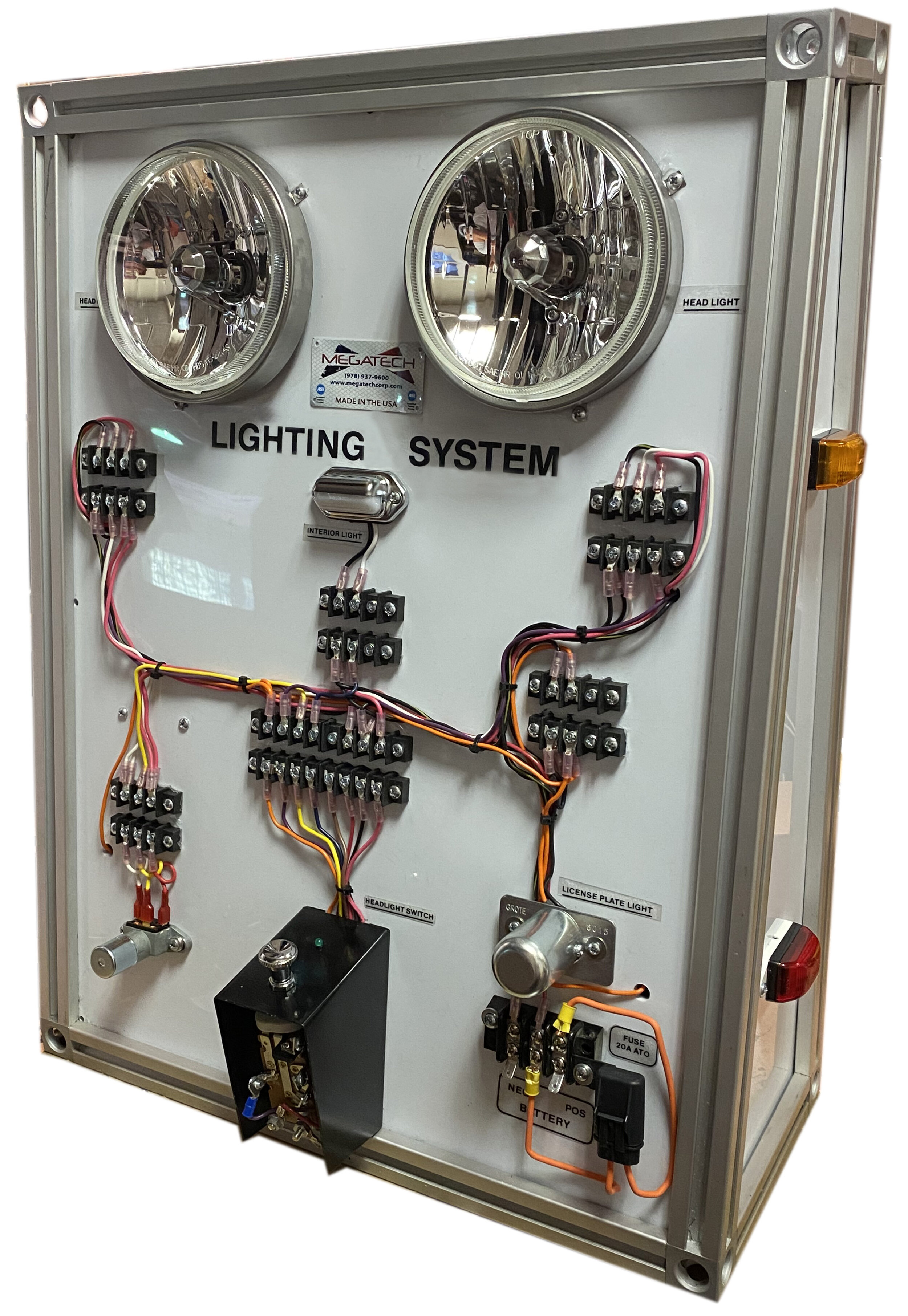
They make all kinds of amazing subsystem training tools, too, like this one for lighting:
…and these beautiful driveline cutaway training models:

…and brake system trainers:

I get that these are serious education tools, but the urge to just play with any of these things is powerful. I wonder how often old, outdated ones of these types of things come up for sale? Because I’d love to have one of these in the house to meet all of my demanding switch/button/lights/spinny things demands.
There’s lots of good rabbit holes to go down on the Megatech site, so please send my apologies to whoever needs you to be productive today. Even (or especially) if it’s yourself.
Top graphic images: Megatech Corp; USPTO


I remember many years ago when I was a kid reading a National Geographic and they had a little feature about Chrysler developing ceramic engines. Even had an image of a guy just holding the whole engine in his arms because it was so light. The promise was: Lower weight and higher temperature resistance meaning much higher fuel economy. Seemed really promising. I think the issue was the ceramic material was super expensive.
Closest I’ve ever gotten to seeing the inside of a running engine was when I tried using a Colortune glass topped spark plug to check the mixture wasn’t too lean or rich on an MG I had at the time.
I recently happened to see something about a teaching tool for such people, and I was fascinating.
JT – There is no doubt. You absolutely are a fascinating specimen.
Now let’s hear about how Ford made a whole transmission out of glass.
Jason, you are Always fascinating, dark arts or not.
lol. oops.
Reminds me of my old Renwal Visible V8 model kit that featured a transparent block and heads. Of course the Renwal was not a functioning engine, but had an electric motor that powered the model including flashing lights to simulate spark. Learned lot about engines from that thing and it only cost about $20. That was, admittedly, expensive for a model in 1964.
I got one of these when I was way too young to have the patience to assemble it correctly. I kind of want to take a crack at it now.
Same here, it was years before I got my hands on it thanks to Dad. He remembered what happened with My Mr. Machine.