

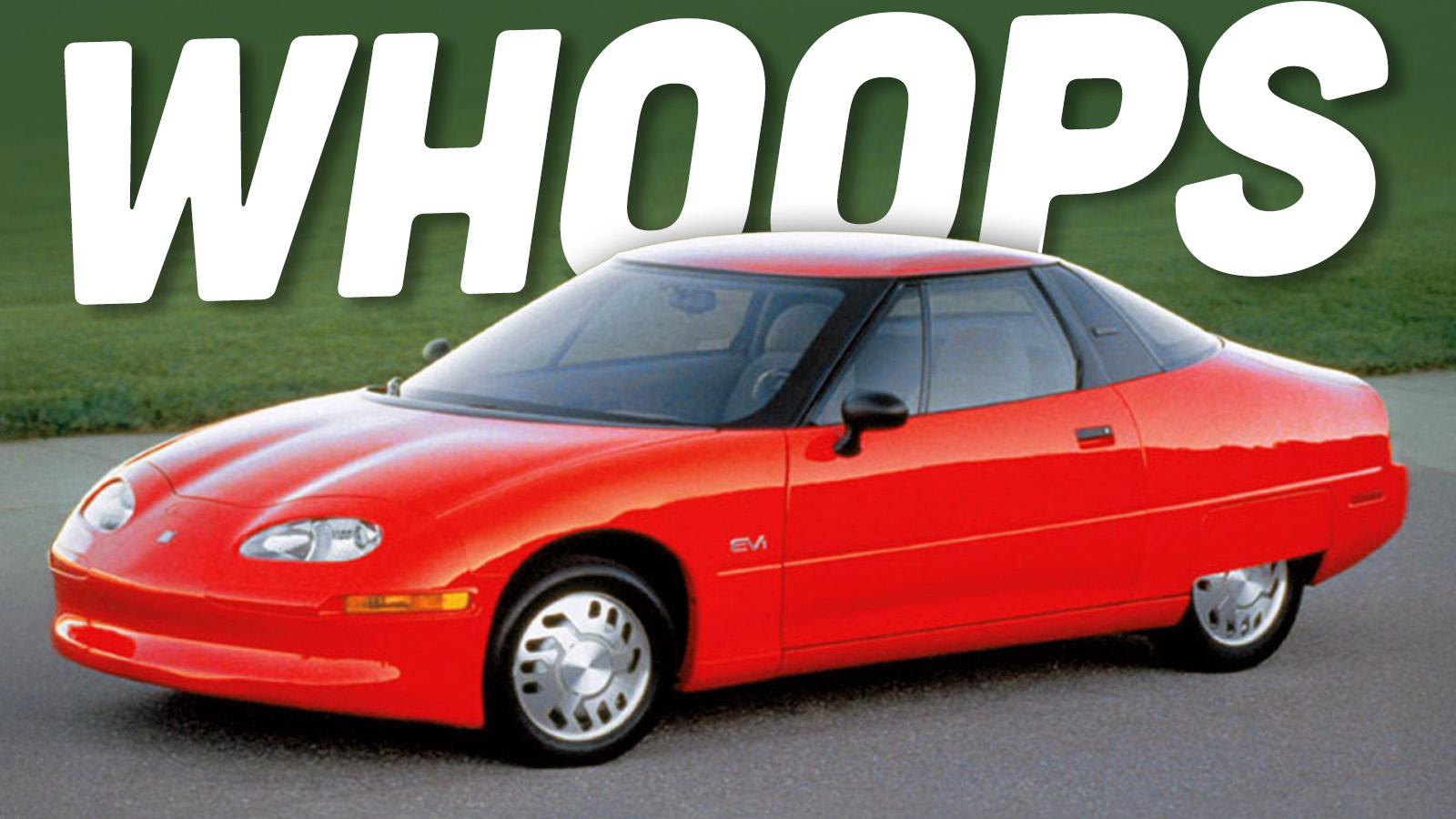
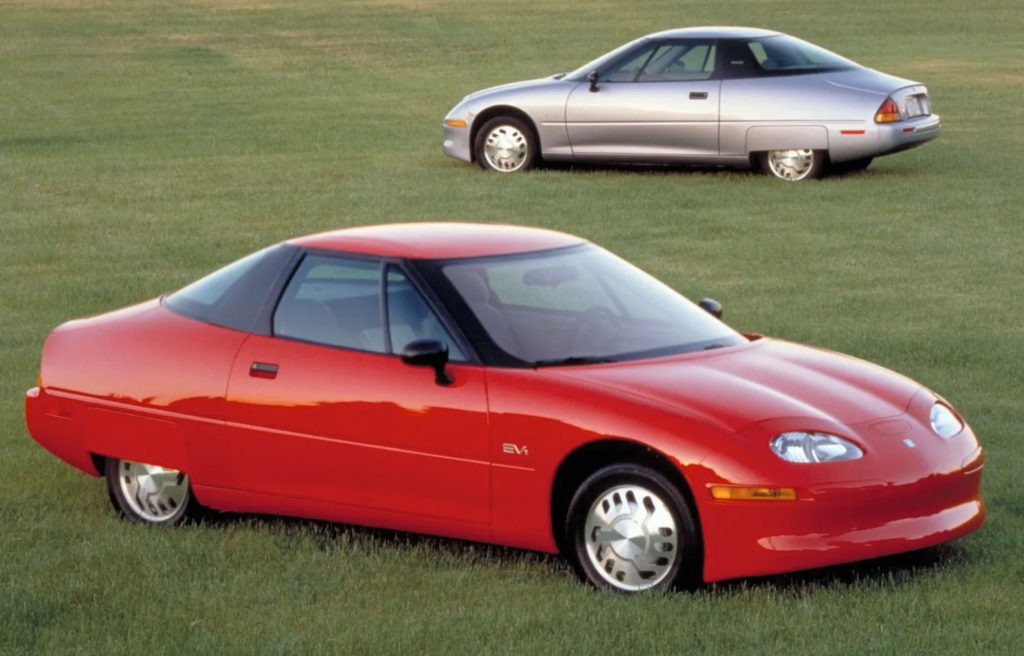
Ah, the EV1. General Motors’ electric moonshot of the late 1990s has become a legend, solidifying itself as the first modern EV for the masses, despite just a handful being leased to owners—several of whom were celebrities—before they were taken back by the company and mostly crushed.
The EV1’s tale is a fascinating one, with tons of data out there about how the car came to be, and all of the interesting ways engineers made it happen. I highly recommend reading David Tracy’s write-up on the EV1 factory service manuals he picked up last year, or our exclusive story on how there was nearly an EV1 convertible.


With just 137 horsepower from a single electric motor, 26 lead-acid batteries, and around 90 miles of range, the EV1 wasn’t exactly mind-blowing by modern EV standards. But it was vastly ahead of its time. This was a viable battery-powered car that hit the market over 10 years before the Tesla Roadster, after all. GM was way ahead of the game and in a position to set itself up for success in the decades to come.
Of course, everyone knows what happened next. Low demand and high costs forced GM to cancel the EV1 program, despite owners voicing their praise for the car. GM collected every example and crushed them, aside from around 40 cars, which were donated to museums and universities. It would be another decade until GM introduced another electric car to the market, the Spark EV, in 2013.
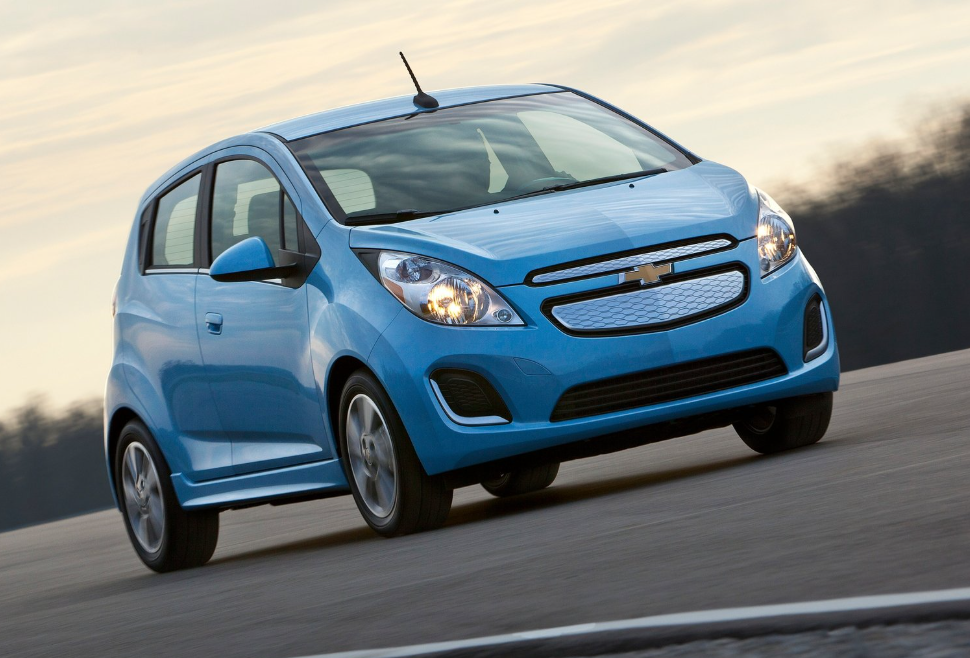
With the electric car market as big and important as it is now, President Mark Reuss, understandably, wishes GM weren’t so quick to lower the EV1 to its grave. When asked about what he’d change with hindsight in an interview with InsideEVs, he brings up the revolutionary EV almost immediately:
I wasn’t around for EV1; I wasn’t in the company. But I think that might have been one example of something that we, the company, should not have done, which was canceling that; that was really quite a car.
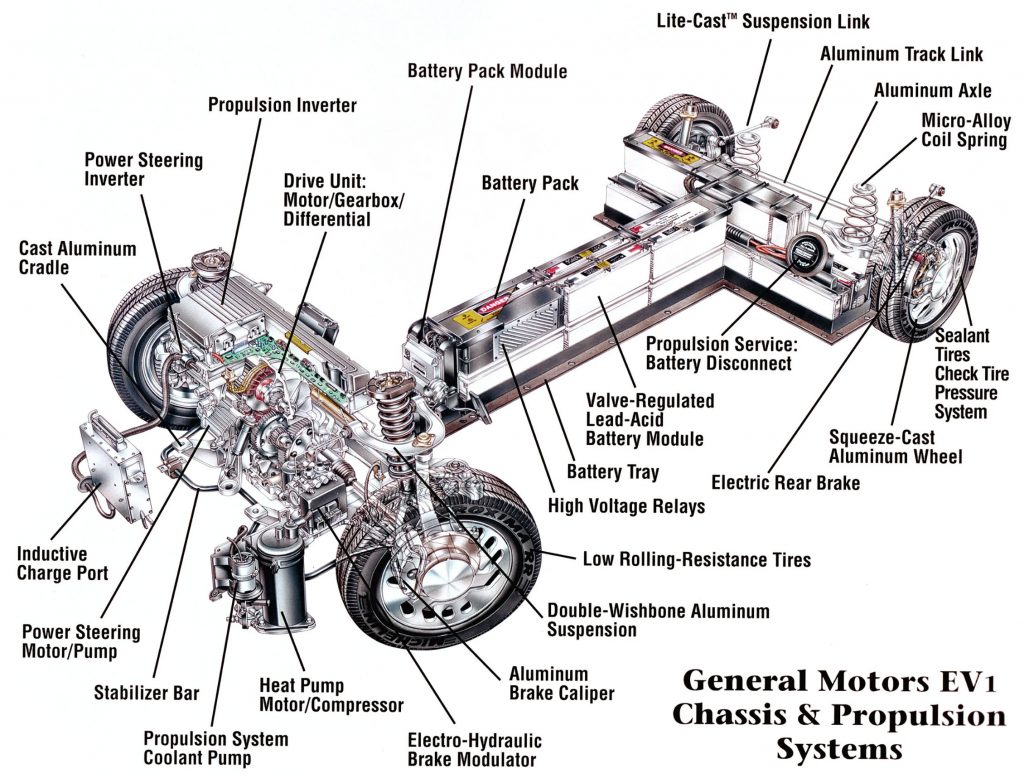
The EV1 was a game-changer for a lot of reasons. It introduced stuff like low-rolling-resistance tires, regenerative braking, HVAC heat pumps, and keyless ignition. Gen-two cars got nickel-metal hydride (NiMH) batteries, which doubled range, while third-generation cars got even longer-range lithium-polymer batteries. It also had a drag coefficient of just 0.19, beating out modern equivalents like the Lucid Air and the Mercedes-Benz EQS. While most other manufacturers hadn’t even figured out EVs, GM was already hundreds of steps ahead. Who knows just how far ahead the company would be now in the EV space had it stuck with developing the car further.
While Reuss believes the EV1 was a stopping point, others at the company believed it was a stepping stone. Gary Witzenburg, GM’s EV program Vehicle Test and Development manager during the EV1’s development, said as much in 2021 in a retelling of the car’s chaotic history, which he wrote for Hagerty:
The momentum the EV1 program generated led to fuel cell electric vehicle (FCEV) research; Allison hybrid buses; plus “two-mode” hybrid technology for trucks, SUVs, and two generations of extended-range electric (EREV) Chevrolet Volts. (Successful and satisfying as the Volts were, they were too costly to be profitable.) Now GM touts the battery-electric (BEV) Chevy Bolt and Bolt EUV, with many more electric vehicles to come.
Witzenburg believed it was limited battery tech that held GM back from building the EV1’s successor in the early 2000s, rather than cost or demand. Whether you agree with him or not, Reuss seems to have learned from the past, going by the rest of that InsideEVs interview:
I think the strategy that we set a few years ago to grow our company with electric vehicles and ICE vehicles, and being able to manufacture some of those in the same place, like Spring Hill, Tennessee, and have cell plants in the United States located in the places we do. You can talk about adoption rate, you can talk about where we are today. But all I know is the adoption rate isn’t as quick as what we thought it was going to be.
The tax credit goes away, what’s going to happen? We’re going to see what happens. But I can tell you that a high percentage of people with buying a electric vehicle, for instance, buy another one. Yeah. So that’s a really good flywheel to be on, and a good trend that’s long term. And while the rate may fluctuate year to year in terms of how many, it’s permanent and it’s real. And I don’t I don’t see ever not being a big part of the U.S. auto industry.
So, despite the notion that EV sales will soon dip in America due to tariff costs and a lack of federal tax credits, don’t expect GM to give up on the tech any time soon.
You can watch the full interview below:
Top photo: GM


Typical gm we messed up but that’s in the past. Didn’t touch on the Chevron mess they made and other things they failed with. But thinks a nothing battery tech will lead to midsize ev trucks. There are already midsize ev trucks. It’s like gm is always living in a bubble of their own bad decisions and nonsense tech after dropping the ball massively.
tell us how you really feel
I’ve seen one recently, so not all were crushed. The National Motor Museum (Birdwood, South Australia) has it. Apparently GM forgot that they sent an EV1 to GMH (Australian subsidiary). Which the museum then acquired.
He should be admitting that basically every decision they make is a mistake.
Mad hindsight here, especially for people who probably weren’t born yet or were kids.
The EV1 was around in a time where there were ZERO public chargers around. No apps to help you find one either. Took ages to charge. You get adventurous and take this thing past the range, which may not have even been 30 miles anywhere, you’re cooked. Something goes wrong with this car away from GM facilities? Who is going to fix it?
EVs remind of of the motorcycle crowd. It’s never their fault, they’re holier than thou and can do no wrong.
They didn’t regret cancelling the EV1 and taking back the cars. THEY HAD NO CHOICE.
Of all the old nameplates to revive, this one seems like an easy one to pick up and run with. Just don’t get cute, stick to EV2, EV3, etc.
Most importantly, choose aerodynamic efficiency over “cute” or “brand identity”. 0.150 kWh/mile or less EVs capable of seating 4 adults in basic comfort should have and could have been a thing 25-30 years ago.
Coincidentally, I just checked Copart for old weird stuff, and found a factory-built 1982 EV I’d never head of before: https://www.copart.com/lot/81824295/1982-datsun-b210-deluxe-az-phoenix-north
Turns out this guy Al Sawyer started a company called “Lectra” in Las Vegas to build EVs on Datsun chassis back in 1979, and this is one of his 210-based wagons. Probably run great on a LEAF pack.
The coloring on the former tach is glorious.
That ammeter is awesome! I’m gonna keep an eye on it, I’ve been thinking about an EV project for years.
Brave thing to say, but I bet the CEO (Mary Barra) would back up Reuss on that.
This is the right way to do EV’s. Aerodynamics is the most important thing. Today’s manufacturers are going about it all wrong with SUV’s and big wheels.
This is especially true for lightweight sports cars.
Mazda could make an electric Miata right now if it wanted to, that weighs similarly to or less than the ICE version. Make it a streamliner with a CdA similar to or less than that of the VW XL1, and now you don’t need any bigger than a 35 kWh battery to get 200+ miles range on the highway. With modern battery tech, the entire battery pack, including housing, BMS, and thermal management, is under 400 lbs. Throw in a Tesla Model 3 drive system, and match the design of the pack voltage and choose cells of sufficient power density to max out the capabilities of the selected inverter, and now you got a 300+ horsepower, sub-2,500 lb track terror ready to mess around with cars that cost 10x as much. And it might even be cheaper to build than the ICE Miata.
But for whatever reason, no one wants to do this. They’d rather sell overpriced trucks and SUVs and don’t want a value proposition that competes.
Not sure how you get that kind of CdA on a convertible, but you should be able to fit a sporty li’l hatchback into that standard low-drag limpet shape.
Set it up like the Miata RF where the operator can switch modes. Just be aware that the EV version when in convertible mode could lose almost half its range vs having the top up! The EPA range figures will fail to show this disparity because of their testing methodology.
To bad nobody wants to build one, because I would sure like to buy one.
For most non-enthusiasts who spend any time with an EV it’s very hard to go back. Especially now with infrastructure getting better by the day I just can’t see myself going back to an ICE car unless I’m forced.
I’ve hardly touched my gas motorcycles since I got my first Zero.
Crawford Auto Museum used to have one. Their policy is that anything in the collection must be driveable. But now I don’t see it on their website. I wonder…..
There’s an EV1 at the Petersen Museum in LA. I don’t remember if GM yanked the batteries out first (it may be a non-runner.)
You could see an EV1 in person at the Buick Gallery and Research Center next to the Sloan Museum in Flint, MI. Unfortunately, that building is now closed. Hopefully, it was moved to another museum.
There’s one at the Henry Ford Museum in Dearborn.
Whenever the EV1 is brought up, you also have to include the story of the NUMMI joint venture with Toyota
https://www.thisamericanlife.org/561/nummi-2015
Demming tried to teach the US industry first…
This!
Toyota taught GM everything, but they learned NOTHING.
Ford’s CEO also has Toyota on his resume, but f course he also learned nothing.
My father was excitedly waiting for the EV to become available for purchase. He was not alone. GM leadership was especially inept at that point in history. They spent all of that time developing them, and never sent them beyond leasing.
A lot of the Prius excitement could have been with GM. The Prius is where my father took his enthusiasm.
Granted, the Honda Insight showed how demand for 2-seat commuter cars hasn’t been great in the US, but it would have been a start.
They could have made the 1st gen Insight a lightweight sports car with RWD, that was almost as fuel efficient as the one we got and not much more expensive, and punched well above their weight when it came to value for the money.
The competition for two-seaters at the time were the likes of the Mazda Miata, Porsche Boxster, BMW Z3, Audi TT, Toyota MR2 Spyder, and similar. Had the Insight been slightly lower, more sporty looking, kept the low drag, was instead RWD or AWD instead of FWD, and maybe had a K20 engine swap, it could have bested any of those aforementioned competitors in a straight-line, while still getting 45+ mpg as a non-hybrid, and maybe the same mpg it is currently renown for if kept as a hybrid but with more horsepower, without costing much more to make.
Keep in mind that this was roughly around the time that Honda unveiled the 40+ mpg 400 horsepower Dualnote hybrid concept car.
As much as I hate to admit it, your suggested strategy matches what worked for Tesla.
I was on the waiting list for an EV1 and test drove it at the Marina dealership near LAX. I *think* it was the first EV I ever drove. I wasn’t in love with it or anything, but would have leased one if they hadn’t killed the car before I made it to the top of the list.
Errrrrrrrrm, Brian, the EV1 was never sold. The majority of the ~1100 examples built were leased — and the leases were rather expensive, IIRC — and GM declined to either renew leases or sell the cars to the few owners who wanted to keep them. A few were given (to China) or parceled out to museums (I think after being rendered inoperable). Jay Leno, who has one of everything, owns one.
The last version had “modern” battery tech (NiMH, I think), which apparently showed a tendency to catch fire. The rest had lead-acid batteries.
I drove one briefly. It was all right, but I turned down a press loaner because my then-house’s electrical system was a little too shaky to add a charger. Plus, range anxiety cropped up, as GM insisted on having it towed to my place on a flatbed, a distance of some 25-30 miles.
I thought it was Francis Ford Coppola who is the only known owner of a functional EV1, because he refused to return it. Jay Leno doesn’t have one.
You might be right, but I did/do think Jay has one.
If he doesn’t, he should.
He showed it on a show with Jay Leno, along with Coppola’s Tucker (he made the movie.)
Yeah, I think that’s the confusion. It was on a Jay Lenos Garage episode or YouTube.
I’m nothing if not fallible.
My recollection is that the leases were expensive but they were also being leased at a big loss vs the actual build cost of the vehicle. The reported sale prices would have had to be roughly $100,000 which is over $200,000 in today’s dollars to break even on them.
Gaah!!! Yeah, alright, the EV1 deserves it’s notoriety as an early modern EV that made it out to consumers, but it was far from all that was happening!
The Partnership for a New Generation of Vehicles https://share.google/toyvq77jaYFfazNvK
The Precept debuted at the 2000 NAIAS and was a 4 door 5 passenger, relatively normal proportions car that was quickly dropped, and received hardly any publicity. *sniff*
Gas was literally less than a dollar a gallon when these went away.
From a post 9/11, post Katrina, post GFC, $4+ gas and widespread Li-Ion world etc vantage, it’s easy to see in hindsight that early EV leadership in the 1990s-00s would have been invaluable, but hydrogen was basically seen the same way at the time and look how that has turned out. It wouldn’t have taken much for electrics to have followed a similar path.
Saw one of these in person at the peterson museum. Really cool car that should have been given more of a chance.
Correction, there was no Gen 3 lithium-polymer battery pack for any of these cars put to lease.
The NiMH version did have a “real-world” highway range of like 130-160 miles doing 65-80 mph on the highway, which was far more than the official EPA range. That range could be cut by more than 30% in the city. Some hyper-milers were able to exceed 200 miles on a charge when diligent and attentive. That’s really good for a 27 kWh pack, and if we want there to be cheap/good EVs, a lightweight, aerodynamically efficient platform that can get acceptable range with a small battery is the way to do it.
Thanks TC, you beat me to it. I was going to ask where the Gen 3 info came from, because I too only saw references to the 2nd gen Ni-MH models.
You forgot to mention the part where they sold the battery patents to Chevron
LOL it took them 20 years to admit they fucked up. Why did we bail them out again?
The decision to sell the patent to Chevron, which then allowed them to attempt to sue other manufacturers of large format NiMH batteries(eg. Panasonic, who made the EV-95 modules for the RAV4 EV) in order to get them off the market, was a decision that single-handedly held back mass adoption of EVs by at least a decade.
This battery was good enough for 200+ miles highway range in the right platform(eg. Solectria Sunrise), didn’t need a complex BMS when configured as a single series string(requires large AH batteries, so the decision for Chevron to limit size to 10 AH made packs at appropriate voltage for long range EVs impossible since economically priced BMSs for EVs didn’t exist for another decade), could be fast-charged from 0-80% in under 30 minutes, made enough power that a < 1,000 lb pack could power drivetrains that could compete with performance-oriented ICE cars of the time, were demonstrating 100,000+ mile lifespans(see Doug Korthof’s Toyota RAV4 EV), and according to former ECD Chairman Rob Stemple could have been mass produced for $150/kWh in volume for 20,000 cars per year.
We could do all of this way back in 1998. We could have had mass-produced, relatively inexpensive, long-range, simple EVs for the masses back then, yet we don’t really have them today, just tech-laden status symbols for the most part which are destined to become landfill fodder instead of repaired and daily’d in their old age.
In 1999, there was a gas station near me selling low test for $0.799 a gallon.
Even back then, EVs could have still been cheaper to run from a total ownership cost standpoint if designed for it.
That’s a good deal which would translate to $1.57 today. Last gas I bought was $2.42, although it continues to trend down due to seasonality. I wonder if ev demand is contributing to downward pressure on gasoline price and upward pressure on electric rates?
Upward pressure on electric rates, sure. But as demand for gas falls, companies are just letting refineries run out their maintenance schedules and shuttering them.
Thankfully the refinery where our fuel comes from (BP Whiting) just got a multi-billion dollar upgrade.
That’s good, but we’ll need much more infrastructure investment like this before ICEVs can be economical and practical for most people. /j
As with 2-door pickups, the market for 2-door passenger cars is all but dead. The EV1 had its plug pulled (see what I did there?) too soon, but that doesn’t mean it would be viable today.
If GM can pull a GM they will.
Simultaneously the most brilliant and maddening car company.
There was a recent BaT auction for a Caddy Fleetwood with both driver and passenger side airbags. In 1975.
Yep. The could arguably out-engineer just about anyone in a vast array of markets. Then the executives get involved.
They sold a few of those in the mid-70s. Airbags were also available on Caprices and some Olds models as well. The problem was that they were meant to be replacements for seat belts, not supplements to them, so they weren’t very safe in a crash. And the option was so expensive, most people didn’t option them, so they were dropped
“Witzenburg believed it was limited battery tech that held GM back from building the EV1’s successor in the early 2000s, rather than cost or demand.”
We were starting to put lithium polymer packs in remote-control planes and helicopters around that time, so high power LiPo use was possible.
I’d love to see it built again, slightly updated design, and called the EV2.
Sounds like a job for The Bishop.
Indeed. Somebody flash the Bishop Symbol!
Is that just like a pointy hat?
It could be. Or the shadow of a bishop from a chess board.
People might misunderstand that though….
This has to happen. And because it’s 2025, the EV2 would most likely be a subcompact crossover instead of a tiny coupe.
Unfortunately though, he’d have to stick with GM’s current hideous design language.
One thing I’ll give GM right now is colors. I keep seeing the Trax and other little SUVs in really nice blues and greens and whatnot.
Screw fad design language. Someone needs to make a no-frills, no-BS, repairable, long-lasting, easily serviced, long-range, lightweight, basic, mostly-analogue, ultra-aerodynamic EV with a low price tag.
GM has been capable of it for almost 3 decades, but the Chinese for maybe 1 decade. Now they want to keep the Chinese out now that the Chinese have proven that simple, long-range, inexpensive EVs are possible at half the cost of an ICE Toyota Corolla. I say let the Chinese in, and no bailouts. That will light a much-needed fire under GM’s ass.
GM’s Bolt is a joke from an efficiency standpoint, and that thing is going to need a big battery to go far. We need a cheaper car that can go far on a small battery. The Bolt uses about 2x as much energy per mile as a basic, cheap, comfortable EV capable of seating an entire family should.
In 1999, GM unveiled its Precept sedan as part of the $200 million+ PNGV government boondoggle, capable of getting 80 mpg on diesel. It had a 0.159 drag coefficient. THAT should be the basis of an economical EV capable of seating a family with a low MSRP. GM could have 2 decades ago an EV competing with the current base model manual-transmission ICE Nissan Versa sedan. They simply choose not to bother, and then they use the force of government to keep cheaper Chinese competition out, because they’d rather sell you an $80,000 truck. Meanwhile, there’s a lot of $1,000+/mo car payments working Americans have signed on the dotted line for over a 96 month period at 10% APR that they can’t afford and default will be inevitable.
Want to take a guess at what private equity is going to do with all of those underwater car loans?