

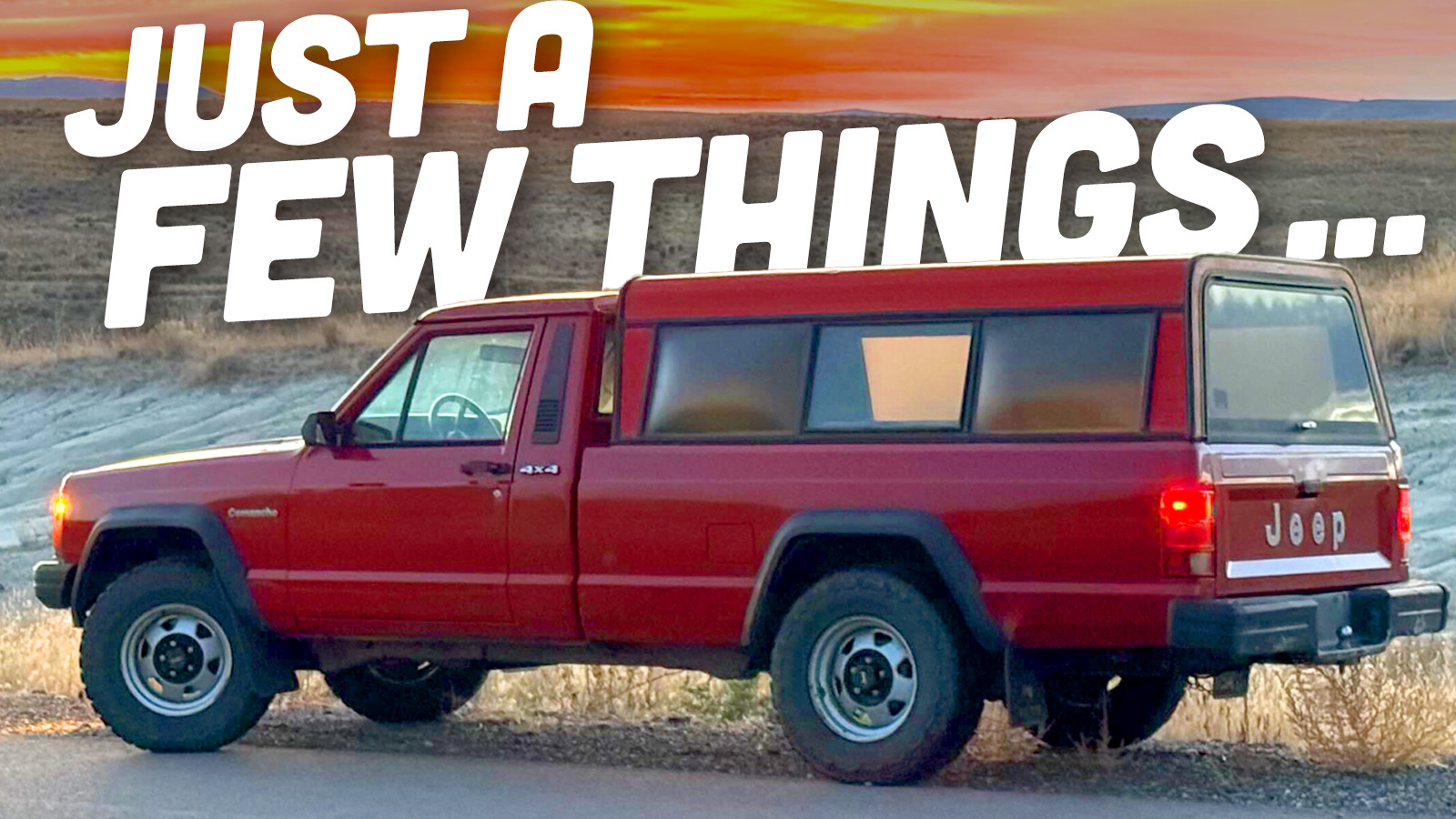
Yesterday I wrote about my flight from LA to Boise to get my first glance at a 1992 Jeep Comanche that I bought sight unseen. It was a magical moment; the vehicle — at least at midnight in the motel parking lot — looked even better than I expected. But now that the sun is out, I get to see this “MJ” Jeep for what it is. Here’s a look at all the (obvious) problems with the 200,000 mile Jeep Comanche that I’ll be spending the next few days driving 850 miles back to LA.
Right away, I’ll say that this Comanche – one of only 952 sold for the 1992 model-year, and probably one of only 200 or so 1992 4.0-liter 4×4 manual long-beds ever built — is in exactly the condition that the seller claimed, which is to say: great!


To be sure, it’s still a bit of a beat-up old truck, with scratches and dings everywhere to the point where I think this thing could be a tough sell to those who aren’t “in the know” when it comes to the Comanche’s greatness. But I don’t mind a well-used truck, so long as it’s solid, and this thing is rock solid.
The Body Is Rock-Solid


First off, this MJ’s underbody is literally flawless. It looks like it just left the factory. Just look at this!:


As much as I’ve made a name for myself as a rust-cowboy, those days are over. Once a vehicle has started to rust, stopping it is a huge chore; given that I live in SoCal these days, I know that buying a solid truck means I’ll pretty much never have to worry about rust again. This Comanche should last forever.


To be sure, there is a little bit of rust on the top-side of the body in the form of bubbling paint. I plan to just sand all that down and paint over it; after that, it will not be a problem ever again.

There’s also a hole in the tailpipe where the hanger is supposed to be, but tailpipes rust pretty much everywhere, and it’s easy enough to replace.
The Paint Is Rough But I Don’t Care

Speaking of paint, the most obvious aesthetic blemishes are found on the horizontal surfaces that share the largest radiative “view factor” with the sun. The hood’s paint is super faded and the clear-coat basically doesn’t exist:

The roof, too, looks rough:

The sides of the truck look OK, but there is some missing clear coat on the right side, and scratches and chips abound.


The tailgate and really the entire bed are covered in paint gouges, as should be the case with any well-used pickup.

Overall, the paint is good enough for an old work truck. I may replace the hood at some point, and I’ll touch up the big scratches/rust spots, but then I’m just going to run it.
The Body Is ‘Straight’
Whereas a Michigander would refer to a rust-free body as a “clean body,” a largely dent-free body is known as a “straight body.” And this Comanche has one! There are some small dings here and there, but actually — for a 30 year-old truck — the thing looks really good. The biggest imperfection in any panel is near the right taillight, though it’s subtle:

The back of the cab has some dents at the back of the B-pillars right near that cab/bed gap; they’re a bit hard to see:

Especially considering how huge this Jeep’s rather flat panels are, it’s pretty amazing how few dings I see.
There Are Lots Of Leaks, And The Fluid Levels Are Low

One thing that I do not mess around with is fluids. The ramifications of neglecting fluids in a vehicle are so enormous relative to the modest price of new fluid that it’s silly to not religiously ensure you’ve got clean dino-juice in your transmission, transfer case, axles, and engine. So that was the first thing I checked before beginning my long journey back home, and what I found was leaks. Lots of them.
Jeep people often joke: “If it’s not leaking, there’s no fluid in it.” And that’s somewhat true given how prevalent leaks are in 4.0-liter powered, AMC-designed Jeeps. But I had to make sure this Jeep wouldn’t blow its gearboxes in the middle of nowhere, Nevada, so I undid all the drain plugs and found: pretty much everything was low.


I squeezed some GL5 into the front and rear diffs, some insanely-expensive Redline GL4 into the transmission, and some cheap ATF into the transfer case; after checking the oil, I felt a lot more comfortable pointing my Comanche south towards SoCal.
The Engine Runs Great, But There’s Oil In The Air Filter And It Only Starts With Throttle
View this post on Instagram
In addition to checking the oil levels, I usually check my air filters. Admittedly, I should change the fuel filter as well, but I’m too lazy and I don’t want to deal with gasoline smell all over my arms.
As you can see in the clip above, my air filter was covered in oil. This could mean one of two things: 1. The engine’s piston rings aren’t sealing, and the pistons are basically pressurizing the crank case and shooting oil out of the vent tube into the air filter or 2. The rear crankcase vent tube is clogged.
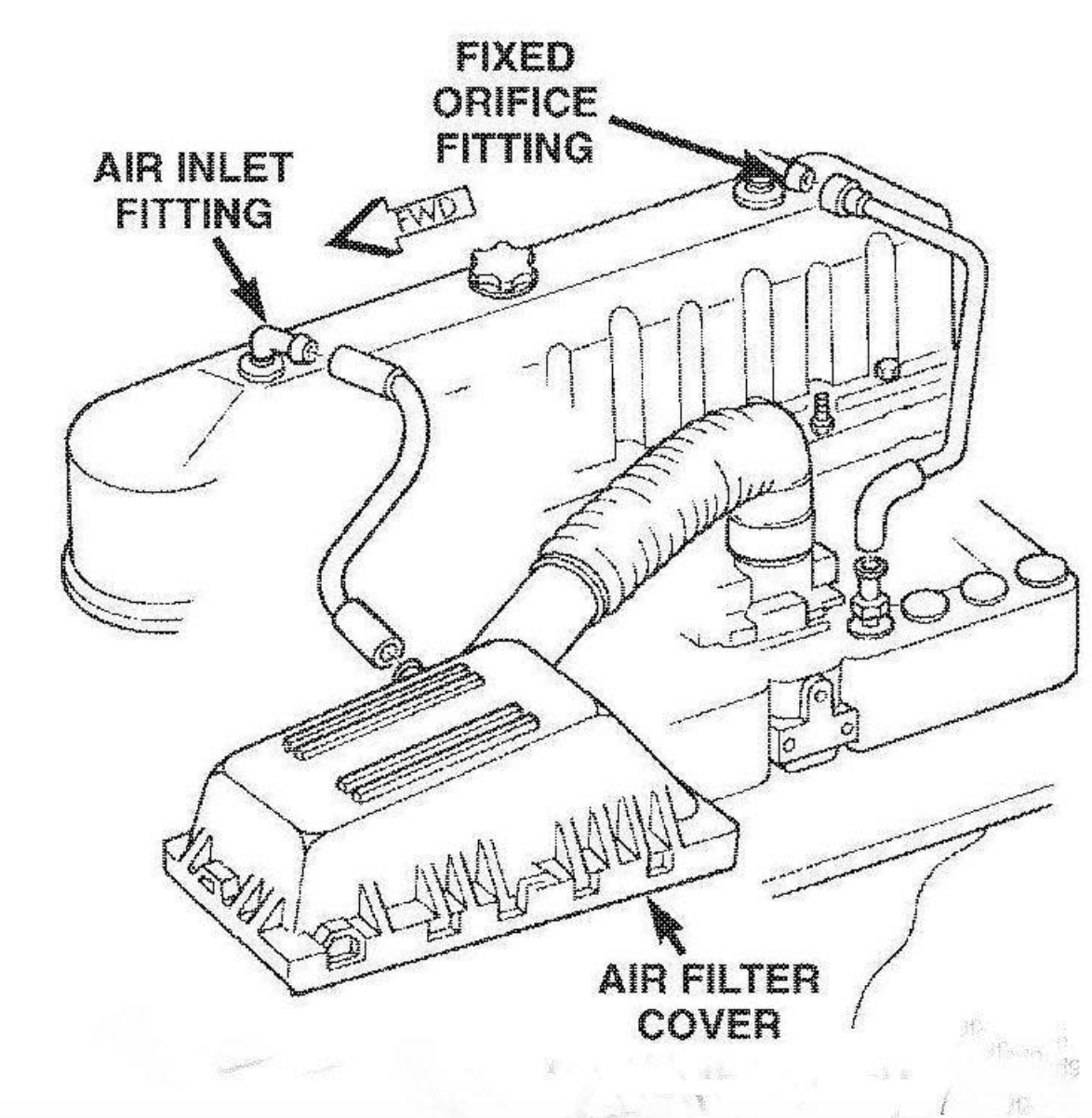
Combustion gases that get past the rings creates crankcase pressure, which has to go somewhere, because the last thing you want is to blow out all your gaskets (oil pan, valve cover, rear main seal, etc. — I’ve had this happen). In the case of a 4.0-liter engine, clean air flows into the crankcase from the air intake (just above the air filter), into the valve cover, and then it’s sucked into the air intake via a tube at the back of the valve cover.
If the tube at the back of the valve cover is clogged, the air pressure in the crankcase forces vapors into the intake, resulting in that black oily-goo in my oil filter. I’ve cleaned out the rear tube and fitting-orifice atop the valve cover, and I’ve replaced my air filter, so hopefully those paper pleats remain clean from here on. I’ll have to check my oil level and the status of that filter after a few miles of driving to see if I have problematic piston ring wear or not; I seriously hope I don’t. Because this motor is otherwise running great.
OK, mostly great. It won’t start in the morning unless I put the pedal all the way down. Then it runs rough for a bit, and then it’s all good. I’m not concerned about it for now, but it will — over time — bother me. Maybe it’s an issue with my idle air control valve; we’ll see.
The Driver’s Door Doesn’t Shut Right

Driving the Comanche, I was reminded of how a former Chrysler coworker once called the XJ Cherokee on which it’s based the “NVH Wonder Of The World.” This thing is a bit of a rattletrap and its sharp corners cleave through the air like a garden shed.
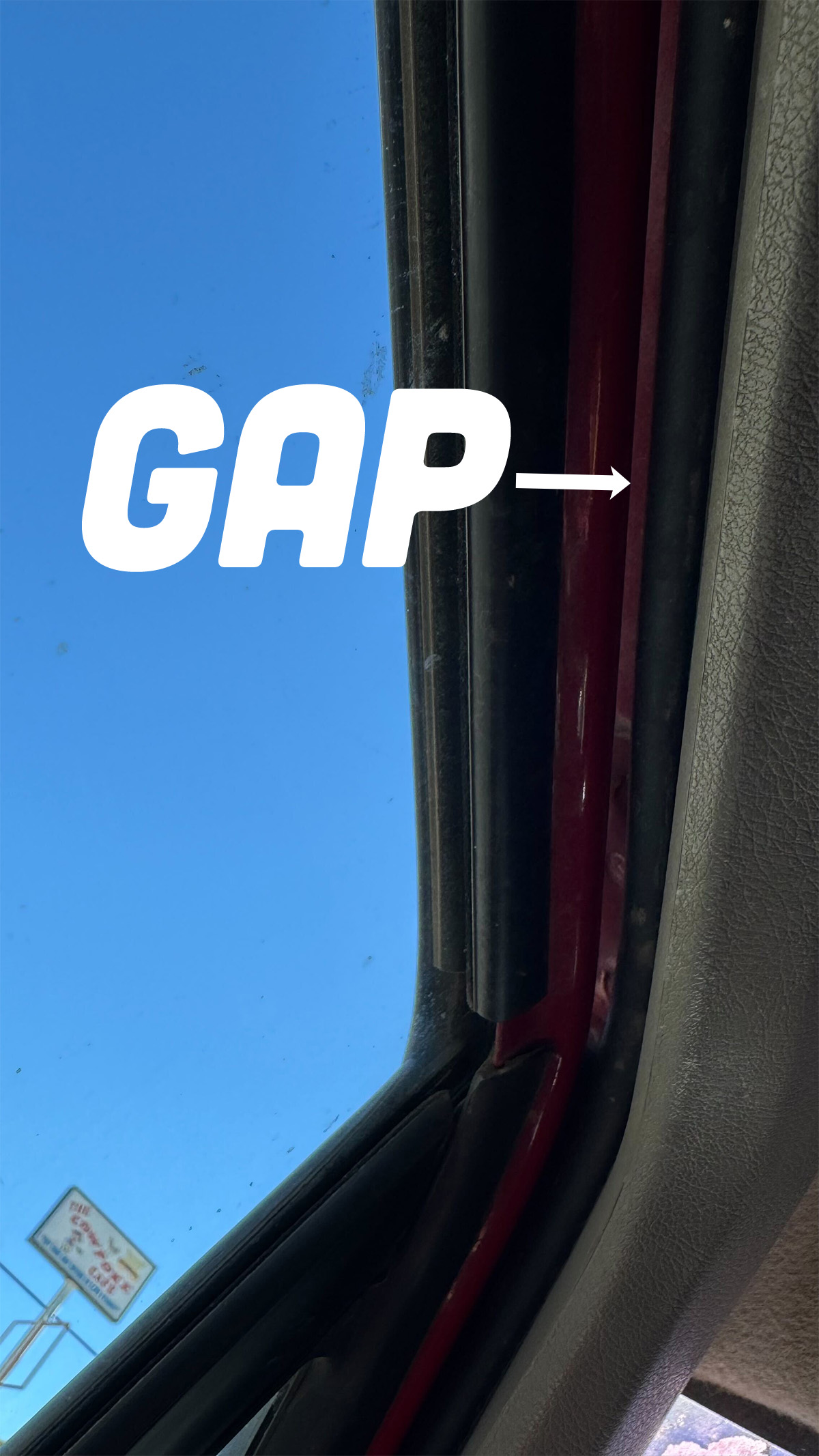
Still, this Comanche sounds especially loud, and I later found out the reason is that the driver’s door doesn’t quite shut all the way. In fact, you can see daylight through the huge door gap at the top. I have to figure out how to get this door to fit better; I’m worried the welds on the hinges may be the culprit.
The Interior Needs A bit Of Work

The Comanche’s cab is tiny and simple, featuring a bench seat, a dash, two door panels, a carpet, a basic three-spoke steering wheel and not a whole lot else. Pretty much all of it needs work. Here’s the steering wheel:

Here’s the dash:

Here’s the seat (well, part of it)

And the door panels…well, they’re fine. They’re vinyl, after all, so they are easy enough to keep clean:
Overall, This Thing Is Fantastic
The truck is rough around the edges. The cabin is fairly well worn, the bed is fairly well worn, the outside has scratches and dings and paint problems. And while that might make a modern economy car look janky, it doesn’t detract from an old Jeep pickup truck one bit.
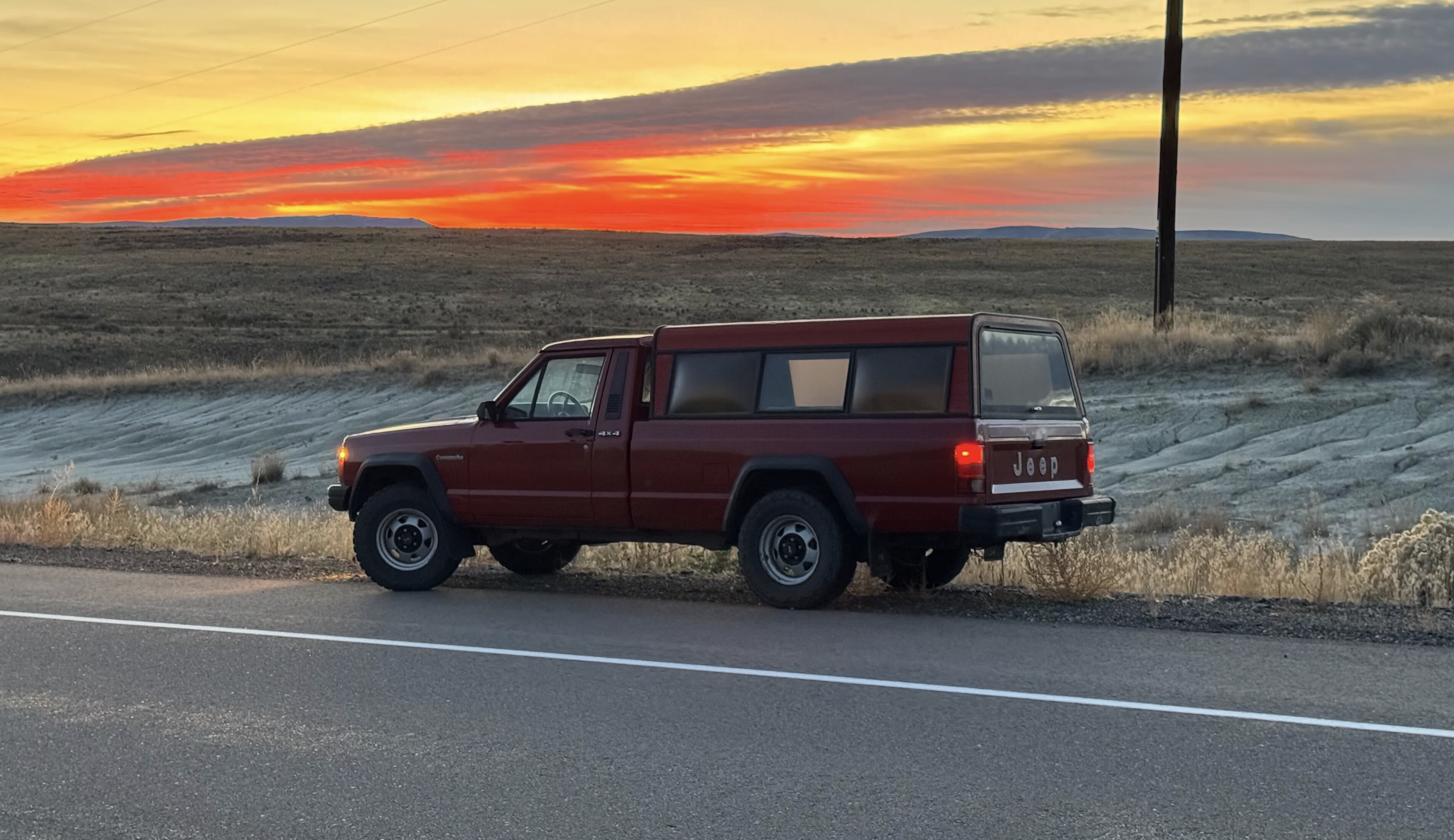
Plus, from about 20 feet, the thing looks mint. It’ll look even better when I ditch that camper (I know this is controversial, but I want my trucks to look like trucks, not SUVs; plus, the cap makes the bed harder to use).


That rust looks a little too deep to just sand over and paint. I would media-blast those areas, grind them a bit, treat the metal with some type of corrosion-inhibiting primer, sand/grind that, light fill, block sand the filler, spray some think coats of primer-surfacer over the fill, block sand that until smooth, re-spray and re-block sand as necessary. Prep for paint, spray epoxy-sealer-primer over the primer-surfacer, then finally and nicely blend (really, it would make more sense to re-spray the entire vehicle) some new paint over the previous rust spot. Then, maybe, you won’t have to worry about it again.
Rust never sleeps and there’s a reason body shops around here pretty-much refuse to touch the stuff anymore.
Otherwise, sweet truck – congrats!
I probably would have left the cap in Idaho.
Pappy caps are a weird thing. They look terrible, but once you have a truck with one, you’ll wonder how you ever went without.
I imagine in Cali the advantages are fewer, but anywhere it rains and snows, they increase the usefulness of a truck exponentially. Especially on a regular cab pickup.
They also allow you to store lightly-valuable things in your (lockable) truck bed when you park on the street, which in my SoCal neighborhood is critical as very few houses have functional garages or off-street parking.
the door gap might just be worn hinges, rather than anything sinister like failing welds.
weld failure is common on these, especially on the 2 door XJ because of how long/heavy the door is. I can’t remember if the Comanche uses the 2 or 4 door front doors.
Would adding a third hinge be worth it?
Usually just welding them back up is ok, but there are reinforcement kits on the market.
I owned a 1991 2 door XJ; can confirm. It suffered from Saggy Door Syndrome.
Looks like my ’86 Comanche after the wind caught the driver’s door and took it out of my hand, bent the hinges.
Or given a thin mounting base a bent steel platform
None of that seems too horrible. Fix all the leaks, maybe get a junkyard hood in the right color and some of those color matched spray cans for the roof and it would be a respectable looking truck. Be sure to sell the other two trucks as soon as you get home.
Years ago my XJ had trouble starting/idling without extra gas pedal, and after screwing around with the idle air controller and such, it turned out that a new battery fixed it…
Can confirm a weak battery caused start/idle problems on my 99 XJ.
I’m going to assume that rear ccv is clogged, because it seems to be on most every 4.0 out there.
Great photo of the sunset David. Good luck with the truck.
Nice.
Actually the pistons going up and down do not pressurize the crank case, well at least if you have an even number of cylinders, since every time one is coming down another is going up.
They do if combustion pressure is leaking past the piston rings into the crank case.
That isn’t caused by the pistons going up and down per se, it is caused by the rings leaking.
Glad to hear it’s in relatively good shape! I hope you actually follow through with getting rid of the J10 and 1500.
Did Chrysler offer any version of this (or the Dakota) with amber rear turn signals? One of the best things about the XJ Cherokee was that it had amber rear turn signals, which I first noticed when my parents traded in their 1987 Wagoneer (XJ) Limited for a 1991 Cherokee Limited. Same bodies, but different lights front and rear. That started (or continued) a lifelong awareness of headlight and taillight patterns and identification.
Maybe swap the hood from your first XJ with this? That way you get to keep a piece of it with you, and – aside from color difference – improve the appearance of the front half of the truck a bit.
You’ve got me pining for my old Comanche. Well, not mine exactly; it was largely oxidized when I got it. A well preserved veteran like yours would be welcome. Bon voyage!
I had a great time meeting you yesterday! I’ll be praying for safe travels for you 🙂
Nice truck. That is not much wrong with what (to me) is about the perfect radwood-era truck. Enjoy!
I just found locally a short bed bricknose F150 for sale… evil thoughts.
Do itttttttt
I may, I’m not really financially constrained and an “old” pickup would make me happy
Dooooooo ittttttttttt
Too many times i have not… A nice, not pristene short bed Ford could be a boon. I also know these, and have an old Ford OBDE IV scanner from my dad. I know a 302/351 V8 and the old I6 isn even better.
Do it, do it, do it, do it, do it, do it, do it, do it, do it, do it, do it, do it, do it, do it, do it, do it, do it, do it, do it, do it, do it, do it, do it, do it, do it, do it, do it, do it, do it, do it, do it, do it, do it, do it, do it, do it, do it, do it, do it, do it, do it…
He probably isn’t man enough.
That will get to him.lol
Yup you must now do it, if DT can buy another you can buy one. Assuming you don’t overpay, like DT did, and you decide you really don’t need it in your life you can sell it for what you paid in 6 months or 6 years.
D O I T
O
I
T
Ditching the cap will make the truck appear younger.
Agree.
Looks like a “Ford” cap with that front slope.
So I’m a car guy, not a truck guy – this isn’t to cause trouble, rather I’m just interested.
What’s the controversy with camper tops, exactly? I get the idea/it makes sense, but at the same time, there’s never an OEM version of them.
I’m not sure if they qualify as camper tops, per se, but various generations of the 4Runner and Bronco have offered removable rear cargo area covers that are as tall as the roof. I grant that they’re not trucks, but they sort of shared that purpose (though also covered the rear passengers, much like a modern Bronco or Wrangler). The gmc envoy xuv also comes to mind, I guess.
I suspect there’s some governmental regulation and/or liability restriction that prevents them being factory options.
While the laws may have changed at least Ford used to offer them as a standard option, they were two tone painted to match the truck they came with and showed up at the dealer with them already installed. See above for the brochure page.
I’m second-guessing myself on the legality part. Ford offers color-matched bed caps for the Maverick (by LEER in some colors, and TAG in the others) for $4500 (!) so unless it’s something specific to separate beds like on a conventional pickup, I’m not sure what the restriction might be. I think I’ve also seen pop-up covers listed on some Build & Price setups for other models.
That’s an insane price. I think I paid a little over a grand for the ARE cap on my Ram 1500.
I know people think they look dorky, but I think it looks fine, and I frequently use the truck to carry inventory for my side business that I like keeping dry and out of sight, and having more room to stack than I would with a tonneau cover.
I don’t get why people think they look dorky, well at least modern ones.
There definitely are pros and cons to having one. That is why I’ve got one pickup with and one without. Mine is a “4dr” with a steel panel on the driver’s side that reveals a tool storage area, a opening window on the passenger side and dual swinging doors in the back. Definitely the most useful one I’ve had over the years.
I think those were dealer created options
No, it was listed in the brochure and from what I understand at least in the 70’s it came to the dealer with it already painted to match and mounted.
Yes lots of dealers will have a deal with a local seller to provide a choice of canopies.
Okay I trust your knowledge as not into pickups back then
Back in the day you could order your Ford with a “factory” canopy, though it was manufactured by a 3rd party, Leer I believe. It did have a unique “compass” badge on it. My former neighbor had one on his Dent side.
Edit found the brochure with it listed as a factory option, my neighbors looked the same except for blue and white to match the truck. https://oldcarbrochures.com/static/NA/FMC%20Trucks-Vans/1975_Trucks%20_and_Vans/1975%20Ford%20Pickups%20Brochure/image8.html
My guess is, in this case, with this time-capsule of a vehicle, the controversy is the sacrilege of getting rid of such a glorious period-correct accessory. Like tossing aside Abe Lincoln’s hat but keeping his suit.
The bed cap is mis-matched to the cab style though — it probably came off a Ford Ranger as someone else mentioned. It’s mostly a 50/50 split on whether it’s a convenience or not.
Personally, I don’t like how much they obstruct visibility through the rear window, how they limit loading height, and how you can’t load or unload over the sides of the bed. But, they’re great for some folks’ use cases and that’s OK!
And his axe! Abraham Lincoln Vampire Killer a great cinematic masterpiece
Because truck manufacturers don’t make them and aftermarket manufacturers want a one size fits all. You ever wonder why there is one size sock for guys from size 8 to size 22?
Sorry size 8 to 12.
I’ve only had one truck with a cap, and that was a legality thing. In New York and truck with a cap and side windows can be registered as a car and drive on parkways. It’s the same deal with cargo vans, so small side windows are called “parkway windows”. The flip side is you can only park in a loading zone in NYC if you have commercial plates, and a business name on the doors.
After we left NY our trucks have had open beds for visibility and ease of loading tall objects, and stuff you handle with a shovel. My current truck has an extended cab so there is some enclosed storage
Fascinating insight – thank you!
I remember this! Was commuting down to the city for school on the Taconic State Parkway. Bought an 87 Ranger with a cap and DMV automatically gave me commercial plates so I couldn’t drive it on the parkways. I had to show them a pic of the truck with cap and a bench seat in the bed (borrowed from a friend, not mounted) to prove it was a passenger vehicle to get passenger plates. Didn’t know about the commercial loading rules…
And those regs are exactly why Willys created and sold “Parkway Conversions” made from the windowless Delivery model from 1946-1964.
Some people hate them – partly because they think they’re ugly, and partly because there’s not always an OEM version so the toppers often don’t fit very well (making them uglier at best, and making them seal poorly at worst).
Some people love them because when they seal properly, you have a huge lockable weathertight trunk. It’s massively functional. You can throw a huge amount of stuff back there, not bother to strap it down, and just … close the topper.
It’s kinda like station wagons. They’re massively functional and some people like the idea as a result. But others see them as an eyesore from a bygone era.
This is an exciting find and I can totally see why it’s more appealing than the Chevy. Congrats on picking up what I can only assume will be a rare DT fleet “lifer.”
“I’ll be spending the next few days driving 850 miles back to LA.”
You going to do some site seeing too?
Really good find David!
Has David confirmed this will pass CA smog requirements? I ask because Idaho does not require smog checks as of July 2023.
I haven’t confirmed anything, but it’s a 4.0 with what looks like a relatively new catalytic converter, so I’m not concerned.
When are you ever concerned? I love how you approach these projects with a non chalance of Matt Magonahey in Sahara playing Dirk Pitt
If the cat doesn’t havea CARB EO # stamp on it you will soon be concerned.
I got my first Comanche in Los Angeles from a guy that couldn’t get it to pass CA smog. It was an 88 running Renix. He had put a new cat on it and a very nice Banks exhaust header. He sold it cheap just to get some cash out of it to put into his other Jeeps as he had an off road modifying shop in Glendale. I was more than happy to drive it home to PA where it passes out emissions testing with zero issues.
At 200k, I’d be shocked if the engine did not have enough blowby to soak the air filter. Buy a new, sacrificial air filter for the drive home, and until you figure out the source of the oil, order a cheap eBay oil catch can.
No kidding, this truck looks remarkably good. You’re a more than good enough wrench to fix any of the problems you find.
Are you peanut butter? Because i’m definitely Jelly. Not a pickup line, i just like the pickup truck…
If you’re a truck person, and you can only have one truck, you really ought to have the truck that you like. Congratulations!
That really is a solid body – which I guess is the key thing. Doe everything else swap with the XJ?
Everything from the doors forward, more or less. I believe the seat mounts are a bit different because of the bench, but thats about it.
That’s the beauty of the MJ, it’s a rare vehicle with the parts support of a very popular vehicle.
There are some unique portions of the MJ but it’s a short list. The rear brake circuit is different as they have a load level proportioning valve. Obviously the bed area is all unique. Comanches have a different rear track and entirely different rear suspension, the most popular axle swap if you have a D35 is a Ford Explorer or Jeep Liberty rear end.
The doors are front doors from a 4 door XJ. Most everything from the door forward is common to the XJ except the floor pans, seat brackets, headliner and parking brake. All MJs have a foot pedal parking brake, XJs all had a center console pull handle.
Sigh, now I’m enabling an addict. Found a Comanche at a local Pgh salvage yard. I may now be stripping it down for David. At a glance looks to have some of the unobtainium bits. We already spoke by e-mail.
Good on you!
This is the Autopian community in a nutshell.
This is awesome!