

The continued lowering of interest rates over the last couple of years was a bit of a salve to a car market stretched by supply shortages, trimflation, tariffs, and other pressures. While buying a car hasn’t gotten dramatically cheaper, it’s still been feasible. How will rate increases hit affordability?
If yesterday’s Morning Dump was an attempt to see the light at the end of the tunnel, today’s TMD is a little more focused on the tunnel itself. A rate hike is basically the last thing anyone wants, even if it’s the sensible thing to do given market conditions. And, wow, market conditions are bad. There’s a new editorial out that enumerates all of the problems.


It could get worse, right? The car industry in Germany is what it looks like if it gets worse. And who is waiting in the wings? China, of course.
The Ripple Effect Of Rate Hikes Is Real
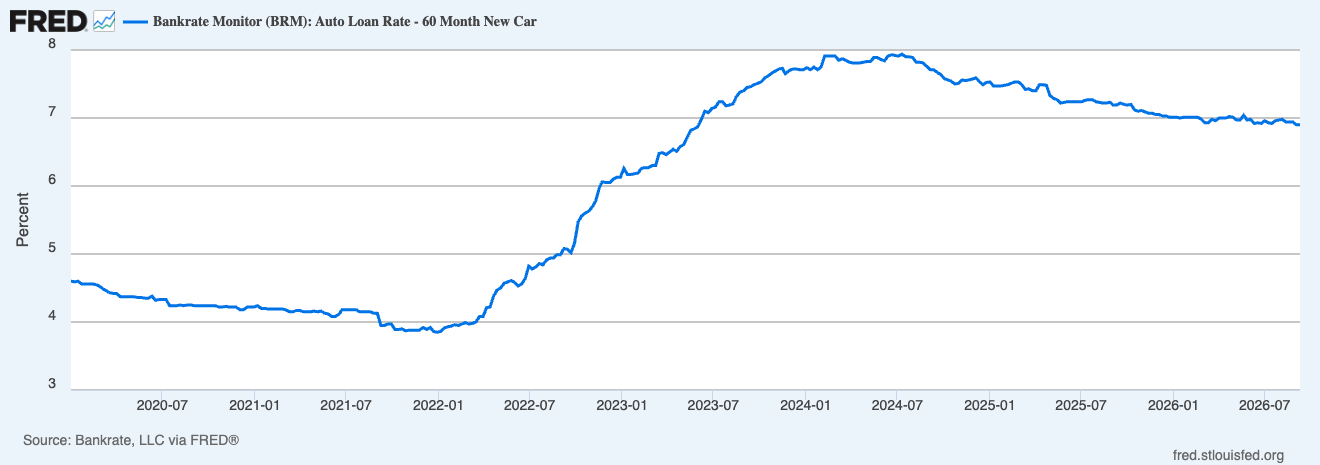
Above is a graph, via my dear friend FRED, of the Bankrate Monitor Auto Loan Rate for a 60-month new car loan (specifically, a $33k loan for someone with a 700 FICO score and a 10% down payment). You can see the impact of pandemic era interest rate policy, as well as the large climb as the fed attempted to fight inflation.
Also at play are the last couple of years of small rate cuts from the Federal Reserve as it had to contend with an economy where nothing feels like it’s getting cheaper, and with an AI development boom that has overheated markets. The Federal Reserve’s Federal Open Market Committee (FOMC) unanimously approved a 0.25 percentage point increase to the federal funds rate (the amount charged by banks to loan excess reserves to other banks).
Here’s what the FOMC said:
Economic activity is expanding at a solid pace. While uncertainty remains elevated owing, in part, to geopolitical developments, domestic spending has been resilient. Productivity growth is strong, and capital investment is robust. Job gains have kept pace with the workforce, and the unemployment rate has changed little.
Inflation remains elevated. Today’s policy action will support a timelier return to the Committee’s 2 percent goal. The Committee will deliver price stability.
The FOMC wants to keep the economy growing and unemployment low, but it also wants to do so while holding the line on inflation. While this rate doesn’t directly tell a lender what it can charge for an automotive loan, it eventually does impact how much it costs to lend/borrow money. If the fund rate is super low, lenders can generally afford to lower the rates for borrowers.
Obviously, carmakers can lower the price of loan whenever they want via captive financing arms, and will sometimes offer 0% financing if it’s determined that the cost/risk of the loan is offset by the value of selling the car. The chart above is just an average, as your own individual rate will depend a lot on your credit score, your down payment, and general market conditions.
This hike could hit the car market twice. The most obvious impact is on buyers, who could see borrowing costs start to creep up again. What car buyers often forget is that dealers are also borrowing money for the cars in their showroom (this is called a floorplan loan). That’s both good and bad. If dealers have to pay more to keep a car on the floor, they’ll try to capture that extra cost in a sales price. At the same time, a dealership may be more motivated to move a car before it has to pay more to keep it in inventory. If rates go up and remain elevated for long enough, this can lower the number of cars dealers want to order, which then causes prices to go up.
Dealers and automakers want to shield buyers from this as much as possible, and they have some tools, as our pal Jessica Caldwell tells Automotive News:
The Fed’s rate increase will not ease auto affordability challenges, but seasonal rate promotions toward the end of the year could balance out the impact, Caldwell said. It’s difficult to know, however, whether or how much consumer or political pressures factor into the Fed’s rate decisions.
“Affordability is at the top and center for most American families,” she said. “Having an interest rate hike isn’t good optics.”
Even if automakers can offer lower financing, and are willing to absorb the risk/cost, the fear is that consumers will hear the words “interest rate hike” and immediately shy away from dealers even if some are offering good rates.
Here’s A List Of All The Challenges Facing The Car Market
The Automotive News Editorial Board has decided to weigh in on whether or not Widow’s Bay is a comedy or a drama and, as good people, have agreed that it’s obviously a comedy. Oh wait, never mind, they are responding to the interest rate hike by reminding everyone of how tough it is out there.
In addition to the rate hike, other problems include:
- A monthslong war in the Middle East limits access to global crude oil supplies.
- A yearslong war in Europe disrupts global diesel refining capacities and drives up fuel costs for goods deliveries worldwide.
- The U.S. administration has abandoned decades of free trade philosophy, imposing protectionist tariffs on allies and adversaries alike.
- Unprecedented private-sector borrowing to fund artificial intelligence data center build-outs drives up capital costs for all debtors — including the federal government, which hasn’t balanced its own budget in 25 years.
Does the Board suggest a solution? It doesn’t. The enumeration of problems is enough. It could be worse though; we could all be living in Germany.
The German Car Industry Must Hang Together Or Surely They Will Hang Separately

Almost exactly two years ago, I used a TMD to ask “How screwed is the European car industry?” and the answer seems to be: still pretty screwed. And that was before tariffs. Germany is in a particularly rough way, with a new report from Manager Magazin indicated that Germany could lose tens and hundreds of thousands of jobs in the coming years.
Is there a way out? If so, it’ll require some interesting cooperation:
Mercedes CEO Ola Källenius (57) had a surprising message. He told the parliamentary group leaders of the CDU/CSU and SPD, who had invited him to their two-day workshop in Münster at the end of August, that he had always been a bit of an economic policy freak: a believer in the free market, no friend of subsidies. But now he had changed his mind: “This can’t go on,” one participant quoted him as saying.
Together with IG Metall chairwoman Christiane Benner (58), Källenius was to brief members of parliament on the situation of the German automotive industry. Unusually united, the two advocated for industrial policy support during the meeting; the state should help the companies. And they were heard. In the four-page resolution paper that the politicians ultimately agreed upon, there are 20 lines entitled “We remain a car nation”: The federal government will therefore strongly advocate for “local content quotas” for cars sold in Germany and Europe, for continued sales promotion of electric cars and models with partially electric drives, and even announced an explicit “commitment to a technology-neutral transition” within the EU.
Everyone loves the free market when the invisible hand is passing out money, and a little less when it’s handing out slaps.
All Your Factories Are Belong To BYD

You know who might want all of that excess European factory capacity? A little company called BYD, according to Bloomberg:
The manufacturer is targeting three vehicle assembly factories as well as one electric-vehicle battery plant in the region, Alfredo Altavilla, a former Fiat Chrysler manager who advises BYD in Europe, told reporters at an event in Turin late on Wednesday.
“This is not for tomorrow morning, but it’s clear that to reach the volume objectives we have and at the same time become compliant with EU rules, this is what we’ll need,” Altavilla said.
BYD has been holding talks with European competitors and governments as it explores taking over underutilized factories in countries including France, Spain and Italy. The European Union has introduced tariffs on Chinese-made EVs and the bloc’s proposed “Made in Europe” rules are expected to increase pressure on BYD to bolster capacity in the region.
It’s quite the bargain for countries, though it’s easier for the ones who don’t rely on China as an export market.
What I’m Listening To While Writing TMD
Feeling Bay Area today, so please enjoy “Feelin’ Myself’ from the too-soon-gone Mac Dre.
The Big Question
What’s the highest interest rate you’ve paid for a car?
Top photo: FRED, Honda


0% is the only interest rate I will buy a new car at. So either a promotional deal or cash.
The only thing that kept inflation at bay was cheap imports, immigrant labor, and relative stability in the Middle East. And this administration has taken a shotgun to all 3.
What the Fed is not outright saying by raising rates is that wages are not keeping up with inflation, and that these conflict impacts are not temporary.
All of which, we already know.
“he had always been a bit of an economic policy freak: a believer in the free market, no friend of subsidies. But now he had changed his mind..”
Gee, rich free-marketeer starts losing money/faces competition and suddenly his oh-so-prinicipled tune changes real quick, go figure.
Anyway, I was buying a Nissan truck in maybe 1994 and the finance guy and me were going over the terms. He wanted to charge maybe nine percent interest, which I balked at. He got kinda bitchy about it and I think we settled at eight, me being quite the negotiator.
Oh, and when I bought my CPO Sonata, in 2017, I got it at 3.45%.
I just financed a small amount at 6%, which shocked me since I have a credit score over 800.
Fortunately for me, I only financed it to get a slightly better deal, and will pay it off when the first payment is due.
Good credit = zero interestGood credit = prime rate
Too many comments on here from people thinking you get low interest with a good credit score. Not true. You just get closer to the prime rate. Which, could be low interest, or it could be very high interest (but lower than someone with bad credit).
I’m tired Boss.
I dont see any quick end to the current Iran crapshoot. Both sides seem very much the dont take no for an answer when it comes to negotiating. So gas/oil/petroleum prices will keep rising. And so will everything that uses diesel and fuel oil to move. SO, EVERYTHING.
And now pipelines are getting attacked too. Other former old site alums at The War Zone have some good coverage keeping up to date.
It kind of sounds like the Federal Reserve that the Iran conflict will continue well into next year. Ugh.
TBQ: What’s the highest interest rate you’ve paid for a car?
When I purchased my Supra 6MT in August 2024 I had a loan at 5.05%, the highest I’ve ever had. Thankfully I had been saving up to buy a car for several years and only needed to finance 25% of the total purchase price (I had originally planned to buy a GR Corolla and saved enough to purchase outright, but decided at the last minute to go for a Supra and needed to supplement my savings). It was a 3-year loan that I paid off in under 18-months.
I’m keenly keeping an eye on prices and rates as my wife’s Touareg will be replaced sometime before Summer 2028. I’m not currently in love with the prices, and rates of the leading contenders, but fingers crossed some price pressure helps things.
One thing the Automotive News editorial didn’t address was the injection of uncertainty into the economy.
When everybody from consumers to corporations to major investors see coherent policies and consistent leadership, even if they don’t agree with everything, they can plan for it.
Could we see another war? A takeover of the Fed? A massive escalation of tarriffs? Who knows. So the response becomes pulling back, shrinking investment, blind gambling, and confused planning all across the economy.
One thing editorial boards can do is be blunt that we need rationality and planning at the top, and instead we get confusion, napping, and vibes.
By historical standards, the federal funds rate is still low. We’ve had a whole generation grow up with low rates from the dot com collapse, the housing market collapse/great recession, and COVID.
Has Trump commenced ranting on untruth anti-social about the increase yet?
I have an 800 credit score but the best I could do for a used auto-loan 6 months ago was around 6% from my credit union. I opted to buy outright which is the first time I have ever been financially able to do that. My previous auto loan for 0% for 60 months.
You know he did and demanded rates be absurdly lowered to under 1%
The US and perhaps global economy are on the verge of collapse. At this point close to 50% of all economic growth is tied to Ai while at the same time Ai is the leading cause of job losses over the past 5 months.
Its now $10 a gallon for diesel in California. Any and everything that you buy will continue to skyrocket in expense. Because almost all of it is delivered via ships, trains and trucks that use diesel.
And when that collapse happens? All of the companies that didn’t want to be the first to do the nasty thing by replacing as much of their workforce with Ai will have a ripe opportunity to lay off their workforces and simply never rehire, instead replacing it all with Ai. This week close to half of my entire team at work was left go. Because of Ai. This trend will accelerate and impact a wide swath of industries.
The US automotive industry along with Germany’s will ultimately fail to compete with Chinese brands. And our beloved orange shitstain in chief just made that outcome a lot more easily attainable here in the US because we for whatever stupid ass reason are in a trade war with Canada.
But OTOH…. who will be able to afford these cars? And its batshit insane that even now the two best selling vehicles in the US are full sized trucks. Like how does that work?
As a minor counter point – lowering the pace of inflation could prevent the increased raising of MSRP on autos so… Take advantage of that 0.25% extra in your online savings account and try to get a bigger down payment.
3.2%
Inflation, and to a lesser extent the entire current financial system, has little resemblance to what I learned in college in the late 80’s. If you take the historical definition of inflation, too much money chasing too few goods, that is not what we are experiencing now. It’s just too much money. Not sure how higher interest rates will help lower inflation, but most people I know are not spending money on “extras” as they don’t have much money left over from their monthly bills. Not sure how much longer this can go on, but I’ve been through two bad corrections, 01 & 08, and this one is shaping up to be worse. I sure hope I’m wrong.
The classic reason is that higher interest rates decreases the money supply. Combine that with your earlier definition of inflation…
Highest I have ever paid for a car loan was 5% for 60 months right out of college. I paid for 3 years then paid the rest off in a lump. I don’t think I would ever pay more than that for a car loan. At some point, when you look at the total cost of the loan, the car is never worth it.