

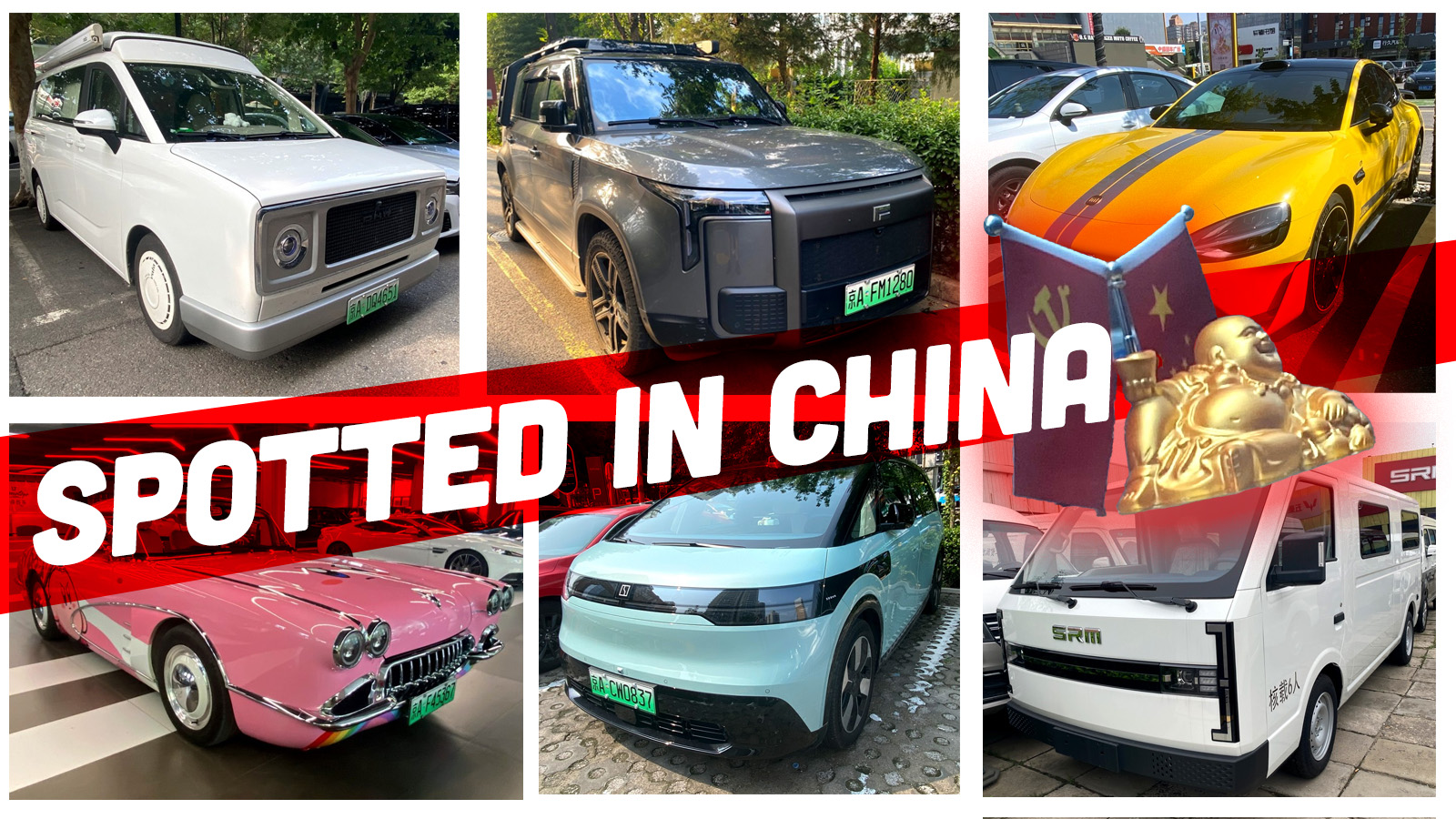
Today, we return to China for a brand new NEV MegaSpot Story® with the latest New Energy Vehicles (NEVs) on the streets of the Chinese capital, Beijing. This piece follows up on an article I wrote nearly a year ago; a lot has happened since. Let’s roll:
Denza Z9 GT
Denza is a BYD brand. The Denza Z9 GT is a shooting brake with oversized headlights. Denza offers both EV and PHEV versions. The Moon Rice car in the photos is the EV. It’s a beast, running BYD’s e³ powertrain with three electric motors — one up front and two at the rear. The setup delivers 966 hp and 848 ft-lbs of torque. It’s a bit hefty at 6,338 pounds (2,875 kg), but still hits 150 mph and sprints from 0–62 mph in 3.4 seconds.



BYD calls its ADAS system “DiPilot.” That’s the English name, but the Chinese name is far cooler: 天神之眼 (Tiānshén Zhīyan), which means “God’s Eye.” The Z9 GT uses 33 sensors in total, including five millimeter-wave radars and two lidars hidden in the black openings in the front bumper.

The Z9 GT has a fully leather interior with wide heated and ventilated seats that even offer a massage function. Still, the owner put a cheap seat cover on top. This used to be a very Chinese habit. Up until about ten years ago, owners of expensive cars always protected their fine leather seats with covers. Younger drivers don’t really do that anymore. So the owner of this particular car is probably an older fellow. The interior color scheme is Rice/Purple Mist.
BYD is one of the last carmakers that keeps the drive selector on the center tunnel. Most other brands have moved it to the steering wheel column. The main screen is huge at 17.3 inches. There’s a 13.2-inch driver’s display and another 13.2-inch screen for the front passenger.

The rear looks impressive, with the widest taillights in China. It also features a rear spoiler and a diffuser. Denza claims a drag coefficient of 0.195 Cd. The Denza Z9 GT EV costs 384.800 yuan or $53K. Denza also sells a sedan version.
- Sales of passenger cars keep rising in China. From January through September 2025, Chinese consumers bought 21.246 million cars — an increase of 13.7% compared to the same period in 2024.
iCar V23
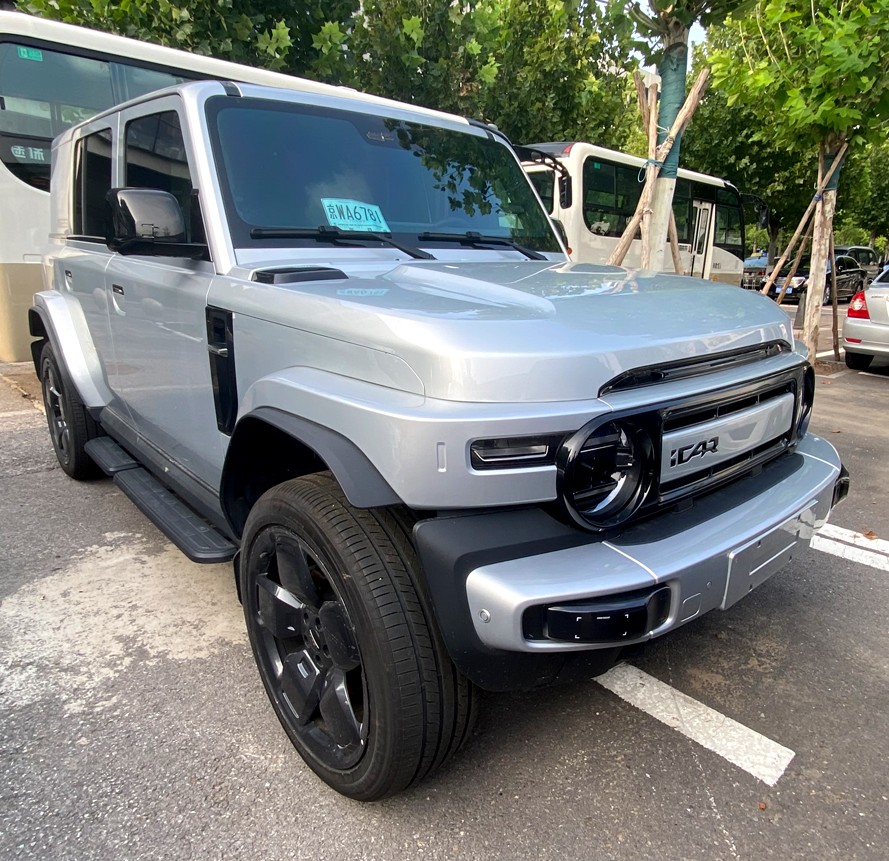
iCar is a Chinese NEV brand under Chery Automobile. The iCar V23 is one of the coolest new cars in China — a fully electric off-roader with a retro design, ultra-short overhangs, and big round headlights. It has quickly become the brand’s best-seller, moving about 6,500 units per month. The V23 has one real problem: not enough power. Even the AWD version tops out at just 211 hp. Happily, iCar recently unveiled the new V23S, which packs 455 hp — a big plus! The car in the photos is the standard AWD model, painted in “Silver.” iCar doesn’t do fancy color names.
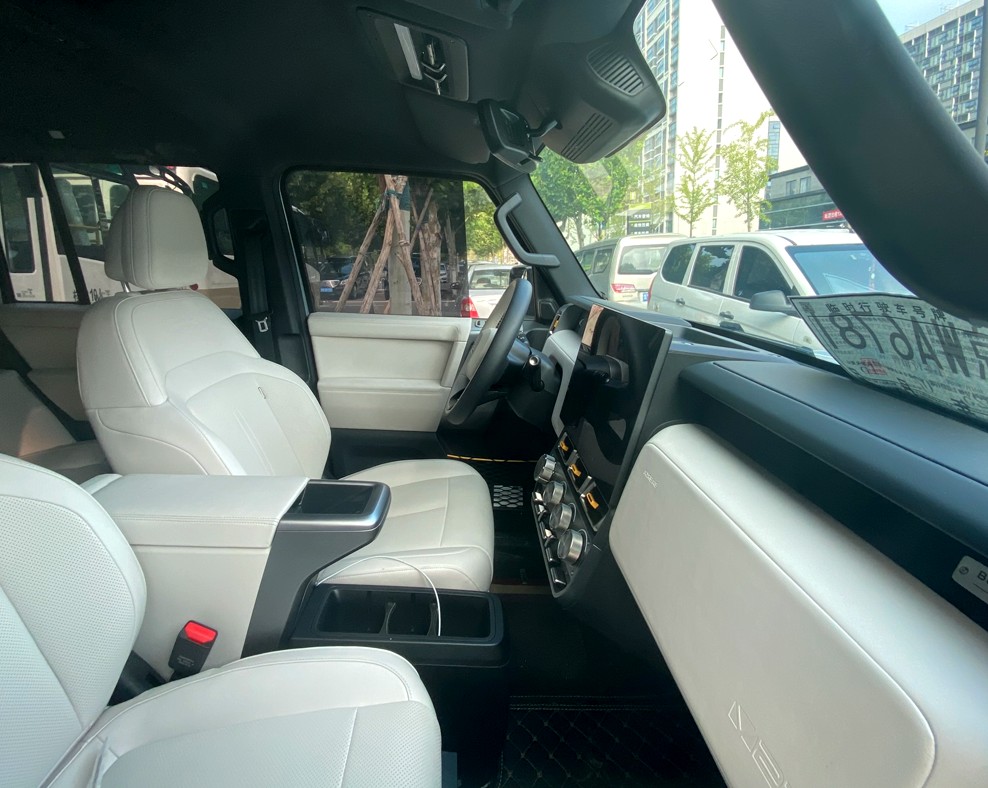
The interior focuses more on luxury than on off-road practicality. It features wide white leather seats, plenty of space, and a large 15.4-inch touchscreen with two rows of physical buttons.
The armrest sits unusually high — a new trend in China. A higher armrest creates a bigger storage compartment in the center tunnel. Chinese brands aggressively compete in marketing by bragging about ever more and ever larger interior storage spaces. I’ve tried a few cars with these extra-tall armrests — they’re uncomfortable and barely usable as an actual armrest — but Chinese consumers don’t seem to mind.
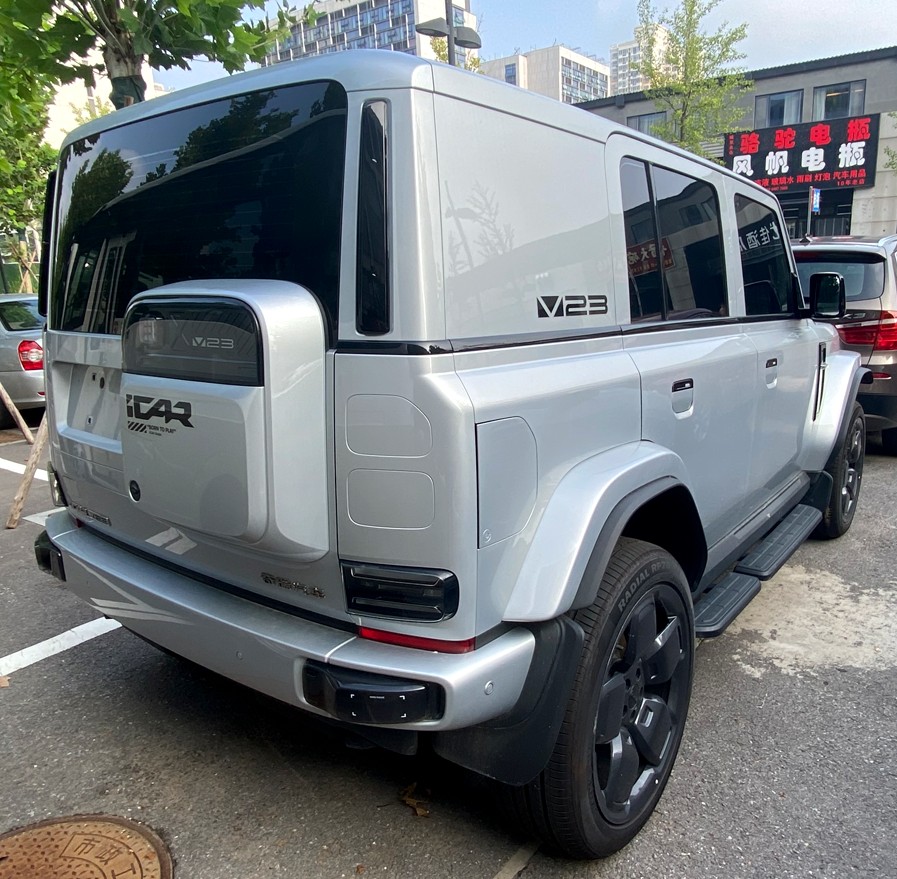
It has an external luggage box on the back, with two LED lights on the upper section. The vertical black bars on each side of the rear window are old-school air vents. The C–D pillar is a bit wide, but the 23-sensor ADAS system covers any blind spots. Note the millimeter-wave radars integrated into the bumper. It also comes with extra-wide fenders, side boards, and — best of all — mud flaps!
- Of those, 11.288 million were New Energy Vehicles (NEVs), up 34.9% from 2024. NEVs now hold a 46.1% market share, a new record for China. Despite all the subsidies and media attention, cars with combustion engines still hold a larger share, though the gap is narrowing. Analysts expect NEVs to surpass 50% in 2026. NEV is a Chinese category that includes EVs, PHEVs (including EREVs), and FCEVs.
Lynk & C0 900

Lynk & Co is a split-personality Geely brand. Abroad, the company markets itself as an eco-conscious brand with a lineup of fairly bland NEVs. In China, Lynk & Co positions itself as sporty, selling high-powered ICE models and extremely powerful NEVs. The 900 is Lynk & Co’s new flagship PHEV SUV, launched in the spring of 2025. It’s a giant three-row SUV with a bold, futuristic design with clean surfaces.
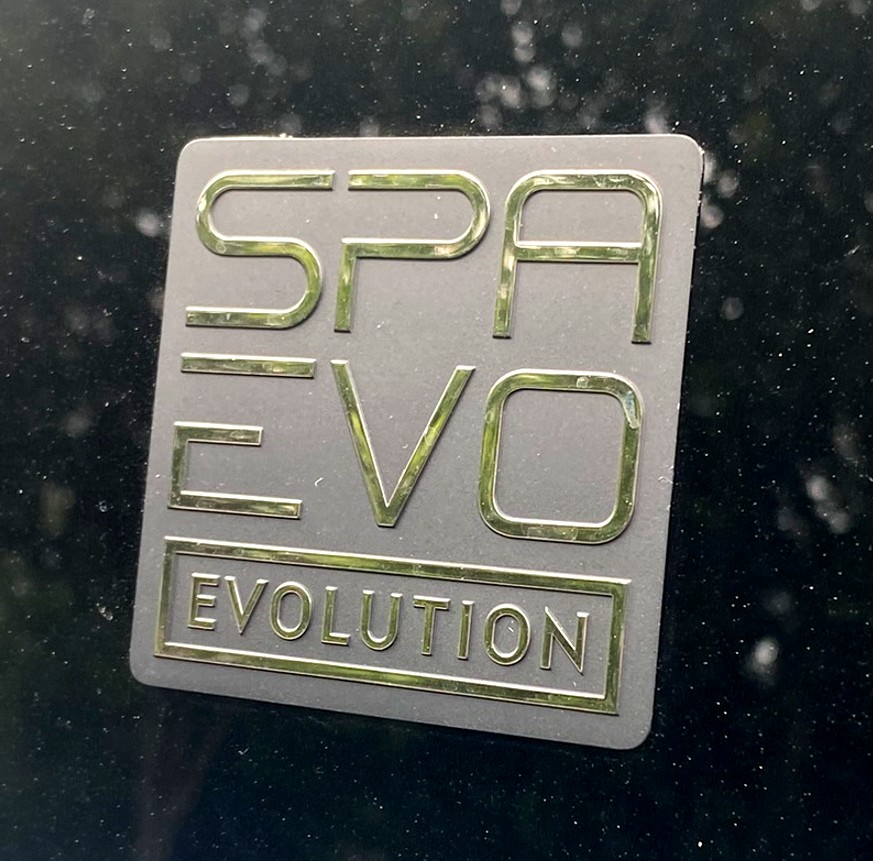
This is a very typical Chinese thing. Some brands — especially those under the Geely Group — love to show off their car’s platform with a badge. In this case, the Lynk & Co 900 rides on the SPA Evo platform, and the badge proudly says both “EVO” and “Evolution.” Not sure why, but hey, twice is better than once. Imagine your Chevrolet Suburban sporting “GMT T1XX” badges!
Lynk & Co offers several PHEV powertrains. The car in the photos is the Ultra Edition, combining a 2.0-liter turbo with two electric motors and a 3-speed DHT. The setup delivers 725 hp and 765 ft-lbs of torque, good for a 150 mph top speed and 0–62 mph in 4.6 seconds.

The Nappa leather interior looks fantastic. Chinese car brands don’t bother with vegan leather or anything like that — at least not for the home market. Nappa leather has become a major trend, and even mid-market cars use it now. The tech is just as impressive, with a 12.3-inch letterbox-style instrument panel, a massive 30-inch central screen, and a giant 95-inch HUD. Big HUDs are another recent trend in China. These displays don’t just show the usual navigation info — you can also watch movies or TV on them when the car is parked.
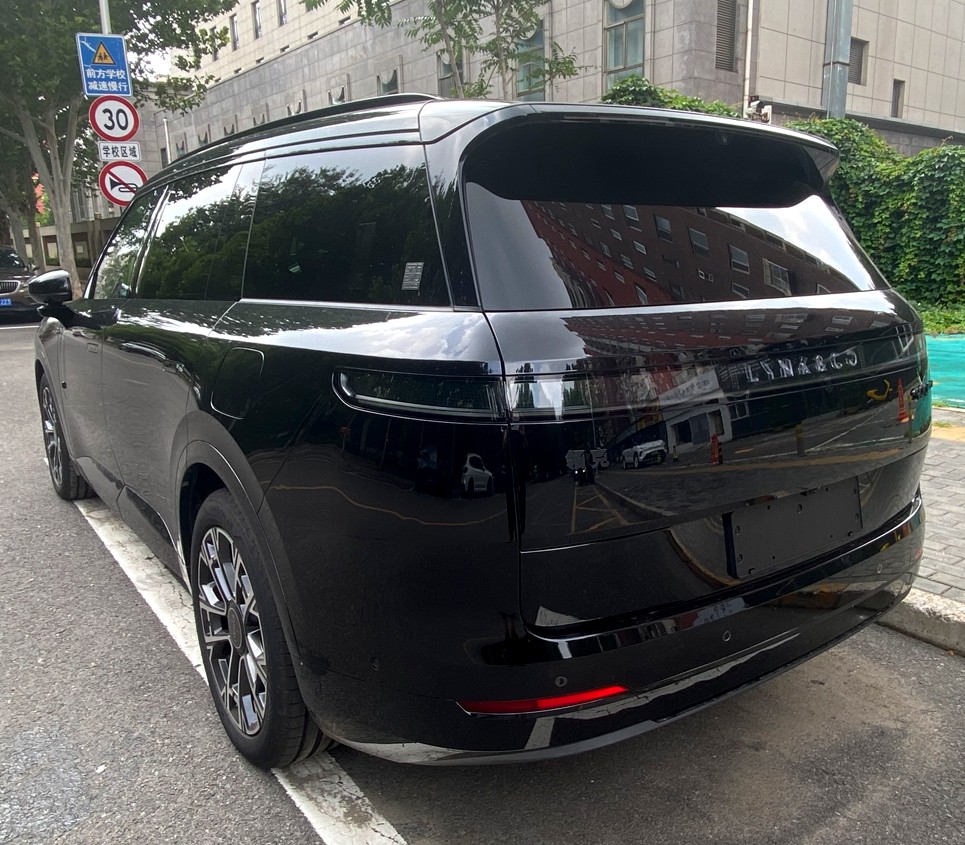
The Lynk & Co 900 Ultra Edition costs 346.900 yuan or $49K. The “Extreme Black” exterior color scheme is wild — a truly deep black paired with darkened everything. It’s so dark that, in certain light and weather conditions, you can barely see the vehicle at all. I once met another 900 at dawn in the rain, and it was almost invisible. Other Chinese brands have since launched similarly extreme black finishes.
SRM E3L
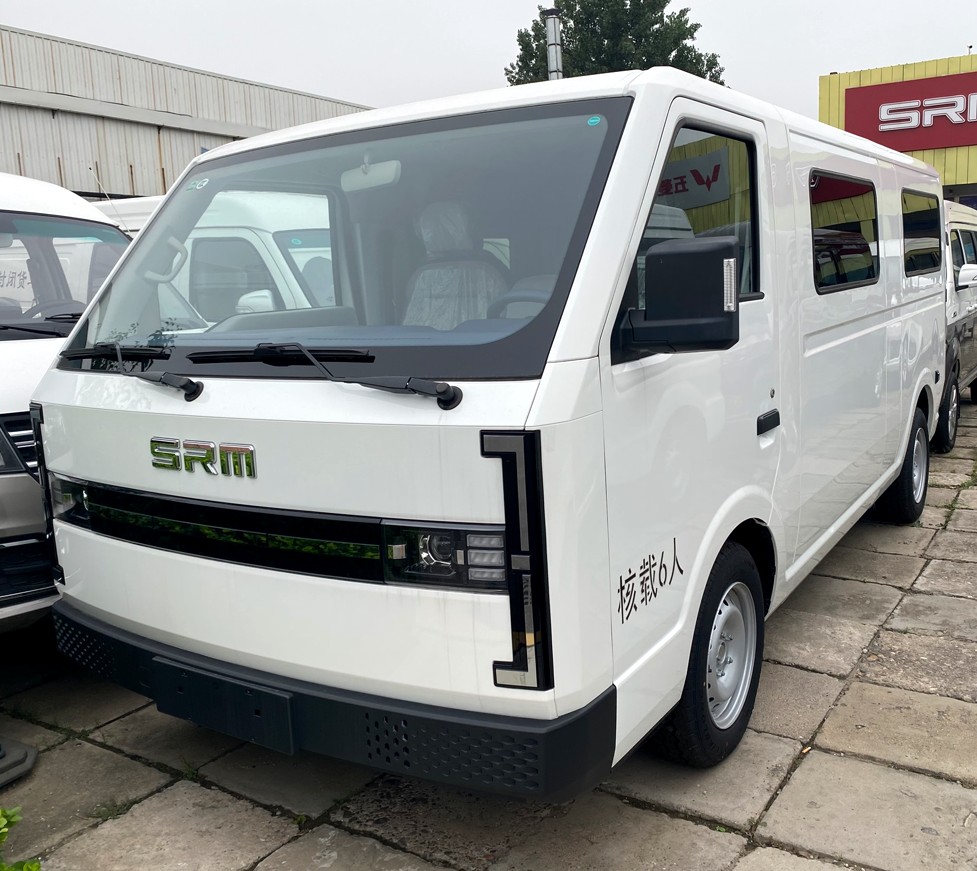
The SRM E3L is China’s coolest van. It has a beautifully utilitarian design with a boxy body and sharp corners. It has large windshield wipers, complex front lights, big plastic mirrors, and ultra-cool steel 15-inch wheels. The side windows are uneven in size; the one on the left is much smaller. SRM sells many versions of the E3L, both passenger and cargo. The Feather White van in the photos is the 6-passenger model.
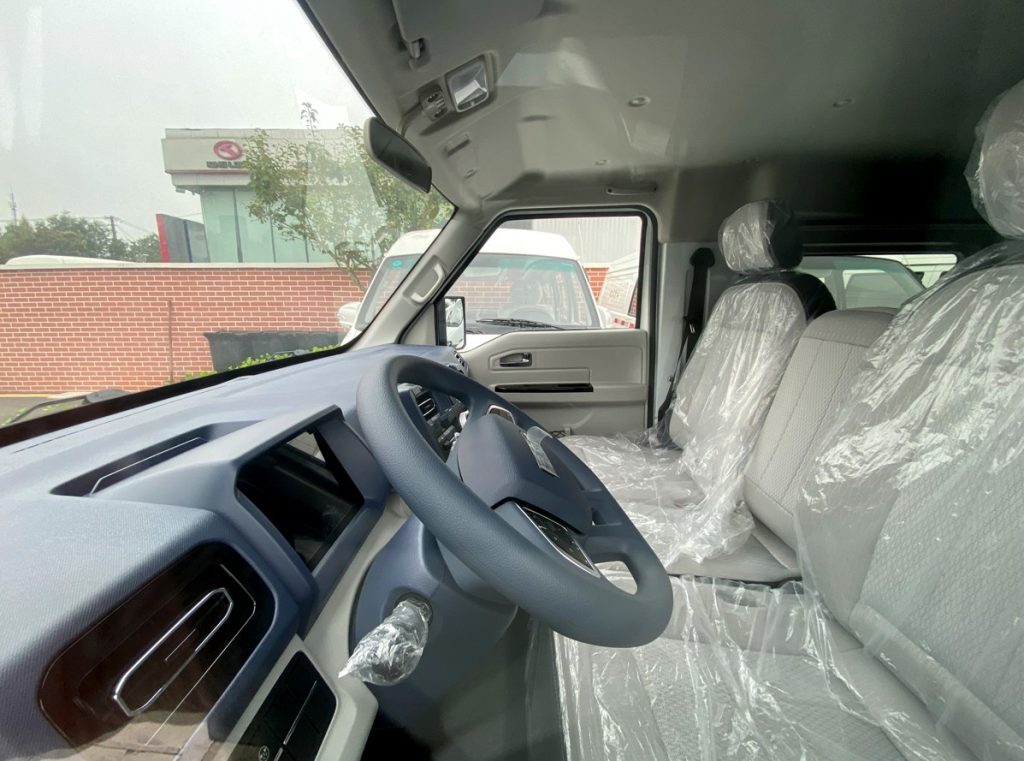
The seat layout is 2/2/2, with a sneaky extra jump seat up front — so you could call it a 6+1. The gray/blue interior looks pretty nice for this segment. Even the steering wheel is finished in blue! It has an 8-inch instrument panel and a 4-speaker audio system.
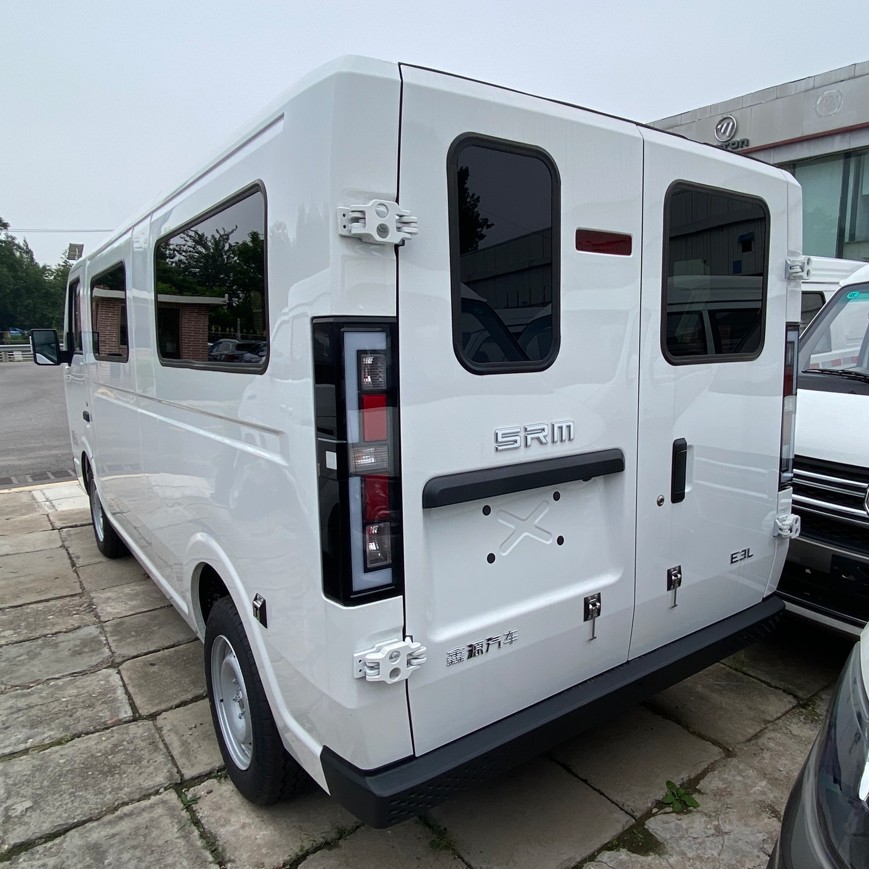
Note the exposed external hinges. The rear windows are uneven in size as well. Interestingly, SRM positioned the third brake light on the right side of the left window. The E3L uses an 82 hp / 162 ft-lbs electric motor on the rear axle and a 41.86 kWh LFP battery. Top speed is 62 mph, and range comes in at 171 miles. The SRM E3L 6-passenger version costs 102,800 yuan, or about $14.5K.
NIO ET9

The NIO ET9 is a massive luxury fastback-sedan-SUV-coupe with striking proportions. It serves as the flagship of the NIO brand, measuring 209 inches long with a 128-inch wheelbase and 7.9 inches of ground clearance. Power comes from a dual-motor AWD setup delivering 707 hp and 516 ft-lbs of torque. Oddly enough, that’s not particularly impressive for a high-end Chinese EV in 2025. The ET9 uses a 102 kWh swappable CATL battery pack, offering a range of 404 miles.
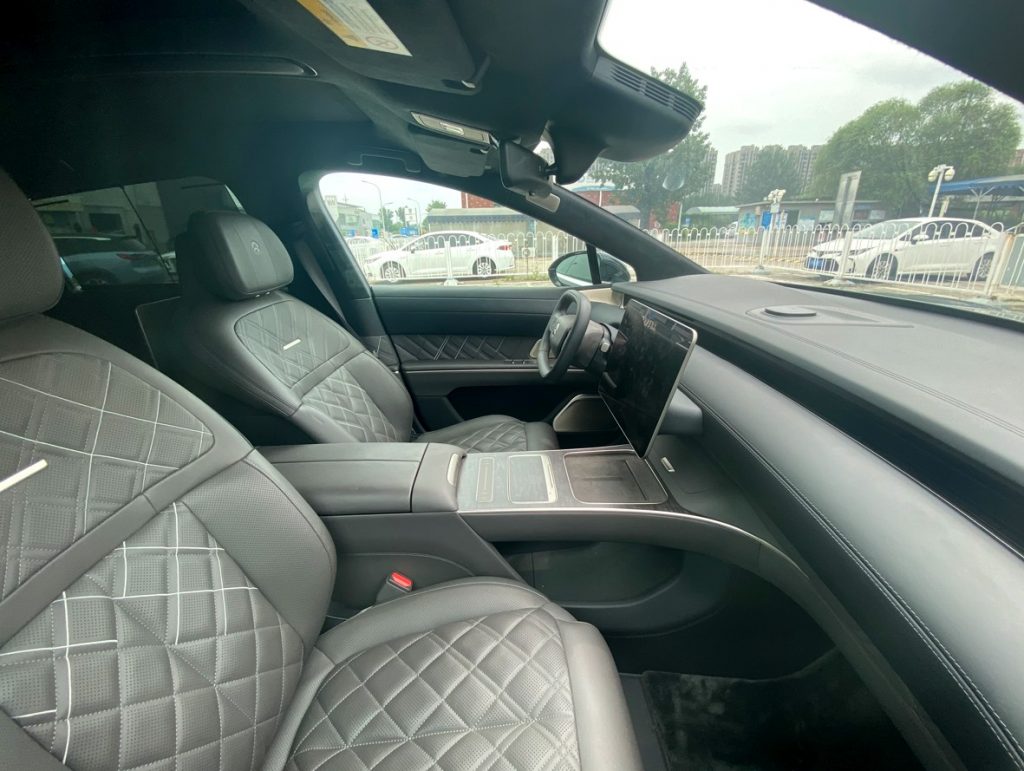
The Alpine Gray Nappa leather seats look great — a bit British with that checkered pattern. The dashboard is minimalist, even by Chinese standards. There isn’t a single physical button anywhere. The main screen measures 15.6 inches, and an ultra-wide, ultra-thin 48-inch display stretches across the entire width of the dashboard. The ET9 comes standard with a 2800W 35-speaker NIO Lyra sound system. Still too much road noise? No worry, it also has an Active Road Noise Cancellation (ARNC) system with a “noise reduction range up to 1,000Hz and peak noise reduction of 14dB.”

NIO poured billions into the ET9 project, targeting the so-called “BBA” trio — Mercedes-Benz, BMW, and Audi (in Chinese: 奔驰, 宝马, 奥迪; Bēnchí, Baoma, and Aodí). Unfortunately, the plan didn’t pan out. The ET9 is pricey, starting at 768.000 yuan ($108K) for the base model, and its design is just a bit too unconventional for the luxury crowd. NIO moves only about 70 units a month. Ouch.
- The top 10 car brands from January to September are BYD, Volkswagen, Toyota, Geely, Wuling, Galaxy, Changan, Honda, Chery, and Tesla. That list includes six Chinese brands, two Japanese, one German, and one American. Chinese brands haven’t yet displaced foreign brands entirely. The situation looks very different in the NEV segment, where nine of the top 10 brands are Chinese, with Tesla as the only exception.
Zeekr MIX

The Zeekr MIX is a truly innovative MPV, one of my favorite new cars. Its door setup is brilliant: both doors on the right side slide, with the front door sliding forward and the rear door sliding backward. It doesn’t have B-pillars, creating a massive 52.3-inch opening on the right side. On the left, the driver’s door opens conventionally, and the rear door slides backwards again. The design stands out too: a one-box body with soft, rounded lines and huge windows. It features glossy black light units, black mirrors, and a lidar unit on the roof. The car in the photos has a two-tone Emerald Blue/Black color scheme.

The interior is brilliant. The front seats can swivel, and the armrest slides backward to form a table. Alternatively, the front seats can fold completely flat, move all the way forward, or rotate 45 degrees. Zeekr says the MIX is the perfect car for camping. Zeekr probably could have crammed in two more seats, but that would have ruined the concept — so despite its vast size, the MIX is only a five-seater. It measures 185 inches in length with a 118-inch wheelbase.

The A-pillar is relatively thin, so the front-side window actually helps visibility. The tech package includes a 13.02-inch driver’s display, a 15.05-inch touchscreen, and a XXX-inch HUD. The shelf behind the screen is a popular option — it’s perfectly sized for a tissue box.

The Mix is based on Geely’s 800V SEA-M platform. It is an electric car with a dual-motor AWD power train. The output is 422 hp and 325 ft-lbs. Even MPVs pack plenty of power in China! Top speed is 112 mph, and 0–62 mph takes just 6 seconds. Families can choose between two batteries: a 76 kWh LFP pack with a 342-mile range, or a 102 kWh ternary-lithium pack good for 436 miles. The Zeekr MIX costs 279.900 yuan or $39.3K.
Full Good SS Dolphin

The Full Good Dolphin SS isn’t new, but it’s so rare that I had to include it. Full Good — previously known as Songsan — is a Chinese automaker obsessed with classic American and German cars. The SS Dolphin is a convertible sports car inspired by the first-generation Chevrolet Corvette (C1).
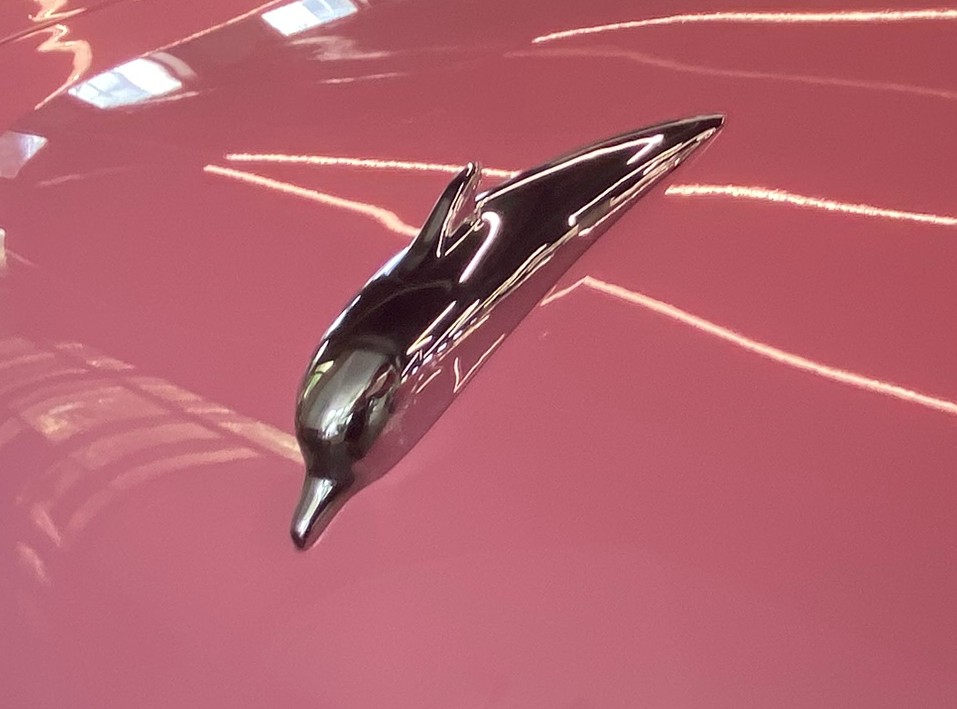
I tried to arrange a test drive, but the company told me they had sold every car and asked me to get back in touch next summer. I will. Luckily, I found a road-registered SS Dolphin at a supercar rental shop, dressed up in a pink Kirby wrap. Full Good doesn’t have a car-making license, so the company outsourced production to BYD — a common way for small Chinese automakers to get started. The SS Dolphin rides on a BYD PHEV platform.

The interior is an interesting mix of modern and retro, with leather seats and metal trim. Full Good clearly put serious effort into the design — just look at those door handles; that’s no lazy kit-car solution. The round air vents are cool, too. Most of the switchgear comes from BYD.

It has big exhaust pipes and bling everywhere, plus retro-style wheels that suit the look perfectly. The front-wheel-drive PHEV powertrain pairs a 1.5-liter turbo with a single electric motor and a six-speed DCT. Total output is 315 hp and 395 ft-lbs, good for a 105 mph top speed and 0–62 mph in 5.9 seconds. The SS Dolphin is no longer available, but when new, it sold for 700,000 yuan — about $98K. The Dolphin SS is a little bigger than the C1, with a 191-inch length and a 106-inch wheelbase.
Stelato S9

The Stelato S9 is a full-size luxury sedan with a sleek, aerodynamic body. The company behind the S9 is none other than Huawei. After the first Trump administration imposed chip-related sanctions on Huawei, the embattled company took two key steps: it developed its own chips and diversified into the automotive industry. In no time, Huawei became a major supplier and launched five brands under its HIMA subsidiary— one of them is Stelato.
HIMA stands for Harmony Intelligent Mobility Alliance. It’s a complex network in which Huawei is the main supplier of hardware and software. Production is outsourced to partner automakers, BAIC builds the cars for the Stelato brand, for example.

Stelato loads the S9 with Huawei tech: Harmony Space (the smart cockpit system), Harmony OS (the operating system), Huawei ADS (the ADAS suite), and Huawei Sound (a 23-speaker, 2080W audio system). Huawei also builds the screens. The cabin is luxurious, with Nappa leather seats, wood and metal trim, and two 50W wireless chargers.

Stelato offers several EREV and EV versions. The car in the photos is the S9 Max, the base EV variant, with a single-motor RWD setup. The Huawei DriveOne motor delivers 309 hp and 292 ft-lbs of torque. Top speed is 133 mph, and 0–62 mph takes 5.98 seconds. A 100 kWh CATL battery provides a 507-mile CLTC range.
It’s a huge car — 203 inches long with a 120-inch wheelbase. Interestingly, despite all that size, the focus goes entirely to the cabin, so the trunk is tiny: just 13 cubic feet!
- How many brands, really? People often claim that China has “more than 500 car brands,” but that’s pure nonsense. When you focus on regular passenger cars, there are 109 brands in total. About 25 of those are foreign-owned, leaving 83 Chinese brands. Of these, only 38 focus exclusively on NEVs, while the rest produce a mix of ICE and NEV models.
Xiaomi YU7

Xiaomi has become the biggest disruptor the Chinese auto industry has ever seen. And that says something, because the industry already lives in a permanent state of disruption. The brand launched in 2024, and by October 2025, it had already reached a record 19th place in China’s sales rankings. No brand has ever grown this fast.
Even more impressive: the YU7 SUV is only Xiaomi’s second model, after the SU7 sedan. And even more remarkable: the YU7 launched in June 2025 and, just one month later, it outsold the sedan. Another massive hit for Xiaomi. The car in the photos is the YU7 Max model in Deep Sea Blue.

The interior is completely different from the sedan. The main tech highlight is the panoramic HUD called HyperVision, which spans the full width of the windshield. BMW just launched a similar system in the new iX3, but Xiaomi did it first. The seats are clad in Nappa leather, of course. The wireless charger delivers 80W — the most powerful in China.
I visited a Xiaomi dealer and took a brief test drive in the YU7. It was an incredible experience. The tech is just insane. The AI assistant impressed me the most — you can ask anything, in any way you like, and the car simply does what you want. It even has exterior microphones, so you can tell it to open the hood or flash the lights while you’re standing outside.

The Xiaomi YU7 Max has a dual-motor AWD powertrain with 690 hp and 639 ft-lbs. Top speed is 157 mph, and 0–62 takes 3.23 seconds. CATL supplies the 101.7 kWh battery, good for 472 miles of range. With its 800V architecture, charging takes only 12 minutes. Chinese consumers pay just 329,900 yuan ($46K) for the YU7 Max — no wonder Xiaomi sells so many.
Xiaomi SU7 Ultra

This is a cheap Chinese electric sedan with too many wings and spoilers. It also has three motors with 1.548 hp and 1.305 ft-lbs, making it the most powerful Chinese road car ever. Top speed is 217 mph, and 0–62 takes 2.1 seconds. Xiaomi claims a surprisingly low electricity consumption of 16.5 kWh/100 km for a 391-mile CLTC range. The SU7 Ultra costs 529.900 yuan or $74K. The car in the photos has the best color: Lightning Yellow with light gray racing stripes and black alloy wheels.
Rox 01

Rox is a new Chinese car brand. Its only model is the Rox 01, a gigantic SUV that looks like a Land Rover Defender from the future. It’s a tank-like machine with a heavyset front, a strong uninterrupted beltline, extra-thick pillars, and 21-inch five-spoke alloy wheels. The owner went wild with the options, adding a roof rack with a side tent and ladder, running boards, and wind deflectors. The color of the car in the photos is Cloud Curtain Gray. The Rox 01 is huge: 199 inches long with a 118-inch wheelbase.

Red interiors are the best interiors. Rox calls it Amber Orange. I call it red. Annoyingly, the owner added a white neck pillow — that doesn’t match. He also likes his tissues, and he clipped fake seat belt heads into the buckles. The Rox 01 has a 15.6-inch screen and a 60-inch HUD, plus two wireless chargers and a 256-color ambient lighting system.
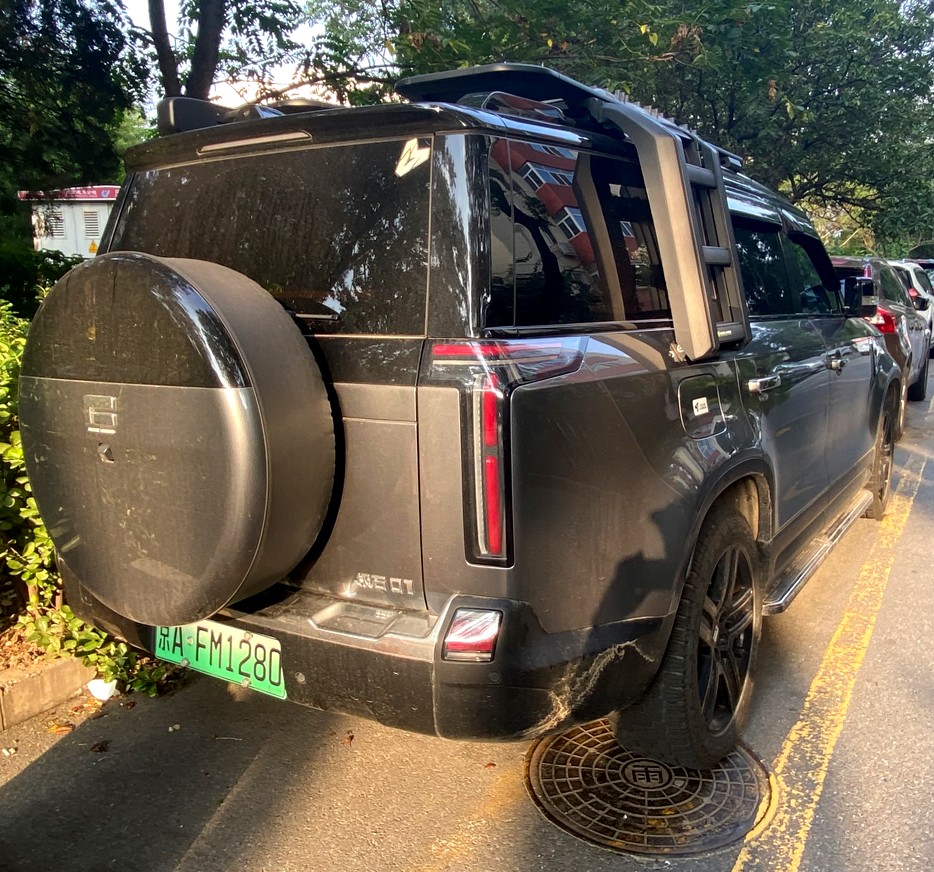
The Rox 01 has an EREV AWD powertrain. The 1.5-liter turbo range-extender engine produces 156 hp, while the two electric motors add 476 hp and 546 ft-lbs. It has a large 18.5-gallon fuel tank and a 58.4 kWh CATL ternary-lithium battery. Rox claims a combined range of 845 miles and a 190-mile EV range. The Rox 01 costs 349.900 yuan or $49K. The Rox brand slogan is “Life in the wilderness starts here.” Well, it should be careful standing on that drain hole with a 5.690-pound curb weight.
- So how do people come up with that “500” number? Maybe if you count all the van makers, truck manufacturers, specialty vehicle companies, and LSEV producers, you’d get somewhere close. But honestly, nobody really knows. It’s impossible to pin down anyway — new companies appear and disappear almost daily.
Hongqi Tiangong 08

Hongqi is one of China’s oldest car brands, best known for parade cars. Today, it builds a confusing mix of ICE sedans and SUVs, a luxury bus, and a fast-expanding lineup of modern electric cars. Consumers like the new direction — Hongqi climbed to 20th place in the sales rankings in October. Just ten years ago, it was down in 71st. The Tiangong 08 is a new electric SUV launched in 2025. The typical Hongqi hood ornament stretches out over the grille. The design focuses on aerodynamics, with a slippery body, a steeply raked windshield, and spoilers and winglets all around the vehicle.

What a mess! In a new car! I wonder what it’ll look like in a year. The screen setup is relatively small for a new Chinese car, with an unusual layout. A 6-inch driver’s display sits alongside a wide 15.6-inch central screen.

A gold-colored statue of a laughing Buddha figure. Behind the statue are two small red flags: the one on the left features a yellow hammer and sickle symbol, associated with communism. The other one is the Chinese flag.

The Tiangong 08 is EV-only; Hongqi doesn’t do EREVs. The car in the photos is the 08 730 Max RWD model, painted in Cloud Creek White/Black. It costs 309,800 yuan, or about $43K. The electric motor puts out 344 hp and 332 ft-lbs, good for a 124 mph top speed and 0–62 in 6.3 seconds. It has a large 111 kWh CATL-FAW ternary-lithium battery, providing a 454-mile range.
BAW Vala

BAW is another very old Chinese brand, best known for the BJ212 and its many successors. The BAW Vala is a purpose-built camper based on the BAW Ace EM7 MPV. The design mixes utilitarianism with cuteness, featuring simple flat body panels, retro bumpers, white wheel covers, and big round headlights. The Vala comes equipped with a roof tent, a side tent, four beds, a table, a microwave oven, and a camping cabinet with storage space and a sink.
[Editor’s Note: I’m really taken by this thing. The front end looks like a bear that just got news that he’s getting audited by the IRS and he knows he’s “moved some money around”:

Poor fella. – JT]

Check out the bed linen in the roof tent. The cabin is surprisingly luxurious for a camper. Chinese consumers like their camping to be glamping. The center tunnel doubles as a refrigerator. BAW has built a real cult following around the Vala, a big achievement for such a normally staid company. There are Vala clubs and personalization options, both from BAW and third-party suppliers.
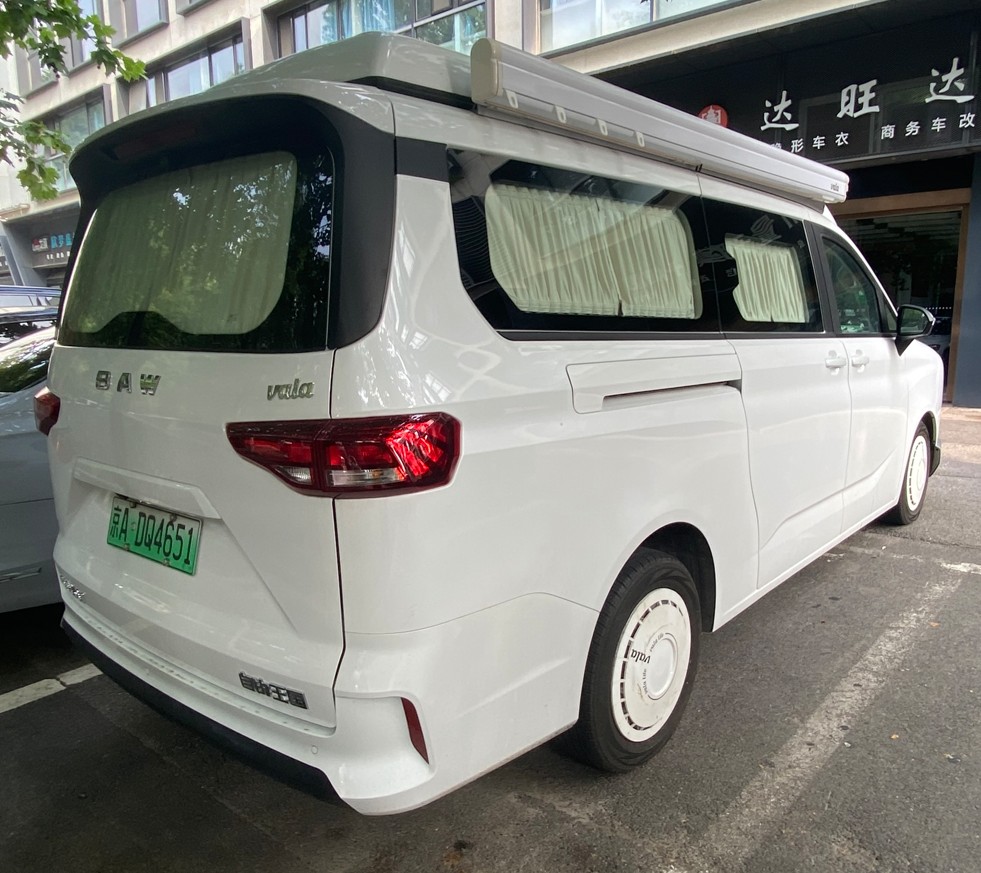
The Vala is a single-motor rear-wheel-drive car. The electric motor delivers 231 hp and 228 ft-lbs, good for an 80 mph top speed. The 81 kWh LFP battery gives it a 314-mile range. That’s not much, but it doesn’t really matter — every campsite in China has fast-charging poles. To go glamping with the Vala, Chinese consumers have to hand over 268.000 yuan ($38K) to the Vala dealer.
That’s it for now. Thank you for reading! More Mega Spots later, perhaps one with ICE cars?
All photos by Tycho de Feijter
Top graphic images: Tycho de Feijter


“The shelf behind the screen is a popular option — it’s perfectly sized for a tissue box.”
Well that’s an interesting indication of the videos Chinese folks like to watch.
Thanks for providing real-world images and some specs with commentary of new Chinese cars!
While I can read through Car News China , I more appreciate your coverage.
I would, and believe Autopian readers would, especially appreciate an article discussing the following related to Chinese cars, especially China’s new brands with limited sales history. Potentially focus on the top 3 to 5, based upon whatever criteria that makes sense. Maybe BYD, SAIC, BAIC, and rapidly growing new brands, like Xiaomi (which may not fit well into the below points due to newness):
With the average US car on the road now about 12.8 years S&P Global (cited by US’s Bureau of Transportation , how does this compare to China?
Again thank you for this article, and I hope editors Matt, David and Jason consider assigning such an article I’ve described to you or another Autopian writer.
Very interesting to see and read. I worked in the Design department of Chinese car manufacturer Avatr that is based in Munich, Germany. A joint venture of Changan, NIO, CATL and Huawei. Would like to see it on the street in China. Maybe you come across one? I am curious how you like it and how it sells in China.
Wow cool! Yes, I have seen many Avatr cars, and I have visited Avatr shops & dealers. The brand sells okay, 40th place in October (out of 108) with sales of 12.879 cars. Which models did you work on? Here are some of the Avatr cars that I saw: https://www.coolcarsinchina.com/category/all-brands/avatr/
Thank you for the fast reply. Website already bookmarked 🙂
I was working on the 11 doing visualisation for the design team, exterior, interior and colour, materials and finish. It was a really nice time working there. Nader, the design director was always positive and he understood well to push the team’s high spirit in the right direction. Very friendly guy, and I was sad when I left because my wife found work in a different city. While I was working there the 11 was the only car in development – though other cars where probably already on the map, too.
I see a lot of the boomerang shaped headlights now and the rear window treatment reminded me of classic cars from Ferrari or Porsche.
Oooh, Avatr is one of my favorite Chinese brands for their unique interior and exterior designs, especially when compared to the rather generic and conformist competition. Their sales are just OK, not disastrous or anything, and seem decent considering their small lineup of 4 vehicles, of which only 2 compete in popular segments. They seem to have somehow stayed as the #2 best selling Huawei associated brand a long way behind only the very successful AITO despite not being one of the 5-6 HIMA brands. With a few more models and early access to some CATL tech, it could become more successful, but the brand lacks hype in China.
So many cars. I wonder how bloody the demise of most of these brands will be in the coming years. Just like the US had 100+ brands and now has a few – this is something which has to happen in China as well. Economies of scale etc.
Even back in 2003, many analysts believed a consolidation was necessary. The government agreed and forced a few unhappy mergers between state-owned car makers. But that didn’t really help. Most of the car industry is private or semi-private now, and the number of car makers has only gone up. There are a few bankruptcies each year, but for each brand that dies, two more are born.
Give it some years. The US brands didn’t die overnight neither.
Meanwhile, Buick sales ranked them 19th in China, behind Audi and ahead of Wuling, as of July, 2025.
At least GM is not unfamiliar with the concept of shrinking market share.
Buick is still trying – new EVs are underway. Chevrolet is dead, and GM will likely pull it from China soon. Cadillac is holding on – barely. Interestingly, GM didn’t go for a Chinese-platform strategy, like VW and Toyota.
Interesting to read about, even if none of them will ever be a thing in the states. The vans are interesting… there’s a certain sameness about all the performance sedans from both exterior and interior POVs: just reclined seats and too much screen, differentiated mostly by tech doodads. Not to be that guy, but I wonder how many/which of these will be videotaped burning on the roadsides of China over then next few years.
Dozens. Hundreds. Thousands. Probably. But the other millions will probably just drive like the other millions of EVs which are already on the roads in China for the past decade (!) and which haven’t caught on fire even though they were made with 10+ years older tech, much lower quality control and with a much lower budget.
I’m aware that domestically (in the states) EV fires are far outnumbered by gas/ICE vehicle fires adjusted for the installed base of cars of course. I am not sure whether the same situation (that EVs catch fire far less often than gas cars) holds true (or as true) elsewhere, including China.
But given the sheer size of the Chinese car market, and the higher proportion of EV sales within it each year, it’s surely got to be in the thousands annually. At least.
Absolute speaking there are tons of accidents and fires of course. They’re selling millions of these EVs in China every year. The older ones with ‘unsafe’ batteries and ‘cheap’ electronics should be a dozen years old almost. Especially the micro cars which aren’t subject to some regulations neither. I don’t know if an EV car catches easier fire than a gas car. Intuitively I’d say ICE cars are more fire-proof than EVs, but the statistics might be otherwise.
Great article and photos. More.
Awesome! I really hope some of these will come to Canada, because:
a. I like some of them
b. to piss off Trump
Full Good…literally translates in German to “Voll Gut” and basically means “great”. It’s really funny to German eyes.
Thanks for including front and back of all these models!
That srm van is neat looking and for the money or even double hard to beat. Would make a great local delivery van or maybe a shuttle.
God help the poor sap that gets rear-ended in the iCar V23. How much would a bumper replacement be when factoring the radars?
Or the owner of a Denza Z9 GT who rear-ends someone else. The bumper, radar units, headlights, DRLs, hood and so on would cost a fortune to replace.
I’m wondering if China has crashworthiness tests, and how these vehicles would do in a real world accident.
China has its own equivalent to the IIHS call C-IASI, which has a crashworthiness/repair cost score as one of its criteria. They seem to be able to test about 50 models per year, which unfortunately isn’t enough to keep up with even just the popular models. FWIW all variations of the Denza Z9 (sedan/wagon, EV/PHEV) sell quite poorly, unlike BYDs (their parent brand).
Either weird designs or blatant rip offs.
I have to take that .195 Cd claim with the same grain of salt as I use when reading Amazon product descriptions for Chinese-manufactured car horns that deliver 600dB of sound pressure.
So this was actually a huge controversy in China a few months ago. Some influencer took an S9 to a wind tunnel and found the Cd to be much higher than 0.195. However, their S9 didn’t have the optional camera mirrors and most aerodynamic wheel choice, and the air suspension appeared like it was set to weirdly high ride height. It then blew up on social media and made it over to Twitter where one of the Tesla fan pages reposted the video, which Elon then quote retweeted as proof that all Chinese vehicle’s claims are lies and Tesla is the only company that makes truthful claims (lol).
After a few days, Stelato demonstrated in the same wind tunnel that they could achieve their claimed number with the right configuration, and also demonstrated how optioning the reflective side mirrors, different wheels, and raising the ride height all increased the drag coefficient. They also sued the influencer for the ordeal I believe.
I’m not super surprised that they were able to hit the number, as the vehicle is quite long and has a pretty optimal profile/roofline. They also seemed to have sacrificed trunk space, by both lowering the trunklid and raising the floor to allow for more of a diffuser. The Tesla Model S and Lucid Air are in the same ballpark.
Yes, that was super interesting. Claimed Cd is always with the most-optimized spec – camera mirrors, aero wheels, and low-resistance tires. There’s a lot of ado in China about influencers allegedly paid by automakers to bad-talk the competition. Gets pretty nasty sometimes.
Why do they keep making EV interiors look like cockpits? Shouldn’t we be able to get a more open cabin without a transmission tunnel to account for? I am tall and cannot stand having big chunky dash elements where my knee needs to go. Most of these look very annoying to drive to me.
High & wide center tunnels are a new trend in China. It is to create large storage spaces in and under the tunnel. Chinese brands are out-advertising each other with ever-larger in-car storage spaces.
Admittedly, my preferred EV front seat would have a bench seat and a column shifter, but these just seem unpleasant to drive.
They are all ugly / stupid looking.
A lot of these look really nice. I think my favorite is the iCar V23. The high armrests might not be a bad thing for shorter drivers, I know armrests are often too low for me with the seats at a comfortable height.
This has to be AI slop. It’s AI slop, right? Tell me it’s all AI slop…/s
That SRM van must be most practical thing I’ve seen in months. Simply suited to do the job. Cheap 15 inch wheels. Nothing over the top.
As an around town shuttle (rarely goes over say 45 mph) or parts/service vehicle, this indeed is the bees knees for its maximum space efficiency!
That’s… oddly specific. Wouldn’t Mr. Editor happen to secretly be a bear? Who has moved some money around?
It would be irresponsible not to speculate!
I’d be rooting for the bear when it comes time to do what bears do best, and rip smaller creatures apart.
Sit-Com in the making!!
Boy, do they hate knobs!
Yes, young Chinese consumers don’t want knobs. They think knobs are old-fashioned, like in their father’s Buick or Volkswagen. Everything is online in China nowadays, so young folks are totally used to having screens everywhere. The only exceptions are these off-road-style cars, which sometimes have oversized handles and buttons, but that’s more for cool than for usability.
The Chinese market continues to be mind-bending. Some of those vans are amazing, and the US needs a reasonable van for $14.5k
We need to open the market but do what China did and have our OEMs partner to learn their innovative ways. Incredible progress.
The E3L is officially my new favorite van and I need to figure out how to get one here.
Send them over!
I really like those Xiaomi and BYD cars.
But I’m biased for car-based hatches.
Almost all of the above offer value for the money that you won’t find in the USA at those price points. Interesting. It can’t be all, or even mostly attributed to, labor cost differences. The US manufacturers also use 3rd world and prison slave labor for parts, just like China.
The long range EVs being sold in China for under $15k are the sorts of long range EVs the US/European/Japanese manufacturers could be making and selling for under $25k PAYING FIRST WORLD WAGES, but refuse because they’d rather sell upmarket where the margins are fatter and where they can hook people on 84-month payment plans at 9% APR.
The Chinese should be allowed to sell their cars here untariffed if the USA automakers won’t make/sell similar cars to what China offers at the low end.
The entire point of EVs was to reduce ecological footprint and reduce operator expenses, and all of these overpriced luxubarges and SUVs/CUVs/trucks with massive battery packs which the market is saturated with really don’t do that. And once these oversized/overpriced vehicles don’t sell, there shouldn’t be any bailouts.
You could have reduced all of that down to the Chinese make affordable car models as well, unlike other (most, majority, you know what I speak of) EV manufacturers that are concentrating on really high priced models.
The USA can’t compete because they used “green tech” as a political football for decades rather than investing in the future. Tariffs are the only defense left
Labor may make a difference, but “Western Executives Shaken After Visiting China: There are no people — everything is robotic”. I’m sure this isn’t true everywhere, but the auto industry is the sort of place where it might be true. China is following the American example and using nearby low-wage countries like Vietnam and Bangladesh for some things.
Also doesn’t help that a lot of Western companies across the entire manufacturing sector are just there to bleed every last cent of profitability out of a place at the bare minimum of investment. Meanwhile China is constantly improving/replacing/rebuilding their factories.
I have to try to find the article again, but when you raise the issue of labor costs, a western journalist was invited to visit a BYD factory and they had to turn the lights on just for him… the entire assembly area was 100% robotic. The only labor costs was for a few engineers performing regular robot maintenance
this one? China’s Dark Factories: So Automated, They Don’t Need Lights | WSJ: https://www.youtube.com/watch?v=MCBdcNA_FsI