


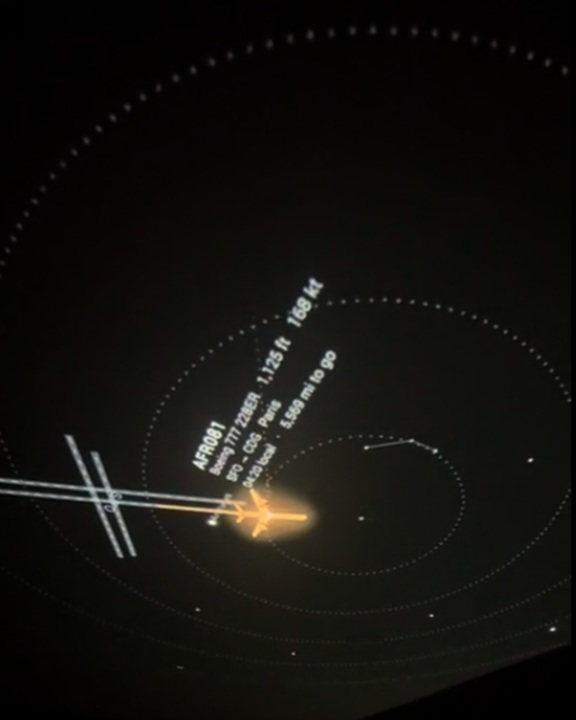
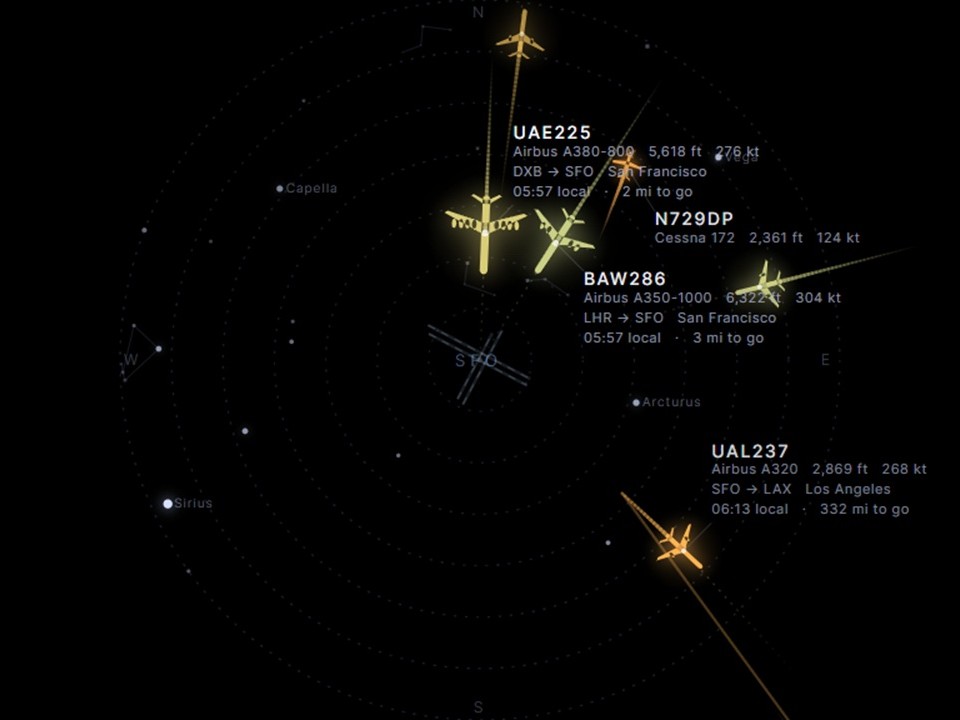
There’s a weird, almost child-like curiosity that comes with finding out what planes are flying above your current location. You never know what you’ll find up there! Maybe you’ll spot an airline you’ve never heard of, or see something majestic like a Boeing Dreamlifter or a rare Lockheed C-121 Constellation. You could use an app or a website like FlightAware or Flightradar24, but someone has found a way cooler way. This is the Skylight Ceiling, and it takes a Raspberry Pi, a projector, and an ADS-B radio to project the flight paths of planes flying over your house or apartment right onto your ceiling.
This little gadget has lit the Internet on fire, and normally, I would not give a single care for “trending” content, but this one captivated me. I’m a sucker for flight tracking apps. Back in the day, when Siri was a new thing, iPhones had a slick feature where Siri could tell you what planes were flying overhead. Nowadays, I spend way too much time looking at sweet aircraft on Flightradar24, FlightAware, and SkyCards. I’ve been considering getting a FlightWall — a live LED display that tells you what planes are flying above — to join my expanding fleet of aircraft models.


Cameron Paczek has developed what’s probably the coolest way to nerd out about what’s flying over you. Instead of making an app or a screen that lays out what’s flying over you in text, he’s taken it to the extreme. The Skylight Ceiling, as he calls it, turns your entire ceiling into the night or day sky, showing the live paths of aircraft in addition to so much more. Check it out in the embedded video below (click here if you cannot see it):
From A Plane Nerd And Software Engineer
Paczek is a software engineer based in Los Angeles who has been coding for about a decade. He says he specializes in JavaScript, but he’s open to all kinds of coding. When he isn’t coding, Paczek’s website says, he’s building custom computers, tinkering with drones, and working with an open-source CMS.
But Paczek isn’t just a computer nerd. He tells me that he just moved into a new place right in the flight path of the San Francisco International Airport (SFO). Apparently, Paczek, who is an airplane nerd, had this grand plan to run out of his home every time a big plane was landing. Then, as the plane landed, he’d pull up a radar site to see what it was. This, of course, is a bit silly if you live in the flightpath of a major airport, where there can be so much traffic at the same time. You’d be sitting outside all day! Paczek came up with a brilliant solution. Why not just project the planes onto the ceiling?
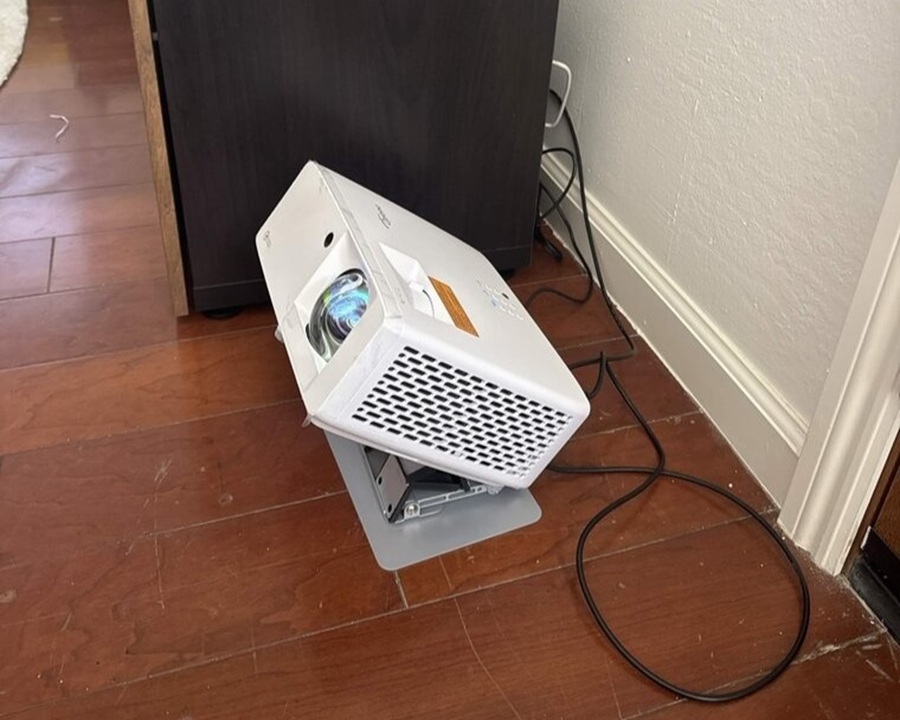
To facilitate this, Paczek grabbed a simple RTL-SDR Blog V4 USB radio antenna, a Raspberry Pi 5, and an Optoma GT2100HDR projector. The RTL-SDR Blog V4 pulls ADS-B (Automatic Dependent Surveillance–Broadcast) signals broadcast by aircraft in the area, while the Raspberry Pi 5 decodes the information into coordinates and renders the data into a display.
The projector fires it at the ceiling in 1080p (1920×1080) resolution.
Here’s what ADS-B is, if you’re not already a massive aviation geek. From the Federal Aviation Administration:
Automatic Dependent Surveillance–Broadcast (ADS–B) is an advanced surveillance technology that combines an aircraft’s positioning source, aircraft avionics, and a ground infrastructure to create an accurate surveillance interface between aircraft and ATC. ADS–B is a performance–based surveillance technology that is more precise than radar and consists of two different services: ADS–B Out and ADS–B In.
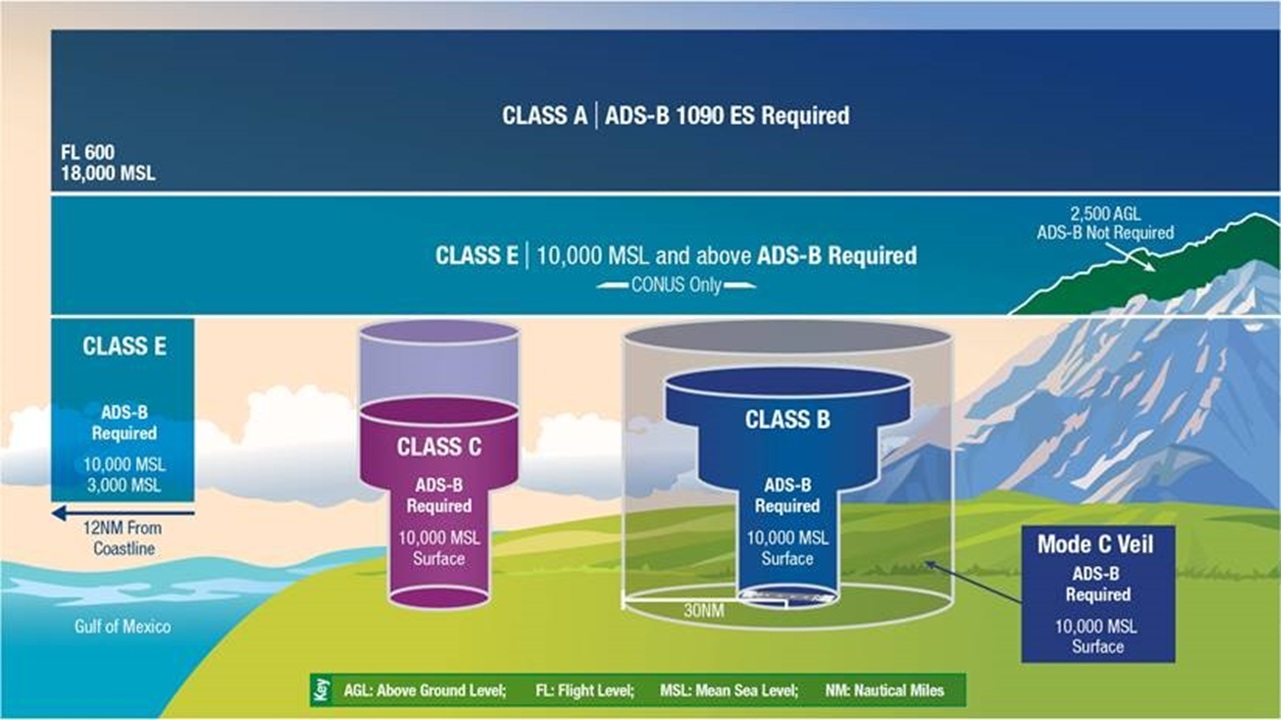
ADS-B Out works by broadcasting information about an aircraft’s GPS location, altitude, ground speed and other data to ground stations and other aircraft, once per second. ADS-B Out airspace and equipment requirements are contained in 14 CFR § 91.225 and the equipment performance requirements are contained in §91.227. ADS-B In provides operators of properly equipped aircraft with weather and traffic position information delivered directly to the cockpit.
The Skylight Ceiling isn’t just a flight tracker, however. The system projects the entire sky onto the ceiling. If it’s daytime, you’ll see the sun up there. If it’s nighttime, you’ll see bright stars, the Moon, constellations, satellites, and even the International Space Station. The data fed to the Skylight Ceiling is in real time, too, so you could peek your head out of your door and see that the plane on your ceiling is actually above your home. Here’s another video of it working, from Reddit (click here if you cannot see the embed):
Used a raspberry pi and ADS-B radio to build aircraft projection mapping onto my ceiling
byu/I_am_Root01 inraspberry_pi
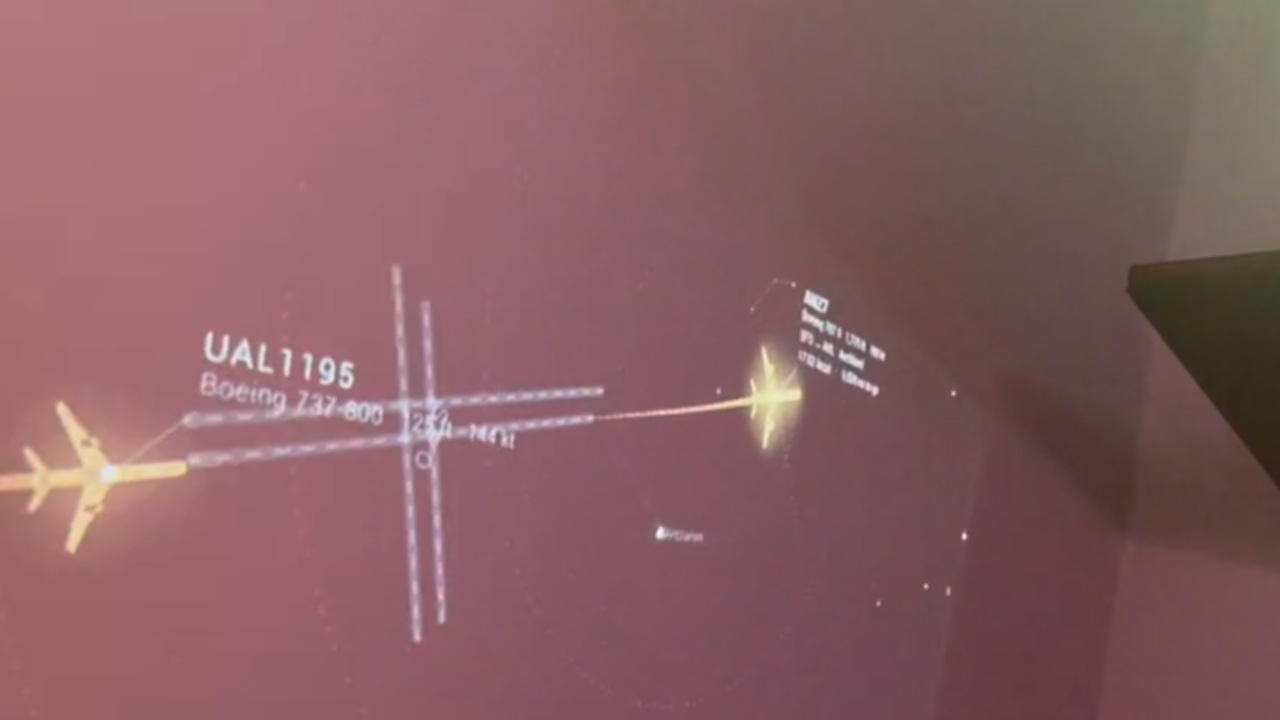
The aircraft part is pretty nerdy, too. You’ll get information about the aircraft type, its airline, where it came from, and where it’s headed. If that aircraft declares an emergency, you’ll see that, too. The awesome part is that the system pulls all ADS-B data, so you’ll catch any aircraft that’s broadcasting from NASA’s planes to the little Cessna that I fly.
The only limitation, Paczek says, is that the system is hooked to open-source data to gather the origin and destination for an airborne aircraft. Sometimes, the data is going to be out-of-date. So, the Skylight Ceiling will show an aircraft flying above your house, but you might see the wrong destination.
The awesome part is that Paczek is not hiding how he did this. On his website, he explains that all you need is a Raspberry Pi, an RTL-SDR, any 1080P projector, and the code to run it. That open-source code is available for free.
Sadly, if you tried to replicate Paczek’s exact setup, you’d be spending a lot of cash. An Optoma GT2100HDR alone could cost you up to $1,500. You’ll probably then spend another $67 on the RTL-SDR Blog V4 and another $45 on a Raspberry Pi 5. Thankfully, Paczek does say that it’ll work with any 1080P projector, and those do get dramatically cheaper than $1,000. But there’s no guarantee what kind of video quality you’ll get out of the other side.
Paczek also has a grand idea to make Skylight Ceiling into a ready-to-run product for people who just want to open a box and turn it on. For that, he says, he hopes to get a Kickstarter campaign going. His hope is to sell the device for around $500. Of course, most of the cost will probably go to the projector.
But for now, if you’re comfortable tinkering with tech, you can copy what Paczek did to get your own Skylight Ceiling.
I’m not going to lie, I’m head over heels for this thing. If Paczek told me he’d sell it to me today for $500, I might have been crazy enough to buy it. My apartment has a huge, blank ceiling that would be perfect for a night light of planes flying overhead. So, maybe I’ll be a Kickstarter backer. Or, maybe I’ll dust off my decade of IT experience and try to make my own. Who knows. Either way, hats off to Paczek for making something so genuinely cool.


We’re near to an airport that hosts an Air Attack base for firefighting. We can recognize whether the aircraft above is a tanker or a spotter by ear. They also floy vintage aircraft out of Nevada County Air Park, so we get some different aircraft.
that is insanely cool. but, hear me out… how about this, but for space stuff?
The software also includes space stuff (stars and satellites and the ISS), and I’m sure you could turn off the ADS-B stuff if you weren’t interested.
Neat!
That’s pretty neat! Would be really cool at my place in Maine, as nearly every airplane going from the East coast airports to Europe goes right over or next to Portland. Boston, NYC. Philly, DC all generally go right up the coast before heading out over the pond, I have been able to look down on Portland pretty much every time I have crossed the pond.
The sky is a mass of chemtrails over me there – no wonder I am so government controlled.
But with all those international flights, the question is which government is controlling you.
Who says there can be only one?
That would make my ceiling 100% less boring.
Ingenious stuff. The sky’s the limit!
Cool stuff and I’ve got an idle 1080p projector just gathering dust.
Get thee behind me SDR Satan!
I see the rabbit hole.
Once you get addicted to FlightRadar24, your life will seem incomplete without MarineTraffic.
Well, do you have a swimming pool? Because I have an idea…
Unfortunately not many boats go over my house.
I’ve been an ADS-B feeder for a few months now and it gets addicting. I started with nothing but an rtlsdr v4 and the antenna it comes with. Now I have 80ft of KMR400 cable, two antennas in my attic (one for 1090 adsb and one for 978 UAT), a Sawbird LNA, two cavity filters, an airspy mini and the v4 which I still use but only for 978. It’s all powered by an I5 minipc.
In return for feeding the big aggregators (FR24, Flighaware, Airnav Radar etc) they give you free enterprise/premium accounts, but feeding the unfiltered, independent aggregators like airplanes.live is where it’s at. So many flights are hidden by the big names.
Just now I heard a piston plane fly over low. I opened up my phone and there it is, a PA24 at 300ft traveling at 125kt.
Thanks for the link to airplanes.live, I’ve mainly used FR24 whenever I hear something unusual to see what type of plane it is, but over the last 2 years they’ve been removing a lot of features that used to be free.
This thing is great. It’s amazing what people can do with off-the-shelf tech and some ingenuity.
Where I live, I would have a blank ceiling 99% of the time. I just checked FlightAware and there’s one aircraft within 50 miles of my home right now, and it’s a regional flight about 40 miles north of me.
If I look up and see an airplane, it’s a rare occurrence.
I only see planes when it’s someone’s toy flying out of the local hobby airport or if there are delays at BOS and planes are looping in a holding pattern.
The only planes anywhere close right now are two small aircraft flying under 3000 feet.
I have the opposite problem, it would just constantly display 2 parallel trains of planes coming in to land at ORD about 10 miles north of me. It’s currently a slow period so they’re only stacked up 5 deep.
Being in between the Bears and the Cubs I’ve seen some really cool planes doing a flyover, my favorite being the B1 bomber. It’s so much bigger than you’d expect and loud in a very pleasing way.
That would make it even better.
The little boy in John Travolta’s new Apple TV film, Propeller, would have loved this.