


An oil change is one of the simplest, most common pieces of maintenance you can perform on a vehicle. For most cars, performing an oil change is painfully straightforward: Slide underneath the engine, remove the drain plug from the oil pan and the oil filter from its mounting location, and let the oil flow out. Then, replace the drain plug, install a new filter, and refill the oil from the top. Simple!
With modern cars and all of their gizmos and gadgets crowding up the engine bay, oil changes can sometimes be a bit more annoying. Whether that means removing multiple skidplates or aero shields to get at the oil pan, or having to remove multiple drain plugs, or having to reset maintenance lights on the dash, even oil changes aren’t immune to the complexities of modern engineering.


The current Toyota Tundra is no exception. Most versions feature a retractable air dam under the bumper that deploys at 37 mph to improve aero efficiency and retracts at 25 mph to unlock ground clearance. When the air dam is in its retracted position, it blocks access to the bolts needed to remove the skidplate, which hides the oil filter. Instead of making people crack open the owner’s manual to figure out how to move the air dam out of the way, Toyota has built in a genius solution that only requires you to have a phone with a camera.
The retractable air dam is standard equipment on the majority of Tundra trims, save for most off-road-focused models, which don’t get one. If you don’t do your own maintenance, you’d probably never even know it was there. When working properly, it can measurably increase efficiency, and unlike the Tacoma’s ungainly, fixed air dam, a retractable unit doesn’t spoil the Tundra’s good looks when you’re parked. Plus, you don’t have to worry about removing it when you’re going off-roading.
The downside, aside from worrying about yet another electrical part that might one day fail, is that when the Tundra’s air dam is in its retracted position (as it always is when the truck is stopped), you can’t easily perform an oil change. Toyota engineers, smartly considering how to make maintenance easier, built in a way to deploy the air dam without having to go through all the pain of removing the whole mechanism.

Many automakers require a special computer or a secret sequence of button presses in the cabin to get mechanical features to work in ways they’re not supposed to, and the Tundra is the same. To get the air dam to deploy, you have to switch the car in and out of ignition-on mode, then, within 45 seconds of shutoff, raise and hold the wiper stalk in the raised position for two seconds. After that, the air dam should deploy manually.
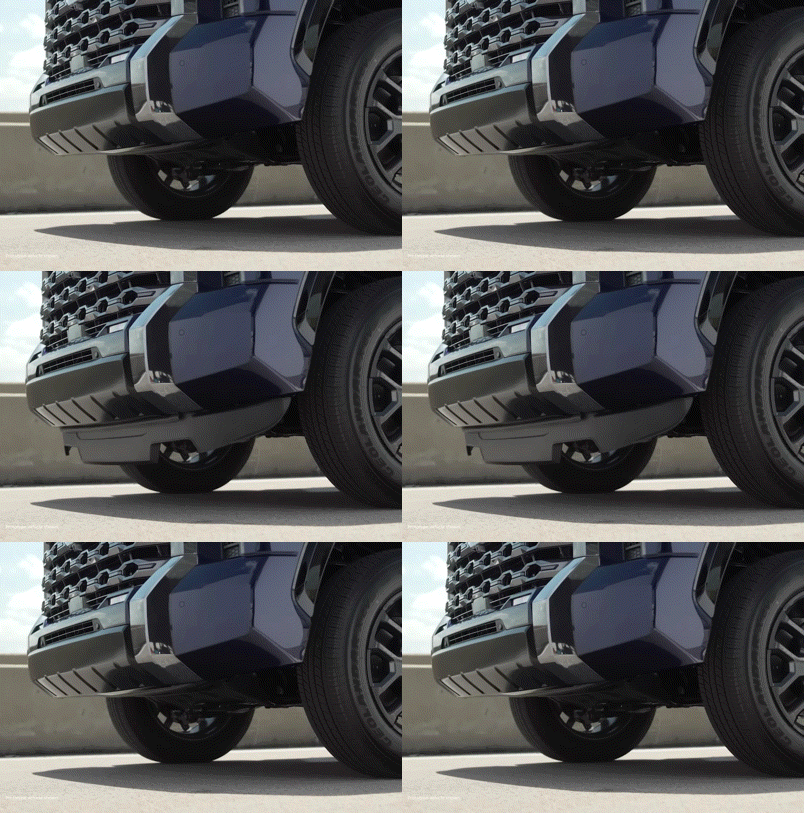
The coolest part about the Tundra’s air dam, specifically, is that you don’t have to spend a bunch of time scouring the internet or digging through the owner’s manual to find this information, like you would on most other cars. That’s because Toyota took the time during design and manufacturing to actually imprint a QR code onto the neck of the air dam that, when scanned by your phone’s camera, takes you to a YouTube video with the instructions. It takes all the guessing out of what to do and makes the process far more streamlined for career technicians and casual DIYers alike.
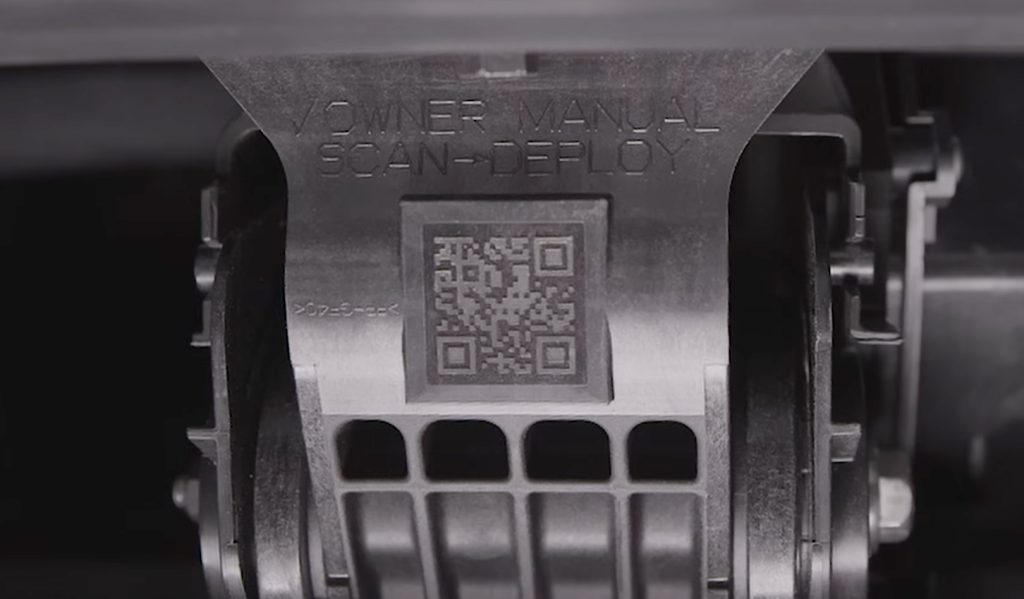
This has been a thing since 2021, when Toyota first started selling the current Tundra, but I’m just learning about it now, thanks to this TikTok I came across of someone doing an oil change job on their Tundra hybrid:
@joybarrett1961 #carspotting #carsoftiktok #mechaniclife #mechanicsoftiktok #foryoupage ♬ original sound – Carrestoration
In it, you can see the QR code molded into the arm of the air dam—it’s physically part of the plastic, not a sticker, which I think is a neat touch. It’s pretty fascinating that we’re at a point where car parts can now feature codes that take you directly to YouTube.
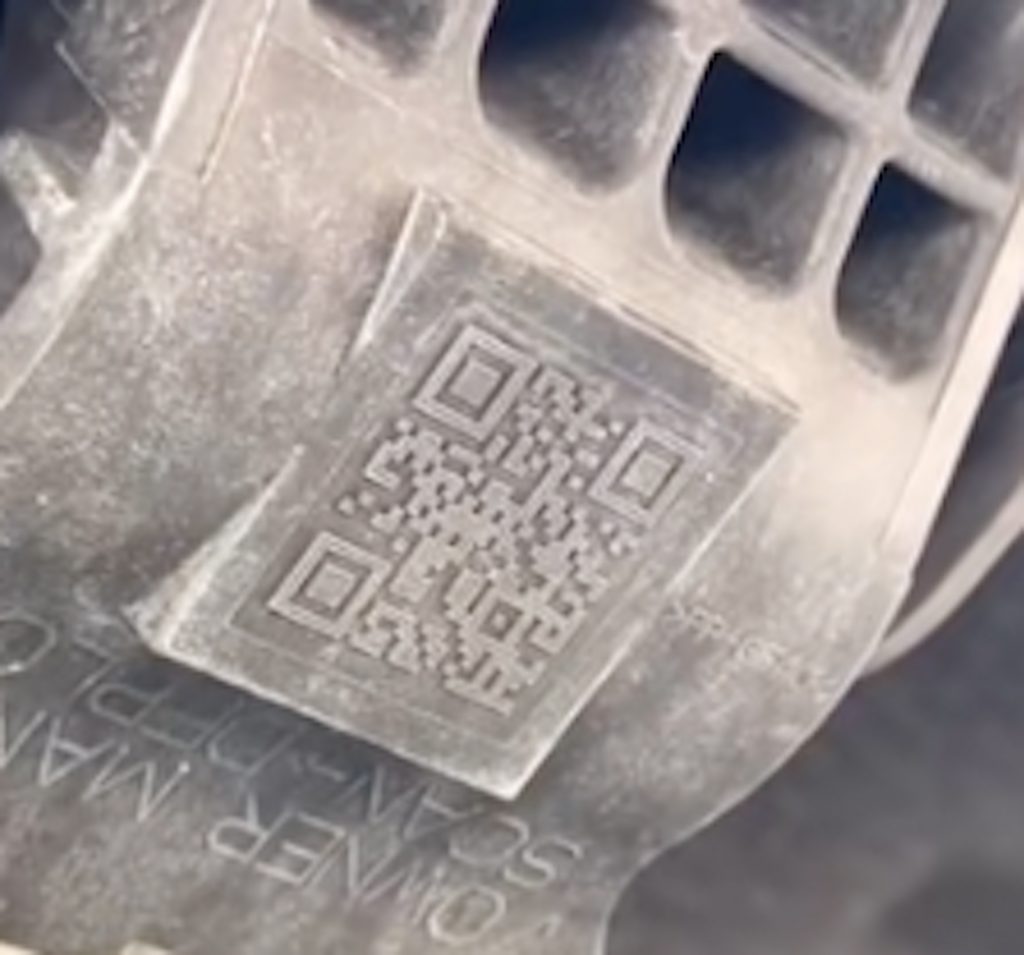
Sure enough, when I scanned the code, it took me to this video published by Toyota back in 2022 explaining why you’d want to manually deploy the air dam, and the instructions on how to do so:
As an aside, I think it’s also worth shouting out the cool built-in funnel for the oil filter. Usually, removing oil filters makes a huge mess, especially if it’s mounted sideways to the engine like it is on the Tundra. But Toyota engineers included a piece of plastic that collects all of the excess oil and funnels it into one tiny outlet.

In this case, the outlet drains directly onto the subframe, so it’s not a complete solution. But it does make catching all of the oil in one place way simpler.
As a person who often struggles with basic maintenance due to generally low brain activity, I really wish every car had QR codes imprinted on various locations that gave instructions on how to repair, replace, or fix things. It would make my life a whole lot easier.
I guess it shouldn’t be too surprising that Toyota is using QR codes in this way. We’re talking about the company that literally invented QR codes in the mid-1990s for streamlining manufacturing at its plants, after all. It’s only natural for this sort of idea to eventually trickle down to the people who fix and own the cars.
Top graphic images: Toyota


How is this better than having an access hatch in the splash shield? The moment you needed to unbolt a splash shield to access the filter I think “genius solution” went out the window…
Have you seen the Honda splash shields? It seems that, every time you remove one, a cheap plastic fastener brakes.
I’m usually a big Toyota fan and the first to defend them, but this is much closer to putting the digital glovebox release button behind five sub-menus than being a user positive experience. How about a cut-out or a little door so I don’t have to move anything? How about another angle on that filter drip catch funnel so it actually drains somewhere useful instead of me having to find a random length of hose in the detritus in my garage that is the wrong size and will surely fall off half-way through the procedure and still get oil on everything?
The car care nut has a plastic molded funnel / ramp made just for this vehicle for this issue, should be able to find it on line. he thought would be nice of Toyota to include it with the truck.
This doesn’t actually make it easy. It adds steps of discovery the first few times until you remember it and still demands you take extra, time-wasting steps to disable an automatic system. You know what would be even better than a QR code?
A latch. No QR code needed, just print instructions and arrows in a couple of places – a couple, because trucks. Just in case you rub it off on rocks or something. “Flip this lever to decouple the dam from the operation mechanism.” Yeah, it looks a lot like a quick-release hub on a ten-speed bike, because that’s pretty much what it is. Dead simple, inexpensive, no phone required. Remember to clip it back when you’re done. No, it won’t set off any codes or anything if you forget, but you’ll head to the pumps about 25 miles sooner than otherwise.
Adding parts is not inexpensive and adds another failure point.
The QR code cost basically nothing because it is a few more minutes on machining on the mold.
“In this case, the outlet drains directly onto the subframe, so it’s not a complete solution”
A piece of hose added over the outlet would be.
My Xterra had a little ramp under the oil filter, which did a great job of covering the swaybar with oil.
My current ZR2 diesel is a piece of cake for oil changes. High enough off the ground that I don’t need to lift it, access point in the skid plate for the drain plug. Easily accessible cartridge filter on top of the engine.
This exact reel was served to me by Facebook yesterday. This article feels creepy and targeted, and I don’t like it.
Google ” OK guys people are onto us, maybe we should tone it down.. NAH”
Very cool, but I don’t like that it depends on a 3rd party site like YouTube/Alphabet. Why can’t this video just live in the Tundra itself with all the other high tech gadgetry?
Because the gorilla at Jiffy Lube will be underneath the truck at the time, and it’ll save him time. I suspect this is meant more for them than the DIYer at home.
I mean, it’s got a bigass screen right there in the cab. Under the heading of Maintenance, an encyclopedia of helpful video tips that just…lives in the vehicle? To help you take care of it?
That sounds a bit too much like empowering the owner. It’ll never fly.
He isn’t in the cab. He is either in a pit or under the truck with it up on a lift.
However, he does have a phone in his pocket that he can use and it goes straight to the instructions. In 30 seconds he knows there is an easy solution and doesn’t try to pry or wedge the air dam out of the way
Also, everyone, hear me out: drain plugs are for suckers.
Get an evacuation pump. Drain the oil pan from above. It’s so damned civilized. Tons of vehicles have their oil filters on top. You just have to remember to wear gloves to keep your hands clean, that’s how civilized this all is.
I’ll stick with a Fumoto valve. Drains the oil from where it’s meant to be drained. Can attach a hose to drain it straight to a empty jug.
Only times I’m using a evac pump is if that’s the prescribed method for oil removal, or it’s a small engine without a drain plug.
They are good for boats, too. I can’t even reach the oil drain plug in my 454 powered Formula. Even if I could, you would have to let oil run down the bilge and out the drain plug for the boat in the back.
I’ve put fumoto valves on half a dozen vehicles now. This is the way. The oil drains more slowly, but that builds in some time to do a tire rotation and general inspection of other things. Also I have a garage TV and I can get in another episode of King of the Hill while I’m out there.
I do it with a pump too. First 4 oil changes were at the dealer. Any FOD is gone. New chip generation is much less after 25000 miles. I ll do 2 in my driveway out the dipstick and 1 at the dealer going forward.
Because draining from below helps flush out any particulates or sludge that may have settled on the bottom, and in general removes a higher percentage of the old oil.
Plus you can look at the underside of the vehicle when you’re down there and make sure everything looks okay.
The 1GR-FE has a topmount oil filter with a catch well around it, that all pours out a nipple on the bottom that’s a small enough diameter to put a bit of tubing on to run to the drain pan. I give Toyota some credit for these small things because it’s definitely more than a lot of manufacturers will give you.
My Polo had a little splash guard around the oil fill…which didn’t drain anywhere, and was a pain in the arse to clean out, so mostly there was just an oily mess..
I’m so jealous because Toyota switched to a bottom-mounted cartridge for the 5th generation 4Runner’s 1GR.
(I suppose if I wanted to spend extra and live just a little more on the edge there’s ways to relocate it…)
They have a big stupid honking touchscreen, why not just have a touch point labelled “Manual air dam deploy” under whatever they call their service heading where you would presumably go to reset the oil mileage tracker?
I was waiting to read exactly that
I was half-writing out the same comment when I read yours. Extending it further, how about they put the manual in the same screen? Perhaps with *gasp* a code reader!
IMO a code reader is the biggest thing they leave out. The big touchscreen would be ideal to display trouble codes.
The quick lube tech is under the truck not in the cab. Both locations would be better but if it is only in one place it should be where it is easy to find when doing the job.
Good point. I forget that people trust those kinds of places to anything but a junker on its last legs.
The hold the wiper control up after key-off for “service position” seems to be becoming a bit of a standard? Both my VW and Kia use that as a command to move the wipers from hidden/stowed into a vertical position to allow blade changes or to lift the blades in winter.
In the wiper case at least using the wiper control makes some amount of logical sense, using it for oil change prep seems a bit more of a reach.
I honestly clicked on this expecting to read about how Toyota had staked out space claims and enforced them throughout the development process to ensure that the drain plug and filter were accessible without removing anything else and ensured the filter was vertical so it doesn’t spill when you unscrew it.
Instead I just read about the reasons I don’t want a Tundra.
I was expecting some kind of manual bypass, like “remove this bolt and the motor is disconnected so you can move the dam by hand”.
Yeah or a quick-release of some sort, not a damn QR code.
Bad memories of changing oil on our ’99 4Runner where the oils drips onto the sub-frame unless you put something to interrupt the flow FROM THE DRAIN HOLE! ! !
For a good laugh check out how “easy” Toyota made replacing the cabin air filter. Apparently it’s a complete dash out job. (Don’t own one and only heard of this a few times anecdotally so take this with a lump of salt)
I’ll let you and Google AI duke it out over this one…..
“Replacing the cabin air filter on a Toyota Tundra is a simple, tool-free process completed through the glove box in about 5 minutes.”
Google’s “AI Overview” did just tell me yesterday that the 4Runner Hybrid specifically took “ECVT TE” transmission fluid and the Sienna hybrid can be hooked up the shore power – so either verify properly or leave it alone.
Oh, just like Jeep. The current wrangler has a cabin air filter that does not fit past the dash structure. To remove is not bad. However the new filter has to crush TWO inches of filter to pass around the dash. Why? Why Jeep.
“Why? Why Jeep.”
Because clearly you’ll buy a Jeep anyway.
Shout out to the funnel on the Ranger 3.0 since without it the oil leaks all over the starter.
https://www.therangerstation.com/forums/attachments/1635367556372-png.67586/