


An oil change is one of the simplest, most common pieces of maintenance you can perform on a vehicle. For most cars, performing an oil change is painfully straightforward: Slide underneath the engine, remove the drain plug from the oil pan and the oil filter from its mounting location, and let the oil flow out. Then, replace the drain plug, install a new filter, and refill the oil from the top. Simple!
With modern cars and all of their gizmos and gadgets crowding up the engine bay, oil changes can sometimes be a bit more annoying. Whether that means removing multiple skidplates or aero shields to get at the oil pan, or having to remove multiple drain plugs, or having to reset maintenance lights on the dash, even oil changes aren’t immune to the complexities of modern engineering.


The current Toyota Tundra is no exception. Most versions feature a retractable air dam under the bumper that deploys at 37 mph to improve aero efficiency and retracts at 25 mph to unlock ground clearance. When the air dam is in its retracted position, it blocks access to the bolts needed to remove the skidplate, which hides the oil filter. Instead of making people crack open the owner’s manual to figure out how to move the air dam out of the way, Toyota has built in a genius solution that only requires you to have a phone with a camera.
The retractable air dam is standard equipment on the majority of Tundra trims, save for most off-road-focused models, which don’t get one. If you don’t do your own maintenance, you’d probably never even know it was there. When working properly, it can measurably increase efficiency, and unlike the Tacoma’s ungainly, fixed air dam, a retractable unit doesn’t spoil the Tundra’s good looks when you’re parked. Plus, you don’t have to worry about removing it when you’re going off-roading.
The downside, aside from worrying about yet another electrical part that might one day fail, is that when the Tundra’s air dam is in its retracted position (as it always is when the truck is stopped), you can’t easily perform an oil change. Toyota engineers, smartly considering how to make maintenance easier, built in a way to deploy the air dam without having to go through all the pain of removing the whole mechanism.

Many automakers require a special computer or a secret sequence of button presses in the cabin to get mechanical features to work in ways they’re not supposed to, and the Tundra is the same. To get the air dam to deploy, you have to switch the car in and out of ignition-on mode, then, within 45 seconds of shutoff, raise and hold the wiper stalk in the raised position for two seconds. After that, the air dam should deploy manually.
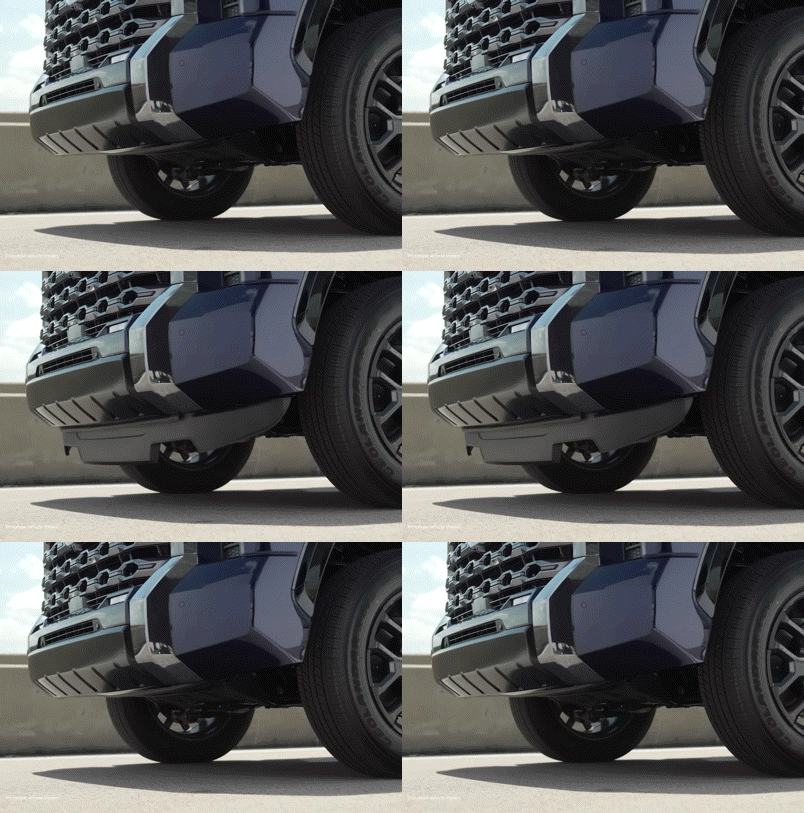
The coolest part about the Tundra’s air dam, specifically, is that you don’t have to spend a bunch of time scouring the internet or digging through the owner’s manual to find this information, like you would on most other cars. That’s because Toyota took the time during design and manufacturing to actually imprint a QR code onto the neck of the air dam that, when scanned by your phone’s camera, takes you to a YouTube video with the instructions. It takes all the guessing out of what to do and makes the process far more streamlined for career technicians and casual DIYers alike.
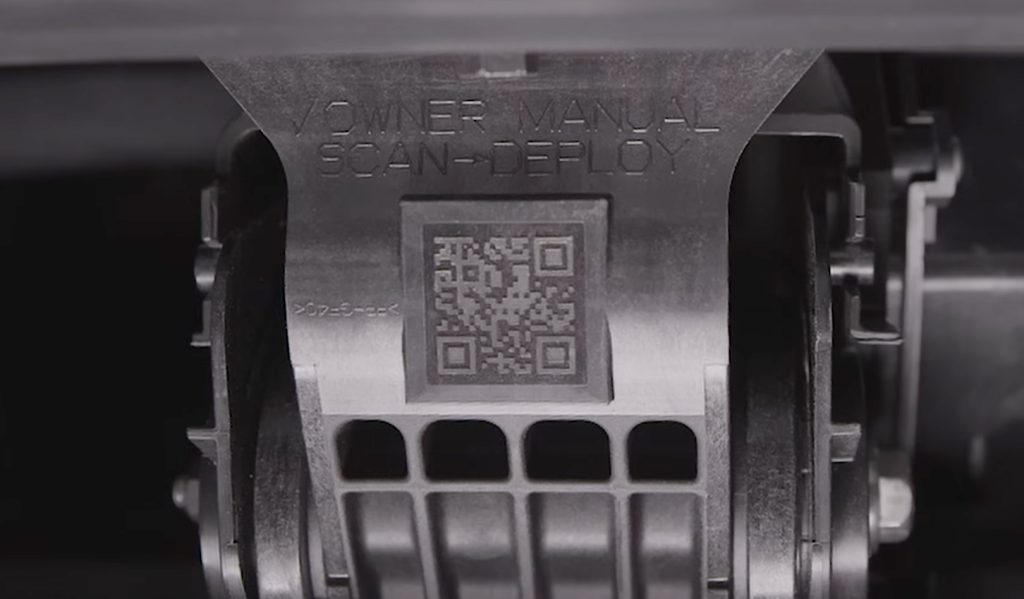
This has been a thing since 2021, when Toyota first started selling the current Tundra, but I’m just learning about it now, thanks to this TikTok I came across of someone doing an oil change job on their Tundra hybrid:
@joybarrett1961 #carspotting #carsoftiktok #mechaniclife #mechanicsoftiktok #foryoupage ♬ original sound – Carrestoration
In it, you can see the QR code molded into the arm of the air dam—it’s physically part of the plastic, not a sticker, which I think is a neat touch. It’s pretty fascinating that we’re at a point where car parts can now feature codes that take you directly to YouTube.
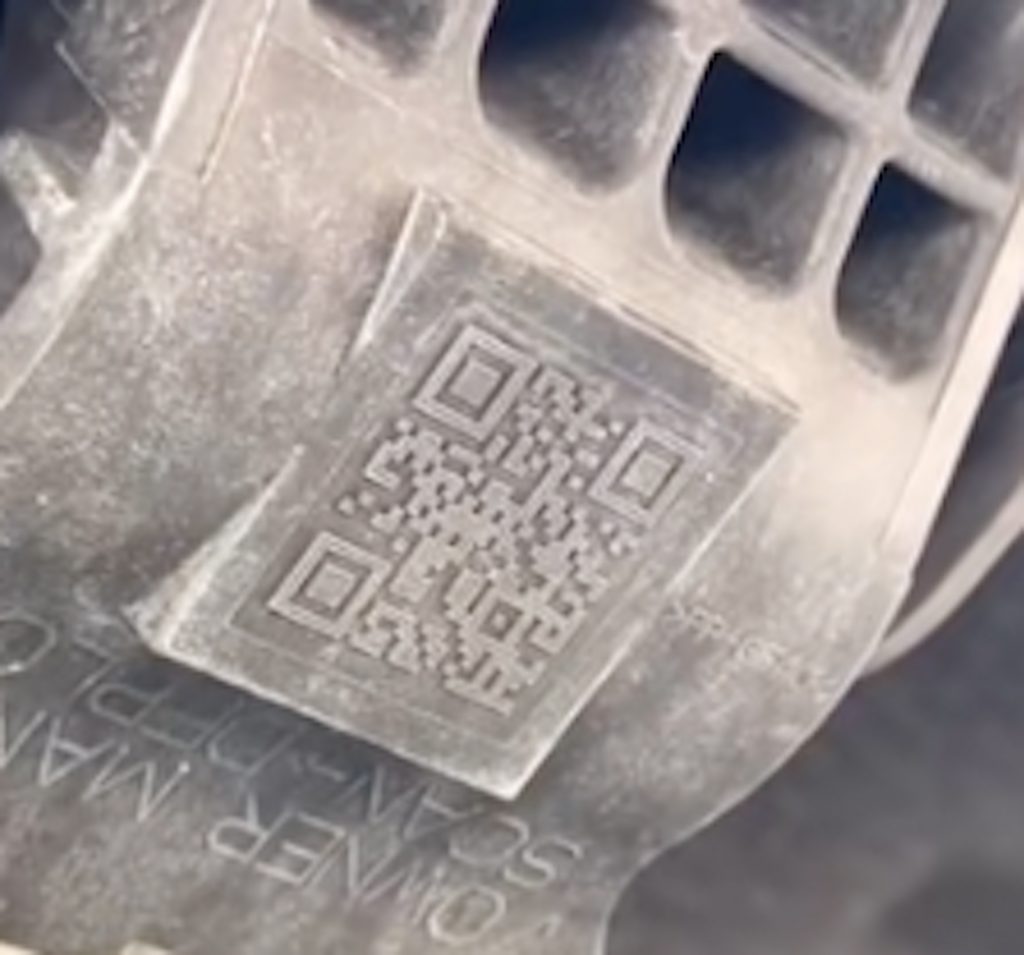
Sure enough, when I scanned the code, it took me to this video published by Toyota back in 2022 explaining why you’d want to manually deploy the air dam, and the instructions on how to do so:
As an aside, I think it’s also worth shouting out the cool built-in funnel for the oil filter. Usually, removing oil filters makes a huge mess, especially if it’s mounted sideways to the engine like it is on the Tundra. But Toyota engineers included a piece of plastic that collects all of the excess oil and funnels it into one tiny outlet.

In this case, the outlet drains directly onto the subframe, so it’s not a complete solution. But it does make catching all of the oil in one place way simpler.
As a person who often struggles with basic maintenance due to generally low brain activity, I really wish every car had QR codes imprinted on various locations that gave instructions on how to repair, replace, or fix things. It would make my life a whole lot easier.
I guess it shouldn’t be too surprising that Toyota is using QR codes in this way. We’re talking about the company that literally invented QR codes in the mid-1990s for streamlining manufacturing at its plants, after all. It’s only natural for this sort of idea to eventually trickle down to the people who fix and own the cars.
Top graphic images: Toyota


It’s great if you have it on a lift, sure, but if you are in the driveway, now you have a thing swinging down in front making it hard to get under the dang truck!
this makes me wonder whether someone’s ever activated the air dam while someone was under the car, and it hit the person underneath. Active aero is dangerous!
I now expect to see this method of deletion in a John Wick movie.
I imagine it’ll play out more like that Austin Power’s scene with the Zamboni
This is a trick to get unsuspecting, or not mechanically inclined homeowners, to void their warranties.
Alternate headline:
Changing the Oil in a Tundra is So Goddamn Complicated with Stupid Electrical Bullshit, Toyota Readily Admits They Will Need to Waste Even More of Your Time Making You Watch a Video to Enter a Cheat Code to Change the Goddamn Oil
Hallelujah, Holy Shit.
OK, that oil filter funnel is TRICK. All vehicles need that
Seeing that you also have a [sterling gray??] 5.0, you also know the pain of the plastic undertray that is trapped on a subframe bar, that the oil filter pukes it’s oil onto.
OMG yes I do.
I have never successfully removed that filter without spilling its entire contents onto said subframe and under tray.
Eventually Toyota will take the page that the QR link goes to offline. What then?
Remove airdam with heavy weapon of choice.
Either it’ll be common enough knowledge for DIY-inclined owners or it would’ve been deleted or stuck open by then?
The Tundra does not have good looks. It’s got a face like a high school bully whose parents are getting divorced. But at least you could stick a piece of heater hose over the spout on the oil drain funnel to keep oil from draining all over the frame.
It’s neat, but given how many parts have QR codes on them these days that are nothing but manufacturing tracking, I’m not sure I’d assume this one linked to useful instructions.
that’s why it’s labeled too
Ha, I was so focused on the QR code I didn’t even notice that. I retract my objection. 🙂
You just know the social media / marketing person was involved in the choice for using such services. Though given how corporate websites change constantly often removing whole parts. YouTube might be the safer bet but qr code redirect service why. Not a bad idea but qr codes are everywhere because they hold more data then a bar code and scan with being partly destroyed plus there are methods to restore them if partially destroyed. If the text gets covered or damaged someome would think it’s just the part number or something.
Title: Here’s The Genius Way Toyota Makes It Easy For DIYers To Change The Oil On Tundra Hybrids
From the article:
Spilling oil all over the subframe and making a mess is not, in my opinion, making it easy for DIYers.
Also, the guy in the tiktok video said it was harder to reach the oil drain plug because the air dam, in the down position, was now in the way.
Just wait until the service they’re using to redirect the QR code (qr studio) shuts down and someone nabs the domain name. I look forward to the day that scanning the code redirects one to a picture of a gorilla giving them the bird.
Or better yet, redirects to this YouTube video https://youtu.be/dQw4w9WgXcQ
Based on my cybersecurity training, I should not scan random QR codes. In this case, hackers will go under my vehicle and slap a fake QR code. After I input my social security number to get a discount for oil change supplies, credit karma will fill my inbox with spam emails about changes in my credit score.
Based on my experience changing oil on relatives’ cars that have been through “quick change” oil change places, this airdam will 100% be broken by the “tech” trying to get the skidplate off and then the skidplate will be mounted back on with only two bolts.
Also, the little funnel is a neat trick… until I read that it drains onto the subframe.
“Also, the little funnel is a neat trick… until I read that it drains onto the subframe.”
Here’s GM’s version that does not drain onto the subframe:
https://www.early-retirement.org/attachments/img_6970-jpg.60101/
I can’t remember models offhand, it’s been a few months, but there are some Fords that have the drain plug aimed directly at a cross member on the subframe that make an almost idealized fan spray pattern.
I know there are tensions between design and manufacturing, but I refuse to believe that anyone in design has worked on a motor vehicle from a service perspective.
And GM has that shit oil filter placement on Canyons. And they always use at least 6 screws to seal the damn air box. And Toyota frequently requires removing a skid plate just to change the oil, one particular time costing me three hours and ruining a bolt extractor in the process.
Fuck Toyota and them saying this is a service friendly move.
And because I’m already kind of in a bad mood, I wish Brian would learn to be a little critical and not be such a rube in celebrating the half-assed scraps car companies throw out for positive press and call them on bullshit when it’s bullshit.
The first time I did an oil change on a 2021 Mazda 3, I was amazed.
A small door is built into the undertray. It has reusable and sturdy clips holding it closed.
Behind this door is the filter and the drain bolt. Both drain straight through the opening.
This is a 15 minute oil change as DIY, including getting out the ramps and having a beverage while it drains. You don’t even need a rag to wipe anything off.
That’s making things easier! Yes!
I don’t think it’s a bad idea, but I’m surprised Toyota used a 3rd party host instead of putting the video on their own servers. If YT goes out of business, or even if they change how URL point to specific videos, the QR code becomes worthless.
If YT goes out of business, we will lose ~20 years of societal progress (and cat videos of course). Please don’t even put that out into the universe.
You’re not wrong, but there are hundreds or thousands of web servers containing vast piles of knowledge that have disappeared, and we have survived as a civilization. Nothing is permanent, especially on the Internet.
Progress? Are you sure about that?
DEVO
Are we not men?
WE ARE AI!
And twenty years of instant and viral disinformation. So, a mixed bag. Imagine if it weren’t possible to see videos claiming people are eating dogs and cats in Minnesota, or that you should eat nothing and drink only water for 20 days to rid your body of ‘toxins’. And they’re recording the video with MacDonald’s breath.
I don’t know that it’s intuitive for people to take their phone under the truck and start to scan QR codes in the hope that something links to youtube when trying to do an oil change if they didn’t know this. Even if so, it then means you need to get back off the dirty ground and get into the presumably clean truck to do the automotive hokey pokey to get it to retract or deploy or whatever it needs to be.
Just engineer the thing correctly in the first place so the filter is easily accessible to the average human or add a button to the maintenance section of the giant screen that makes it deploy. It’s. Not. That. Hard.
I’m of the firm belief that many oil filters (present AND past) are located in more difficult to reach or messy places than they need to be purely in order to funnel service dollars to the manufacturer’s dealer service departments.
Truth be told, things are likely placed where they are for engineering performance/reliability targets and ease of assembly during the manufacturing process. If we can ship a car off the line 5 seconds faster, that is an additional 100 cars a day or 27k extra per year that didn’t cost us any extra money
Not to mention the same engine is often shared in several vehicle families that may have very different frame/accessory geometries and attempting to optimize the filter placement for all of them is impossible.
A lot of OEMs now design a single cylinder then stretch that out for the different applications. Commonality of parts/locations helps keep our costs down.
I do not own a smart-phone, so this is yet another reason for me not to buy a Toyota, I guess.
I remain annoyed that I needed to buy a scantool with specific Porsche programming to reset the maintenance interval on the Panamera. It definitely tells you what Porsche’s maintenance expectations are.
While a fireman I learned that all newer Mercedes cars have QR Codes inside the fuel door and on the driver’s side B-pillar. When scanned by first responders, it will bring up the rescue card for that particular vehicle. It will show all of the air bags, no cut points, how ton turn off the car if EV, etc, etc, etc. And if your Mercedes is old enough and does not have the QR Codes, the service department will attach them.
That’s a great and simple idea that other manufacturers could make a uniform standard.
That’s an awesome idea.
The problem for the air dam manufacturer is that a valid QR code is now a functional requirement of a good part (just like weight, dimensions, etc), so they would have had to create a quality check for confirming the QR code scans correctly for every part over the multiple years of the program. Toyota would look like morons if their slick QR code doesn’t scan.
I used to work for a Toyota interior plastics supplier and (almost) had to manufacture a part with a customer-facing QR code molded in. Technically we couldn’t just point an industrial vision camera at it and read the output with dedicated software, because the end user has a cell phone with completely different (worse) lenses and consumer grade QR translation programs. We half-seriously considered chaining an iPhone to the work cell and making the operator scan the code for every part. Luckily the QR code got removed and we didn’t have to worry about it anymore.
Or…hear me out…they could just put the oil filter on top of the engine.
“Toyota makes oil changes way harder than everyone else and needs extra parts to collect spilled oil because of dummy filter placement” becoming “Toyota is fucking genius for using a QR code” is some Thank you for Smoking level PR work.
Thanks for the chuckle
Or add a digital button in the maintenance section of the giant screen “Deploy air dam for oil change” and the next time the key is cycled it automatically reverts back to the default setting.
Yeah, that would only require programming and not a physical button.
Right? What’s with the secret wiper stalk code? Just add a button in the infotainment and make the user confirm their selection to avoid accidental deployments.
Exactly. When I wanna jack the Q7 I don’t have to input a PS1 cheat code using the wiper stalk. I just go to service on the screen and check “jacking mode”, and next time I drive it, it turns itself off. Toyotas solution is botched from start to finish.
Considering how my Toyota has two completely separate oil change maintenance alerts that I both reset with each oil change I’m not optimistic.
Wait till you see how easy it is to change the oil on the 3.0 SCV6 and 5.0 SCV8 JLR engines. All topside.
…if you have the “oil sucker” vacuum device.
Insurance adjuster: “explain to me one more time how your windshield got cracked”.
I don’t think the air dam position is what is spoiling the Tundra’s looks.
I feel like a power airdam was a feature of multiple bubble era Japanese sports cars. For some reason the R31 Skyline and A80 Supra come to mind. That makes this truck extra JDM.
Is this catch-feature for the oil new, I can’t quite tell from the image where it resides on the engine?
A lot of the top-mounted filters I’ve seen have a drip trough to catch the oil. I’ve never followed the drain tube where they go though.
they just drop back in the engine, at least that’s how it is on subaru. Make sure you clean the tray before attempting to remove the filter
Wait, when did Toyota go to the standard “can” oil filter design?
when did they leave the can? All of my toyotas have been can; Mazda and Subaru have been pleated insert.
FJ’s and 4runners changed to dual overhead cam in 2010 so the filter had to be moved from up top to the bottom which also switched to a cansiter style. My 2013 FJ is a PITA for oil changes since the filter is under the front skid plate which has been rusting to hell and has snapped some bolts. At times wish I had a pre-2010 but they also had their own issues and less power.
Every Toyota I’ve seen in my shop has had a filter like a Pentastar: a cartridge with an o-ring.
I guess it just depends what people see and when.
Yeah this is like “sit to wipe” and “stand to wipe” people discovering each other for the first time….I legitimately thought every Toyota used the cartridge design.
That’s a very specific bar you patronize.
It’s a crappy place called The Heart of Darkness.
Hmm… I have owned several Toyotas, and all have used the normal tin can spin-on filters.
That’s what you own versus what I’ve seen. I see plenty of 2008+ 3.5’s and 2 liters, which use NAPA’s 27047, for instance.
Huh? All of the US-market Subarus I have ever seen are equipped with an old-school metal cased spin-on oil filter.
Every Toyota I’ve seen has a easy to break canister filter under the car. Then you either have to buy a whole new assembly from Toyota or get an aftermarket part made from aluminum – and still breaks the next time you change the oil.
Feels like whatever they decided for a given model and engine.
4th gen 4Runner? Can on top.
5th gen 4Runner? Cartridge on bottom.
6th gen 4Runner? Can on bottom.