

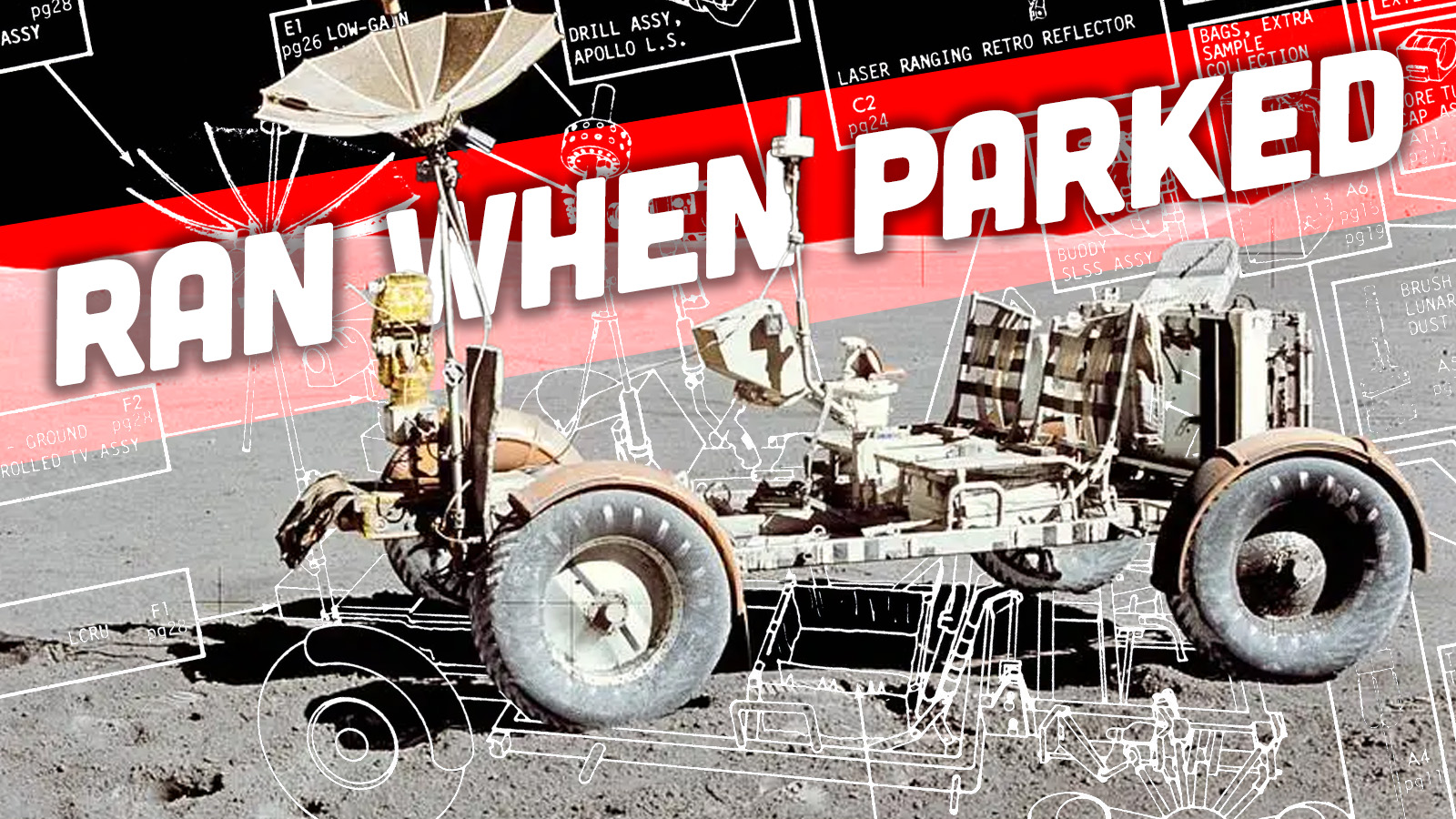
As we speak, there are four daring astronauts that have just flung around the moon for the first time in over 50 years, and are currently, let’s see, as of this writing, about 136,700 miles from home. This particular Artemis II mission is going to (hopefully) be the start of many more missions to the moon, including ones that will put people back on the surface of the moon, and, ideally, establish some manner of permanent presence on our only natural satellite. This is exciting to me. It also means that, if we’re going to be going back to the moon, we’re going to need some way to get around.
Sure, there will be new, advanced lunar roving vehicles developed, I have no doubt, but this is the Autopian: we can’t just ignore the fact that there are at least three perfectly good used car projects just waiting for us on the moon! They all ran when parked, too, and I’m pretty sure rust or mold isn’t a problem up there on the moon, so I think what we’re looking at here are three smoking-hot deals, just waiting to be had!


You’re all familiar with the Lunar Roving Vehicle, right? They’re all 1971 and 1972 models, and there was a production run of three, not counting earthbound test versions, all bound for export to the lunar market. These rovers went up on Apollos 15, 16, and 17. Here’s some nice video of one of these babies in action:
They all should be in about the same general condition, though the Apollo 17 one had a minor mishap that led to it having one of its fenders repaired with some tape and lunar maps, so if you want a minty one, go for the 15 or 16 ones:

A Little Overview
They did their jobs incredibly well; NASA wasn’t going to take any chances, so they made a rule that the furthest astronauts could drive the rovers would be in a circle with a six mile radius, the maximum walk back an astronaut could do given the restrictions of supplies in their spacesuits. Even so, that gave a lot of area that could be explored, far more than could be done on foot, and on Apollo 17, for example, they drove 22 miles in the rover. This was well within the 57 mile range of the rover’s batteries, which we’ll get into more detail about soon.
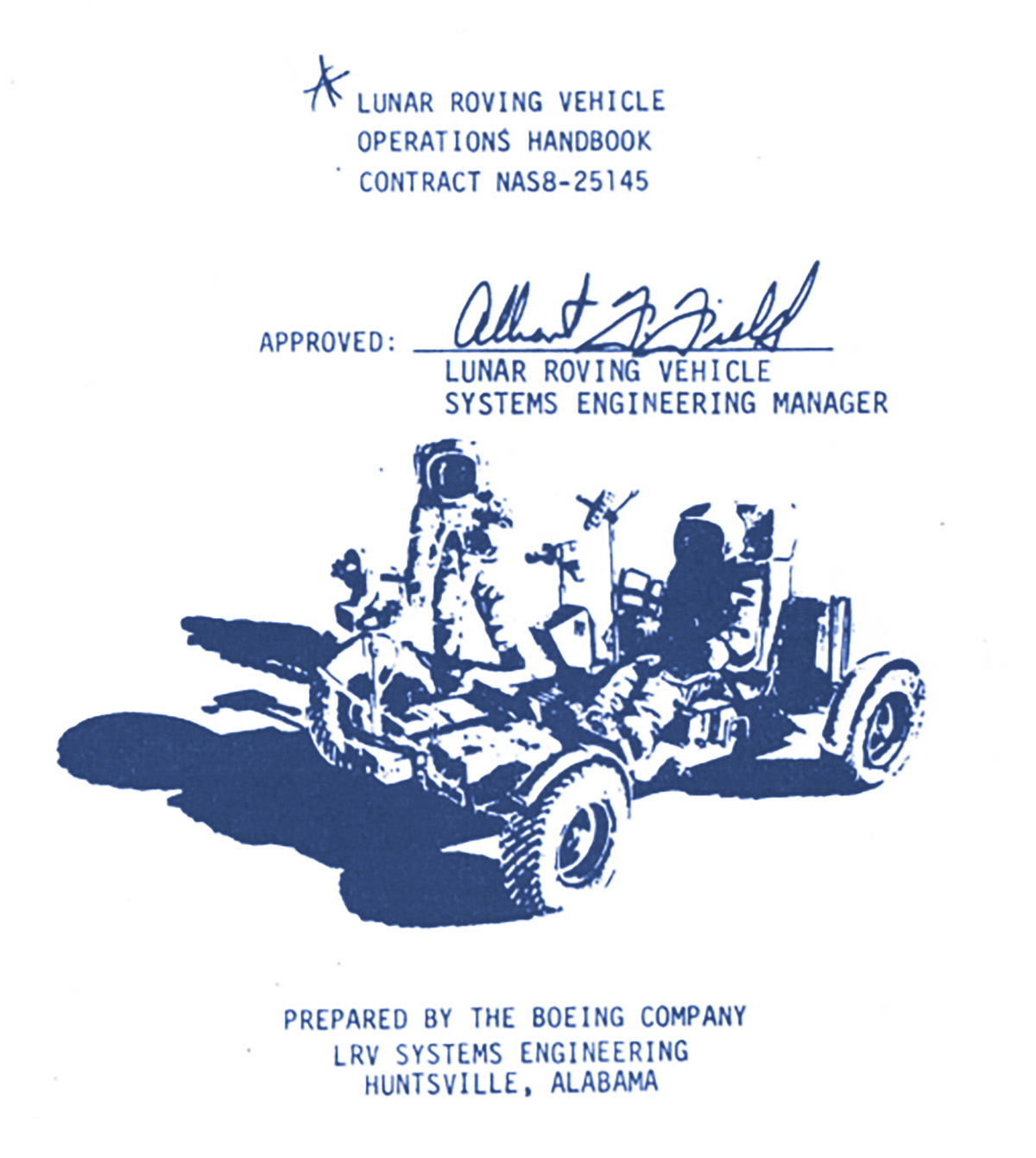
The rovers had a total of only about one horsepower, divided between four 1/4 hp motors, one driving each wheel. That may not seem like much, but you have to remember that the moon only has 1/6 of our usual gravity, so even though it weighed about 480 pounds on Earth, on the moon that’s under 80 pounds! It was rated with a top speed of 8mph, but Gene Cernan got one up to 11mph during Apollo 17.
Where To Find Them
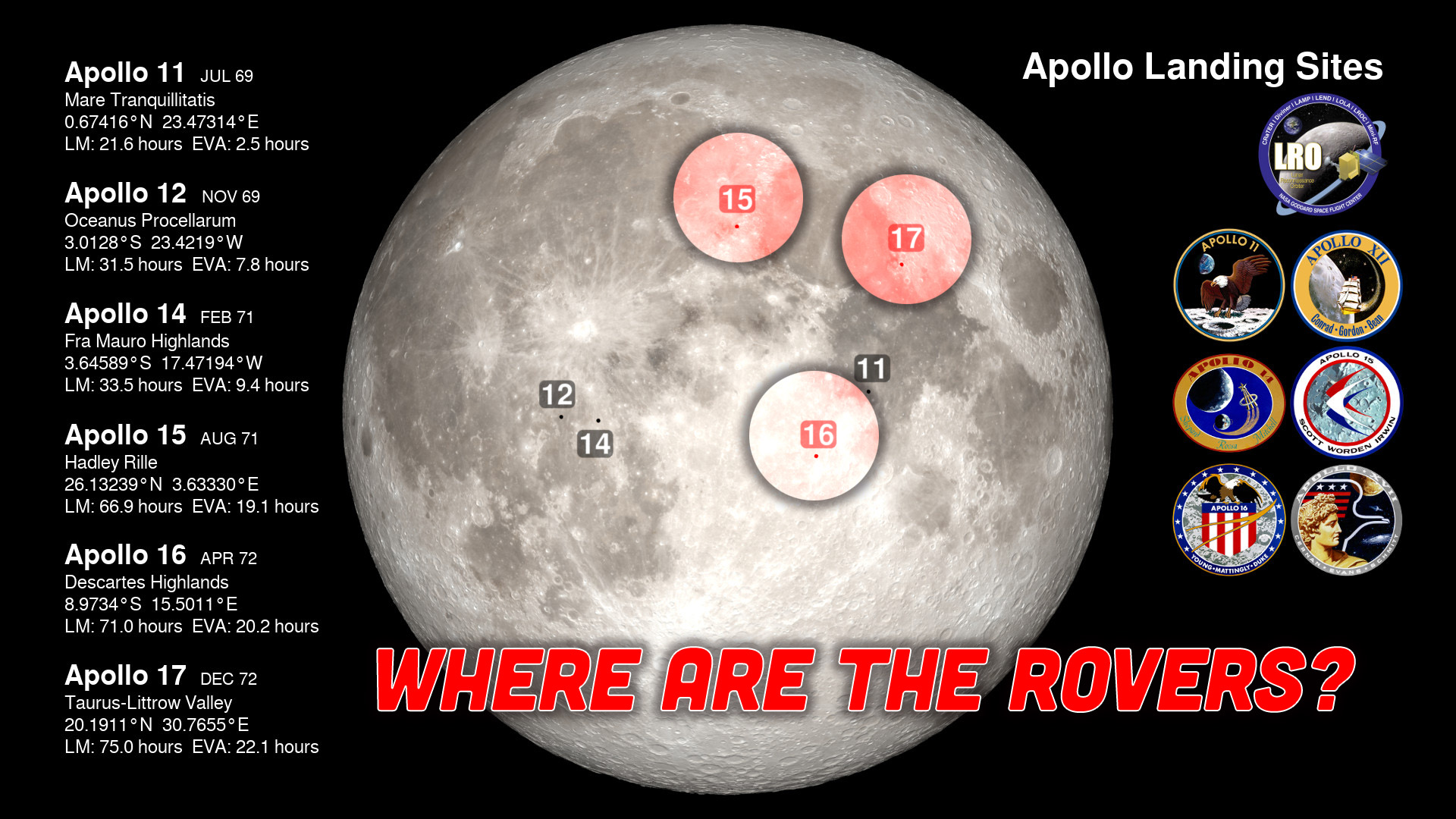
Here’s the locations of the three rovers: one at Hadley Rille, one in the Descartes Highlands, and one in the Taurus-Littrow Valley, so now you know what sections on Lunar Craigslist to check.
What Will They Need To Get Going Again?
The good news here is that all of these rovers are very low-mileage, one-owner examples. All were in perfect running condition when parked over 50 years ago. There’s no weather on the moon as such, so really the only wear they likely have been subjected to are thermal fluctuations and the UV rays from the sun, which likely has faded paint and decals and could have degraded some exposed wire insulation, possibly. I’d bring some electrical tape just to be safe.
The biggest thing that will need replacing are the batteries. These were never designed to be recharged. The rovers use a pair of 36V silver-zinc batteries in special plexiglass housings. These batteries were good for 115 amp-hours, or about 4.14 kWh. Either battery could operate the entire rover for redundancy’s sake, though in normal operation one battery drove the front wheel motors, and the other drove the rear.
The batteries are mounted at the front of the rover:
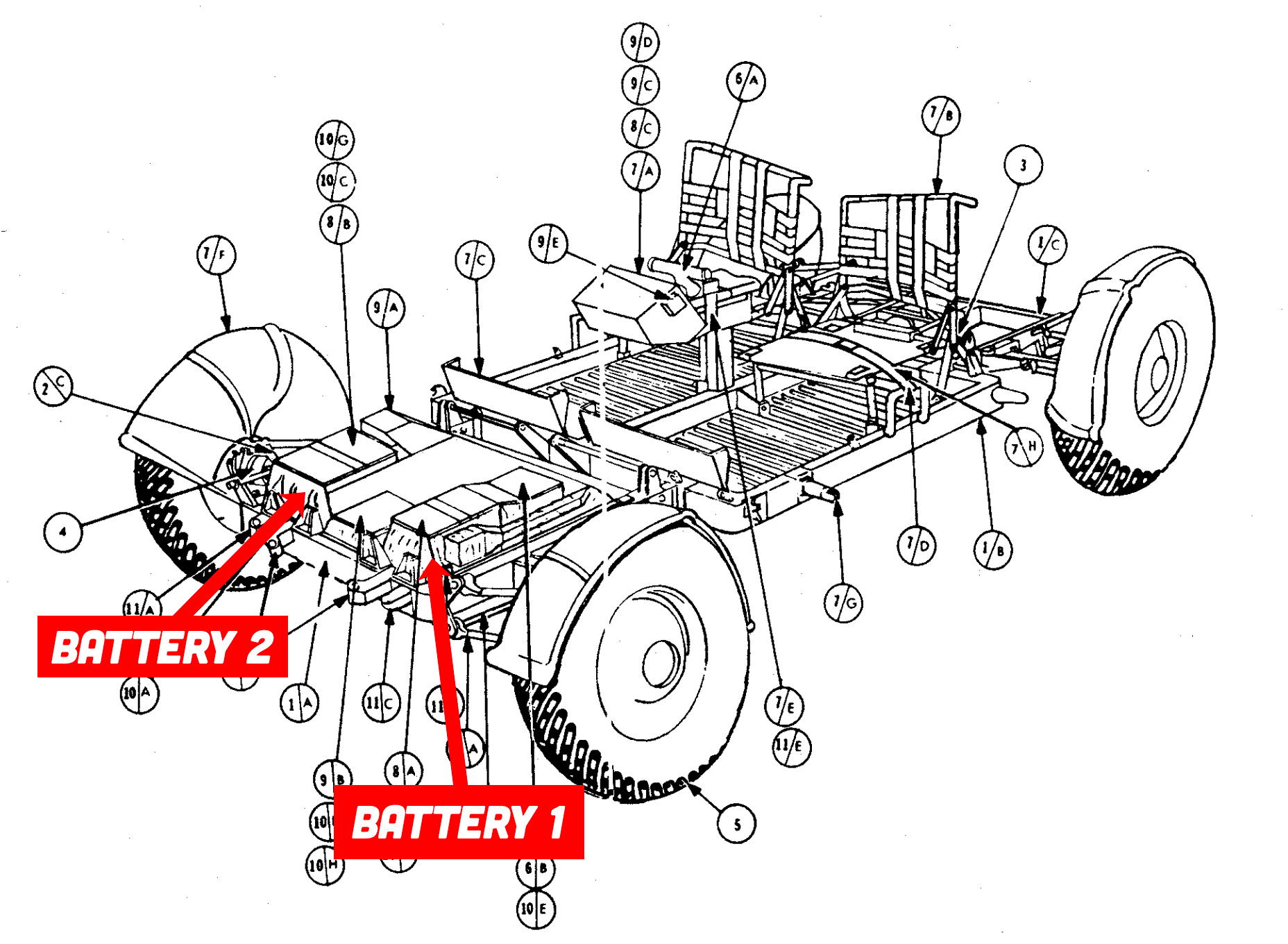
The batteries are under thermal blankets and are also used as heat sinks for some of the other electronics on the rover to help maintain their operating temperatures. Here’s the temperature range NASA set for the batteries:
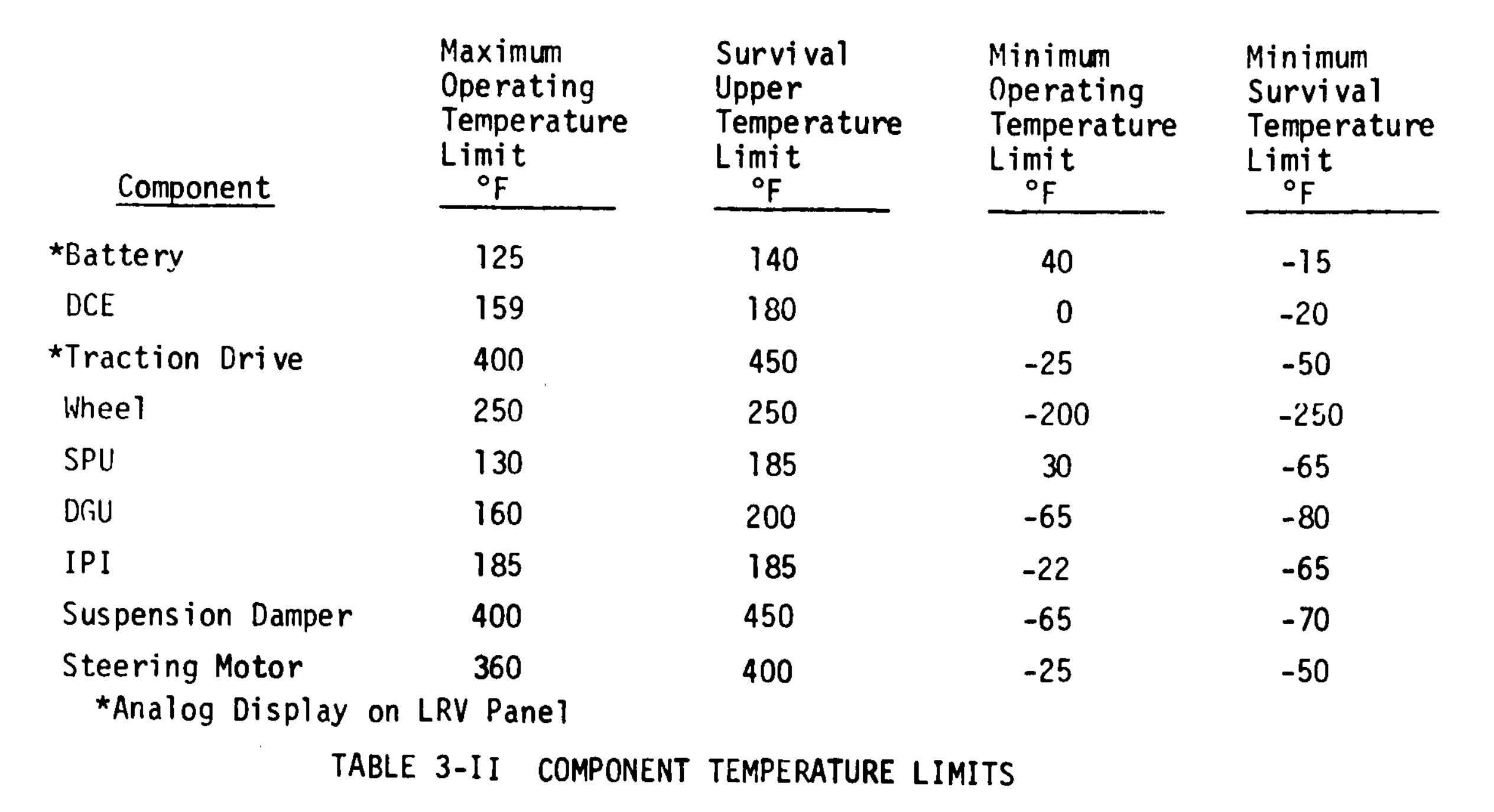
So, it looks like the thermal system was designed to keep the batteries at an operating temperature between 40°F and 125°F, with a survivable range of -15°F to 140°F. This is actually good news for the plan to restart these rovers, which will involve replacing these batteries with modern lithium-ion batteries, which are generally able to operate between -4°F and 140°F.
Also good news is that there’s plenty of lithium-ion golf cart batteries that are 36V! Here’s a bunch on Amazon! But let’s get good ones, since we’re going all the way to the moon. This one is a 36V (technically 38.4V, like all the 36V batteries here, but that should be fine) that makes 120 amp-hours/4.32 kWh, so that’s even better than the originals. And I think it should fit pretty well – it’s not exactly the right size, but it’s within a couple inches on each dimension, so I bet with a little hammering/finagling, we can get it to fit. So order two of those.
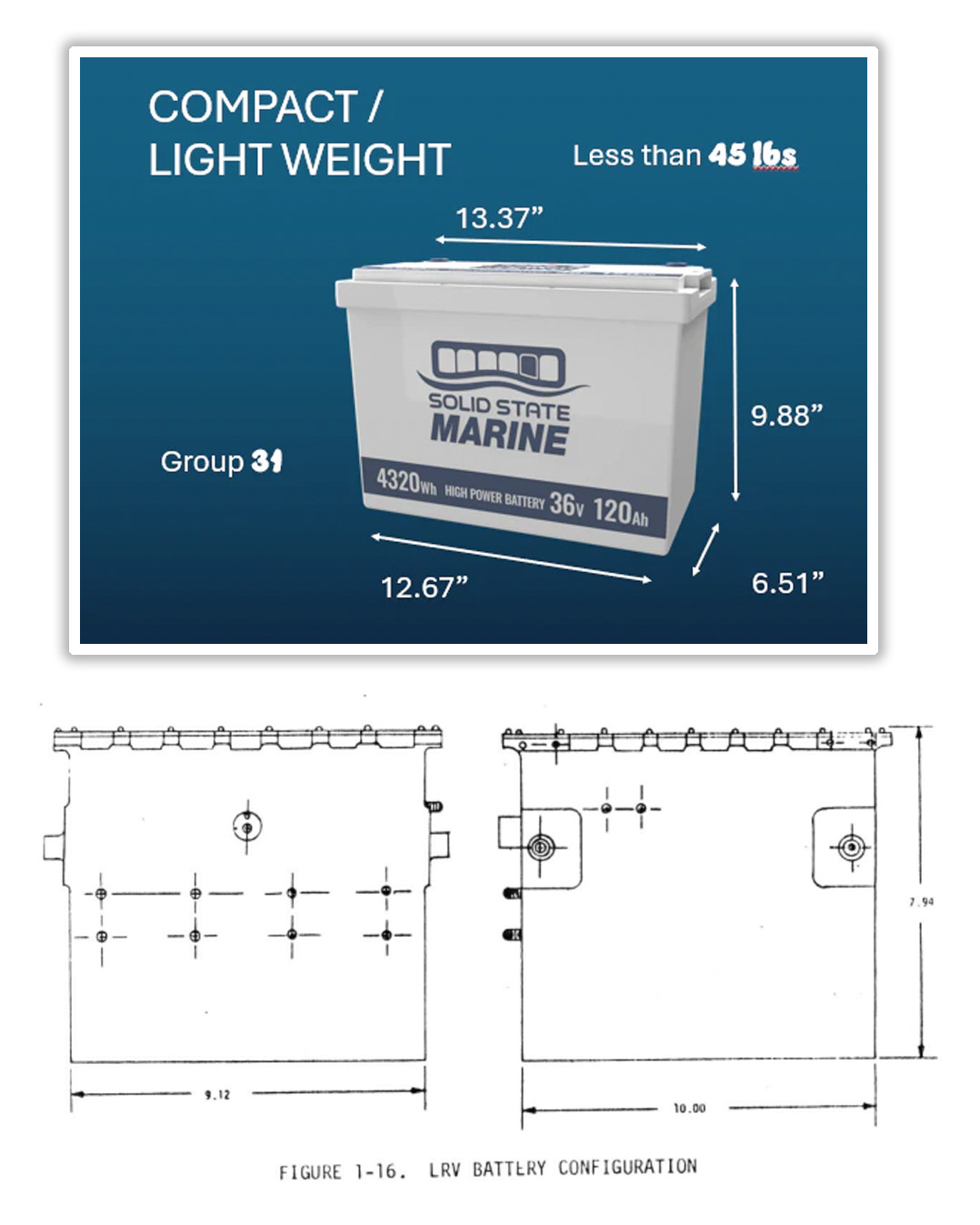
The procedure for removing/replacing the battery doesn’t seem too bad, either; these instructions are for the Earth-based training rover, but it should be pretty similar to the ones on the moon, because the whole point of this thing was to train astronauts for the real thing:
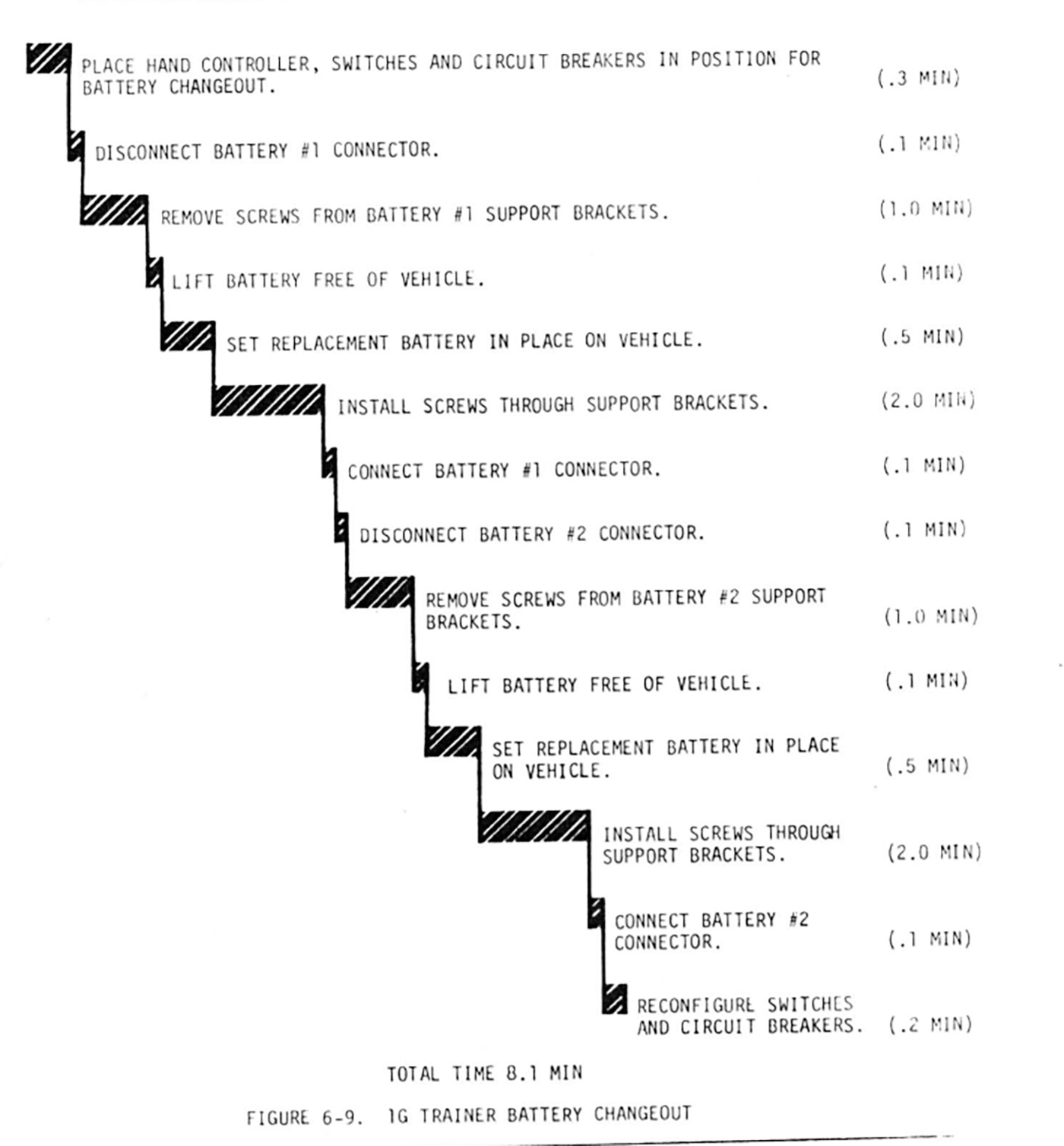
I think the trickiest bit will likely be the connector; I haven’t been able to find definitively what the battery electronic connectors that were used, but I strongly suspect that it’s a MIL-DTL-5015 connector, likely a four-pin one, based on schematic diagrams. Two pins are for the usual positive and negative terminals of the battery, and I think the other two are instrumentation.

I’d say go up ready for any possibility; have a cable with these MIL-DTL-5015 connectors, but also maybe have pigtails that you can just splice into whatever the rover actually has. I think if you can get the + and – connected, you should be good to go!
How To Drive It
Okay, I’m confident that this is going to work, that the new lithium ion batteries will be able to be crammed into those battery trays, that the thermal management components can be replaced, and connectors either plugged in or spliced on, and you’ve got 36 rich, creamy volts flowing through the system.
So now what? How can you drive these? Happily, it seems pretty straightforward. First, have a seat in one of the two seats, and look in front of you. You should see the instrument panel:
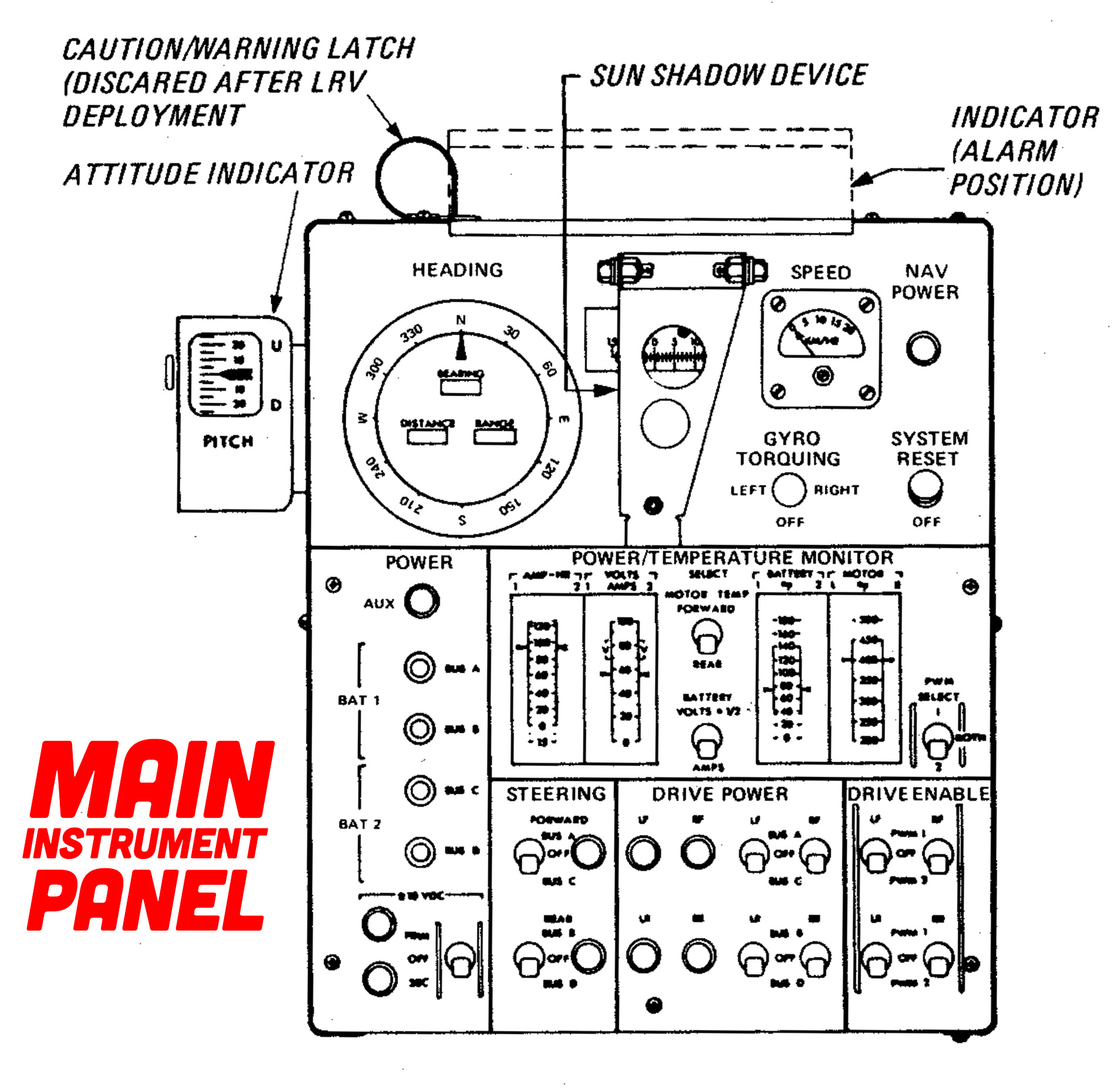
Hopefully those four vertical lights on the left side will be illuminated, two BUS lights per battery, showing you that you have power. To turn the thing on, you’ll want. to flip these switches to ON:
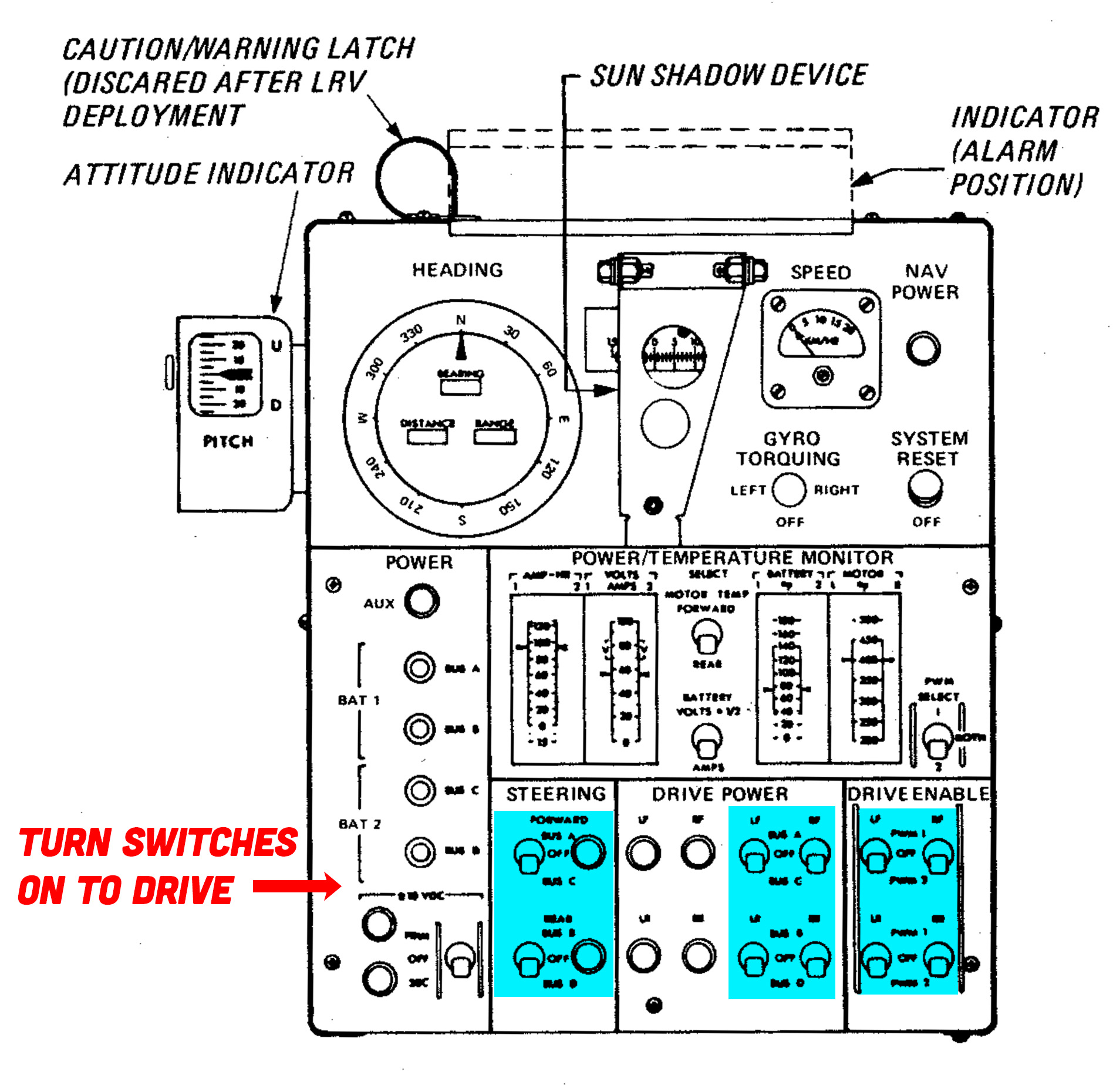
The leftmost two starts the steering systems (front and rear), and then to the right of that are four switches, one for each wheel’s drive motor, and then four DRIVE ENABLE switches, again one per wheel. So just flick all those on!
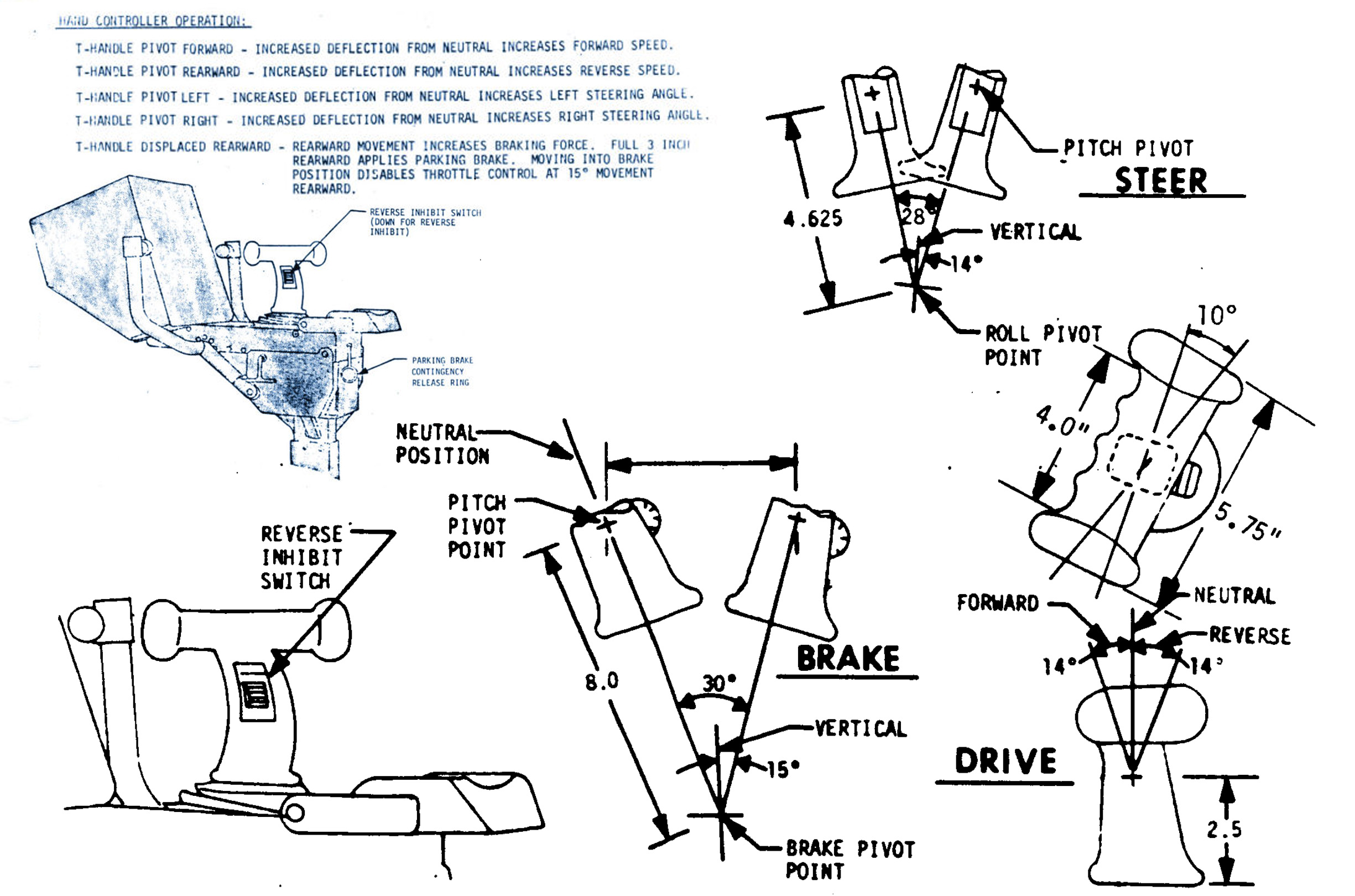
Now, to actually drive, there’s a big T-shaped handle in the middle, between the seats. To accelerate, push forward, to brake pull back. If you keep pulling back, you’ll go into reverse, unless that REVERSE INHIBIT switch is on.
To turn, just rotate the handle in the direction you want to turn! It’s that easy!
We Can Do This
There are three perfectly good lightly-used rovers on the moon. It would be criminal to just leave them there! Cars were meant to be driven, after all, and if all these things need are new batteries – which I think it’s a safe bet to assume that’s all they need, it’s at least worth a try – then why not get those classic rides going again?
Think about it, NASA! Why waste the money? These are prime deals, just sitting there!
Story and top graphic images except where noted: NASA


Imagining Derek Bieri.. “Lemmezee if I can get this heap running and drive it 238,000 miles home, sparkulators, yup!”
First thing I thought of as I was reading the story.
“Well, a feller bought himself a moon rover! Hasn’t moved in about, ohhh, fifty years or so. We’re gong to throw some lightning cubes at it and drive it a couple hundred thousand miles home. Or somethin’. It’s fine. “
You did him better <3
Watching him pull out the old batteries and throw them 100 yards away would be worth it alone.
Now I’m suddenly wondering if Derrick Barry is a pun on Derek Bieri and I just never noticed…
This is going to be David Tracy’s next crazy project isn’t it?
You need oxygen for rust. Also, I don’t think AMC had any part in this project, had they?
No rust, he’s not interested
He’s going to combine all three into one running model, and drive it to Moab for Easter Safari.
Well on one hand no oxygen, on the other he gets two parts cars to fix one.
No one can say if this one will be harder than the prior ones.
You gotta approach this project with at least one donor rover. Parts are near impossible to source.
Changing the batteries? In space no one can hear you use a chainsaw.
“The rovers had a total of only about one horsepower, divided between four 1/4 hp motors, one driving each wheel. That may not seem like much, but you have to remember that the moon only has 1/6 of our usual gravity, so even though it weighed about 480 pounds on Earth, on the moon that’s under 80 pounds! It was rated with a top speed of 8mph, but Gene Cernan got one up to 11mph during Apollo 17.”
I mean, it’s basically a Changli.
” I bet with a little hammering/finagling”
/chainsawing…
“Never seen rain”
For once you can actually believe that line in the ad.
This might be one of my favorite Torch articles ever.
Weren’t the Lunakhods nuclear powered?
it probably took less than $500 in hardware to turn this into RC car
The plastic webbing on the seats is probably nearly dust from the UV, so budget for upholstery
At least air in the tires is not an issue.
…or salt damage.
literal run-flats
I love this, Torch. So much!
I was expecting to see “chainsawing” in there when talking about making batteries fit.
Send Stephen, he can fix Jags. This should be a walk in the park for him.
Ok, but does NASA still have the titles? Are there gonna be back fees on the registration?
Gonna be a huge hassle renewing registration without a VIN. They’ve really cracked down on that in the last 50 years.
What makes you think they don’t have a VIN? Due to the age it won’t be the current 17-digit format, but I’m sure they have serial numbers.
As a VIN nerd, now I need to know this.
Ha. I wonder if the serial numbers are 000000001, 000000002, and 000000003.
Not to mention the overdue parking fees.
It’s a GM product, so they’ll probably run, just bad. Shot of space ether down the gullet, she’ll go.
I would be so happy if the rover shared even a single part with a production car. What are the chances they raided the parts bin?
It’s GM, so about a 150% chance.
We need to get the guys from Roadkill up there.
or Vice Grip Garage.
There definitely needs to be some discussion about which car tuber or writer we need to shoot up there to do this. Cleetus too tall he’s out. Derek of VGG definitely has the skills and focus but there’s no O’Reilly’s up there. Torch has a family. I vote for John Ross.
Are there an boats on the moon? Maybe a Whaler? Perhaps it came with its harpoon?
Just gotta look out for the local buggalo farmers. Gotta keep your hands off their daughters, for sure.
Perfection
Tommorrow’s Shitbox showdown:
NASA Lunar Roving Vehicle (1971) vs. 1976 Citroën Méhari – Only One of These Has Been Parked on the Moon for 55 Years and Is Still There Right Now
It’s the open-air, low-speed, absolutely-no-business-being-driven-anywhere Shitbox Showdown you deserve.
In one corner: a fold-up aluminum dune buggy with wire mesh wheels, zero suspension worth mentioning, a top speed of 11 mph, no roof, no doors, no windshield, and a price tag of roughly $38 million. It was steered with a T-shaped hand controller, could not be repaired if it broke down, because where exactly were you going to walk to, and was simply left on the Moon after each mission like a rental car in a long-term lot that nobody is ever coming back for. There are three of them up there right now. Just sitting there. Perfectly preserved in the vacuum.
In the other corner: a French plastic box on wheels that weighs 500kg, rusts if you look at it wrong, has a top speed of 62 mph that it will only hit once before something falls off, and was designed specifically so that French farmers could drive it through a vineyard. It has no doors. It has a folding fabric roof that is laughably vestigial. It is wonderful and terrible.
Both are essentially golf carts. Only one of them has driven on another world.
Only quibble is the rovers are proven reparable: all you need is some duct tape and a couple pages of mission protocols.
lol, very true. But I do wonder if it truly had something going wrong beyond replacing a fender, what could have been done. The nearest NAPA or Oreilly is about 238,855 miles away. But maybe they can ship a part on the next SpaceX flight, might take 3-4 days for it to get there.
Shipping is going to suck though and sure hope you have insurance.
Sure it costs a bit more, but I think it’s worth splurging on Comprehensive.
And yeah, that had been my original thought years ago (what happens if it breaks?). I first assumed it had to stay within walking distance, in which case, what’s the point? But now I know “walking distance” = 6 miles. And I guess once you determine in the first couple feet that the “tires” really do grip and everything works as expected, you have a lot more confidence taking it further.
Pish! Order parts from Amazon with two day Prime delivery!
Problem solved!
Genuine question: could this thing even function back on earth? I know they had trainers, but I assume they were heavily modified to deal with the other 5/6ths of earth gravity and what not.
The gravity affect is really just about the vertical loads that it needs to withstand. The mass is the same, thus acceleration and braking will be similar as long as traction between the wheels and ground isn’t the limiting factor. On flat ground, traction probably is ok to stop and go within the limits of the motors even with the fine, loose dust, but turning could be more trouble with only 1/6 the normal force to create traction between metal wheels and the ground. Uneven ground is really the biggest issue though, as it doesn’t take much speed to turn an otherwise innocuous bump into a ramp that would get the Rover and occupant space-borne, where they no longer have any control over their flight path, this can’t avoid obstacles or could flip
I’ll take the Rover 🙂
Room for a 6ft3 guy’s legs in the Mehari is nonexisting!
(But I’ve seen worse, in a Jaguar XK120…)
“Ran when parked.” Love it!
The moon knows what it has.
What goes on at the moon, stays on the moon!
Something about hookers and blackjack.
(sees the repaired damage….kicks tires) Ehh…it needs some body work….best I can do is $250.
The webbing on for the seats has likely disintegrated in the extreme UV exposure, so bring a space pillow to sit on.
probably better that way. Adds lightness and will improve the quarter mile times significantly.
A pillow?! 5-gallon bucket is just fine.
Clearly the absolute goal of this endeavor is to resurrect all 3 rovers and line them up for a …
SPACE RACE
Disappointed to see there’s no gaff holder on the rovers. Where do you stow your harpoon?
“To turn the thing on, you’ll want.”
Did Torch briefly go to Yodaspeak?
Wouldn’t vacuum welding of the moving parts be a problem after 50 years up there? Though maybe the wild thermal swings prevent that? And saying UV and thermal swings “might” be a problem is underselling that quite a bit.
hopefully they’ve been garage-kept.
All joking aside, I wonder if there will ever be a time some billionaire recovers one for a collection
Jeff Bezos recovered some Apollo program rocket engines from the sea floor, a rover would definitely round out his collection.
This was exactly what I was thinking about
-OR- It would be the perfect artifact for someone looking to one-up Bezos with his silly rusty F1s.
Look up “Salvage 1”, a TV movie/short-lived series from the late 70s. The premise was recovering “moon junk” to resell back on earth.