

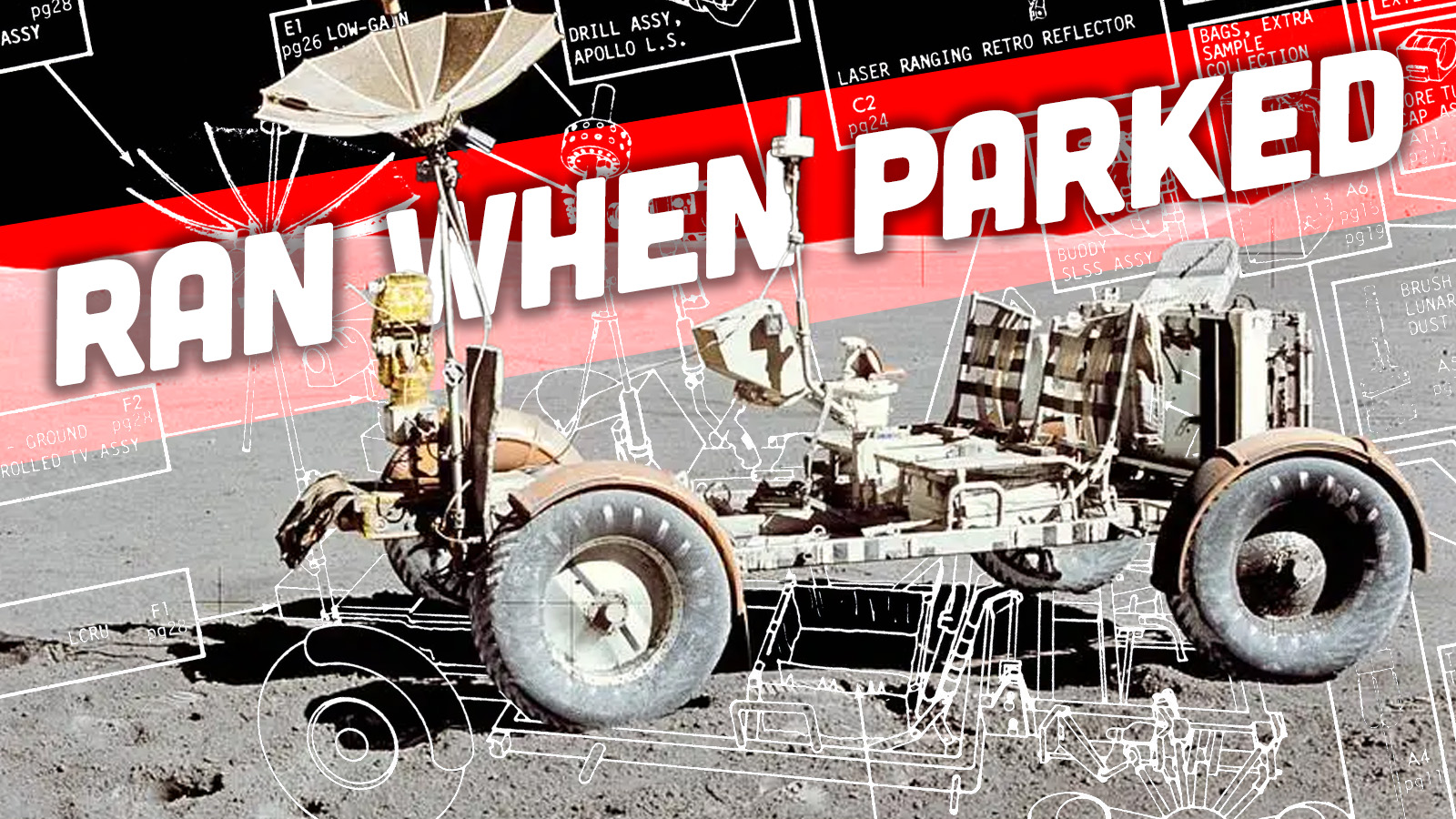
As we speak, there are four daring astronauts that have just flung around the moon for the first time in over 50 years, and are currently, let’s see, as of this writing, about 136,700 miles from home. This particular Artemis II mission is going to (hopefully) be the start of many more missions to the moon, including ones that will put people back on the surface of the moon, and, ideally, establish some manner of permanent presence on our only natural satellite. This is exciting to me. It also means that, if we’re going to be going back to the moon, we’re going to need some way to get around.
Sure, there will be new, advanced lunar roving vehicles developed, I have no doubt, but this is the Autopian: we can’t just ignore the fact that there are at least three perfectly good used car projects just waiting for us on the moon! They all ran when parked, too, and I’m pretty sure rust or mold isn’t a problem up there on the moon, so I think what we’re looking at here are three smoking-hot deals, just waiting to be had!


You’re all familiar with the Lunar Roving Vehicle, right? They’re all 1971 and 1972 models, and there was a production run of three, not counting earthbound test versions, all bound for export to the lunar market. These rovers went up on Apollos 15, 16, and 17. Here’s some nice video of one of these babies in action:
They all should be in about the same general condition, though the Apollo 17 one had a minor mishap that led to it having one of its fenders repaired with some tape and lunar maps, so if you want a minty one, go for the 15 or 16 ones:

A Little Overview
They did their jobs incredibly well; NASA wasn’t going to take any chances, so they made a rule that the furthest astronauts could drive the rovers would be in a circle with a six mile radius, the maximum walk back an astronaut could do given the restrictions of supplies in their spacesuits. Even so, that gave a lot of area that could be explored, far more than could be done on foot, and on Apollo 17, for example, they drove 22 miles in the rover. This was well within the 57 mile range of the rover’s batteries, which we’ll get into more detail about soon.
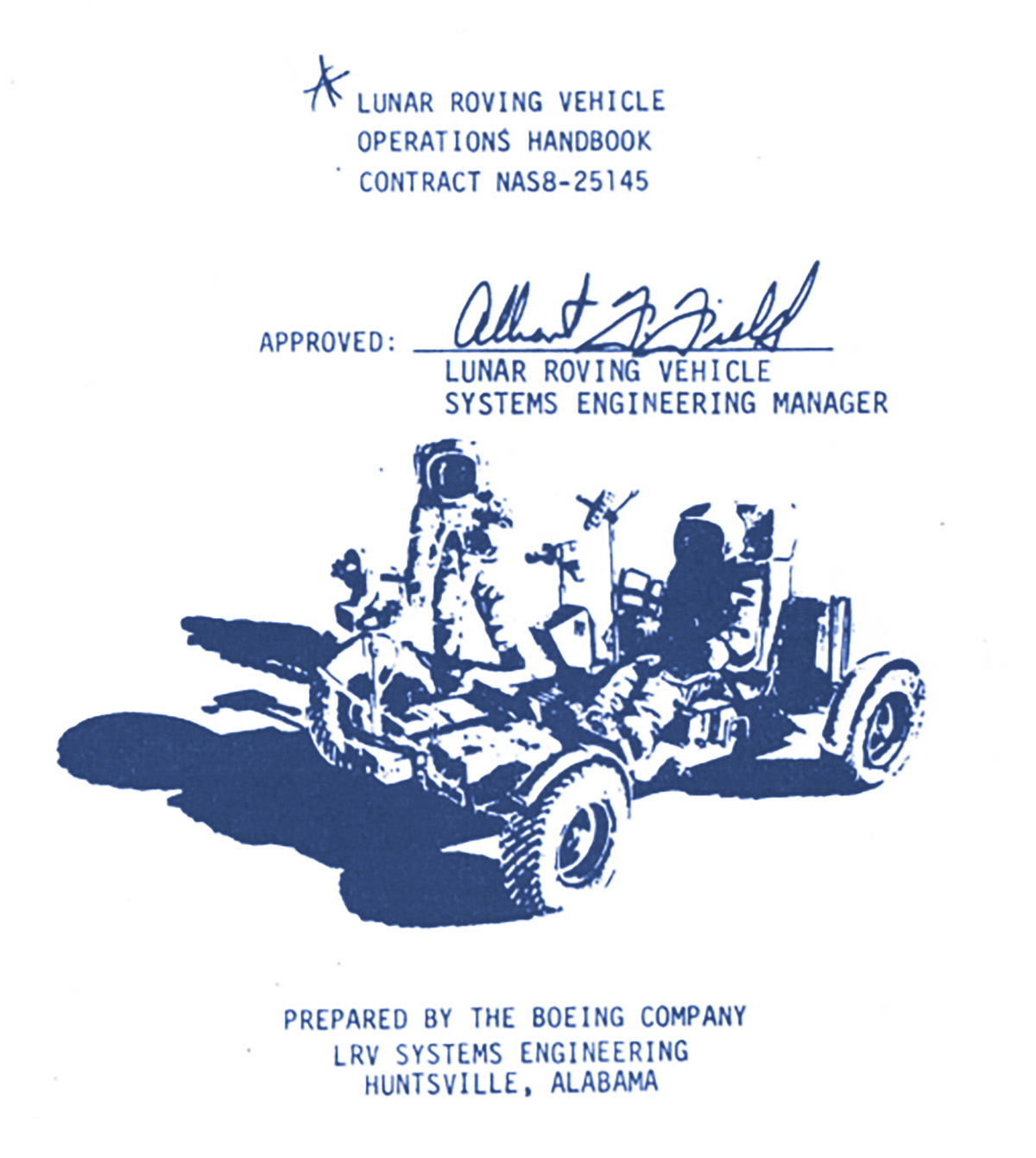
The rovers had a total of only about one horsepower, divided between four 1/4 hp motors, one driving each wheel. That may not seem like much, but you have to remember that the moon only has 1/6 of our usual gravity, so even though it weighed about 480 pounds on Earth, on the moon that’s under 80 pounds! It was rated with a top speed of 8mph, but Gene Cernan got one up to 11mph during Apollo 17.
Where To Find Them
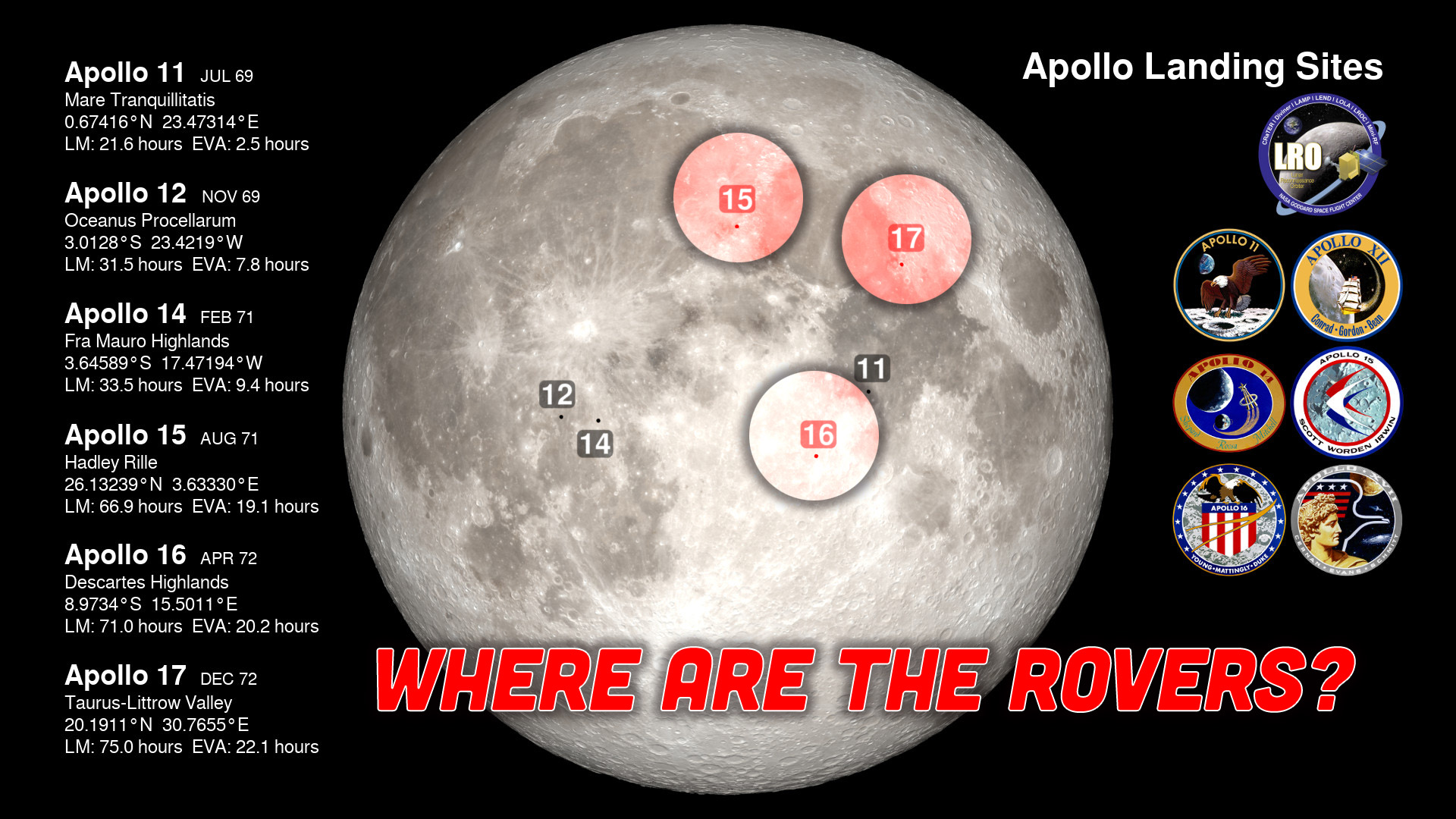
Here’s the locations of the three rovers: one at Hadley Rille, one in the Descartes Highlands, and one in the Taurus-Littrow Valley, so now you know what sections on Lunar Craigslist to check.
What Will They Need To Get Going Again?
The good news here is that all of these rovers are very low-mileage, one-owner examples. All were in perfect running condition when parked over 50 years ago. There’s no weather on the moon as such, so really the only wear they likely have been subjected to are thermal fluctuations and the UV rays from the sun, which likely has faded paint and decals and could have degraded some exposed wire insulation, possibly. I’d bring some electrical tape just to be safe.
The biggest thing that will need replacing are the batteries. These were never designed to be recharged. The rovers use a pair of 36V silver-zinc batteries in special plexiglass housings. These batteries were good for 115 amp-hours, or about 4.14 kWh. Either battery could operate the entire rover for redundancy’s sake, though in normal operation one battery drove the front wheel motors, and the other drove the rear.
The batteries are mounted at the front of the rover:
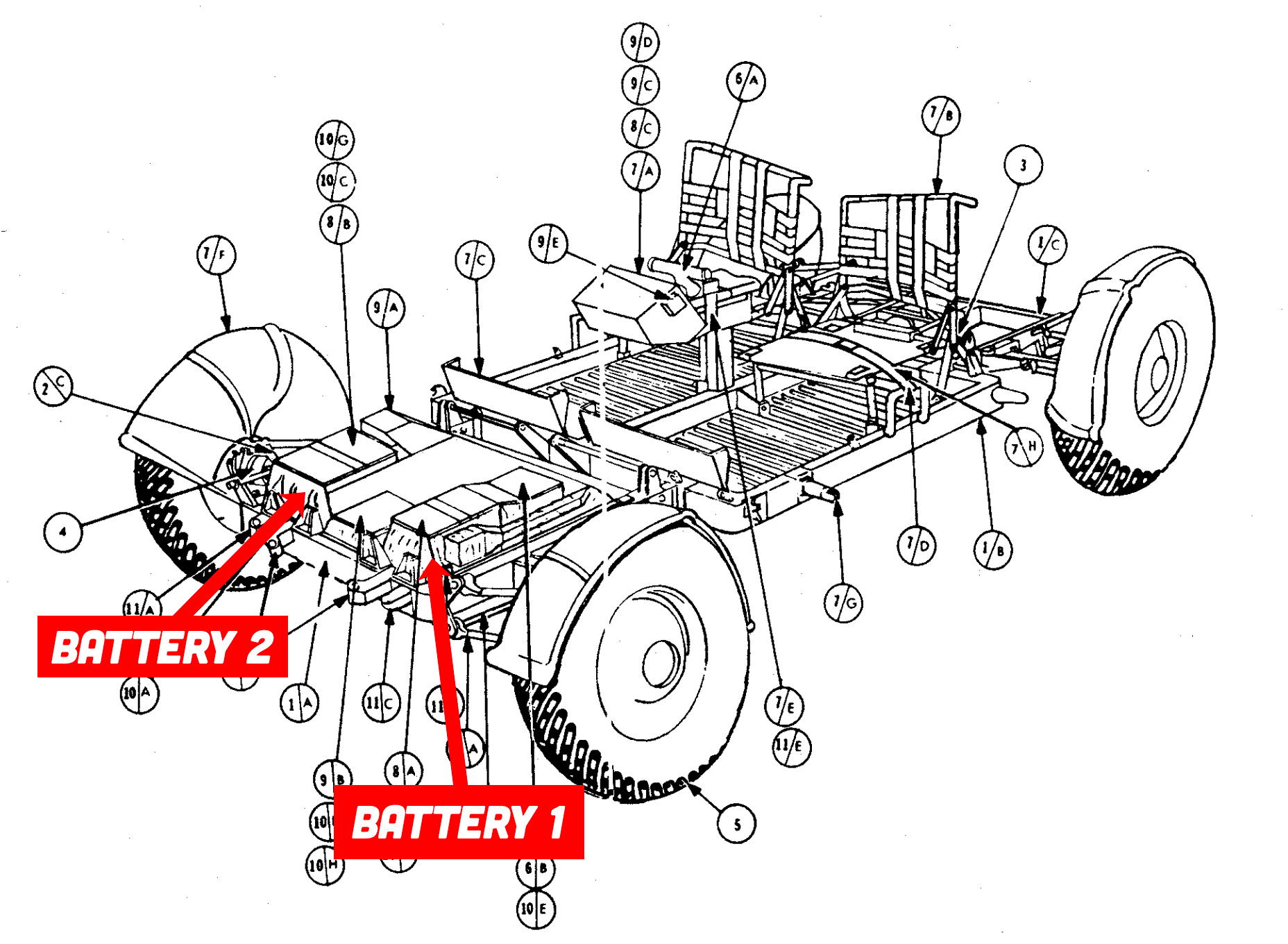
The batteries are under thermal blankets and are also used as heat sinks for some of the other electronics on the rover to help maintain their operating temperatures. Here’s the temperature range NASA set for the batteries:
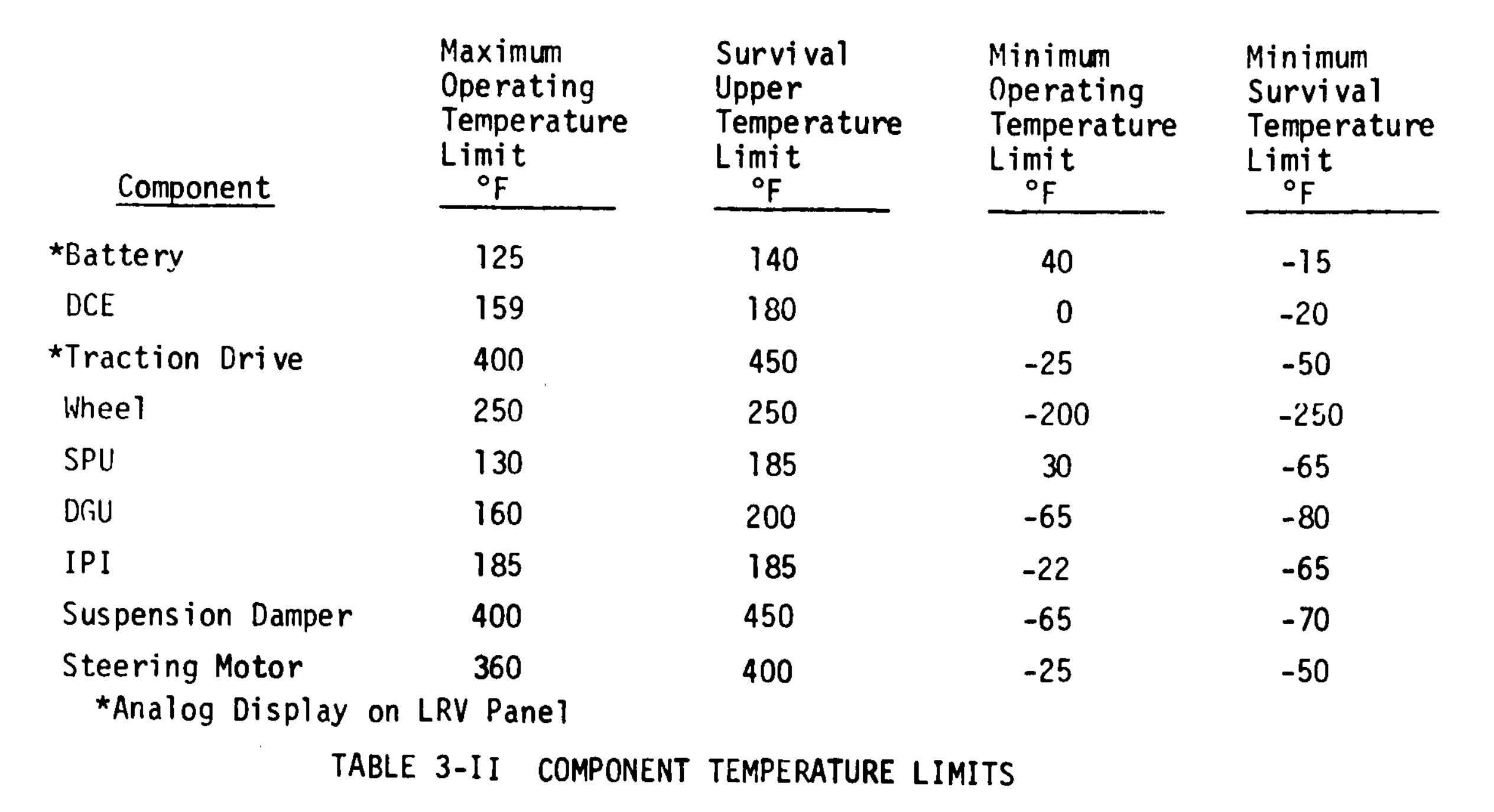
So, it looks like the thermal system was designed to keep the batteries at an operating temperature between 40°F and 125°F, with a survivable range of -15°F to 140°F. This is actually good news for the plan to restart these rovers, which will involve replacing these batteries with modern lithium-ion batteries, which are generally able to operate between -4°F and 140°F.
Also good news is that there’s plenty of lithium-ion golf cart batteries that are 36V! Here’s a bunch on Amazon! But let’s get good ones, since we’re going all the way to the moon. This one is a 36V (technically 38.4V, like all the 36V batteries here, but that should be fine) that makes 120 amp-hours/4.32 kWh, so that’s even better than the originals. And I think it should fit pretty well – it’s not exactly the right size, but it’s within a couple inches on each dimension, so I bet with a little hammering/finagling, we can get it to fit. So order two of those.
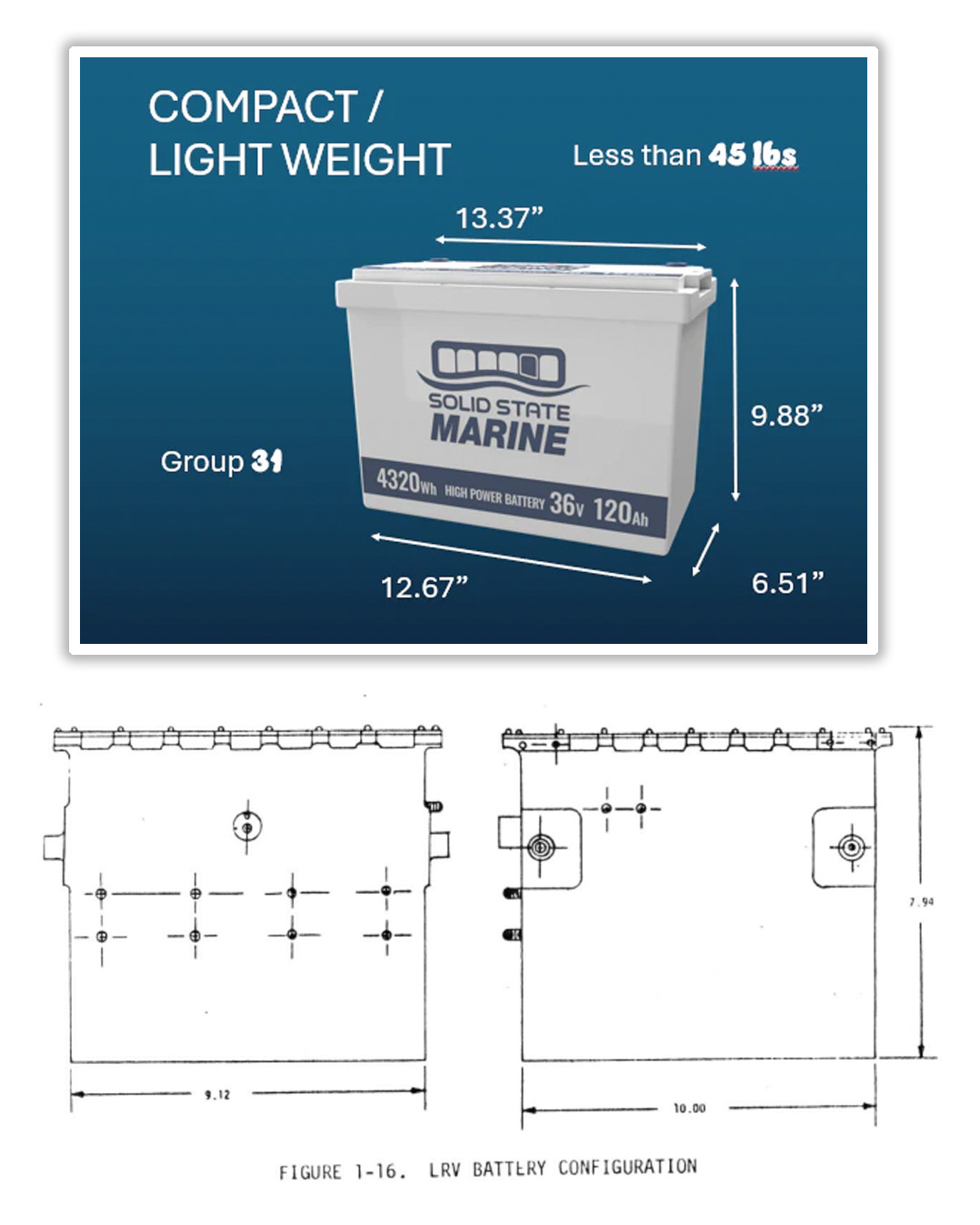
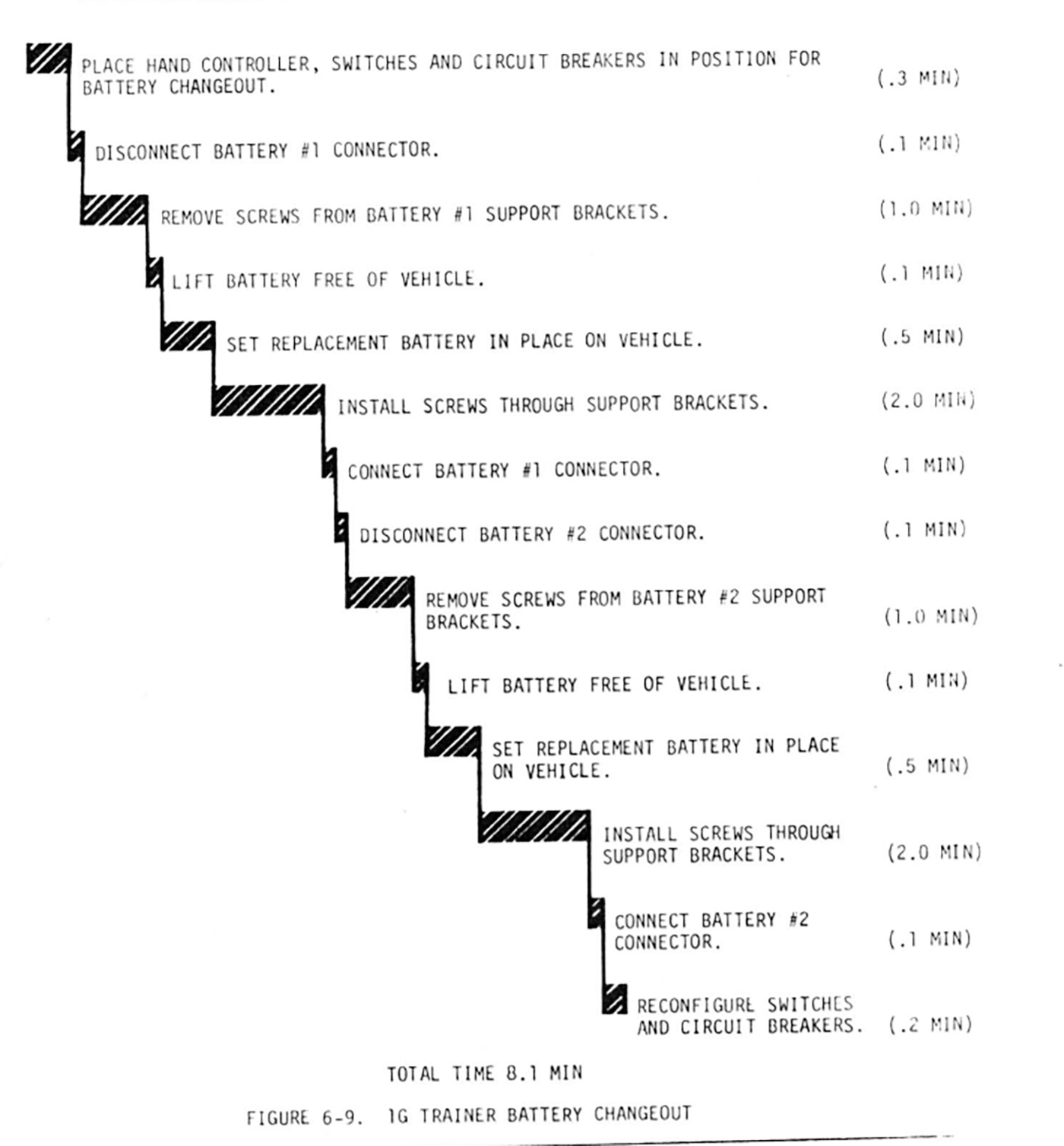
The procedure for removing/replacing the battery doesn’t seem too bad, either; these instructions are for the Earth-based training rover, but it should be pretty similar to the ones on the moon, because the whole point of this thing was to train astronauts for the real thing:
I think the trickiest bit will likely be the connector; I haven’t been able to find definitively what the battery electronic connectors that were used, but I strongly suspect that it’s a MIL-DTL-5015 connector, likely a four-pin one, based on schematic diagrams. Two pins are for the usual positive and negative terminals of the battery, and I think the other two are instrumentation.

I’d say go up ready for any possibility; have a cable with these MIL-DTL-5015 connectors, but also maybe have pigtails that you can just splice into whatever the rover actually has. I think if you can get the + and – connected, you should be good to go!
How To Drive It
Okay, I’m confident that this is going to work, that the new lithium ion batteries will be able to be crammed into those battery trays, that the thermal management components can be replaced, and connectors either plugged in or spliced on, and you’ve got 36 rich, creamy volts flowing through the system.
So now what? How can you drive these? Happily, it seems pretty straightforward. First, have a seat in one of the two seats, and look in front of you. You should see the instrument panel:
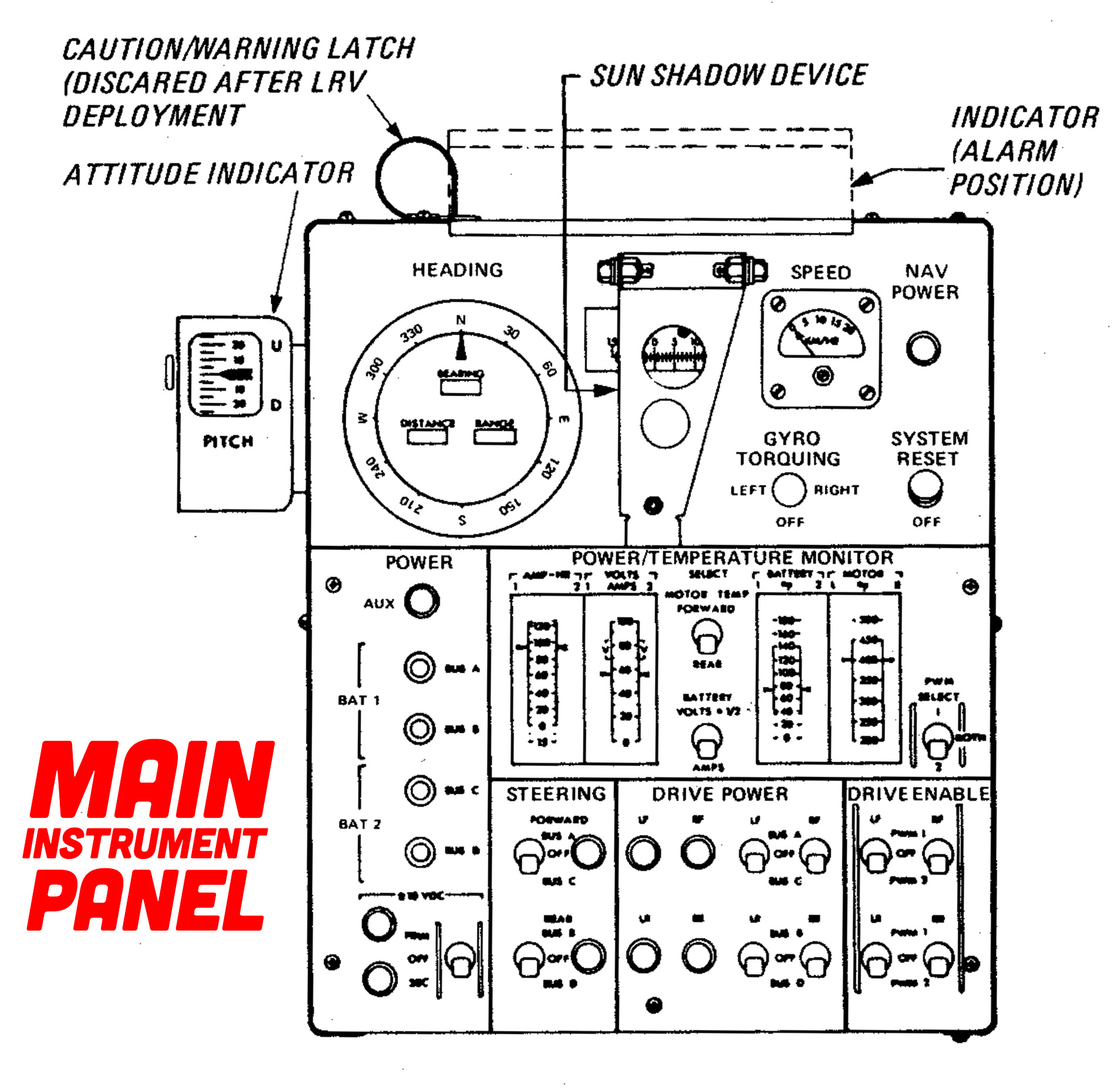
Hopefully those four vertical lights on the left side will be illuminated, two BUS lights per battery, showing you that you have power. To turn the thing on, you’ll want. to flip these switches to ON:
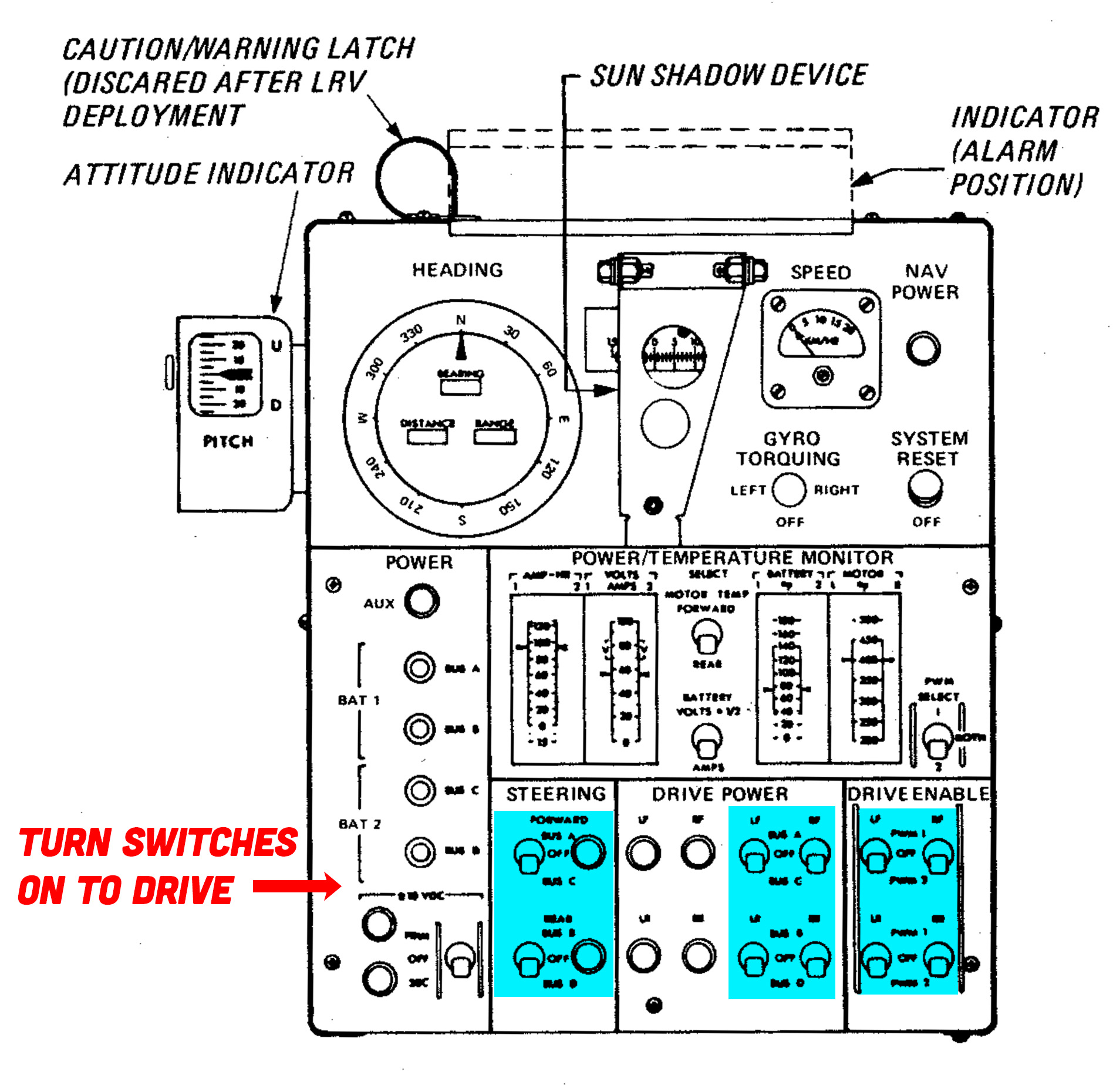
The leftmost two starts the steering systems (front and rear), and then to the right of that are four switches, one for each wheel’s drive motor, and then four DRIVE ENABLE switches, again one per wheel. So just flick all those on!
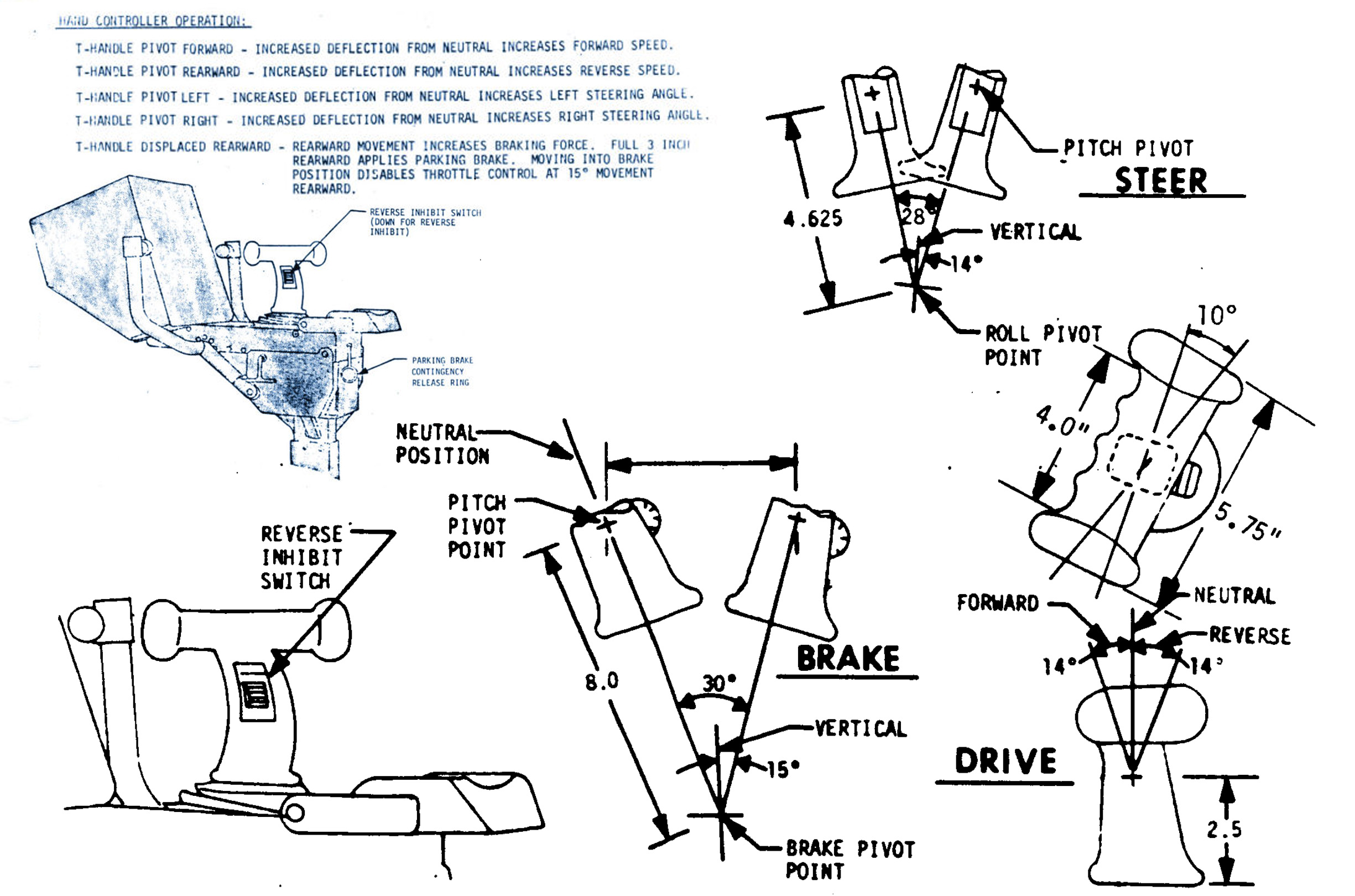
Now, to actually drive, there’s a big T-shaped handle in the middle, between the seats. To accelerate, push forward, to brake pull back. If you keep pulling back, you’ll go into reverse, unless that REVERSE INHIBIT switch is on.
To turn, just rotate the handle in the direction you want to turn! It’s that easy!
We Can Do This
There are three perfectly good lightly-used rovers on the moon. It would be criminal to just leave them there! Cars were meant to be driven, after all, and if all these things need are new batteries – which I think it’s a safe bet to assume that’s all they need, it’s at least worth a try – then why not get those classic rides going again?
Think about it, NASA! Why waste the money? These are prime deals, just sitting there!
Story and top graphic images except where noted: NASA


It would be awesome if we could a NASA engineer’s take on the guesstimated condition of them. Can TheAutopian try reaching out to them?
If there is no magnetic field on the moon for a compass, what does the “heading” indicator do? How does it work? Inertial navigation system?
There’s a great book on the rovers called Across the Airless Wilds, by Earl Swift. I think another Autopian recommended it. It goes into all of the development and their use on the Moon.
Of course, you’d also need to take a chainsaw, in case the old batteries are stuck.
I thought we weren’t supposed to talk about that?
While I like the idea of using pigtails, I’m not sure how well heat shrink is going to perform. Plus make sure to bring a wire stripper—huge hassle using your teeth.
Lithium batteries do not accept a charge below 32 degrees, so you’re going to want one with a BCM that prevents charging at low temps, and instead directs any current to the heating elements on the sides of the case. I have self heating batteries in my skoolie for this reason, and in my solar shed I built an insulated battery box with seed starter mats taped to the big ass lithiums, plugged into a wifi controlled programmable outlet.
But yeah imagine sending a few teams of gearheads up there, give them 3 days to mess with them, then do a drag race… ON THE MOOONNNNNNN would be rad af.
We should send Clarkson/May/Hammond now that I think about it lol
As a taxpayer, I support this message. Spend the money on stuff we don’t already have sitting around (e.g., a moonbase!).
Also great STEM challenge for schools; how to repurpose the LEM base sections?
I like where your heads at.
How did I not know before now that we just left the rovers there?
The more you know…
Wait until you find out how much military equipment and vehicles our country leaves all over the world after they’re done killing brown people.
After we smash the important bits with axes to ensure they are nothing more than immovable litter.
My grandfather told stories of driving jeeps into the ocean and burning HUGE piles of useful things when he was deployed as part of the WWII occupation forces in Japan.
It’s the defense industry’s version of paying some people to dig holes and others to fill them in.
In fairness, it’s a tough problem to solve. Not too many people know how to build a tank. You’ve got to keep them working—even if you don’t need any more tanks—so you’ll be able to ramp up if and when you do.
So your options are let this hardware rot in the desert, engage in constant unnecessary wars, or sell them to other countries, including those with questionable motives. The US has taken an “all of the above” approach.
Mine did too! Specifically, he was tasked with unloading giant boxes of brand new 1911s and M1 Garands off the ship that just arrived, piling them up on the beach, and setting them up in giant bonfires. He said they were even allowed to take and keep one if they wanted to, but I don’t know if that was official or on the down low.
Yup, this is exactly how the Philippines started their Jeepney industry
Everyone is the same colour looking down a gun sight.
We also left a bunch of bags of poop. Humanity’s gift to the cosmos.
There is one in Boeing’s Museum of Flight.
Love your plan. There is one small problem.
We aren’t likely going back within walking distance of the old landing sites.
They can drive to the old ones, tow it to the new home, and then get it running. Typical project car. It’s just rude to fix it at the seller’s house and drive away.
Bring A Trailer goes to the moon.
Seems more like a C&B listing: “before I review all its quirks and features, big news! This Lunar Rover is currently offered for sale on Cars & Bids right now so head on over and place your bid today!”
Maybe if we wait another 50 years we can just call Elon’s Moon Uber. Some ex-con will come pick us up in a clapped out old Cybertruck and take us wherever we want.
I hope a day comes when one of the rovers is in the Smithsonian museum. Not likely in my lifetime, but maybe someday.
When Integrity lands, it will have almost as many miles on it as my K3500! Paint will probably look the same.
NASA coverage begins at 6:30pm ET tonight. I hope it goes well.
They do have unused ones in some of the museums. I believe I saw one when I visited the Huntsville AL location.
I love the whole idea of the lunar rovers. Leave it to Americans to make the herculean effort to land humans on the moon, but also decide that when we get there, we can’t be expected to just walk everywhere like peasants!
I can only imagine the conversation:
“Well, we landed men on the moon. How do we follow that?”
“I mean, look at Neil and Buzz hopping around up there like a couple of chumps. They look ridiculous. Are we Americans or not? Obviously next time we’re going to take a car with us.”
“Great idea! What else?”
“We’ve got a couple West Point grads in the program. We should take some rifles! With no atmosphere and low gravity, I bet one of these army guys could nail some really long-range bullseyes.”
“Hmmm. That would definitely be very cool, but I’m not sure about the optics. We did that whole ‘We came in peace for all mankind’ thing, after all.”
“Okay, next best thing: Have Alan Shepard just whack the living crap out of a golf ball.”
“I think we’re done here.”
This is all dependent on us getting back there and not finding them up on cinderblocks, completely stripped down.
*regolith blocks.
I can only wonder what kind of vacuum cementing various components have experienced over 50 years. And while things are in a hard vacuum more or less, you also have to wonder about the occasional puff of monatomic oxygen that is just dying to become part of some larger molecule in conjunction with something else.
I can’t remember if it was Popular Science or National Geographic but it was a fascinating article that introduced me to the gases that exist in the somewhat misnamed vacuum of space, just hanging out more or less as individual atoms each in their own orbit, looking for other atoms to crash into at hypersonic velocities and become part of something bigger.
I heard the amount of material as if there was a room the size of earth, one beach ball would be in it. I hate the use of the word “vacuum”, reduced pressure is more descriptive. We use “pumps” called “turbos” to get chambers into the millitorr range, but are they pumps? No, at the pressure they’re run at you’re just hoping molecules get wacked by the turbo’s vanes into the exhaust. After that we use cryro “pumps” which are plates cooled with liquid helium, so that molecules “stick” to them.
I remember getting air…err, lack thereof, rather…in these in Gran Turismo 6. I can only hope they have a race with these if they get them running again. Motorsport on another world. Just imagine it.
Honestly this sounds like a deleted scene from the latest Fast & Furious movie.
There was a TV movie/short-lived series called Salvage-1 in the late 70s. It was about a rich junkyard owner who built a spacecraft to collect the “junk” from the moon and bring it back to sell. The rover was one of their targets. Stared Andy Griffith. Space crazed kid me loved it. Mom and Dad were expecting another Mayberry type show.
Great movie to watch as a kid. The cement mixer space capsule was just perfect!
This is one of the reasons why I love this blog. I never knew this existed!
Once Atlas V archeology became a real thing, the irony was a bit deep.
Don’t forget fogbank.