

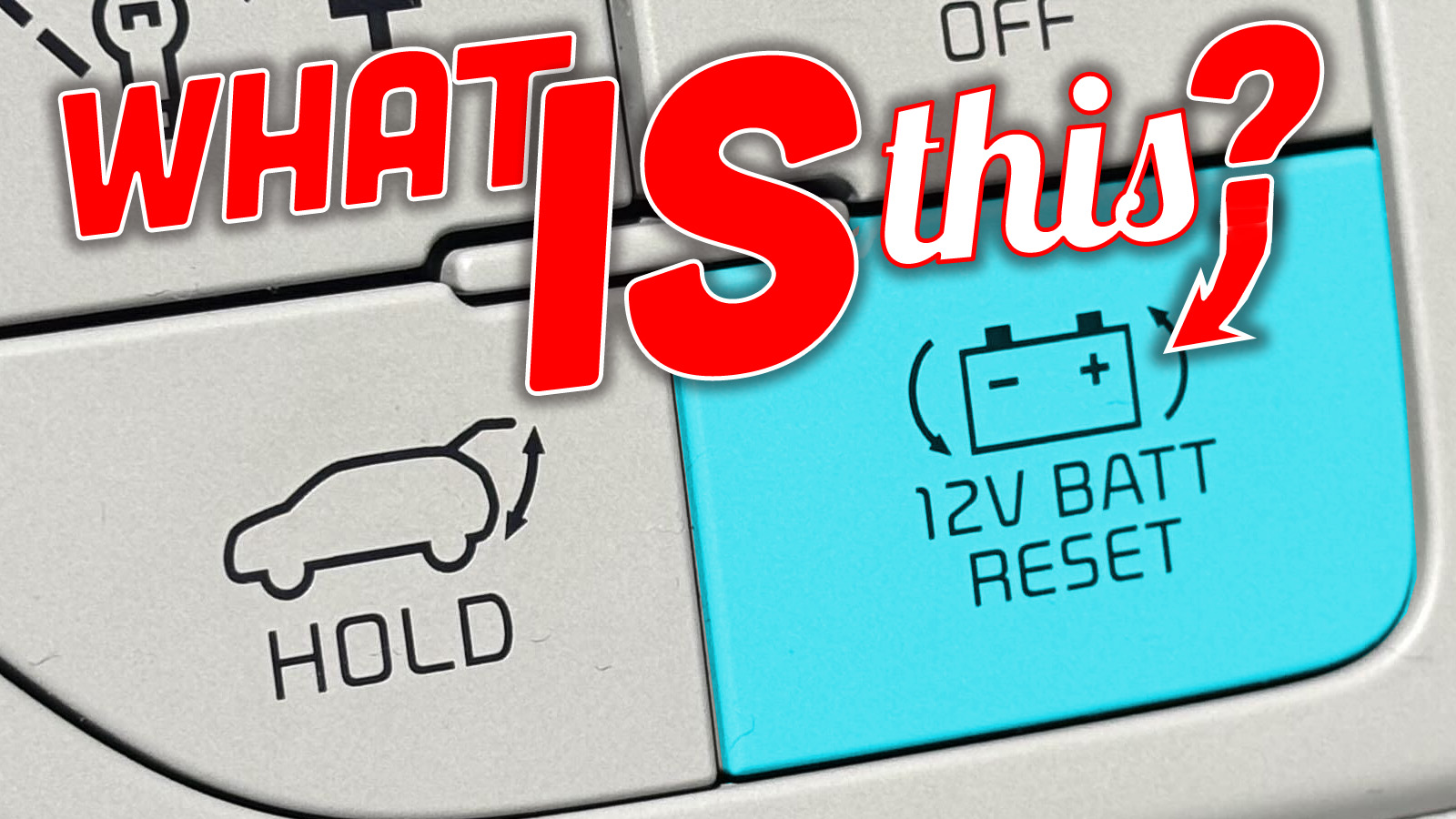
The idea of a “12V battery reset” button strikes me as odd. Hell, even the idea of a battery reset feels strange, because I’m an old man who drives cars with all of the technical sophistication of a meat tenderizer. Also, the concept of resetting a battery still feels weird to me, unless that resetting is being handled with a chainsaw, the preferred method. But this button actually does seem to do something useful, something that should help address an irritating Achilles’ heel of hybrid vehicles. Let’s take a quick look at what this thing does.
In most hybrid or electric or even hydrogen fuel cell vehicles, there’s still a separate 12-volt battery of some sort to power all of those old-school vehicle accessories that aren’t worth re-engineering for higher voltages, like windshield wipers, lights, and audio system components, and so on. Sometimes the source of these 12 delicious volts is a conventional lead-acid car battery, and other times it’s a newer-style lithium-ion battery, either an independent unit or something integrated into the larger main traction battery of the car.


The 12V battery has been an issue on hybrids and EVs because, unlike conventional combustion cars that recharge the battery via their spinning alternators with every use of the car, 12V batteries on hybrids or EVs tend to be charged via a DC to DC converter, taking charge from the large traction battery to charge the 12V. The car has systems to detect when the 12V battery gets below a certain charge and then recharges it automatically.
Usually, at least. This doesn’t always work out, and if the 12V battery dies, your car becomes a big, immobile brick that can’t start until the battery can be recharged from an outside source or replaced. It can be a colossal ass-pain. That’s what this button is supposed to help with.
The way it works is if you get to your car and find it unable to start because of a drained 12V battery, this button should help you get out of that jam. Well, that is, after you manage to get into your car using the physical key hidden in the key fob and manually unlocking the door via the hidden key slot on the underside of the door handle, because normally all of that is handled with 12V electronics.
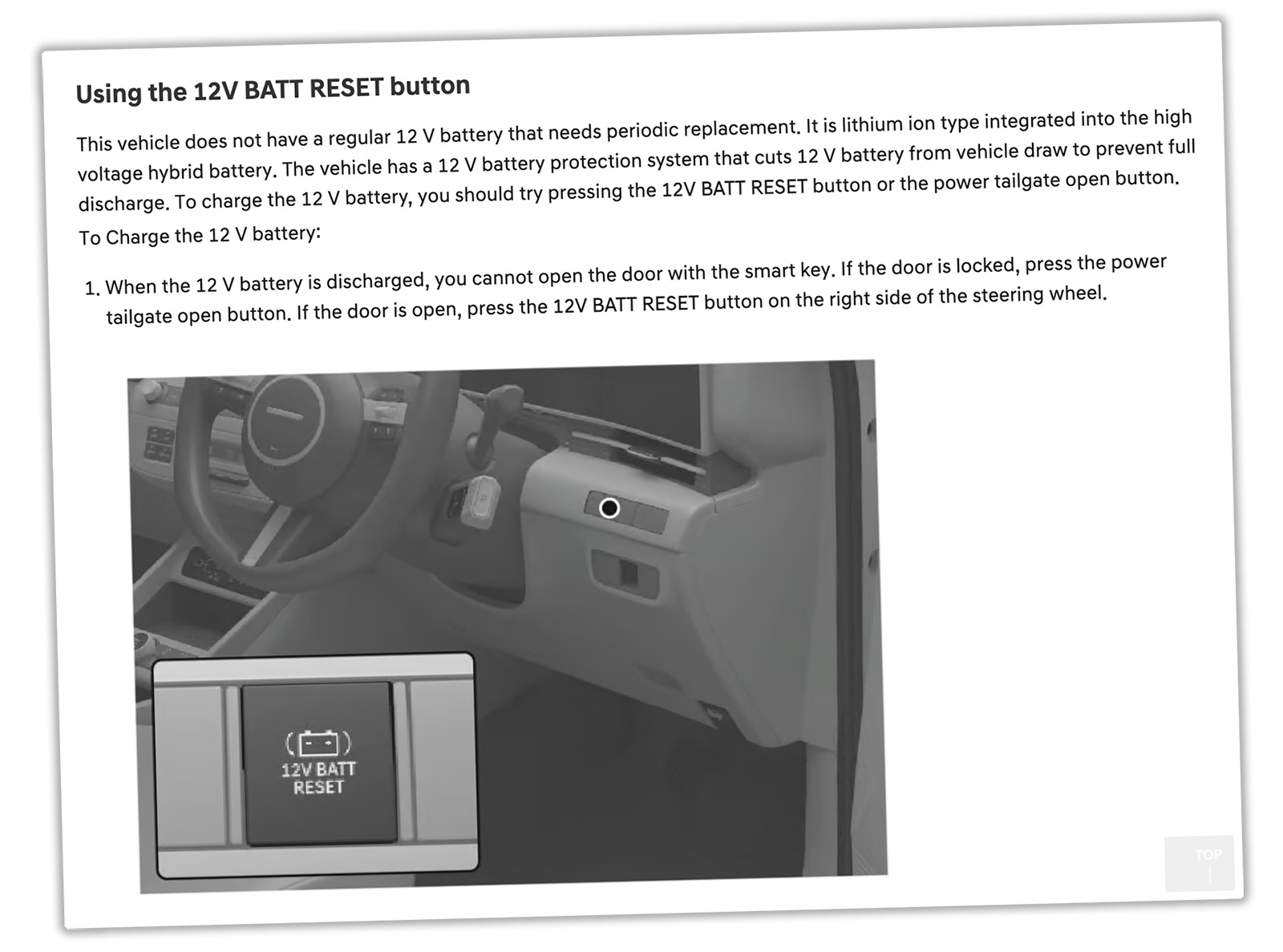
Once you manage to get into the car – it looks like the external power tailgate switch can open it if the key won’t or you don’t have a brick handy – pushing that 12V BATT RESET button will force the main battery to begin to recharge the 12V battery. You then have to start the car within 30 seconds. The recharging will then start from the main hybrid battery, and the combustion engine may not actually come on, at least at first. The owner’s manual says that when you do this, you should drive the car for at least 30 minutes to get the battery charged up, which almost certainly will use the gasoline engine on a hybrid.
The manual also notes that:
The following items may need to be reset after the battery has been discharged or the battery has been disconnected.
See chapter 4 and 5 for:
Power Windows
Utility View
Climate Control System
Clock
Sunroof
I get things like clocks, and maybe the radio and other presets needed to be reset, but power windows? Why do they care?
All of this is a little odd, for a number of reasons. First, I wonder why all of this isn’t more automated? Like, why does the owner have to push that button at all? If the 12V is below a certain point of charge, the car must be aware of that, right? So why wouldn’t it begin to replenish the 12V battery from the traction battery supply as soon as someone attempts to open/start the car? Is there a point to having a button to effectively jump the 12V system from the main power system? It just feels like if the car is capable of handling this from the push of a button, it could just as well make sure this doesn’t happen in general? Am I missing something crucial here?
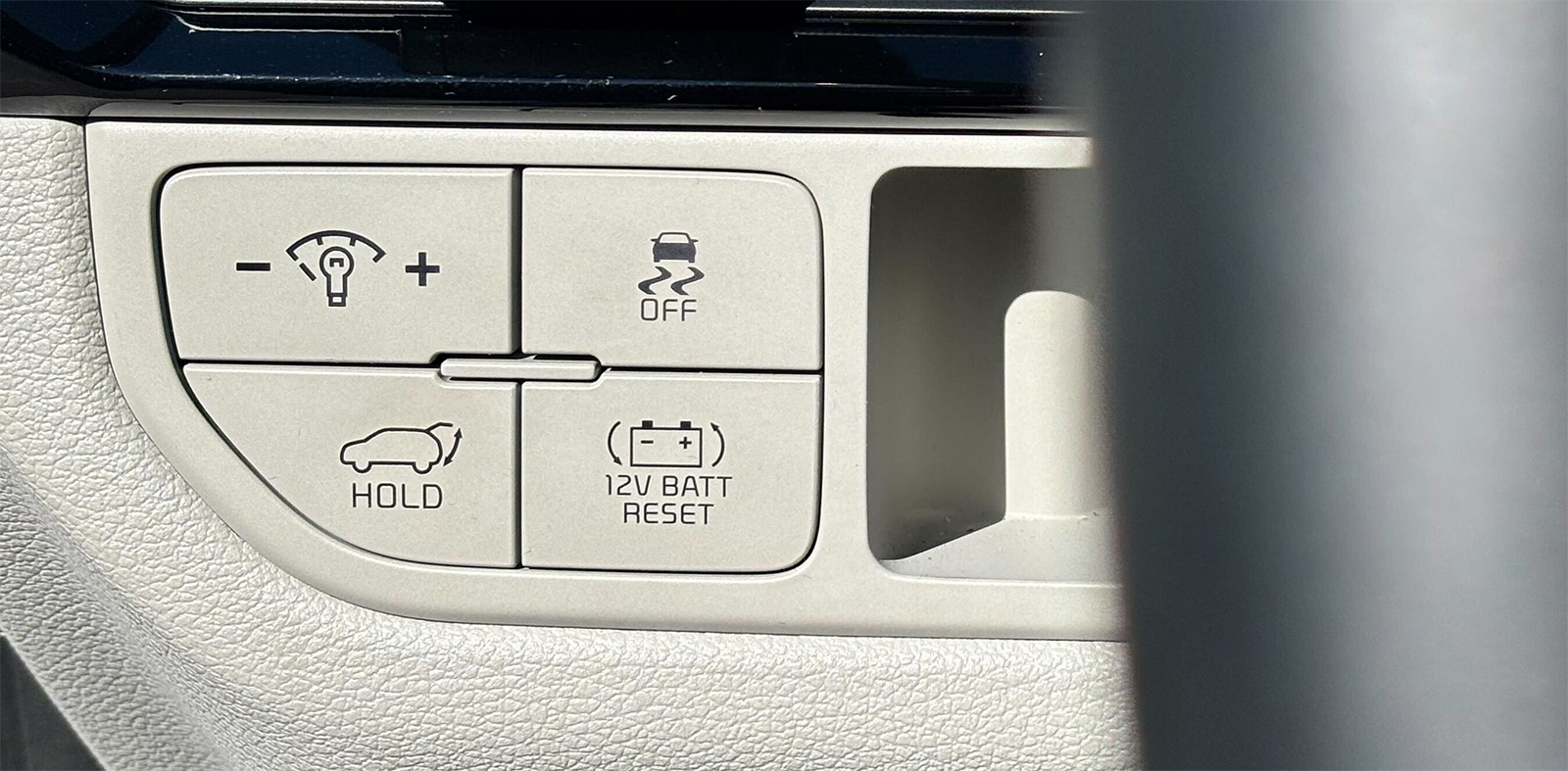
Maybe there’s a good reason for the BATT RESET button. But it’s also strange because the 12V battery has become, in many of these systems, more of a concept than an actual object. If the 12V battery is just a sort of segregated part of the main battery, then the 12V battery has become more software than hardware, a mode in which a portion of the larger battery runs in, emulating the behavior of an old lead-acid battery. It’s a strange idea to consider. So when there’s a button just for resetting the battery, it’s taking the place of removing terminal connections or jump starting a battery from another car, or accidentally dropping a wrench on the two terminals until it glows red hot and melts.
The 12V battery is now, on many cars like these, the idea of a battery.
So, what does that button do? It doesn’t really reset the battery – whatever that may actually mean – but rather just recharges the depleted on-board battery from other on-board sources of power. It all seems a bit strange to me, though, like a strange half-solution to a problem that maybe shouldn’t even really exist anymore?
Top graphic image: Matt Hardigree


All the circuitry that “decides” anything presumably runs off the 12V juice, so if the 12V battery dies, none of that will work. So the car can’t tell that the 12V battery is dead, because the 12V battery is dead. I assume that that button engages some emergency minimal charging system that is there only for this specific purpose.
Also, the power windows are the only thing that need resetting on an Opel Adam after the battery (the only in this case) dies. You need to roll them down and then up again; that’s. I think it calibrates the position sensor that tells the car if the windows are up or down (and by how much). Oh, and the FM radio forgets the last station (but not the presets), and the trip counter resets to 0.0. But those don’t create codes.
In my RV there’s a battery boost button that allows the engine to be started with juice from the house batteries if the under hood battery has run down. Seems similar in concept and result, if not in technology.
The 12V reset allows you to reconnect the 12V battery to the car after it was electrically disconnected due to a low state of charge to allow an attempt to start the car. It does not however use the traction battery to boost the 12v battery when depressed. The electronics only recharge the battery once the vehicle is turned on to the ready to drive state. Torch is misunderstanding what the button does and doesn’t do in this case.
That makes a lot of sense. There are 12V batteries with similar tech built right into them (though I haven’t seen one for sale in a while).
I wondered about this button on the Sportage Hybrid I had as a rental last month. Figured it was something like this. But it does seem like this could be way more automatic.
Though I also get why for safety reasons the high voltage battery is (in most cars) completely disconnected when the car is off. The main purpose of the 12V battery is to activate the big relay that reconnects it. Seems like there should be some big-azz Frankenstein style knife switch to do that manually in a pinch, LOL. Or a discrete lever in the trunk, for the boring.
I think the big manual switch adds some pretty major safety issues. The 12V electronics do some checks first to make sure the HV system is fully isolated so that if something goes wrong or gets damaged it’ll just refuse to start rather than set itself on fire or introduce the occupants to 400V+.
No sense of adventure!