

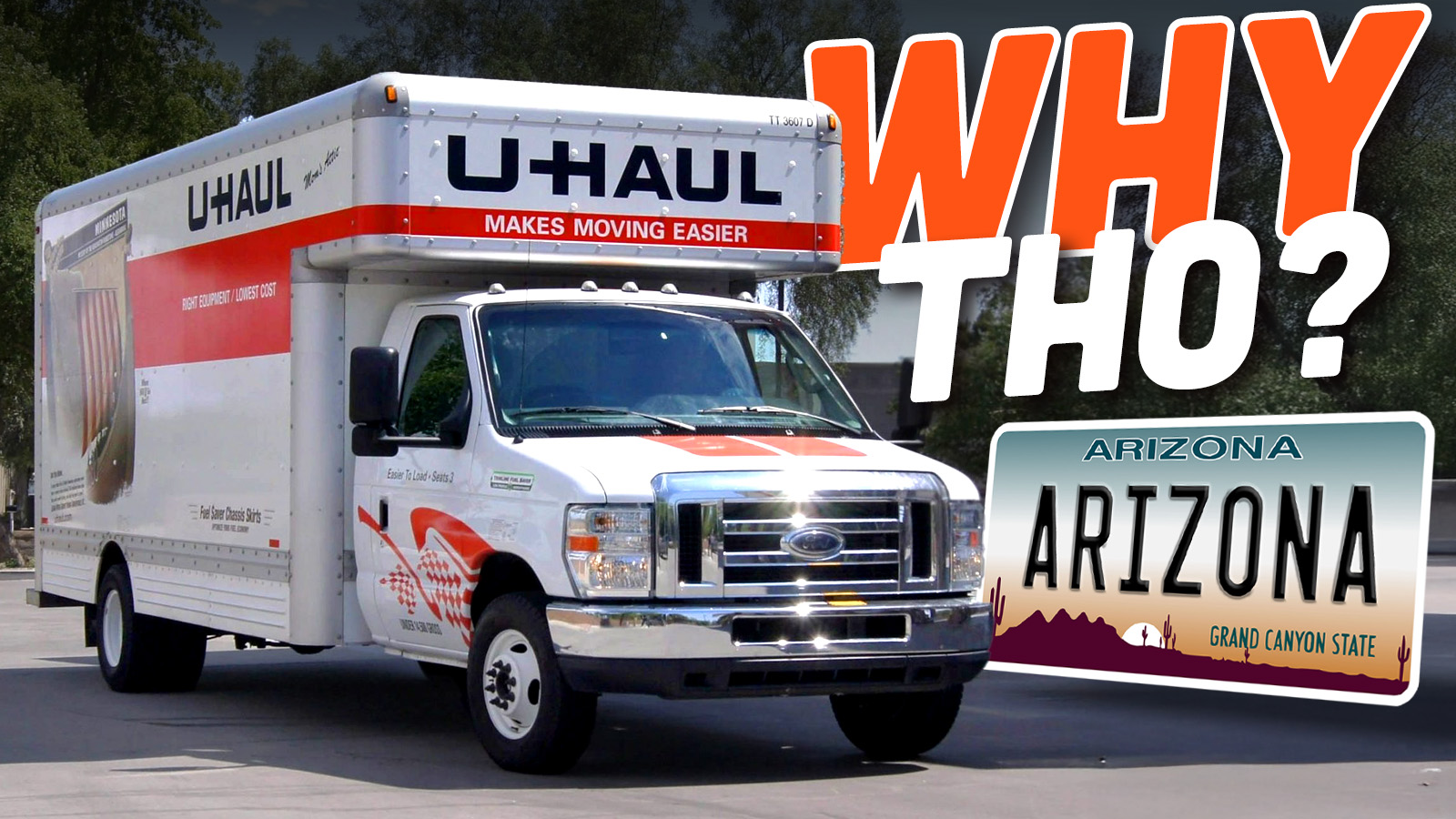
If you’ve ever rented a U-Haul truck, you’ve probably noticed that each and every U-Haul truck is registered in Arizona, despite the fact that you might be renting the truck in a state that’s nowhere near Arizona. What’s up with that? How can U-Haul register its trucks in a completely different state than the ones the trucks reside in, but you cannot? The answer is simple and practical – and you won’t be able to stop seeing it.
How U-Haul “gets away” with registering its trucks in Arizona is a question many people have had for years, but the subject has become a hot topic of discussion recently in the wake of Cody “WhistlinDiesel” Detwiler’s arrest for allegedly evading taxes in Tennessee by registering a Ferrari in Montana. To some fans responding to articles and videos like Doug DeMuro’s recent take on the issue, Cody registering his Ferrari in Montana is no different than U-Haul registering its trucks in Arizona. Yet nobody is trying to arrest U-Haul reps.


I’m not here to litigate what Cody did or did not do. Honestly, I do not care about YouTuber drama. But I do care about U-Haul trucks, and I find this renewed curiosity about U-Haul truck registration to be interesting, and the reason why U-Haul’s trucks are totally legal has to do with the same reason why you’ve likely seen so many truck trailers with license plates that say “Apportioned” on them.

One Plate, Multiple Jurisdictions
The reason why so many vehicles are registered in states where they’re not operated has to do with what is called the International Registration Plan, which was launched in 1973. Here’s what the official website explains:
The journey of the IRP began in 1968 when the American Association of Motor Vehicle Administrators (AAMVA) saw the need for a unified system to manage the registration of commercial vehicles across multiple jurisdictions. To tackle this challenge, they formed a sub-committee dedicated to developing a comprehensive plan based on various reciprocity theories.
By 1972, an Ad Hoc Committee for National Proportional Registration was established during the AAMVA International Conference. This committee laid the groundwork for the IRP. The first IRP registrations were issued in 1973 by nine pioneering states: Kentucky, Missouri, Tennessee, Texas, Minnesota, Nebraska, Colorado, Utah, and Oregon. This early success showcased the feasibility and potential of a national, uniform interjurisdictional registration plan.
A significant milestone was reached in 1974 when a resolution passed at the AAMVA International Conference officially made the IRP a reality. The resolution aimed to create a cohesive system to streamline commercial vehicle registration and enhance cooperation between jurisdictions. In 1991, the IRP expanded internationally when Alberta became the first Canadian province to join. This move underscored the growing importance and acceptance of the IRP across North America. Three years later, in 1994, IRP, Inc. was established as the corporate repository of the plan, providing structured leadership for its future direction.

IRP, Inc. has been an independent entity since 2015. The spread of IRP is far and wide, and includes the 48 contiguous states, Washington D.C., and all 10 Canadian provinces. IRP, Inc. handles 3.3 million commercial vehicle registrations.
The general idea behind IRP is that a trucking company or fleet can register its vehicles in the state where its headquarters is based, and those vehicles can keep those plates no matter where in America they operate. Now, you might feel like this is some huge loophole. What if a company is based in a state with low registration fees and taxes?
IRP is designed to level the playing field by paying fees to states based on mileage and weight class. For example, U-Haul’s trucks are all registered in Arizona, but may never leave a state like Illinois because the truck is used for U-Haul’s In-Town rentals. In this case, Illinois gets money from the miles the truck drives in the state. If you have a truck that is based in one state but drives across America, each state will get a cut based on mileage and weight.

Depending on where you live, you can identify a vehicle registered under IRP because the plate will say “Apportioned” on it. Here’s what my home state of Illinois says:
The International Registration Plan (IRP) is a registration reciprocity agreement among 49 jurisdictions states of the United States and 10 provinces of Canada providing for payment of license fees on the basis of total distance operated. Apportionment is required for vehicles operating in two or more International Registration Plan (IRP) member jurisdictions that have a combined gross weight or used in combination where the weight exceeds of more than 26,000 pounds, including the weight of the vehicle and the maximum load, or is a power unit having three or more axles, regardless of weight. Commercial vehicles weighing less than 26,000 pounds operating intrastate in two or more jurisdictions must also apportion. Apportioned power units (truck, tractor, truck tractor, buses, mobile home trailers, power wreckers) do not have to be titled in Illinois to purchase apportioned plates. Trailers registered in Illinois must be titled in Illinois. A fleet is defined as one or more Apportionable Vehicles registered in the same jurisdictions.
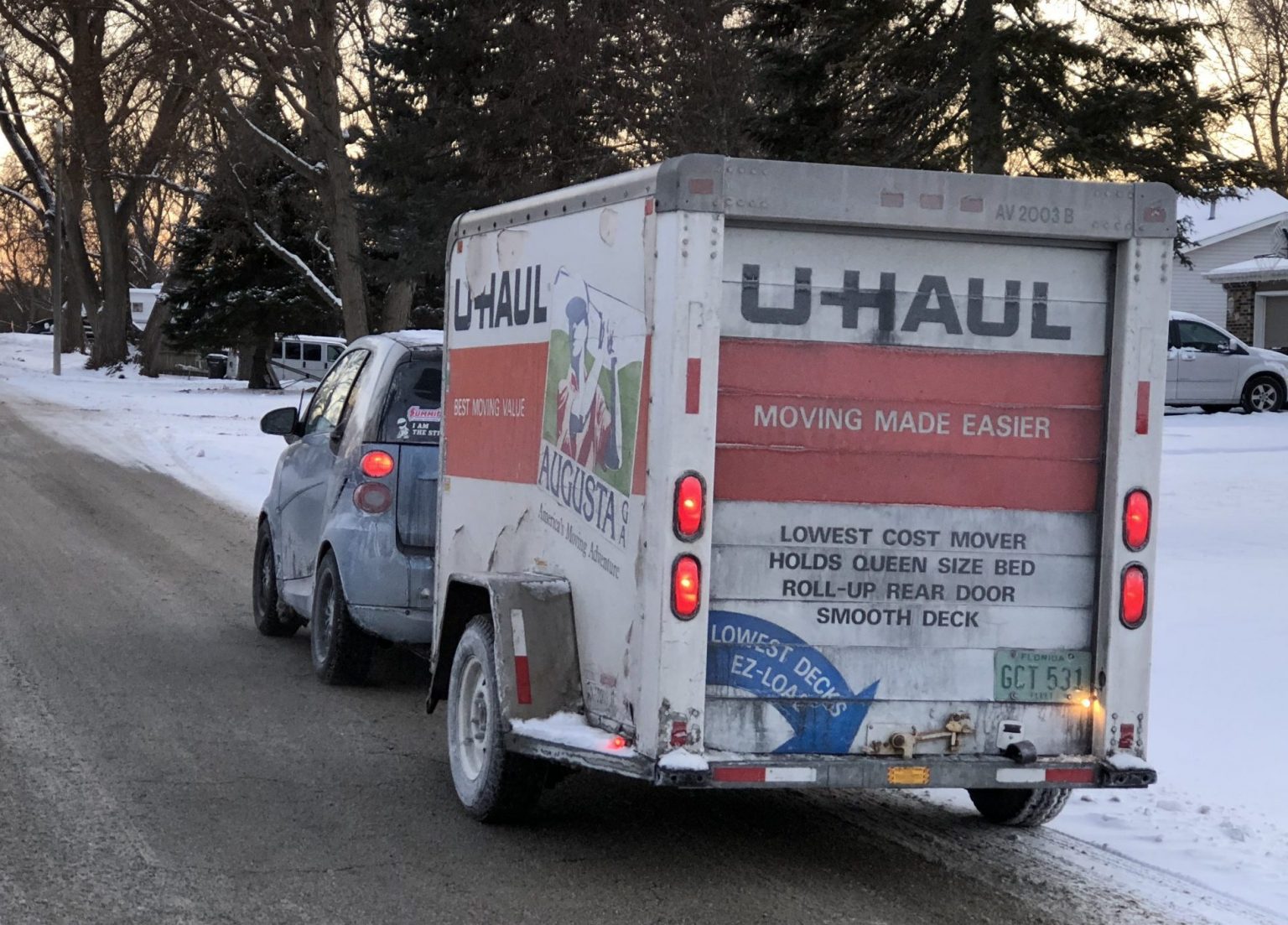
Each state’s Apportioned fee is 25 percent of its annual fee. That sounds like a deal, but when you add up the fees from all of the states that your rig drives through, that could easily cost you a couple of grand. U-Haul doesn’t disclose how much money it spends on IRP fees, but did report to CNN that it’s “a vast sum of money.” Collectively, trucking companies and fleets spend a few billion dollars in IRP fees each year. For U-Haul, the exception to the rule is its trailers, which do get registered in other states. Check out the Florida-plated AV trailer that I hauled with my Smart years ago:
This system makes a ton of sense. In the past, trucks would have to carry separate license plates for the jurisdictions they operated in. Now, they just have one license plate, but the state still gets its cut. Everyone is happy.
Now, you, like me, might have also seen countless semi-trailers with Maine license plates on them. Maine is a little weird, sort of like how Vermont used to be. You can register a semi-trailer in Maine for years for little money, and you don’t even need to live in Maine to take advantage of it.
Registering In Montana

So, now we get back to WhistlinDiesel. Again, I’m not going to get into YouTuber drama here, so I keep it short. Cody was allegedly arrested for evading taxes on the purchase of a Ferrari F8 Tributo that he destroyed on his channel. As reported by the Drive, Tennessee Circuit Court for Williamson County claimed that Cody “did unlawfully and willfully attempt in any manner to evade or defeat any tax due the State of Tennessee in an amount of five hundred dollars ($500) or more, to-wit: sales tax due on the purchase of a 2020 Ferrari F8 Tributo.”
What’s the big deal? Why is Cody taking heat but not U-Haul? The answer comes down to registration. Cody didn’t register his Ferrari through IRP, nor would you be going through IRP for a car, anyway. Instead, Cody did what so many vehicle owners do, and he utilized the Montana registration loophole. Montana will allow you to register your car in its state without paying sales tax. You just need to create a Montana LLC.
Unlike a vehicle registered under IRP, you’re not paying any money to the state where the vehicle actually resides. Instead, Montana gets all of the cash. The folks who buy supercars love the Montana loophole because it means they can buy a car worth hundreds of thousands of dollars without paying a dime in sales tax. As the Drive reported, Cody himself admitted to registering the Ferrari in Montana to avoid paying perhaps $30,000 in taxes.
Not every use for the Montana loophole is about taxes. If you buy a car that has a screwed up title and choose to go through a service like Dirt Legal, you’ll likely get a Montana license plate and title. Dirt Legal will get you a bonded title, and thanks to the Montana loophole, can send those plates to wherever you live. For full disclosure, the Autopian’s Nissan NV200 and Murano CrossCabriolet were registered in Montana, but this was due to titling headaches.

If this sounds like the old Vermont loophole that closed in 2023, it sort of is, but sort of isn’t. Vermont didn’t require you to have a title, but it did require sales tax. Vermont was also cheap, charging you only $76 plus tax to register a vehicle there. It’ll likely cost you around $1,000 to open an LLC in Montana alone, and then you’ll have to pay more for the registration. Dirt Legal currently starts at $1,299.99 for its services. In other words, you really aren’t doing the Montana loophole because you want to register that $500 hooptie that doesn’t have a title.
But let’s get back to the original question. Nobody bats an eye about U-Haul’s Arizona plates because U-Haul takes advantage of IRP rules and then blows a ton of cash to every state every year.
If you’ve ever wondered about why the heck every U-Haul truck is registered in Arizona, and why that’s not a problem, now you know. The International Registration Plan allows you to register in one state, but still pay fees to other states. It’s a neat bit of registration trickery, and it’s always been hiding in plain sight.
Top graphic image: U-Haul




On the specific subject of Cody and the Tennessee tax authorities, Trae Crowder’s routine:
The Worst Kind of Child Support There Is – Trae Crowder – Stand Up Clip
I remember road trips in my youth and passing semi trucks and counting how many different license plates they had on the front. Why yes, I am old.
My son’s an owner-operator whose electronic log records mileage state-by-state. The numbers get added up and submitted each year when he renews his registration. He says that’s a good thing because otherwise there would be a whole lot of estimating.
So if you get a Uhaul in Alaska or Hawaii it will have local plates? And what about the Territories in Canada (Yukon, Northwest, Nunavut) or are they too small to even worry about?
Even in Canada they have AZ plates
I used to work for my state’s tax authority. We had a special project where we were looking for people who had their sports cars, motorhomes/RVs/etc registered through Montana LLCs, and if we could prove they lived more than 50% of the time in state, would determine their vehicles were required to be registered here and would assess them sales tax based on the MSRP of their vehicle.
I live in South Florida and I see exotic cars multiple times per day. I am aware of the Montana loophole and I’ve seen several exotics sporting Montana tags.
I’m not aware of Florida cracking down on this yet because I believe those wealthy people OWN the state government.
At least here in PA you pay sales tax only at time of sale and a managable annual registration fee. Many classics are inspection exempt, anything driven under 5000 miles annually or over 25 yrs old is no longer subject to emissions. I lived in VA for a while and that annual car tax bill can be a killer. I see why some want to cheat.
In MN, if the car was bought within a certain amount of time, the owner had to show that sales tax was paid, and if not, then they would be charged at the time of registration.
That’s interesting. Were people telling on themselves on social media when you were there? It seems like it would happen often.
It was mostly from tips submitted by employees. I was stuck in traffic behind an Aston Martin with Montana plates one day and snapped a picture. There was plans to work with car dealers and mechanics to have them let us know if vehicles with MT plates came in but I left before that went anywhere.
There was a story on the local news about a guy that built “garagedominiums” basically luxury garages people can rent for their fancy cars, that had little kitchenettes and bathrooms and maybe a bedroom and the rest garage. They were interviewing some of the first tenants and a few of the cars had MT plates and a couple days later we sent some auditors to talk to the owner of the building.
I like how Autopian articles manage to answer questions about obscure things I had noticed over time but not so often to actually look into it.
I have to imagine the logistics within U-haul are amazingly complex. Recently a friend rented one in NY to haul a car one-way to Texas. He was initially going to rent a pickup/car dolly, but when he went to go pick it up they told him they could offer a much cheaper rate if he took a big box truck instead of the pickup. He didn’t need a box truck, but U-Haul apparently needed it moved back to Texas, so they offered a huge discount to get a renter to do it for them.
Wonder how much the fuel difference was, since that isn’t a short drive. I can’t really do the math since Texas’ size can account for nearly half the trip.
Probably more then the savings
Has any reader here, aside from Jason et al, registered a vehicle through Dirt Legal? Any issues? Would you do it again?
I could ask that question to randos on the internet, but I would rather trust a semi-rando Autopian commentor.
As someone who enjoys hunting for as many license plates as possible on road trips, I’m well aware of the Arizona U-Hauls and the Maine trailers. Both are states that would otherwise be hard to find close to home, but thanks to those vehicles, they’re easy! I always feel like I should get extra points when I find one on a passenger vehicle.
U-Haul trailers are also fun to spot while playing that game, because it’s almost a total roll of the dice where it’ll be from!
I played that license plate game in my midwest college town a few years ago and was amazed to see all 50 states and DC plates in about 6 months. I can see driving here from Alaska, but are people really shipping their boring economy cars here from Hawaii? Is this a military thing?
Wow, impressive! I don’t think I’ve done better than 48/51 on any given road trip. (And I don’t think I was actively hunting at the midwestern college I went to. It had a disproportionate number of out-of-state students, though, so that would have made it easier). Now that I’m back in Canada it’s harder to find that much variety
I’m glad you mentioned the trailer exception, cause I was worried I was getting the Mandela Effect about seeing plates other than AZ. I rent more U-haul trailers than trucks.
Mercedes… Think I need to hook you up to interview my oldest son and his wife. My son works as a transfer agent for U-haul corporate, and my daughter in law used to operate a U-haul dealer. They both have some crazy stories to tell.
Please do! I’m a firm believer U-Haul is an essential service!
Cruise America also has from what I can tell all it’s fleet registered in Arizona as well since it’s HQ is Mesa AZ.
When I was much younger, I remember seeing trucks with secondary license plates that had no numbers or letters on them, just many spaces for registration tags. I’ve tried to find some images but must not be using the right terms. I’m betting these were for pre-apportioned days for multiple state regs.
Yeah, I remember those. And trucks with lots of different plates on the front.
Moved to SC recently and discovered they cap the sales tax on vehicles at $500. So I pay the same sales tax on my $100K C8 as some guy who bought a $7,500 beater. But they do get you on the property tax on the plates on new cars, I’ll be paying $3,000 first year on my C8, the beater guy a few hundo I guess. The tax goes down eventually as the car ages but the first few years are painful.
I moved to central SC right before the pandemic, and the property tax on vehicles surprised me. That’s how they make up the sales tax, I guess.
Come to Massachusetts. You get to pay full (minus the value of your trade in) sales tax of 6.25% on your auto, plus the excise tax on top of that. Excise is also based on MSRP, seems to be about the same amount % you are paying in SC, and then it falls in value annually as the auto depreciates in value, you will always pay something.
Your C8 example, based on MSRP of $100k with no trade in, means $6,250 in sales tax and assuming you bought it on Jan 1, 2026, your excise tax over the next 5 years equals another $5,625 ($2,250, $1,500, $1,000, $625, $250) and then $250 for every year after that.
Calculation Of The Excise Amount (Massachusetts)
The amount of the motor vehicle excise due on any particular vehicle or trailer in any registration year is calculated by multiplying the value of the vehicle by the motor vehicle excise rate. That rate is fixed at $25.00 per thousand dollars of value. The value of a vehicle for the purpose of the excise is the applicable percentage for that year of the manufacturer’s suggested retail price for that vehicle.
The applicable percentages are set out in Ch. 60A §1 as follows:
In the year preceding the year of manufacture 50%
In the year of manufacture 90%
In the second year 60%
In the third year 40%
In the fourth year 25%
In the fifth and succeeding years 10%
California collect sales tax (71/4% to 12% depending on jurisdiction of residence) each time a car (or trailer) is sold (come on, the first buyer paid sales tax, why should I?). Then they collect a rather sizable property tax at each year’s registration. My 7yr old KTM registration for this year was $180. The cars are considerably more. Apparently a 13 yr old BMW has stopped depreciating.
The US really is just fifty countries flying in close formation isn’t it?
I prefer “Fifty small squabbling countries in an ill-fitting trenchcoat”
WHOOSH!
Hey baby, check out my Florida!
Also, want to buy a real Rolex from Delaware?
The term is federation
Yes, but that’s also an advantage. Various states get to have different policies about different things, and then you can see what people (or the market) prefer. One national policy is fine when it’s smart, but disastrous when it isn’t.
Historically, people often said “The United States are” rather than “The United States is” for exactly that reason. People mostly switched to “is” after the civil war for reasons you can probably figure out.
AAMVA developed and deployed IRP, and now is seemingly focused on banning Kei cars…
good and bad can have the same parents.
This explains why they’re allowed to or “get away with” registering in a single state, but why do they do it?
There must be an advantage in registering in Arizona, surely?
Not much mystery to it:
“The general idea behind IRP is that a trucking company or fleet can register its vehicles in the state where its headquarters is based, and those vehicles can keep those plates no matter where in America they operate.”
U-Haul Corporate Office
2727 N Central Ave
Phoenix, AZ 85004
Sure, but not all Hertz cars are registered in Florida or Enterprise cars in Missouri etc. It’s still a deliberate decision to not locally register by market.
U-Haul rents commercial vehicles. Hertz rents cars.
See the part of the article about >26k pounds GVWR and >2 axles.
Even their trailers are manufactured in AZ.
U-Haul moved their corporate headquarters into one of two, matching, very lovely mid-century modern apartment buildings on Central Ave. This act has probably saved both of those buildings from being replaced with something larger and uglier, as happened with several other MCM buildings along Central after the light rail was built down the middle of the road. Have a look at it on Google Street View: https://maps.app.goo.gl/sa3ssVdUpEm43Ng49
The Chinese lions are an interesting touch.
It really is MCM style all the way down for those buildings!
Thanks for the link, those are cool looking buildings. Certainly better than some generic glass tower.
I don’t know about commercial vehicles, but vehicle registration in Arizona isn’t particularly cheap, especially if you drive a new and/or expensive car since your fees are based on the value of the car. For my two cars, it’s like $1300 per year, whereas in Oregon, I only paid $250-ish every two years.
Arizona probably has low taxes or lax regulations or both for U-Haul the company.
Great article! I’ve wondered about this. Sort-of related: I once rented a nice-for-me car that I made sure at the counter had in-state plates to reduce the blatant “rental car + you’re-not-from-here-are-you” on the roads. (Of course, once parked, the bar code gives it away.) The agent rolled their eyes but confirmed as they handed me the keys. Then I got to the car … with in-state “fleet” plates. D’oh! I later went down the DMV regs rabbit hole and it made sense from the company’s registration/renewal perspective, but my strategy was for naught. (Everything turned out ok.)
I always try to grab a car with plates of the state you are in for the same reason. Rolling probable cause when you are from out of state. No reason/advantage to stick out like a sore thumb if avoidable.
Was pulled over in a rental in Illinois years ago just for this. Trooper did not like my PA license and OH plated rental car in BFE I80.
Probably chose Arizona because of the best looking license plates in the U.S.
Arizona’s tag is nice but I prefer the Alaska design. Hawaii’s tag is also an iconic classic.
I’m not thrilled about the new South Carolina tag design I’ll be getting in July.
“Clean Air Blue Skies”, the plates that look exactly like the clouds at the beginning of the opening credits of The Simpsons?
I’ve heard from fleet people they sometimes get deals with the state for special plates that help them streamline their tracking. But also dealing with 48 or 50 different states for registration would be a headache and probably end up costing more because you would need someone in each state to handlenot. Penske has their own Indiana appointed plates. I believe I’ve seen a uhaul az one. I’ve also seen uhaul vehicles not only trailers with other then az in the past.
Taxi cabs can be interesting from registration stand point too. For instance several years ago the DC taxi cab commission made all the taxis operating in DC get a DC plate but most also kept their original plate from where they live in md or va. So you had a situation with cabs with two plates.
Hmm, I’d guessed that it was just some corporate workaround, like credit card companies being based in Delaware to get around usury laws in other states. Glad to know they actually pay what sounds like reasonable fees to do so.
IRP. Interesting! At UPS in Nebraska, I noticed the plates were Indiana. After moving to Colorado and trying to get my same job I saw all the UPS trucks with Colorado plates. Never inquired my employer about it. But, my curiosity is with rental car companies. How do they handle a fleet of cars registered in multiple states. Another head scratcher is the occasional business vehicle with multiple plates.
I’ve noticed the ups thing too. It seems like Indiana is default but in states where they have more infrastructure they will register them there. Perhaps has to do with states that have emissions or safety inspection too. Like many states in the south it’s Indiana plates but I know they register them locally in Virginia, Tennessee, Texas, Colorado, New York, Pennsylvania, California and I’m sure a lot of other states too.
The rental car company question is something I am curious about because I’ve seen some interesting things with my favorite being this little adventure:
Several years ago I got a loaner from a company that picks you up while getting deer damage fixed on my car. As I walked around the rental before jumping in it I noticed the tag was out of date. I told the rep and he ‘fixed’ the problem by going inside and pulling an in date plate out of a drawer and put it on the car. I asked if that was legal and he told me that we do this all the time.
When I was picking my car up from the body shop a state trooper was there on another matter. I told him about the plate switcheroo and he said it wasn’t legal and they were going to look into it. Two days later there was a job posting for a manager at the rental car company.
In 2010 I rented an Equinox with a temp tag. Didn’t think much about it until I got home to pack and noticed it expired in two days. The rental was for a week! Called Enterprise and they said bring it back. When I got there some guy came out and just screwed some plates on on it.
In 2020 I rented a Corolla from Enterprise and after I got it home I realized the tags had expired a few days before I picked it up. They said to bring it back and swapped it for a Cherokee.
I knew a guy who managed a Pepsi distribution facility. He went out with one of his drivers one day, and the route went through a sketchy part of town.
At one of the stops, after they unloaded and stocked the shelves, they got back to the truck and discovered the registration sticker had been stolen off the plate. The driver just opened the glove box, pulled out a roll of them, peeled one off and stuck it on the plate.
The manager asked him where he got them, and he said they got stolen so often on this route, the previous manager had worked a deal with the DMV so they didn’t have to go back every time it happened!
Hmm, I pull off the old tags and then cross hatch the new tag with a razor blade so that it would come off in pieces. A thief with time and talent could reassemble it, but they would probably just go on to the next vehicle.
Colorado has a fairly strong law requiring businesses operating in Colorado to register their vehicles in Colorado. The fleet plates are related to meeting emissions regulations. The thing that’s different in Colorado is that most businesses are centered in the middle of the state, unlike many midwestern and eastern states, where major cities often share a border with a different state. Here, in St Louis, you see both Missouri and Illinois plates, with each state having different taxes and registration rules (that some people blatantly try to exploit).
I feel that if your vehicle has a local phone number painted on the side, then it should be registered locally. I don’t think small, non multi-state, contractors are paying IRP for their work trucks.
Not a total answer, but remember rental car companies are really just used car dealerships. I don’t think many stay in the fleet beyond a year, so just register it in whatever state it starts its life in and it’ll be someone else’s problem by the time it needs new tags. But I’m sure there are countless complications I can’t even imagine.
I once had to take a rental across state lines. When I parked at the hotel a guy was looking at the car for a real long time.
He came up to me and said “the front of your car is registered in Florida, but the back is Michigan.” As in, two totally different license plates. Spent the rest of the trip waiting to get pulled over. When I complained to the rental company the person shrugged and said “the back one is the only one that matters.” Cool.
If the registration is in a state that only requires a rear plate, then the front can be anything (or nothing at all, of course). My wife still has her NH front plate on her van, which is now registered in Indiana. Never any problems, even when going through EZ-Pass, which uses plate recognition — and the transponder is originally from NH. I peeled off both the month and year stickers from the NH plate, so it’s clearly not a valid plate any longer.
Indiana hasn’t used front plates for as long as I can remember, back into the 1970s. There’s always been a smattering of cars rocking their owners’ prior home state plates in front, especially from non-Midwestern and coastal states.
I always kinda wondered about this. I’ve seen plenty of cars with foreign plates on the front, which seems fine since there’s no way it’s the valid plate, but now and then I’ll see one with a California plate or something on the front and wonder if it’s legal.
I’ve got a stack of old plates from various places I’ve lived, but never had the desire to make my cars uglier with a front plate.
I drove through three states on that trip. Granted I didn’t know this fact at the time, I also didn’t know (and still don’t…) the laws for those three re: front plates. And the rental place sure didn’t know where I was headed and whether it was going to be a problem for me.
I guess the only way that could get weird is if you’ve got a truck with a front Missouri tag and, say, a rear Michigan tag.
As I understand it (after looking into it after noticing it while visiting), trucks in Missouri are only legally required to have a FRONT plate, so you could seemingly fulfill the requirements for multiple states at the same time? (I never saw many trucks in Missouri with just the front plate, but after seeing a truck with some sort of decorative plate on the back, I had to look into it)
That’s weird because Florida doesn’t have front plates.
Ok you called my bluff. I didn’t remember which random states, nor did I think it really mattered, but I should have been upfront.
Rental car companies have agreements with all the state DMV departments for some kind of special fee structure.
According to a seminar I attended, you can save even more money on registration by not having a license plate at all, just tell the cops you’re traveling and not driving
Well, it wasn’t really a seminar, more of a guy with a van covered in hand-painted billboards who was yelling through a bullhorn from the corner of a Walmart parking lot
Make sure you take note of the colors of the fringe of the flag when you get dragged into court; if they’re gold, it’s an admiralty court, and thus has no jurisdiction over you!
</s, in case it’s unclear>
I just have a scrap of cardboard that says I’m a sovereign citizen. For the uninitiated, that means I’m my own little country everywhere I go and don’t have to follow any laws!
Really, though, all you need is a scrap of paper in the rear window that says “lost tag” and you’re good to go 20 over in the right lane in your Altima with three donut spares and half a bumper cover hanging off.
I saw you on YouTube!
Good on UHaul – doing the right thing.
And good for Tennessee, cracking down on WhistlinDiesel. I have zero patience for the breathless social media model of “der, huh, let’s do something stupid for the clickz.” The sooner this fad fades, the better.
I accidentally made a viral video once. I recorded 40 seconds of the vacuum wipers on my son’s Rambler doing their thing in an Oklahoma rainstorm. I posted it to share with some friends talking about how well / not well vacuum wipers work. Seven years later, it has 11,000 views?! I can only assume people are into it for the ASMR.
You can’t tell this bunch of weirdos that and not post a link!
We must see this. You’re about to get 1k more views.
@StillNotATony and @5VZ-F’Ever and Ever, Amen …
Sorry – apparently I should have linked the video. 40 seconds of straight six humming, the creak of the clutch spring, the patter of rain, and the faint shush-shush of the best vacuum wipers I’ve experienced. The description mentions how we rejuvenated them.
https://youtu.be/QBUUnicCBa0
I had to follow that up with some Heywood Banks.
my wiperwiperwiper blaaaaaaaades
https://www.youtube.com/watch?v=3mZb3OxStaU
Fun UHaul fact- if they dont make a hitch for your car, theyll make you one for free so they can make it for others! You just need to leave it at their facility in arizona for a few days
https://www.uhaul.com/Trailer-Hitches/
The drop downs actually let you select all sorts of stuff going all the way back to 1919, though (especially given their reputation for fussiness about renting trailers to anything other than late-model vehicles) I don’t know if they’d actually let you bring in your 1923 Jewett Sedan for a free trailer hitch.