

It’s hard to say exactly when or how the most recent war in the Middle East will end. While huge in scope, time-wise, WWII was a TikTok video compared to the longer conflicts in Iraq and Afghanistan. Even the battles in Ukraine continue to rage with no sign of stopping. Unless you can get around on a bicycle and live in a house that is powered mostly by renewables, the cost of today’s conflicts will eventually impact your life. For car buyers, this is most easily understood as the cost of gasoline or electricity.
There’s data that shows that buyers are suddenly more interested in “electrified” models, which includes different types of hybrids and EVs. Does that math? For hybrid buyers, recouping the difference between the price premium and gas prices might take a little longer than you might guess. The other way to look at this is from a viewpoint of a country. How much money is a place like China saving by having all these EVs?


I’ve talked a lot in The Morning Dump about how a lot of good used EVs are going to come into the market soon. Is this a good deal for dealers that need nice used cars? Or is this just going to be a replay of the price wars of the past?
That’s a lot of questions, so let’s see if I can pull together some answers.
Nearly A Quarter Of Car Buyers Are Looking At ‘Electrified’ Vehicles
Would you like to see a chart? Here’s a chart:
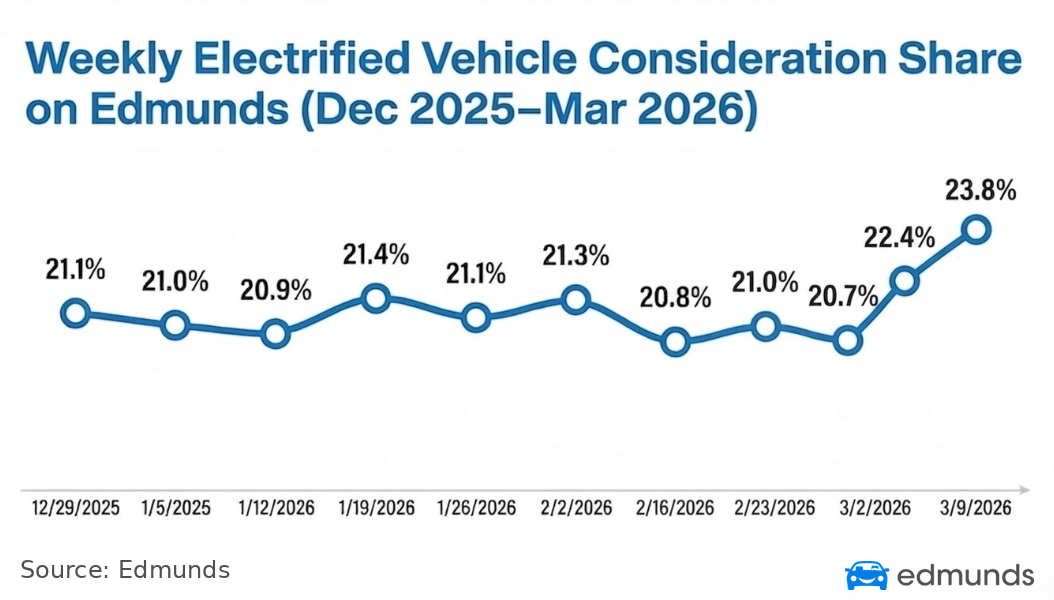
This is from Edmunds, which measures how often people are looking at photos, reading reviews, or browsing inventory of various vehicles. As recently as early March, the number of people interested in any form of electrified vehicle (hybrid, PHEV, EV) was hovering around 20.7%. It’s understandably jumped up to 23.8% as gas prices and crude prices have increased the most since Hurricane Katrina.
“High gas prices combined with elevated interest rates are a tough one-two punch for car shoppers,” said Head of Insights and verified cool person Jessica Caldwell. “If oil prices remain volatile, it could keep inflation and auto loan rates higher for longer, putting continued pressure on monthly payments for consumers who are already feeling stretched. While it’s too early to gauge the full impact, a prolonged conflict involving Iran could also drive up supply chain and logistics costs, placing further pressure on vehicle prices.”
Are oil prices going to stay volatile? It sure seems like it. President Trump just waived The Jones Act, which is something I wasn’t sure I’d ever see in my lifetime. That’s a seemingly obscure but very important maritime law that means any good shipped between ports in the United States have to be shipped on a vessel built here and owned by an American company. Getting rid of it, even temporarily, is a big deal.
The recession fears are real, too, as inflation is still too high and only likely to get higher as the impacts of the war ripple through the supply chain. That could mean a delay in interest rate cuts, as Caldwell points out above. Moody’s just put the chance of a recession in the next 12 months at 49%. Obviously, 49% is sort of like saying “I don’t know,” but the lack of uncertainty is the safe bet.
Does all this mean people are making a safe bet by buying hybrids? That depends.
Hybrid Buyers Still Need To Own A Car For Years To Make Up The Difference
There is a point that gas prices could hit where almost anything that doesn’t need gas is likely to be a good deal. We’re not quite at that point yet and, of course, it varies a lot depending on which car you want to buy. A Toyota Corolla LE is $22,925, whereas a Corolla Hybrid LE is $24,775, for a difference of $1,850. Using the combined EPA estimates, the ICE-powered car gets a good 35 MPG and the hybrid gets an impressive 50 MPG.
A person who drives 12,000 miles a year and has to pay the current $3.84 average per gallon (AAA), will save roughly $395 a year, meaning it’ll take 4 years and 8 months to make up the difference. If you assume that hybrid cars will carry a higher resale value and not compromise reliability, that’s not a bad deal. If average gas prices drop to $3.00, that’ll take six years, which still seems reasonable. If gas rises to $5.00 a gallon, that’s less than four years to make up the difference.
That’s at the lower end, however, and S&P Global Mobility puts the advertised range in prices between $1,614 and $13,121 for full hybrids. Assuming a 15 MPG improved efficiency at the high end, that would take more than 30 years to make up the difference. The average is a little better at $4,300, but that’s still ten years.
As more automakers sell hybrids, this delta should shrink, but high demand in the interim is causing an observed drop in incentives:
In many instances, because hybrid demand has gone up, there are fewer incentives applicable to hybrid versions or dealers were asking over MSRP for the hybrid model making them even more expensive compared to the gas only version. The result is a hybrid vehicle that typically costs more than the gas only counterpart with potentially fewer applicable discounts. However, even when there are higher discounts, it doesn’t offset the higher initial price.
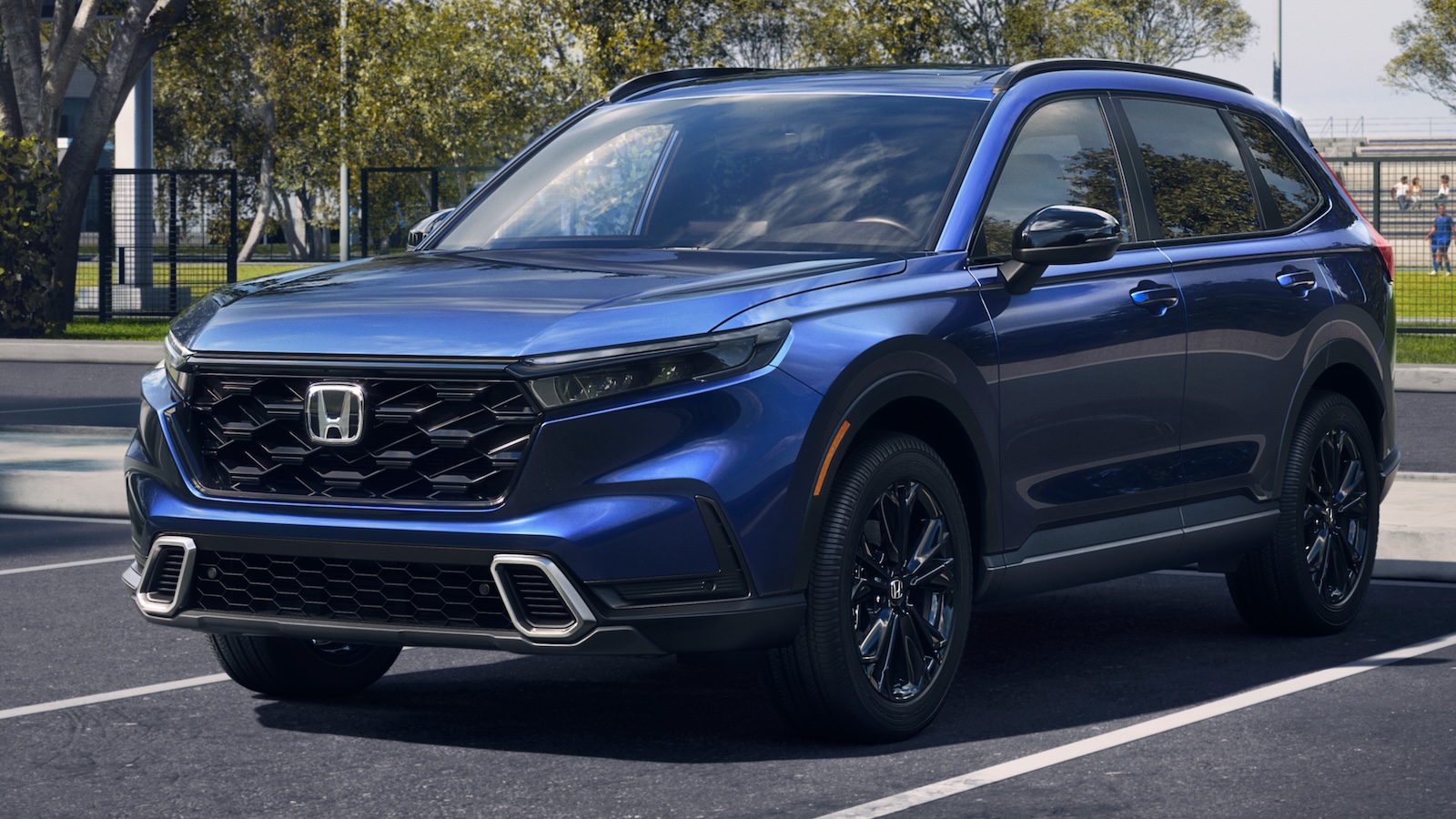
Again, this is going to depend a lot based on where you live, what you’re currently driving, and how long gas prices are going to last. For something like a Corolla, CR-V, or Maverick, the small difference will likely be to your benefit over the long term. If you’re buying a Lexus LS500h? The third owner will reap those savings.
EVs Probably Saved 2.3 Million Barrels Of Oil A Day Last Year

The hybrid calculation is the easier one to make because you’re just comparing the usage of one fuel source to another. The cost of electricity is not only regional, it’s also related to delivery mechanism. Fast charging is, typically, a lot more expensive than home charging. It gets even more complex. While gas prices are likely to go up due to the war, so will prices associated with creating electricity.
Environmental group Transport & Environment looked at the EU market, took into consideration the potential impacts, and found that the price of gas is likely to rise about five times more than the cost of shoving some electrons into a battery:
Petrol car drivers can expect to be hit far harder by price rises related to the Iran conflict than electric vehicle drivers, new analysis finds. With oil prices surpassing $100 a barrel, the additional cost of fueling a petrol car is expected to be five times the extra cost of charging an electric car, according to T&E. Electric vehicles will be top of the agenda for EU Environment Ministers meeting in Brussels today when they will discuss a proposal to weaken climate targets for carmakers in the EU Automotive Package.
T&E analysed the likely impact on petrol prices and found that fuelling the average petrol car would cost €14.20 per 100km, a rise of €3.80 due to the conflict. The average cost of charging an EV would be €6.50 per 100km – an increase of €0.70 because of higher electricity prices due to more expensive gas. [1] For company cars, which drive high mileage, the impact will be even greater: an extra €89 per month for every petrol car in a company’s fleet. EV company cars would cost just €16 extra per month to charge.
As a producer of natural gas, and not an importer, American consumers might see that the price increase for gasoline might be ever greater than for electricity. But what about at the macro level? How much are countries saving by the EV switch? New research from BloombergNEF shows that last year the savings were meaningful:
Growing global adoption of electric vehicles helped avoid the consumption of 2.3 million barrels of oil per day last year, according to a modeled scenario from BloombergNEF.
Those fossil fuel savings are expected to increase every year for the rest of the decade as more drivers turn to battery-powered vehicles, said Claudio Lubis, BNEF’s oil analyst. The research group projects that by 2030, avoided daily consumption could more than double to 5.25 million barrels under the economic transition scenario, where governments deploy technologies that are economical rather than implement policies primarily driven by climate goals.
Put another way, globally, enough fuel was saved to account for about 15% of daily consumption in the United States. That’s not nothing. Another report cited by Bloomberg showed that, at current levels of consumption, China would save about $28 billion annually in lower oil imports, and that was when the price was $80 a barrel. As of this morning, Brent Crude prices jumped to nearly $110.
Are Cheap Used EVs A Trap For Dealers?

Numbers are fun. Let’s do some more numbers, shall we? In 2025, about 2% of cars coming off lease were EVs and 93% were ICE-powered. This year, Edmunds projects 8% will be EVs, or about four times as many. As I’ve discussed before, this is a quirk of the way the Inflation Reduction Act was enforced, meaning that way more EVs were leased than purchased. We’re not even at the peak, which should come in 2028 (roughly 2.5 years after the revocation of the IRA).
If you’re in the used market and are in a position to buy an electric car, this is potentially a great deal. The War in Iran, counterintuitively, is probably bad for buyers if the potential supply glut is suddenly met with more demand, but that’s far in the future.
Could this be good for dealers? Potentially, but there’s a risk. When EV mania took over during the early part of this decade, dealers took on a lot of used EV inventory. This was suddenly a curse for some dealers as Tesla lowered its prices and other brands followed. The relationship between new and used cars usually means that when new car prices drop, the comparable used car prices have to go down as well. Dealers might have spent $30k for a used Tesla Model Y at auction, only to see values crash.
As Automotive News points out, the operative question is how automakers are going to price these off-lease vehicles:
Bowman Chevrolet expects used-EV lease returns to balloon starting in May, though they already are trickling into the market, Jackson said. The dealership bought two off-lease EVs in December from GM to see how customers reacted to pricing. The first of those two cars sold the first week of February at a profit and the dealership has since sold the second vehicle, he said.
The dealership is waiting to see how GM prices off-lease EVs once “the floodgates open,” Jackson said.
“Are we going to see normal demand in spring or fall?” Jackson said. “That puts us in a position where all we can do is buy some to try and and see who calls.”
I will be keeping my eye on it this year.
What I’m Listening To While Writing TMD
For no reason at all, here’s “I Ran” by Flock of Seagulls. I wonder how hard it is to play the drums while spinning in a circle? Probably easier than wearing a garbage bag in a hot studio.
The Big Question
What’s the biggest jump (or dip) you’ve made in fuel economy from one car to another? The Forester got about 24 MPG combined and the CR-V Hybrid I have now makes about 35 MPG in my driving experience, so that’s +11 MPG.
Top photo: Ford




” But Does It Really Make Sense?”
Let’s get one thing out of the way… most car buying choices have little to do with “what makes sense”. If logic and sense drove most car buying decisions, then far more people would be buying Toyota Corollas and far fewer people would be buying full size gasoline V8 powered trucks from Ford, Stellantis and GM. We would also see far fewer people buying BMWs, Mercedes-Benzes and Audis.
Most buyers buy based on image, style and emotion.
“Hybrid Buyers Still Need To Own A Car For Years To Make Up The Difference”
That depends on the person buying, how they use the vehicle and how much they drive.
In my case, I live in the city, I drive quite a bit (25,000km – 30,000km per year) and I only change cars after they wear out.
So in my case, my C-max plug in hybrid has cut my consumption of gasoline by 42% compared to my previous vehicle (a 2008 Honda Fit with a manual transmission).
And for the amount of driving I do, it means it’s saving me around CAD$1000/year.
And in terms of payback, when I was in the market, to get another low mileage Honda Fit of similar age/mileage, there was little to no price difference between that and the C-Max I bought.
And there is another benefit… often hybrids like the C-Max and Prius are cheap to insure than average. Also my C-Max needs less service. I only need to change the oil half as often compared to my old Honda Fit. And that’s mainly due to doing a lot of driving in EV mode.
So for me, the C-Max purchase has made a lot of sense and the ‘payback’ was more or less from day 1 compared to what my costs would have been if I bought another Honda Fit of similar age and mileage.
But I’m not the typical buyer
“Are Cheap Used EVs A Trap For Dealers?”
Dealers exist to sell vehicles. I don’t see why the fuel/energy source of a given vehicle matters. A sale is a sale.
“What’s the biggest jump (or dip) you’ve made in fuel economy from one car to another?”
The biggest drop was when I switched from my worn out 2008 Honda Fit to my current 2017 Ford C-Max Energi… I went from averaging 5.88L/100km (40mpg using US gallons) to averaging 3.41L/100km (69mpg) so far…. which is a 42% drop in fuel consumption… or a difference of 29mpg.
I don’t know what mileage my 540i gets because there are so many dead pixels in the display that I can’t read the odometer. But it’s probably not good. I’d also have to factor in oil, as it leaks a couple quarts per tank of fuel.
Biggest MPG jump for me was when I went from a moderately janky ’84 Cadillac (~13) to a new ’01 Civic (~33). This probably didn’t save me money since the Caddy was $1500 and the Civic was $18000. Even at $4/gallon it would take over 85k miles to break even. Gas was a LOT cheaper then so I probably never broke even despite driving the Civic for a decade. The Civic was more reliable, though.
Realistically, buying a more efficient car isn’t the best way to save money on transportation costs. If you want to save money, drive a cheaper/crappier car. Buying a new EV or hybrid doesn’t make economic sense. Buy a well-used hybrid or EV can be a great choice, though.
Over a period of two years we went from a Focus ST and Outback with the V6, to a Blazer EV and Maverick hybrid. Our gas bill is about 20% of what it used to be, although our electric bill has certainly gone up. Even then, we’re saving about $150/mo on fuel costs (Washington State, high gas prices but cheap electric)
When I graduated from college, my only vehicle was my ’70 GTO that got in the very low teens for mileage. When I could afford it, I bought a Nissan Sentra SE-R Spec V that got about 30 MPG. That was a big boost.
Focus SE to ST, I went from 36 to 30 mpg, but that was also 87 to 93 octane.
Went from a 16MPG City/Highway/Always TJ that is the avatar to a 2009 VW CC that would easily get 37mpg highway. With all the miles I did I think the gas savings were >>> the car payment.