


It’s hard to say exactly when or how the most recent war in the Middle East will end. While huge in scope, time-wise, WWII was a TikTok video compared to the longer conflicts in Iraq and Afghanistan. Even the battles in Ukraine continue to rage with no sign of stopping. Unless you can get around on a bicycle and live in a house that is powered mostly by renewables, the cost of today’s conflicts will eventually impact your life. For car buyers, this is most easily understood as the cost of gasoline or electricity.
There’s data that shows that buyers are suddenly more interested in “electrified” models, which includes different types of hybrids and EVs. Does that math? For hybrid buyers, recouping the difference between the price premium and gas prices might take a little longer than you might guess. The other way to look at this is from a viewpoint of a country. How much money is a place like China saving by having all these EVs?


I’ve talked a lot in The Morning Dump about how a lot of good used EVs are going to come into the market soon. Is this a good deal for dealers that need nice used cars? Or is this just going to be a replay of the price wars of the past?
That’s a lot of questions, so let’s see if I can pull together some answers.
Nearly A Quarter Of Car Buyers Are Looking At ‘Electrified’ Vehicles
Would you like to see a chart? Here’s a chart:
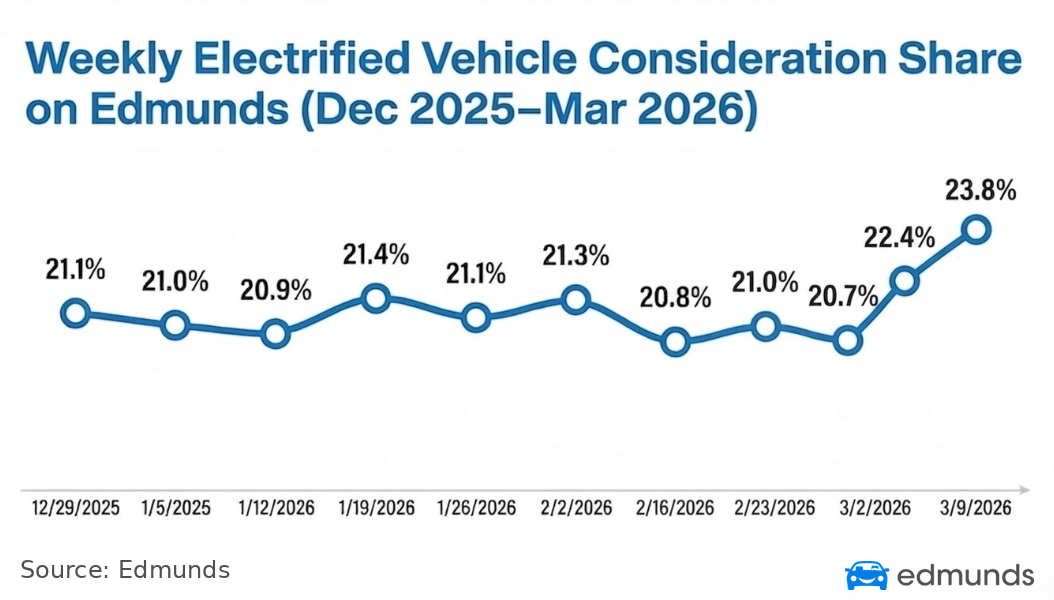
This is from Edmunds, which measures how often people are looking at photos, reading reviews, or browsing inventory of various vehicles. As recently as early March, the number of people interested in any form of electrified vehicle (hybrid, PHEV, EV) was hovering around 20.7%. It’s understandably jumped up to 23.8% as gas prices and crude prices have increased the most since Hurricane Katrina.
“High gas prices combined with elevated interest rates are a tough one-two punch for car shoppers,” said Head of Insights and verified cool person Jessica Caldwell. “If oil prices remain volatile, it could keep inflation and auto loan rates higher for longer, putting continued pressure on monthly payments for consumers who are already feeling stretched. While it’s too early to gauge the full impact, a prolonged conflict involving Iran could also drive up supply chain and logistics costs, placing further pressure on vehicle prices.”
Are oil prices going to stay volatile? It sure seems like it. President Trump just waived The Jones Act, which is something I wasn’t sure I’d ever see in my lifetime. That’s a seemingly obscure but very important maritime law that means any good shipped between ports in the United States have to be shipped on a vessel built here and owned by an American company. Getting rid of it, even temporarily, is a big deal.
The recession fears are real, too, as inflation is still too high and only likely to get higher as the impacts of the war ripple through the supply chain. That could mean a delay in interest rate cuts, as Caldwell points out above. Moody’s just put the chance of a recession in the next 12 months at 49%. Obviously, 49% is sort of like saying “I don’t know,” but the lack of uncertainty is the safe bet.
Does all this mean people are making a safe bet by buying hybrids? That depends.
Hybrid Buyers Still Need To Own A Car For Years To Make Up The Difference
There is a point that gas prices could hit where almost anything that doesn’t need gas is likely to be a good deal. We’re not quite at that point yet and, of course, it varies a lot depending on which car you want to buy. A Toyota Corolla LE is $22,925, whereas a Corolla Hybrid LE is $24,775, for a difference of $1,850. Using the combined EPA estimates, the ICE-powered car gets a good 35 MPG and the hybrid gets an impressive 50 MPG.
A person who drives 12,000 miles a year and has to pay the current $3.84 average per gallon (AAA), will save roughly $395 a year, meaning it’ll take 4 years and 8 months to make up the difference. If you assume that hybrid cars will carry a higher resale value and not compromise reliability, that’s not a bad deal. If average gas prices drop to $3.00, that’ll take six years, which still seems reasonable. If gas rises to $5.00 a gallon, that’s less than four years to make up the difference.
That’s at the lower end, however, and S&P Global Mobility puts the advertised range in prices between $1,614 and $13,121 for full hybrids. Assuming a 15 MPG improved efficiency at the high end, that would take more than 30 years to make up the difference. The average is a little better at $4,300, but that’s still ten years.
As more automakers sell hybrids, this delta should shrink, but high demand in the interim is causing an observed drop in incentives:
In many instances, because hybrid demand has gone up, there are fewer incentives applicable to hybrid versions or dealers were asking over MSRP for the hybrid model making them even more expensive compared to the gas only version. The result is a hybrid vehicle that typically costs more than the gas only counterpart with potentially fewer applicable discounts. However, even when there are higher discounts, it doesn’t offset the higher initial price.
Again, this is going to depend a lot based on where you live, what you’re currently driving, and how long gas prices are going to last. For something like a Corolla, CR-V, or Maverick, the small difference will likely be to your benefit over the long term. If you’re buying a Lexus LS500h? The third owner will reap those savings.
EVs Probably Saved 2.3 Million Barrels Of Oil A Day Last Year

The hybrid calculation is the easier one to make because you’re just comparing the usage of one fuel source to another. The cost of electricity is not only regional, it’s also related to delivery mechanism. Fast charging is, typically, a lot more expensive than home charging. It gets even more complex. While gas prices are likely to go up due to the war, so will prices associated with creating electricity.
Environmental group Transport & Environment looked at the EU market, took into consideration the potential impacts, and found that the price of gas is likely to rise about five times more than the cost of shoving some electrons into a battery:
Petrol car drivers can expect to be hit far harder by price rises related to the Iran conflict than electric vehicle drivers, new analysis finds. With oil prices surpassing $100 a barrel, the additional cost of fueling a petrol car is expected to be five times the extra cost of charging an electric car, according to T&E. Electric vehicles will be top of the agenda for EU Environment Ministers meeting in Brussels today when they will discuss a proposal to weaken climate targets for carmakers in the EU Automotive Package.
T&E analysed the likely impact on petrol prices and found that fuelling the average petrol car would cost €14.20 per 100km, a rise of €3.80 due to the conflict. The average cost of charging an EV would be €6.50 per 100km – an increase of €0.70 because of higher electricity prices due to more expensive gas. [1] For company cars, which drive high mileage, the impact will be even greater: an extra €89 per month for every petrol car in a company’s fleet. EV company cars would cost just €16 extra per month to charge.
As a producer of natural gas, and not an importer, American consumers might see that the price increase for gasoline might be ever greater than for electricity. But what about at the macro level? How much are countries saving by the EV switch? New research from BloombergNEF shows that last year the savings were meaningful:
Growing global adoption of electric vehicles helped avoid the consumption of 2.3 million barrels of oil per day last year, according to a modeled scenario from BloombergNEF.
Those fossil fuel savings are expected to increase every year for the rest of the decade as more drivers turn to battery-powered vehicles, said Claudio Lubis, BNEF’s oil analyst. The research group projects that by 2030, avoided daily consumption could more than double to 5.25 million barrels under the economic transition scenario, where governments deploy technologies that are economical rather than implement policies primarily driven by climate goals.
Put another way, globally, enough fuel was saved to account for about 15% of daily consumption in the United States. That’s not nothing. Another report cited by Bloomberg showed that, at current levels of consumption, China would save about $28 billion annually in lower oil imports, and that was when the price was $80 a barrel. As of this morning, Brent Crude prices jumped to nearly $110.
Are Cheap Used EVs A Trap For Dealers?

Numbers are fun. Let’s do some more numbers, shall we? In 2025, about 2% of cars coming off lease were EVs and 93% were ICE-powered. This year, Edmunds projects 8% will be EVs, or about four times as many. As I’ve discussed before, this is a quirk of the way the Inflation Reduction Act was enforced, meaning that way more EVs were leased than purchased. We’re not even at the peak, which should come in 2028 (roughly 2.5 years after the revocation of the IRA).
If you’re in the used market and are in a position to buy an electric car, this is potentially a great deal. The War in Iran, counterintuitively, is probably bad for buyers if the potential supply glut is suddenly met with more demand, but that’s far in the future.
Could this be good for dealers? Potentially, but there’s a risk. When EV mania took over during the early part of this decade, dealers took on a lot of used EV inventory. This was suddenly a curse for some dealers as Tesla lowered its prices and other brands followed. The relationship between new and used cars usually means that when new car prices drop, the comparable used car prices have to go down as well. Dealers might have spent $30k for a used Tesla Model Y at auction, only to see values crash.
As Automotive News points out, the operative question is how automakers are going to price these off-lease vehicles:
Bowman Chevrolet expects used-EV lease returns to balloon starting in May, though they already are trickling into the market, Jackson said. The dealership bought two off-lease EVs in December from GM to see how customers reacted to pricing. The first of those two cars sold the first week of February at a profit and the dealership has since sold the second vehicle, he said.
The dealership is waiting to see how GM prices off-lease EVs once “the floodgates open,” Jackson said.
“Are we going to see normal demand in spring or fall?” Jackson said. “That puts us in a position where all we can do is buy some to try and and see who calls.”
I will be keeping my eye on it this year.
What I’m Listening To While Writing TMD
For no reason at all, here’s “I Ran” by Flock of Seagulls. I wonder how hard it is to play the drums while spinning in a circle? Probably easier than wearing a garbage bag in a hot studio.
The Big Question
What’s the biggest jump (or dip) you’ve made in fuel economy from one car to another? The Forester got about 24 MPG combined and the CR-V Hybrid I have now makes about 35 MPG in my driving experience, so that’s +11 MPG.
Top photo: Ford


Last year I went from a 2012 Forester (with the EJ25 turbo) that did a measly 15mpg, to a Mazda 6E EREV that does 59mpg! In metric that’s 15L/100km to 4L/100km, plus I’ve gone from pumping premium to regular, so I’ve slashed 75% off my per km fuel cost.
Granted these are city figures, on the highway it’s 26 vs 40mpg. One of the tradeoffs of an EREV I guess.
Of course we don’t get such vehicles here, only more trucks.
I have a perfectly good ICE car that I like. It’s paid off and all maintenance is up to date. On average it costs me 6 litres of regular gas per 100km of driving and some fresh fluids about once a year. I suppose spending 50K or more on a new EV or hybrid makes perfect sense.
Nothing bad can happen. It can only good happen.
I swapped a Lexus GX460 running Premium and averaging 17-18mpg to a 100MPGe Mach E. so 82-83 mpg increase
even having to reply on lots of expensive DC fast charging…… my per mile cost went down more than 50%
I naively suspect (hope?) the jump in interest in electrified vehicles is less about a faulty “this totally changes the math” and more about a “hey, gas prices are in the news, would a hybrid/PHEV/EV work for me, I hadn’t thought about that.” My perception is that part of this may be driven by attractive aspects of electrified vehicle other than fuel economy. Others have mentioned positive economic aspects of electrified vehicles but my impression is in a lot of models they are quicker and often come in higher trim levels than the gas only (not sure if your price analysis nets this out) so gas prices might help people justify bumping up a level. An extreme example is the market for small electric outboards for dinghies–they are much more expensive, of neglible or negative environmental benefit (energy intensive to make and then they barely get used) but people still buy them because they’re soooo much nicer than a stinky, finicky, loud gas outboard.
I think there are a lot of people out there that haven’t given EVs a thought beyond “eh, seems more complicated” and didn’t give it an serious thought when gas was $2.75. Or one spouse (let’s call him “me”) likes the idea of a cheap EV lease versus a 7% interest car loan on a sticker price Rav, but the other spouse (let’s call her “my wife”) is concerned about range and remembering to charge and those sorts of things. And then gas goes up 75 cents in a week and people are suddenly open to giving it some thought when they previously hadn’t.
I went from a 1974 Mercury Capri, which I totaled, to a 1963 Ford Galaxy 500 XL Convertible that weighed over 4,200 lbs and had a 390 ci V8. Of course, this was in 1976, when gas was a lot cheaper than it is now, and I never checked the milage of either, but I know there was a fairly big difference.
TBQ: I went from a Ford Flex, which saw about 24 mpg at it’s absolute peak on a road trip (and that was once, never to be seen again; I would routinely get ~21-22 mpg on the road), to a Kia Optima, which peaked at 40 mpg on a road trip (with a very helpful wind at my back), but would routinely get 36-38 mpg on the road. Normal life averages were in the neighborhood of 19 mpg for the Flex, and 32 mpg for the Optima.
Nothing in the entire history of gasoline suggests prices will be high for 4 to 5 years.
https://afdc.energy.gov/data/10641
Biggest MPG change between cars? Well, I’m still on my first car, a 30 MPG Geo Tracker, but if we want to compare that to my previous vehicle, it gets far worse mileage than the ~150 +/- 50 MPG that my old 66cc two-stroke bicycle got!
Used Bolts with recently replaced packs are looking mighty nice when it comes time to replace my DD Mazda5 (6MT!)… that may be quite a while. Just about everything I’ve owned has been between about 19mpg (turbo FC RX-7, RX-8) and 28mpg highway (Saab 9-3, Mazda5), so I’ve been dithering around the same range for a while. Right now the Mazda5 is up on jack stands as I repair the exhaust and replace the brakes, so the RX-8 is getting driven every day – 50% worse fuel economy + at least $1 more/gallon for premium is definitely noticeable.
I bought one of those Bolts in ’24 and haven’t regretted it a bit. My biggest gripe about the car is the ride, which is too stiff for my taste.
That’s something I love about my Leaf, it has an amazing ride, better than every other vehicle I’ve ridden in or driven in the past 2 years.
My Tacoma gets ~19mpg, so the 33mpg I see on the motorcycle is a huge jump! And just as the weather starts warming up. Mid-grade here in Denver (87) is already like $4.50, so great. Love all this Winning we’re doing.
I went from a 1987 Trans Am GTA with a 305 to a manual 2nd-gen Fit. Granted, the use cases for them were very different as I’d just graduated and gotten my first real job, but that’s gotta be a swing of at least 15-20 mpg.
We are looking to get a hybrid within the neat year- probably a 4th-gen Prius. It’s to replace my wife’s aging Fit though, so not really a reaction to the recent high gas prices.
It will never stop baffling me how reactionary people are with vehicle purchases. The “looking at electrified” chart tracks so closely with gas prices. My suspicion is that a very large number of people are already at their financial limits with their vehicles, so an increase in fuel prices directly adds strain, so they roll that into their next vehicle intentions, rather than reducing Total Cost of Ownership to be in a more stable position financially.
The gas price issue is so large, that if you look back over the last 60+ years, when gas prices spike during an election cycle, the party in power loses every. single. time. The current administration is absolutely desperate to lower gas prices because even in their lack of forethought at planning, they see the writing on the wall. This is why the Jones Act was waived, because even though the US is a great supplier of oil, the crude we pump does not work with our refineries, so we are desperate to get oil onshore from abroad. This is the same reason oil sanctions against Russia were lifted, because even if we don’t buy from them, it increases global supply with the straight of Hormuz closed. Even DJT understands that like in Dune, the oil must flow.
To be insufferable, in the case of EVs this of course does not include cost savings such as almost zero maintenance for EVs, somewhat offset by differences in insurance costs or increased registration fees. My state tacks on a hefty EV tax to registration to offset lost gas tax revenue
Hopefully these unjust fees will be addressed at the federal level by a different administration, with some logical sanity being applied.
I’m confused as to how the fees are unjust. EVs damage the roads as much as ICE vehicles do. Just because you’re not spewing exhaust doesn’t mean you shouldn’t help pay for the road maintenance. I’m assuming the fees aren’t punitive and replace gas tax revenue as stated bt JT.
The extra weight of an EV probably damages them more. I’m looking at you Hummer EV!
I didn’t want to get into the weight argument because all cars are getting so heavy these days, but yes, the 3+ ton vehicles definitely cause more damage.
They are punitive though, as they usually equate to more than the equivalent gas tax would have come out to since they aren’t mileage-aware. Of course that differs by state, but here in PA they’re absurd.
In many cases the fee is fixed and much more than what the state would collect from gas taxes. For example, Alabama charges EVs an extra $200 a year and their gas tax is 30 cents a gallon. Someone driving a regular non-hybrid Accord would have to drive 22,000 miles a year to pay that much in gas tax.
Light duty vehicles are doing almost no damage to roads. 95% of weight related road damage comes from commercial vehicles
This is the reason. In NH where I live the fee is $100/year on top of other registration costs. It should instead be commensurate with how much I drive. Or the gas tax should be replaced with an equivalent flat fee for ICE cars, but that is a regressive tax policy
… or we could scrape the gas tax and simple charge all vehicles: ICE, EV, CNG, H2 a set fee per mile.
Actually, $100 per year isn’t ridiculous. If you drive 12000 miles per year at 30 mpg and you pay a gas tax of $0.30 per gallon, you’re paying $120/year. of course gas taxes and these fees vary from place to place, as does actual mileage.
To be clear, I don’t agree with any policy that punishes people for choosing a BEV rather than ICE.
In my state the taxes on electricity are much higher than on gasoline.
The difference is that gas taxes are for roads, whereas electricity taxes are for who knows what.
People don’t react with reason, they Do something weather it works or not.
Going from a 38 mpg Chevy Cruze to a 100+ mpge Model Y. About 60ish mpg equivalent or so higher. And it’s coming up to the sunny time of year so rooftop solar will help offset the energy the MY uses. Plus the delta between retail and wholesale electricity prices will widen and my utility rebates me the difference in exchange for letting them control the charging during super off peak hours.
Diesel Cruze?
The 1.8 with a six speed easily hit 38 mph highway. I could get into the low 40s if I didn’t screw around.
I think you mean mpg, but it’s funnier as written.
Stick shift Eco. Basically a 1LT with a whole bunch of aerodynamic modifications.
Honestly the greatest benefit to ‘electrified’ vehicles is the increase in reliability for the ones worth buying.
As you mentioned it takes years for the monetary gains from the efficiency of a BEV or a quality hybrid to be seen
For BEVs their drivetrains tend to be much more reliable than ICE across the board, including range extended BEVs.
For Hybrids ones with e-CVTs tend to be much more reliable than pure ICE across the board.
However people should stay away from the Hybrids with traditional automatic transmissions. The MPG gains from the hybrid system are so minimal that they only matter to fleets (whether it be for CAFE or traditional fleets). However the hybrid system adds complexity since instead of building a hybrid drivetrain they instead take an ICE drivetrain and shoehorn (a) motor(s) and batteries into the drivetrain.
I love BEV drivetrains, and if I could I’d only use them (including range extended ones) for the rest of my life. However features unrelated to the drivetrain are often gatekept, and so I’m sadly moving to an ICE drivetrain for my next daily driver.
First automaker to come out with a range extended BEV pickup with a 6 seat interior, height adjustable air suspension, and at least 6000lbs of towing will get me as a customer.
What features are gatekept? I’m drawing a blank here.
In my specific case a 6 seat interior for one.
I would have bought a F-150 Lightning if I could have gotten it with a 6 seat interior.
Ford in their infinite wisdom decided that the electric version of the lightning would only be available as a 5 seat crew cab short bed pickup, really maximizing the modularity of a BOF design by coming in as many configurations as their unibody Maverick pickup.
If you wanted a 6ft+ long bed F-150 ICE was your only option.
If you wanted something other than a 5 seat crew cab F-150 ICE was your only option.
Oh, so it’s not gatekeeping, it’s just that no one makes your specific desired config due to the niche market segment.
Depends on how you define it.
They make an ICE automobile that uses the same cab, yet they refuse to offer it with a 6 seat interior, even though said interior in no way is incompatible with the BEV drivetrain.
To me that’s gatekeeping.
Having sat through a full teardown of a Lightning, it’s a unique chassis, cab, and bed. If you look at the sales penetration numbers, Lightning’s represent about 3% of F series sales, despite being the most common configuration (4dr short bed). It’s really a completely new truck that shares some parts and general shape, rather than a F-150 with a battery bolted in.
I’m more familiar with the GM EV trucks, which are almost 90% different than the ICE counterpart.
If you look at the Body in White of the F-150 Lightning there is nothing preventing the 3 seat front bench setup from being installed.
Man, if only there was an option you could just run on electricity and plug in at home every night. That sure would save a lot of trouble. Oh wait…we’ve gone on a full frontal assault against those to own the libs, and thanks to misguided deregulatory efforts gas guzzlers are so hot right now and very much back on the menu.
If you want something more efficient you’re going to have to pay a premium and in many cases wait, because line must go up. But head on down to your local RAM dealer and they’ve got Hemis for days and brand new 96 month financing! We’re reverse engineering V8s BACK into stuff too, baby, because who cares about efficiency or emissions? V8 GO BRRRRRRRRR! FREEDOM, BABY! I GOT MINE (until it’s repossessed when gas climbs to $7 a gallon).
All of this is immensely stupid, but as a nation we wanted stupid. We wanted belligerent. We wanted dick waving toxic masculinity. We didn’t want to THINK or CALCULATE! We want WAR! We want IMPERIALISM! LINE! MUST! GO! UP!
…until the consequences affect us directly, then they’re a travesty, an injustice, and something we just couldn’t see coming despite the buffoons we lined up to vote for out of spite loudly saying this is what they were going to do over and over again. How could we have known? NOOOO MUH RAM IS BEING REPOSSESSED THANKS A LOT BRANDON!
Sometimes the hypocrisy is blinding – so much so that many people can’t even see it…
No no, you don’t understand. There isn’t enough electricity for everyone to drive an EV! And even if there was, we don’t have the infrastructure to get it to the people! There is no way anyone should ever consider an EV as their full time vehicle, because that would bring down the entire US electric grid.
(This dumb comment brought to you by the paraphrase of the very first thing my dad said to me when we were out for drinks this week. He will not be deterred by $5/gal gas!)
Yeah and it’s not like the people pushing that narrative are making money hand over fist from huge AI data centers using up electrify in obscene quantities!
…oh.
I had actually never broached the subject of data centers of any stripe (that are popping up like weeds around here) with my old man. Surprisingly, he’s absolutely against what’s going on with them, at least from a fiscal POV. Too many communities giving millions away in tax breaks for < 30 permanent jobs, in a state that has possibly the worst power generation policies in the union!
Everyone I know personally is against them, no matter where they are on the political spectrum.
Yeah, it’s wild how data centers have put me on the same team as people with “No Solar Farms” signs in their fields.
I guess it’s better to have mixed feelings about rural politics than when driving through farm country was like a political horror show. Maybe we’ll be able to find some more common ground to start some reasonable conversations?
Hey, I can dream. 😛
I mean, it would be rather dumb to cover productive farm fields with solar panels. There’s lots of arid land that would be a much better spot for them. They would produce more energy from the lack of rain too.
Most of the farm fields around here are growing corn for ethanol production, which is approximately the worst use of the land possible. And there’s not arid land for at least hundreds, if not thousands, of miles, so pre-clear-cut farm fields that are already being used for nothing but energy production are actually pretty ideal places for solar farms.
He’s not wrong, especially on the infrastructure front, but that presupposes no more generation capacity and infrastructure will ever be built, and that adoption rates are orders of magnitude greater than they currently are…
You’re both right, of course. My only response is: Why can’t we get there? Even forgetting about electric cars, so much more of what we’re doing as a society is going to drive up the need for electricity generation and transmission. We should be making the grid better in all aspects, and effectively make EV adoption a non-issue.
The grid, added power generation and AI are the current wild cards. All of that record added generation, and the grid upgrades directly tied to them, could be going for something more useful than AI.
Napkin math:
Tesla ModelY: 15.3 kWh/100 km (metric because numbers are easier)
20,000km/y (~12,500miles) mileage annually = 3060kWh/y consumption (avg. 8.38kWh/d)
Based on Chicago IL (so, reasonably far north): 1kW of solar panels would produce 2.05kWh/Day in the winter. It would be 3x that in the summer.
Thus, you’d need ~3kWh of solar panels
If I picked some mid-performance solar panels, they’re in the 400-500W range.
I would need 6x solar panels to cover the average consumption.
I feel like we’re not trying very hard.
Solar PV is almost always a better investment than EVs, because a grid-linked system can produce all day. Compared to that, cars are lazy- the average American car is driven only one hour per day.
Expanding the napkin:
If you consider a 3kW array is roughly in the $4-10k range (wild range depending on installation, incentives, etc…). Let’s assume $6k being a fair number to use.
Theoretically you could use that entire 3kW installation to offset your fuel costs by pumping it direct into an EV (we can argue about time of use, but electricity offset of daytime vs nightime and off-peak rates – you’re right that you’d probably come out ahead for grid-connected depending on jurisdiction)
If your EV is offsetting, say,
A Civic Hybrid ~265gallson of fuel
An F150 5.0V8 ~625 gallons of fuel
The PV array would pay off with:
The Civic at $3/gal in 7.5 years.
The F150 at $3/gal in 3.2 years
(**$5/gal, it would be much much much faster)
Considering the PV array would continue to provide power for many years beyond the warranted “life” of the PV panels of 25 years (the point at which they guarantee minimum 80% rated output) – you’re well ahead, and have provided you and your neighbours energy security (with grid-connected PV).
Stretch this further – PV costs drop as the size of the array increases, and only improve the return on investment.
So much for “facts don’t care about your feelings”
MUH FEELINGS DON’T CARE ABOUT YOUR FACTS, LIB!
A V8 in a lightweight, aerodynamically-streamlined, tiny frontal area hoonable, would actually be more efficient than today’s norm. But that same platform would make for an even better EV. I think that there’s a market for both, if only it were offered at a price the low-end of the market could afford.
I’m always here to support the Toecutter Agenda
Yes please, I’d love a big NA engine in an EREV, big gobs of reliable power without the complexity of a turbo engine. My EREV’s 1.5 NA 4-pot just wheezes at low-SoC and high load, do an extended climb or overtake someone at highway speeds and it just screams for mercy.
A properly built and maintained NA V8 will last a VERY long time. The design of the cars themselves, not so much the engine choice, is the problem. If you’re pushing a 3-ton brick through the air, going from a V8 to a turbo-4 is not going to yield much gains in fuel efficiency. You’ll get an extra 25%, if you’re lucky. You could get the same gains in highway fuel economy cutting CdA and mass by 1/3 by re-designing the vehicle, and drag could be cut by half and mass by 2/3 if we built cars the way Amory Lovins of the Rocky Mountain Institute had recommended way back during the 1970s/1980s/1990s.
I’d LOVE to see a miniaturized ~3L LT-like V8 engine in something like a GM Ultralite set up as a PHEV parallel hybrid with a manual transmission. Imagine having a high-revving NA V8 getting 70+ mpg when using fuel, and maybe getting a 50+ mile real-world EV range with a 10 kWh battery(7 kWh kept usable). And then having AWD with 1,000+ horsepower in a sub-2,500 lb car with drag so low you can hold 150 mph on about 100 of those horsepowers. The SUV would die.
Option does not mean 1-1 replacement.
I’m replacing my 2025 Nissan Leaf S with a 2026 Ram 1500 Crew Cab Long Bed with the 3.0L I6 (specifically wanted a turbocharged engine due to living at over 7000ft of elevation).
I originally ended up buying the Leaf because a BEV was perfect for my use case, problem was 99.99% of BEVs on the market were unnecessarily technophilic to the point it compromised reliability, so while a Fiat 500e would have been more practical for my use case I got the Leaf, because I wanted mechanical door handles, mechanical seats, a mechanical parking brake, etc. but even then I had to compromise still.
For my current use case the Leaf no longer pencils out, so my parents are getting it to replace a very tired guest car.
I’d love a BEV pickup that has seating for 6 and height adjustable air suspension, it just doesn’t exist. There’s only 1 automaker that makes a pickup with height adjustable air suspension, it’s Ram, and it’s for 1 model, the 1500, and if you want a 6 seat interior it’s for 1 trim, Big Horn, and you can only order it online, dealers cannot order it by themselves (learned that the hard way).
The closest thing coming out in the near future is the Ram 1500 REV, which to date has only been spied with a 5 seat interior and the rambox bed (which isn’t compatible with camper shells except for one from Australia that the company who makes it won’t direct ship to the US or if you get a stupid lift system that physically lifts the camper shell off the bed rails so you can access the cargo boxes.
Who knows how many years it’ll take for RAM to sort out all the teething issues with the REV, and how many years after that for them to offer a 6 seat interior and a non-rambox bed if they will at all?
Current US market Hybrid Trucks besides the Maverick are all dogshit at best,
Current production US market EV Trucks are all technophilic at best.
Independent of drivetrains there are lots of things people want in their automobiles that they cannot get from other brands.
Idk what you define as a “full frontal assault” against BEVs, so if you would I’d greatly appreciate if you expound on that so I can properly address that.
I agree with a lot of your points, but at the same time there’s a lot of generalizations made in your comment that miss major realities for people looking to buy a new car.
Unpopular opinion: seating for 6 = 3 row wagon, not a pickup truck. But, feel free to seek out the ugly, 3 legged unicorns.
I need it to be rated to tow at minimum 6000lbs, likely more due to how tow ratings work, and the height adjustable air suspension helps with the shifting payload that is horses
The new Dodge Charger would be a great candidate for such a vehicle, provided they made it a wagon, and got rid of the electric door handles, and height adjustable air suspension (like an American Audi A3 Allroad).
That being said it would be a tight squeeze for road trips (1 Irish, wolfhound, 1 mastiff mix, 1 baby, 2 adults, and all our stuff) but doable.
Currently the plan is to put a nice mattress in the truck bed with a camper shell for the Wolfhound (he doesn’t like riding in cars in general, and a 3 seat bench is still small for him due to his long legs). The bed is 6’4″ long so there would still be room in the bed for stuff.
Valid response and I’ll add my usual “I have no issue with people who have a legitimate need for a truck owning one” disclaimer. They’re tools. Hell I think many of them are pretty neat and are engineering marvels. It’s absolutely nuts what a bog standard half ton is capable of in 2026.
…but I will continue to make fun of the average Kyle who has no use for one and still went out and bought it on hilariously bad terms for ulterior motives you can allow your imagination to fill in
To be fair I’m not going to be towing every day, hauling everyone in the family every day, or even using the bed every day, but at least twice a year I’ll be doing all of the above at the same time, so I had to come up with a compromise vehicle that could do all of that while still being a comfy and somewhat fuel efficient vehicle
As Nick Adams said below a Wagon would be the better option, and on paper he’s right. However noone makes one for the US market that would do the job I need it to do (though the new Dodge Charger would in Wagon form with height adjustable air suspension, making a sort of American Audi A3 Allroad).
I do agree that poor automobile choice should be criticized and that there are a lot of assholes driving obese POS that they have no use for.
Don’t worry, online know-it-alls will see you with an empty bed and no trailer once and all of a sudden “tHaT gUy NeVeR tOwS” no matter how often you actually do it.
Nothing makes some people happier than projecting their values and choices onto everyone else’s supposed needs. As if they’ve never bought anything beyond the barest minimum for their own needs.
I’m an equal opportunity shit-giver. I also think it’s incredibly lame to buy performance cars and never drive them to their potential. I felt like there was a part of my Kona N missing until I took it to the track. If I’m going to own something that’s meant to be driven that way then damn it, I’m going to do it.
I’ll feel the same way if I wind up with an off road capable SUV for my next car. I like to use things to their potential for their intended purpose or I feel like I’m being wasteful. Folks are always like WELL WOULD YOU TAKE YOUR HYPOTHETICAL 911 TO THE TRACK and I’m like…yeah! Absolutely! The dudes mothballing them are just as lame as the average doofus driving an HD truck to his desk job and back.
You have no idea how refreshing this is.
I agree about your point with performance cars. Ever since I’ve been driving I’ve been of the ‘slow car fast’ mentality
Before I got my Leaf I tried to get a 24 Wrangler 2 Door Sport which while not optimal for my short driving use case would have been very capable for the snow and surprisingly good for in town driving (fairly tight turning circle and short OAL). Yeah it didn’t have Dana 44s, but I was going to put lockers in it, and if I ended up breaking the axles driving on paved roads in the snow and on forest service roads then I’d upgrade, but those axles would have probably held up perfectly well for my use case.
Sadly didn’t get it because the last NOS one in the country with a hard top and the Trailer Tow Package was built wrong by Jeep, and after a month of waiting on a single part that was being put on new production Jeeps, Jeep had not allocated the part, nor provided a ETA between now and the heat death of the universe for said part, so I canceled my contract and got the Leaf in 3 days for $21,500 brand new ($8500 under MSRP)
I think the Jones Act requires that goods shipped between US ports be transported by US-built and flagged SHIPS, not that the goods themselves be made in the USA. It opens the transportation of oil products up to non-US ships
Oops, left out a few words there. Considering how much I listen to the Odd Lots podcast that’s an embarrassing oversight. Thanks!
Well, your mistake results in me getting a new podcast recommendation, so a net plus in the end!
Your clarification is what I took away from the article that Matt linked on it too – it’s about the ships, not the product or good onboard.
Flocking back to electric, just in time for your friendly local size-of-a-neighborhood AI data center to start hoovering up 1/4 of your state’s electric supply and send rates into the stratosphere.
Also, I am an original owner of a 2023 CR-V Sport (hybrid) and have zero regrets and have had zero issues with it. It is a fantastic vehicle that was worth every penny.
Its just like anything else. If you’re looking for a new car already, the current fustercluck is putting a much heavier thumb on the scale towards hybrids/ev’s/something to reduce fuel costs.
I expect these off lease ev’s to be very popular. I know at least one of my coworkers is gonna be looking at one for her commuter car between her and her husband.
Especially as gas is already at about $4.89-5.30/gal for regular here. Even at costco
What is nice about off-lease EVs vs ICE, is that if the previous users abused an ICE car(using full power/high revs before the engine is broken in) you’re probably getting a lemon, whereas the EV is much more tolerant to abuse when new. The prospective EV buyer is definitely going to have to have someone who knows what they are looking at check over the battery pack, no matter the car’s condition even if it sat unused after manufacture for years before the sale.
When I stopped commuting 100 miles a day, I sold my commuter car, a 1.0 Ecoboost Fiesta that got about 40 mpg, and relied on my F350 instead (11 mpg).
Of course, considering the drastically fewer miles I was driving, overall fuel usage was flat or down.
If I ever have a long commute again (hopefully not), I’ll likely end up buying some 50 mpg hybrid since nothing I own is very efficient and the payoff would be fairly quick.
I really hope I make it to retirement before all the remote jobs disappear. It is amazing how little I have to drive and how much of my limited driving is more pleasurable now.
I’ll be more open to structured hybrid or in-office work when my kids are older I think, but for now it’s a lifesaver to be mostly at home.
I traded a Camaro RS (30mpg highway) for an Ioniq hybrid (60mpg highway), then later traded the Hyundai for a Challenger R/T (23 mpg), so that was some swings there. Will say the Challenger does average pretty spot-on to EPA estimates in real world use
TBQ – I think it was when I went from my manual transmission 2007 Toyota Matrix, where I averaged around 32-33mpg, to a 2018 VW SportWagen with an automatic transmission and got around 23-24mpg.
We need an inexpensive EV with the efficiency of an Aptera, and the robustness/reparability of a Slate pickup. THAT is what is going to save people money over using an ICE car, and a hell of a lot of it at that.
These touchscreen-laden tech-bloated abominations with triple-digit kWh battery packs are going to be very expensive to fix when the time comes, and it will. A 10-15 year lifespan is built into the majority of them, when it’s not hard to make them last for the life of the buyer given the inherent simplicity of electric drive systems. Anything less is really a waste of the materials and energy that went into the vehicle’s construction.
Further, as AI datacenters start driving the cost of electricity to the stratosphere, efficiency is going to become that much more important to the vehicle’s overall operating cost. The cost of the battery is already terrible enough and a smaller pack for the same range is preferred.
It’s almost like we’ve been here several times before.
To quote some talking head somewhere, “Same as it ever was”
And, long term, gas prices still trend up.
So who’s laughing now?
This is the worst sequel to Groundhog Day ever.