

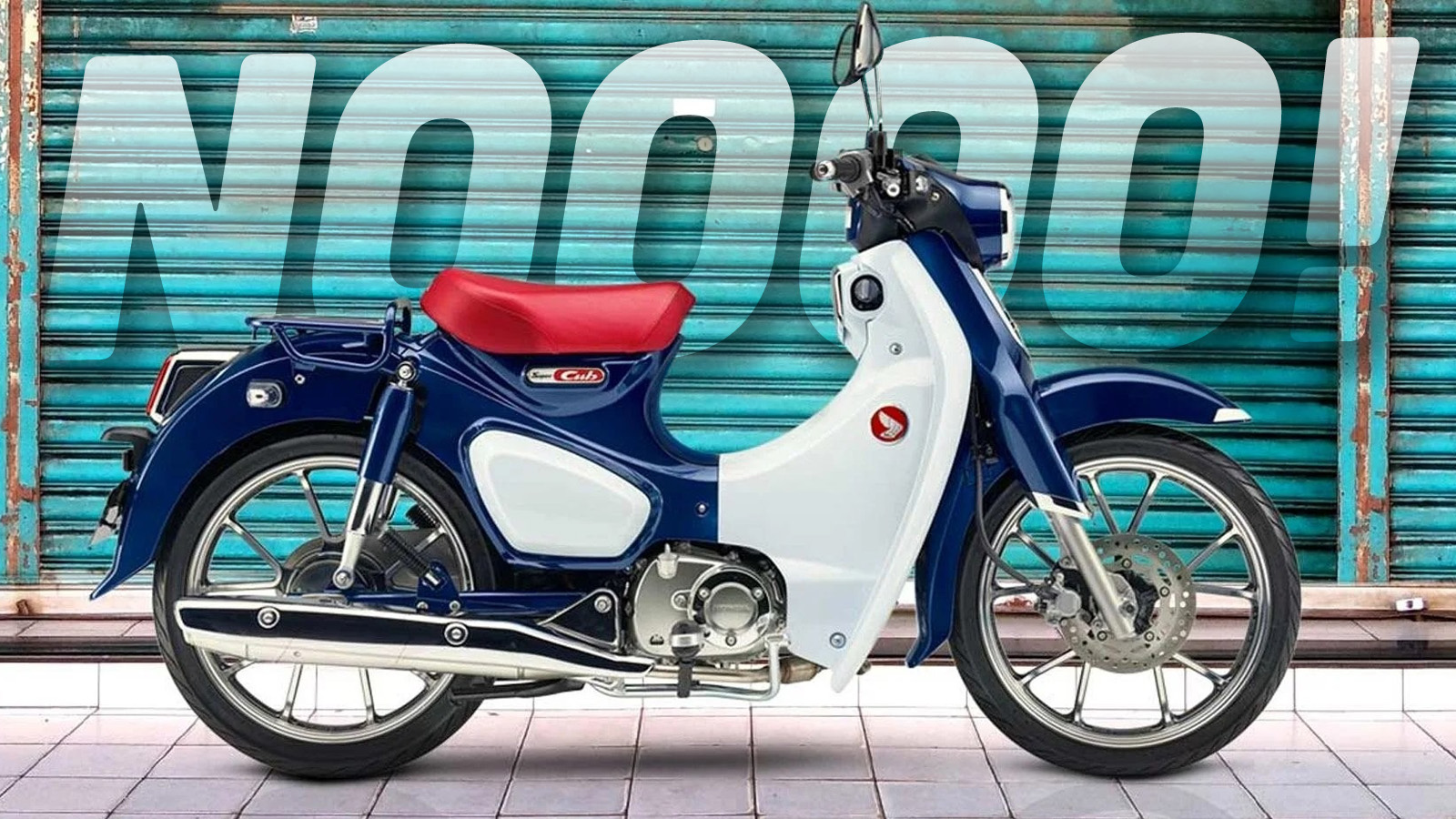
What’s the best-selling motor vehicle of all time? Volkswagen built over 21 million Type 1 Beetles, while Toyota has moved over 50 million Corollas since its original launch. Neither of them holds a candle to the Honda Super Cub. As of 2017, Honda sold more than 100 million Super Cubs, and it was the motorcycle that got much of the world on wheels. The Super Cub was also a sensation here in America, but not anymore. According to a recent report, Honda quietly discontinued the Super Cub in America in 2024, and somehow, nobody noticed until now.
This story comes to us from our friends at RideApart, and honestly, it was shocking. I sometimes write about Honda motorcycles and sometimes visit Honda’s site to make sure I’m abreast of current models and pricing. I’ve lost count of how many times I went to the Honda Powersports website and remember seeing the Super Cub there throughout most of 2025. When did it disappear?


RideApart notes that Honda scrubbed the Super Cub from its site in 2025. Using the power of the Internet Archive, I can confirm that the Super Cub remained on American Honda’s website until at least December 8, 2025, then it disappeared. The model displayed through early December 2025 was the 2024 Super Cub.

Unfortunately, no mistake has been made. Honda’s American arm has decided to stop selling the Super Cub here. It just took until now for everyone to notice. This marks the end of an incredible journey. The Honda Super Cub was more than just a motorcycle. It was a movement. This was the motorcycle that got non-riders on two wheels and helped foster an image that not every biker is a belligerent man in leathers riding a loud Harley. For decades, the Super Cub was the motorcycle for everyone from all walks of life. Now, at least for Americans, it’s a motorcycle for nobody. Let’s look into what made the Super Cub an all-time sales hit around the world.
Born From Bicycles
Like so many household names today, Honda did not get its start in motor vehicles, but in bicycles. Soichiro Honda grew up helping his dad repair bicycles. His heart wasn’t only on two wheels, as Honda has a passion for cars and planes as well. As a teenager, Honda would learn how to tune cars and build his own racecars. In 1928, Honda opened a motorcycle and car repair shop. He would also become a known name in car racing in Tokyo. That was until a fateful race in 1936 when, at the newly constructed Tamagawa Speedway in Tokyo, his racecar rolled three times at 75 mph, throwing him from the wreck. After recovering from the crash, Honda decided to hang up his repair hat and get into parts manufacturing.

Honda’s first parts were piston rings, which, according to the book, Japan’s Motorcycle Wars: An Industry History by Jeffrey Alexander, were such a highly-sought commodity in late 1930s Japan that they were worth more than their equivalent weight in solid silver. Yet, Honda’s first piston rings had failure after failure. Eventually, Honda scored a deal to supply Toyota with piston rings, but only three of the 50 rings provided to Toyota met the required spec.
Honda, who had no formal training at the time, decided to attend an engineering school, visit some factories, and study Toyota’s quality control so he could better understand the science of casting.

Immediately following the events of World War II, Soichiro Honda found inspiration in the little engines that powered wireless radios during the war. Honda figured he could use a wireless radio engine to make his wife’s life easier. He mounted an engine on her bicycle, and it allowed her to ride to town much quicker than just riding on human power alone. Given that smashing success, Honda decided to make a whole business out of it.
At first, Honda’s new motor company was small, and featured 10 men working in a small building who mated 50cc Tohatsu two-stroke wireless radio engines into bicycles. When the team used up their supply of 500 engines, Honda designed his own engine, which resembled a chimney. Honda says its earliest engines were problematic. The engines were required to be warmed up before starting them; the oil didn’t lubricate very well, and riders had to kick up to 30 times before the engines would even fire.
You Meet The Nicest People On A Honda

One of my previous stories about Honda continues from there:
Honda’s first product was the Honda A-Type, launched in 1947, a year before Honda formally founded the Honda Motor Company, but a year after Honda started engineering. The A-Type was a die-cast two-stroke engine with rotary valves that delivered power to a bicycle’s wheels through a patented belt drive. Honda built its engines on assembly lines, and parts were designed so that anyone could put them together without manually filing and shaping the parts. In reality, Honda says, most of Honda’s early parts still needed manual finessing before they could fit together, but the concept was still sound and was refined as time went on.
It was only 11 years later that Honda would change the world. Honda and managing director Takeo Fujisawa traveled to Europe, where they found out that the small motorcycle culture was way different there than it was in Japan. They went back to Japan, convinced it was time for a revolutionary new way to travel. Honda’s new motorcycle would be neither a moped nor a scooter. It would also be designed to be inherently friendly and easy to ride. Further, this new bike was to be designed from the start to be for everyone, from the suited Japanese businessman to a woman in a clean dress. Oh, and the motorcycle couldn’t be complicated, so a traditional manual transmission was out, and the motorcycle had to be seriously rugged and powerful to survive Japan’s rough roads.
In 1958, Honda launched the Super Cub. The little motorcycle did everything Honda wanted and more. It was truly a motorcycle for the masses, no matter where in the world they lived. Perhaps even more brilliant than the Super Cub itself was its marketing. The Super Cub came to America in 1959. In a time when motorcycle riders were gaining a negative “biker gang” reputation, Honda proudly marketed the Super Cub as being the motorcycle for everyone. “You Meet The Nicest People On A Honda” remains one of the greatest marketing lines of all time.
Allegedly, that European tour involved visits to Kreidler and Lambretta dealerships. Honda concluded that the Euro bikes he saw didn’t really have a future. Sadly, Honda would be proven correct in one way or another, as so many European brands do not exist anymore.

Part of what made the original Super Cub such a winning vehicle was Soichiro Honda’s formula. According to Honda, he told company engineers to “create things that can fit in the hand” and “create things that are easy to operate.”
Specifically, Honda wanted a motorcycle that someone could ride while carrying an order of soba noodles in one hand. Honda’s engineers had to build something that they hadn’t ever seen before. Until then, Honda produced 50cc two-stroke Cub engines for bicycles that made only a single horsepower. Honda demanded that these new engines be both four-stroke and make four horses.
Overcoming Challenges
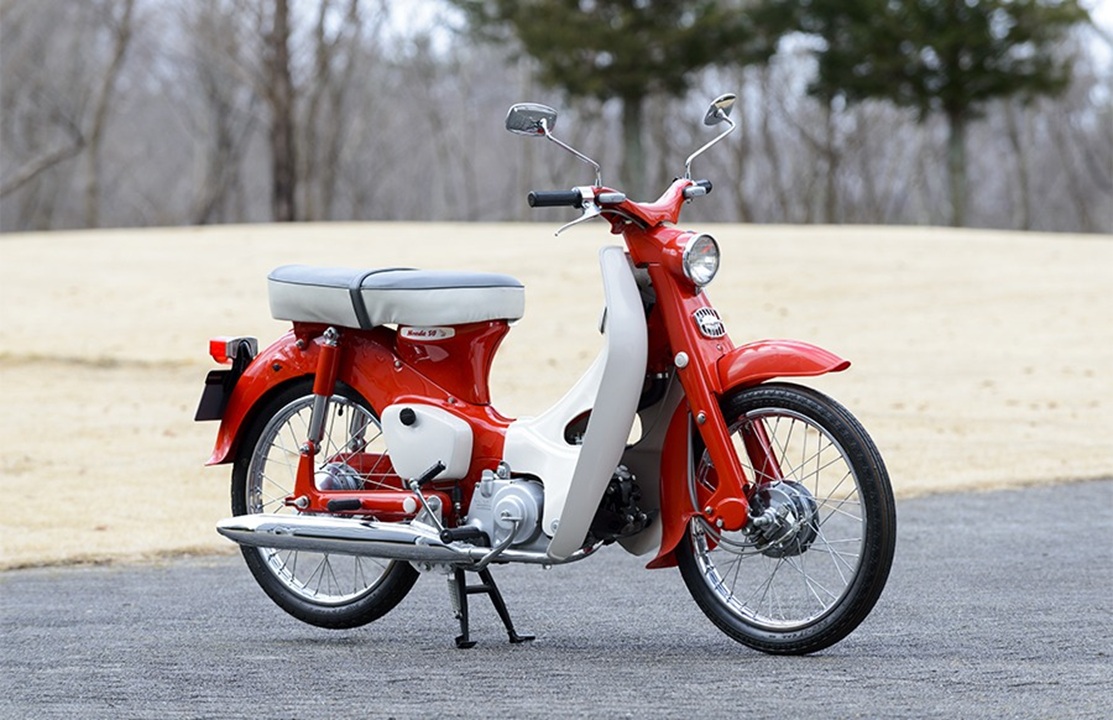
Engineers actually beat expectations, creating an OHC engine that pumped out 4.5 HP at 9,500 RPM. The motorcycle’s frame was given a step-through design so that anyone could ride it no matter what they were wearing, and the transmission was given an automatic centrifugal clutch so that the rider didn’t have to be concerned with operating the clutch themselves. Transmission designer Akira Akima explained further, from Honda:
“The development of the centrifugal clutch itself was not all that difficult. However, figuring out how to engage and disengage the clutch in synchronization with gear shift operation proved to be complicated. On top of that, because of the kick starter ratio, the clutch needed to disengage when stopped, but it also had to engage automatically when starting.”

Owing to a structure that at first glance seemingly had to meet conflicting requirements, the team found that they couldn’t come up with good ideas quickly. Even Soichiro seemed to be thinking about it constantly, and every morning he’d drop by the design room asking, “How’s it going?”
Akima — “One day as I was leaving I said, ‘If we used a screw, we could convert the rotation of the kick action to the axial direction, but I’m afraid we might run into trouble owing to co-rotation.’ After saying this, I gave it a bit more thought, ‘Since the clutch has a certain amount of drag, it might just cancel out the co-rotation,’ Just then the Old Man came running back in saying, ‘Since the clutch has resistance, I’m sure we can make it work! I told him that was just what I’d been thinking, and he retorted, ‘Sometimes we even think alike!’ and we shared a big laugh. Eventually, we applied this method to solving the problem, and I was finally freed from the pressure of his constant visits to our room every morning.”

The Super Cub presented further challenges that required creative solutions. For example, according to Honda, the Super Cub’s fork was created after an engineer watched Disney’s Bambi, and they saw Bambi running. The fork is supposed to resemble a running deer. Placing the engine in the middle of the frame reduced weight, improved balance, improved cooling, and allowed the wheels to be taller. Those wheels allowed the Super Cub to tackle rough terrain while looking friendly like a bicycle.
Then there was the bodywork, from Honda:
While the gist of the design was thus being established, another part worthy of special mention—and one of the Super Cub’s most distinctive and eye-catching features—is the use of totally new polyethylene resin in the creation of its front fender and leg shields. This new material also made the bodywork remarkably light compared to FRP (fiber-reinforced plastic). Additionally, polyethylene’s more pliable properties made it almost unbreakable, while giving the body parts a remarkably warm texture.

Kimura — “Since the plastic parts had a softer quality, I changed the colors to create a combination that exuded both softness and brightness. I called these the colors of the sea and the sky, as they’re colors that are familiar to and popular with most Japanese. Since the Super Cub was designed to be a vehicle for the masses, I wanted to use familiar colors rather than fancy shades. As an accent, we made the seat a reddish purple color. In those days, the Old Man used to wear a red shirt and drive a red sports car, which gave me a hint. Then I recalled a scene I saw in the movie ‘Summertime’ starring Katharine Hepburn, in which a piece of Italian Venetian glass glistens with a purplish deep red hue in the light. This made me think that if the seat were a slightly bluish red, then it would perfectly complement the blue of the body.”
As for the polyethylene used to make the body parts, the specialty makers of the time had never processed such large molded parts. So in order to get Honda to outsource the production of the parts to them, they agreed to the condition that Honda would provide the molds. Could this have been because not only Honda itself but also the subcontractors were eager to create an innovative new motorcycle that the world had never seen before?
As a note regarding the color changes, Honda himself was reported to be colorblind.
A Worldwide Sensation
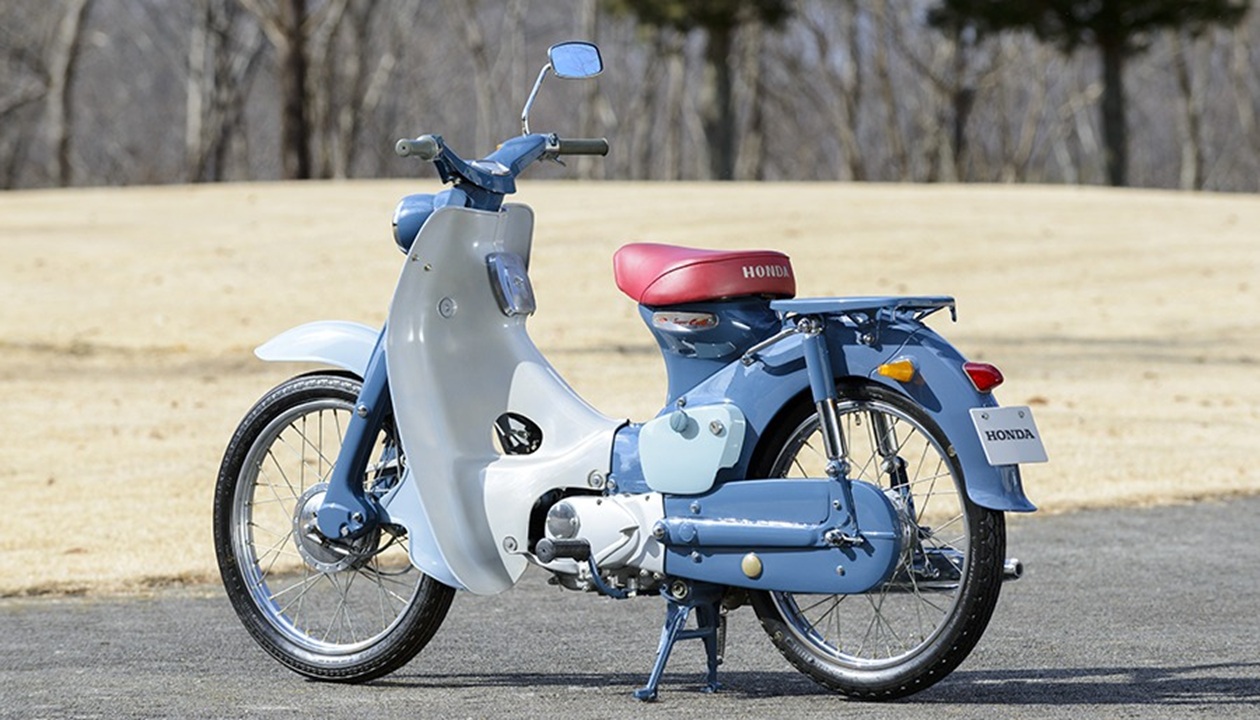
Honda’s team knew they captured lightning in a bottle when they looked at the final product. As Honda reports, managing director Takeo Fujisawa said that Honda could sell 30,000 units. Apparently, the development team thought that he meant 30,000 units a year. He’d clarify that he meant that they’d sell 30,000 units a month. That was shocking, as at the time, the cumulative total of sales of all motorcycle makers in Japan was 40,000 units a month.
Amazingly, the Super Cub is one of those examples where an ambitious production target might have been conservative. The Super Cub would dominate the sales charts. Some 564,000 units were sold by 1960, and sales hit the 5 million mark by 1966. It would go on to become not just the best-selling motorcycle in Japan, but by 2008, sales reached 60 million copies since production began in 1958. By 2017, sales surpassed the 100 million mark. The Super Cub even had an off-road variant in the form of the Trail and the hot Sports Cub.
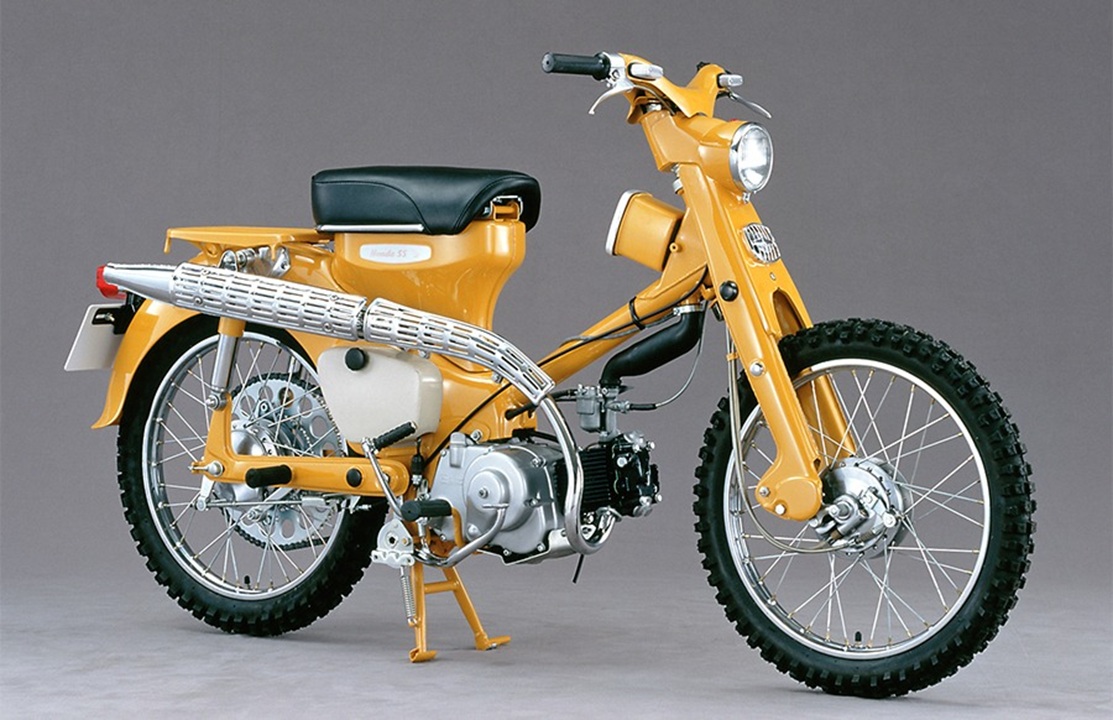
The Super Cub was popular everywhere.
In the developing world, Super Cubs helped give people mobility. Here in America, the Super Cub and Honda’s iconic marketing helped shift the image of motorcycling. The Super Cub was the perfect two-wheeler for the counter-culture movement in America. In Vietnam, the U.S. military shipped over some 20,000 Super Cubs. Locals would love them so much that Honda managed to sell 750,000 units between 1967 and 1969. Super Cubs remain in use as everything from daily drivers and delivery vehicles to taxis and trucks. Super Cubs got their own variants in Taiwan and China, too. Super Cub culture remains strong in Southeast Asia today, and lots of Honda fans out there customize their Cubs.
The Super Cub Got An Upgrade…
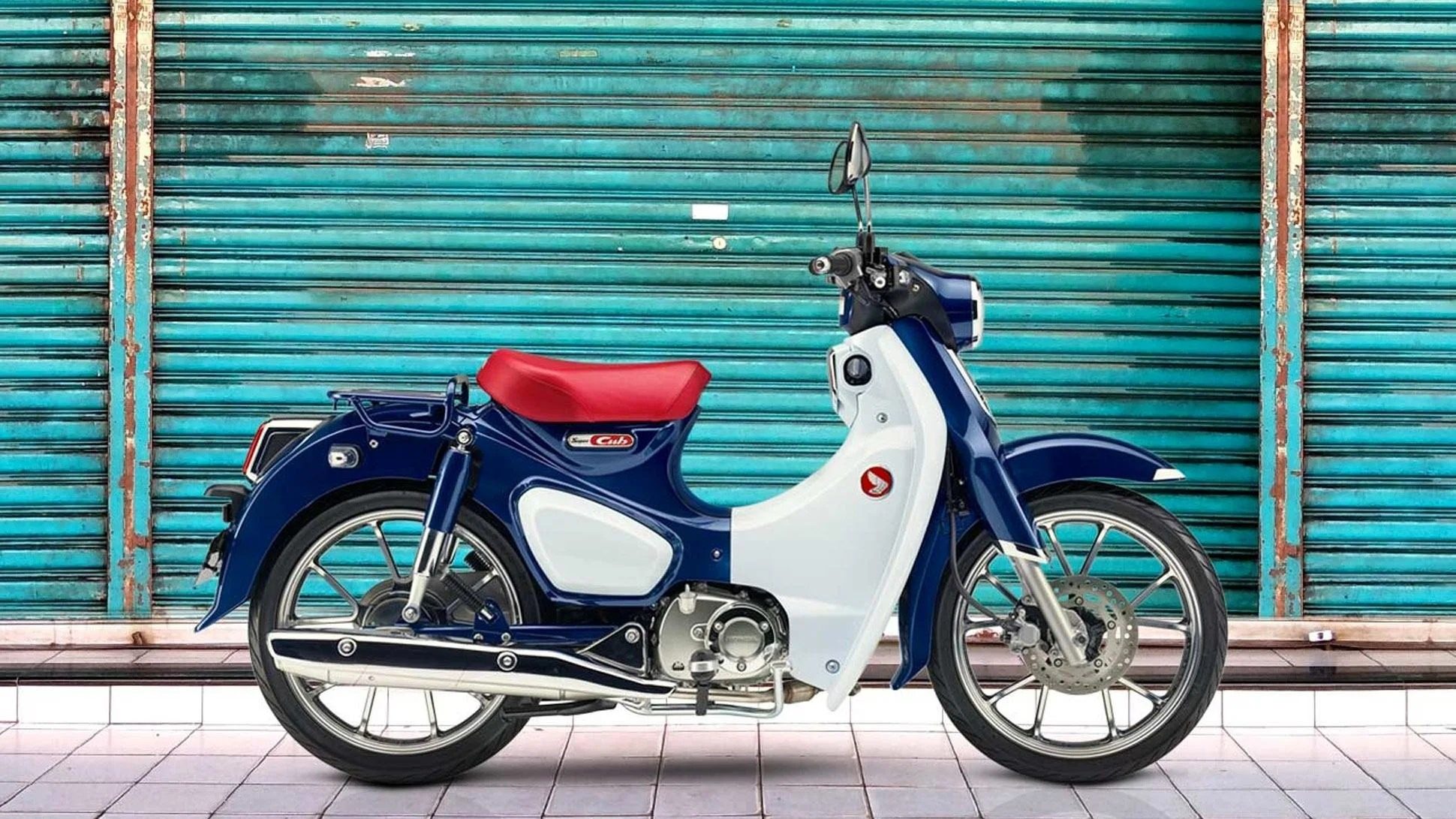
America would eventually lose the Super Cub in 1974, and its descendant, the Passport, in 1983. Then, America wouldn’t see an official Super Cub release for decades. Sure, we were able to buy the Sym Symba and other licensed copies, but none straight from Honda itself. That changed in 2018 when Honda said that the Super Cub was on its way back to America for 2019.
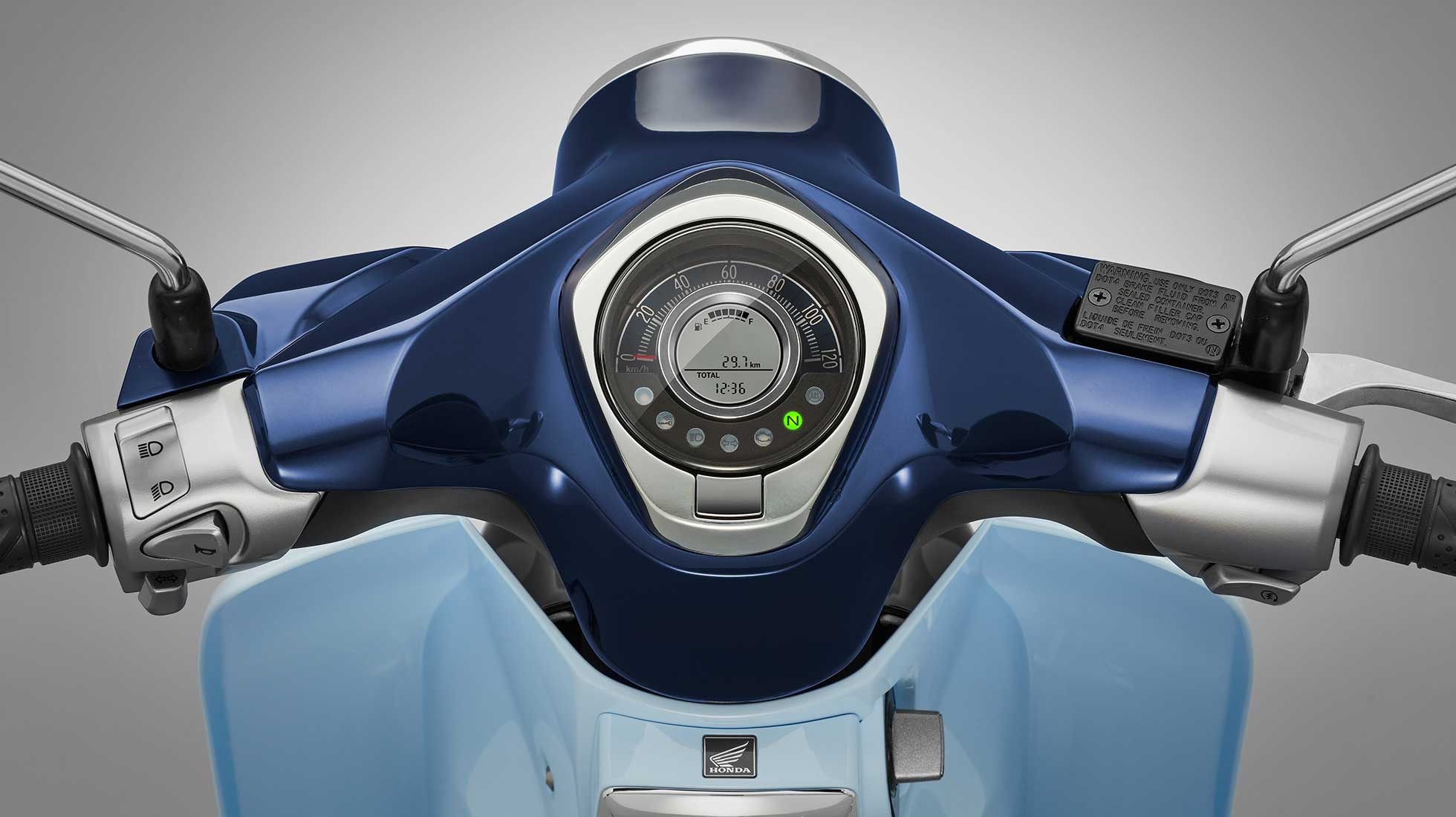
The new Super Cub C125 looked vintage, but was a thoroughly modern build. The old Super Cubs had frames of pressed steel, but the new ones are tubular steel with plastic panels on top. It has a 124cc single-cylinder fuel-injected engine with 9.6 horsepower on tap, a semi-automatic centrifugal clutch, ABS, an LCD screen, and even a 220mm front disc brake. The new Super Cub is a thoroughly modern motorcycle that only looks old.
Honda kept the Super Cub accessible, too. It had a price of $3,600 at launch, was easy to ride, had a usable top speed of around 60 mph to 65 mph, and its 1-gallon tank was good for 100 miles.
The new Super Cub got positive reviews. Some folks, myself included, feel like the Super Cub brings you back to a purer kind of motorcycling. It doesn’t have a million horsepower, isn’t trying to wheelie at every given moment, and doesn’t require a ton of skill. A Super Cub is all about the fun of motorcycling.
…Then Left America
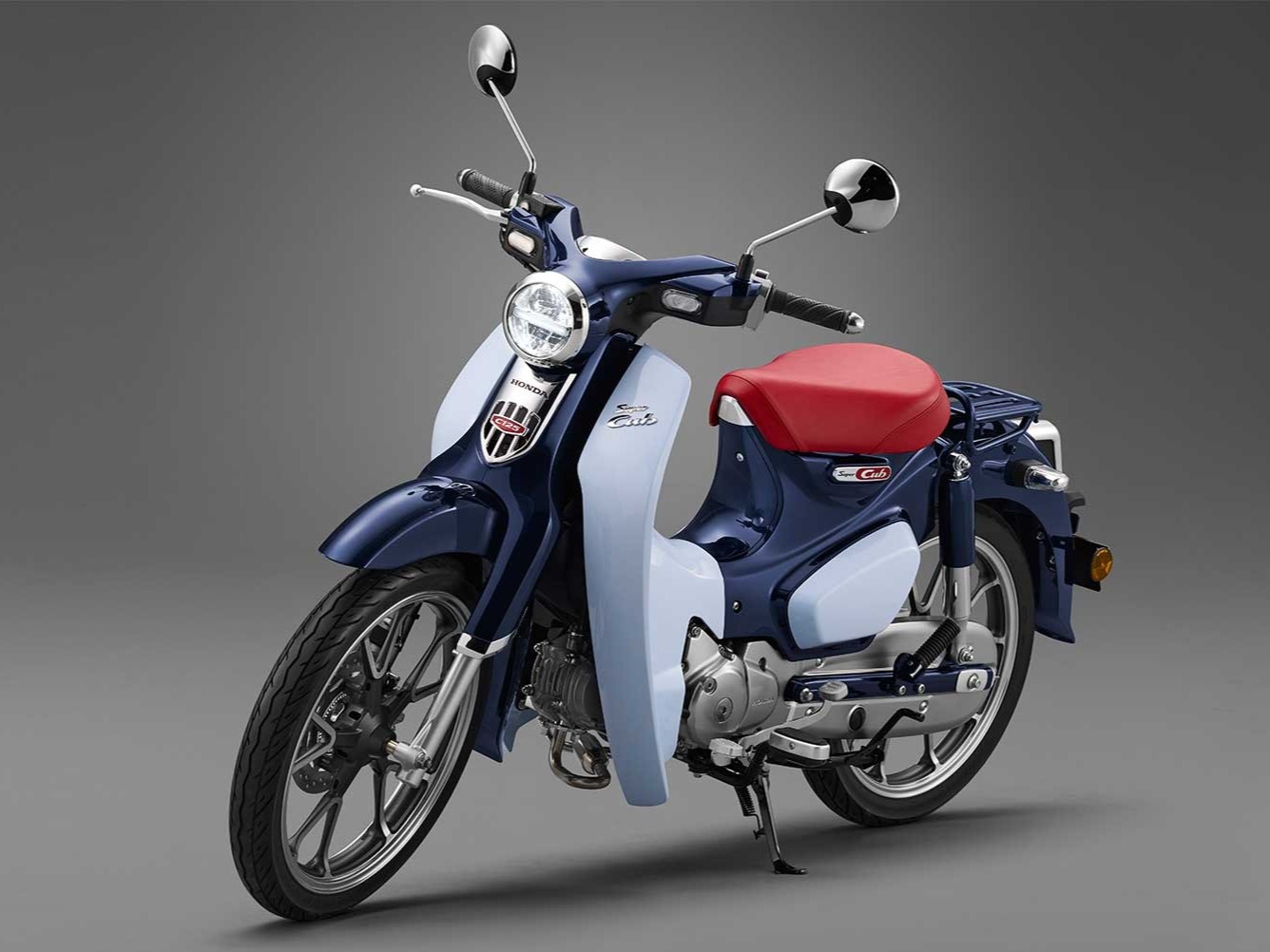
Weirdly, Honda hasn’t really released sales data after 2017. So, we know that the Super Cub surpassed 100 million in sales, but we don’t know by how much. We also do not know how many were sold in America. What we do know is that Honda silently discontinued the Super Cub in America after 2024. The Super Cub page was never updated for the 2025 model year. Then, as I noted earlier, the page was taken down entirely in December 2025.
Thankfully, the Super Cub appears to be alive and well elsewhere. Europe’s and Thailand’s models of the Super Cub just got new colors for 2026. Honda killed the Super Cub 50 in 2024, but keeps smaller Cubs around in the form of the Super Cub 110cc Lite and its variants.
It’s unclear why Honda pulled the Super Cub out of the American market. The small motorcycle is one category that has seen healthy sales in recent times, bolstered by affordable options from Royal Enfield, CFMoto, and Honda’s MiniMotos. Even Triumph got into the small-displacement game because that’s what younger riders are buying nowadays.
I don’t want to get into speculation, but Honda’s MiniMoto lineup had a lot of tiny bikes that had the same engines and fulfilled different, but similar roles. There was the Grom, the Monkey, the Dax 125, the Super Cub C125, and the Trail125. Then there was the super beginner-friendly Navi and four different scooters. Perhaps Honda learned that it’s possible for there to be too much of a good thing. Tariffs may also play a role. I reached out to Honda to see if I could get some clarity.
The good news is that it doesn’t appear that cheap motorcycles are going anywhere. CFMoto and Royal Enfield are still coming out with affordable models, and Honda still has the whole lineup listed above, minus the Super Cub.

There’s also a non-zero chance that the Super Cub is gone forever. Here’s what Janaki from RideApart reported:
However, I reached out to American Honda to ask if it was truly gone for our market. I was told that yes, MY2024 was the final year for it here. However, Honda cautions that it may not be gone for good, but “any potential return of the Super Cub would depend on ongoing product planning and market considerations.” There is no confirmation that this will change any time soon; however, we shouldn’t rule out the possibility completely.
I think the saddest part about this is that Honda officially stopped selling the Super Cub in America more than a year ago, but it never bothered to tell anyone. Then again, it took until February 2026 for this news to drop. I planned on buying a new C125 this year. Looks like I won’t be able to do that unless I find new old stock.
So, the Super Cub C125 is gone in America. It’s a depressing end, but this wasn’t even the first time Honda pulled the plug in America. No matter what happens, the Super Cub’s impact on motorcycling and the world will probably be eternal. For many, the Super Cub will always be more than just a tiny motorcycle. They offered mobility, fun, and a shining example that motorcycling didn’t have to be grumpy, loud, and mean.
Top photo: Honda



I haven’t read the article yet (I’m waiting for my coffee maker to start) but of course I know and love (a word I don’t use lightly) the Cub/SuperCub so much. Watching videos about it online (including the FortNine ones about small motorcycles of all kinds) is basically what motivated me to finaly get one myself (a small bike, sadly not a SuperCub, which would have been a better choice).
I can’t believe that Honda is killing the Cub for America. Is everyone buying electric now, even in developing countries? The Cub IS Honda IMO… to my mind, there’s no other single product that exemplifies the ethos of the company and its founder. Simple. Sufficient. Carefully designed, engineered, and constructed.
BTW, I also heard that Billy Steinberg just died. Not a household name, but if you’re of a certain age, most or all of your formitive years happened to his soundtrack. His wiki: https://en.wikipedia.org/wiki/Billy_Steinberg …if you’re not familiar with him, you won’t believe how many big pop hits of the ’80s and ’90s were penned by him.
Jeez, no more SuperCub. 🙁 That’s sad.
I believe Honda introducing the Trail 125 killed Cub 125 sales. For awhile there they were releasing a new 125 it seemed like every year hoping we would collect all of them.
I did happen to feel an urge to own every version myself, but I just attributed that to whatever chromosome it is that’s responsible for my OCD. 😉
Seems like there’s still lots of new ’24 models for sale out there!
I’m a little confused by the caption on the first bicycle photo, “A bicycle with a wireless radio engine”. Was that a thing?
Sad about the Cub. My wife loves the look of them, but couldn’t justify buying one for where we live.
They were basically generator motors.
OK, thanks. New knowledge to store somewhere.
I can say that i have never ever in my life laid eyes on one of these. Maybe they dont sell them in South Carolina.
What is the ratio of scooters sold to motorcycles sold in the United States? I’m curious.
2025 numbers:
. 11,104 – Scooters
132,114 – Off-Highway
343,250 – On-Highway
486,468 – Total
Thank you.
Thank Revzilla Common Tread. They just did an article on 2025 motorcycle sales.
Thanks Revzilla Common Tread!
Honda reads the US market pretty well after all these years, does not throw away their tooling and is not adverse to making USA specific models when it makes sense to them. The US is after all the only place on earth that they still offer the Fury and the Shadow Phantom. So I’d agree never say never on the Super Cub, but it will take more than nostalgia to bring it back.
With kids getting E-bikes, a starter motorcycle is not on their radar (or their parents’). I would imagine sales have been dropping as a result, which would make this decision appropriate for current market conditions.
Now if we could just get E-bike riders to learn the rules of the road, and follow them…
the scooter community knew about this for months. It comes and goes. If you see an energy crisis where gas skyrockets it will be back. It was nice to have during the pandemic when everyone had extra money to spend. I blame the Grom and Dax for its demise in America, we want our mini motos burlier
Nothing can stop noodles!
Honda has been toying with an electric version for a while and that may be the eventual replacement. The Cub E is available in China, but its 25 kph top speed wouldn’t cut it for all markets.
Unfortunately, after 18 months of sales, the Cub:e was a resounding failure in the Chinese market, and was discontinued. the Dax:e and Zoomer:e were better, but are now also discontinued due to China’s redefining and restructuring of the e-bike laws.
Good to know. Does Honda have any intention to update the designs for the new requirements?
Sundiro and Wuyang Honda likely cannot update them. The new e-bike rules basically gimped the whole thing, because “e-bikes” were getting out of hand, in their eyes.
Considering that some 75% of americans weigh more than a road-ready Cub, it’s not surprising Honda withdrew the model from that specific market.
I learned to ride on a Cub, not sure if was a regular super that had the shield and chain guard stripped off or if it was a trail cub. Someone traded it to my grandfather for some scrap metal, I think it was on top of a pile of junk in the truck. The scrap guy knew to stop at our farm last because we were always buying stuff.
Anyway, the engine was the first engine I ever reassembled after taking it apart, and I distinctly remember it having pushrods.
The pressed metal frame and fork was an impressive bit of engineering. It was remarkably durable after hitting things that would send me over the handlebars. The handlebars themselves got broken and brazed back together.
Apparently the pre 1965 cubs had pushrods and are collector’s items now. Oh well.
There are so many early cubs out there that it is a buyers market. Finding one with a useable kick start can be tough as the spindle and splines are weak and those parts have gotten hard to find.
I should get one, they are sort of perfect. As I remember you can’t bump start them. Putting STP in the engine oil was a mistake I’ll never make again, maybe that had something to do with it.
They will bump start, Best solution is find a c102, that has e start. Or, just get a Super Cub, then parts are everywhere and you gain a bit more go plus you don’t need to shift into, then out of neutral during gear changes.
Well the one we had a problem bump starting, and I vaguely remember that the STP in the motor oil did something to the clutch. I can’t remember whether it was because the clutch slipped on account of the STP ( it did and caused other problems like overheating) or because there wasn’t a way to pop the clutch and the tire would just skid through the dirt. It was only 60 years ago.
Wait, with no hand clutch how do you bump start it? Even if a ten year old hadn’t messed it up?
My BSA gold star was easy to bump start and since the kick start shaft broke that was the only way to start it. The only problem was running fast enough to grab the clutch lever and let go of the gas once it was running.
Put it in second gear and push, the centrifugal clutch will grab and spin the engine… if there is no STP in the crankcase.
Another way (if you have some help) is to shift into second and hold the shift lever up (buy foot) while being pushed, then let off the shifter once at speed.
Your STP gummed up the gearset and clutch. This unit doesn’t have a pressure oiling system, it has splash oiling like a basic lawn mower engine.
If I ever encounter one again I will have to try that. I don’t remember it’s centrifugal clutch ever engaging without the engine spinning, and I think I would have remembered that in contrast to all the other centrifugal clutch equipped stuff around the farm. I guess there must be some sprags or something in there, sort of the opposite of an overrun clutch.
Honda sells only like a third of their models to US anyway. There are other Honda bikes that I would rather they sell here than the Cub.
My wild and crazy dad had a Super Cub for about a year in the early 60s. I think it left an impression on me.
I’ve had a few bikes (including a GL1800 Gold Wing) over the years and now have an ADV 160 to poke around town and on dirt roads out in the country nice days. It can be ridden with one hand like a Super Cub, but I generally don’t have to as it has enough storage under the seat to hold a couple of grocery bags.
It is a bit sad that the SC is no longer being distributed in the US, but Honda probably has their reasons.
Just then the Old Man came running back in saying, ‘Since the clutch has resistance, I’m sure we can make it work! I told him that was just what I’d been thinking, and he retorted, ‘Sometimes we even think alike!’ and we shared a big laugh.
A veteran, now retired, Honda designer, a massive fan of Soichiro Honda, once told me that you could always tell when he was nearby because you would hear people laughing.
It’s really not surprising I was shocked they lasted more then 2 or 3 years back. The people that wanted thme probably bought them. Maybe bring them in once a decade for those people. People were far more interested in the grom partly because it was about $1k cheaper. Then you get into clones and China bikes and the whole 125cc not really being a think in the us. The Cleveland cycle works guy big thing almost 20 years ago was make 125cc bikes people wanted here because he had spent time in Europe and thought they could take off here. The kids are all on the electric dirt bikes that’s probably as close as they are getting. A 250 might be even not much of a match for the toque and speed those things have so if they go to a gas bike it will probably be a 400 or bigger. I suspect many of them will stay electric though. And won’t have any problem buying some random Chinese brand because they already are.
The Honda Trail Cub CT110 was the biggest selling moto in Aus for a long while, because our postal service used them. They had Honda make a special varient, without the low-range gear ratio option but with tougher wheels and struts for all the kerb hopping. After a point Aus Post would auction them off, generally needing carb and clutch work but otherwise being good cheap motoring. I got one when I lived in Sydney, it was a perfect inner urban way to get about. I still have it, with a nice big stainless steel box on the rear rack to make it the perfect little shopping vehicle. I would dearly love Honda or someone to do an electric replacement that I could get locally.
Oh, that sounds nice Pimento! Would you happen to have a photo of your bike with the box online somewhere to share?
Great username BTW! 😀
I have a poorly cropped one here: https://bsky.app/profile/pimento2000.bsky.social/post/3mf3pcwdt522w
Thanks! It looks authentic. I had a big box (in my case, just a plastic folding milk crate thingy) on the back of my Vanvan. Makes it ideal for around-town errands, instead of taking a whole car. 😉
“by 2008, sales reached 60 million copies since production began in 1958. By 2017, sales surpassed the 100 million mark.”
Am I to understand that it took Honda 50 years to sell the first 60 million units and then they went ahead and sold 40 million in the next 9 years? They were selling roughly 4.4 million a year!? How can I walk outside without tripping over one?
I think part of the reason for the colossal manufacturing numbers is that they were built under license (and possibly without) in markets outside Japan.
Sadly, the vast majority of them are nowhere near America! But, apparently, they’re all over Asia.
I’m not sure if that post-2008 number includes strictly only the Supercub variants, or other derivatives and spin-offs.
Like including the Dream (millions or even tens of million sold in SE Asia), Wave/Blade/Innova (many millions sold for sure) would skew those numbers up sharply for sure.
LITTLE HONDA
(Beach Boys’ 1964 tribute to the 50cc Super Cub)
Go!
I’m gonna wake you up early
‘Cause I’m gonna take a ride with you
We’re goin’ down to the Honda shop
I’ll tell you what we’re gonna do
Put on a ragged sweatshirt
I’ll take you anywhere you want me to
First gear, it’s all right (Honda, Honda, go faster, faster)
Second gear, I’ll lean right (Honda, Honda, go faster, faster)
Third gear, hang on tight (Honda, Honda, go faster, faster)
Faster (it’s all right)
It’s not a big motorcycle
Just a groovy little motorbike
It’s more fun than a barrel of monkeys
That two-wheeled bike
We’ll ride on out of the town
To anyplace I know you like
First gear, it’s all right (Honda, Honda, go faster, faster)
Second gear, I’ll lean right (Honda, Honda, go faster, faster)
Third gear, hang on tight (Honda, Honda, go faster, faster)
Faster, it’s all right
It climbs the hills like a Matchless
‘Cause my Honda’s built really light
When I go in to the turns
Lean with me and hang on tight
I’d better turn on the lights
So we can ride my Honda tonight
First gear, it’s all right (Honda, Honda, go faster, faster)
Second gear, I’ll lean right (Honda, Honda, go faster, faster)
Third gear, hang on tight (Honda, Honda, go faster, faster)
Faster (it’s all right)
First gear, it’s all right (Honda, Honda, go faster, faster)
Second gear, I’ll lean right (Honda, Honda, go faster, faster)
Third gear, hang on tight (Honda, Honda, go faster, faster)
Yeah, it’s sad. But in reality, anyone in any part of the world that has electricity should be replacing their small bore commuter bike with something that has an electric motor. The good news is that the Super Cub design should make it fairly easy for Honda to create an electric version. Replace the engine with an electric motor, and fill the gas tank space under the seat with batteries.
I considered getting a newer Super Cub instead of an e-bike a couple years ago but the cost, noise and need to keep it outside were disqualifying factors.
My late grandfather left an early ’80s model in the barn (for a while it had been in a hangar with his last plane, a Piper Super Cub) and I considered doing an electric conversion on it. I looked into some kits and builds and might still try that, but the cost of the conversion plus the other items it needs would probably break $3K. For now my electric moped suits me fine and nudges me to get some casual exercise.
Technically, the best-selling Corolla was the E120/E130, sold from 2000-2008, with volumes of almost 13 million worldwide, though the follow-on E140/E150 was pretty much a heavy update of the same car, and supposedly sold another 10 million through 2020.
A few decades ago my brother picked up one of the licensed Super Cub clones. It looked like the 1970s ones, but with a front disc brake and (I think) about 8.5hp. It was fine on slow, city streets, though reaching the 50mph top speed was anxiety-inducing on 2-lane roads with traffic.
But, it was absolutely a bike that anyone could ride and was more fun than the horsepower rating would make you think. It wasn’t fast, but when I was puttering around on it I had a dopey smile on my face the whole time. I didn’t give the Super Cub much credit back then, as I had a built, 70+hp KX250 at the time, but in hindsight the Super Cub was honestly the more fun bike because of just how well-rounded and tame it was.
I have a moped and I’ve had a few full sized bikes over the years. A quick bike on a fast twisty road is a ton of fun. And so is taking a longer ride to find some serene drives.
But for bopping around town, the moped is always more fun. It’s just easier. Give it a full twist of throttle and enjoy the ride.
I have five bikes, two of them are scooters. The Spree is just for fun because it’s so ridiculous that something that small and slow can be road legal. But the Buddy is the true sweet spot. I also like my bigger bikes, but I agree with you: if I just have to run into town for something, for sure I’m taking the Buddy. It’s just so convenient.
My 50cc Suzuki is fast enough now (with a big bore and a pipe) that it can comfortably do 30mph (versus struggling to get to 27-28mph stock) which is perfect for me to ride around a few miles in any direction of my house in our downtown area. With a few exceptions, most of the roads are 25mph and due to street sizes and pedestrians 30mph is about the fastest people need to go.
I had a supermoto for a few years, which was a great around-town bike that could handle some highway. But it didn’t get used around town because of the scooter, so it got sold. The scooter is just so much fun at those speeds, and a full size bike is kind of annoying when you can’t open it up a little.
I bought my 50cc Buddy from a friend, I have no idea the history on it but it will do 40mph on the top end. I don’t know if this is typical, most of the time I see people talking about 50cc scooters, 30-35 is about all they have. So I almost wonder if mine has had something done to it at some point in its history, but no complaints!
I think it’s market dependent to some extent, and then at least partly due to age.
A lot of 50cc scooters/mopeds can go just shy of 30mph and many have variations that have lower power to limit them to 20mph. In NY, below 30mph doesn’t require a motorcycle license and below 20mph doesn’t get you any other benefits (it’s technically a different vehicle class but doesn’t really impact anything) so most old scooters push 30. Some newer ones, especially when you get to things that have 2spd transmissions or CVTs are capable of more than 30 pretty easily and are limited by simple tuning or intake air restrictors that are very easy to remove.
My ’87 Spree is actually an Iowa model, which was restricted due to state regulations to 25. I put a non-Iowa muffler on it and it will do 30 now. Reading up on it just now, there was main jet and gearing differences on the Iowa model as well, but I’ve never touched any of that. Funny enough, the Spree feels quicker off the line than the Buddy, which almost makes me feel like the Buddy was modified for top end, but then maybe my Spree is taking advantage of Iowa gearing. I’d have to look into that further.
NOOO! This makes me sad- I love the Super Cub, especially the years with colors (Sorry, not a fan of the matte black).
I would bet that you can still find some new old stock leftovers. Its a bummer that its been disco’d, but hopefully it comes back. If not, then the Trail125, Dax, and Grom will carry the torch for now. And maybe one day they will also carry the Torch.
Figures. Stop making cents, lose your “nicest people” status.
Great piece Mercedes – I always enjoy your eye for deep dive research like this!
I find motorcycle manufacturer websites and general business transparency always a step or two behind that of the auto industry, perhaps due to the relative volume of interest. It’s not uncommon to see 2 year old models on corporate sites, often sitting alongside the current offering even. And I’m sure there’s often hiatuses in final production, so your 2026 was actually built in 2025 or earlier.
Bummer for the Super Cub, buy top of my motorcycle list would be the Trail125, They need to bring the high/low transmission back like I had on my 1970 Trail 90.