

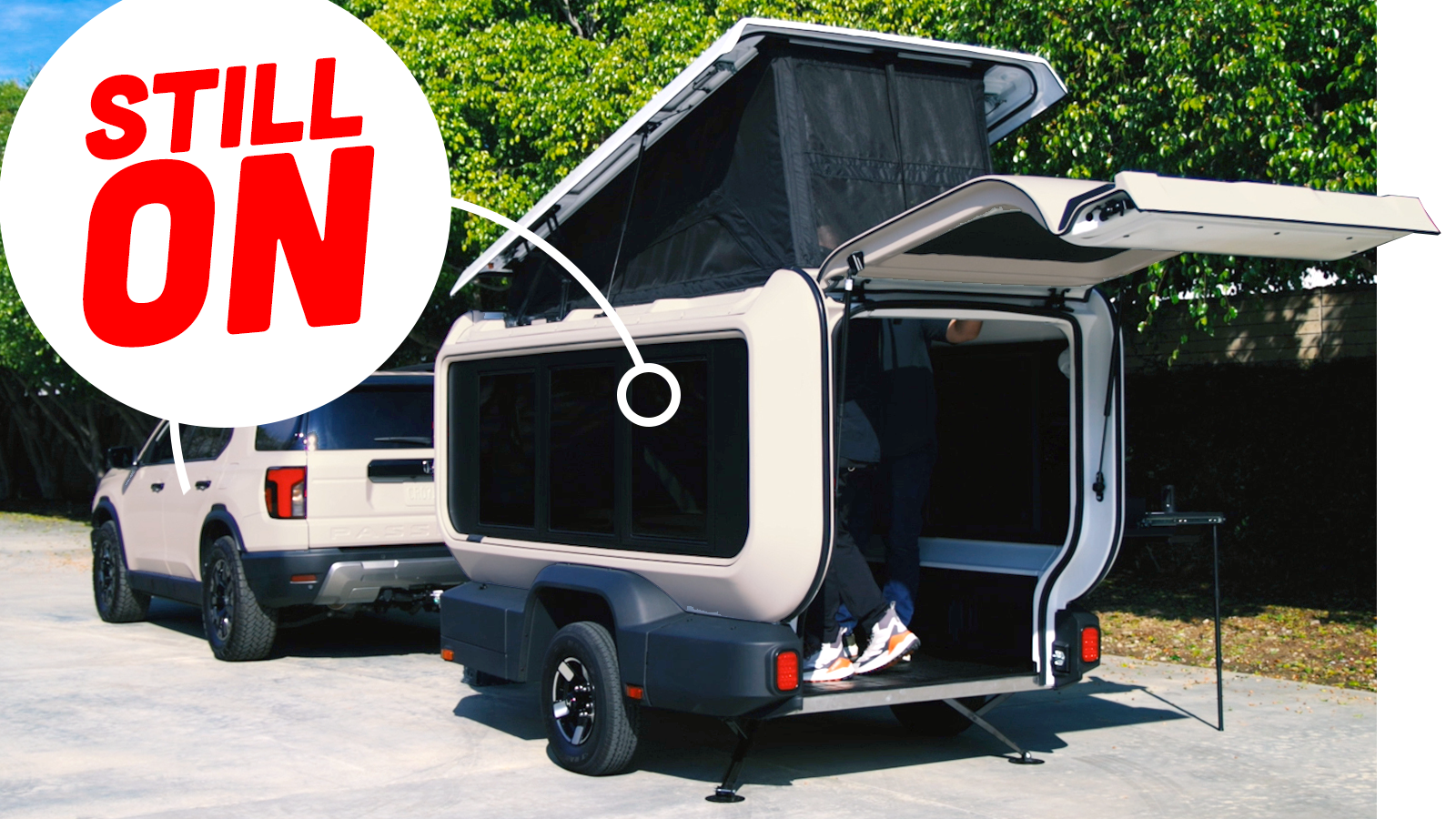
Honda is one of those brands that can seemingly sell anything it wants. How many other automakers have generators, outboards, motorcycles, and jets in their portfolios? While Honda has recently laid waste to its new EV plans in America, it’s seemingly still exploring other outlandish ideas. Honda just published a new look at its Base Station camper prototype, and it’s amazing that Honda is still experimenting with an RV after canceling the EVs that the camper was meant to be towed by.
There was a time when Honda, like other automakers, was proud to talk about its future EV plans. Honda was on a roll after selling a GM-built EV, the Prologue, better than GM itself did. Honda pulled the covers off the Honda 0 Saloon and the Honda 0 SUV, two prototypes that previewed Honda’s homegrown EV future. They were even slated to be built right here in America at Honda’s plant in Marysville, Ohio. Joining them would have been the Acura RSX electric crossover.


As we reported last month, Honda has pulled the plug on its American EV strategy, canceling all of its new American EVs at the same time. Depending on your views, you were either extremely disappointed or satisfied with Honda’s abrupt change in EV strategy. But there was one factor that many people hadn’t considered. Honda doesn’t really see itself as an automaker, but a provider of mobility solutions. Now, three vehicles that were a part of Honda’s big plans are gone. What does that mean to you and me?
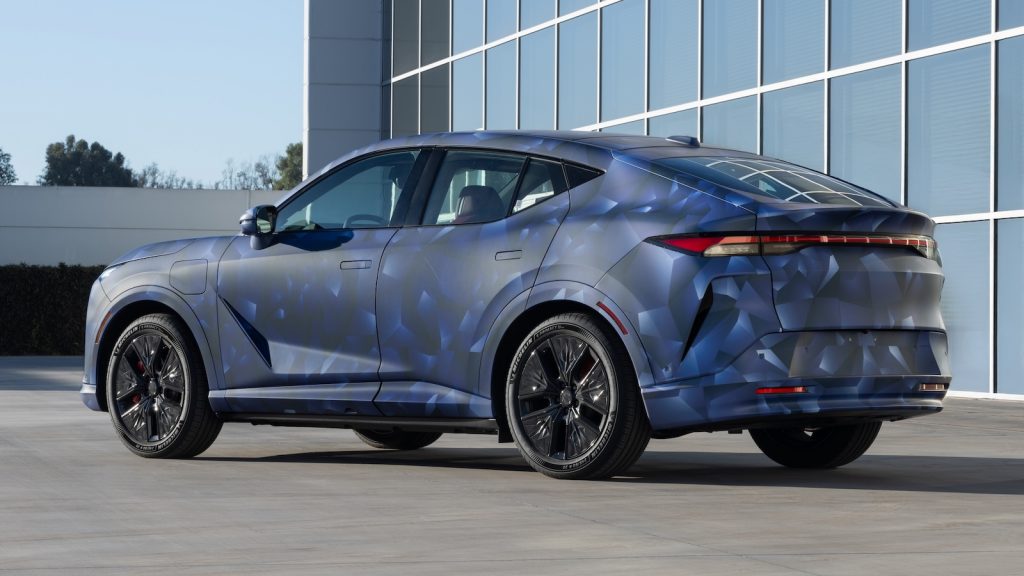
Honda has launched some strange products in recent years, but officially, they’re all supposed to serve a purpose. The Honda Navi mini motorcycle is supposed to provide easy urban mobility to just about anyone. The Honda Motocompacto is supposed to be a scooter that you store in your car’s trunk and use to complete the last mile of a journey. Honda has developed an entire sort of ecosystem where the company’s products, from its generators to its EVs, are supposed to make your life easier.
Honda Goes Camping
That includes the Base Station camper, which Honda still considers to be a mobility device.
Specifically, according to Honda’s latest video (embedded above, or click here), the Base Station is a mobility solution that helps support your lifestyle wherever you go. Honda saw its all-electric camper as being the perfect companion for your all-electric Honda.
Its bold design even matched the designs of the Honda 0 Series EVs that were supposed to pull it. When Honda visualized camping with the Base Station, a Honda 0 EV was hitched up to it.

The world got its first look at the Honda Base Station back in January, and it was a genuine surprise. Honda’s idea for a future camper is something that’s bigger than a teardrop, but smaller than a full-size travel trailer. The Base Station is big enough to stand in, but small enough to be hauled by a huge variety of vehicles.
But there’s so much more to it, as the Base Station is a new take on the old concept of the modular camper. From Alanis King’s article:
When we saw the Base Station recently, Honda popped the roof and rear tailgate but didn’t let us touch or enter the camper because it was still a prototype. But the company did tell us that the Base Station will come standard with a lithium battery, inverter, and integrated solar panels if people want to power their campsite without emissions. In addition to that, the idea for the Base Station is to offer a bunch of camper accessories — air conditioners, external showers and kitchens, induction cooktops, and more as upcharges — allowing people to choose what they want to include on their build.
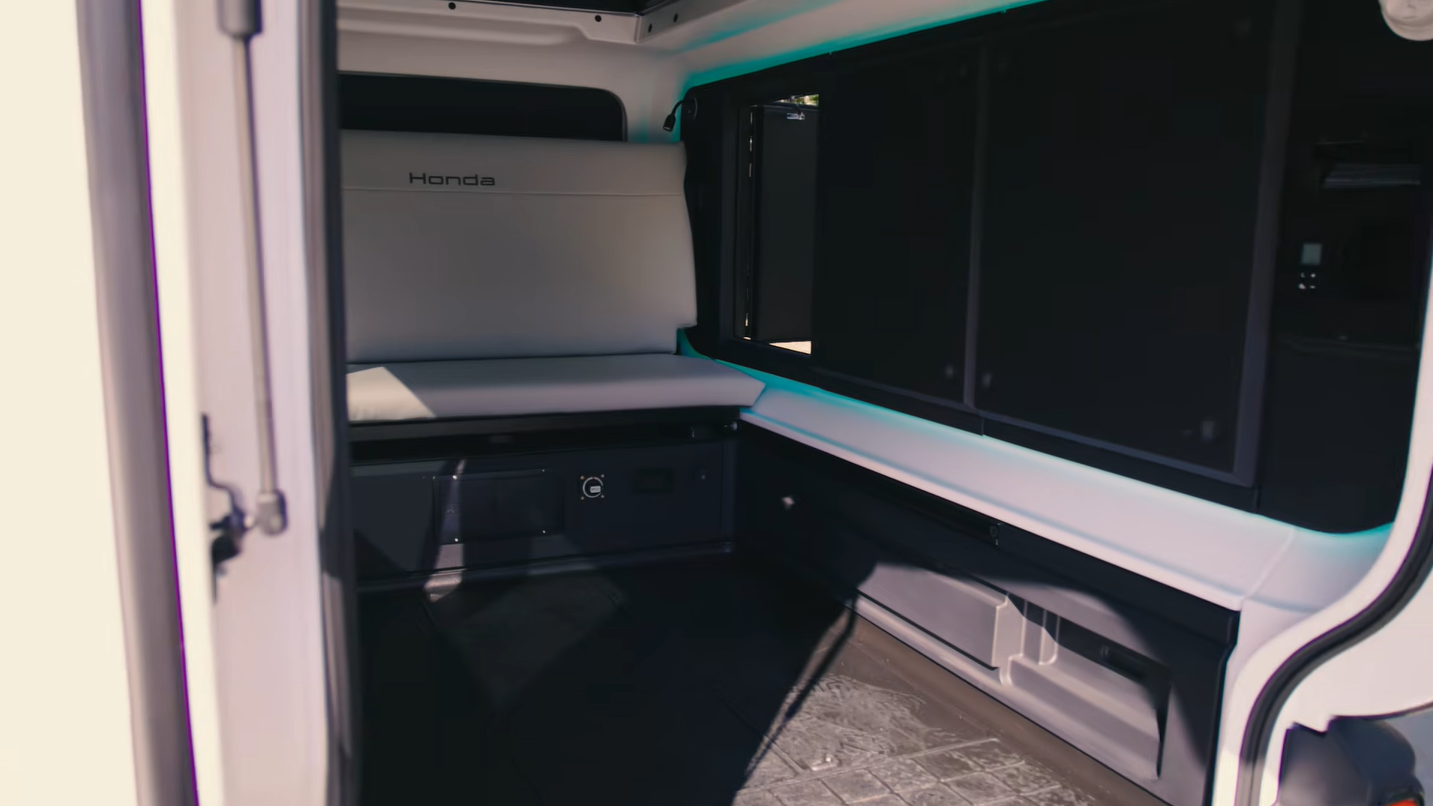
Honda also says popping the Base Station’s roof can create seven feet of stand-up space, and that the Base Station can “sleep a family of four comfortably with a large futon-style couch that folds out to provide a queen-sized sleeping area and an optional kids’ bunk bed.”
The Honda Base Station is being designed by Honda’s teams in California and Ohio for the American market. Amazingly, despite the shakeups with Honda’s EV lineup, Honda confirmed to the Drive that it intends to put the Base Station into production, with more information coming later this year.
The good thing is that campers don’t really care about what’s going to tow them. So, even though the Base Station has a Honda 0 design, it could just as easily be hooked up to the back of a Passport, a Pilot, a CR-V, or, heck, even a Toyota, Ford, or Chevy. Sure, the camper will look a little weird not being hitched to the car it was designed to match, but it doesn’t really matter. If anything, the Base Station’s wild design is perfect as a standalone camper, anyway.
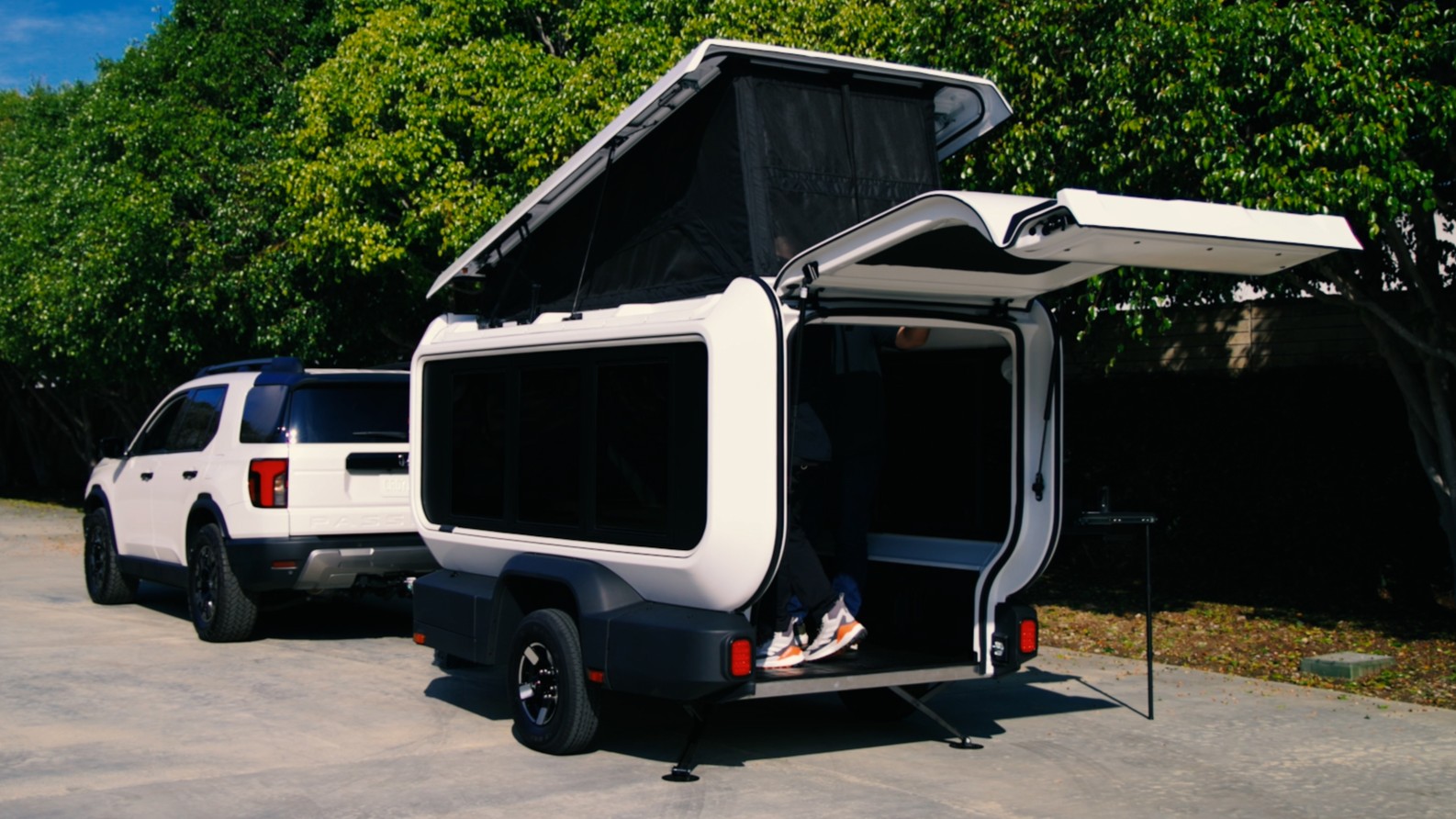
Honda’s new video shows us new angles of the camper, but doesn’t tell us much that we hadn’t heard before. In the video, Honda Industrial Designer Geemay Chia says that the Base Station was designed to be relatively lightweight so that the majority of the Honda lineup can tow it.
Making a camper small and light enough to be pulled by most current Hondas meant that the team had to get clever with the interior design. The video shows a couch that slides into a bed.
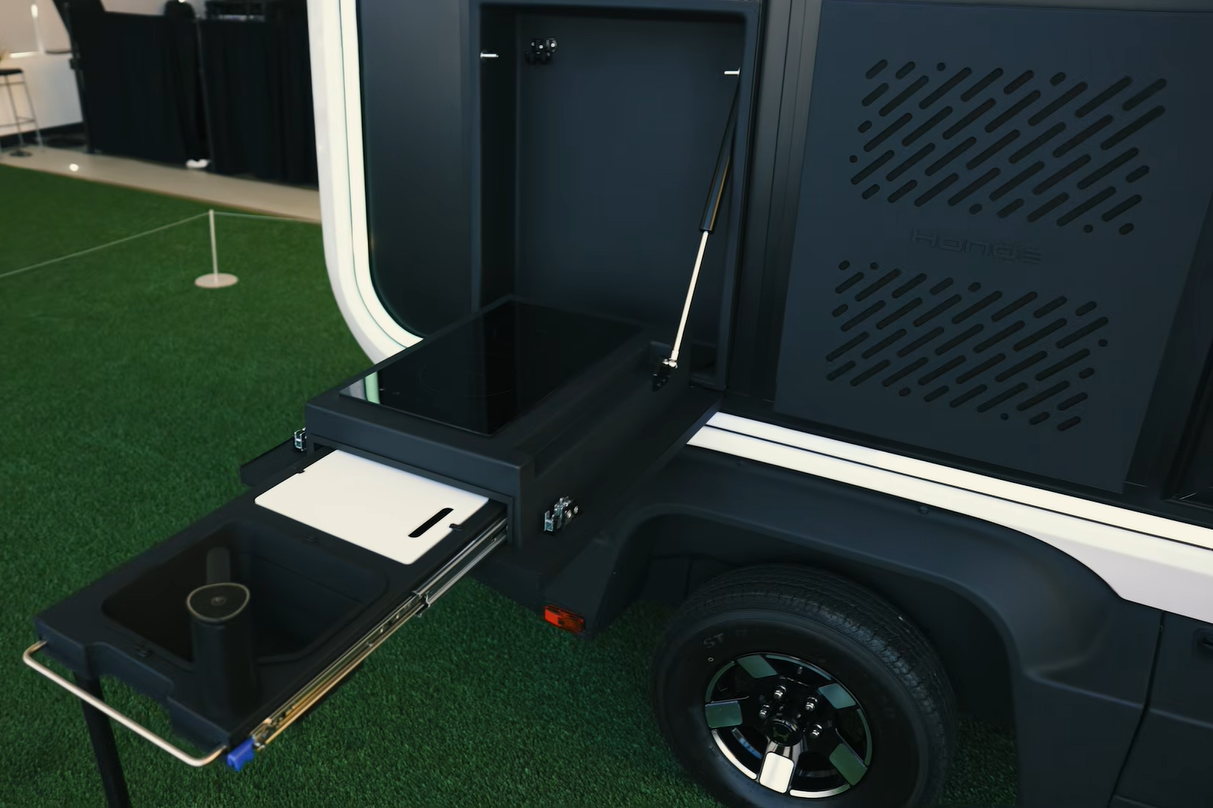
There’s also an outdoor kitchen that Honda engineered to compact down into a tiny module. The box next to that, presumably, is where the outdoor shower would be.
What I find fascinating is that none of Honda’s ideas are that new. Adventure “squaredrop” campers come with couches that fold into beds and place the kitchen and shower outside. But those campers often feel like bunkers on wheels. What’s different here is that Honda is doing the same thing, but giving you standing room, three large windows, and minimizing the space taken up by the camper’s equipment to maximize interior space.

I’m not a fan of all of Honda’s ideas. I’m not sold on the huge LED lightbar that runs the circumference of the trailer. It looks cool, and can have the practical purpose of providing campsite lighting. However, too many people leave their camper’s bright LEDs on all night, unnecessarily pouring light into the campers and tents of neighboring campsites. I can let it go for now because the Base Station is a prototype, and prototypes often look bombastic and flashy, where a production variant would not.
I’m also not sure about having a giant hatch be the only entry door, and I don’t see much in the way of storage solutions for gear that you don’t want inside the camper. But, again, maybe that will change on the way to production.
Still A Good Idea
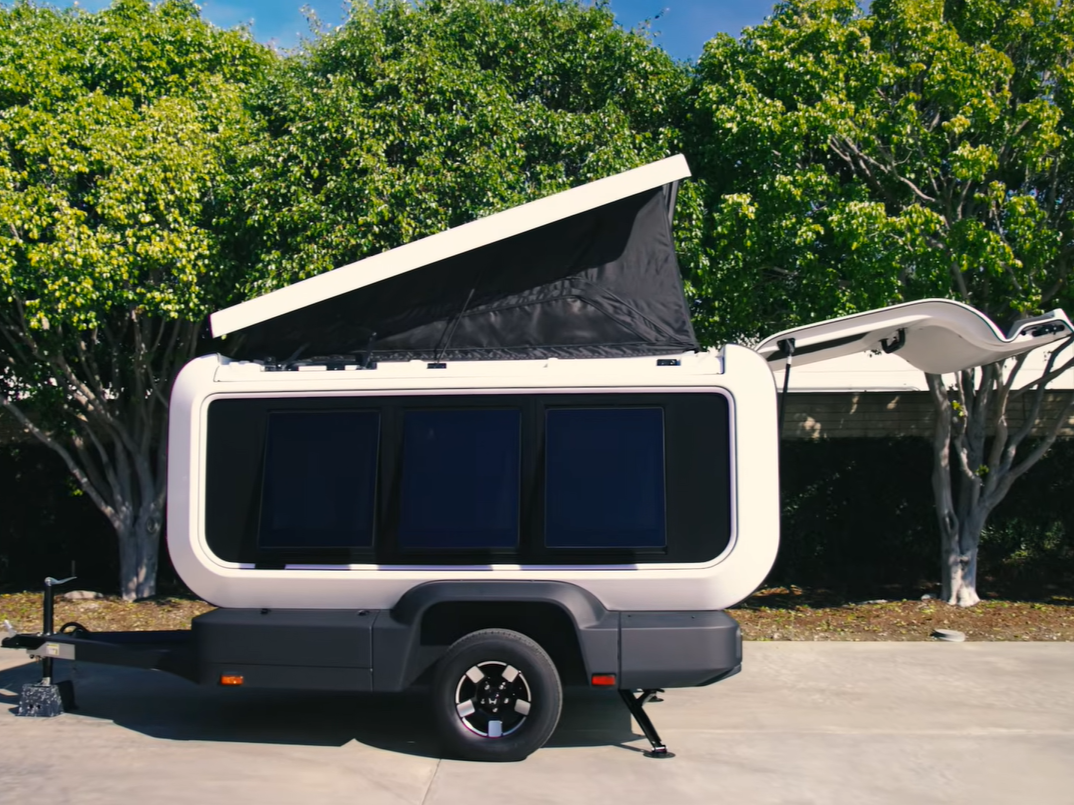
Honda says the Base Station is meant to “democratize camping,” and I think that’s going to depend heavily on the pricing strategy. Honda says the camper will be priced to compete with similar trailers that can cost anywhere between $20,000 to over $50,000. I think this camper might be a hard sell at $50,000 as you can get lots of fully-featured and well-built campers for that price. But I could see $30,000 or so for a Base Station with the kitchen and shower module, or around $20,000 for a bare one.
Either way, the Base Station is a great idea, and it makes sense that Honda is still developing it. While RV sales are down from their peak, there’s probably still room for an innovator to carve out a niche. Many RV buyers have been begging for something new and different. Well, the Honda Base Station is certainly that.
I love the idea of Honda building everything from cars and trucks to a jet and RVs. I love how this thing looks like no other camper on the market, and I bet Honda quality in an RV would be pretty cool. Hopefully, nothing happens between now and when Honda gets around to putting the Base Station into production.
Top graphic image: Honda




I mean, if they’re serious about selling these in the 20k+ range, I could understand it. If they manage to give this thing legitimate Honda build quality, as well as crucially, weaponizing Honda’s financing arm, I wouldn’t be shocked if they moved some of these. It may not be feature packed, but we all complain about how shitty the Indiana campers are. Some people might be cool with trading some features for something not made from garbage.
I don’t see anything here that would make me pick this over an Aliner. Small, light, easy to tow. It folds down, but it has hard sides and roof. You can stand up in it. It’s been around forever in much the same design. Everyone tries to do small campers, but there’s a reason that the Aliner continues to sell in what is largely its original form.
“Honda says the Base Station is meant to “democratize camping,” “
No it won’t. The thing that ‘democratizes’ camping is called a tent.
Taking that a step further…accessible prices vastly increase democratization.
God I hate this recent trend of saying $30-100k toys are “democratizing” anything. I like Honda, and this makes me jealous of some of my former co-workers who no doubt worked on this, but this doesn’t offer a damn thing to make camping more accessible and it’s certainly not offering anything a majority of people can afford.
“Honda is one of those brands that can seemingly sell anything it wants.”
While their efforts are commendable, they can’t compete with Yamaha (motorcycles and pianos), bombardier (jets and escalators), and Mitsubishi (heat pumps, cargo vessels, god knows what else..)
I’ve got a soft spot for any company that make wildly different products. The more random the better.
Mitsubishi was also briefly the caretaker of the CRJ program!
Obligatory Simpsons reference:
https://youtu.be/NDJ8gqX1e_8?t=108&si=nnQdoPmk9qAy-4F7
it looks pretty cool for like, an overnight stay at the beach parking lots, but not sure this is utilitarian enough for a week in the woods.
It looks like a well thought out camper but the biggest thing Honda has going for them is their name. As covered MANY times here – the camper and RV industry has a horrible reputation for putting our junk that is broken before the customer even takes delivery.
I don’t know if that’s enough. While it sounds like they’re doing the manufacturing and design in-house, consumers are catching on that reputable brands will license their name to someone else to make a quick buck.
But Honda would never! Especially for a new futuristic product like this, or those Type 0 cars, or the Prolog… Oh.
No doubt it would need to be quality. Honda builds quality products in other industries so I have no reason to expect this to be different. I know from first hand experience that they give their suppliers no quarter.
For sure. They’re doing it the right way. My point is I think consumers are wary/skeptical when they see brand names on products outside their core portfolios.
Honda has a leg up there as well. They make everything from line trimmers to jets.
What are the expensive but similar trailers that you mention Mercedes? Something like this, if it can fit a motorcycle in it, would be a great solution for me.
Honda won’t say what it’s benchmarking, so the best I can do is guess.
The Happier Camper HC1 has a modular design and a big hatch (so you can park a bike in it) and decent build quality for a starting price of $29,950.
If you don’t care about carrying a motorcycle and just want an affordable, well-built place to sleep, a Scamp 13 can be had for around $25,000 before options.
There are countless brands slinging teardrops and “squaredrops” for on-road or off-road use that fall within Honda’s broad price range. (Mission Overland, Bean, Taxa Outdoors, TCTeardrops, Off-Grid trailers, Mammoth Overland, NuCamp, etc.)
The list of small campers that can haul motorcycles in their interiors is shorter. But one example would be the inTech Flyer Explore, which starts at $22,725.
I still don’t get it. It’s a box with a futon for $20,000+, which means you still get to go find the pit toilet at 2AM, and fire up the Coleman out in the weather to heat up them beans for dinner. Built to a high standard or not, that’s a niche value proposition.
How far outside of town did Honda expect an EV to be able to yank this extra weight before running down the battery? Towing is murder on range.
This is more than a box with a futon. The fold down outside kitchen is interesting and looks functional. No doubt it has an awning for weather and likely even an enclosed outside room. There are supposed to be modules to go inside.
As to a toilet – there a lots of compact toilet options that make a lot more sense than wasting space in a small camper with a dedicated bathroom (which will by nature be tiny and cramped). Personally we went with a Trelino separating toilet.
As someone who has recently started camping with two young kids and one old dog, everything we bring gets covered in dust, dirt, and peanut butter in the first 3 hours. Maybe I’m doing it wrong, but never would I ever consider spending real money on something with real quality at this stage of life. That said, there are plenty of campers geared toward families. I don’t know if people just accept they will look like trash immediately or if there are hacks I’ve yet to discover. Or maybe you wait a few years and trade peanut butter stains for sulky teenagers yelling at you for picking a place with no cell signal.
I still see them selling as packages with a vehicle right off the showroom floor.
That being said, there’s a very long list of campers I’d buy first for the price.
They’ll sell like crazy if packaging them with a car lets dealers sell the car+camper at RV financing term lengths.
Or it could be like the Motocompacto where Honda sells tons of them at first, then sales fall off a cliff. Honda might have made the Motocompacto a little too close to being a toy than real transportation…
I’ll be curious to see which way it goes. I don’t think it will go the motocompacto route. While it looks neat and that likely juiced their initial sales, I don’t think too many people saw their neighbor puttering around on one and thought “I should get me one of those.” A sleek camper with a personal recommendation on the other hand…
I’m just imagining people getting loans on a CRV+camper at $675/month on a 20 year term and thinking they got an amazing deal.
Financing can be powerful. Large AG companies did that with their attachments and put some rather well known smaller companies out of business because they couldn’t afford to buy down a loan by 5%.
Yeah. If they did commit to the EVs I can totally see ppl seeing the rig in the showroom and buying on impulse. (“I just checked with the boss and we can add the camper to the loan for an extra $89/month”)