

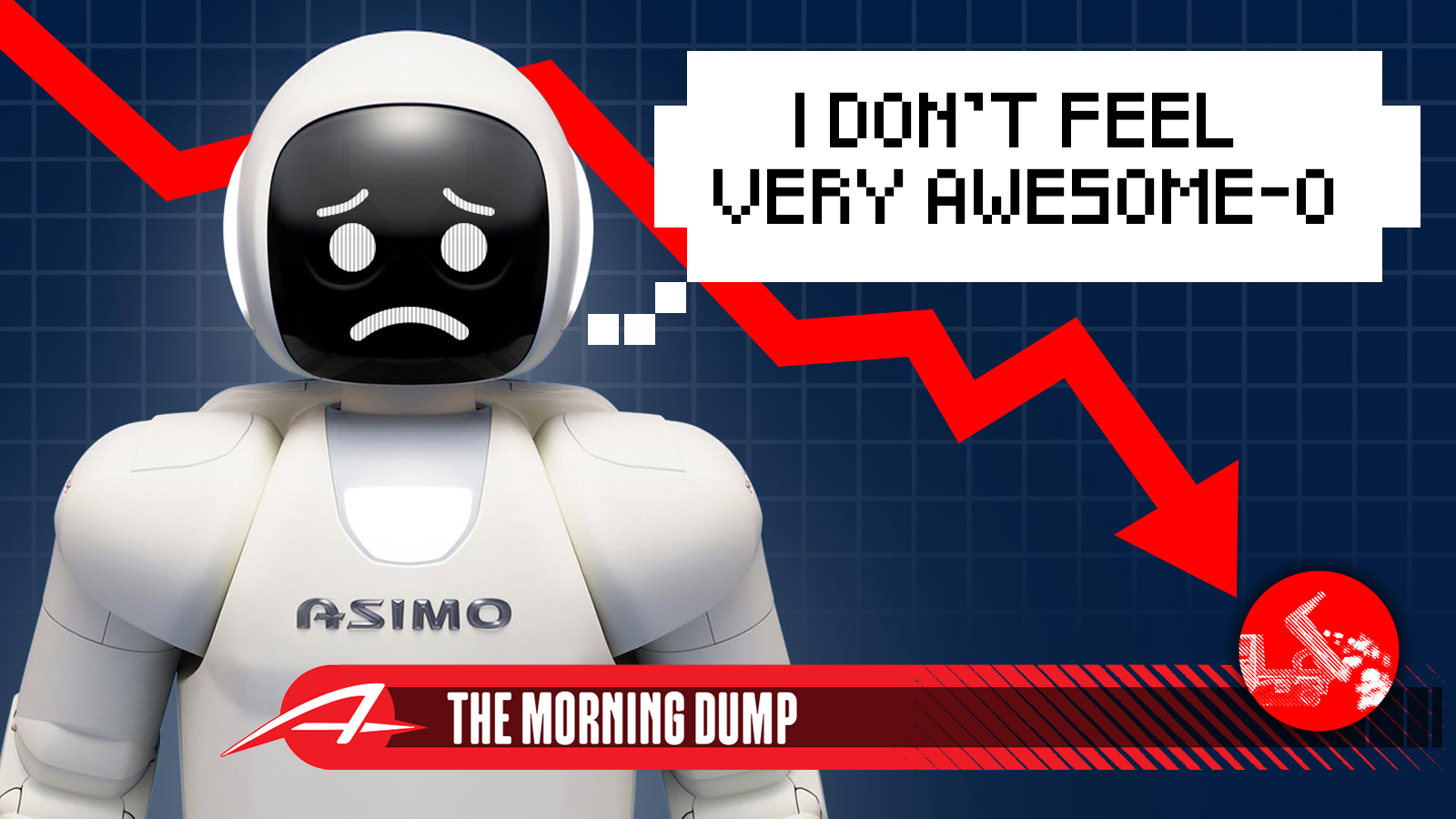
There are few global automakers that aren’t reeling from this or that crises. The French brands are fighting with Chinese ones. The Chinese brands are fighting with one another. The American brands face tariffs and a lot of competition. The German ones are, as usual, losing a war on two fronts. Even the typically solid Japanese automakers are in trouble.
The Morning Dump is often full of woe, and today is no different. It’s being reported that Honda will report its first annual loss since it was in the business of reporting those things. While Toyota is still in the black, it’s less so than expected, for some similar reasons.


Volkswagen’s harvest isn’t going much better, and now it sounds like it’s contemplating letting four of its German plants go fallow. Back here in the US, Ford is having to play catch up to build enough trucks to satiate demand, and now GM is trying to strike while it can.
Honda Releases Statement On Report That It’s Going To Lose Money, Reaffirms It Lost Money

Honda went public in 1957 and has, in the 69 years since, never reported a full-year annual loss. Even when the bubble burst in the ’90s, Honda’s strength outside of Japan was enough to carry the company through. Given its reliance on the US for profits, you might have expected a loss during the GFC, as Toyota did. Nope.
What Honda couldn’t survive, though, is the combination of higher tariffs, elevated energy prices, and outsized EV investments that didn’t result in vehicles that would be competitive in either China or the US. Honda itself outlined this a few weeks ago in a statement to investors:
Setting a goal to realize carbon neutrality for all products and corporate activities Honda is involved in by 2050, Honda has been working to reduce its environmental impact. To realize carbon neutrality for smallsize mobility products, including passenger cars, Honda believed EVs would be the optimal solution from a long-term perspective. Based on this belief, Honda shifted its strategic direction toward the popularization of EVs. Supported by its internal combustion engine (ICE) and hybrid electric vehicle (HEV) business with accumulated technologies and know-how, as well as a stable profit base provided by Motorcycle business and Financial services business with a solid customer base, Honda has been promoting EV adoption. However, the profitability of Honda’s Automobile business is declining primarily due to the impact on the ICE and HEV business caused by the United States government policy shift including the imposition of import tariffs, and a decline in the competitiveness of Honda products in Asia due to the impact of the allocation of more resources to EV development.
In addition, the business environment surrounding Honda is changing dramatically day by day, and the outlook remains uncertain. The United States government policy shifts including the abolition of tax incentives for EV purchases, as well as the easing of fossil fuel regulations have slowed down the EV market. In China and other Asian countries, what customers value more in automobiles is shifting from hardware features such as fuel efficiency and cabin space to software-based features that continuously advance in line with customer preferences. This has intensified competition due to the rapid emergence of newer EV manufacturers that leverage their shorter product development cycle and strengths in the area of software-defined vehicle (SDV) technologies, including advanced driver assistance systems (ADAS).
That is a brutal and reasonable assessment of what happened. Some of this is self-inflicted. Honda could have been earlier to electrification, although that didn’t seem to help Nissan. It could have spent less on EVs trying to catch up and more on hybrids, which definitely would have helped.
Honda attributing its woes to the U.S. government and not to them building cars for which there isn’t enough demand seems like a deflection. They’re not wrong on tariffs/rebates, but those are not the biggest issues when it comes to EV sales. There are demand issues.
Any one of the above issues would have been a challenge, but all of them simultaneously is just too much. It’s a rough spot for Honda, and I’m not sure anything the company’s leadership is going to do is going to be met with a lot of excitement. If the company leaves more of its EV development to its Chinese partners, the pro-EV folks are going to be unhappy and point to it as a sign of Honda’s decline. If the company invests more in EVs, people will wonder to what end.
Either way, the company’s reversal on EVs is going to cost it. A lot. The question is not if Honda is going to report a loss for FY 2026 (which ended March 31st), but how much. Nikkei Asia thinks it knows how much:
Honda Motor recorded an operating loss of approximately 400 billion yen ($2.55 billion) for the fiscal year that ended in March, Nikkei has learned, heavily impacted by problems related to its electric vehicle business.
The operating loss would be the company’s first since going public in 1957. It posted 1.2 trillion yen in operating profit in the previous fiscal year. The company aims to generate profit at the operating level for the current fiscal year ending March 2027, boosted by strong performance in its motorcycle segment.
The size of Honda’s operating loss would be the second largest among Japanese automakers, after Toyota Motor’s 461 billion yen for the fiscal year that ended in March of 2009 during the global financial crisis, although a simple comparison is difficult due to differences in accounting standards.
What’s interesting is that Honda put out a statement basically saying “we didn’t say that” while also reaffirming the previous guidance:
It was reported in the Nikkei online edition on May 8, 2026, that Honda’s consolidated operating loss for the fiscal year ending March 31, 2026 would be approximately in the range of 400.0 billion yen. However, our company has not made any announcement concerning this matter. Honda’s consolidated operating loss for the fiscal year ending March 31, 2026 is expected to fall within the range of the full-year consolidated earnings forecast announced on March 12, 2026, due to factors such as losses associated with the reassessment of automobile electrification strategy.
It’s an odd response, because the 400 billion yen estimate is at the lower end of Honda’s estimate of 340 to 570 billion yen. If Honda came in at 340, it seems logical that Honda wouldn’t say anything and beat the reported estimate. If it’s a greater loss, well, maybe you’d say something.
All will be known by this time next week.
Toyota Made A Profit, Just A Smaller One Because Of The War In Iran

Toyota has played it about as well as you could these last few years, given all the geopolitical disruptions (which is to say, charitably, a current administration in the US that prioritizes chaos over coherence). It still sucks for the company, though, which has been hit especially hard from the War in Iran.
The stock reversed gains and fell as much as 3.5% on Friday after the Japanese company issued an outlook for ¥3 trillion ($19.1 billion) in operating income for the fiscal year ending March 2027. That was far short of the average consensus estimate for ¥4.6 trillion, as well as ¥3.8 trillion posted in the prior period.
Toyota’s outlook shows how geopolitical shocks are hitting even the industry’s most profitable automaker, threatening margins through higher material, shipping and tariff costs. Suppliers warned last week that they are beginning to see shortages due to the Iran conflict, now in its third month, as Toyota said it would be difficult to offset the resulting ¥670 billion hit to its bottom line from the regional turmoil.
There’s a sense in the article from at least one analyst that Toyota is lowballing its guidance, but if the Iran conflict/war/sideshow doesn’t end quickly they may not be.
Volkswagen Is Reportedly Planning To Let Four German Plants Go

It’s clear that the historical way of doing business at Volkswagen just doesn’t work anymore, and a key complication is how much production is in Germany. The company already made it clear that the historical agreement to not close plants in its home country is no longer in force. Now, per Manager Magazin, it sounds like there’s a rough idea of a plan for at least four German plants:
The fact that four plants are under scrutiny due to excessive costs had already been reported by the Handelsblatt newspaper. These are the VW plants in Emden, Zwickau, and Hanover, as well as the Audi production facility in Neckarsulm. Now, however, Blume and the board members who took office with him have revealed their actual plan: They intend to phase out production once the models currently manufactured there are discontinued. No more cars at all in four factories – that would be a far more drastic cut than previously suspected.
The company stated that plant closures were not discussed in the supervisory board meeting. However, participants reported that the goal of potentially phasing out the plants was presented and apparently explained in the slides shown. The company does not expect a significant increase in sales and, consequently, production figures in the coming years. The phase-out could begin in the early 2030s, according to the company.
It’s possible these plants could transition to munitions factories or, perhaps, be sold to Chinese automakers.
GM Smells Blood In The Water

Ford has said it’ll catch up on F-150 production later this year, assuming the plant where it gets most of its automotive-grade aluminum doesn’t catch on fire for a third time.
Truck buyers are generally loyal, and F-150 buyers especially so. Still, GM seems to think there’s an opening, as Automotive News reports:
General Motors wants to boost inventory of its money-making pickups on U.S. dealer lots after falling short of demand to start the year and as a production snag at rival Ford Motor Co. presents an opportunity to gain market share.
“It’s prudent to be increasing right now just because their inventory is low relative to demand,” said David Whiston, an auto analyst with Morningstar. “But if you’re GM, you want to take advantage of Ford’s weakness.”
GM ended the first quarter with 9 percent fewer pickups on U.S. dealer lots than it did a year earlier, CFO Paul Jacobson said on an April 28 call with analysts. That’s a notable decrease considering the pre-tariff sales rush GM and other automakers saw in the first quarter of 2025.
GM and Stellantis only report quarterly, so it’ll be a couple of months until we know for sure how well GM and Ram (and, maybe, Toyota) did.
What I’m Listening To While Writing TMD
I could only pick one Shania Twain song this morning. That’s hard. There are endless bangers. I do love the music video for “Man! I Feel Like A Woman!” for the throwback to Robert Palmer’s video for “Addicted To Love.”
The Big Question
If you’re buying a half-ton truck tomorrow, what are you getting?
Top photo: Honda


Honda’s slow decline needs to be studied. They’re still living off their 90’s/early 2000 reputation, and honestly, their reputation for reliability started going downhill after 2010-2015, when they started to switch over to smaller turbo powertrains to meet environmental standards.
I plan to keep my NA 2010 running for as long the body doesn’t succumb to rust disintegration. $300-$1kish CAD per year recently in maintenance, but that still beats regular car payments, and it’s super duper dependable.
Interesting that the companies that are not profitable or growing have stock multiples far beyond Ford, which is profitable, strong EBIT, and growing. Most of their debt is due to Ford Credit which is operated like a bank. They borrow low APR and loan higher so it’s owed to them, and secured debt. So, I think the market needs to correct.
Yeah, Honda is not doing great in Europe either. Their lineup is just not great.
CR-V is fine, but most people just get RAV4 as both hybrid and PHEV are more frugal, and finally it has trunk. CR-V is a bit worse in all sectors, and I haven’t seen that many new ones. However older 2.2diesel ones are everywhere.
Civic and Accord suffer from lack of wagons. These family cars almost only sell as wagons, especially here in Nordics. Older wagon accords were huge hit, especially in 06-08 versions, and more pretty (but shittier trunk) 09-12. But in general I feel like Honda seems to follow Lexus formula too closely. Here we like wagons and big trunks. Both marques seem to hate that. Still looking at you RX.
Used? Probably a GMT 400 or 800.
New? If your paying for a Raptor.
Once again a very interesting read that would be made more interesting and more informative with economic information. Most of the woes could have been predicted as Toyota did. Sure Ford has a loyal following but you don’t need to sell a Chevrolet pickup truck to the Ford CEO and the Ford family members just to 5 to 10% of the least loyal buyers. It’s what corporate entities do to family operations. Reduce the price steal just enough customers to close down the mom and pop then raise the price back up once you own the market. I don’t see why people can’t read the obvious.
“If you’re buying a half-ton truck tomorrow, what are you getting?”
A clean 5th or 6th gen F100 Custom with the 300 Inline 6 or 302 V8.
None of those new oversized “I’m a workin’ guy” cosplay behemoths for me.
And maybe if companies like Honda hadn’t thrown away billions of dolllars in development costs on nothing – had stuck with Plan A and brought their EV products to market instead – they might be raking it in right about now.
Nope EVs with no bribe of taxpayers dollars makes them to expensive. Hybrid was the best first step. You can’t run a marathon that goes from the starting line straight to the finish line with out the steps to cover the 26vmiles.
Meanwhile the US Regime shovels our money into the pockets of Big Oil via public subsidies, which then gets shoveled into the pockets of Congress and the cadre in the White House via lobbyists, “campaign donations” and insider trading – who then put their thumbs on the scale in favor of Big Oil…
….and we’re still paying through the nose for fuel.
If we didn’t subsidize Big Oil and actually paid at the pump what it costs for that sweet-sweet distilled Dino-Juice, folks in the US might be singing a different tune.
Plus – there are other countries besides the US where Honda, Ford and others sell cars and need to compete with the Chinese.
Generally speaking it was all going down quite smoothly, and quite rapidly looking at the numbers, from the starting line to the finish. Additionally, Biden’s 2022 IRA Act saw to it this nation would gain independence from China on critical rare earths and materials necessary for magnets, motors and batteries, culminating in various new factories (jobs, on US soil, good paying manufacturing jobs) coming online. All of that was disrupted by Trump. ALL OF IT.
As someone that owns a 60s pickup, you’re wrong if you actually want to do work. You’re gonna get half the gas mileage, with 1/10th the comfort, and absolutely no safety features, while being slower and way less capable. But sure, let’s hate on modern trucks because they are too capable? My truck can’t defog it’s own windows in a rain storm, but sure, lets act like it’s the better option for work….
Is it cooler and more fun, absolutely, but is it even as close to as good an option for daily driving or anything “work” related? Hell no.
100%.
I feel like everyone should own at least one old truck, I don’t care if it’s 50’s, 60s, 70’s, 80’s. They’re so fun to work on, easy on the eyes, and taking one for a drive just makes you feel like the world’s going to be alright.
But good lord, compared to even a mid 90s truck, with about 5000lbs or more behind you, or a solid 1,000 lbs in the bed, unless you stay under 50mph (if your engine even has enough ass go get you to that speed) it is S K E T C H Y.
If you actually have to do work, you have to use the right tool for the job.
I don’t foresee any truck or truck adjacent acquisitions in my remaining decades.
On the economy front, things appear to be looking up for a cohort of administration adjacent individuals who are profiting bigly from the chaos.
If I won the lottery tomorrow and decided to buy a truck it would be a military Humvee
I worked with a guy who owned a new H1. I’ve ridden in farm tractors with better ergonomics, handling, ride and performance. It was too big for urban use. Thing was a steaming pile IMO.
69 profitable years? Nice.