

Automakers in Europe are feeling the pinch as emissions regulations tighten. Ultra-strict Euro 7 regs are set to take effect in the European Union later this year, with manufacturers scrambling to hybridize and electrify their fleets to remain compliant. One such company is BMW, which is currently in the midst of a big electrification push with its line of “Neue Klasse” EVs, including the iX3 crossover and i3 sedan.
While its big-boy M cars like the M5 and XM have also been treated to partial electrification, BMW isn’t giving up on pure gas-powered drivetrains. The company announced today it’s implementing a new version of technology once used by Honda in the 1970s to bring its high-horsepower straight-six up to modern emissions standards.


The tech lies inside the engine itself, specifically within the cylinder head. It’s called combustion pre-chamber ignition, and it promises huge strides in efficiency, specifically when the engine is under high load.
The Revolutionary Tech
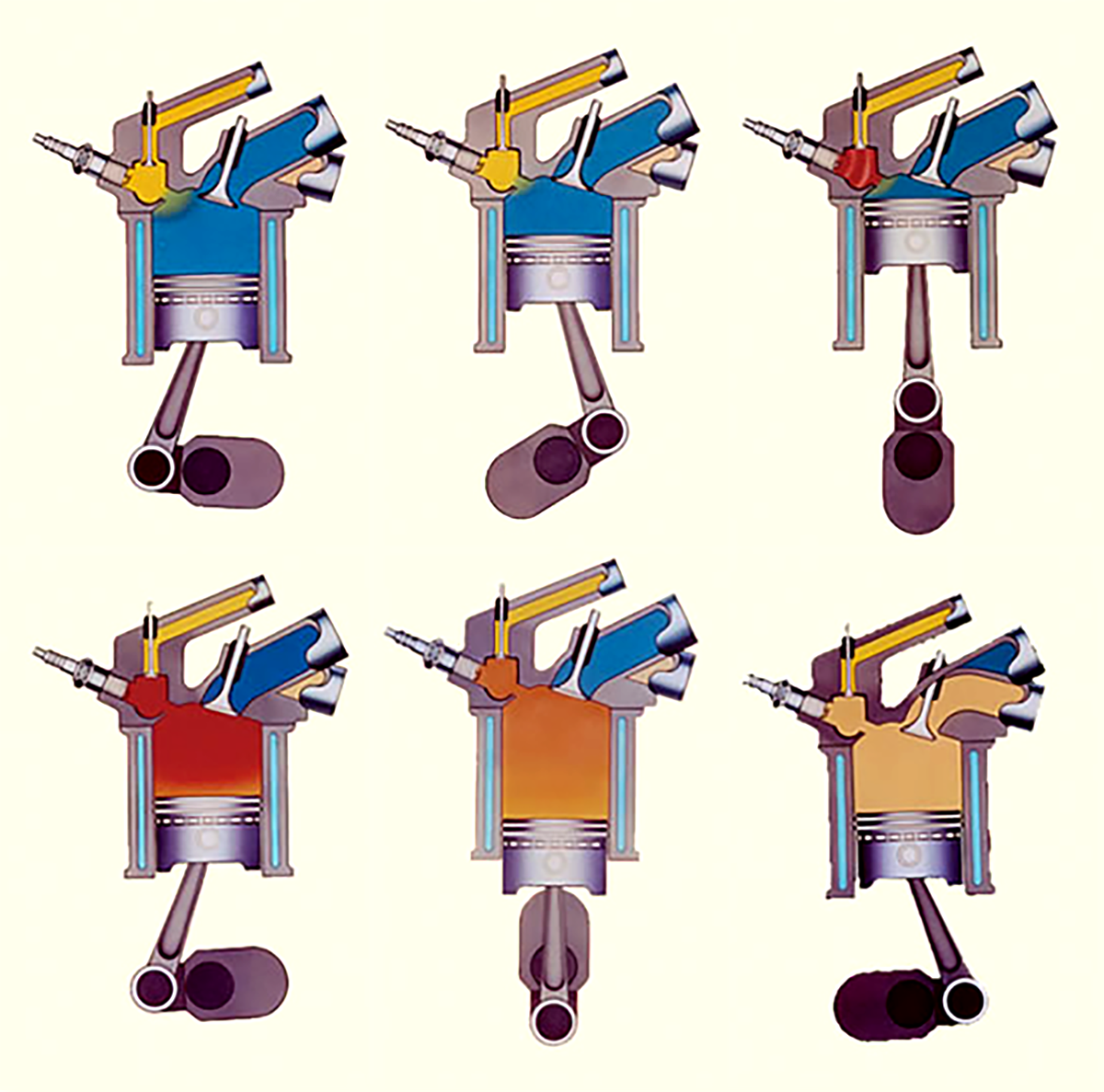
Pre-chamber combustion tech has been around for a long time. American audiences got their first taste of the concept in the mid-1970s with the introduction of Honda’s CVCC engine, installed in its Civic hatchback. CVCC stands for Compound Vortex Controlled Combustion, which doesn’t do much to explain the tech. But basically, there’s a chamber in the cylinder head that sits above the main combustion chamber, with its own fuel delivery path and spark plug. This “pre-chamber” ignites its air-fuel mixture first, pushing those flames into the main combustion chamber and causing a vortex that makes the air-fuel mixture there burn a whole lot more evenly.
Here’s a diagram showing the CVCC engine’s combustion cycle:
Honda’s system burned fuel so cleanly that it could pass California’s then-newly minted emissions regulations without the use of a catalytic converter. Interestingly, the testing was done on the engine using a car that wasn’t a Honda at all. From the company’s history file on CVCC:
“Test data was taken with the CVCC engine installed in a Nissan Sunny,” said Ken Mizoguchi, the Honda representative on-site in Ann Arbor. “At that time, Honda still didn’t have a car that was big enough for the CVCC engine. We even used sandbags to try to increase the weight.”
Indeed, the Civic had only been introduced a short time before, on July 21, leaving Honda with no alternative but to take the qualification test with the body of a competing vehicle.
CVCC proved so effective that other automakers couldn’t help but put it in their own cars. Soon after its introduction, Honda signed licensing agreements with Toyota, Ford, Chrysler, and Isuzu to allow the tech to appear in their engines.
The Revolution Continues
In an effort to keep its smaller M cars purely gas-powered in the coming years, BMW is introducing a pre-chamber ignition system of its own to its S58 3.0-liter turbocharged straight-six engine. Found in the M2, M3, and M4, this refreshed powerplant will become standard equipment on those cars starting in July for the M3 and M4, and in August for the M2.

Though the basic concept is the same as Honda’s original idea, there are some big differences. For one, the CVCC setup is a totally passive system, and uses a carburetor to feed the pre-chambers and main cylinders. BMW’s version, on the other hand, is active and adjustable, with the engine’s computer able to activate or deactivate the system based on load and revs. The pre-chamber and the main combustion chamber each get their own spark plugs, meaning there are 12 per engine (have fun servicing this thing, BMW techs).
Here’s how BMW decides when and when not to use the pre-chamber system, per its press release:
At low and medium revs, the conventional spark plug in the main combustion chamber fires before the spark plug in the pre-chamber. But when the engine is operating under higher revs and loads, the pre-chamber ignition takes over the lead role, with part of the fuel-air mixture channelled through the openings into the pre-chamber also ignited there. The flames generated as a result exit the pre-chamber at around the speed of sound.
These ignition jets then ignite the mixture in the main combustion chamber above the piston at multiple points at the same time. The result is a significantly higher combustion speed. Meanwhile, the possible cause of uncontrolled combustion – i.e. “knocking” – is also countered effectively. An additional effect of this technology is a drop in the temperature of the exhaust gas.
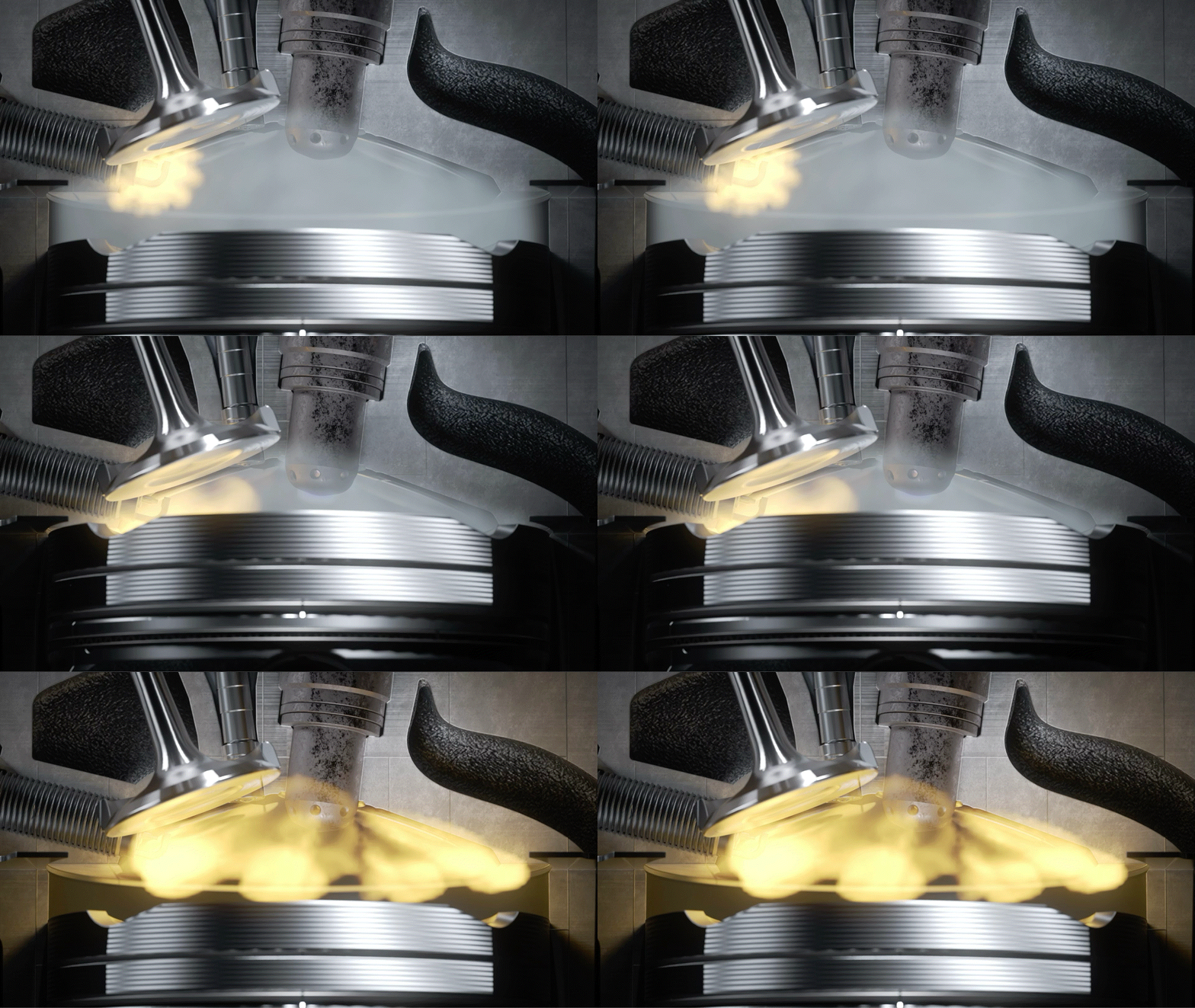
BMW has created some nice visuals that depict the difference between a normal combustion cycle and a cycle using the pre-chamber ignition. First, here’s how the engine works without the system active (note the spark plug on the left firing and igniting the air-fuel mixture, with no involvement from the pre-chamber on top):
And here’s how the combustion occurs when the pre-chamber is activated. The initial ignition occurs in the pre-chamber first, before it propagates into the main chamber to ignite the rest of the air-fuel mixture:
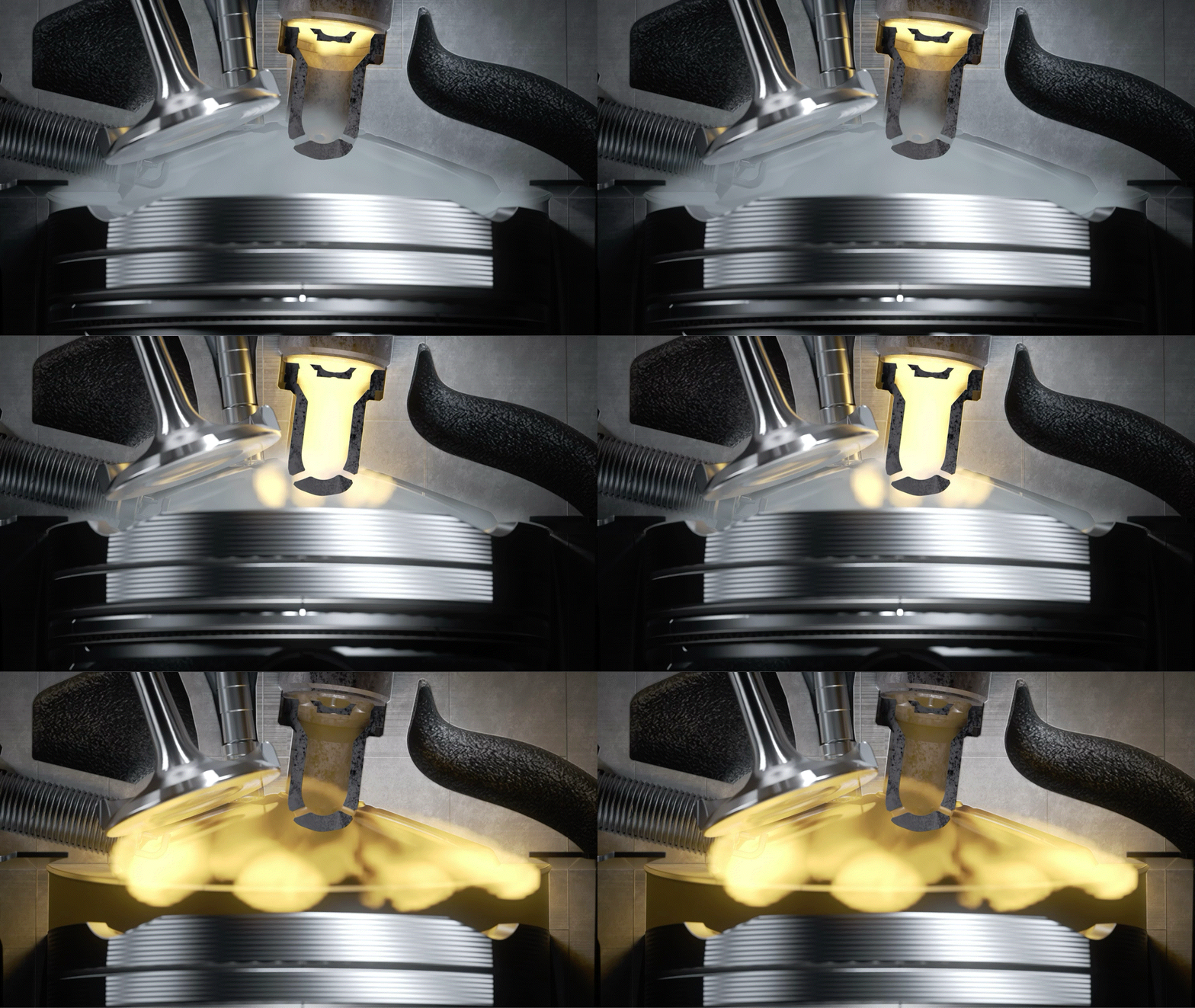
Instead of just a singular pathway from the pre-chamber to the main combustion area, like what’s shown on the Honda diagram earlier in this article, BMW has split the pathway into seven separate “jets,” so that the flames spread out more evenly through the main combustion chamber. Here’s a top-down visual to give you a better idea of what that looks like:

In addition to the pre-chamber ignition system, it’s also given the S58 a higher compression and variable-geometry turbochargers to boost efficiency further. The company doesn’t say exactly how much more efficient the engine is, but describes the improvements as dramatic, “especially when the engine is being pushed to its limits.” If you take your M car to the track often, that should mean noticeable savings. From the release:
Under high loads, fuel consumption drops substantially. This is particularly beneficial for BMW M customers who drive their cars on race circuits – e.g. during track days: the fuel consumption reduction enabled by BMW M Ignite technology means they can keep lapping for longer on the same amount of fuel.
This kind of active pre-chamber combustion tech isn’t totally new. Engines like the Nettuno V6 found in the Maserati MC20 and GrandTurismo, as well as the Hurricane 4 inline four-cylinder in the Jeep Grand Cherokee, use similar cylinder head setups. But with emissions regs now tighter than ever, it’s not terribly surprising that more companies like BMW are spending the extra development and manufacturing costs to implement it into their cars.
While pre-chamber combustion systems make engines even more complicated than they already are, I think this is a worthy tradeoff. To me, a few more spark plugs are a better alternative to adding a heavy hybrid system or losing the gas engine altogether to purely electric power.
Top graphic image: BMW



Semantically, isn’t that a bottom-up visual since you’re looking at the valves which are typically on top of the engine?
so you mean bmws will finally no longer need the walnut blasting on their DI engines? lol
Reading about the compression and high load efficiency gains is making my lizard brain think of how the aftermarket will somehow make even more power out of stock S58s. I’m all for it.
You’ll just need 100 octane gas..
Does anyone truly think the BMW engineers will get this “new to BMW technology” right?
I feel like 5-6 years after these models hit the market, we will see widespread engine failures because the engineers forget one important detail, used plastic instead of metal, or made some $15 part an engine out job.
strangely, it doesn’t seem to matter to BMW, as long as it works well enough until the lease or warranty is up, then they don’t really care. somehow secondary market value is less concerning for primary BMW owners
///M Car Engines always have an Achillies heel, it is part of the charm. With the S55 it is the crank hub, S54/65/85 it is rod bearings and S63 it’s the whole engine.
“To me, a few more spark plugs are a better alternative to adding a heavy hybrid system…”
Yes on the heavy hybdrid system. But then a typical Toyota hybrid weighs half a metric ton less compared to a typical BMW.
Looked it up because I was thinking the same, the M3 weighs over 3,800lbs, Camry hybrid weighs around 3,500lbs. Granted that’s comparing apples and oranges, but it seems like a BMW problem not a hybrid tech problem
So, will this work all the time? Or do you need a paid subscription through the BMW-app?
Sounds really cool, whatever allows us to have pure ice a while longer.
My 2027 6mt g80 order will be produced right around the cutoff, I wonder what I’ll get
“The pre-chamber and the main combustion chamber each get their own spark plugs, meaning there are 12 per engine (have fun servicing this thing, BMW techs).”
Looking at the images I wonder if it the spark plugs, fuel injectors and pre combustion chamber couldn’t all be combined into a single replaceable unit.
That’s exactly what it looks like to me.
So you have to replace the plugs and the injectors and the assembly at the same time, every time?
I guess that it’s simpler, but that sounds expensive.
Good plugs and injectors can go 100-150k without even being looked at so why not? Plus Germans LOVE complex solutions. This is right up their alley!
Unintentionally I think the Euro 7 standards will lead to more emissions. Having double the spark plugs will mean more repairs and problems which will lead to some of these BMW’s becoming mechanically totaled sooner.
Spark plugs and coils almost never cause complete engine failure. If it ever does, its rare and this makes it twice as likely, but still rare. Don’t get your point here.
The engine on my step dad’s Q50h ate itself when one of the spark plugs physically broke inside the cylinder. Thankfully it was still under warranty and Infiniti replaced the engine without a fight. If it hadn’t been…well I don’t like to think about it.
While such a failure may be rare it’s twice as likely here than on a single plug design and it would absolutely suck if it did.
And double the labor cost (for the plugs) for a typical BMW owner.
Two spark plugs per cylinder have been used for over 100 years, and it hasn’t been a problem yet. In some cases the only purpose is to increase reliability , for example on fire engines and aircraft. Spark plugs have been dead reliable for at least 40 years.
It’s not like the 1960s where you would routinely sandblast and recap the plugs about as often as changing the oil.
Alfa GTA twin plugs are pretty robust for 1960s technology.
Replacing plugs more frequently isn’t idle but $400-$500 just isn’t that bad if you’re already invested in owning a BMW M car.
Is that how expensive spark plugs are now ?
I think the last time I bought spark plugs was about 1985 when I was building an engine and they were about $2 each. Even the weird Magneti Marelli plugs weren’t all that expensive. God forbid I ever have to get another Magneti Marelli distributor cap though.
In modern cars the spark plugs seem to last longer than the rest of the car.
Now I’m wondering if I should change the plugs in the Prius. 150,000 miles on the originals, and no codes. I’m only getting about 47 mpg which I am told is crummy, but I’m driving at the prevailing speed on California freeways which seems to be in the mid 80s.
Yikes, $30 a plug?
Hmm.
I got high-quality spark plugs and ignition coils for my Honda Fit.
NGK Iridium plugs and Hitachi ignition coils were $280 CAD (plugs about $12 each, coils $50 each)
So it’s probably not that plugs are expensive; it’s just the German car tax.
Yeah, it’s bananas but if I have the $80k for the M car, I probably don’t care much about a few spark plugs. Must be a nice way to live!
It is just another take of Sir Harry Richardo’s stratified charge engine isn’t it?
I tend to think of him as the King of Squish, but he was so much more.
I was about to mention that myself. Presumably the pre chamber charge will be much richer than the main chamber charge. If the flame front coming out of the pre chamber is supersonic, isn’t that by definition explosive detonation, as opposed to deflagration? It sounds like the cure for knock is just let it happen, and have the rest of the cylinder slow it down and dampen it. If that’s what is happening, it’s a very clever solution. I wonder how that affects the NOx. It starts out hot, rich and supersonic, then transitions to cooler and slower as it hits the piston. I guess whatever happens to the nitrogen the catalyst will sort it all out.
It’s sounds very neat.
I guess it is not going supersonic, definitely interesting. Like many others I’m leery of costs down the road.
Well the BMW press release reads “ . The flames generated as a result exit the pre-chamber at around the speed of sound.”
But the weird thing is WTF is the speed of sound in an engine at TDC at the beginning of the power stroke?
According to a random source on Google
“ The speed of sound in air is directly proportional to the square root of absolute temperature meaning it increases with higher temperatures and decreases with lower temperatures, typically changing by ~0.61 m/s per degree Celsius.”
The speed of sound relates to pressure too because higher kinetic energy in molecules makes pressure waves travel faster, but it’s REALLY complicated inside an explosion.
I suspect that “at around the speed of sound” means they don’t actually know what the speed of sound is locally, not to mention that the speed of sound inside the flame front is radically faster than outside it, and the speed of sounds is increasing as a result of the fuse in temperature and pressure on the compression stroke.
But don’t take my word for it, my degrees are in art
There are a few big points that are missed in this article. First off, the Honda CVCC system was a lot more complicated and “active” than the passive prechamber used by BMW here, or in the Stellantis hurricane engine. The Honda system has a while separate intake valve and path through the carburetor that made the fuel:air mixture in the prechamber more rich than the mixture in the rest of the cylinder (which was kept very lean) to improve ignitablity near the spark plug, creating jets of combusting mixture into the main chamber to and quickly ignite the lean mixture that would otherwise have trouble burning fully. Since it was lean, there was very little CO and hydrocarbon emissions, but ultimately tighter regulations on NOx as well as those others forced the use of a three way catalyst which negated most the other benefits for Honda.
Second, those BMW animations show the prechamber firing in both scenarios, but at low to mid load the spark plug in the main chamber is also firing. Only at high loads does the prechamber alone fire. It’s important that the prechamber also fires at light loads because otherwise the fuel and air trapped in the prechamber would be very hard to burn and would likely come out as unburned hydrocarbons, hurting efficiency and potentially blowing emissions.
Third, active prechambers typically refer to designs that include fuel injection and sometimes air inlets into the prechamber directly. Ones with spark plugs only are typically called passive since their control is essentially the same as a normal spark plug.
Prechambers tuned for high loads are really focused on fast combustion with strong jets under those conditions, meant to ignite the rest of the cylinder more quickly than a conventional flame front could, thereby consuming the fuel before it would have a chance to autoignite (knock) at high loads. This allows BMW to avoid making the mixture rich at high loads to avoid knock like most boosted engines (also part of the reason they are used in F1), which has fuel consumption benefits but really is meant to abide by upcoming emissions regulations that don’t permit running rich at WOT for thermal protection. A side benefit is often being able to increase the compression ratio to help efficiency elsewhere in the operating range.
However, #4 is that prechambers tuned for high loads will have small holes to make those jets and high surface to volume ratios in those holes, meaning high heat and flow losses. These have the biggest impact at low loads and thus air densities during compression where the burned residuals from the previous cycle cannot be flushed from the prechamber effectively, making ignition much more difficult and slow at low loads. Add to this the higher heat losses of the prechamber as flame pass through those holes, and you have a system that works very poorly at low load, necessitating the conventional spark plug as well.
Perhaps at low load and high rpm, like backing off the throttle, the flame from the pre combustion chamber doesn’t spread fast enough in the cylinder and the second spark plug is needed to get the flame front where it needs to be so as to complete ignition in a timely manner.
The Honda CVCC system was remarkable for working using only vacuum and fluid dynamics to control things. I thought it was amazing how a single carburetor was delivering two very different air fuel mixtures at independently variable volumes.
It’s amazing how engineers designed logic circuits and did both analogue and binary computation with plumbing and air, or in the case of the automatic transmission, plumbing and liquid.
Wait a moment, how is the richer mixture or any fuel at all getting into the BMW preechamber ? I thought it was like older Mercedes diesel engines with glow plugs and newer F1 engines where the fuel was injected into the precamber.
Press release reads “ But when the engine is operating under higher revs and loads, the pre-chamber ignition takes over the lead role, with part of the fuel-air mixture channelled through the openings into the pre-chamber also ignited there. ”
“How does this “channelled through the openings” work?
I thought I understood what was going on here , but now I’m not so sure. Is heat retention in the prechamber making the local behavior act like detonation while sparing the rest of the combustion chamber from those effects by the time the flame front travels there?
How does scavenging work?
The Honda CVCC engine has a whole dedicated poppet valve and intake flow path with a rich mix from the carb specifically to the prechamber with its own timing and everything to induct a rich mixture into the prechamber, while most of the cylinder gets a lean mixture. So fresh air and fuel displaced the Honda prechamber residual gas and it didn’t have a problem with scavenging. Passive prechambers, like BMW and Stellantis are using with just a spark plug inside them, don’t have this option… They need to rely on dropping in pressure to atmospheric during the exhaust stroke, then getting enough fresh mixture pushed into them during the compression stroke to dilute or displaced the exhaust residual enough for combustion. This is a problem at low loads when throttled though, since not only is the in cylinder residual higher but the compression starts from a lower, throttled pressure so you can end up in a situation where there is a lot more residual trapped in the prechamber than in the main chamber, hurting ignition and early flame growth. Then the higher heat losses of the prechamber due to it’s relatively high surface to volume ratio, especially around the jet holes, allows or quenches the flame kennel even more. The dynamics of how the prechamber heats up and cools down during load changes can have a big impact on the way the engine runs. However, it shouldn’t get hot enough to cause detonation unless there are some serious heat transfer problems between it and the head.
At high loads, Combustion happens in the prechamber first (which only contains single digit percentages of the chamber volume typically), and as the gas in the prechamber burns, it heats up, rapidly increasing pressure. The hole size is kept small to create very fast jets of burning mixture that shoot out into the rest of the combustion chamber, ignoring it faster than a laminar transitioning to turbulent flame front could reach the extremities of the main chamber. The purpose is to avoid pre-ignition by getting all the fuel to burn in a faster but still more controlled way before it has enough “cooking time” to autoignite
If this allows the S58 family of engines to soldier on, count me in. BMW’s EV efforts have been great lately, but I love the choice.
I’m very curious about the “dramatic” improvement in efficiency under heavy load. I had to fill up my M2 mid track day a few weeks back. The combination of 6 mpg and a ~13 gallon tank wasn’t brilliant…
Interesting they don’t mention the B58 as inheriting this tech. Maybe they will achieve efficiency gains there with mild hybridization – which presumably they’d want to avoid on the M cars?
“The pre-chamber and the main combustion chamber each get their own spark plugs, meaning there are 12 per engine (have fun servicing this thing, BMW techs).”
As if BMW’s are designed for serviceability now?
Meanwhile – Dual Ignition engines are nothing new:
The Nash Ambassador for 1932-1948 used twin sparkplugs on their straight eight engine.
Other Dual Ignition Engines:
Modern Chrysler Hemis (2003 onward)
Nissan’s NAPS-Z engine
Mercedes-Benz M112 and M113 engines
Ford 4 cylinder Rangers (from 1989) and Mustangs (from 1991)
Alfa Romeo had an entire lineup of “Twin Spark” engines from the mid 80s to 2009.
Alfa Romeo had twin spark plugs on their racing engines in 1914, then airplane en started using them in WWII Gasoline was pretty crummy in 1914, and getting high enough compression without breaking things from detonation required two spark plugs.
We live in a funny world where a Jeep Grand Cherokee made by Stellantis is receiving advanced engine technologies years before BMW can use it in their top of the line performance cars!
I’m pretty sure this tech is used to increase peak power; it’s likely offsetting power loss from other changes that improve emissions in lower load engine scenarios. The Jeep manages to get 325hp/332lb-ft out of a 2.0T using the tech, when most normal 2.0Ts are still in the mid-high 200s.
A lot of work to avoid a much simpler 2-motor hybrid system.
Counterpoint, this allows continued use of manual transmissions for those of us with easily bored left feet.
Manuals are almost a rounding error in BMW’s global sales. Forget if the CEO is still saying if you want one buy it now because the next generation of vehicles will not have manuals.
BMW is introducing a lot of mechanical complexity with their ICE engines to avoid the inevitable.
BMW is mainly targeting Europe with this car, and they would need to use a PHEV system for emissions and ZEV zones that’s gotten a ton of backlash in other models due to its weight (current models including this engine use a relatively strong 48V MHEV). This engine tech allows them to keep their top performance models lightweight, while they can still hybridize or electrify the rest of their lineup. Plus, those hybrids can still benefit from this tech to a lesser extent.
They are still only putting off the inevitable. In 2030 the EU corporate fleet average drops to 50 g/km CO2. That is the equivalent of 109 mpg US.
If you go double-check the article, the ICE-only powertrains are intended for the M2, M3, and M4. Manual take rates for these cars are much higher. For the M2 in particular, it is about half.
… and yet as recently as February BMW’s CEO said they plan to get rid of the manual because the current one can’t take the power expected of a M car and it doesn’t make sense to design and tool a new one. Manuals are about 1% of BMW’s sales and only available in 4 vehicles.
I see your point and I think you’re right that this is obviously putting off the inevitable. But much like Porsche’s GT cars, the availability of the manual on M cars is important to enthusiasts and the take rate is high on those specific models.
I have a manual M2 and would not have considered an automatic or a competitor that doesn’t offer a manual.
A correction to my statement above – BMW now offers 3 cars with a manual as the Z4 recently ceased production.
A new Porsche with a manual starts at $130K. That is why they can afford to keep a manual in the lineup for the small number of people that want one. A M2 starts at $70K and the M2, M3, M4 and M5 combined only account for 71K cars in 2025. The M2 is 50% manual but the M3 and M4 are only 20%. The M5 is auto only. It is simple a numbers game.
You can say you won’t buy a car that doesn’t have a manual but you can also expect the price of that car to continue to climb.
That’s because they are cowards and won’t admit they need to ask Tremec for a gearbox.
“BMW is introducing a lot of mechanical complexity with their ICE engines to avoid the inevitable.”
German engineering 101.
True. I know first hand.
Counter-counter point, there have been several true manual hybrids over the years. The systems are not incompatible.
Sounds like the prechamber is helping avoid what would otherwise be very retarded spark timings at high load. Modern boosted DI engines are typically optimized for fuel economy on test cycles, which in high power engines like these means they’re never at high load. The engines can make much more load but to avoid damaging knock they have to run very late spark timings, with a hefty fuel economy penalty. This is why many boosted pickup truck owners saw their fuel economy beat their old naturally aspirated V8 fuel economy under normal conditions, but when towing it might have been worse than the old V8.
The prechamber should allow for faster burn rates, significantly reducing the time for the flame to fully propagate through the combustion chamber, and therefore allowing them to advance the start of combustion significantly at high load conditions. It also enables igniting much leaner mixtures which helps efficiency across load map, but this likely isn’t being implemented due to emissions issues (three-way cats like stoichiometric mixtures, and the alternatives are often less effective and very expensive).
Wonder if it’s their own system, or if they’re licensing Mahle’s Jet Ignition system tech.
Knock control is generally a race between turbulent flame propagation from the spark and the ignition delay time of the unburned air-fuel mixture ahead of the flame front. Once that ignition delay time is done, BOOM, you get knock.
They did say this reduces exhaust temperatures, which should help NOx, but how much room do they have to play with in that regard for running leaner mixtures, who knows. Maybe it’s an EU thing or I’m reading this wrong, but this makes it seem like they measure emissions under high load conditions, which I was not aware was done.
Damn NOx, the industry could run engines under much leaner conditions if it weren’t for them, saving so much fuel.
It’s not exhaust temperatures that drive NOx, it’s peak in cylinder temperatures during combustion. They are definitely not running lean since TWC’s are only effective at reducing NOx when stoichiometric (when warm, typical efficiencies are at least 99%), but if that efficiency number drops much, there’s no way it’s passing.
That’s the big change driving a lot of this, real world emissions testing and disallowing the engine to run rich at high loads for knock and thermal protection.
If there’s enough heat to get the three way started, it generates plenty of heat to keep going.
The ECU can manage the temperature to start the three way then just provide whatever it takes to keep it going.
Eh, mostly this is true, but emissions are tight enough that the whole THC and NOx “budget” can be spent just on the cold start so any deviation after that blows the test
Google Catalytic Converter Preheating. There are surprisingly many ways to skin that cat.
The 3way converter will take care of the Nox as long as the is enough carbon to give to the NOx and convert it to oxygen,CO2 a nitrogen.
I had in mind a lean mixture that would be too extreme for the cat to handle, but that essentially exists. I don’t know what I was thinking.
The flame front starts out supersonic, Then it slows and cools a bit before it smacks into the piston
This will elevate “Break My Wallet” to a whole new level.
Wonder if the variable usage is worth the additional spark plug per cylinder. I figure you can run the CVCC system constantly and not have a traditional ignition spark plug, but BMW engineers definitely know more than I do here.
What is strange for me is that they say this is to make their engine Euro 7 compliant and yet it’s only used in high load-high rev situations?
How relevant for emissions regulations are high load-high rev scenarios?
It likely helps increase power at those high rev high load situations which is used to offset some other compromise that benefits emissions at lower revs/loads but reduces power. Though emissions at max load at any RPM seems to be a difficult zone on the BSFC chart.
Needles Balloon is likely right, but maybe the EU tests emissions under those conditions, too?
It’s high loads, low revs too… That’s really where fuel enrichment for knock mitigation was important, but that’s not allowed with real world driving emissions testing since it would blow the hydrocarbon budget. That’s really the main reason for this, although does allow a higher CR that is useful at low loads to
Been a while since I’ve said this, but absolutely great job and massive kudos to BMW for this move. Genuinely, I mean that. Given the vitriol generally given to their hybrid setups, if they’re stuck having to add complexity one way or another to get emissions down, this seems like the best option by FAR. It’s an extra set of spark plugs and injectors, and a more complicated head casting, but that’s about it. Not to mention that pre-chamber ignition allows for much safer use of higher compression ratios because the fuel-air mixture is controlled much more tightly, and ignition at high load and RPM is much safer.
It’s an order of magnitude or three simpler than a hybrid system, should increase power and cut emissions and fuel consumption, and keep the M cars ICE only for another generation with a possible weight hit of what, 8 pounds? Genuinely fantastic work.
No, it isn’t a order of magnitude simpler than a hybrid. Hybrids are simple and allow the engine side of the equation to be simpler. No more turbos, no more variable displacement, no more cylinder deactivation, no more gasoline particulate filter ….
But on the flip side of that argument, on a hybrid you would be required to package a battery, inverter, motor, cables, additional control electronics, and often some semblance of additional cooling. Not to mention the amount of additional calibration is far more complex, blending in power and regen from a hybrid system across a range of scenarios and engine loads.
Also in the case of BMW, every single engine has turbos, this would not change regardless of hybrid or not. Also, BMW has never used cylinder deactivation on any current or former models. Only Nissan does variable compression ratio, and nobody does variable displacement, and only some models need a GPF, which is far from complex in the realm of vehicle integration. All that to say, in many cases, a this is a more simplistic solution than a hybrid.
More than 50% of BMW’s sold in Europe are hybrids. This isn’t something new for BMW. There are some extra electronics but you also get rid of the starter and alternator.
Almost every gasoline DI engine with a turbo sold in Europe has a particulate filter starting with Euro 6 when started in Sept 2014. In the USA they are not required YET so only some models have them because manufacturers can bank emission credits for making vehicles cleaner than required. This changes for EPA Tier 4 that phases in from 2027 to 2030.
Particulate filters are a known technology for manufactures. They are also a HUGE pain for owners that keep their car outside of the warranty period. You can count of having to replace the filter at least oncee in the life of the vehicle and they cost $$$$. A Dorman aftermarket GPM for a 2025 Ford Maverick is $2,338. They also put the vehicle in limp mode when they fail. The more stop and go city driving one does the more problems you can expect.
How heavy you make the hybrid is up to the automaker. Apparently BMW knows only how to make them from pure German Lead and Tungsten for maximum impact.
The Germans seem to love heavy stuff. The doors on my Sportwagen seem to weigh a lot, and closing them is a bit like shutting a bank vault. The doors on my partner’s Mazda3 can’t weigh much less, but they feel much lighter and are easy to close. I know this is an area that automakers like to tweak based on how they want their doors to feel, and of course the Germans went with “heavy.”
We did business with a car door latch company, and they note how the doors and latches are tuned even for sound to appear more solid than otherwise for an impression of safety.
It’s like adding food coloring to things to be more visually appealing to eat.
I once worked at an ice cream shop, and people lost their shit when we removed the green dye from the mint chocolate chip. They swore it tasted different but literally all we did was omit the food dye.
Oh this is definitely a thing. Tear downs at Munro have done showed that Kia appeared to invest in door lightweighting for the EV9 (I think), but then they also found a ballast farthest from hinge to make the door feel heavier. They speculate that the product people came in last minute and decided the doors felt too light, hence the ballast rather than using cheaper, heavier materials throughout the door.
Many German hybrids are PHEV to help meet EU fleet CO2 limits.
I don’t think that is the main reason. They assumed that anyone who wanted an electrified vehicle of some sort would plug it.
But it turns out this wasn’t the case. PHEV owners in Europe hardly charge them.
Some of them, such as VAG are reversing their decisions and introducing conventional non-plugin hybrid versions of the Golf and the T-Roc (and surely to be extended soon too many other VAG cars).
The purpose of PHEVs in Europe is to meet CO2 regulations The current limit is 92 g/km CO2 (59 mpg US) and that drops to 50 g/km CO2 (109 mpg) in 2030.
However, because a high number of PHEVs are company cars that are not plugged in the EU has changed the calculation for PHEVs and the have higher CO2 ratings now. That makes a PHEV less desirable as a way to hit fleet CO2 limits. .
I can relate to that with personal experience. Company guidelines have gone from mandating mHEV and HEV, to PHEV and possibly soon BEV.
And that’s in Spain. In other countries (Germany, for example) BEVs are already mandated as company cars.
In some cases, those PHEV company cars came with vouchers for running costs like gasoline, but no offset for your power bill. These people were literally incentivized not to plug in.
Correct. Gas car for fuel but charging at home is out of pocket.
Then people are shocked that people don’t plug in their PHEV.
Great topshot, Pete(?)!