


Utah native Tyler Fenn was on one of his favorite off-road trails in Moab, Utah when he heard a loud clunking noise coming from the bottom of his 1994 Jeep Grand Cherokee ZJ. “I immediately knew…something had broken,” he told me.” Upon inspection, he found that part of his axle housing had ripped right off, leaving him with no way to drive the 3.5 hours back home…unless he came up with a fix.
To understand exactly what happened with Tyler’s Jeep, and how wild his fix was, it helps to know how a five-link coil-sprung suspension works. The Jeep Grand Cherokee ZJ was actually a pioneer in off-road suspension design, offering the very first dual-five-link coil-sprung solid axle setup ever — a design that was then adopted by every Wrangler to this day.


Why The Track Bar Is A Critical Part Of A Jeep’s Suspension
I wrote a whole story about the ZJ’s suspension here, but here’s a bit of a primer:
The ZJ was a huge deal back in its day. It took a formula pioneered (pun intended) by the Jeep Cherokee XJ — pairing a unibody with two solid axles — and built upon it. It kept the XJ’s track width, extended the wheelbase a bit, fixed the XJ’s cooling system inadequacies, and took the XJ’s Quadra-Link front suspension and adapted it to the rear, creating the Quadra Coil. The Quadra Coil went on to become the standard for off-road rear suspension designs, with everything from the Land Cruiser, Bronco, 4Runner, FJ Cruiser and so many others adopting the excellent suspension layout consisting of a track bar, two upper control arms, two lower control arms, coil springs and shocks (some separate, some coilovers).
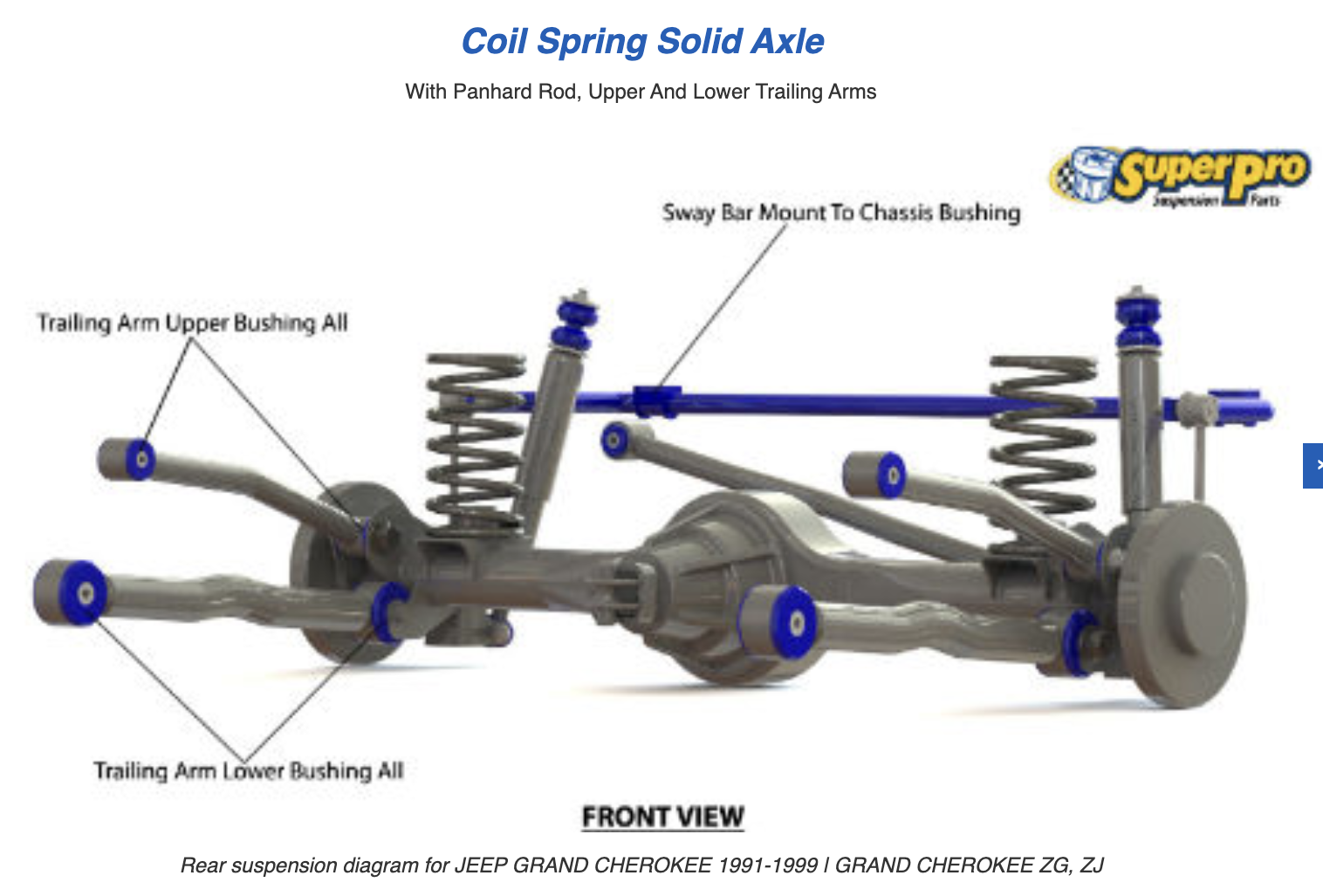
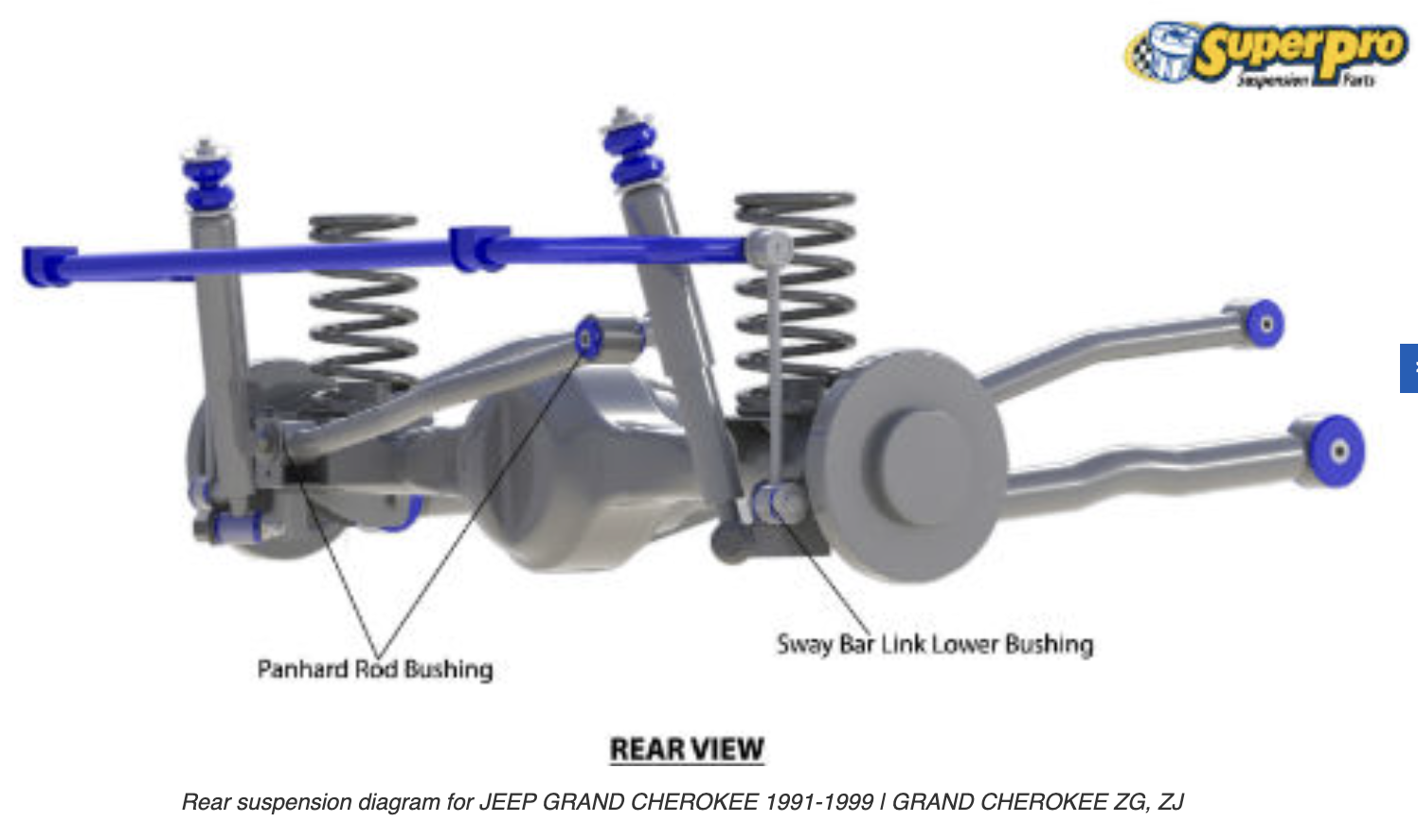
In fact, the Jeep ZJ would go on to be the only Jeep ever to pair a relatively lightweight and stiff unibody design with a fully coil-sprung five-link suspension front and rear. (Some call it a four-link, ignoring the track bar, which is also called a panhard rod). Here you can see the ZJ’s excellent suspension setup, courtesy of suspension seller Super Pro:
You’ll notice two lower control arms (or trailing arms), which are there to place the axle in the longitudinal direction (i.e. fore-aft), you’ll notice a track bar/panhard bar that places the axle in the lateral direction, and you’ll see two upper control arms/trailing arms to prevent axle wrap (i.e. the axle twisting) when braking or acceleration.
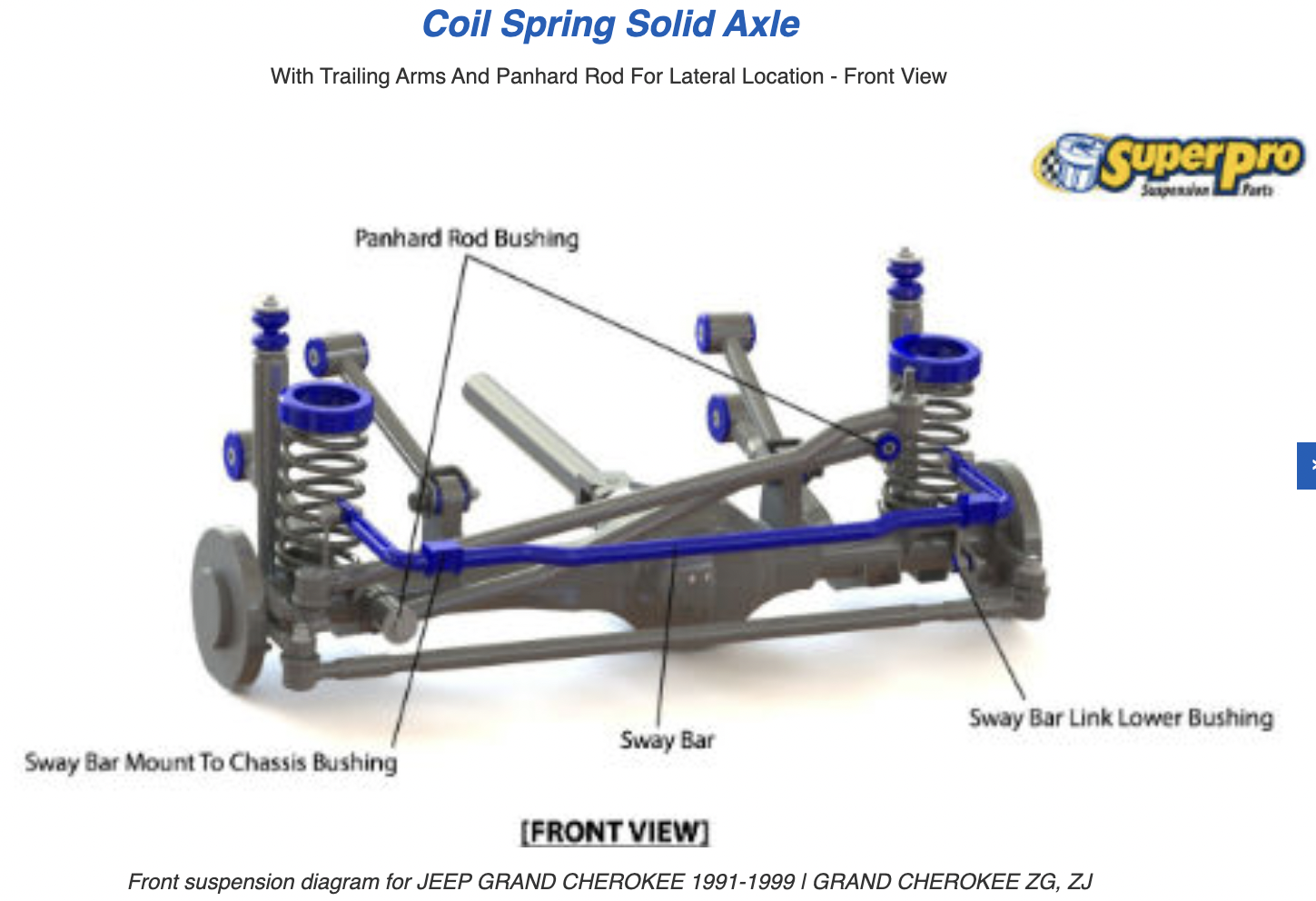
Here you can see that this is essentially the front suspension, but flipped around:
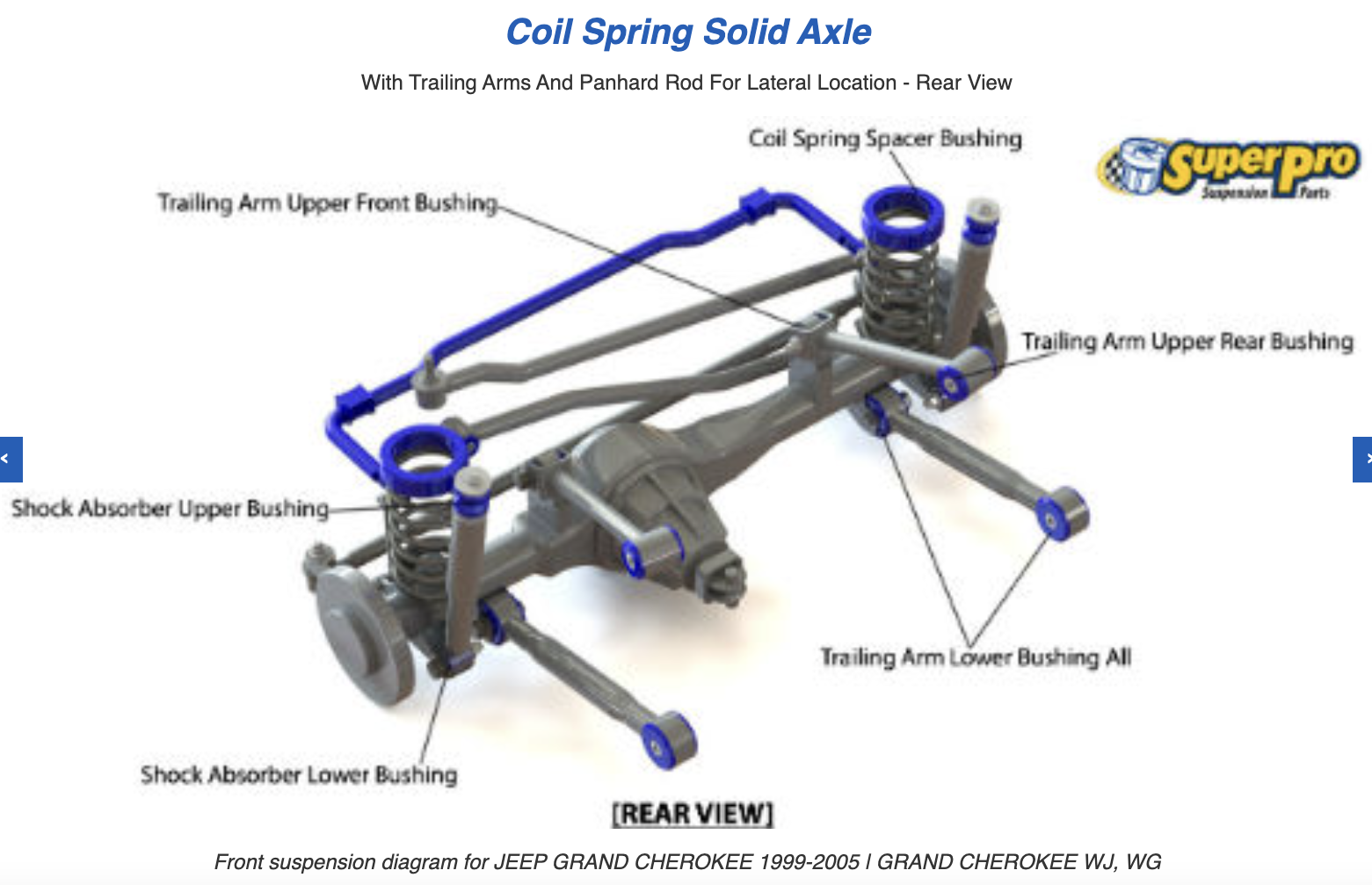
This sensational suspension design — which offers a ratio of comfort:suspension articulation never before seen in a dual solid axle vehicle — would never be seen again on a unibody Jeep, though the ZJ’s successor, the WJ, offered a strange variant of the design.
It should be clear based on that article, and on those photos, why a track bar (panhard bar) — which connects the axle to the frame — is so important. It’s what keeps each axle from wanting to move side to side when taking turns. The fore-aft oriented control arms only keep the axle from moving fore-aft/twisting, making the track bar’s job absolutely critical — so critical, in fact, that when Jeep found that its Wrangler JL’s track bar mount brackets were failing, it issued a recall and stop-sale to prevent a “vehicle crash without prior warning.”
How The Failure Happened
So that brings us back to Utah native Fenn, a general contractor, real estate agent, and “vice president of training and education for a SAS company that provides software tools to real estate professionals.”

“Several years ago, a friend took me to Moab, and we went rock crawling for the first time. It was something that I’d always wanted to do and just never had the opportunity, but that first trip hooked me,” he told me. “My first Jeep was a 1995 Jeep ZJ that I purchased for my son when he got his driver’s license. I purchased it from a family member who was the original owner. It was so clean that we decided it’s probably not one that we wanted to take off-road.”
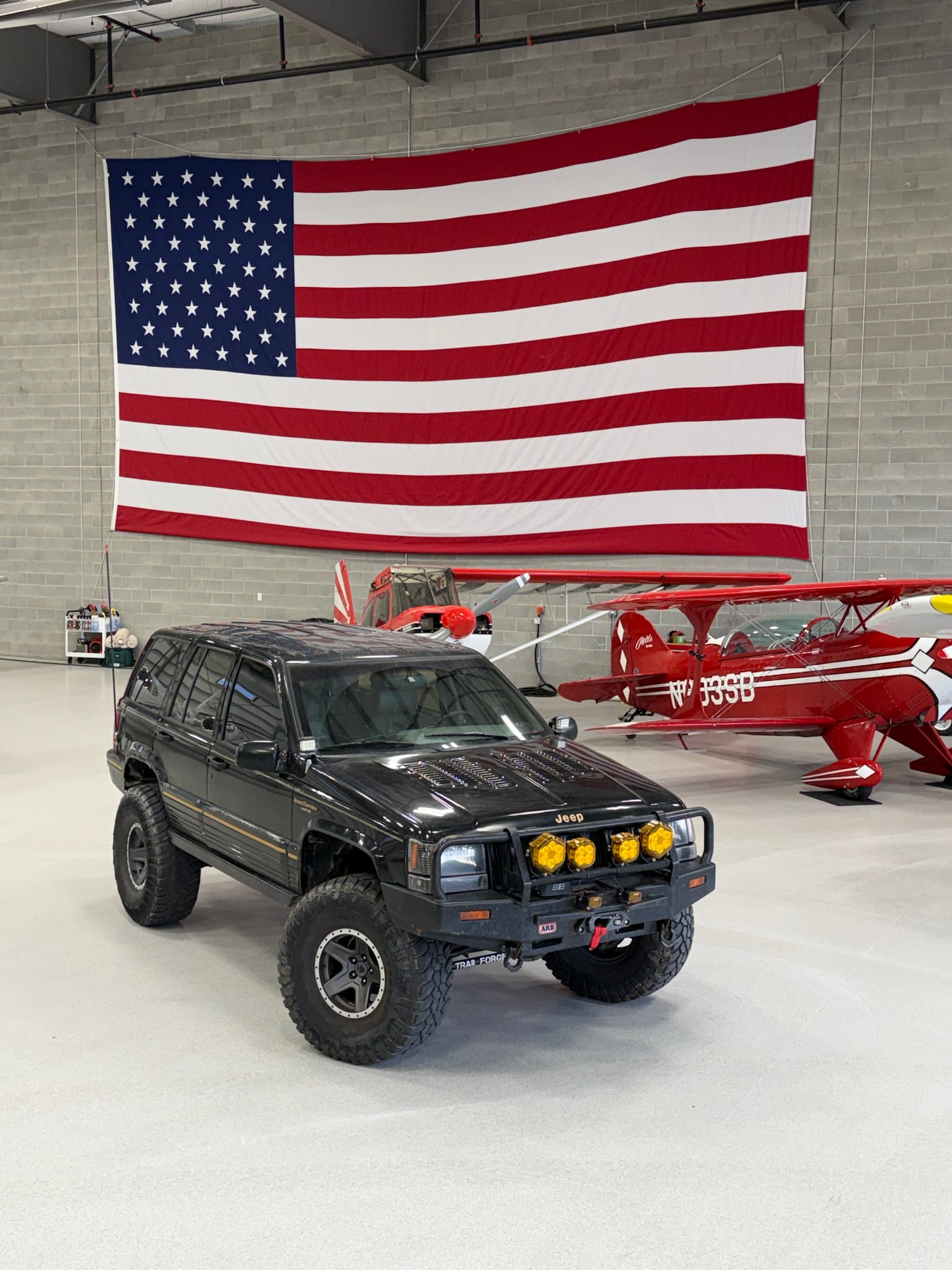
This got Fenn involved in the ZJ Grand Cherokee community, where he found a tastefully modded 1994 V8 Grand Cherokee, with a 3.5-inch lift and stock axle housings with 4:56 gearing, 30-spline chromoly shafts, and a rear Eaton E-locker. On the ends of those axles, Fenn added 35-inch mud-terrain tires, plus he bolted on rock sliders, a second battery, a cowl intake, one-ton steering, and much more.
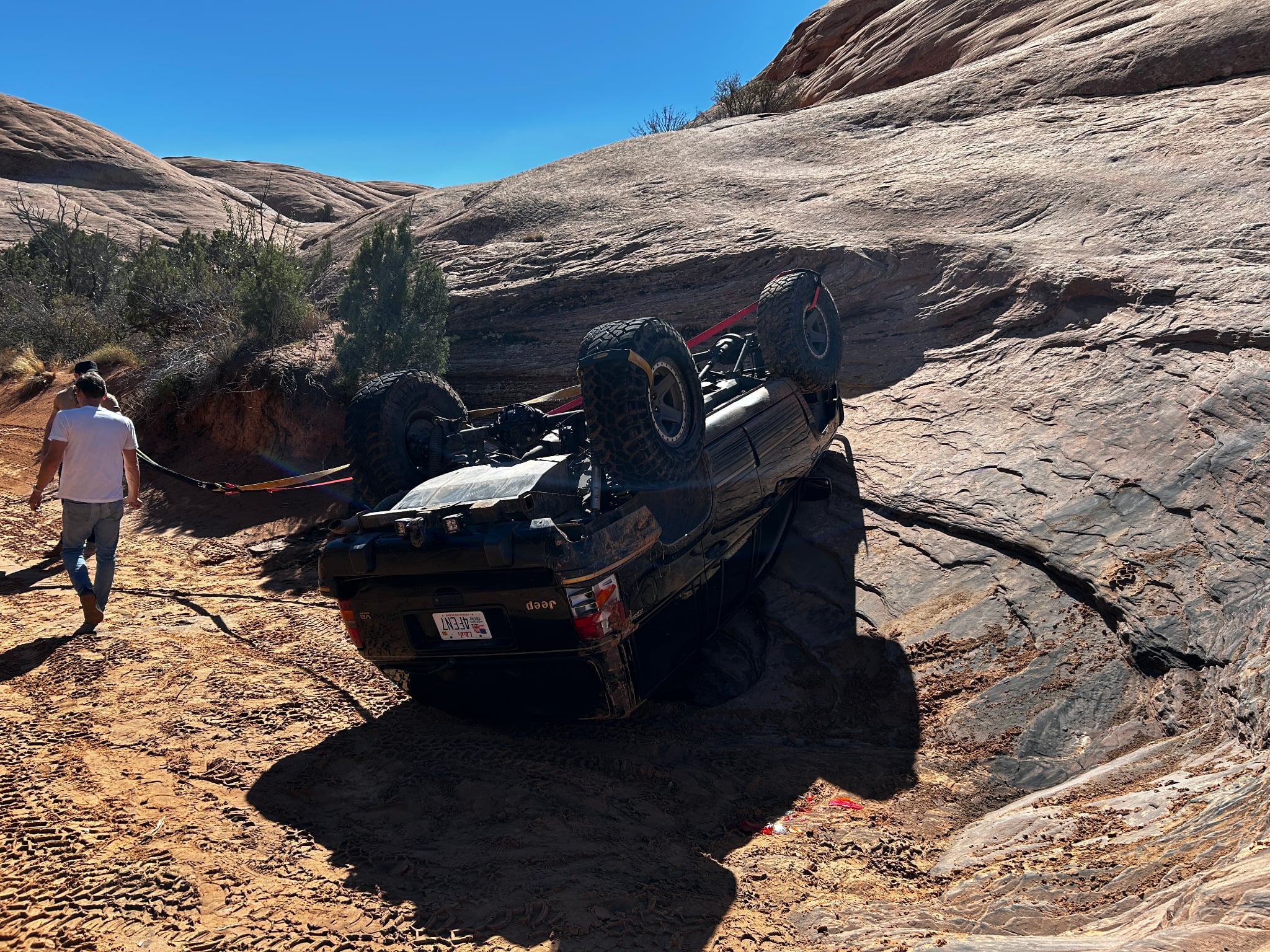
What he built is a beast that he off-roads hard, which is why he was comfortable joining some friends on this Labor Day Moab trip even though those friends were rocking Jeep Wrangler JKs on 37-inch tires. “The first trail we did while we were there was Behind the Rocks, which has a few pretty significant obstacles, including Rubble Hill, High Dive, and White Knuckle Hill,” Fenn told me. “I was able to climb Rubble Hill and make it down White Knuckle Hill, but opted to take the bypass around High Dive because I don’t think I have the clearance to make it down that without rolling. I rolled this Jeep last October on Hell’s Revenge and didn’t want to spend another trip with it upside down.”
Here’s a look at that roll:
“The break happened on Poison Spider, which is a moderately difficult trail in Moab, but one of my favorites.” [Ed Note: This is a very tough trail to the average off-roader. -DT]. “Once you get through the part of the trail known as the waterfalls, I started hearing a clunk from the rear end that I immediately knew was the sound of something that had broken. At such slow speeds on these trails, I didn’t feel anything from the cab, but the
noise was a solid indicator that something had broken.”
A Serious Failure, An Unserious (But Functional) Repair
Fenn crawled under his ZJ and “immediately noticed that the drivers side upper control arm bracket, which also includes the rear track bar bracket on the axle, had torn clean off the rear axle.”
As Fenn notes, this isn’t uncommon on the Dana 35 rear axle. “I wheel this fairly hard, so I’m sure that it had just fatigued over time,” he guesses. “The stock brackets are 1/8-inch steel, and being a 32-year-old rig without any reinforcement finally took its toll.”
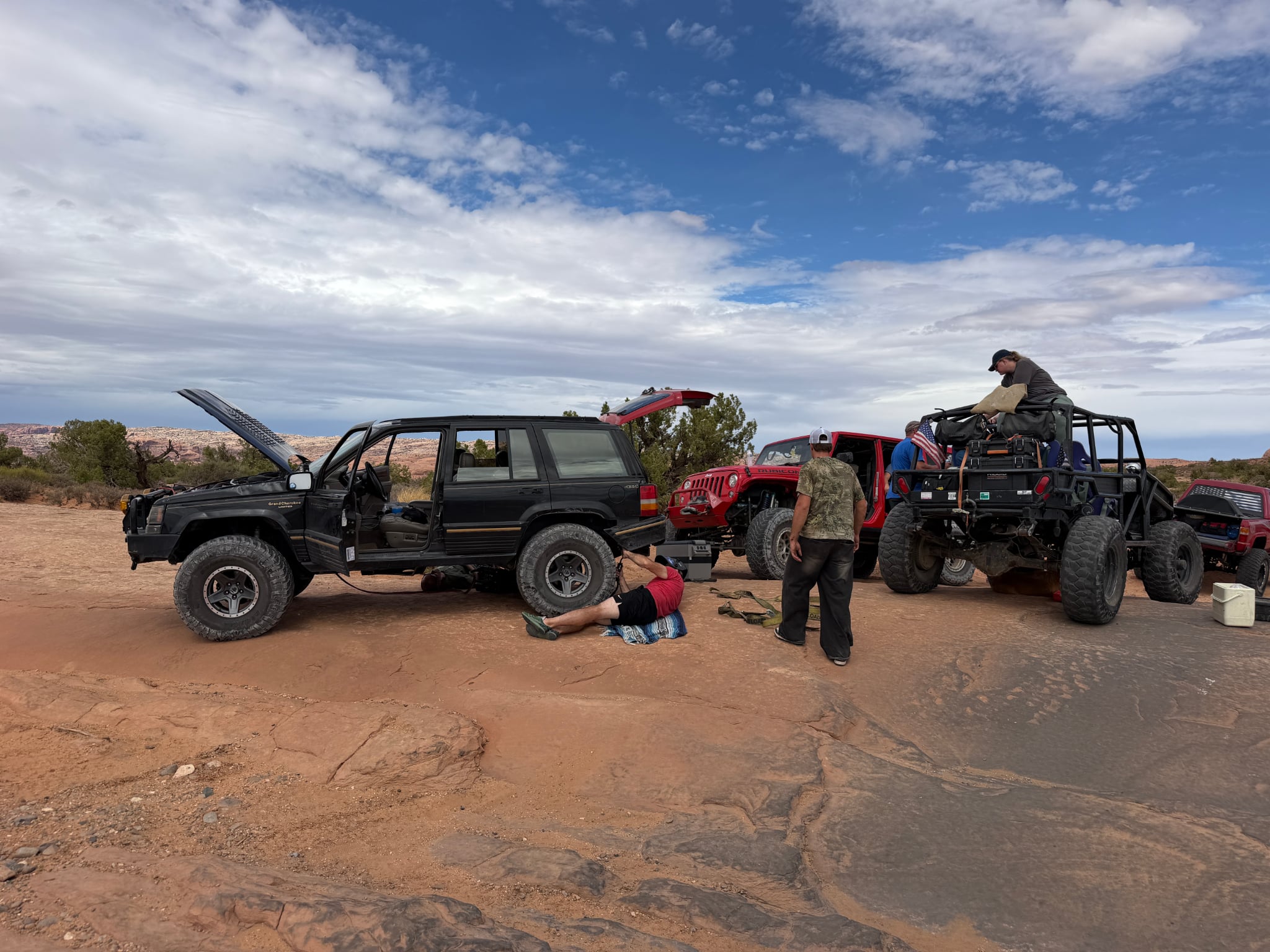
Fenn had to figure out how to get back to the road and ended up getting lucky, as someone on the trail had a portable welder. “We started by attempting to strap the bracket for the upper control arm and the track bar to the axle using a combination of tie wire and ratchet straps. One thing I love about the off-road community is that if you’re stuck on the trail, people are always willing to stop and lend a hand. There was a group of four or five rigs that came by and asked if we needed help. We asked if they had a portable welder, and luckily one of the rigs had one.”
And while Fenn managed to connect that welder to the ZJ’s dual-battery setup and actually weld the control arm back to the axle, there were bigger issues.

“What we didn’t realize is that the welds for the track bar mount were also fatigued and cracked, so our focus with the welder was spent on the control arm bracket. After we welded that back together, we made our way back down Poison Spider and back down into Moab, and made it back to our Airbnb without any issue.”
That’s when problems arose again.
“The next day, on our drive home, I noticed once we got up to highway speeds that there was far more swaying, and the Jeep was walking all over the road. I knew that there was still something wrong, so I pulled over and crawled underneath again. I noticed that the
welds on the track bar bracket had finally given way, so that rear axle was simply walking back and forth underneath the Jeep and causing me to walk all over the road.”
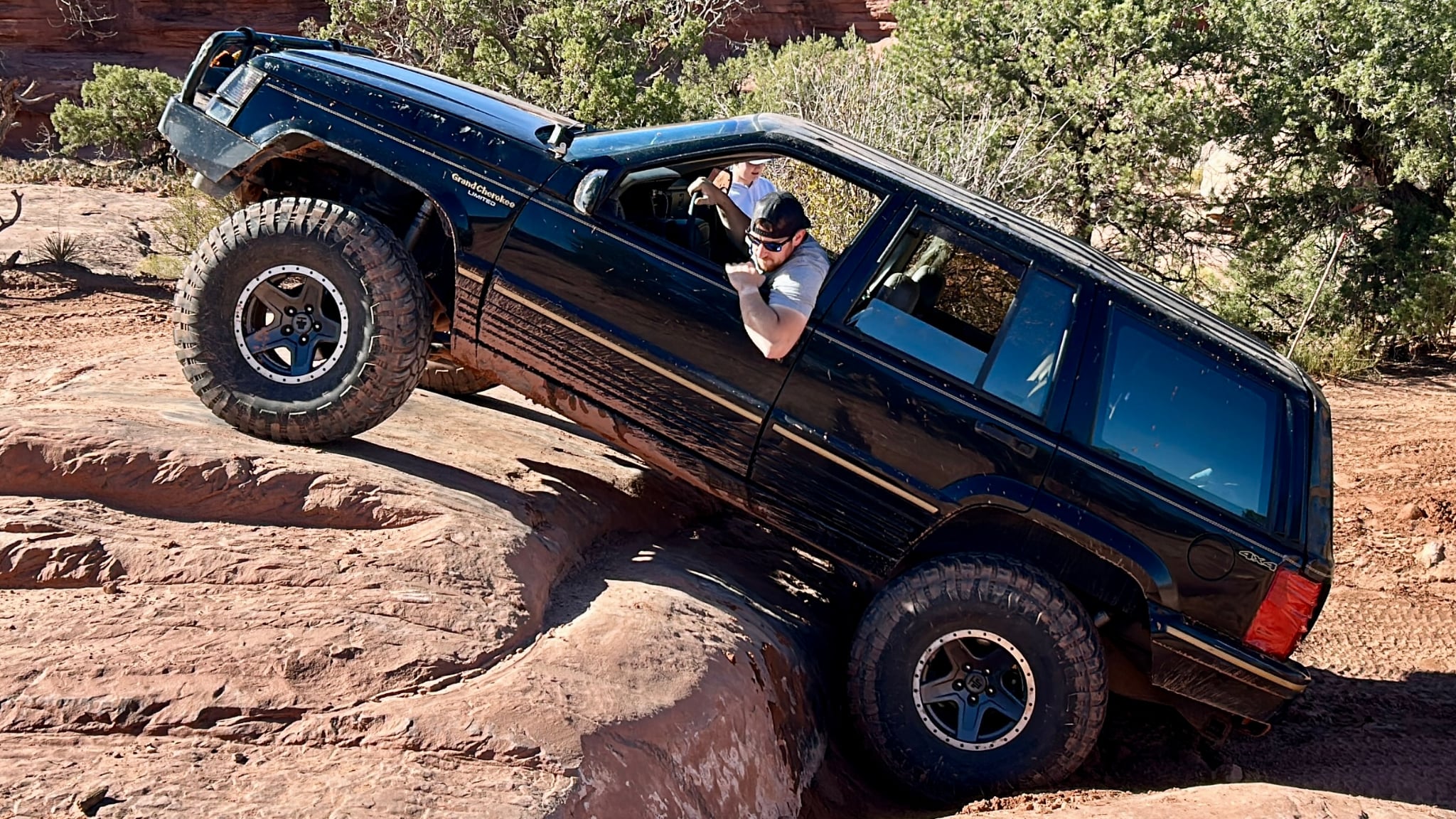
Fenn, who considers himself a handy guy when it comes to finding scrappy solutions, knew what he had to do: Instead of worrying about the track bar bracket, he was going to focus on the track bar bracket’s job: Keeping the axle centered under the vehicle, especially when under lateral loads (while steering). “The thought came to mind that if I could triangulate something that would hold it in place, then I could probably make it home. In other words, I figured that if I could create my own triangulated four-link suspension, then at least I’d be able to make it the three-hour drive home.”
By “triangulate,” Fenn is referring to the concept of building a triangle whose two sides (i.e. not the base of a triangle) can work to restrict motion. “I didn’t have anything stiff or rigid…in the Jeep, but I did have ratchet straps….The first thing I did was connect a ratchet strap from the passenger side of the frame, where the upper control arm mounts to the frame, and run the ratchet strap down to the lower control arm bracket mount on the passenger side of the axle. As I tightened that, I was able to pull the body over far enough so that it was centered, and then ran another ratchet strap in the opposite direction from the passenger side of the frame to the driver’s side axle. Tightening those two things down meant that I effectively triangulated my axle under the body.”
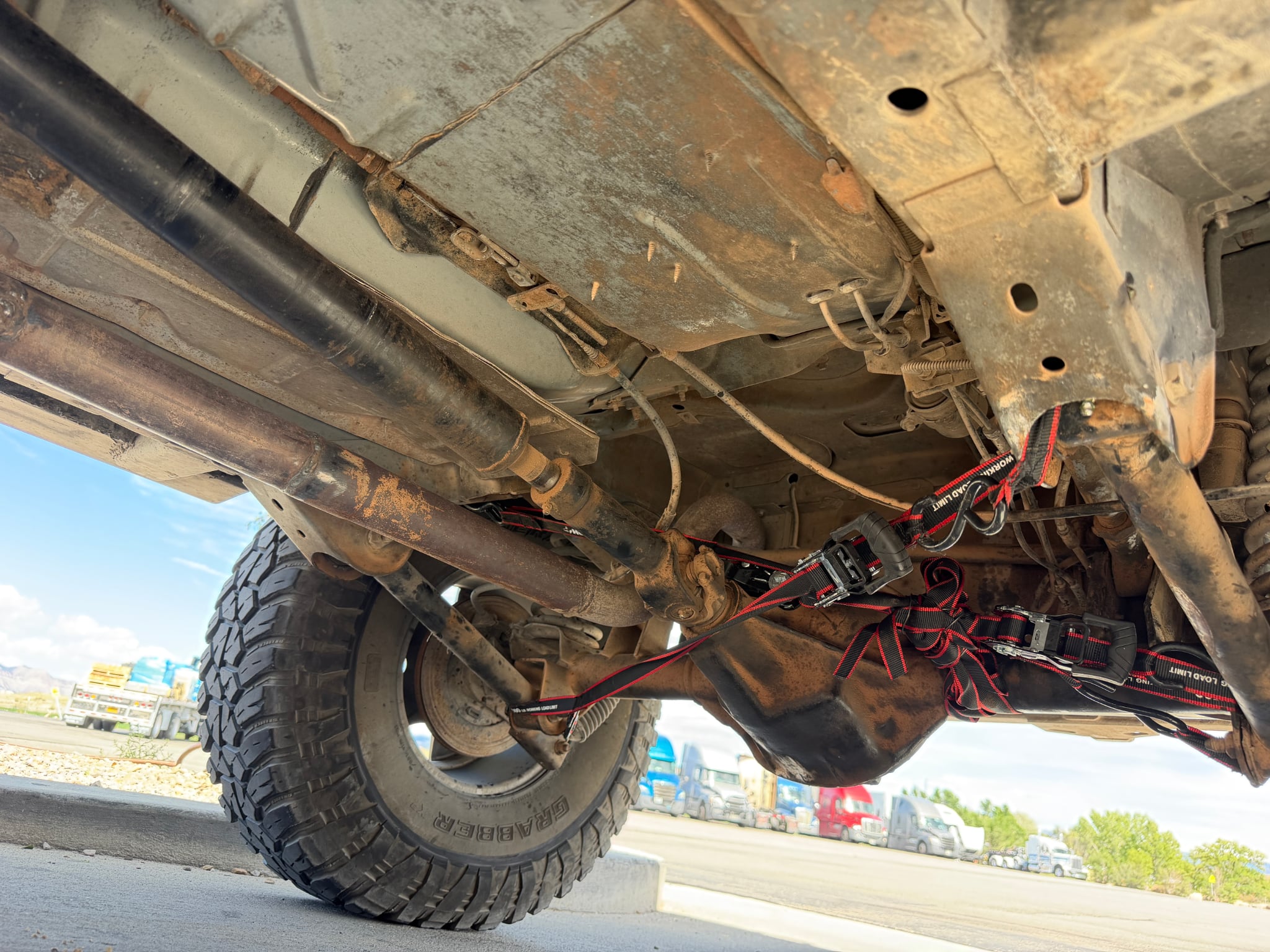
It was a clever (if sketchy) solution, and routing it so that the straps didn’t melt against the exhaust or abrade against the driveshaft was tricky. In time, though, Fenn figured out a ratchet strap routing that seemed OK. “My Jeep drives pretty comfortably at 70 or 75, but I opted for a bit slower speed just in case and poked along at about 60 mph. I was pleasantly surprised at how solid the ride was the rest of the way home. I made sure not to take any corners or bumps too harshly, just in case, but I was fortunate enough to make it home without any other incident.”
As for the future, Fenn plans to fabricate a long-arm suspension setup for the front and rear of the Jeep. “Part of that project will be reinforcing all of the stock bracketry on the axles,” he said, though in the end he’s likely to just swap out the axles for something beefier. “Eventually, I’d like to put 1-ton axles and 40-inch tires underneath. I’m planning the current suspension upgrades with that in mind. All of the bracketry around my frame will
be built strong enough to handle those 1-ton axles and larger tires.”
“I’m sure I’ll buy other Jeeps and other rigs over the years, but this one is really my first off-road rig, so I’ll just keep fixing it and upgrading it till the day I die.”
All Images: Tyler Fenn


Scary! I wonder how many cars with similar ‘repairs’ I encounter during my commute. Very rarely I’ll see a vehicle (almost always a battered old work van) with obvious suspension issues.
Trail bodges happen quite frequently. Nissan dude tried to wheel with a mostly stock front IFS and lost the whole front spring assembly, but a jack and a large branch brought it back to an adequate ride height. he drove that like that home, probably 80 miles, even though we all offered one of our trailers.
I am kind of impressed he took a dana 35 into moab with 35 inch tires. Not notoriously reliable axles right there.
I love the ingenuity but I have those exact straps and they fray if I so much as look at them wrong. I’m so glad they made it home safely.
Clever solution and great article. My son is also named Fen, but without that extra consonent.
David has a history of letting cheapness take priority over safety. Please do not expect to find any appropriate criticism of the safety of this article. Cheapness is a disease with externalities
https://www.theautopian.com/what-it-was-like-driving-my-worn-out-1966-ford-mustang-2500-miles-from-detroit-to-los-angeles/
“To help describe what I was feeling, imagine a car whose front two tires are pointed inboard towards one another (the right wheel is pointed left, the left wheel is pointed right). That vehicle, on smooth surfaces with uniform traction, will track straight. But, as soon as one tire gets more grip than the other, the vehicle will want to turn wherever that tire is pointed. So, oftentimes I’d hit a bump or a bit of gravel with my right tire, and the vehicle would then dart towards the shoulder, requiring me to then steer left. Of course, me steering left then made the car’s body want to roll right, putting more weight on the right side, increasing the grip there, so the car then wanted to pull left (where the right tire was pointing). So then I’d correct, and I’d get caught in these cycles of the car wanting to turn left then right then left then right; eventually, I’d get it under control, but it made for a long, long 3,200 mile road trip.”
To be fair neither of them hit anything so that is a 100% safety record.
What Fourmotioneer is describing is the feeling of a vehicle with improper alignment — something many Americans drive regularly. I, however, am meticulous about not only inspecting my vehicles, but also paying attention to sounds and vibrations that might spell a mechanical issue.
I’ve driven some of the crustiest, rustiest cars on the planet, and I have a 100% safety record, thanks mostly to a technical background that allows me to make sound decisions. I do joke about my janky vehicles, and that has led some folks to mistake my humor for lackadaisicalness, but the Roadkill guys and Top Gear guys got the same critique, so I’m in good company.
As for the ratchet straps in this story? As I noted in the piece: it works, but yeah, it’s sketchy.
I would much rather be around a careful driver who knows something is wrong than someone not paying attention in the first place in a mechanically perfect vehicle.
This is something I try not to think too much about. I inspect my vehicles almost weekly; the average person inspects their vehicles…never. Gulp!
I argue survival bias.
lol. (But also, my junkers have made it through some of the most thorough inspections on the globe — Germany’s TUV and Australia’s state-wide safety inspection. Even the POStal Jeep got inspected by a tech in Detroit before my trip; passed with flying colors!)
LOL unserious and full of logical fallacies. Nope
Classic Fourmotioneer 😉
60mph on that! WTF. That’s just dangerous as hell.
This guy is a jackass for driving that on a public road. His fix would be good enough to get it off a trail but taking it on the road in that condition was completely disregarding the safety of every other person he got near.
This kind of shit really pisses me off.
Yeah that is crazy if he would have just gotten off the trail and maybe just limped along the side of the road going 15-20 to get to a shop/trailer then that would have been fine but to be driving this death trap at highway speeds is just crazy. I guess the only good thing is he was at MOAB so a lot of long stretches of road where you might not see a soul for miles.
Agree. If you can’t pay to play then play something you can afford. This needed to be towed the minute it got out to main roads.
Putting others in danger for your cheapness isn’t okay.
Years ago I was attending the annual Miatas At The Gap (aka the Tail of the Dragon… MATG NOT M.A.G.A.) along with about 1200 other Miataphiles that year. About 1/3 up the Dragon there’s a pull off near the top where you can view the Smokies (the Dam Overlook). It’s pretty, and also pretty common to stop there for a spell and hang out with others running the Gap.
So early Saturday I was there in my 2004 MSM (MazdaSpeed Miata, the one with the factory turbo and 17″ wheels), chatting it up with about 20 other Miatai off on the side of the road parking spots when we hear this screaming Miata coming up the road…
An old NA come FLYING around a turn then brakes slam as he kills his engine and pull off on the side and jumps out and pops his hood. It’s a young lad and he’s visibly shaking. We all crowd around “What’s up Dude?” He blurts out “My gas pedal is stuck!”
Now the Tail of the Dragon is 318 (all sharp and nearly all blind) turns in 11 miles U.S. 129 between TN and NC. Some call it a road, other’s call it a track but regardless it’s unforgiving. On one side there’s solid mountain rock, the other is drop off into the tops of trees. No guard rails. It’s an absolute blast to drive with sprit in the proper motor car (it really is Miata heaven!), as long as you keep it on your side of the double-yellow and drive within your limits. Absolutely NOT the road you want to have a stuck throttle on!
… so we’re high in the Smokies, no cell coverage, no town within 20 miles, and he’s afraid to get back into his car.
I reach in and grab the throttle at the intake and give it a twist and sure enough, it’s got a problem, His old throttle cable is fraying and jamming up. It still moves the throttle plate, but it’s got enough friction that when you press down on the gas, you get ALL the GO, but the spring isn’t able to pull it back.
,..that’s when I walk back to the trunk of my 2004 MazdaSpeed with those 17″ wheels. See my Miata came with a factory spare, but IF you have a flat and take the spare out the trunk and put it on your Mazdaspeed, you WON’T be able to fit the OEM 17″ flat tire in the trunk! Only the little space-saver spare fits. That’s why I kept a couple of bungee cords in the trunk at all times in case I needed to wedge a 17″ flat in there and bring the trunk lid down, and it was a cheap-ass bungee cord that saved the day.
I hooked it to the throttle in the NA, wrapped it around his strut brace a few times, got in the car and tried the gas pedal, It WORKED. Harder to press, but at least it came back.
I told him he could have the bungee if he promised not to sue me if it didn’t work and he died on the Dragon. With that I also begged him to drive back home and get a proper replacement throttle cable and to NOT rely on the my bungee cord fix.
He thanked me and took off down the mountain, a bit slower this time. I don’t know if he took my advice or just stayed and played all weekend, but I didn’t hear of anyone launching themselves off the Dragon while I was there, so I guess he survived.
All hail the trunk bungee!!!!
“vice president of training and education for a SAS company that provides software tools to real estate professionals.”
Not to be pedantic, but SAS is “solid axle swap” SaaS is “software as a service”.
I thought this was going to be the best “I broke it, but fixing it is what I do” story ever.
Could also be SAS like the statistical modeling language. You never know.
That SAS is going the way of the dodo bird. Everything at my employer has moved to R.
Nope. SAS means Steering Angle Sensor.
SAS is Scandinavian Airline System, the national carrier for Denmark, Norway, and Sweden.
I immediately thought of the UK “Special Air Service”…
shoulda sprung for AAA premier especially if you’re playing with old cars, you get 5 tows a year up to 100 miles, and 1 of them up to 200 miles.
“The Jeep Grand Cherokee ZJ was actually a pioneer in off-road suspension design, offering the very first five-link coil-sprung solid rear axle ever”
Lada Niva had that in 1977.
So did the 1968 Fiat 124. I’ll adjust that to say it was the first ever to do it on both axles. Thank you for the feedback!
-left the straps in place for two years and sold it on to somebody else – there finished the story
Nothing is more permanent that a temporary repair.
Stellantis accountants taking notes.
I have done this to get off the trail. I would never, ever get onto a populated road at any speed with it. Cannot endorse.
I was going to say something similar. This isn’t some poor guy who can barely afford his hobby. He should have trailered it home.
If you can’t afford to properly transport your toys, you can’t afford them.
I didn’t mean to say this would be acceptable behavior if he couldn’t afford to have it towed, just that I would understand it more.
I don’t condone it either, but in my youth, I did tow a broken down XJ 100 miles with a tow strap. (Down I-75 in Michigan).
I was young!
Didn’t you test drive your home made CJ sitting on top of a milk crate.
Yes, and it was awesome.
Bingo. I wheel hard, but I have never taken a fix like this on the road – it was to get me back to the trail head and nothing more. Driving at highway speeds like this is unacceptable.
Just reading that he takes an old, lifted Jeep on 35″ tires up to 70+ mph and considers 60 mph as poking along is scary enough. My old XJ when stock was marginal at 75 mph, but with 31″ tires the chassis dynamics get downright frightening over 65 mph. With the even larger tires, 60 mph would be pushing it even when not damaged. I’ve passed plenty of rock crawlers on the highway around Colorado and Moab that are going 50 mph max, they actually understand.
Yup. I ripped a shock bracket off in Moab last time I was there. I found a guy in town who welded it back on that evening for like $50. I wouldn’t have left town without getting that fixed.
Yeah. I love this as an emergency fix to get back to a road. It’s really cool.
But then getting on a highway… That’s not a risk anyone else out there signed up for.
Even Victoria Scott towed her Hiace from the first service station she could get to once she got down off the canyon. And she had more creative materials for her solution. To a broken undercarriage https://www.thedrive.com/news/41563/disaster-on-cuyama-peak-how-i-nearly-destroyed-my-van-alone-in-the-wilderness This series is highly engaging even as it reveals much about her mental health which may be uncomfortable for some – recommended.
This is an excellent solution to get you to a welder in the next town. This is a fairly dangerous way to travel 3hrs at 60mph surrounded by civilians.
Of course, there are vehicles in far more dangerous states than this, so you need yours to be in good shape and ready to avoid them.
Clever, I admire the ability to secure the axle long enough to get home, but I question both the wisdom and ethics of doing so. By “150 miles” I’m assuming he lives along the Wasatch Front urban area and had to drive highways 191 and 6 to get there, both of which are busy undivided highways with notorious fatality rates.
But then, those vehicles which aren’t held together by ratchet straps are being driven with a level of impatience, impulse control and even malice which probably makes this Jeep one of the safer vehicles on that route simply because its driver is paying attention and not trying to pass seven cars and a semi over a double yellow at 100mph.
US6 pre-facelift was one of the most dangerous highways in the US.
Now that it’s got passing lanes at times, it’s only moderately dangerous.
But it’s still not a place I’d want to go with dodgy suspension, just because it mixes all the hazards in one convenient location: a curvy road (fine), drivers who are unaccustomed to driving curvy roads coming from I70 (less awesome), those same drivers who will mash the brakes every time they see headlights because they’re not used to driving curvy, undivided highways, and let’s not forget the semi’s that use it to cut I70 to I15 or the… shall we say, excessively imbibing population of the greater Wellington/Helper/Price corridor to add a certain spiciness to the mix.
For Mr. Fenn, like… lots of people with lots of trailers in Utah, and for the price of a six pack you can usually find some help.
There’s a Mark Watney quote that seems appropriate here. Not the one about if you solve enough problems you get to go home – the one about having to science the shit out this.
Clever solution in an emergency.
I like it.
The JB welded manual shifter in my old Volvo salutes you.
i dont find ‘fun’ driving trails that damage my vehicle.
4 wheel drive ! ?
From the article, looks like he has a locked rear and open front, so 3 wheels can be powered. That’s likely why it looks like the front driver isn’t getting power in the video.
And this one in a V8, which means fulltime 4WD in ZJ’s. The early (pre-1996) V8 ZJ’s had a less-than-ideal t-case that did not have the ability to lock the center diff. In a stock ZJ with an open rear, in certain situations ALL the power could be sent to just one wheel.
I had a 97 ZJ with the fulltime case, in 4Hi the center diff was open, in 4low the center diff automatically locked.
And we share the road with these broken vehicles bodged together.
It’s terrifying what can be around us on the road. I am a big fan of Bus Grease Monkey on YouTube – he recently got in a 40Klb Prevost bus conversion that had ONE, count it, ONE fully working brake. That is absolutely terrifying. And it got driven some distance to get to his shop.
Call AAA and get the POS towed home!
Bus Gease Monkey is very good, and so is The Motorcoach Technician.
Yes! I have started watching his stuff too. He’s more into the modern stuff, which is interesting. BGM mostly works on a lot of the stuff I drove 30 years ago, so interesting to see what’s changed.