

A few years back, Tesla became one of the first big-name manufacturers to adopt a new type of assembly process, which it called “gigacasting.” This assembly process, also known as megacasting or unicasting, uses large casting machines to create unibodies—the “skeleton” of the car—in a handful of large, single segments, rather than through hundreds of smaller pieces.
The system, designed to lower assembly costs, is the basis for the chassis of the Model Y, Tesla’s most popular car (and for a few years, the best-selling car on the planet). Ford, in its attempt to make a modular EV architecture that’ll include a $30,000 electric pickup, is adopting a similar approach.


For a while, people worried whether small crashes or other damage to these gigacast parts would increase repair costs, since one large component would have to be replaced instead of just a smaller piece, where the damage is contained. But the data shows repair costs are usually in line with standard unibody cars, if not cheaper.
What else is going on in the world of cars? Following the issue of a stop-sale earlier this week, Hyundai has issued a recall for over 60,000 Palisades after the power-folding rear seats killed a two-year-old girl. Plus, Rivian and Uber are teaming up to build a bunch of Robotaxis, and Rolls-Royce promises it’ll keep building V12s past the year 2030.
Let’s get into it.
Ford Expects Repair Costs To Go Down, Not Up, With Unicasting
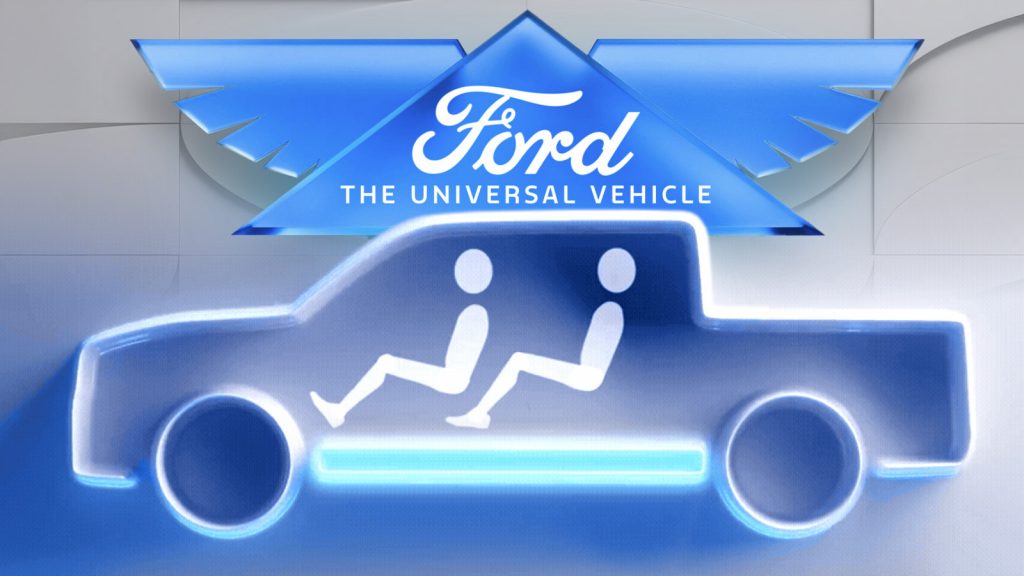
The Autopian has covered Ford’s revolutionary new EV pickup quite a bit, but here’s the short version: The company plans to build its $30,000 electric truck using three subassemblies. The two front and rear assemblies will be based on large aluminum unicastings, allowing them to travel down their own assembly lines. Eventually, they’re joined together by a third subassembly, forming the basis for the vehicle.
Back when the Model Y was new, repair shops took an “all-or-nothing” approach to repairing pieces of the gigacast unibody. According to InsideEVs, bodywork people would simply replace the entire damaged piece, which would be costly and time-consuming.
But as time has gone on, repair shops have figured out ways to repair gigacast pieces of metal or replace only portions that are damaged. Ford told Automotive News that early research indicates vehicles made with unicastings are now actually less expensive to fix, so long as they’re designed to be repaired from the start.
“What we quickly found is that actually, it’s easier to repair a vehicle that has unicastings,” Alan Clarke, Ford’s executive director of advanced electric vehicle development, told reporters. “When you make it a constraint — that it needs to be repairable at specific speeds, because we see customers actually having accidents at those speeds — it actually creates a bunch of creativity with engineers who figure out the easiest way to repair it, and it ultimately becomes an advantage.”
It’s not just Ford claiming unicasting is cheaper for repairs, either. Autonews references a study from UK-based firm Thatcham Research, which discovered that, on average, a Model Y in need of a partial gigacast replacement costs way less than a similar repair on a Model 3, which uses a traditional unibody structure with no gigacast parts. From the study:
Comparative analysis revealed that the Model Y’s mega cast construction delivered consistent cost advantages across multiple scenarios. Partial replacements cost £2,167 less than the Model 3’s traditional multi-part steel rear sub-assembly construction, while full replacements saved £519. Similar patterns emerged when comparing against other manufacturers’ vehicles, with the Model Y demonstrating lower repair costs than other models, including the Mercedes EQE, Hyundai IONIQ 5, and several internal combustion engine vehicles.
That £2,167 works out to nearly three grand in American dollars, which is not chump change. Those kinds of savings mean more money in consumers’ pockets, not just due to direct repair costs, but thanks to lower insurance costs, since insurance companies have to pay less to get the car fixed.

Those cost differences aren’t just because repair shops have figured out ways to repair or partially fix unicast parts on their own. The parts Tesla supplies for gigacast repairs make things incredibly easy for body shops:
Darren Bright, Thatcham’s principal engineer for automotive repair, told Automotive News that repair parts from Tesla have slots on the end designed to easily slide into the casting and be attached with adhesive, structural rivets and bolts.
“There’s no welding involved,” Bright said in an interview, making fixes simpler and faster.
Ford, then, is smartly copying Tesla’s homework for everyone’s benefit. From Autonews:
A Ford spokesperson, in a statement, said the upcoming electric pickup will be engineered similarly.
“We designed the vehicle to localize damage to specific areas for low and moderate speed collisions — the most common incidents on the road today,” the spokesperson said. “Although our unicastings are single structures, they are designed to be modular for repairability. We are accomplishing this with predefined cut zones to decrease variability in repairs.”
What does a “predefined cut zone” look like? Well, according to Ford, it’s basically like a stencil you’d see your kindergarten-age child playing with after school. From the factory, these unicastings will have pre-drawn lines where repair shops can slice out damaged pieces and replace them with new factory-supplied parts.
This makes things easier for body shops, not only because they don’t have to decide where to cut, but because it standardizes the repair process, meaning fewer unique replacement parts need to be ordered or fabricated from scratch. The repeatability means shops aren’t doing something totally new each time, either, further driving down the time needed to perform the repair.
If the casting is damaged, they’re designed to be partially repaired and replaced, in many cases more simply than on traditionally built vehicles.
“I think we often forget that repairing a sheet-metal vehicle is really challenging after a small speed collision,” said Ford’s Clarke.
In contrast, he said, a vehicle made with large castings “literally has a dotted line of where to cut, and you just cut it and the manufacturer offers the repair part and you glue it in place.”
It’s nice to know that if someone rear-ends me in my electric Ford truck, I won’t have to replace an entire third of the vehicle.
True To Its Word, Hyundai Recalls Palisades After Folding Seats Kill A 2-Year-Old
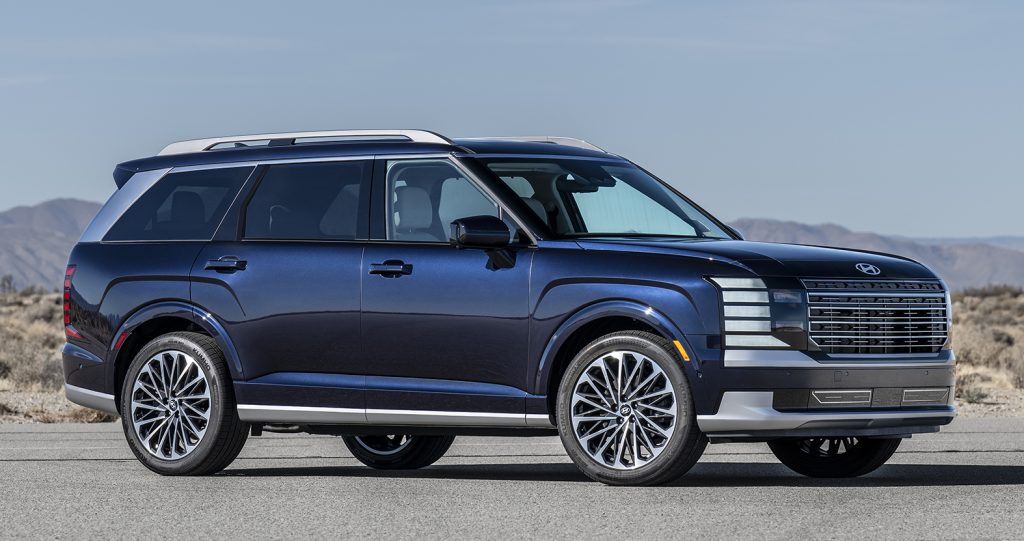
On Monday, Hyundai ordered dealers to stop selling its three-row 2026 Palisade SUVs equipped with power-folding second- and third-row seats after it learned a two-year-old girl in Ohio was killed by one of the seats earlier this month. That day, it promised it would issue a recall for the affected cars—all either Limited or Calligraphy trims—that would include a software update as an interim fix.
Today, that recall has been made official. The report reveals that, in addition to the complaints highlighted on the NHTSA’s site before the child’s death, reports were coming in about problems with the seats from as far back as August 2025. Hyundai was already investigating the potential dangers of the seat for months leading up to the March fatality. It’s not a great look.
As for a permanent fix, Hyundai says it’s “still in development.” It’s urging 61,093 owners to exercise caution when using the power-folding seat functions, and to avoid the “one-touch” function on the second-row seat back, which folds the seats forward for easy access to the third row, altogether. In the meantime, it’s going to offer up some new software, either through a dealership visit or over the air. From the recall doc:
As an interim action to mitigate the risk of injury, Hyundai plans to notify owners to bring their vehicles in for a software update or, for eligible vehicles whose owners have enrolled in Hyundai Bluelink, to complete an over-the-air software update. Additional information will be provided when available. When made available, all remedies will be offered at no cost to owners of affected vehicles, regardless of whether the affected vehicles are still covered under Hyundai’s New Vehicle Limited Warranty. Additionally, Hyundai will provide owners of affected vehicles reimbursement for out-of-pocket expenses incurred to obtain a remedy for the recall condition in accordance with the reimbursement plan submitted to NHTSA on March 2, 2026.
If I had a Palisade that fell under this recall, I think I’d probably just pull the fuse to the power seats just to be safe. So long as it doesn’t affect any other safety features, like airbags, it’d be the most effective solution (until the real fix comes out, anyway).
Your Uber Might Likely Be A Rivian By The End Of The Decade

Uber announced a pretty serious $1.25 billion investment into Rivian yesterday that could see the ridesharing company and its partners purchase up to 50,000 units of its new R2 SUV for autonomous robotaxi use.
The deployment of said robotaxis will happen in two phases, according to Rivian. The first, funded by an initial $300 million investment from Uber, will see the company deploy up to 10,000 autonomous R2s starting in 2028, using Miami and San Francisco as testbeds. Should Rivian achieve “certain autonomous milestones by specific dates,” it’ll get the rest of the funding. By 2030, your closest big city will very likely have Rivian-based Uber robotaxis operating in it. From the release:
Should all milestones be achieved, the companies will have deployed thousands of unsupervised Rivian R2 robotaxis across 25 cities in the US, Canada, and Europe by the end of 2031. The companies also have the option to negotiate the purchase of up to 40,000 more autonomous Rivian R2 vehicles beginning in 2030.
What those milestones are, and when they need to be achieved, isn’t clear. Back in December, Rivian showed off its latest LIDAR-based, Level 4 autonomous driving technology at its “Autonomy & AI Day” event. Back then, Matt wondered why this tech was being introduced on the R2, rather than the more expensive R1. Now that this Uber deal is public, it makes a lot more sense. Whether Rivian can get it all to work is another story. Google’s Waymo has been operating for years now, and it’s still far from perfect. Guess we’ll see.
Rolls-Royce Says V12s Are Here To Stay
Back in 2022, when Rolls-Royce launched its first all-electric production car, the Spectre, then-CEO Torsten Muller-Otvos made a bold declaration: “By the end of 2030 we will no longer be in the business of producing vehicles with internal combustion engines,” he said.
At the time, Rolls expected 20% of sales to immediately go to the Spectre when it was released, and that 80% of the company’s sales would be electric by 2028. Things have obviously changed since then, with demand for EVs and emissions rules softening.
Chris Brownridge, Muller-Otvos’s successor, is of a different, more realistic mind. He says the company is abandoning that 2030 EV goal, and sticking with what customers know and love: 12-cylinder powerplants. From his interview with The Times:
“For every client that loves an electric vehicle there is one who does not,” said Brownridge. “Some clients do want an electric vehicle, we build what is ordered.”
He said Rolls-Royce, owned by the German group BMW and which manufactures 5,600 vehicles a year at its plant in Goodwood, West Sussex, would continue to offer cars with V12 engines.
Brownridge said of the pledge of Muller-Otvos that it was “right at the time” adding: “The legislation has changed. That prediction was based on a different set of circumstances. We recognise some clients would rather have a V12 engine. The V12 is part of our history.”
Seeing as how there are just six manufacturers left that still make V12s for production cars—Aston Martin, Ferrari, Lamborghini, Cosworth (through Gordon Murray Automotive), Mercedes-Benz, and Rolls-Royce—I’m glad Rolls isn’t dropping out any time soon. For a modern Rolls-Royce, a V12 just feels right, anyway.
What I’m Listening To While Writing TMD
Chuck Norris passed away yesterday at the age of 86, and while Walker, Texas Ranger finished airing before I entered 3rd grade in school, the show’s theme song is still somehow baked into my mind.
The Big Question
Do you think unicasting will become mainstream? Should it?
Top graphic image: Ford


If those unicasting repair costs are real world number comps, that’s great and encouraging, though what happens once the vehicle is no longer in production? It’s no small feat for an aftermarket company to purchase the old equipment, move it, set it up, and get it up and running. Warehousing these large parts takes space that costs money unless they build on demand, but I would think the casting equipment is a lot less cost effective when turned on and off. The potential volumes might not be there to make it a profitable endeavor and that’s just for one model (though I would imagine the casting would be designed for as long a production life and use with a high enough number of models as possible). Then again, it might be one of those things where, if designed correctly, if a crash is severe enough to damage the unicasting, a car in a traditional unibody would have also been totaled for cost, something that happens more easily as the car ages. Of course, as a labor of love, someone could still opt to repair the unibody, but is that an option on a unicasting if there are no replacement sections available? Rather unimportant sentimental edge cases aside, it does sound like the compromise of cost vs service is overall falling on the side of the unicasting. I’m interested to see how this goes.
Your concerns mirror mine. The “giant chassis castings enhance repairability” argument seemed dubious once I thought about what the replacement parts chain might be like. I think it’s going to be more like “castings can make repairs simpler and cheaper for common instances of low-speed collisions, but only so long as manufacturers are supporting that vehicle.”
What the carmakers seem to be saying here is that while unicasting was very expensive to develop, making smaller cast subsections and bonding them to the original casting costs less than the former repair method of cutting away sections of sheet metal and welding in new ones. I think the veracity of that idea will depend on how much of the cast structure can be easily repaired, and the answer seems like “pretty much just the outer bits.”
Let’s say you damaged the right front section of your cast chassis and need a new segment that runs two “cut here” marks back. That particular fix will require a part comprising just those two sections, with carefully engineered lugs to mate up with the undamaged portions of the original casting. If that’s the plan, carmakers will have to make and stock a lot of different parts for a lot of combined sections unless they use individual parts for each cutaway area and glue them all together, like sewing up Frankenstein’s monster. The former sounds very tooling- and parts-chain-intensive, and the latter sounds sketchy as hell.
Yeah, the numbers are highly suspicious when taking in the entirety of the chain. Maybe they’re cheaper in the body shop when comparing specific damage repair, but more varied repairs? What about production, storage, transport? Even receiving and moving large sections at the end user are seemingly unaddressed challenges that are being ignored because they’re trying to sell their technology to a populace getting wary of the inability to repair new tech and for that alone, I’m staying in the suspicious camp even if I’m receptive to real world results that mark me as wrong. I’d love to be wrong as, like most other modern tech, we’re getting this shit nobody asked for whether we like it or not and I’d rather hope it isn’t only for the worst or hugely imbalanced with minimal real benefit like most of it has been.
The production of so many permutations of repair segments sounds pricey to me. If making and running molds is expensive, that’s a lot of additional machinery to buy and maintain, plus more square footage and rack space on the factory floor and in warehouses.
Unless I missed something, they’re not talking about cutting up these unicastings like sides of beef and splicing the needed bits onto damaged cars. It’s like woodworking… you can’t glue endgrain to endgrain. Each repair segment is a unique new part that has tabs or lugs or such to interface with the remaining structure and provide the shared surface area needed for the bonding to work. That parts chain sounds like a lot to manage.
Like you, I’m cautiously optimistic. I can’t do bodywork to save my life but I have epoxied and riveted things with passable results, so maybe it will be helpful to individual end users.
Yeah, that’s what it sounds like to me, too—they would need to make different sections separately so that they have structure-overlapping mounting assemblies incorporated into them. Unless they make it so that the mounting brackets are separate pieces that are attached afterwards, I don’t see how that would work, which means separate molds for the different sections for repair work only as a unicasting self-defines as a single piece, which is what the assembled car would be built from. If they did do it so that someone cuts up unassembled unicastings as needed, that would make them even more difficult for logistics as well as a lot of waste. I suppose someone could pre-cut the pieces for storage until needed, but who? Not that it couldn’t be done, but that seems like a kind of hacky operation for a modern assembly plant unless they outsource and now you’re extending the chain even more and paying another party.
Leaving that aside, I can see how it could be cheaper for a body shop. Epoxy and mechanical fastening is a lot easier to train someone than find a good welder who can weld with potentially awkward access and be familiar with all the different metals being used today. Good welders aren’t likely working at auto body shops.
I used to dread unicasting/gigachadcasting years ago, but the more I learned about the technology the less I hate it, and oddly enough the more I have thought it is a better idea.
The central theme is that to use unicasting, you’re really designing the car using a completely different approach than a stamped unibody, and it almost becomes like a hybrid approach between body-on-frame and unibody again. It’s why the technology grew up with and around the EV transition and skateboard frames.
Fundamentally, the idea is “By the time you damage the unicast subframe enough that OEM repair guides aren’t feasible, you’ve already totaled out a regular sheet metal car anyway”.
Unibody on frames.
“How I Learned to Love the Bomb”
Instead of “learn to code” the career slogan will be “learn to heliarc weld”.
While I really like the idea of pre marked cut lines and easy to install (no welding) replacement parts, this only works if the special replacement part is still offered by the Factory. It seems like 5 or 10 years after a car is out of production the factory part support dwindles. Then you are stuck using junkyard parts, but those don’t have the special features (let’s be clear, the replacement part is a different unique design compared to what was used in the original car to make it easy to assemble). Then you are stuck cutting and welding an complex aluminum casting, which sounds harder (especially since you likely lost the temper that made it strong in the first place). So this is great if you only keep your cars for the warranty period, but probably totals your 12 year old car with most incidents once the factory replacement parts are gone.
You ever watch Pakistani metalworking factory videos? We/they/sombody will figure out how to cast a new section in-place using handmade clay molds and the nearest 36-rack of beer cans.
Exactly – guys in sandals will be expertly rebuilding 2026 Teslas in 2076
hey you know what maybe i should change my name back to the ol’ lighting website’s “The David Tracy of Vans”
“Do you think unicasting will become mainstream? Should it?”
Based on what I heard Sandy Munro say about them, and factoring in his decades of engineering experience, I’d say the answer is yes.
The reason why it hasn’t been done sooner is because it involves a large capital outlay on large casting equipment.
Re: “The reason why it hasn’t been done sooner is because it involves a large capital outlay on large casting equipment”
Also factor in the costs of maximizing the value from a manufacturer’s existing unibody casting equipment/molds
And the costs (including down time) involved in switching from the old uni body casting equipment to the new
And costs to either re-engineer / re-design existing vehicle models or find the right break in the company’s product lifecycle…
Maybe Ford should copy Toyota instead, since they actually know how to make cars. Remember that Jim Farley has Toyota on his resume and actually worked for Toyota, but he learned absolutely NOTHING from them.
Rivian should make passenger versions of their delivery vans.
hoping they don’t ape everything Tesla does in the face of convention.
Saw Ford exec praise Tesla’s use of less wiring and all I heard was praise for adding a crazy number of critical electrical failure points to save on wire.
Zonal Architecture would like a word with you
Oooo new thing to look up, you got it.
While there might be plenty to argue with Tesla about, I haven’t heard anything that says the way they wire cars is more problematic than the way legacy OEMs do it. So I’m not sure I follow your point.
I’ve been under the impression of the Cybertruck’s novel wiring being trouble but I do recognize there’s already so many potentially confounding issues.
The cybertrucks primary issue is that it has entirely abandoned a 12V architecture in favor of a 48V one, meaning every. single. component. needs a new 48V equivalent, every switch, sensor, screen, input, control. All of which Tesla has to now make in house from the ground up. It’s a gargantuan task, and with Tesla quality issues being what they are, every single part being a brand new design with new tech is a guarantee for issues. The idea is that 4x the voltage means 1/4 the current for same power, so it cuts out a significant amount of copper out of wiring, which is a real benefit, but the implementation is not yet up to standards.
The way Rivian and Tesla do wiring is way better than legacy big 3. The difference in their architecture in how its designed, makes for less wire to be used in Rivian and Tesla. The place I work makes the wiring for the Hummer EV, its a monster of a wire harness, they had to change the usual way to run the line for that specific carline.
The difference between GM, Ford and Stellantis is more about the component selection and how they split the different parts of the wiring in sections, Stellantis go the cheap route, GM has a lot of redundancy.
Japanese automakers are the best in wiring, they dont make a lot of changes as they move forward in their different stages of their product, less changes = less issues. Less complexity, less engineering changes, production line runs very efficient, our company actually has a better chance to optimize the design to save weight and money.