

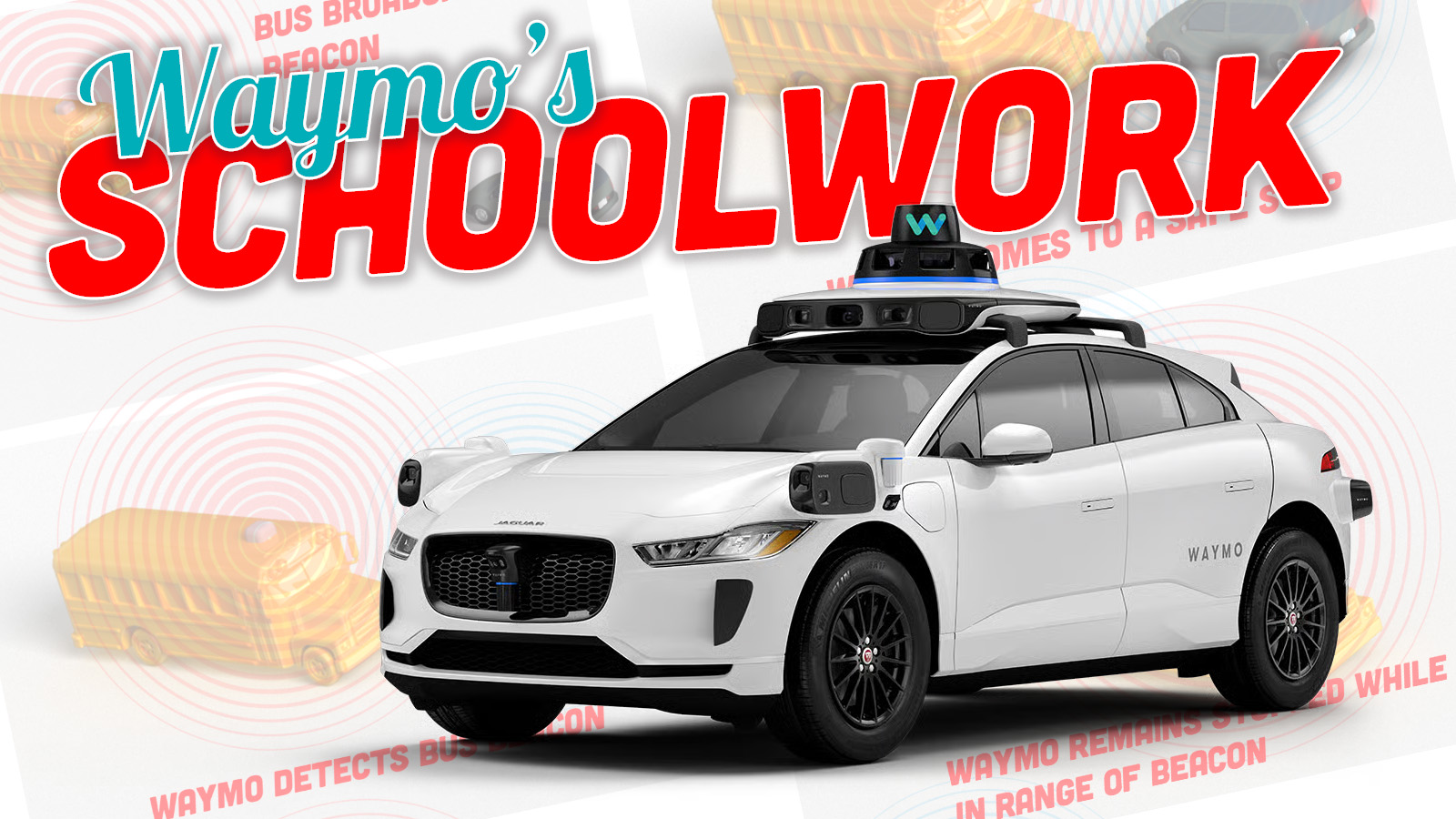
Remember when there were all those reports of Waymo automated robotaxis getting confused by school buses, possibly the most consistent and distinct – both visually and regarding the sorts of behaviors demanded by them – categories of common vehicle on the roads? Sure you do. We covered some of these incidents, but there have been a surprising number of similar events, especially in Austin, Texas. There’s an NHTSA investigation pending about Waymo’s school bus-related difficulties, and Waymo has attempted to fix the issue on two occasions, but so far it doesn’t appear that any significant improvements have happened.
The most recently recorded/documented event of a Waymo robotaxi was from January of this year, in Austin, and that’s on the heels of 24 instances where the Austin Independent School District’s buses own cameras have recorded Waymo vehicles driving past them while the flashing lights and the stop arm were deployed, the sort of driving violation that would be a serious offense for a human driver. In a number of the videos, children can be seen walking on the road, either entering or exiting the bus.


Austin Police Assistant Chief Travis Pickford noted to local Austin news station KXAN in January that, when it comes to humans making similar driving violations compared to the Waymo automated vehicles,
“The data we collected from the beginning of the school year to the end of the semester shows that about 98% of people that receive one violation do not receive another. That tells us that the person is learning but it does not appear the Waymo automated driver system is learning through its software updates, its recall, what have you, because we are still having violations all the way up until last Monday.”
So, the Waymo vehicles do not seem to be learning from their mistakes. In fact, a letter from the Austin Independent School District notes five events that happened after a software fix was deployed by Waymo. The district has requested that Waymo vehicles simply cease operating in the hours when school buses will be making their rounds, but Waymo declined to do that. Still, I do believe it is entirely Waymo’s responsibility to solve this issue immediately if they wish to continue operating in cities that also have school buses.
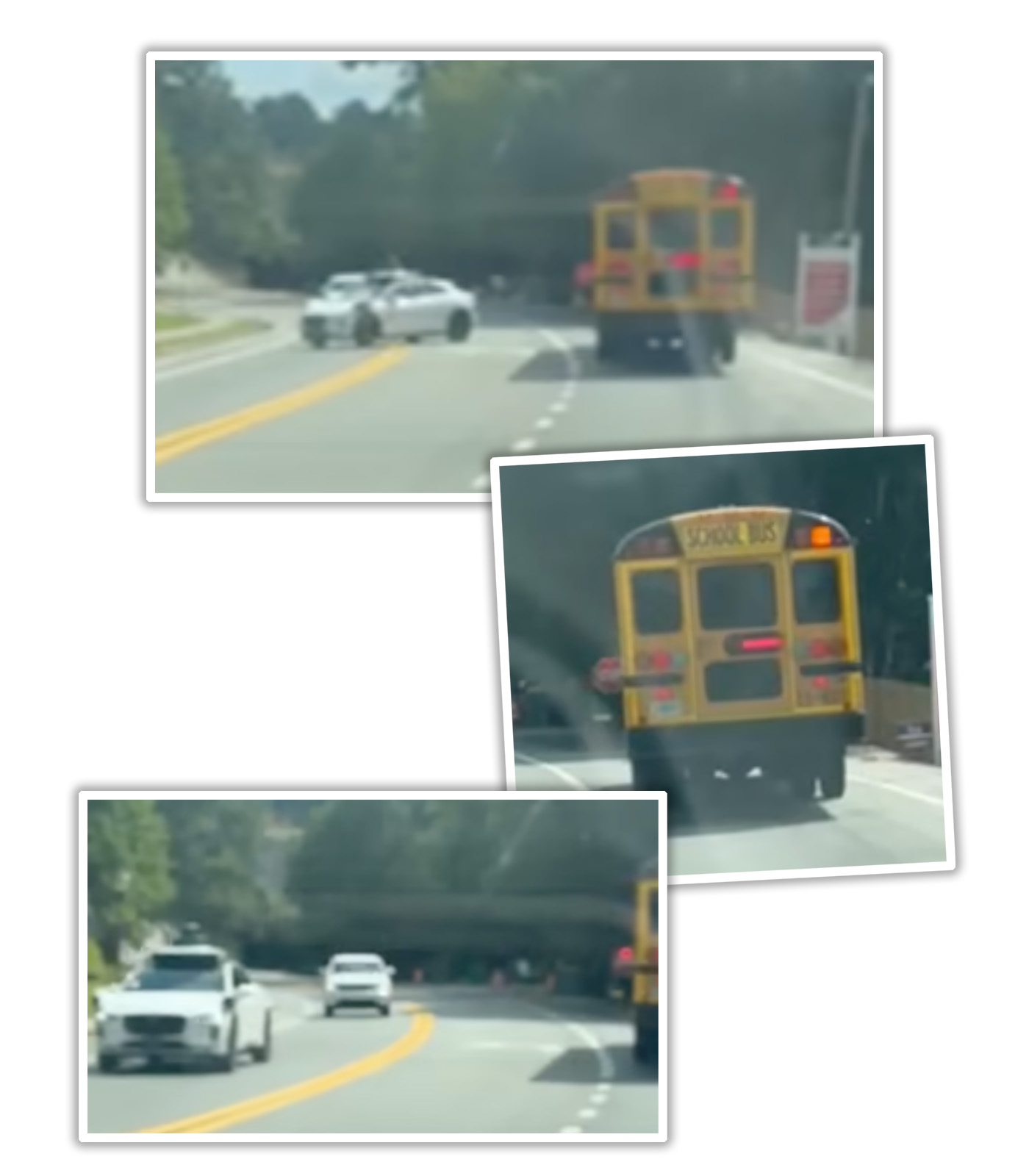
I don’t see any reason why anyone should be hesitant about this. It’s Waymo’s problem, not the problem of the cities they operate in, their school systems, bus drivers, or students. Just like with a human driver, it’s up to Waymo to take action to insure these sorts of potentially dangerous incidents stop happening. If Waymo’s software is unable to solve this problem – a problem that involves children walking on the road surrounded by cars, it’s worth remembering, and a situation that is, let’s be honest here, one of the most clear-cut and obvious common driving situations a human or robot can encounter – then other means must be taken to solve it.
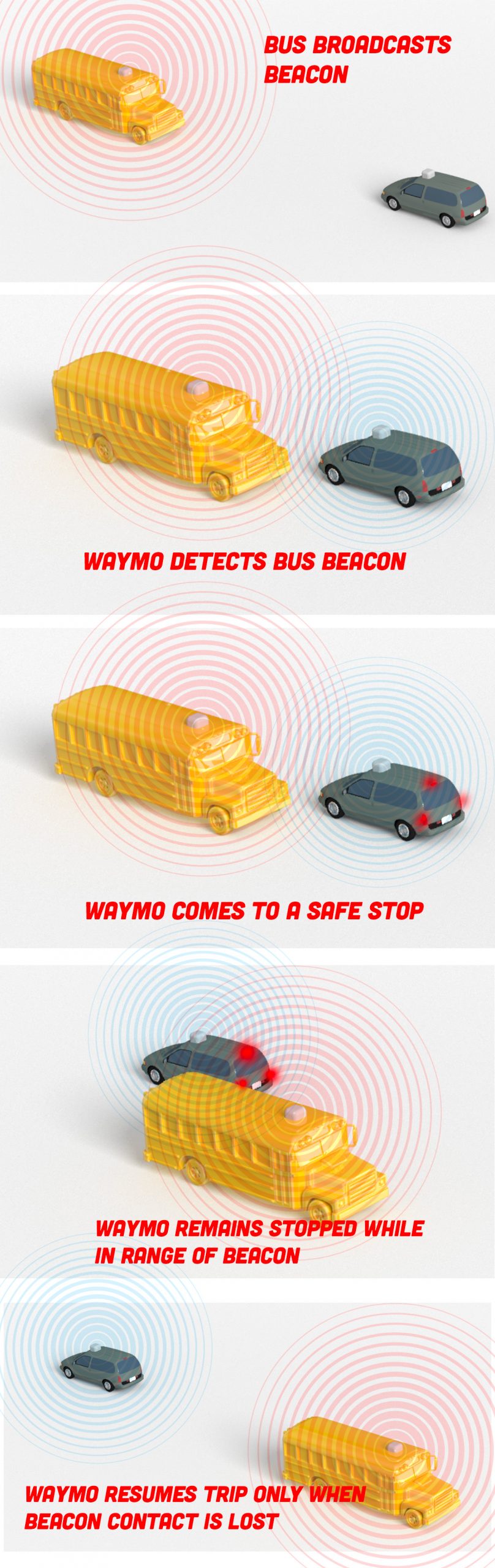
So I have an idea. Maybe not the most sophisticated idea, but maybe something that can get us thinking. Waymo has already demonstrated that a software fix alone is, at best, difficult, and not a solved problem. Okay, fine. Then maybe we need to add a little bit of hardware into the mix. What if we equip all active school buses with some manner of “beacon,” a device that broadcasts a short-range wireless signal – it could even be a Bluetooth-type signal, since I just learned that it’s possible to broadcast those with a range of about a kilometer, which would be plenty.
When a Waymo approaches a bus close enough to “hear” the beacon that gets activated when a school bus is approaching a stop, not all the time, of course – and the distance would be calibrated to approach what would be an ideal distance for someone to interact with a school bus, I’m not sure what that is, but maybe it’s, say, 300 feet? I don’t know, but someone will. Anyway when that happens, the Waymo will come to a careful stop, turn on its hazard lights and do nothing until the bus leaves, and its beacon signal is no longer received.
Once the bus is gone, the Waymo resumes normal operation. That’s it. Just keep it simple: school bus signal heard, stop and wait, school bus signal gone, continue. There’s no special coding beyond a very basic conditional, which I’ll rough out in the language I assume Waymo uses, circa 1983 Applesoft-like BASIC:
10 IF BEACON="ON" THEN GOTO 30

20 IF BEACON="OFF" THEN GOTO 40

30 STOP DRIVING

35 GOTO 10

40 KEEP ON DRIVING

50 GOTO 10
See? Easy. And Waymo should pay for every now-nonexistent penny that this project would require: designing the broadcast hardware for the buses and the receiver for the car, adapting their software to use the receiver and act accordingly, installation of the hardware on the buses, and so on. This is Waymo’s problem, not anyone else’s and if they want to keep sharing the road with school buses and kids, then they need to actively do something to make sure their vehicles are capable of sharing those roads, which, as of this writing, they do not appear to be.
School buses are not exotic edge cases. They’re part of the everyday landscape of the road. Waymo needs to address this issue and solve it in a simple, straightforward, and obvious way. If they want to keep developing software fixes, great. But they need something more fault-tolerant, something so basic and simple it simply can’t fail. A system where the buses make their presence unquestionably known to the Waymo robotaxis would work, as long as the robotaxi has no ability to ignore the signal and behave accordingly.
It’s not ideal for Waymo, and it’ll cost them some money, but I don’t care. Unless you work for Waymo, you shouldn’t care, either. That’s just the cost of doing business, and if Waymo doesn’t want to fix this issue, they are free to pause operations until they’re ready.
We’ll wait.


Or just enact a law that makes any driverless car owner liable for a $5 million fine for every occurrence. Waymo will then find a way to fix it.
Hey Jason, you might be interested in this group https://www.openmobilityfoundation.org/ –it’s a coalition of cities and companies that operate a data standard for moving data (both ways) between connected vehicles of any type (on one side) and cities (on the other side). So, for example they can do things like sell curb parking space for deliveries by the minute, tell fleets of UAVs to avoid parts of a city or slow down in that area when there’s an event or emergency, or monitor agreements about where robotaxi fleets will provide service. So in this case it’s only an indirect solution but you could for example easily use their standard to tell Waymos where the bus routes are and avoid them during child pickup and delivery hours as an alternative to shutting down completely, or prohibit them from passing stopped vehicles on those street during those times.
Waymo as a business is a single entity. Same as a single human being. If a single human driver repeatedly was caught ignoring busses that have stop signs and flashing lights, that single human driver would no longer have a drivers license.
Why is Waymo being treated differently and being allowed to continue without a remedy?
I am always amazed at the predilection of children (usually toddlers, not school-age) for just wandering into the street as if drawn by some magnetic force.
I think the technology sequence should work like this:
My idea involves armour penetrating rounds, your idea is reasonable by comparison.
If the robo-car technology is as good as advocates claim this should be a solvable problem without the addition of the beacon. While a beacon seems like a simple solution it also relies on both devices being functional and integrating the code into the current Waymo logic. If they can’t update the visual/LIDAR recognition systems to recognize a GIANT YELLOW BRICK, with lights and signs I don’t see the beacon being more reliable an indicator. The code would have to be absolutely sure the beacon input has absolute priority over the visual/LIDAR systems. The car’s AI also couldn’t have the system privileges to override the beacon in almost any circumstance. What happens when a fire truck or ambulance is also trying to navigate traffic around the school bus and nearby cars? What does a Waymo do then? Likely just sit still and do nothing because the beacon is saying “don’t move, school bus present”.
Just more proof these systems aren’t ready for anything but limited circumstances and settings.
The problem with this solution is Bluetooth is the wrong protocol. Yes the signal can cover the distance needed to function, but Bluetooth is not a broadcast protocol. It requires a pairing process, and a regular ongoing handshake to stay active.
What you are specifying is a V2I/V2V (Vehicle to Infrastructure/Vehicle to Vehicle) system, something the industry has tilted at several times from both a regulatory and technological perspective. While there are working POCs and an entire V2X city has been built at the American Center for Mobility, the spec keeps dying in committee.
What really needs to happen here is the Waymo’s should be grounded until they can prove that they are safe to operate in all edge cases, not gambling with children in the public.
“all” edge cases is an impossible bar. I had a friend who came upon a herd of cows on the road from an overturned livestock trailer. All I’m saying is there are countless crazy things (including ones we cannot imagine) that hardly anyone will come across in their entire life, yet happen somewhere in this country everyday. But yeah, “school bus” isn’t one of them.
If a human can adapt to the circumstances, then an autonomous vehicle must be able to. Until then it’s a public beta test without safety guard rails.
Humans are far from perfect drivers, they just tend to make different kinds of errors. I agree with your overall point that it’s absurd we’ve let/are letting these companies move quick and
break thingskill people. My quibble is where we draw the line at “safe enough,” understanding perfect safety is impossible. Every year 30k+ people die in this country in auto accidents. If the robots can cut that number in half, why wouldn’t we accept that? Does it really matter if you’re killed by a computer vs the old fashioned way (by someone trying to order ahead in the starbucks app or whatever)?I mean the 50% death reduction hypothetically, as I doubt these systems have that ability today, and perhaps never will.
As with everything, percentages require context. If we cut deaths in half, but they are all suddenly school children getting on and off busses, or crossing the street, is that acceptable? I’ll back off from my 100% claim, but if 90% of drivers on the road can manage the event, there is reasonable level of safety if an autonomous system cant meet that.
Take the pedestrian that was drug under a Waymo in SF, the Waymo didn’t cause the accident, but made it far worse by not properly recognize the circumstances, making the outcome far worse for that human.
You make it sound like the Waymo took the nearest freeway ramp and drove non-stop to NY via every cactus patch and washboard road along the way.
It didn’t. As soon as it sensed something was wrong it pulled over in 20′, the shortest distance possible while calling for help. There is no reason to think a human would have done any better. Indeed the only other human involved did far, far worse:
“Waymo didn’t cause the accident”
The human that DID cause the accident GTFO and remains unpunished.
And yet it’s the Waymo that gets the torches and pitchforks.
If a Waymo vehicle cannot stop for a school bus that is legally stopped in the process of loading or unloading of children then that vehicle needs to be removed from the road, full stop.
What Waymo needs to realize that a couple of old dump trucks sitting in front of one of their refueling/maintenance facilities can render an entire cities’ fleet down and out very quickly and effectively.
That’s an idea I like. If these things ever come near me I want to pool together some resources to procure a couple blockade-ready trucks for this kind of thing
What’s Bluetooth’s ability to propagate through humid or wet weather? I genuinely don’t know, and I don’t want to just dismiss that frequency/codec’s viability out of hand. But I would rather see a known reliable and probably less-busy frequency range used. I don’t need me listening to old Car Talk reruns causing the robot ahead of me to do its best impression of Colapinto and Bearman vs Super Clipping this weekend.
oh man. I didn’t consider people intentionally spoofing the protocol. Come to think of it, I bet there are plenty of other ways to mess with these things (laser pointer at the LIDAR sensor, etc).
…I mean, GPS and ADS-B/(what’s the maritime one) spoofing is happening to airliners and ships in warzones.
true. But nation states don’t have their eyes on the Waymo fleet. All it takes is one viral tiktok showing that the IR signal from a TV remote (or whatever) will brick these things to create chaos.
Robots are bad at recognising buses.
The people who invented the captcha tests know that.
I suppose they park in front of fire hydrant, drive of stairs and ignore crossways too.
Or maybe autonomous driving technology just ain’t what it’s cracked up to be.
60% of the time, it works every time.
Great idea and probably easy to get done, but since all of these allegedly autonomous vehicles are usually remotely monitored, by people, why not just employ a person, as a driver. This whole AV taxi bubble seems largely powered by speculative investment and the famous “small dick energy” (to quote Greta with regard to the well-known scumbucket Andrew whicheveroneitwas) of the tech bros.
Also – Waymo. Stop mutilating Jaguar iPaces. I had one and it was lovely.
Haven’t most of the Waymo school bus problems been with the Waymo approaching from behind the bus?
You could build a module that replaced the bulb in the lights that flash when the bus is stopped for letting students exit. You could make it for less than $10 with a healthy profit using an ESP32.
How about a nation wide standard for vehicle transponders giving location coordinates, bearing, speed, drive mode (FRNP) as well as a standardized vehicle type and size category ( school bus type b). Broadcast short range with unique ID.
Because if anyone can broadcast real data, then someone can broadcast *fake* data.
You could literally create a car crash by broadcasting a fake signal claiming to be stopped vehicle, causing all vehicles in the vicinity to slam on their brakes
This is a solved problem. Encryption, checksums, GPS, and rolling code all come to mind as fast as i can type, and none of them would add cost.
Anyway, Waymos stop for T-shirts already
No, it isn’t. Car companies can’t even prevent hackers from making tools to spoof people’s car keys.
Some car companies can, and some don’t even bother.
Also, since there are cameras involved you could have a bus sized object with a sign, or a licence plate necessary to stop.
The problem is that it would be easy to do without the extra technology but you would have a massive number of false positives with Waymos parking in traffic. Eliminating the false positives is a big part of the problem. See the T-shirt problem.
While they are at it, a beacon for emergency vehicles parket is weird places and whether the Wawmo should just park in the middle and wait, or get out of the way would be good.
Of topic, but why don’t cops in the USA know hand signals for directing traffic?
because drivers don’t know them either.
Yeah, last time I made a hand signal on a tractor for a left turn, the idiot behind me thought I was signaling that I wanted him to pass me.
Because “Heien v. North Carolina”
A cop doesn’t have to know the law, but you do.
Ha.
My daughter when she was in middle school had an interaction with a policeman, where she lectured him on the 4th and 5th amendments, and pointed out that his grammar was atrocious and that the literal meaning of a double negative was exactly the opposite of what he probably meant.
Anyway, she got arrested, but the judge burst out laughing and said that she could dismiss the charges right then, but if we wanted we could make the cop’s next year fairly miserable, and that my daughter ought to consider a legal career.
I think the advantages of being a cute white 13 year old girl were mentioned, and that in later life she might not have those advantages, and the police hate being made fools of was also mentioned.
Fortunately the Supreme Court was not involved.
yup. It can be done. Doesn’t mean car makers will do it. They’re not exactly great with software…
So they distinguish geometry and can read STOP but don’t know what red is. Teslas and fire engines?
It looks like they are fine with recognizing red.
Maybe even fire engine yellow.
Wasn’t Tesla’s problem early on that it ignored vehicles on the freeway that were not moving?
I think it was something like “a vehicle should not be stopped there, therefore it must be a shadow or paint spot” I think there continues to be some roadrunner/coyote behavior regarding not knowing the difference between a picture of a road and an actual road.
Waymo uses lasers which work better, but kill digital cameras.
Instead of RF, we could use a different wavelength. Perhaps one that is also visible to humans, oh, maybe say 633nm (red). Then, this red “beacon” could be deployed, giving a sign that the bus is stopping for kids. Both waymo and humans would detect this 633nm red sign, and know to stop.
I call it: “A Stop Sign”
Na, it’ll never work.
(P.S. yes I understand that RF is less attenuated by most objects, and is there for more omnidirectional, unlike red light that can be blocked. But that’s not funny.)
The trouble with red lights is that there are so many of them, and they are context sensitive.
Also, most STOP signs on a hexagon mean to drive up to the sign, stop, check for cross traffic then go.
They only work for humans because there is a lot of context, and humans dont get it right either.
It was just a joke man. 🙂
Yeah I knew, I just got off on a tangent.
Shouldn’t you have a line “35 GOTO 10”?
Otherwise you go straight from line 30 to line 40 and start driving again immediately after coming to a stop.
crap, you’re right! I’ll fix!
Maybe a 0.1 second wait statement before the loopback, so it doesn’t run the GPU hot in a mad sprint? I’m not a coder, but that seems reasonable.
He’s just pseudocoding the basic logic, not attempting a full implementation which would have more code such as the timing loop you quite sensibly recommend.
Yeah I was definitely being too picky, the line I suggested wasn’t necessary to convey what Jason was conveying.
Rf does seem like a simple solution. Especially as cheap as they have gotten. Some of the busses have hot spots now I believe Google was paying for some at somepoint. Allowing kids to do their work on Chromebooks. Becons from those hotspot could also be used.
I do question if the thing can see railroad crossing signs. Also many busses have a white beacon light on top maybe they could use that in some way.
is that a mercury villager/nissan quest waymo? if so thank you, i love it, it has brightened my day
if not that’s fine you can’t stop me from pretending it is
Think it’s a Jag i-Pace. Thanks for playing.
i’m quite clearly referring to the illustrations with the bus at the bottom of the article
Ohh – Ford Windstar.
Seems to obvious for a Torch image
I don’t know. I’m also getting Mercury Villager vibes from those vertical brake lights.
Nautica trim.
Red lenses means Quest, Villager owner agrees.
I’m no Luddite, but I’m not an early adopter of tech either. I like tech that just WORKS and and actually HELPS ME. I’m utterly baffled by appliances connected to the “internet of things”. WHY?!? I open my fridge daily and can see if I need milk!!! If I do laundry, I still have to manually move the stuff, add soap and empty the lint trap. I have about the simplest old-school washer and dryer on the market. And they work, every single damn day. If they don’t, I can usually fix in an hour and one run to the appliance parts store. I run a normal digital thermostat with a timer (that I don’t use). It costs me less to hold a steady temp than yo-yo multiple times a day. I loathe Rolls Royce solutions to Chevrolet problems.
I feel for those that spent thousands fully wiring their homes with Cat5 and fiber in the ’00s; only for WiFi to become prominant a decade later. My dad just ran a single Cat5 wire outside from a basement window to an upstairs bedroom window. It has since been removed…
Ok, I’ll stop yelling at the clouds if you get off my lawn.
Thousands?
I wired my home with Cat5e (through walls and crawlspace), and it’s still better than WiFi. Faster between computers and more reliable. It also serves as the backhaul for my mesh routers so everyone’s WiFi is better because of it.
Hundreds maybe?
No, my appliances aren’t “smart”.
“Smart” appliances are dumb.
I have Cat6 ran in my house, I like to keep stationary things on the wire as it’s typically faster and saves some WiFi bandwidth for everything else. I have bought 1 1000ft box of the stuff in my life and I’m maybe halfway through it, so expense is minor and the benefits are great. With gigabit internet the desktops can use the speed too
NoMo.
“GOTO considered harmful” – N. Wirth, 1987
🙂
A human driver would lose their licence after repeated school bus violations.
This is the problem. The punishment for an individual is severe enough to change behavior.
Google/Waymo need enough of a punishment to make them change.
I hate saying this, but I’m afraid it’s hitting and killing a kid. That’s what it will take for them to care. (Not that they care, as a corporation, about the kid, but the liability and punitive damages would be enough to make them care a little.)
Need to place Tesla FSD near the top of that list. I agree with you, it likely will require a tragedy prior to seeing real action / legislation to force big business to change.
PSA, Morgan and Morgan can be reached at: #LAW.We’ve already had tragedies. All it will do is make these companies pledge to have human monitors or whatever and then quietly remove them 6 months later.
True. That’s why legislation needs to be in place to force big business to take ownership of their mistakes and subsequent tragedies. I don’t see that happening soon. Unless we can get Torch and others to testify to Congress, But that would require a Congressional investigation into FSD and other self driving modalities. That is possible but would not succeed under the current administration.
yes! this js the crux of the issue: waymo is the same driver for all incidents. waymo has a SINGLE license for their fleet, if two individual vehicles are ticketed, then waymo as an entity has two offenses, and license revocation for ALL of the fleet (in state that issued license) when it incurs enough moving violations.
What happens to humans who violate these laws repeatedly? They lose their licenses and eventually will end up in jail. Do the same to Waymo – if they do it more than once, remove their permission to operate. If they keep doing it, shut them down and/or charge their board with crimes.
This is the answer. Impress upon them the severity of the situation. Make a solution to the issue a financial necessity and I’ll bet it happens pretty damn quick.
There should be a law where any traffic violations are charged directly to the CEO as if they were the driver. All the problems would be solved, easy peasy!
Ooo, I like this one!
Not that easy peasy as CEO’s of the big businesses involved in autonomous driving tech likely have a battery of corporate lawyers who will tie it up in the courts for years.
You say this as if it is a bad thing? Those lawyers aren’t exactly free, either.
But those costs are written off as part of doing business. Big CEOs are not like us common people
“cost of doing business.” Even at tens of millions, it’s still a rounding error to them.
But corporations are people! At least according to the Supreme Court.
Though by that logic they’d quickly get enough traffic violations to have their license taken away…