

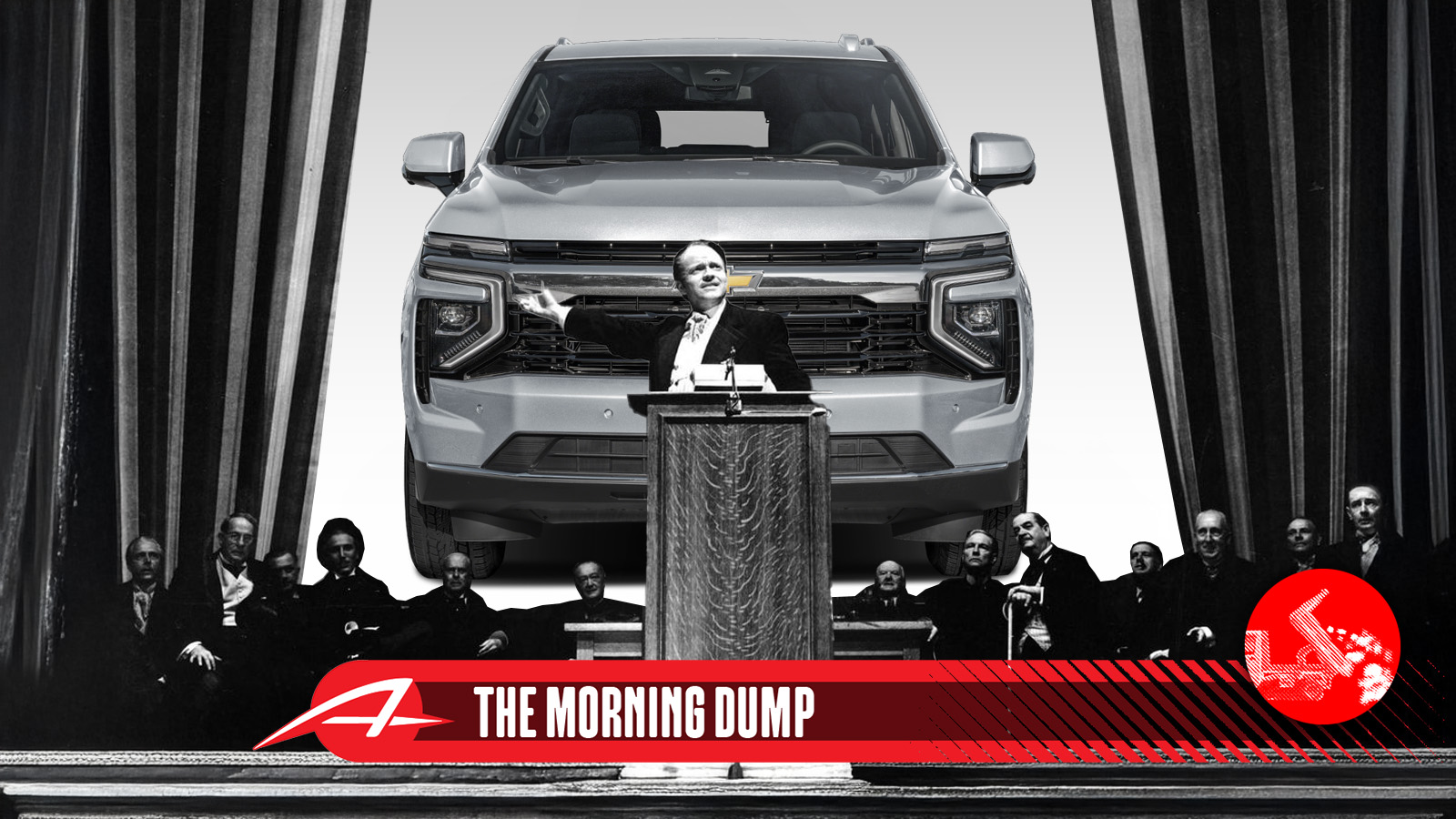
General Motors was the biggest automaker by sales in the United States, and it managed to achieve this without an enormous incentive spend. The company generated a lot of cash and is returning some of that cash to investors. These are all healthy signs.
If you regularly read The Morning Dump, you’re probably familiar with my GM-related struggles. Of all the US-based automakers, I think it’s the one doing the most right things right now. It’s the future I worry about a little, even though GM thinks it’ll be fine and the market will probably agree.


Will the trade war ever end? Probably, though this seems like a Seven Years’ War situation, wherein too many parties get involved, and “winning” merely sets the stage for more conflict to follow. Just ask South Korea, which was recently celebrating a bilateral deal with the United States, only to see the United States threaten to raise tariffs again. The EU, lately, seems to be trying to get off this crazy ride, and just announced a huge deal with India.
And, finally, Volvo might make a big three-row thing, because the brand refuses to build what we really want: A giant van. Also, today’s theme is Orson Welles. I don’t know why, it just is.
Am I The Weird One Here?
I often think about the very old fable of the Scorpion and the Frog. The best retelling of this is by Orson Welles, above, in the film Mr. Arkadin (or, sometimes, Confidential Report).
The basic story is that a scorpion needs to get across the river, so he asks a frog. The frog doesn’t want to do it because he thinks the scorpion will sting him, but the scorpion explains that doing so would kill both of them. The frog agrees, and then the scorpion attacks the frog in the middle of the river, and both die. Scorpions will always be scorpions.
When it comes to this particular story, I’m not sure who the scorpion is. By constantly waiting for GM to stumble and fail, perhaps it’s the media. Or, maybe, by behaving just long enough to get itself in trouble, it could be GM. Remember, GM has earned its reputation for abandoning great ideas. At the same time, journalists never let them forget this fact, and almost no one involved in, say, the cancellation of the EV-1, is still around.
Again, if you’re a regular reader, you’ve seen my struggle with this. Back in 2023, GM announced it was doing more buybacks and dividends as it said it was minting enough cash to boost its share price. I was skeptical, pointing out that neither the company’s Ultium platform nor Cruise robotaxi business were in a solid place.
Cruise, obviously, ended up being a big waste of money (of course, if some of it can be rolled into SuperCruise, maybe that investment wasn’t too bad). GM is now the #2 electric automaker in the United States, and while it hasn’t made back its investment on EVs, they don’t seem to be much of a drag on the company’s earnings. Less than a month ago, I was praising GM for mostly pulling it off.
GM released its numbers for Q4/2025 and, other than taking a lot of adjustments for various repositionings, EV/Chinese investment write-downs, ongoing tariff costs, and legal costs, it was a good year. So good, in fact, that Mary Barra, in her shareholder letter, said she’d be doing more dividends and more stock buybacks:
We expect the U.S. new vehicle market will continue to be resilient, and with our compelling vehicles, technology-driven services, and operating discipline, 2026 should be an even better year for GM. We expect our full year EBIT-adjusted margins in North America will be back in the 8-10% margin range.
For several years now, consistently strong cash generation has allowed us to execute all phases of our capital allocation program, from investing in the business and our people, to maintaining a strong balance sheet, and returning capital to shareholders. We believe this is sustainable, so we are increasing our dividend rate by 20% and our Board authorized a new $6 billion share repurchase program.
Looking ahead, we are operating in a U.S. regulatory and policy environment that is increasingly aligned with customer demand. As a result, we continue to onshore more production to meet strong customer demand for our vehicles. Over the next few years, our annual production in the U.S. is expected to rise to an industry-leading 2 million units.
This is positive news, and it sent shares upwards of $84 this morning, representing an increase of more than 50% from a year ago. If GM is truly generating a ton of cash, selling a lot of cars, and improving margins, there’s a reasonable argument to be made that returning some of that cash to investors makes sense. While it’s on the far end of projections, some analysts have set a price for GM over $100 per share.
In this way, it’s a bit like the anti-Tesla. GM is planning to make more cash, sell more cars, improve its margins, and put that money back into investors’ hands via dividends. Tesla, of course, is the only other American automaker (and one of a few automakers) with a share price in the three digits, and it’s sort of going in the opposite direction as a carmaker (lower margins, declining sales in key markets, no dividends). Obviously, share price is both a function of value and the number of outstanding shares, so comparing one stock to another merely on share price doesn’t give the clearest view of value. That being said, if GM were to hit three digits, it would be a big deal.
Can it last?
GM has a lot going for it right now. The company has “right-sized” its EV capacity, which is to say that it’s cut a lot, and therefore will cut its losses. It’ll no longer have to purchase compliance credits, which will save it more than half a billion dollars, and it’s expecting to raise prices a small amount.
That being said, GM is following the lead of the current administration and going all-in on relocating production to the United States, and expects that onshoring production and software expenses to reach “$1-1.5 billion of costs.” What if the next administration has a different idea about trade? What if it gets more expensive to build cars in the United States because of a trade war? What if the company faces more price pressure and has to lower margins?
It’s much easier to second-guess than it is to first-guess, and GM still has a large global operation that made money this year, largely because it increased revenue from everywhere that wasn’t China, while also losing a lot less in China.
The company is still making a huge bet on the United States economy staying solid, customers buying its big trucks, and a production shift to the United States going smoothly. If the company can do all that while improving its cash flow, as it is projecting to do, then I’m worrying for nothing.
President Trump Threatens To Raise Tariffs On South Korea Again
Don’t count your chickens before they’ve hatched seems to be the theme of the above clip from the great Citizen Kane. Hyundai has done what it can to placate American politicians, and South Korea has willingly gone along with promising a lot of money in investment here. The details haven’t yet been worked out, and South Korea has to be careful it doesn’t crash its own currency in the process.
Perhaps seeking a distraction from his own overplayed hand, President Trump has said South Korea isn’t moving fast enough, so he again raised the tariff on cars to 25%. If this isn’t resolved soon, it’ll be more good news for Japanese automakers as Automotive News reports:
A 25 percent tariff rate puts South Korean exports at a significant disadvantage to Japanese competitors, which face a 15 percent rate. Even before Trump’s latest volley, Japan’s trade minister Ryosei Akazawa noted that Japanese automakers had a slight trade tailwind.
That is because Trump’s original tariff agreement raised duties on Korean vehicle exports from 0 percent to 15 percent, but raised Japanese duties to 15 percent from 2.5 percent.
“In a sense, this 2.5 percent difference gives us price competitiveness over South Korea,” Akazawa said earlier this month at a Japanese automotive industry new year’s gathering.
It sounds like South Korea is going to quickly figure out how to pass something, so I don’t think this will be a drawn-out tariff, but it does make planning difficult for automakers.
The EU And India Pass Historic Deal
My all-time favorite speech from Orson Welles (and one I’ve used here before) is the one he wrote for The Third Man:
Like the fella says, in Italy for 30 years under the Borgias they had warfare, terror, murder, and bloodshed, but they produced Michelangelo, Leonardo da Vinci, and the Renaissance. In Switzerland they had brotherly love – they had 500 years of democracy and peace, and what did that produce? The cuckoo clock.
It’s such a great quote, if not entirely historically accurate. Either way, great tension creates great opportunities, and both India and EU are seizing the dual threat of China and the United States by getting into bed together.
As CNBC reports, European automakers could benefit:
Michael Field, chief equity strategist at Morningstar, said that in an increasingly volatile environment, any international trade deal is good news.
“That autos are one of the largest exports from the EU to India means this deal could be a welcome boost to the European autos industry,” Field told CNBC by email.
“The Indian auto market is heavily dominated by domestic players, which will be difficult to disrupt, but this gives European auto manufacturers a fighting chance,” he added.
The deal could also open up a new market for luxury European auto manufacturers, such as Germany’s Porsche, with price points “more affordable” for the middle classes, Field said.
Gas-powered Macans for all my homies in Kolkata.
Is There A Future For A Rebadged Zeekr?
While Booth Tarkington gets credit for the words, I love this bit from the restored opening of The Magnificent Ambersons as conceived by Orson Welles. I specifically love how he shows Joseph Cotton’s character going through various fast-changing styles.
Volvo has somewhat resisted this trend and doesn’t have a full-size three-row vehicle in spite of its popularity. Its parent company, Geely, does, and Brian’s sampling of Geely products showed that those vehicles were fairly on par with what we’re getting.
So could we get a three-row Zeekr rebadge? As Automotive News notes, it’s not an impossibility:
CEO Hakan Samuelsson highlighted growing demand for full-size three-row SUVs in the U.S. and China during a Jan. 22 media briefing here.
“Bigger SUVs — that is something we’re looking into,” Samuelsson told Automotive News, noting that such a vehicle has not been greenlit.
Give us the Zeekr 009! That’s what America wants.
What I’m Listening To While Writing TMD
It’s The Third Man Theme by Anton Karas, which is maybe as popular as the film itself.
The Big Question
Who will be the first automaker to sell a luxury van in the United States?
Top photo: Citizen Kane/GM



Cruise isn’t dead, it was just rolled back into the corp and kept a bit hush hush until things blew over. One of my former students jumped to them a little over 2 years ago and just posted on Linked In that they are hiring again for several positions.
Journalism is hard work.
> Who will be the first automaker to sell a luxury van in the United States?
Genesis, natch.
The Chrysler Pacifica would like a word on the luxury van front… Some of those are quite nice
Lately I’ve been thinking of Charles Foster Kane. He built an opulent palace to showcase his wife’s talents. It didn’t work out very well.
Luxury van? Kia Carnaval will suit any sane person.
I don’t think there is much demand for a true luxury van. I was driving around a wealthy neighborhood the other day and was blown away by the number of new Toyotas and Hondas. Sometimes I wonder if the people are just house poor, which might be part of the problem, but also, most new cars are nice enough that luxury cars feel slightly superfluous. (Although I prioritize my ride enough that I wouldn’t take on a $1M+ home loan and then settle for driving a Pilot)
Anyway, as for who will be first? It’s been done, especially if you are talking about vans and not just minivans. As for who will be next? I think it will be the Japanese or Koreans since those products already exist.
Maybe they are smart people.Why should anyone be ashamed of driving a Honda or Toyota?
Just to clarify I didn’t mean they were unintelligent, just that it doesn’t match my priorities. I meant that for most people the difference between a luxury car and Honda or Toyota is just the price tag. Personally I don’t care about luxury as much, but I love cars so aside from the Civic Type R or Maybe a Supra I just don’t have much interest in their other offerings but I also know that I am in the minority.
I suggest you read “The Millionaire Next Door”
I have a lot more respect for the guy in a very nice house with a used Honda Pilot than I do for the guy in a new Porsche or new Jaguar in the mobile home park or a 2 bedroom apartment.
Cars nowadays are like watches, most of them do what they’re supposed to do very well regardless of price. In the mid-eighties if you got out of a Subaru Loyale and into a Mercedes it was a world apart. Now not so much. I still love all of them, but nowadays I love them from afar.
Yeah, you used to get something for your money from a luxury vehicle, especially like Mercedes; most other current “luxury” offerings are born out of performance brands. There is still a performance difference between a BMW and a Honda, but they are both reasonably well-appointed, and the Honda is probably more reliable. The features available and the build quality of most vehicles have rendered luxury cars outdated.
Many rich people didn’t get rich by blowing their money on “luxury” cars, they own Toyotas, Hondas and Fords with the most popular vehicle owned by millionaires being the F-150.
I re-watched Citizen Kane recently, after originally watching it 30+ years ago. I was aware that current President Camacho said it was his favorite movie. The clip of Kane’s campaign promise scene hits on a few similarities, but when re-watching the movie in today’s world, I was unpleasantly surprised by how closely he is following the script, and how closely it mirrors his personal life. From a loveless childhood, to working to control the media, accumulating wealth, slandering political opponents, staffers ready to claim election fraud, sycophantic followers, and more, it was almost surreal (but unfortunately not).
After watching Citizen Kane, follow this link to the 3 minute video with this sad human’s “moral of the story”.
https://www.austinfilm.org/2017/06/wait-erroll-morris-made-a-short-interview-film-with-trump-about-citizen-kane/
Yep, I re-watched it when Criterion released it in 4k and the similarities are all there.
No thanks, I’ve got more important things to worry about in my life than Turnips.
One of the coolest recent uses of the scorpion and the frog fable is in the movie Drive – Ryan Gosling’s silver jacket. Is Driver the scorpion or the frog?
Tesla, make it a smooth edged cube, in stainless, with 1500hp, they’ll sell millions I tell yah. /s
Luxury van? Lexus. Possibly Kiw/Hyundai.
I just want to note that Orson Welles was born in Kenosha, so if anything he should be linked to Stellantis-related news.
I’ve owned several Volvo cars with 3 rows of seating. If Volvo brings back the 145, 245, or 745, I’ll be first in line.