

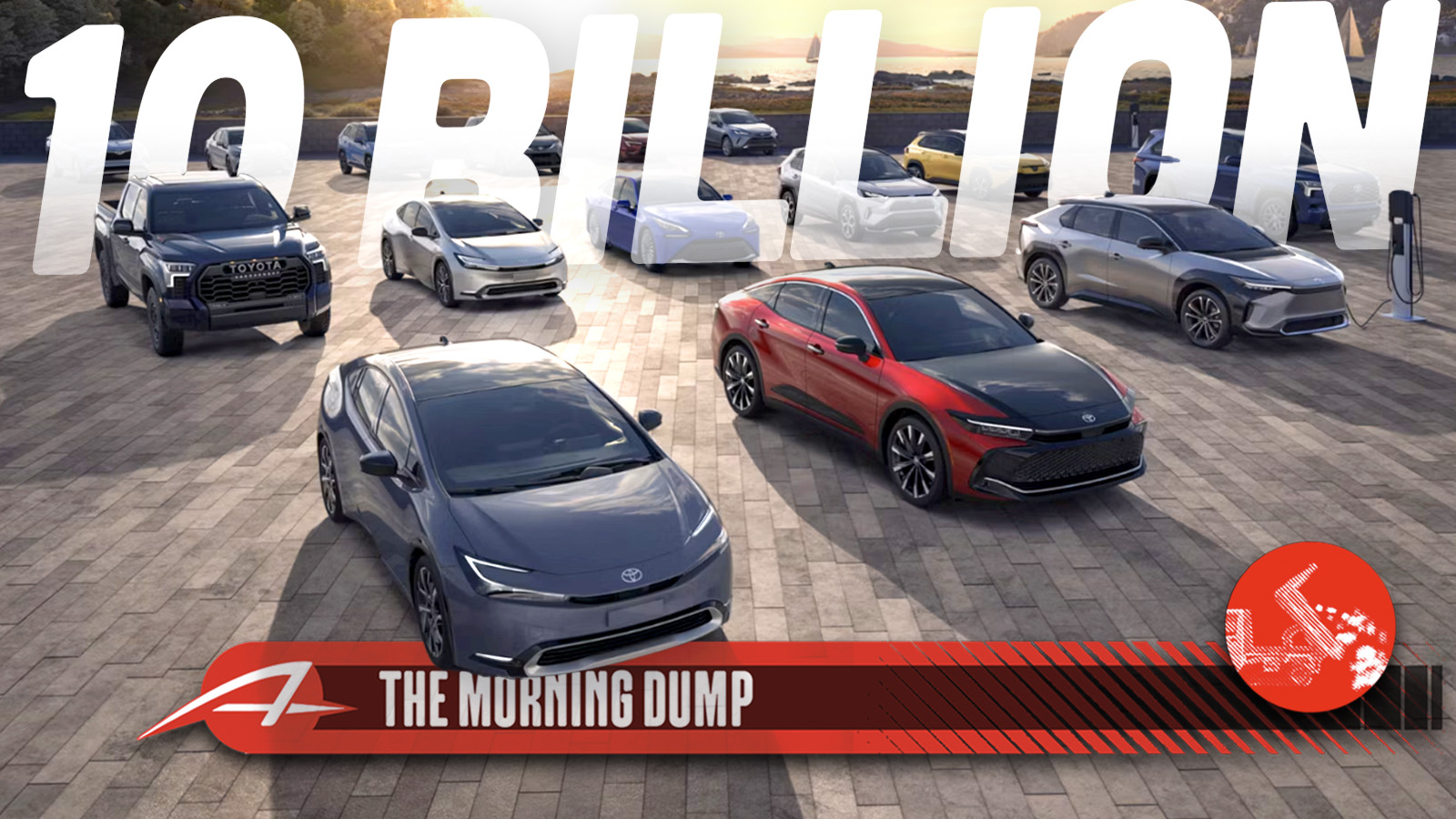
Toyota was the last of the major Japanese automakers to report its earnings and projections for the upcoming fiscal year, with the company announcing it’ll see about $9.68 billion in tariff-related costs through next March. The unresolved question of all of this, ultimately, is who will end up paying the price.
For now, it’s the automakers, but anyone who reads The Morning Dump is aware that what can seem like short-term gain can soon turn into long-term ruin. I’m getting some real Tavares-era Stellantis vibes from the economy right now, and I’m not alone in sensing something might turn the wrong way.


Subaru has the same concerns. The automaker is simultaneously releasing a slew of electric cars while, at the same time, considering whether or not it needs to slow down its electric car plans. This is a slow motion reversal, as opposed to whatever has been going on at Lotus.
Is it Thursday already? I guess it is.
Toyota Will Take A $9.68 Billion Hit And Also Remain Profitable
Japanese automakers are on a fiscal year that ends in March, which is why roughly a year ago, I got to write about how Toyota became the most profitable company in that country’s history. This was a high point for Toyota, but the numbers didn’t tell the full story. As we would learn, this rush to profits involved allegedly squeezing its subsidiaries nearly to the breaking point, and resulted in a bunch of embarrassing admissions about fudged tests and a call for major reform.
The automaker was in the process of making these reforms when a new administration in Washington decided to upend global trade. The result? Here’s how Toyota put it in its FY2026 Q1 presentation:
The full-year operating income forecast has been revised downward by 0.6 trillion yen from the previous forecast to 3.2 trillion yen. Concerning the impact of U.S. tariffs, in light of the Japan-U.S. agreement, we have now factored in the full-year effect. As a result, we are expecting a 1.4 trillion yen impact, a 1.2 trillion yen increase from the impact reflected in the previous forecast.
If you can’t do the conversion in your head, that’s about $9.7 billion at the current exchange rate. Is this being conservative? Probably! Toyota is a conservative company, and the recent trade deal might be more in its favor. Additionally, if the yen falls against the dollar again, that could help reduce some of the impact.
Will Toyota still make money? Sure. In the last quarter, there was a 142% drop in year-over-year operating income, but the company’s margin was still a healthy 9.5%. Toyota projects that it’ll see operating income for the full fiscal year drop by about $4 billion, with a margin of 6.6%.
Not great, not terrible.
There’s a bit of a question as to who exactly will pay for all of this.
You Will Pay For Some Of This, Eventually
I’ve become a little obsessed with the short-term/long-term of all of this. There’s a version of history that says the Democrats lost in the last election cycle because everything got more expensive. One of the reasons everything got more expensive is that companies used the pandemic as an excuse to raise prices beyond what was justified by cost increases. This is called “greedflation,” or maybe “Sellers’ Inflation.” In the automotive world, we had “Trimflation.” If you were bummed that your bag of potato chips suddenly felt lighter, that was “shrinkflation.”
Most economists have expected that all of the President’s tariffs would make everything more expensive, which seems counterintuitive to what voters expected, but it’s a bit more complicated than that. Companies have been slow to raise prices. Why? Bloomberg points to a couple of reasons why:
US businesses are the ones coughing up the money to pay the tariffs at ports and airports across the country. Even at 10%, those fees result in a substantial increase in costs. (One shipping container coming into the US will often carry $1 million worth of products. A 10% tariff means $100,000 more in taxes.) This leaves companies with a couple of choices: They can eat those costs and simply accept lower profits, or they can pass those tariffs along to us. So far neither has happened in a major way. What’s going on?
Chad Bown, an economist at the Peterson Institute for International Economics, has been studying the tariffs. “It’s all that I do,” he says. He thinks we’re in a kind of liminal space with tariffs. The reason: Many companies haven’t really been paying Liberation Day tariffs yet, because they started panic-importing long before April 2. “Trump campaigned on tariffs,” Bown says. “When Trump won the election, American companies said, ‘Gosh, we’d better import as much stuff as we can and put it into storage in case he actually does impose those tariffs.’”
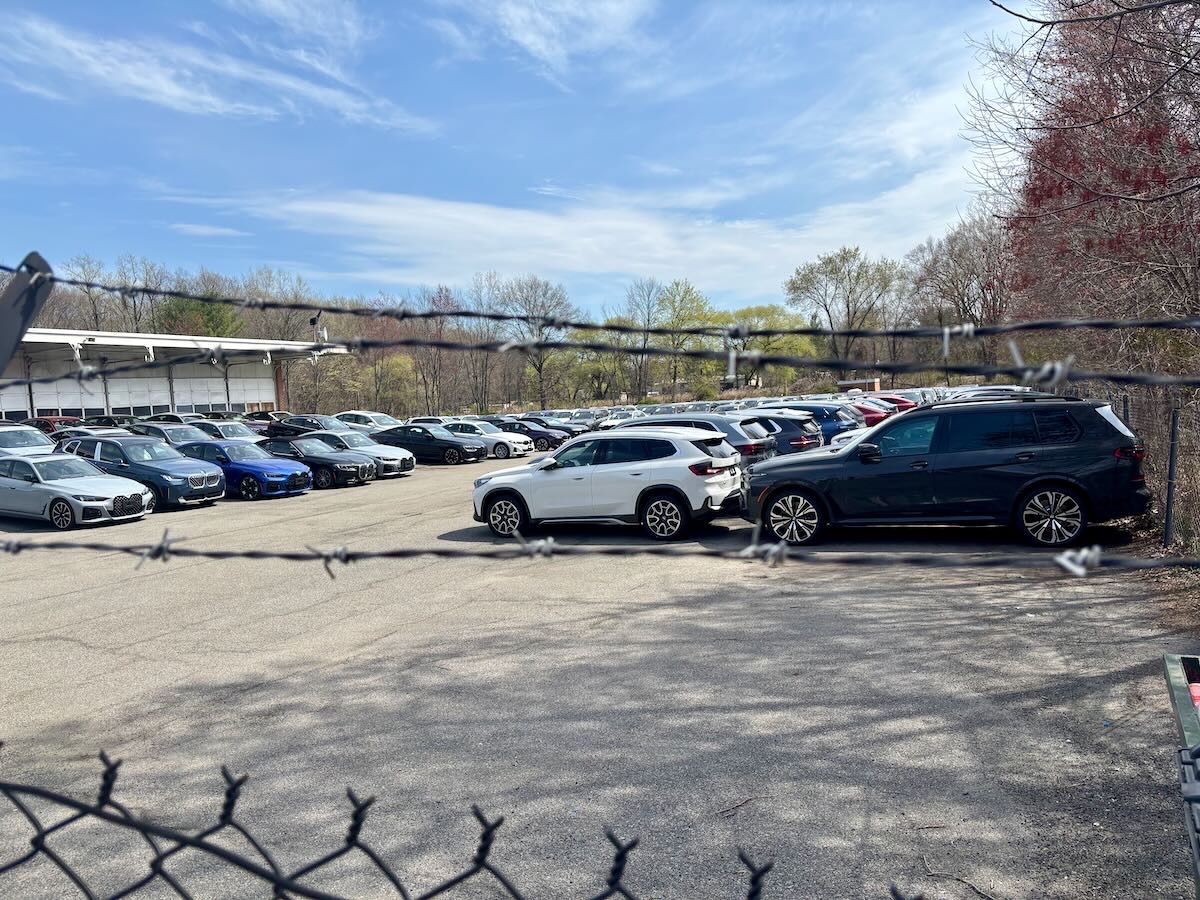
Every few weeks, I go to the lots where automakers store excess cars brought in via the New Jersey port, and those lots seem extra full recently. Erin Keating, an analyst over at Cox Automotive, points out that costs are not immediately rising dramatically:
So far, consumers have been shielded from higher prices. Average transaction prices (ATP) are mostly flat or slightly down year over year, even as manufacturer’s suggested retail prices (MSRPs) continue to rise. We believe MSRPs are more closely related to the cost of producing a vehicle, and our estimates show that MSRPs were up 2.3% year over year in June, marking the third consecutive month of higher MSRPs. This increase is lower than long-term averages, but after nearly two years of steady new-vehicle prices, the trajectory is clearly on the rise now.
ATPs, on the other hand, were higher by only 1.2% in June, suggesting consumers are not yet feeling the full force of higher costs. Instead, automakers and dealers are containing the higher costs created by tariffs while watching profitability decline. Popular compact SUVs are being hardest hit by tariff policy, as many are imported. With tariffs in place, automaker costs increase by an average of $2,800 per imported unit. Subcompact SUVs are hit hard as well: The average tariff bill is nearly $3,000. Consumers, however, are not yet seeing this level of increase at retail.
But that won’t last. The Cox Automotive team still expects consumers to see retail prices climb by 4–8% by year-end, with price increases accelerating as 2026 model-year vehicles hit the market. An update on July prices from Cox Automotive will be available next week.
That 4-8% impact on car prices is what consumers will pay, and that giant range is a measure of how much uncertainty remains in the market, and how different automakers will see different outcomes. Toyota has a strong balance sheet, global sales, and enough heft to absorb a lot of this.
If you look at the base Corolla, that’s approximately a $24,000 car, delivered. With a 4% increase, it becomes a roughly $25,000 car. At the higher end of the estimate, it becomes something closer to a $26,000 car. In this scenario, you’re paying $1-2,000 (plus another $400 possibly in interest), and Toyota, potentially, is paying $2,000. My guess is that Toyota will remain at the lower end of the range, given its modeling. It’s not the biggest leap in the world, but for consumers still facing higher interest rates, it’s not welcome news.
Is there an upside to this? Maybe. More companies are looking to expand operations in the United States, meaning more jobs in certain places and certain industries. For automakers who make big trucks, there are ways that relaxed fuel economy standards could offset some of these increased tariff costs and make those vehicles cheaper.
Even if the cost to consumers isn’t an immediate wallop, there are other concerns, which the Bloomberg editorial board laid out in stark terms:
Tariffs that are substantially — even if not ruinously — higher will raise prices, blunt competition and hold down living standards, especially in the US. Note that choosing not to retaliate, while embarrassing, leaves Japan and Europe more open to trade, ensuring that the US will be the biggest long-term loser.
Worst of all, US bullying will cause lasting and possibly irreparable damage to America’s alliances. From now on, humiliated governments and their angry electorates will discount US promises and no longer look so kindly on its geopolitical priorities. Over time, they’ll lessen their reliance on Washington and deepen other economic, diplomatic and security relationships instead.
Even if the administration’s short-term gamble pays off politically, this supposed triumph will eventually be seen for what it is — an inordinately expensive, and entirely self-inflicted, error.
Historians may judge this as a massive foreign policy error; completely unrelated: President Trump just fired a bunch of foreign policy historians.
Subaru Walks Back EV Spend, Cranks Up U.S. Factory

Speaking of history, I do wonder if society will look back at the present moment and see the drop in electric car commitments as a response to White House policy. I think that would be largely incorrect. The example of China and Norway is that consumers will adopt EVs (or at least EREVs) when it’s made easy and affordable for them because, for most people, these are way better cars.
No offense to the Volkswagen Santana (I now badly want a Chinese-market Santana taxi, thanks, LionZoo), but a Nio ET7 is a 9,000x better vehicle.
The other lesson of China and Norway is that it’s enormously expensive and labor-intensive to make this switch right now, given the state of battery chemistry limitations. The reality, automakers were already well on their way to trimming back forecasts before the election, and the idea that the market in the United States would suddenly be 80% electric cars by 2030 was always a bit silly. What do I think the new car market will look like in 2030, roughly?
- 20% EV
- 30% Hybrid
- 5% PHEV
- 10% EREV
- 35% ICE
That’s backed up by nothing but vibes, but there you go. I’d love for there to be more EREVs, so I hope I’m wrong.
Where does Subaru end up in all of this? Here’s what the company announced, via Hans at Automotive News:
Amid the weakening earnings, CEO Atsushi Osaki also said the company was re-examining the timing and allocation of its ¥1.5 trillion ($10.37 billion) investment in electrification.
It is also looking for ways to produce more vehicles out of its only U.S. assembly plant.
Citing the end of U.S. tax credits for EVs and the cooling sales growth for battery electrics, Osaki said Subaru wants to boost its production ratio of internal combustion and hybrid vehicles.
Subaru Corp. has previously said it wants to electrify all its vehicles — with either standard or plug-in hybrid setups or full battery-electric systems — in the first half of the 2030s.
Now it says it expects to achieve a 50 percent all-electric ratio sometime after 2030.
So, “sometime” could mean 2031 or 2099.
At the same time, because of tariffs, the company is looking to see if it can squeeze 400,000 cars out of its one American plant this year. That’s more shifts and more work for people in that community, which I’m sure they’ll be grateful for.
European Lotus Boss Leaves After Four Months

I mostly skipped the drama around Lotus because it happened so quickly and, you know, our Norfolk readership ain’t huge. If you missed it, the Financial Times reported that Lotus parent Geely was going to shutter the historic Hethel factory earlier this year. Then, a day later, the Government stepped in and Lotus said it was absolutely not going to close its Hethel factory.
Unsurprisingly, European Lotus boss Matt Windle, who just got the job, ain’t sticking around for much longer. I’ll let the FT take it away since they’ve been on top of this story:
Windle, who started off as chief engineer at Hethel, was promoted from running the UK business to head of Lotus Cars Europe in April when his predecessor, Dan Balmer, left after less than a year.
However, following the turmoil over the future of the Hethel plant, Windle recently agreed to step down from his role and has been absent from significant meetings over the past few weeks, according to two people with knowledge of the situation.
Lotus and Geely declined to comment. Windle did not respond to requests for comment.
Lotus is one of those companies I will probably always be rooting for, mostly because Lotus is one of those companies that will always require people who root for it in order to survive.
What I’m Listening To While Writing TMD
Rob Harvilla just put out an episode of his excellent podcast on Wilco’s “Heavy Metal Drummer,” and it’s just reminding me how much I love the album Summerteeth. I suppose Yankee Hotel Foxtrot is supposed to be the American OK, Computer, which also reminds me that I also slightly prefer The Bends to that album. I’m weird that way. It’s a drag-ass Thursday, so let’s listen to “I’m Always In Love.”
The Big Question
What’s your favorite Toyota product of all time?
Top Photo: Toyota


Best Toyota? How about a yellow 1974 Celica GT with black vinyl top and black vinyl interior and manual transmission. Maybe I’m biased because of it being my first car way back in 1990. Plus, if you squint a little, it looks like a baby mach 1 mustang
XV10 Camry. My kid has one, it’s first owner was my FIL.
So it’s 33 years old and has almost 400,000 miles. It starts and drives EVERY DAY. The A/C is ice. It still keeps up with traffic no problem.
It has issues, for sure, but… it…keeps…on…running.
The sheetmetal is thicker, like a Mazda Millenia. It was developed alongside the first Lexus ES, during the Japanese Bubble era, and they threw a shit-ton of money at it. Intended to beat the Ford Taurus, and I’d say it did, handily.
My favorite Toyota of all time is the FZJ80 Landcruiser (1993-1996). Perfect mix of old school capability and build quality, with just enough modern features to make it a comfortable (albeit thirsty) daily driver or long-distance adventure rig.
It’s the last Toyota sold in the US to feature a solid front axle and twin locking diffs.
Favorite Toyota product? My (team)’s current 2 Toyota garage for the Gambler 500:
2005 Corolla: everything works on it, bumpers removed, on Prius wheels with snow tires. Made it through the same trails that Ford was doing a Bronco Camp at in Moab… they were not happy. It is also spray painted to look like the car from Days of Thunder… it is not a good representation of that..
2007 Rav4 V6: 260,000 miles of only Minnesota roads. Still way faster than anyone expects, every damn thing works on it, shockingly good off road.
What’s your favorite Toyota product of all time?
Tough question, and as usual I would say there is no single answer I can give.
My favorite Toyota was the 1981-83 Toyota Trekker. I love the 79-83 Toyota truck styling and it is special to my family (my dad bought an 82 brand new). Imagine mixing that with the rarity of the Trekker (1500 made?), the usefulness of the back seat addition, and the oddball factor. The forerunner to the 4runner is neat.
Second place is the FJ Cruiser. Unkillable (as long as the frame stays unsalty), awesome colors, STEELIES, and a manual option. I personally love the styling.
Third place is probably the first gen Tacoma. I have owned several and they are the right size truck. Reliable too.
Special mention to the 100 and 200 series Land Cruisers.
I agree of the FJ mines has about 165k miles but the salt is slowing starting to kill it. Had to replace my toytec lift kit on it due to rust eating through the front springs and causing them to crack/shatter. It is mostly going to be my off roader and winter beater from here on though. Maybe in the future I could get a manual one to have as a weekend cruiser or even a daily if I don’t live in the salt belt anymore hah.
Ugh. So sad how easily these and the 4th gen 4runners (in particular) rust.
Yeah it sucks but isn’t to surprising after the whole Toyota frames rusting from the inside out lawsuit but you think they would have adapted better after that.
Wild to me that the Tacomas and some Tundras were recalled, but not the SUVs.
I think The Bends is an amazing record that doesn’t get its due…but out of all the music opinions in the world, preferring it to OK Computer is absolutely one of them. The Bends is a very good 90s alternative rock record…but OK Computer is one of the greatest albums of all time.
Edit: favorite Toyota is the LC500, because duh
Interestingly enough, I feel like the US isn’t far away from the Karma Police being a real thing.
Favorite Toyota currently is probably the first gen Rav4 Convertible. They are just so darn cute and charming and I love them.
Best Toyota for me is the Prius. I’m on my third and wouldn’t swap it for anything else. Toyota changed the game with hybrids and, for those of us who can’t use an EV, it’s the best solution.
The hybrids are second to none. I daily a ’14 Camry hybrid with 251k, daughter has an ’08 Prius with 281k. She is still getting 45 mpg or so on a used car of questionable provenance bought for $2k. My Camry still averages near 40 mpg and is still on original battery and drivetrain.
I’m here for vibes, so this is good. I think TMD is a great mix of vibes and facts, actually.
Best Toyota? The game changing 1989 Lexus LS400. It actually put fear into near peak Mercedes.
Ultimate Toyota – 2000 GT convetible in “You Only Live Twice”
As an owner of a 1986 Mercedes S class, I fuckin love me an LS400 (and the LS430 that followed it).
300SDL. I’m a diesel tech by trade, so I loves me a diesel. Has 320k miles and runs like new! Even if i gotta go full throttle just to accelerate with traffic, lol.
I would give the original LS my #2 favorite Toyota prize.
I think many big companies that can afford to do so are playing “wait and see” and not making drastic changes based on Trumpian whims of the day.
What isn’t getting talked about much is that TWO levels of the Federal judiciary have already ruled that Trump’s use of the law he is using to do this is illegal. It just had an “en banc” full appeals court arguments Monday, and those arguments did NOT go well for Team Trump. I fully expect that 11-judge panel to nearly unanimously rule against Trump. At that point he will inevitable appeal to the Supreme Court, which while a bit more of a crapshoot, I think they are unlikely to overrule the lower courts in this. He certainly hasn’t been getting THAT many wins with them, even though the wins he does get suck, because nearly everything he does sucks.
FYI – the basis here is that the President has the ability to unilaterally impose tariffs in “an emergency” – and the courts have agreed that our having a trade imbalance is not an emergency, never mind the BS he is doing with trying to punish Brazil for prosecuting their former President, a country we have a trade *SURPLUS* with.
I hold out little faith TBH. The Supremes seem to be in his pocket overall.
They really aren’t. He’s losing more than he is winning with them. But as I said, any wins suck, because he sucks.
SCOTUS’ conservative majority is old school conservative, they’re in the pocket of money and power. If those interests dovetail with Trump’s, he gets a win. If they don’t he loses. His using tariff policy to hand out favors is costing too many people too much.
Yup, my employer is waiting until the fall to send out price increase letters explicitly based on today’s tariffs. In the meantime, they’re “eating” the tariffs and hoping for the best, but they’re not going to do that indefinitely.
Locked in our price increase in May. Fat margins selling old inventory today. We’re safe if the tariffs do stick tomorrow and just more fat margins if they get dropped in the future.
I sincerely hope you’re right, although I have no faith in the FSCOTUS.
Ultimately, reality is any decision they make is most of the time going to make about 50% of the population happy, and the other 50% pissed off in these finely divided times. <shrug>
But this is one that is probably an exception to that, as you have to be the most brain-washed of MAGA-morons to think that any of this tariff nonsense is a good idea.
The Cheeto turd has no concern about doing what/anything that is defined as legal.
A lifetime of lies, grifting, and bullshit has proven that.
Fuck him.
“…punish Brazil for prosecuting their former President, a country we have a trade *SURPLUS* with.”
A surplus is a negative deficit. It’s both negative, and a deficit. Goddamn that Lula guy is sneaky.
J40’s I really want to get one at some point.
Yay for The Bends! I would never Boo OKC but The Bends is an actual rock record with better songs.
The Bends is like a really good burger and OKC is like a 5 course meal. There’s a time and place for both, and both are great and satisfying in their own ways…but they’re not really in the same league in my opinion.
If you want to listen to 1 or 2 Radiohead songs The Bends has some stellar options…but if you want to sit down and have the full Radiohead experience I don’t really think it compares to OK Computer.
We need to get back to albums as an experience.
One of my absolute favourite things about long drives is getting to listen to a complete album start to finish.
I’m actively loading up a few for the 1200km road trip I’m doing this weekend. Re-visiting my teenage years with some Coheed, and somehow The Mars Volta’s De-Loused in the Comatorium always sneaks into the rotation. I haven’t decided what else to add.
I’m on the tail end of the album generations (I’m in mid 30s) and I couldn’t agree more. In the era of streaming and social media albums are a dying art form. Don’t get me wrong…I listen to plenty of playlists and enjoy individual songs, but there’s just something about sitting down and dedicating an hour to hearing a record as the artist intended.
Too often these days albums just wind up being a random collection of songs without much rhyme or reason. It’s a shame, because organizing a record and having it flow well with clear themes that carry throughout it is tough to do.
Plenty of artists were doing concept/experience albums up into the aughts (I’m also mid 30s). But I listened to the alternative landscape just about everywhere it would take me. Mainstream definitely killed the albums as an experience in the 90s.
Speaking of concept/experience albums in the aughts, The Heroin Diaries from Nikki Sixx (the same Nikki Sixx from Motley Crue) is a ride. Maybe load that one up too for your aforementioned road trip.
Even if you dont like Motley Crue (I do not) the album is definitely a good listen.
Ooh, added. Thanks for the suggestion!
I would be curious what the general consensus of music enthusiasts would consider in what percentage of albums were ever good enough to be an “album as an experience.”
I grew up in the 70s and 80s and really my memory of it all was that most albums were at least 50 percent meh if I was lucky. Too many had a hit, a b-side lesser hit and filler.
I do not consider myself a music nerd really, I enjoy it but just don’t get into it that much. I had some really close friends that were in bands, worked at the local record store (Turtles) and all that so I was around it a lot but I could not name 10 albums I would say qualify for listening from beginning to end.
Overall, I think the trend of digital music (to a lesser extent, streaming) has been mostly positive and from my POV it looks like most everyone is looking at the past through the proverbial rose-tinted eyewear.
Concept albums and albums designed to be listened to as a whole, have always been a limited thing. There’s just less of it now because very few buy albums any more.
Think about how much new music comes out every year. It’s not rose-tinted glasses, you only remember the stuff you like. Sometimes you liked individual songs instead of whole rides.
I think remembering only the stuff you like is the very definition of rose-tinted glasses but I do take your point.
I guess my comment is in response to your original comment of “getting back to albums as experience.” I sort of took that as going back to requiring us to buy the whole album instead of being able to subscribe or buy the singles. I would not like this. Not in a box, not with a fox.
But, in the way you’re talking about it, I’m sure some do but if you could truly put together a solid hour of music I bet it would sell. I think the artist can require full album purchases on most platforms after all. If it was successful we could see more of it. I suppose anyone could do this now but as you say few would buy the album so would an artist invest in that?
I personally do buy the album if it’s solid all the way through. Unlike it used to be when I was a kid, now the album is a solid value vs buying all the tracks individually.
I almost won’t listen to an artist, and that includes newer artists, if they can’t be arsed to put together an album I enjoy from beginning to end. Surprisingly, I never run short of listening material.
For the ones I remember, they are some of my favorites. But then I grew up in the era of the one-hit-wonder so my experience informs my expectations I guess.
Living Colour – Vivid
Amazing album all around but really good for road trips
What’s your favorite Toyota product of all time?
I had a 2006 Extended Cab Tacoma – 2wd, 4cyl, 5 speed. That truck was great. I wish I still had it, but family necessitated something larger.
Fav Toyota? I’m tempted to say my GR Corolla, but I’m always keeping an eye on Marketplace for another MR2.
I’d love to do a 3rd gen with a 2GR-FE swap.
I would normally say mark 4 supra, but nowadays my 2007 hybrid camry with 245k miles is my favorite as buying it was by far the best automotive decision ive made in my life. It perfectly conpliments my 14 tundra that i use for truck stuff and my 92 corvette for fun stuff. Plus in barcelona red with black chrome 18 inch enkei rpf1’s it looks decent enough to be in my stable.
Hey hey hey, a fellow Camry Hybrid owner with RPF1s! Mine are 17 x 8 in black on my Ice Edge 2022 Camry.
Hell yeah!
Favorite Toyota I’ll say the Hilux and resulting mini trucks to compete.
Maybe the Prius, at least conceptually. While I do think mass market hybrid adoption might have been better if the Prius had been cooler, larger, or more comfortable, it has been a heck of an example of longevity and utility, and there are a lot of them out there. The Primes (both Prius and RAV) have also been a great way to let people commute on EV power without adjusting planning for longer trips.
Favorite that I have actual desire to own, it’s probably the HiLux/Pickup.
The current company that I work for (Tier 1 supplier) makes all the product in Mexico and Central America, almost impossible to make it here due to the skills needed and huge amount of manual labor. They are tracking how much is costing them all tariffs related, we still made a profit but not as big thanks to that. What are they trying is to push OEMs to pay for this, at the end that will translate to higher prices eventually to us as consumers but its not going to happen this year, it will eventually bite us by the end of the 4 years like you mention.
The way they phrase this, everything is very fluid, meaning our current administration is changing their mind every day and they have no idea what they are doing.
I’m in a similar boat. We make most of our products in the US, some comes from plants in Europe, and some purchased components from Asia. What’s killing us is almost all of our raw materials (steel/Al) comes from Canada.
We’re a pretty even split between tier 1 & 2. Basically we are pushing for tier 1’s to pay the entire tariff and then when it comes to OEMs taking whatever we can get, which varies drastically from agreeing on a 50/50 split to telling us to kick rocks.
Is the steel coming from Canada because it’s a specialty metal like tool steel or because it’s geographically convenient?
Geography might play some role, but I would guess the strategy of our “strategic sourcing” team is find the lowest price.
Lemme guess…..the aluminum from Canada is because they have lots of cheap hydro and aluminum smelting takes a lot of electricity. Makes sense.
Ding ding ding. Damn that woke energy.
My biggest tariff fear right now? The lagging whipsaw effect that might only be obvious and fully materialize under Trump’s successor, at which point it could be blamed on the new person. Alternatively, the way things run right now, a Trump “heir apparent” will use the Jedi Mind Trick on us and blame macro problems on something OTHER than tariffs, then come up with another wild solution and campaign on that.
Or how about this: The successor (assumping a Trump acolyte) says that the tariffs have done their job, so we can rescind them now. The economy pops, everything improved, and the leader takes full credit for it. I’m actually getting curious about what the exit strategy is because I haven’t heard much from the leadership about “long-term effects”. I actually want leadership to admit they have a long-term plan with specific goals and dates, and that’s the exact reason you should vote for their groomed successor. I’m sure Bannon or the P2025 people have this figured out, but IMO Trump’s lack of messaging about “short term pain, long term gain” has been severely lacking…as it has been with most modern presidents.
This is the major issue with our two party system and general population’s innability to think farther out than 4 months from now. We get whiplash from back and forth policies every 4 years and because they just reverse whatever the last guy did, they take the pendulum even more extreme every time. Unlike many past examples, I think we will see some very clear connections to the current adminstration as far as direct result of policy on macro economic items but otherwise it’s always a delayed effect that the next candidate takes credit for or blames the last guy. I’m so sick of it. If we could just see a policy go for a little while and judge it based on quantifiable results to judge if to continue. But that would require people decide whether to believe the people who have built their careers around evaluating these things or the talking head on social media that reinforces their feels.
Soooooooo, we’re fucked.
Hey, be careful talking bad of the 2 party system. I’ve had maga idiots yell at me for being left, and the left yell at me for not taking a side, being a coward, if you are not with us you are against us. All direct quotes. Ya expect the right to be toxic, but damn, the left is too. Lovely politics on this planet
Oh, that’s for sure. It wouldn’t be so bad if such a huge portion have decided to make politics their religion and take all or nothing stances on everything.
Some of the worst parts of the Big Bullshit Bill aren’t going to fully take effect till the end of his terms, and just like the TCJA, working-class tax cuts will expire at the end of his term.
The short term effect I’m hoping for is for prices to jump just in time for the 2026 midterms.
I could not possibly be more biased, but the 2011-20 Sienna and the mindset it represents is Toyota at its peak. Nothing flashy, but the best-made appliance vehicle possible.
Handsome styling, sufficient power and space, superb reliability, decently well equipped, only a few corners cut for cheapness.
I had a 2015 Sienna for ~6 yrs and it was perfectly adequate. Nothing that exciting, but what’s really exciting about a minivan.
The Sienna certainly got uglier for 2021.
“What’s your favorite Toyota product of all time?”
I’m torn.
Lexus SC300/400/Toyota Soarer
or
Toyota Corona EXiV
or
Toyota 2000GT
I always forget about the 2000GT. Then, when I’m reminded of it, I get happy because it’s such a beautiful thing!
1984 Corolla SR5 because it was my first car. You always remember your first.
I remember my first car, 92 cavalier, but its definitely not my favorite Chevy! the Sr5 on the other hand actually is in contention of best toyota, so carry on.
Due to a mix of recency bias and the fact that I’ve had two trucks with it, the 2UZ engine. Smooth and reliable as you could ever want. It’s not the most powerful, and doesn’t get the best gas mileage (it barely gets teens) but in both my former 03 GX470 and my current 07 Tundra, it’s absolutely sublime. Honorary mention to the 2ZZ, also hilarious and fun, but I have yet to own a car with it.
And edit to add, the 4.6L 1UR that replaced the 2UZ had significant issues that will pop up, namely the valley plate that causes an in-vee coolant leak, and the occasional timing chain tensioner failures. Yes it makes significantly more power, but its not the indestructible tank of a motor that the UZ engines were, despite the timing chain.
I bought a 2UZ Sequoia with 250K miles a couple of years ago. I’ve never had a vehicle with that kind of mileage before, and never would have entertained the idea of buying a vehicle with that many miles if not for the engine’s legendary reliability.
I know some engines are overhyped, but the 2UZ really does seem to be the real deal, the fabled million-mile tundra written about was a 2UZ, and my 2003 GX was on it’s original coils and plugs as of 2024 with 170k miles, and ran absolutely flawlessly. According to Lexus’ service records it’s original TB/WP didn’t even get replaced until 2016 at 130k miles. Meanwhile my friend’s coyote powered 2016 F-150 blew it’s water pump at just under 90k, and had coolant pipes explode the year prior, and more. As far as I can see, the only way you can kill a 2UZ is by snapping the timing belt or running it without any oil.
Mine is non-VVTI and from what I’ve read they can even survive a snapped timing belt.
I bought mine not knowing when the timing belt was last changed. Popped the cover off and looked at the belt and it seems fine so I’m rolling the dice for a few years.
I have been checking the market for 2UZ equipped vehicles lately. The idea of an engine that will last essentially forever is increasingly appealing these days.