

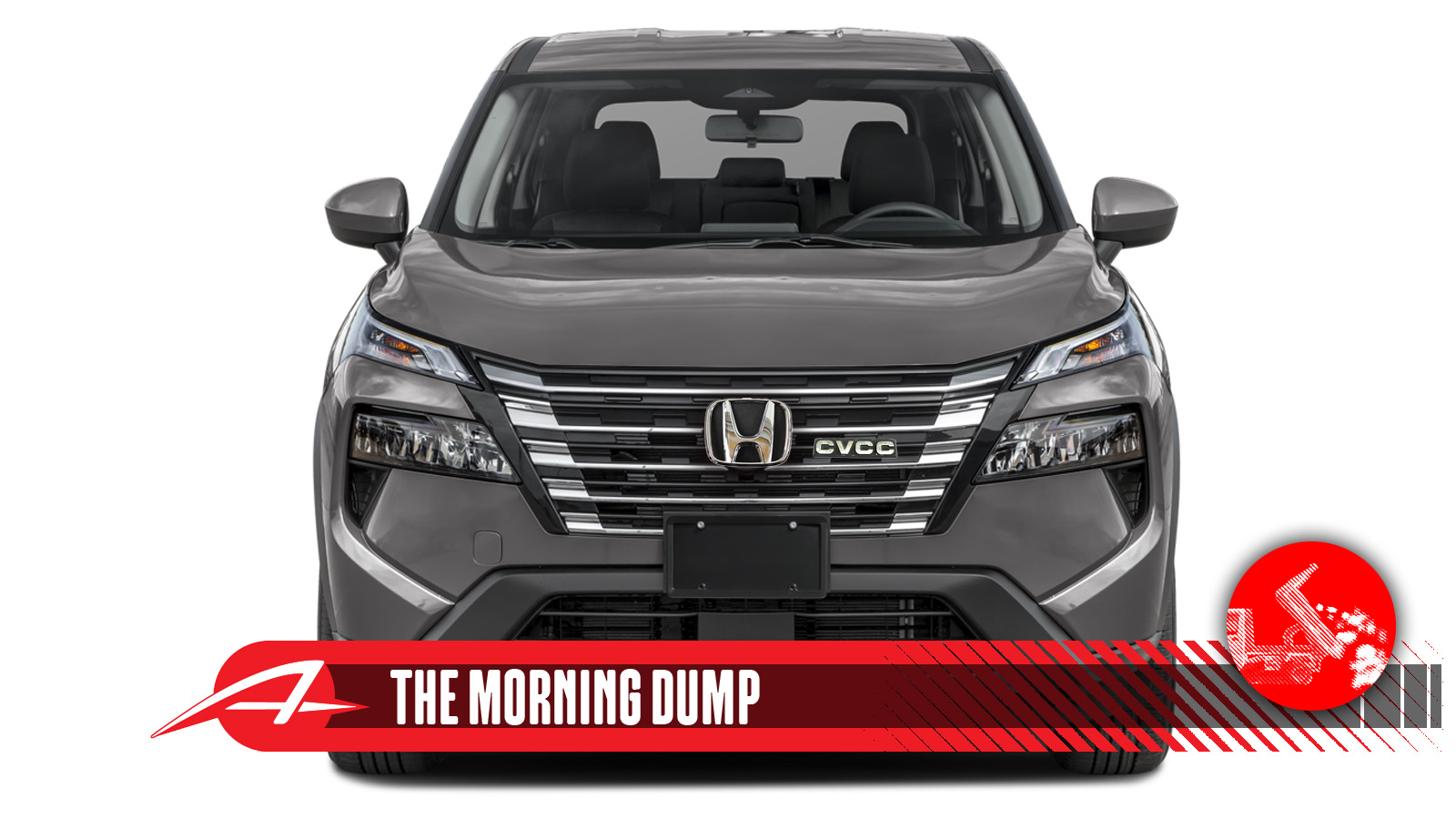
People love a will-they-won’t-they plot, and there’s an enormous amount of leeway given to storytellers to drag them out almost to infinity. But if people adore a Ross-and-Rachel stringalong, they equally abhor a Moonlighting-style quick resolution. My credit to the writers of the Nissan-and-Honda coupling, as they’re experts at the tease.
I greatly enjoyed covering the Nissan/Honda/Mitsubishi/Foxconn drama over the last year or so in The Morning Dump, and I’m glad to hear that it’s not going away. Nissan’s new boss hinted that there are a lot more possibilities for the two companies here in the United States, where both are squared up against Toyota.


Another partnership worth watching is Rivian and Volkswagen, which is hoping to make money by selling its software to other automakers. Software is the key, and Waymo thinks its self-driving software is the best, which is backed up by the Alphabet-owned company’s latest moves.
Trade? Sure, I’ll talk about trade. Specifically, I’m curious about the harmonization between our standards and Europe’s standards.
Nissan CEO Is Buttering Up Honda For An American Tie-Up

If you were unconscious for the last year, then you missed the fun that was the Nissan-Honda whirlwind. The short version of it is that Honda and Nissan hastily announced a vague-but-serious partnership last November, which looked a lot like Honda just buying Nissan. It was quite the hasty move, and it was revealed shortly afterwards that this was borne out of fear that the Taiwanese (aka the ROC) company Foxconn might try to take over a struggling Nissan.
Mitsubishi is still tied up with Nissan, and there were various rumors about this love quadrangle, with Nissan being variously tied to Honda, Foxconn, Mitsubishi, or some mix of the three. Eventually, Nissan’s CEO got cold feet over the idea of being subservient to Honda and killed the deal. Facing massive losses, the old CEO got booted, and Nissan appointed happy drummer Ivan Espinosa to the top role.
Nikkei Asia did an interview with Espinosa, and a big theme was that he would love to do more with Honda in the United States:
“We are talking about how we can collaborate in the U.S. Is there any opportunity for joint product development or for powertrain development? These are the topics that we are discussing,” Nissan President and CEO Ivan Espinosa said in an interview held at the automaker’s headquarters in Yokohama, Japan.
[…]
Though he did not explicitly state whether Nissan could produce Honda vehicles at Nissan’s facilities in the U.S., he did say: “We are open to anything. … The good thing is, both companies have very good coverage in the U.S. in terms of manufacturing, supply network and also engineering capabilities. So we have a lot of, I would say, options to explore.”
Even with Nissan closing plants and shifting more production to the United States, the automaker probably has too much capacity at the moment for its current sales. Honda doesn’t seem to have this problem, as that brand has a way lower inventory than the national average, whereas Nissan is usually well above it.
If Honda and Nissan could collaborate on, say, a small crossover, then Honda could have Nissan build it in Tennessee and use its production capacity for higher margin vehicles like big crossovers. Or, and this isn’t that crazy, the next Honda truck could be a rebaged Nissan with a Honda hybrid powertrain, maybe? That sounds right to me.
Rivian and VW Think There’s A Way To Make Money Off Software

Developing software for cars is hard, and almost everyone is bad at it. Volkswagen was really bad at it, and it took advantage of Rivian’s need for cash to create its own budding romance. It seems to be going ok so far, although rumors from Wolfsburg have shed some light on the potential difficulties of the partnership.
New relationships take time, especially when you get out of the honeymoon phase, so maybe this May-December romance will work out. Bloomberg has a sense of what a successful coupling might look like:
The two companies’ joint venture, known as RV Tech, said it has made solid progress on delivering the EV electrical and software platform that Volkswagen needs to compete with Tesla and Chinese rivals. The JV is focused on delivering models for Rivian and VW but is keeping communication open with third parties about the scalability of its platforms.
“We’re solving a problem for the larger automotive industry,” Wassym Bensaid, Rivian’s software chief and RV Tech co-chair, told journalists at an event in Palo Alto, California, on Wednesday. “That could become an opportunity” for others as well, he said.
The platform is designed to be scalable across vehicle sizes and segments in Western markets.
The earning potential from licensing the technology “is a very different ballgame,” Bensaid said, “and a very different margin profile from a business standpoint than making cars.”
Rivian is having to do a bunch of work to make the platform work for gas-powered VW cars, so once that investment is made… maybe margins can be found!
Waymo Gets To The Highway First
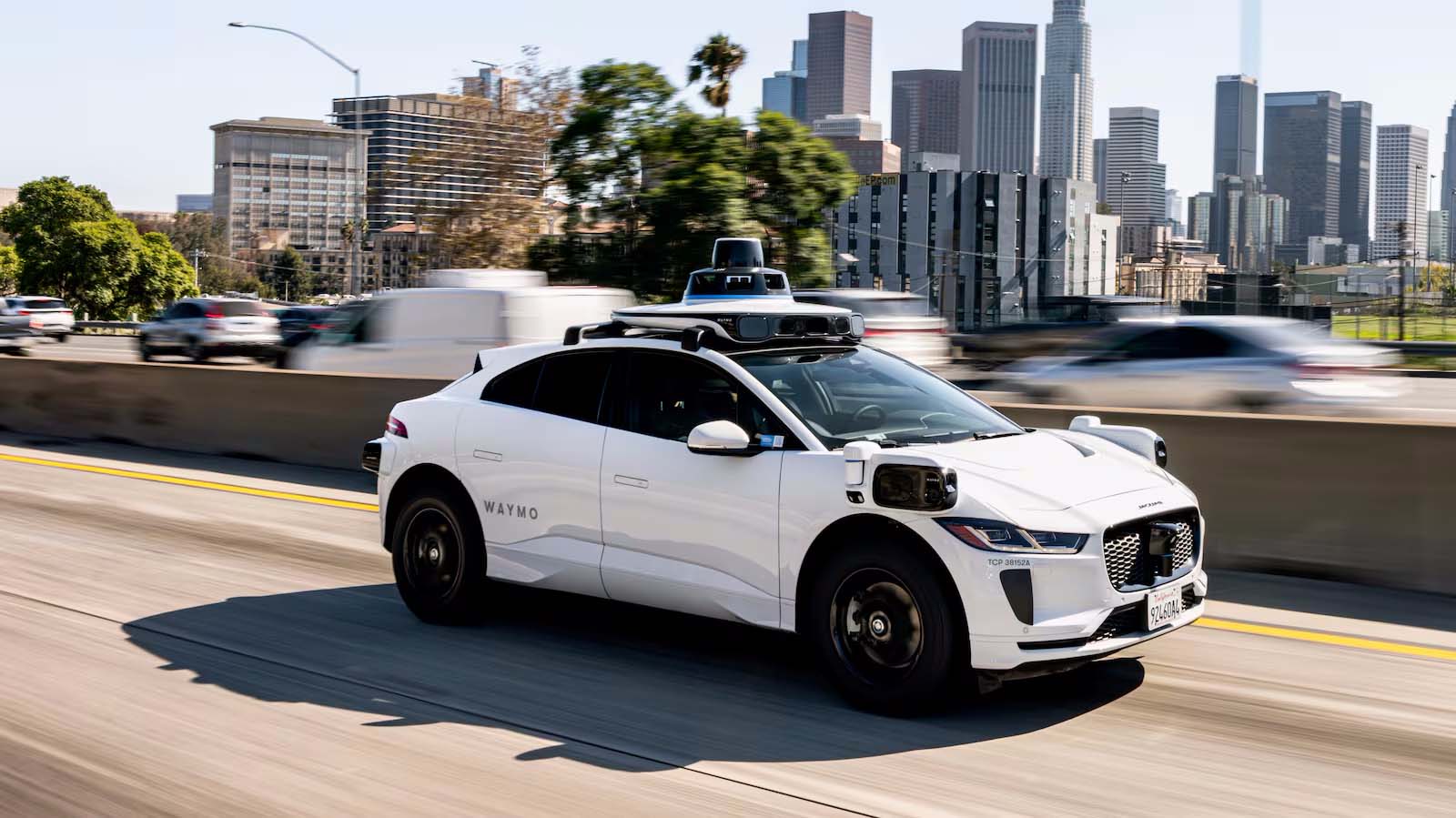
The secret of Waymo is that it works very well, even if the Google-owned robotaxis aren’t perfect. While the vehicles are geo-fenced like Tesla’s robotaxis, the reality is that the Teslas currently operate in a small area and can’t go on the highway.
That’s going to change this week, according to Automotive News:
Rides in San Francisco, Phoenix and Los Angeles will become faster with highway route options starting this week for a limited pool of riders before expanding, Waymo said Nov. 12.
“Freeway driving is one of those things that’s very easy to learn but very hard to master when we’re talking about full autonomy without a human driver as a backup and at scale,” Waymo co-CEO Dmitri Dolgov said on a media call.
Google’s self-driving car project first started testing on highways in its early days more than 15 years ago, Dolgov said.
So far as I know, no other robotaxis in the United States have highway operation, especially without a safety driver.
Is EU-US Harmonization Coming Soon?

The United States agreed to lower the tariff on European cars to just 15%, but like the plans for my BMW, it’s all vibes/few details. We could end up in a world with two very different types of standards and cars, or one where EU countries and American automakers share common (or at least accept different) standards.
From Bloomberg via Automotive News, that’s not out of the question:
The so-called implementation action plan, which has yet to be shared with the U.S., would focus on five areas, according to the people. Those areas include tariffs and market access, where the EU is seeking lower rates for several additional goods including wines and spirits.
The plan also seeks a dialog to address issues such as standards, digital trade, technical barriers and other trade grievances, said the people. It would also explore cooperation on steel and aluminum where the bloc wants to work with the U.S. to tackle global overcapacity.
The EU is still facing a 50 percent tariff on steel and aluminum exports, as well as on many derivative products. The bloc is especially concerned that the breadth of goods hit by the levies risks hollowing out the 15 percent tariff ceiling it agreed with the U.S. The commission, which handles trade matters for the bloc, wants a quota system that would allow a certain amount of the metals exports to receive lower duties.
So you’re saying there’s a chance… I can get a Škoda Superb truck?
What I’m Listening To While Writing TMD
I think it’s clear that I have a weakness for female-led modern/dance-y pop music. But there is a queen above all queens, and that’s Robyn. Robyn is amazing. Just take the day off to listen to Robyn, you have my permission. After a long wait, we finally have new Robyn in the form of “Dopamine.” ROBYN!
The Big Question
What should Honda and Nissan build together?
Top photo: Honda-Nissan


They should build nothing. I am still dealing with the fallout from Honda’s last marriage. I don’t want to deal with two bastard children vehicles at the same time.
If the results are similar to my GM built Honda Prologue, I say nothing. Only 3500 miles in and already had it back to the dealer for service high voltage system TSB on an air conditioning valve that can ‘shift’ it’s position, glad it’s a lease as so far not getting a ‘keeper’ feeling.
Good old GM engineering. I’ve had to ream two A/C lines out so far this month on those piles of crap. I thought we were going to have more issues in the summer time but nope, it’s when people started using the heater more. Oh and had another one today with a failed brake master cylinder. Hot off the one last week with a failed video processing module for the 360 cameras. Fun times!
It wouldn’t be so bad if they didn’t list for over $50k, but you know…they list for over $50k! Oh well, again, it’s a lease, but didn’t expect to be back at the dealer pretty much until it was up.
> agreed to lower the tariff on European cars to just 15%
no, America added tariffs to European cars. Not lowered them.
What should Honda and Nissan build together?
GT-R powered NSX.
Ah an American Nissan-built Honda, when life give you lemons, make Lemon Law!
Have the Waymo people ever driven on the freeway in Phoenix? It’s fuckin chaos out there. If those stupid-ass robot taxis are programmed to drive the speed limit on the freeway like they are on the surface streets, it’s gonna end poorly.
Methinks the second Tesla should read “Waymos”
I mentioned in a reply below but I don’t think Honda cares about BoF, it would just be a product that fills a void that happens to be BoF. It seems like Nissan and Honda are both developing V6-hybrid powertrain for larger utility vehicles, so there may be some duplication of efforts when it comes to something like hybrids of their own Xterra and Passport.
Quick fixes – Altima is gone, but Nissan could slap the name on some Accords if Honda decides they want to move more units just to get more volume. That could apply in China too (not sure if Altima is still in production there). Or Nissan could be a sneaky way for Honda to offload some models into rental fleets which they typically try to avoid (but Nissan seemed to scale back on that too).
I find it interesting that while controlled access highways are the safest to drive on since there is less “noise” like pedestrians and cross traffic, somehow they are the hardest for autonomous vehicles. Even with the higher speeds, it would seem like this would be an earlier environment to conquest.