

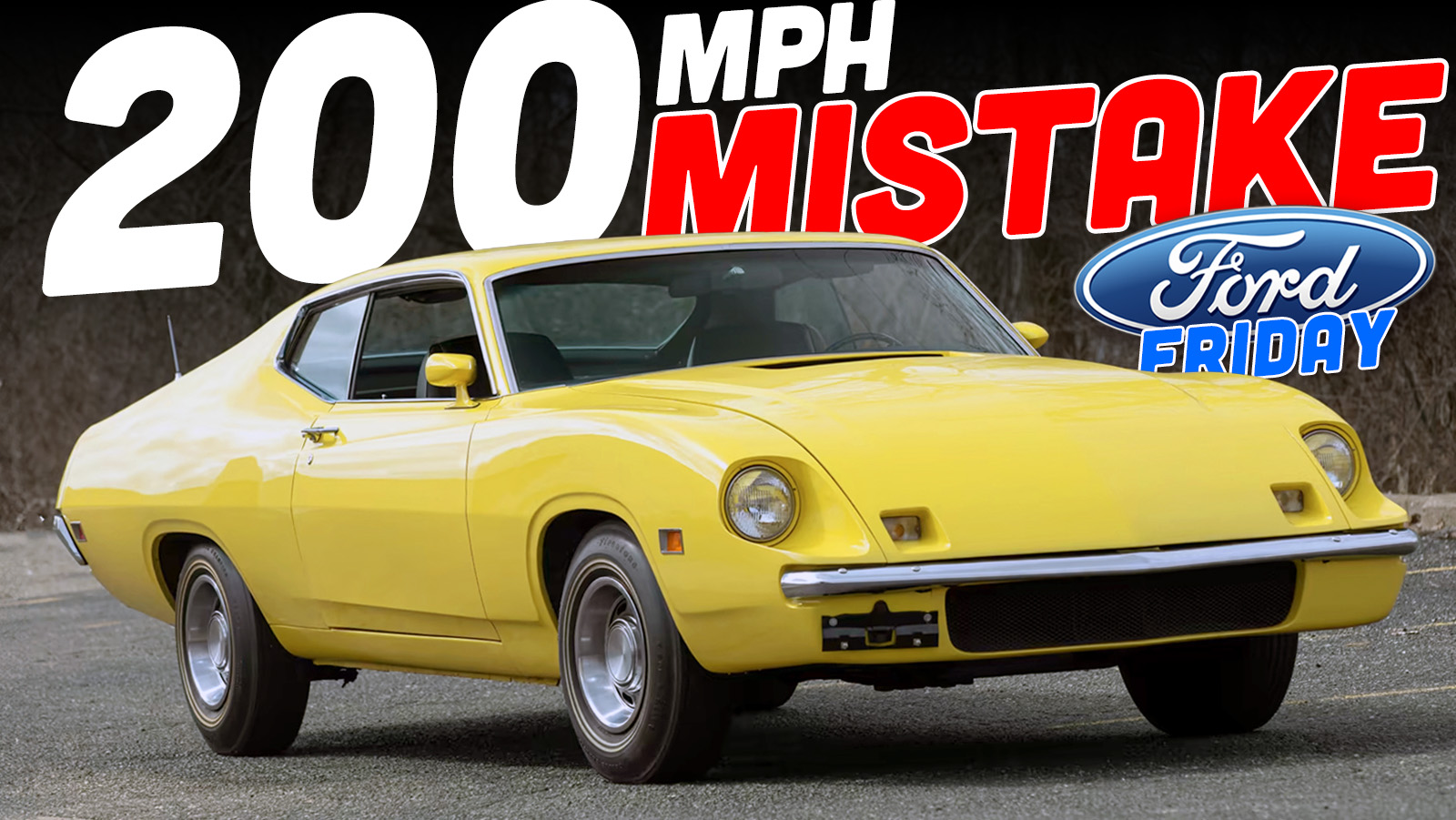
You know that kid back in seventh grade who ruined it for everyone? I mean, the teacher was cool if you flicked pencils up at the ceiling tiles and such, but somehow this buddy of yours went too far, ended up overturning the teacher’s desk or something, and brought on flat-out martial law by the staff.
That’s sort of what happened with NASCAR back in 1970. Chrysler had been pushing the envelope with absurd-looking aerodynamic homologation specials, and somehow the Ford guys just couldn’t let that be. No, they had to be better, they had to be faster, and in the process of doing chasing ever more MPH, they ultimately killed the “Aero Warrior” superspeedway supercar for good.


Wait, We’d Go Faster If It Didn’t Look Like A Brick?
Even though aerodynamics had been A Thing with cars like Tatras and Citroens, American cars and thus NASCAR didn’t get into it for a long time. Oh sure, being restricted to “stock” automobiles meant there was a limit to how much could be changed from the showroom car to the race car, but modifications at the time were allowed as long as there was a homologation run of at least 500 cars. In the late 1960s, Ford would take advantage of this loophole by modifying their rather slick “SportsRoof” fastback Torino to make it even more slippery.

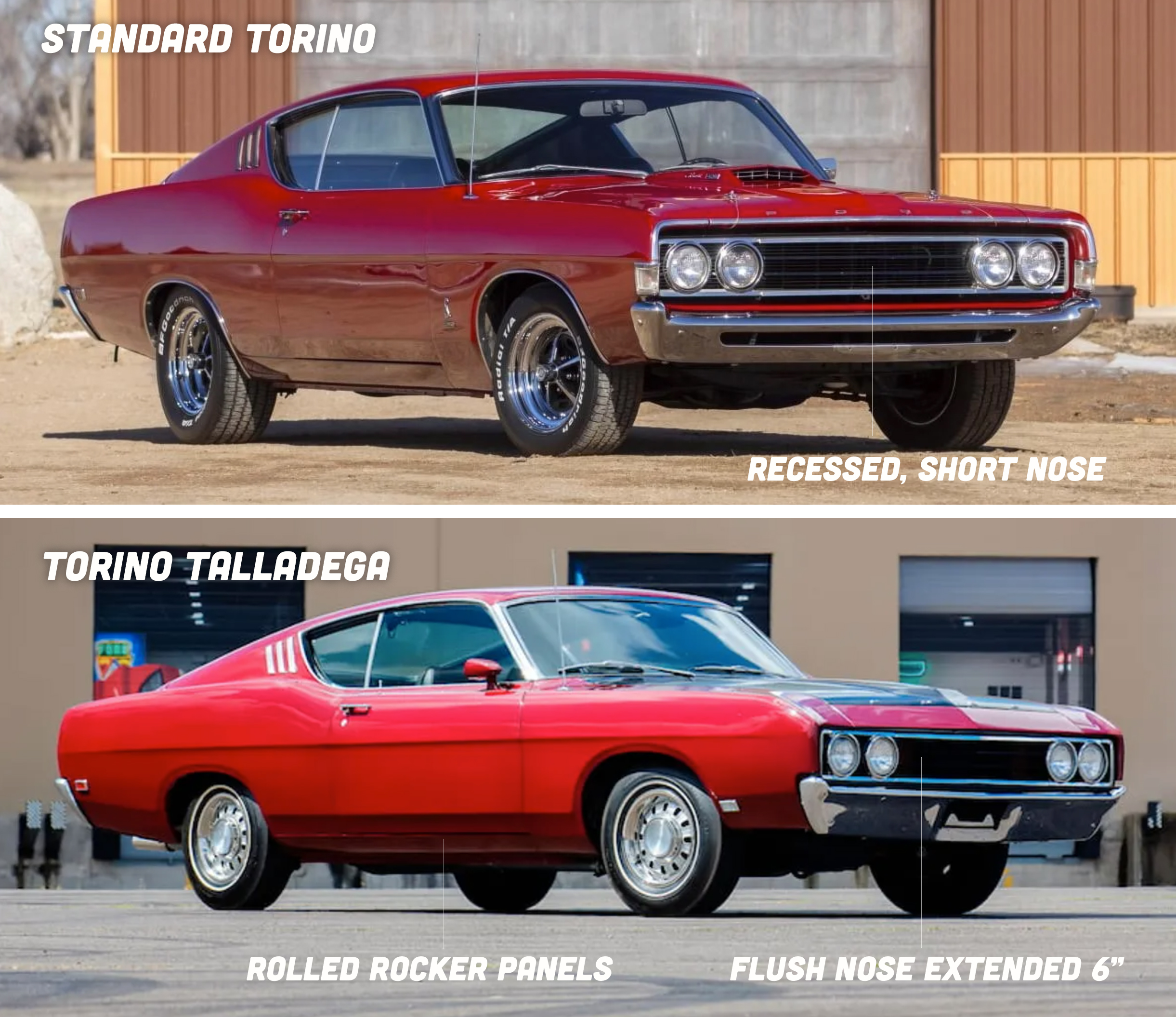
Named for the superspeedway it was designed to rule, the Torino Talladega filled the sunken-in grille of the factory car that played hell with the aerodynamics and also extended the nose about six inches (all done with the sheet metal, not an added-on fiberglass component).


An even more subtle and hardly noticeable trick was Ford’s rolling in of the rocker panels to allow the race version to sit lower to the ground, or at least legally do so.
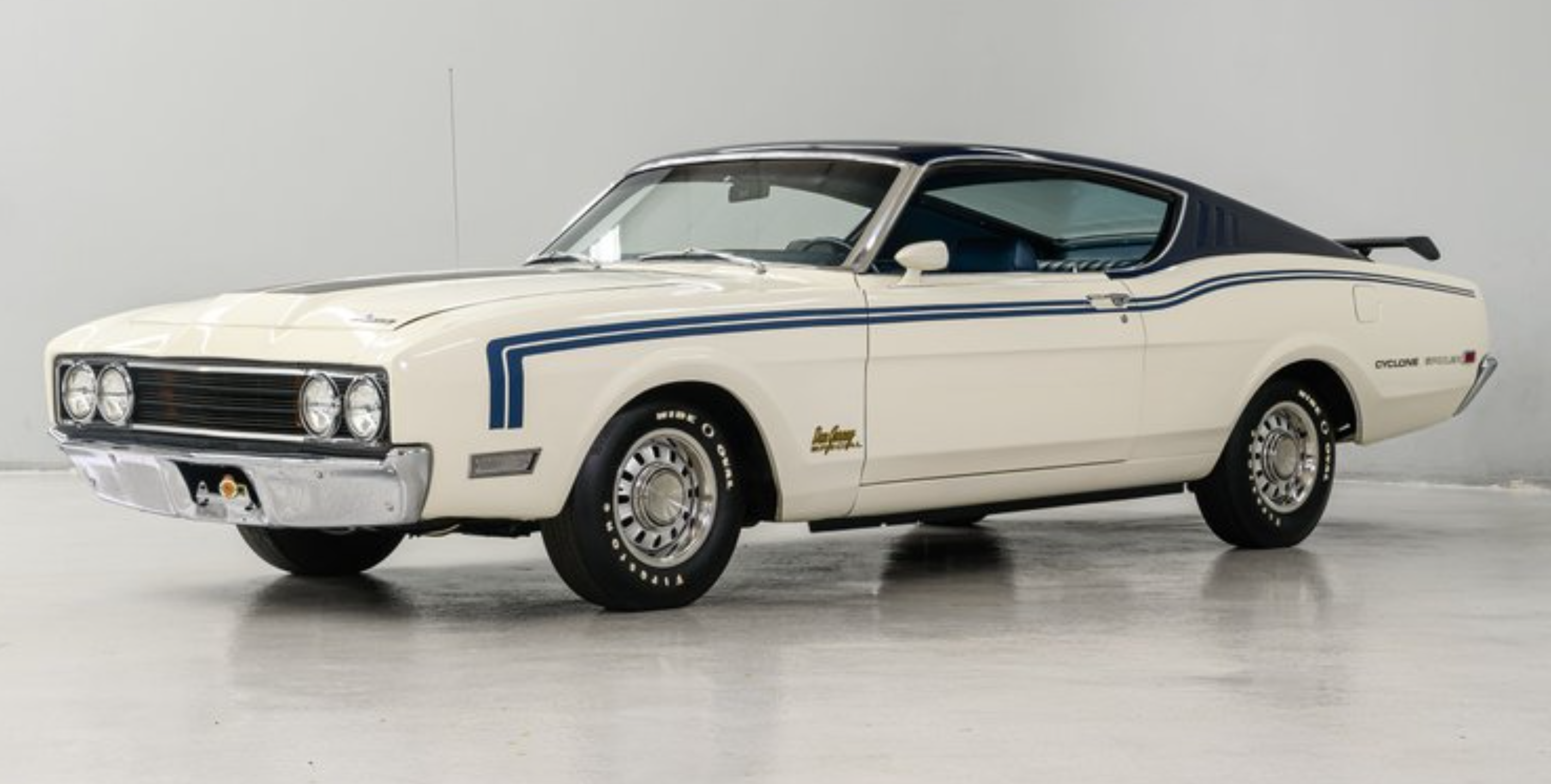
Likely owing to the rather clean, factory appearance of the Talladega, Ford was able to sell at least 750 units of this special, far more than the 500 needed for homologation. Mercury also made their own version of the Talladega, the Cyclone Spoiler II. It looks identical, but reportedly the nose is a few degrees lower in angle, which was good for a few more miles an hour at the top end on the track. True to the name, the “Spoiler” actually did feature a small rear deck wing as an option for the street models, though I see no evidence of it being used on the race versions.
When equipped with the 429 Boss V8, both the Ford and Mercury versions could exceed 190 in competition form, but they never officially broke the vaunted 200MPH barrier. Mopar was the other major NASCAR player at the time, and they couldn’t let these Ford products go unchallenged. The Torino’s modifications were relatively subtle, but Dodge decided to make something that looked a bit like an object Wile E. Coyote would build to chase the Road Runner. With a long, pointed, and painfully stuck-on nose cone combined with a two-foot-tall wing spoiler, the Charger Daytona (and later nearly identical Plymouth Superbird) showed Ford that the gloves were off – “unlimited” cars lapping speedways at over 200 miles an hour (officially 200.447MPH to be exact, posted by a Charger Daytona) would be the way.


Now it was back to Ford to up the ante. Unfortunately, the new-for-1970 Torino was not as aerodynamic as the earlier model, so some major changes would be needed to beat that fearsome Mopar. Thankfully, they had just the person to make it happen.
Shinoda Creates Shinola, Again
As luck would have it, Ford had just recruited legendary Corvette designer Larry Shinoda, a man who would also create the Boss Mustang, the Rectrans motorhome, and the first Jeep Grand Cherokee. Shinoda was tasked with modifying the stock Torino, but he took a different approach than Dodge. Instead of the Mopar solution of a pointed nose cone stuck onto the existing car, Shinoda replaced all of the sheet metal ahead of the firewall (well, the hood was fiberglass).

Turn signals were faired into the nose in a manner not unlike a Ferrari Dino 246GTS. Also like the Dino, the headlights were placed in recessed “buckets” at the leading edges of the fenders. Removable covers to flush out the recesses were supposedly going to be “accessories”. I would have hoped Ford was envisioning some kind of motorized mechanism to retract these in the production homologation cars, but I see no evidence of that.
To combat the issues the Dodge Charger Daytona and Plymouth Superbird were having with overheating, Shinoda added a prominent radiator grille below the bumper.

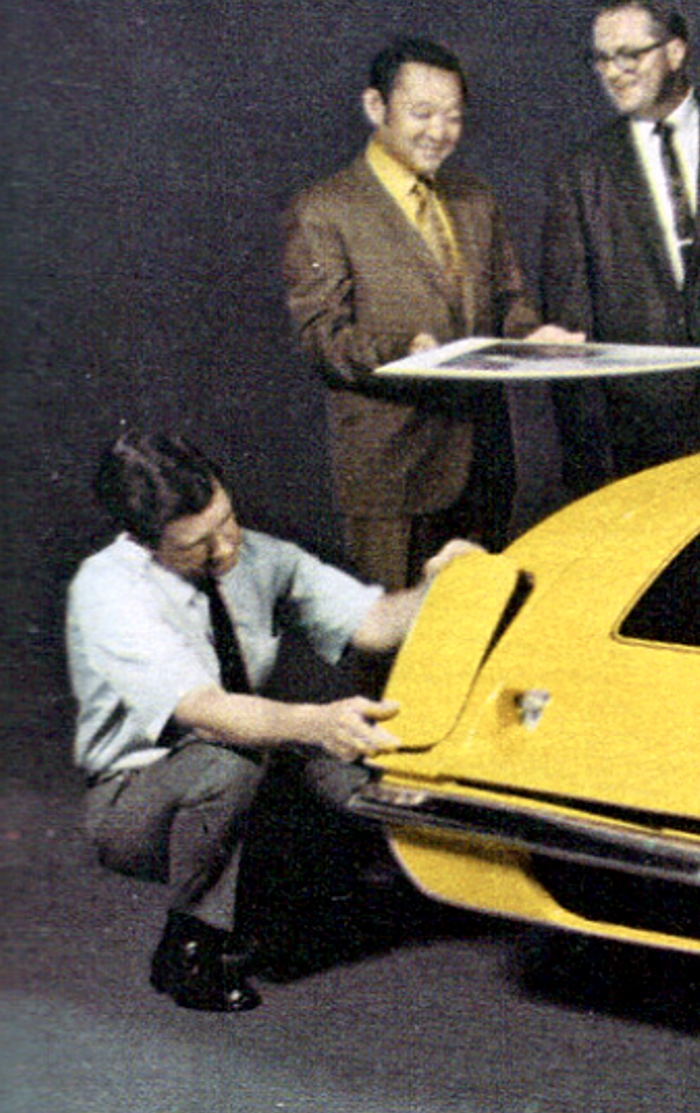
Regardless, the Kind Cobra looks pretty gawky with the open lamps, as if a Torino and a Datsun 240Z had somehow had a child. Were you supposed to get out of your King Cobra at dusk or in the rain to unbolt the covers by hand and throw them in the trunk? That’s a pretty poor design, Larry; I see you below just ignoring that dude installing those stupid things.
Another rather odd omission on Shinoda’s part was a wing of some kind to match the massive ironing boards of the Mopar race cars. The King Cobra didn’t even have a small lip spoiler, much less something as on the earlier street versions of the Mercury Cyclone Spoiler (which, you know, had the downforce appendage in its damn name). These devices weren’t there just for decoration, as Ford would soon find out.
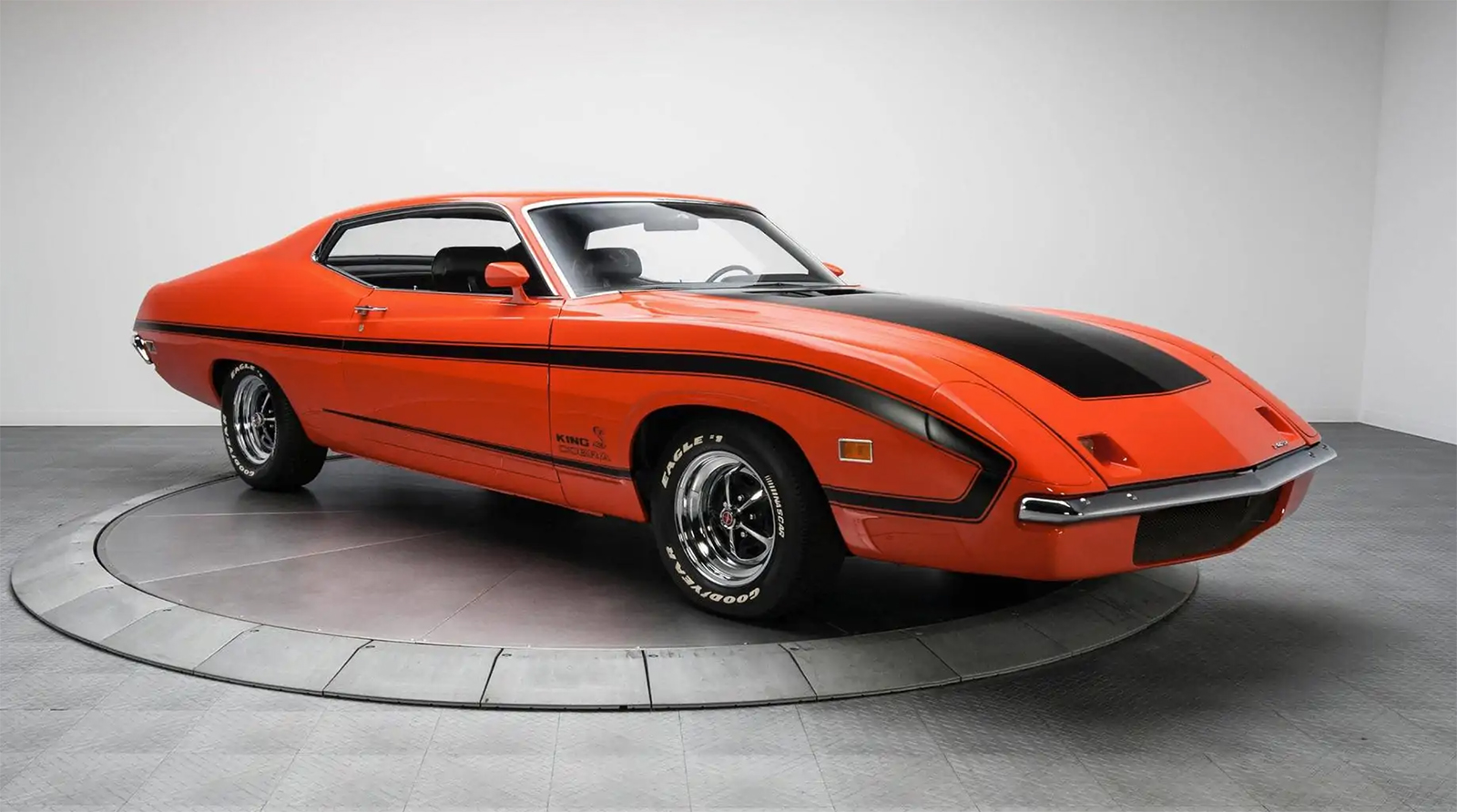
Out on the track, the aerodynamic nose did the job of getting the Torino up to speeds in excess of the magic 200-mile-an-hour mark; almost certainly, the Ford would have been able to go head-to-head with the insane Dodge and Plymouth twins at the super speedways. That sharply raked nose also created downforce, alright: maybe too much downforce. With the lack of any kind of rear wing and the air-sucking recessed rear window, those back wheels were struggling to make contact with the tarmac.

Cale Yarborough did the test runs and charitably called the King Cobra “a real handful.” Ford could have put some kind of wing on back and flattened out the sunken-in backlight to work out the handling, but other factors came into play that would deem such modifications moot. Stories are sketchy, but NASCAR manager Bill France reportedly saw what was going on with Cale testing this deathtrap and decided enough was enough. At 200+mph, any crash would be more like an aircraft accident than a car collision, and with none of the safety equipment presently in NASCAR machines. France wanted no such negative publicity for the sport.
Don’t believe the headlines of clickbait articles claiming that the aero warriors were “officially banned,” however. France’s way of dealing with the problem was remarkably passive-aggressive: instead of the typical 500 cars needed to homologate one of these crazy race machines, he changed the requirement to essentially one needing to be made for every dealer that the brand in question had in the country. For Ford, that meant three thousand or so cars; moving five hundred Torinos with the nose of a 240Z would be hard enough, but six times that? Forget it.

Now, my understanding is that winged cars could still participate in NASCAR events, but there was a big caveat: these 500-car-homologated machines were limited to a maximum displacement of 305 cubic inches. Such a car was not going to be competitive for the Big Prize. Bill France reportedly didn’t like how these spaceship-looking things bore little resemblance to cars on the showroom floor that were built in the tens of thousands, which to him was the heart of NASCAR. He was able to get “stock” cars back to being closer to “stock” by legislating them away without technically “banning” them.
At this point, Ford’s president was Lee Iacocca, who saw zero benefit from the racing program. Remember, at the time, General Motors wasn’t even involved in NASCAR, and Mopar was already a distant third member of the Big Three and no threat to Ford’s sales. Win on Sunday? Lose on Sunday? Lido would sell Torinos regardless. With that decision, the King Cobra project died along with the brief age of Aero Warriors.
Warriors Never Really Die
Despite all of the work, a total of only three King Cobras were completed, and it appears that all are accounted for today. All of the examples are powered by 429 V8s, but they’re all very different and interesting in their own right. Here’s the group:
The Yellow 429 Cobra Jet
This one looks remarkably like a street car with no graphic stripes, which, for some reason, makes it look even more bizarre. It’s also the only one pumping power through a three-speed automatic and sold back in 2016 for $525,000.


The 429 Boss
Rolling on Magnum 500 wheels and with Shinoda’s signature graphics, this four-speed equipped example is arguably the best looking. It is also reportedly the only one with a convex backlight. It was listed for sale a few years back for $459,000.


The 429 Super Cobra Jet
I’m assuming that this is the car shown in the Ford promotional shot with Shinoda and team. Also, it’s a four-on-the-floor example.

The owner of that Super Cobra Jet example also owns a very special version of this Aero Warrior. A Mercury Cyclone Spoiler version with an identical nose was thought to have never existed until it turned up in a barn a few years ago. Fully restored, you can see the different roofline from the Mercury version of Ford’s midsizer.
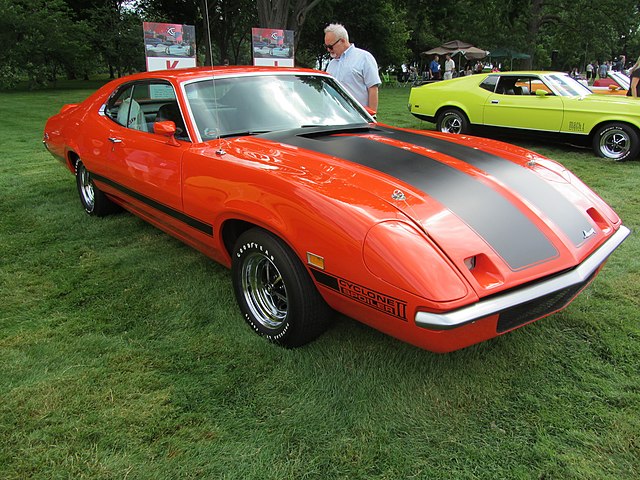
Oddly enough, at least two examples of Torino have appeared with nose cones from the King Cobra. It’s not surprising that Ford had extra parts on hand when the program was cancelled. Nobody appears to have ever built replicas of these front clips since, well, they’re not exactly an improvement over the stock Torino.
Ironically, with the death of the Aero Warrior, the playing field was leveled enough that GM did get back into the NASCAR game after all. The General did rather well for themselves until Ford came back years later with another aero weapon, this time in the form of a slick street-legal 1983 Thunderbird.
The King Without A Country
Considering that survivors of the 135 examples of 426 Hemi-powered Superbirds can sell for over a million dollars, you would think that a historic racer made in quantities you could count on one hand would go for even higher seven-figure sums. That’s not the case with the three Torino King Cobras, which struggle to break half that amount. Sure, they look a bit odd, and they never did turn a wheel in anger on the track, but that just adds to the mysterious appeal of this warrior that came to the party too late to be a spoiler (excuse the pun) for Mopar.
Top graphic image: Mecum




lead photo gave me the impression of a lotus europa.
weird.
I saw that too. The heaviest Europa ever.
In my early teens I had a neighbor a couple of blocks away that had a beautiful BRG ’72 Europa Special. Going through a Wikipedia article about Europas, I had no idea the early ones were so gutless. Probably handled great, but straight-line acceleration was definitely not their thing. It was certainly cool to look at back then, but getting in and out of one would not be fun these days.
Funny Torino Talladega trivia, the front bumper was a Torino rear bumper because it worked better with the modified nose.
GM pulled similar shenanigans in the mid 80 with the Monte Carlo Aerocoupe and the Grand Prix 2+2, which grafted a fastback and a sloped nose onto the square rigged G body to compete with the slippery Thunderbird.
I would like to add one of the aero cars that weren’t included in this piece: The 1968 Dodge Charger 500. It predated the big wing cars and was more like the Torino Talladaga, with a flush mounted grill to reduce drag and a flush rear window (the recessed one on the normal models produced unwanted lift. Only 392 examples were built.
My older brother was a designer at GM in the mid 70s and was sent by Chevrolet to put Cale Yarborough’s Monte Carlo into the Lockheed wind tunnel outside Atlanta for fine tuning modifications. It was top secret for awhile, but every team eventually had to get smarter about aerodynamics. Cale drove for Jimmy Johnson’s team at the time, and was winning a lot of races during that period. Driving my brother back to the airport on one trip, Junior jumped out of his car at a traffic light in downtown Atlanta, whipped open the trunk of his Cadillac and grabbed a 12 pack of Mason jars which he handed to my brother, got back behind the wheel and off to the airport. The Mason jars contained crystal clear corn liquor from Johnson’s own still! The cool factor was that running that moonshine from the feds was a concept that evolved to become NASCAR eventually, so sipping that whiskey made my brother feel connected to his assignment. And proud than Junior Johnson obviously approved of his contribution.
Yes but still illegal at the time he made you his drug mule lucky you didn’t get caught
Nah it wasn’t the King Cobra that killed the aerowars, it was Big Bill France Sr.
Years ago, I was wandering around North Alabama looking at if a real hand crafted rug was in budget (spoiler alert it was not). Went to this giant warehouse that was full of carpets I couldn’t think of affording. In the center was this old guy with about 20 filing cabinets. Ends up he was the head of the engineering team that worked on Chrysler’s bid for the Apollo project. When Chrysler didn’t win that contract, he thought he would be looking for work, but Chrysler told him to take over the team to do the aerodynamics work on the Superbird.
So, it makes sense that the Ford’s effort, designed by a car designer would have problems that the Chrysler product did not. The guys that designed the Superbird were literally rocket scientists where 200 mph considered walking pace. Because something can look fast and not actually be fast, with tiny little tricks to make a giant difference. Dude showed me briefly some faded drawings of the Superbird and talked a bit about some of the minor details that made a huge difference.
The old retired Chrysler engineer loved having a fellow engineer to taught to and we talked for a couple hours. The Superbird was a boring subject to him. Just a simple job to make the car faster and more stable, nothing to it. What he loved was the Turbine car, which he said he took over in the early 70s and by the late 70s had test cars that got 30 mpg that were lasting on the test track for 200k+ miles with no problems. He retired when Chrysler dumped that car for the crappy K cars, which he was quite salty about.
I wonder what happened to him. I hope his family kept his stuff.
When I was in high school a girlfriend had a Talladega Torino which her father had picked up used really cheap. Really nice car considering.
But the next NASCAR version in the article was a total disaster.
I once spoke with Benny Parsons about those models vs the MOPAR Super Birds, or Daytona Chargers. He said that the Fords were death traps and that NASCAR wanted them banned for the unstable handling as Big Bill France felt that the optics of drivers being killed, or injured would hurt the sport. As well as damage the expansion plans France had in mind for the sport at the time. So the Fords were stuck with a basically stock body, and it was pretty much uncompetitive vs the MOPAR offerings.
Not sure of the exact year here, but I think it was 1970. The King of NASCAR, Richard Petty had switched to Ford from MOPAR. The story I have heard is that the Fords were so inferior to the MOPARS that he left Ford and switched back to the MOPAR offerings in mid season.
A lot of folks don’t realize or remember that Petty was the face of NASCAR, as he was the most popular and the winningest driver at the time. I recall that one season he won 30 races out of some 60 races he had entered, I believe it was in 1966, but not certain. I have the actual numbers, but they are in a book. which is buried somewhere in a box in my house, so apologies for any possible lapses in my memory.
Benny told me that Ford had trouble getting anyone to actually test the proposed Fords in this article due to how unstable they were at speed. According to Benny the MOPARS were damn near impossible to spin out or crash unless a tire failed.
I remember seeing one of the Fords that Cale Yarborough drove in the storage area of Talladega in about the year 2000. It was waiting to be restored for display in the Talladega museum. Compared to the MOPAR offerings it looked like a poorly adapted dinosaur.
Thanks for a well written article here. Appreciate your efforts.
Edit. Just looked up some more about this subject here. Amazing how many of the search results were just total crap, as in AI written, and full of errors.
AI is just like the current President and his turds. Full of non facts and lies.
When I was a kid we knew someone with a Cyclone Spoiler II, and I never once considered it special at all until today. I knew it was rare, because I have never seen another one, but I had no idea of its history and thought it was just a sticker package with a spoiler.
Definitely never felt the “what if?” pains of these never having made it to production. And, WTF, the stripe on the orange one doesn’t even follow the curves of the car. They’re cheap because they’re hideous, never raced, and the Torinos have never been tops with collectors, especially vs the Charger/RR.
Probably looks great after you drink a few King Cobras.
Only a face a mother could love.
It looks like somebody was let loose with a crashed Maverick and Europa and merged the two
The old 240 to 280 Z cars always looked better when a clear head light cover completed the aero lines on them. I could have definitely seen these ford covers being clear plexi had they been homolgomated. https://zcardepot.com/cdn/shop/products/datsun280zheadlightcover.jpg?v=1659385983
They were popular aftermarket for obvious reasons, but the OEMs weren’t allowed to sell cars with covers. I believe the official reason was causing glare, which is funny when you consider the magnitude of that issue with modern supernova lighting vs the mellow-colored scented candle output of old sealed beams and halogens. I think the aftermarket covers were technically illegal (“off road use only”), but I never heard of anyone getting bothered for them on any kind of car unless they were smoked and a cop had another reason to want a look at you.
Yes, I wanted them for the family 280z 2+2 but we were in a state with annual inspections so no. Plus dad would never go for drilling into the car.
I’m in one, too, but you could just remove the covers for it. Or not, as things were also more laid back then and it wasn’t too hard to find “a guy” to slap a sticker on nearly anything for a higher fee, though one usually went to them for emissions or rot reasons. My S30 Zs didn’t have the covers and I swear I could feel the drag from the headlight pockets with what was already terrible aerodynamics (lot of drag, lot of lift).
I baked my own curved clear plexiglass covers for my Vega Sportwagon which had the later, scoopy headlights. Two reasons clear headlight covers were illegal back then: No access to the three nubs in the sealed beam bulb glass that alignment jigs used to legally aim headlights correctly, and the belief that anything other than glass was considered not durable enough. Ha ha, my Vega had then-illegal in the U.S., European Cibie halogen headlights with concave faces and no nubs in the glass anyway! Gotta remember, this was back in the 70s, when I think SAE engineers must have been Mr. Magoo’s blind kids. (The headlights outlived the Vega, which dissolved in two years!)
Bishop: great job matching the photos for comparison/contrast! Very easy to see the elements you highlight.
I’ve seen those cars for years and honestly didn’t know the changes were that extensive until researching this post.
All they had to do was go south and enlist the the Pursuit special mechanic to add a Monza snout and Phase 4 Heads. and Bobs you uncle.
I got a model of a King Cobra for my birthday one year.I had my dad take me back to hobby store to return it for a Richard Petty Superbird.I still have that model somewhere in my basement.How about that old Testor’s glue???I had no clue why my eyes would water or how I got dizzy but after enough time I really didn’t care.
Those were the days, right? LOL.
And my parents wondered why I would spend all day building models back then…
And the weird metallic pliability of the tubes. I’m sure they were made of lead. Good times.
Gotta say, that King Cobra just looks ungainly. The Torino Talladega looks fantastic, though – I’d love one of those.
On another note, I remember seeing a yellow Superbird in a supermarket parking lot when I was a kid and wondering what planet it came from.
I am old enough to have seen a charger/superbird get driven around on the street in the early 1980s and hear how people did not want them as they were so strange. I wonder how those old timers felt knowing they could have gotten something cheap that would be a small fortune one day.
I’d bet a lot of them were laughed at as it took quite a while for them to take off (bad pun intended), or most muscle cars for that matter. In the early ’90s, a friend of mine had a matching number BB ’68 Chevelle SS that he restored with his father starting when he was 14. It was appraised for insurance at $6k. I was always more into sports cars and weird stuff, but I remember being shocked at what a deal most muscle cars were, particularly as they still more than held their own performance-wise, if only in a straight line. Those with patience would have won in the end.
One of my favorite bits in Joe Dirt is that Joe’s first car is a Superbird. Clapped out, but still a Superbird. The connotation that it would be the appropriate car for a down on his luck janitor is very much of its time.
I was just thinking about that. I was like “Holy crap; he has a SUPERBIRD? Dude is rich!”
Joe Dirt’s car wasn’t a Superbird, but a Daytona (a clone in real life).
David Spade bought a real Daytona, in meticulous condition, but somehow sold it at a loss. More recently it went for $1.46 million.
https://www.mecum.com/lots/539535/1969-dodge-hemi-daytona/
Dang!
And yet – it wasn’t quite “The End Forever”, was it?
Because look what Chevrolet and Pontiac did with the Monte Carlo and Grand Prix Aero Coupes of 1986-87 in response to the concurrent Ford Thunderbird?
They probably were cut some slack because they were playing catch up with their brick shaped 1978 G body coupes with the aero T bird being undisqualifyable since that was the stock shape.
That’s totally why GM did it – but it was still done primarily for NASCAR just the same as the Superbird, Talladega, etc.
Chevy sold a lot of Monte Carlo SSs, so the higher homologation numbers didn’t matter. Pontiac, OTOH, I guess they must have barely hit the minimum as they sold very low 4-figures because holy Persephone were they ugly!
U-U-G-G-L-L-Y, if these don’t draw top bucks, that’s why.
Despite the silliness, I think the automotive world would be better off if racecars were actually based on real roadcars rather than tube-frame-and-custom-engine-with-stickers.
It depends on the racing series in question. A lot of Rally cars are based on the real thing, as is a lot of touring car and endurance racing classifications, but otherwise I totally agree. It’s hard to get excited about “stock car” racing where the car isn’t even built by the company it’s playing dress to look like. And an F1 car is so far removed from a regular car it might as well be a different sport altogether.
Agree. But check out IMSA…the GTD class is pretty as close to road cars (with added safety and racing accouterments) as it gets.
That Ford front end looks damningly close to a pinto. Fugly At least the Superbird completed the cartoonesque part of the brief.
I see more Maverick, but I thought the first couple of years of Pintos looked fine. They were fun to drive as I remember,
A true hot hatch.
Too bad they didn’t use the aero lessons learned towards improving fuel economy.
They could have improved both performance and fuel economy, if they’d have kept the big V8 engines(even if de-tuned for emissions), and then made the platform as efficient as possible around the big engines. Even in the 1970s malaise-era, Cd values around 0.20 for streetable cars were possible. Consider the Mercedes C111-III streamliner with its 0.19 Cd value as a starting point.
This could have yielded V8 “muscle”cars with 160-200 horsepower, that with shrunken dimensions to allow weight reduction and frontal area reduction, could have been as fast as the actual musclecars of the 1960s, while getting maybe upper teens MPG in the city and 30+ MPG highway. Then have 4-cylinder models and diesel V8 models that get close to double that economy.
By the late 1980s, with further improved aero with Cd values into the 0.1X range and rising engine outputs, maybe we could have seen a twin-turbo V6 from a Buick GNX placed in a 2,700-ish lb coupe with a Cd value around 0.19, that got like 50 mpg highway, 0-60 mph ~4 seconds, and a top speed over 200 mph.
Designing a car for use at 200 mph is completely pointless for American roads though, kinda like how we sell pickup trucks with the hauling capacity of an earthmover to urbanites.
I want a race series that is basically “run what you like as long as it’s safe in a crash, but you only get X gallons of pump gas.” If the cars get too fast for the track, cut the fuel ration.
And you have to arrive, race and leave on the same set of tires.
I have thought that a race series that was anything you want but with a skinny 400 tread wear rating spec tire, and a spec driver cell. Maybe have a claiming provision for engines, or spec a torque-limiting coupling with a minimum weight and size engine.
Everything thing else is open. Want active aero, dual mass suspension, or anything else Jim Hall or Colin Chapman got outlawed? This is a home for you.
Not necessarily cheap racing, but anything goes engineering.
Think CanAm on truck tires.
Great piece – thank you Bishop!
Back in those days, seems Ford was often playing the spoiler – its experimental 427 SOHC V8 was built for the same reason, in that case to dethrone Chrysler’s Hemi. It too never saw official action, though IIRC NASCAR did officially ban it.
I think that the SOHC 427s wound up on the drag strips, where rules were flexible.
“kind cobra” almost sounded more like a joke at how much friendlier it looks with that goofy front end, took me a second to think about how it was probably just a typo
Well, every pic I’ve seen of Larry Shinoda has him at least glancing benevolently at his creations, say compared with Carroll Shelby, who always looked like he was scheming…
Cobras can actually be quite friendly once acclimated to people handling them.
https://www.youtube.com/shorts/A2Q6qTp8yjc
https://www.youtube.com/shorts/VIS5GF6xpj4
My king cobra likes to be handled.
And what would Bill France think of the “stock” cars these days?
Nothing stock about them any more. BF Sr. is definitely a spinning top in his grave right now.
Now to harness that energy and use it to charge EVs. That would probably get him spinning even faster, enabling even more EVs to be charged, spinning him ever faster and providing clean cheap energy for the world!!!
You sir have found the pathway to free energy my friend.