


Citroën is known, as I think I’ve made abundantly clear, for making some pretty idiosyncratic cars. That’s why I’m so fond of them. Well, maybe this goes more for Citroën past as opposed to modern Stellantis-run Citroën, but you get the idea. Still, for all of their weirdness, there’s really one weird-car hallmark that Citiroën hasn’t really touched: rear engines.
Well, I guess that’s not entirely true. The Citroën 2CV Sahara quite famously had an engine in the rear, but that is only because that was the only place to stick a second engine, which was the way that the company achieved a 4WD 2CV. So, yeah, that’s a rear engine, but it’s one of two engines, so that doesn’t quite count. I’m talking about single-engined cars with rear-mounted engines, like a Volkswagen Beetle or Renault Dauphine or Chevy Corvair or something.


Still, I’m not going to pass up a reason to show a 2CV Sahara cutaway:

I never get tired of those. So, anyway, Citroën is known for odd cars, but not really rear-engined cars. And, when it comes to rear-engined carmakers, I’ve written before about a strange and usually unrealized dream these companies seem to have, the dream of a rear-engined, streamlined one-box sort of zeppelin-shaped car.

Really, it’s amazing how often it seems to come up. Volkswagen/Porsche, Tatra, Fiat, all these companies had prototypes of cars like this, or, sometimes, actually realized models. Other smaller carmakers like Stout or Buckminster Fuller’s Dymaxion played with these ideas as well, but only a few of these cars actually made it to any kind of production, like the Stout Scarab or, more successfully, the Fiat Multipla. I think we can out the VW Type 2 Microbus in this category, too, if we’re feeling generous.

The basic traits of these cars are a sort of mono-volume body, usually quite streamlined (at least streamlined according to early-to-mid 20th century understanding) and an engine tucked away at the rear. These cars could be fairly large, but they used their interior space generally well, being essentially like sleeker-looking vans.
What I never realized, somehow, is that in this set of more expected rear-engine proponents like Fiat and VW and Tatra, Citroën at least once experimented with the idea of a streamlined, fuselage-like rear engined car, and they were doing it early, as in 1936 early, essentially contemporarily with the Stout Scarab, one of the most famous pioneers of this odd breed of car.

The experimental Citroën in question was a concept car that was part of Citroën’s bold 22CV program, which was essentially a plan to make a V8 version of the famous front-wheel drive pioneer, the Traction Avant.
22CV refers to the French tax classification system that gave the 2CV its name, but since this proposed 3.8-liter V8 engine would have made about 100 hp, very much no joke back in the 1930s, it would understandably be taxed at a much higher rate, 20 more than the humble flat-twin 2CV.
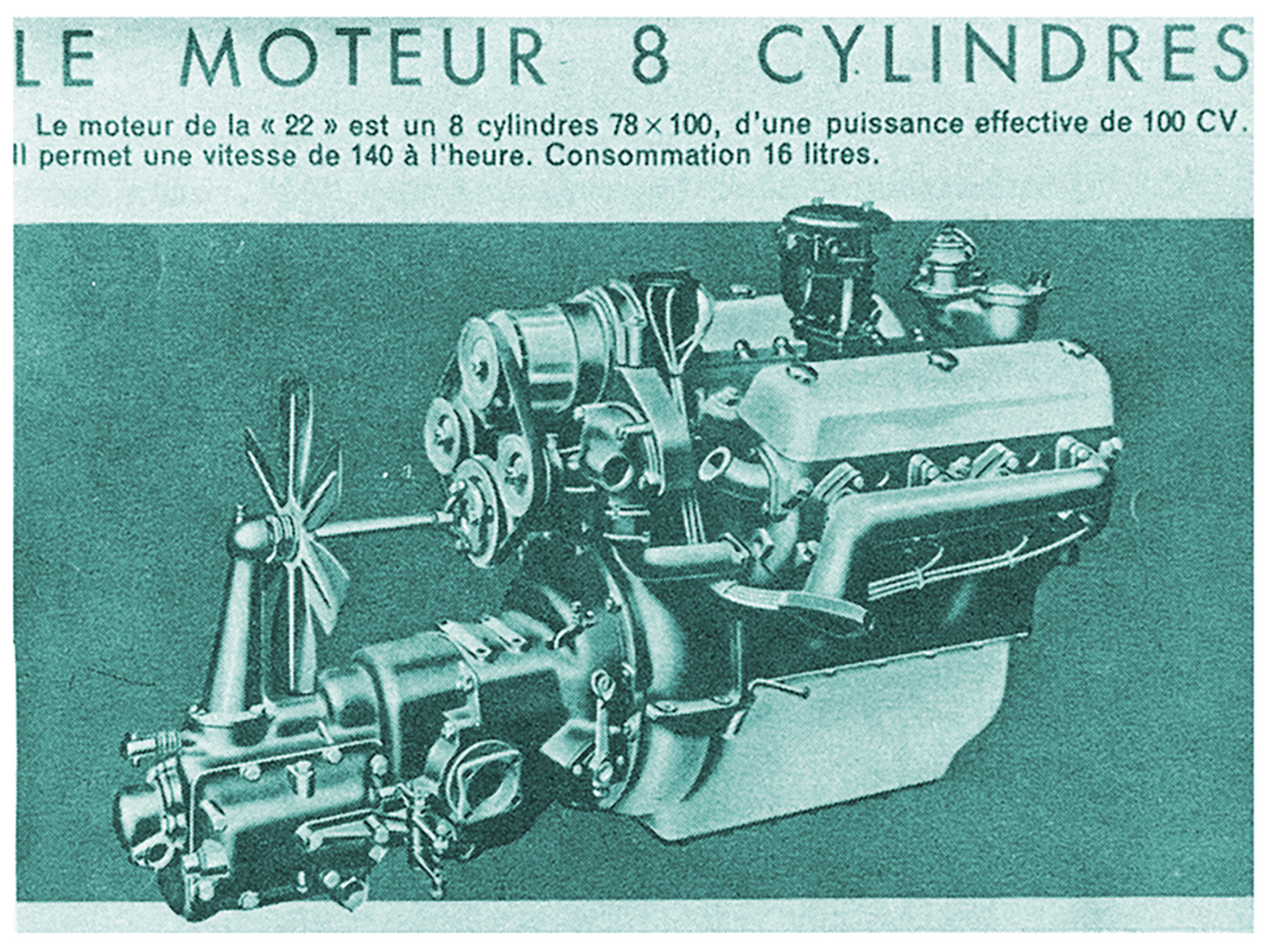
The 22CV was intended to be a production car, the flagship of the Citroën fleet, a large, fast, luxurious FWD machine, available in sedan, convertible, and even longer sedan forms. It was shown at the 1934 Paris Salon auto show, and there were even drivable versions for demonstration rides, but those were suspected to have used Ford flathead V8 engines.
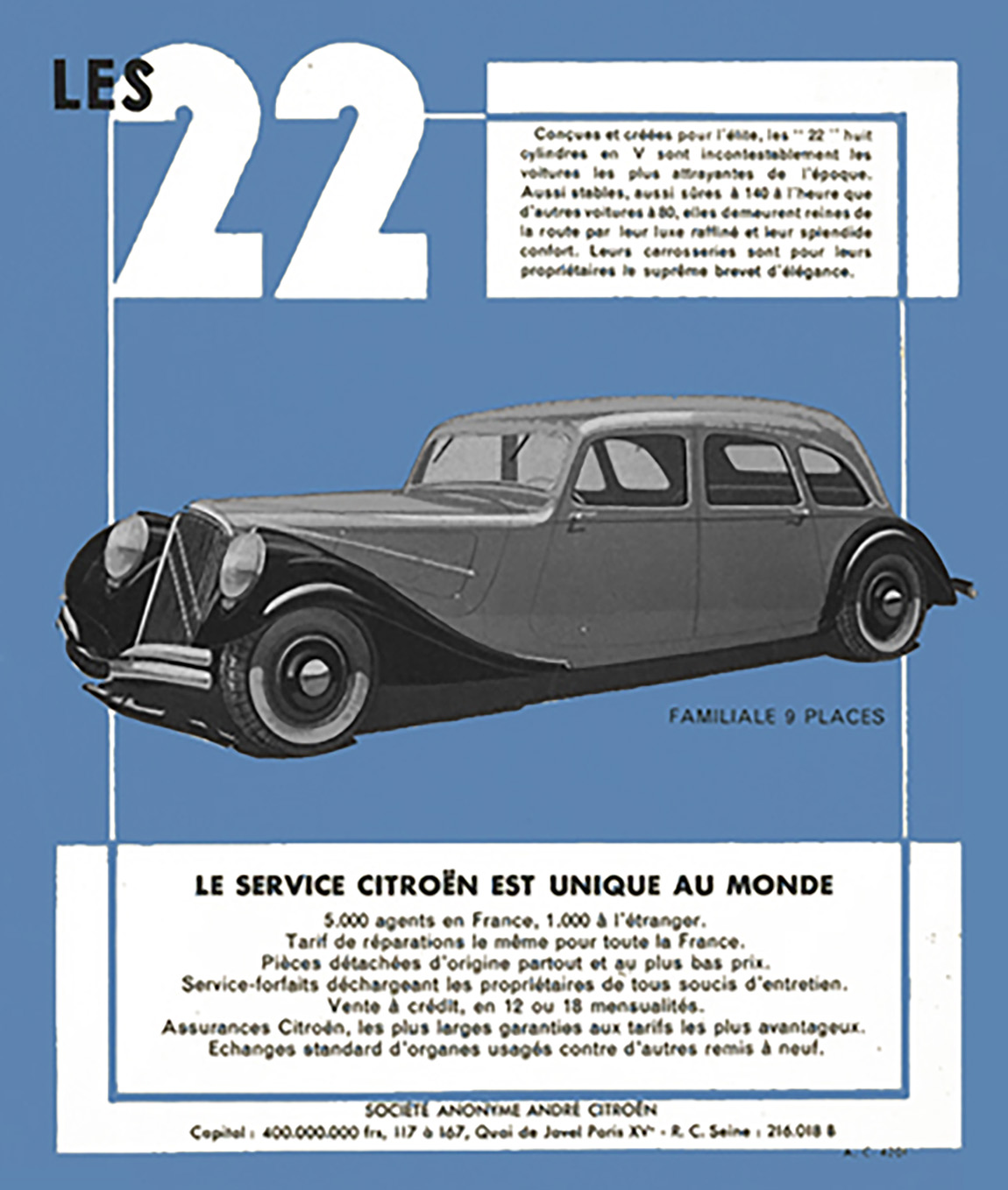
For a variety of reasons, the 22CV never made it to production, though a number of prototypes were built. And while it’s not clear if one of those prototypes was ever the rear-engined concept, that did at least exist in the form of, well, at least one drawing. I’ve been looking for other examples of the car, renderings, blueprints, whatever, but so far have had no luck.
From the one drawing I have seen, we do seem to have an ideal member of this retrofuturistic concept: we have the 22CV Traction Avant drivetrain re-located to the rear, and everything else wrapped in a streamlined envelope that feels more like a train than an automobile.
The doors and side windows look to be borrowed from the longer-wheelbase Traction Avant bodies, but here we have those doors inset into a body with glass or maybe more likely perspex/plexiglass roof panels, all four wheels skirted, and a dorsal fin much like the contemporary Tatra T77.
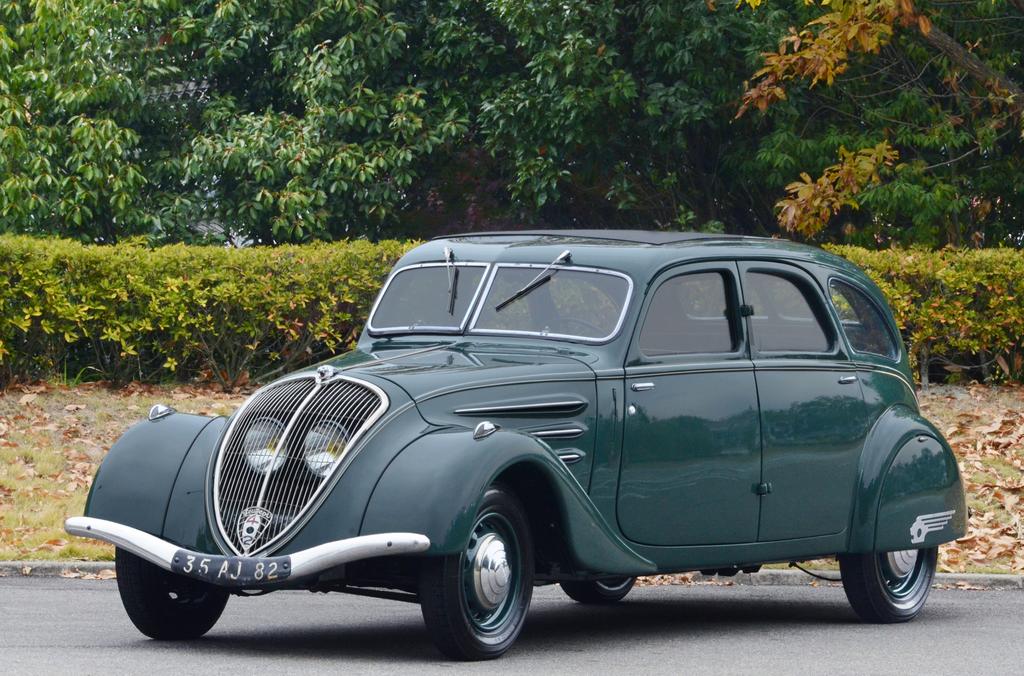
There’s a grille there, too, which makes sense, seeing as how these were liquid-cooled engines, so there must be a radiator and a lot of long hoses in there, and the headlights are inset behind the grille, much like a Peugeot 402 from that same era, with its “fencing mask” grille that contained the headlamps.
I wish there was more information about this car out there, but it seems everything written is all going off that one promotional image from the company. I’m amazed how early this concept was, and how much it is like all of those similar attempts that followed, well into the 1960s. Citroën is just not a company I ever associate with rear engines, so this is especially odd and compelling to think about.
The 22CV itself is something of a Citroën mystery, a lost car of sorts, and this rear-engined zeppelin version is even more rarified and strange on top of all that. Part of me wishes history had progressed down lines that would have made cars like this common, and in such a world we’d likely travel a lot by dirigibles docking to masts on skyscrapers, eating in brightly-lit automats and looking stylish in hats.
That’s not where we ended up, but it’s fascinating to see records of these refugees from a future that never was.




Reminds me of one of the best COTD’s ever that I’m amending:
Flyingstitch:
“…and I need to fix my CV boots.
This could make for a great “who’s on first” conversation at the parts counter.
“I need 22 CV boots.”
“That many?! Sure, make and model?”
“Yes.”
Engines were always Citroen’s bete noir. The DS was originally to have a pancake six, but that went by the wayside too. I can attest the 2.3 in my ’74 Pallas was none to sprightly, even with the Borg-Warner five-on-the-tree. But then again the brief was transporting four businessmen from Paris to Lyon in comfort, not rapid acceleration.
And actually, once you got the thing up to speed it had a chassis capable of maintaining said speed for a long time.
Hence why the DS was successful in the early days of rallying.
Time for the next Citroen history tidbit 🙂
Pierre-Jules Boulanger, Citroen’s eventual next president, came with Michelin. He’s known as the father of the TPV which became the 2CV, but also with his little “optimizations” once the Germans took over Citroen during WW2.
As all the production went for the German war machine, refusing to work or sabotaging were a quick way to the gallows or to the work camps in Germany proper. So some French finesse had to be applied to the production process.
Besides slowing down the production of military trucks for the German army to the slowest possible pace before becoming blattantly obvious, Boulanger is credited with the introduction of the “Wermacht export special” (or at least that’s how I call it) oil dipstick.
The “Full” notch was simply moved further down the dipstick 🙂
The truck would leave the factory in perfect working order, and once on the front, the German mechanics and engineers would dutifully and regularly check the oil level and confirm it’s at full, while the engine was oil-starving. Sooner than later, it would seize.
This was combined with some creative choice of main bearings, mixing and matching bearings with sizes that shouldn’t be put together.
The French couldn’t get further in sabotage at the factory, as controls and checkups were severe.
The hundreds or thousands of French trucks seizing the second they saw harsher use only solidified the Germans’ prejudice that French engineering was nothing to write home about, and that well – these things happen. It took them a while to figure out what was going on.
Keep ‘em coming please 🙂
I know this is a bit off-topic, but I’m reminded of this: https://www.youtube.com/watch?v=NNjaIbDaKD8&t=6s which is worth a look. This was in the 1920s mind you. 🙂
The bit that I like is the fan support in the V-8 engine drawing!
One of the interesting things about the illustrations and pictures of vehicles of this era is the general lack of any arm rests. I suppose people were supposed to obediently sit with their knees together and hands clasped in their laps quietly listening to the preacher go on about incest and smiting cities, etc.
Armrests, the decadent modernity of it all. How far we have come.
And the cupholder hadn’t even been invented yet.
Modern transit busses are pretty much this design… although typically boxier and missing the streamlined curvature of the vehicles shown in the article. I say that because most of these busses are rear-engined and have a single box design.
So the layout has been validated and is in constant use today. As for why this design doesn’t translate into consumer vehicle adoption? Probably a multitude of reasons, but the biggest reason that makes sense to me is that building a new rear-engined vehicle for an MPV is that most makers don’t have powerplants and vehicle platforms that would work well for this. Which means all of the design, tooling, processes and manufacturing would be clean-sheet new stuff. And all that new stuff requires heavy investment.
It’s much easier to take a two-row vehicle, slap in a third row and stretch out the frame a bit while retaining everything else from the donor model while calling it a day and patting yourself on the back. In fact, it used to be quite commonplace to have multiple wheelbases on the variants of a single model (all the way up to the ’80s or so).
In which case I suspect Torch’s obsession would be with water-cooled front engined three box sedans.
Man, the rear passenger in that VW Type 700 cutaway better hope they’re only driving on glass. Any bumps….
Was thinking the same thing.
That drawing of the Traction Avant makes the hood look super long. Had to do some googling to see the real proportions. I’d like to hack one down to a four seater without shortening the wheelbase so I can stretch the hood out loong and stuff some sort of irrelevant but silly engine into it, like a Buick Straight 8 or something.
It would look like the gangsters’ cars in The Triplets of Belleville!
Oh man, I love that film, haven’t watched it in a few years.
A bit of history here… DAMN FORMATTING, IT COMPRESSED IT ALL IN A SINGLE BLOCK AGAIN !!! Time for asterisks. Sorry.
*** Andre Citroen was an extravagant genius. He first made a fortune in cogwheels in the early 1900s.
*** The double chevrons logo comes from the double chevron (herringbone) cogwheels he was selling. Depending on sources, the claim is he originally found the concept in Slovenia, or one of the Baltic states, or Poland, while on a trip. My money is on Slovenia, as the first Citroen dealership one can see in Slovenia after the Karavanken tunnel used to have a pair of huge (like 12ish ft) chevron cogwheels on display in the front.
*** Andre Citroen made his main fortune during WW1, making shells and other ammo.He was an amazing engineer combined with an extravagant compulsive gambler. He’d lose and win entire fortunes in a night. The legend goes that one night he opened at the Deauville casino with a 20 million francs loss, ended the night at a 80 million win, and gifted a Citroen car to every single croupier present.
***He was constantly in debt, always able to pay it back. Usually. Mostly.
***This all went till the early 30’s. He became heavily indebted – mostly to the Michelin brothers – with the development of the Traction Avant along with his extravagant life habits. The Traction Avant was released too early, and had plenty of teething problems. Andre Citroen and the Michelin brothers, it is claimed, were good friends.
*** The story becomes murkier from here. One day a small creditor presented an immediate payment request for a debt for 160000 (or was it 60000) francs – a ridiculously low sum by Citroen’s standards, which he expected to be able to pay in a snap. So he went around the usual suspects for a small loan to cover this.Turned out – no one would advance him a single centime anymore. The thing snowballed, and very quickly Citroen went bankrupt, with his largest creditors – the Michelin brothers quickly taking over everything. They then invested whatever little money was needed to fix the Traction Avant’s issues, and it became a hot seller.
*** History’s jury’s still out about the Michelin brothers’ role in this. Many claim that the whole operation with the small creditor popping out was orchestrated by them. From there, the opinions are split – some claim it was a nasty operation to steal Citroen from Citroen, others say that they simply were seeing no future for the company with Andre Citroen at the helm, considered he was dooming it, and decided to save it as it was toast anyway.
*** Andre Citroen died within an year. Many say the events killed him.
*** This is where this prototype comes in. The Michelin brothers were notoriously frugal, financially responsible and cautious. Just as the Peugeot family was. These guys didn’t do into extravagance or oppulence. They took over in December 1934. This prototype is from 1934. Probably the first of many to go on the chopping block.
I didn’t know this piece of history, thanks for sharing!
Sounds like such a similar story to other early Automotive pioneers like Billy Durant (or to a lesser degree David Buick, Ransom E. Olds etc). Thanks for sharing!
To be clear, Citroen’s bankrupcy was a complex affair with many factors involved, and while the economy was doing good Andre Citroen’s extravagance was an asset as much as a liability, as it allowed him to get credits quite easily.
It’s just that once the economy crashed, things went sideways. Didn’t help that Citroen was the only manufacturer heavily relying on American steel, which got heavily taxed. It was basically raining stones.
The Michelin brothers also didn’t just snap their fingers to fix things, they applied modern economics and set clear goals to achieve. And it worked.
Michelin also hit the wall with Citroën. After buying Maserati and developing the SM and the CX the 1973 oil embargo put them in a bind and they divested the vehicle businesses. Citroën was sold to Peugeot and Berliet merged with Saviem as Renault’s truck division. Neither remained independent, RVI was bought by Volvo and PSA by Fiat.
Its French so its weird! I collect antique radios and while most people love Zeniths and other American sets, French radios are often super bizarre in a very good way. Much like this and other equally weird French cars.
The reason the “regular” 22 wasn’t built let alone the Scarab-looking one is that the Traction Avant’s development broke Citroen and Michelin bought them out.
It had a 3.8 litre V8… because the idea was to have two 11CV inline fours sharing a single crankshaft.
Which in turn were probably a pair of 2.5CVs. LOL.
Citroen had another one-box concept, though it was conventionally FWD like the 2CV, and I think borrowed heavily from the 2CV’s engineering: You see some echoes of the Messerschmitt Kabinenroller, and precursors of the HM Freeway. Similar goals yield similar results, I reckon. Unlike those other two, this one actually seats more than two people, and two abreast.
If you look at this picture you can see that the dash goes on forever, like the GM Dustbuster vans of the 90s. Had to put the engine somewhere; in a front-engine aero model, it goes under the dash.
It’s unfortunate that none were ever made; that’s such a slippery shape it would have achieved appreciable speeds even with the little two-banger under the Duck’s hood, or simply fabulous fuel economy.
YES!
That’s the one that came to my mind too! I think it’s incredibly charming and a huge shame it wasn’t put into production. I believe the prototype also has a hydropneumatic suspension and aluminium body.
Though i’m not sure i’d like to share the same space with the pretty vocal little 2cv engine, i’m curious how they would’ve dealt with noise and heat insulation.
There’s also a picture of an earlier prototype featuring a gullwing door.
With the 2CV providing the engine, it’s hard to imagine the C10 getting the hydropneumatic suspension from the DS. That’s a power suck, and the little flat-twin doesn’t have a lot to spare. BUT – that curb weight is crazy low. You thought the 2CV was a featherweight, this makes the 2CV look a little thicc. Believe it or not this thing weighs 500 pounds less.
Imagine tromping the brakes on the C10 and zooop now your sunglasses are all the way in the nose. And you ain’t getting ’em back either, because there’s no romping on the gas to try to get them to zooop back to you, 800-lb curb weight or no this thing ain’t no stoplight dragster.
I’d like to know more about that red Ford Probe like prototype in the slideshow.
Bon appetit!
Apparently it was a concept test bed combining Citroen’s well known hydropneumatic suspension and an actively-controlled anti-roll bar, hence the name.
It is pretty.
Yet – the theme continued (albeit FWD) for the very cab-forward C10 Prototype of 1956:
https://en.wikipedia.org/wiki/Citro%C3%ABn_Prototype_C
If Jason’s index finger were a car…
When you go to change the oil and it looks like the stuff drained from Torch’s finger, you might need a new head gasket.
We’re from France!
Fascinating. I was aware of all of these excepting the Citroen 22. Thanks Jason for expanding on my mental collection of weird and obscure automobilia!
It looks like something that would take tourists around under the water at some retro/futuristic water park.
Conjured up “Fantastic Voyage” and a 25yo. Raquel Welsh.