


Everyone is curious about the $24,950 Slate truck, a completely outside-the-box electric pickup that champions simplicity, affordability, and customization (the truck can be converted from a truck to two styles of SUVs!). On Monday, I had a chance to talk with Slate’s engineering team and also drive the truck. Here’s what I thought.
Monday was one of the coolest days in my automotive journalism career. I not only got another chance to experience the gradual birth of this startup automaker, but I visited its brand new design headquarters in LA, talked with its nerdiest engineers, and even got behind the wheel of one of the most exciting, hotly-anticipated vehicles in the car-world today.


Here’s my video review:
I’ll get into what it was like driving the charming little EV truck in a moment, but first here’s a look at the new design headquarters building in southwest LA:
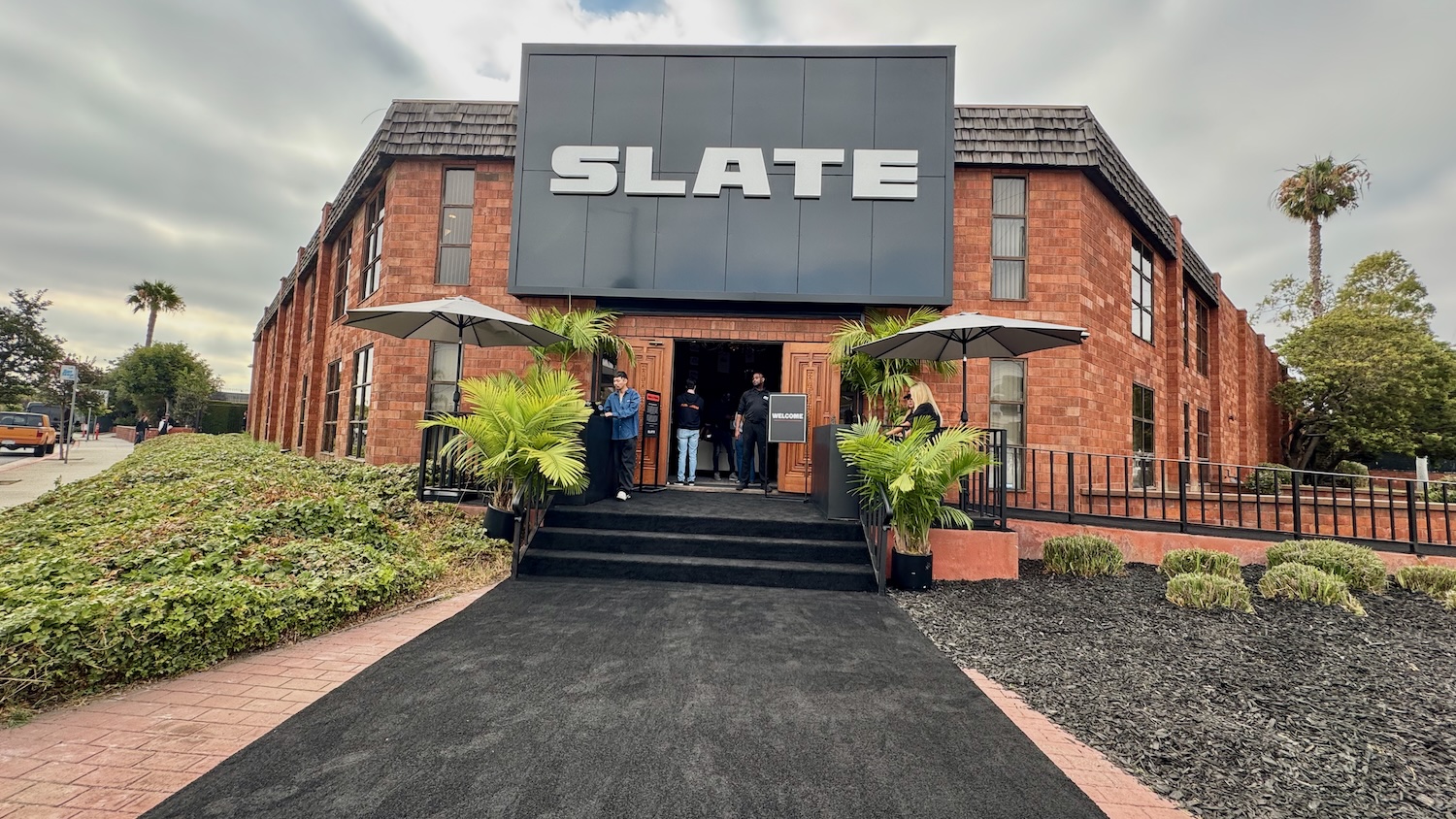
The large warehouse-ish section of the building appears to have recently been a Habitat for Humanity Restore (basically a furniture-Goodwill), though the most impressive part of the facility is its entrance, which gives off vibes you might expect from the entrance of the old American Motors facility or perhaps the old Packard plant:
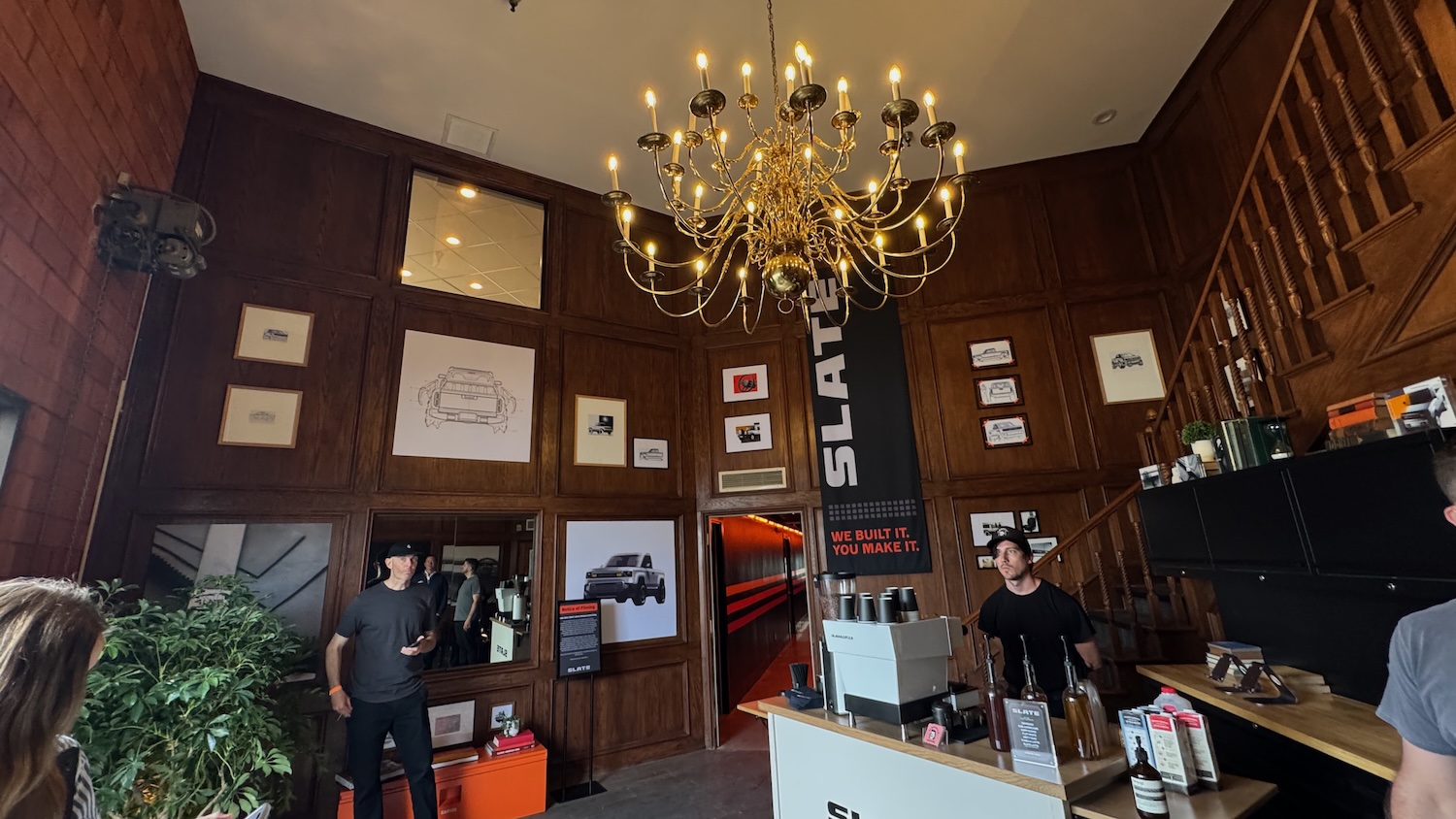
The tunnel between that entrance and the warehouse area is very cool:

Leaving the tunnel I was greeted with a vast open area filled with lots Slate trucks and SUVs, as well as nerdy employees eager to talk about their baby:

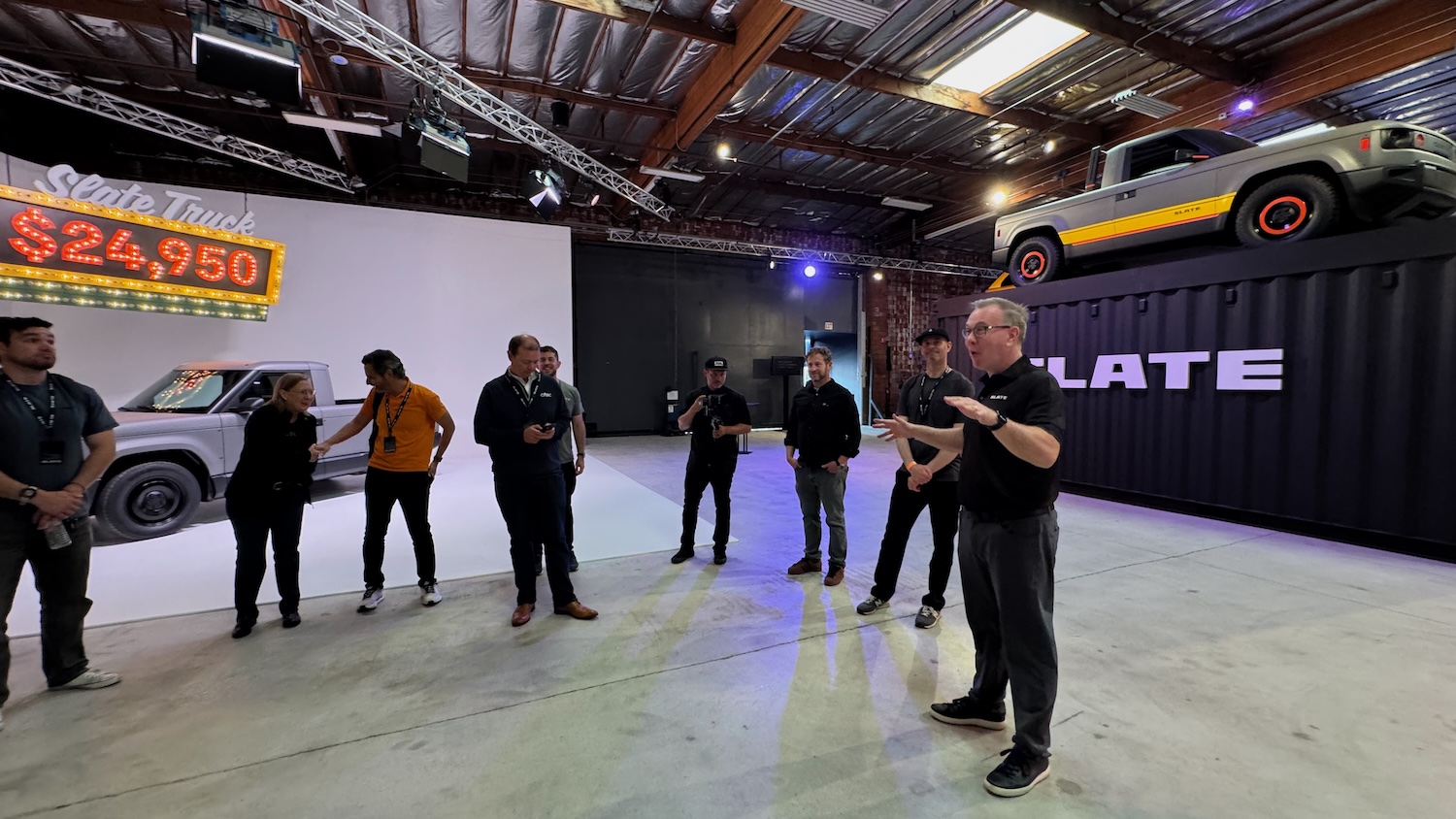
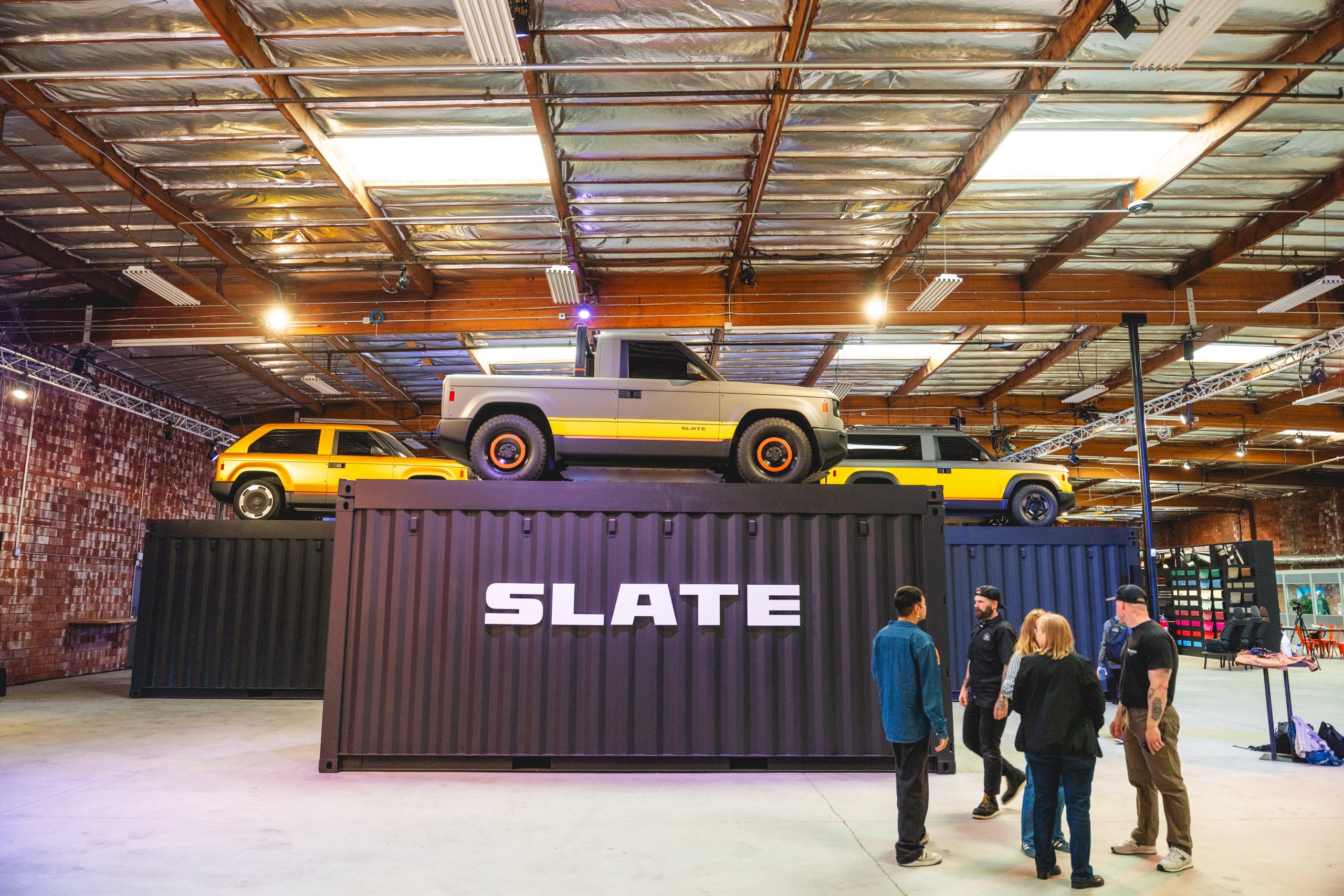

It was in this space that Slate had set up a bunch of modules so journalists could learn about the truck’s engineering and especially its modularity/personalization.
Slate Focuses On Smart Compromises, Not On Cutting-Edge Technology

Slate is a very different company than any other I’ve covered since becoming an auto journalist. The entire team does not try to prove that its vehicle is a state-of-the-art piece of engineering. There’s no discussion about fancy megacastings, there’s no talk about how the team has built some kind of complex coolant valve or heat pump to eke out the last bit of vehicle efficiency (the Slate uses a basic PTC resistance heater for cabin eat), there’s no mention of AI or autonomous driving or exotic materials.
This is a small team of fewer than 200 engineers — many hailing from Chrysler, Nissan, Tesla and other OEMs — who together have been tasked with creating a vehicle with these main attributes: safety, durability, reliability, customizability and affordability.

Whereas most automakers want to show journalists how they came up with the most advanced and most efficient solution, Slate freely tells journalists that it considered a manual steering rack, leaf springs, drum brakes, a body-on-frame architecture, and other bits of what one engineer referred to as “yestertech.” (Drum brakes seemed like an ideal option for this truck, but per Slate, the supply base for drums has dried up).
“We did a decision matrix for everything,” Slate told me. The leaf spring idea, for example, didn’t work because, in order to package the battery, Slate would have had too short of a leaf spring pack, causing the suspension to “build rate too quickly” and ride too stiff, one engineer told me. The same engineer said the truck’s crank windows only just made it into the program. “Nobody manufactures [manual window regulators] in the US, but they do in Brazil,” he said. Choosing this over an electric window, he continued, saved the company $40 per vehicle; that’s a fortune in vehicle-development terms.
This is all very unique; an automaker is proudly saying that, unconstrained from legacy vehicle architectures, it looked into ancient technology instead of simply taking at face value that this old tech doesn’t belong anymore. All in the name of affordability.
A Totally Different Battery Pack With Improved Range

Those window cranks may come from Brazil, but the Slate truck is still expected to be built of 60 percent US/Canada content, with 12 percent from Mexico and the rest from other nations. The Slate truck’s battery pack, for example, has a capacity of 65 kWh gross, 63 kWh usable. Assembled in Illinois, the pack’s LFP cells are from Chinese supplier Gotion. This is a significant change from the 52 kWh NMC pack from South Korean manufacturer SK that Slate initially chose, reportedly in part to qualify for the now-dead federal tax credit.
Slate says it stepped the base battery pack up due to overwhelming demand for the upgraded battery. “[Looking at] online reservations, people were opting up,” President of Vehicles Chris Barman told me. The 52 kWh pack that Slate initially showed at its debut last year promised a 150 mile base range, while a 84.3kWh upgrade was to offer 240 miles on a single charge. Now there’s just that single 65 kWh option whose size — along with some aerodynamic and thermal tweaks to the Slate — has brought expected range up to 205 miles.
A Conventional Body With A Weird Suspension
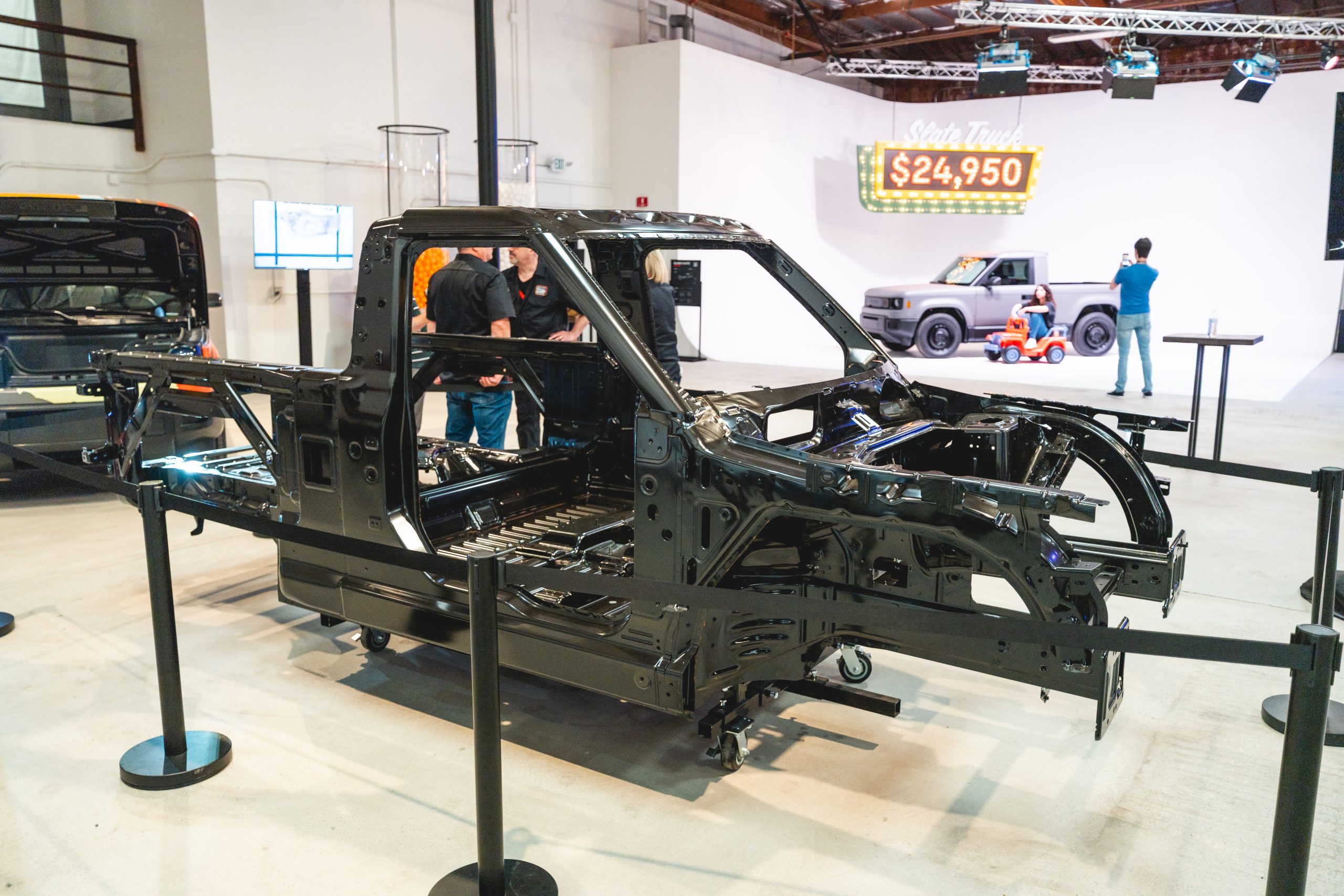
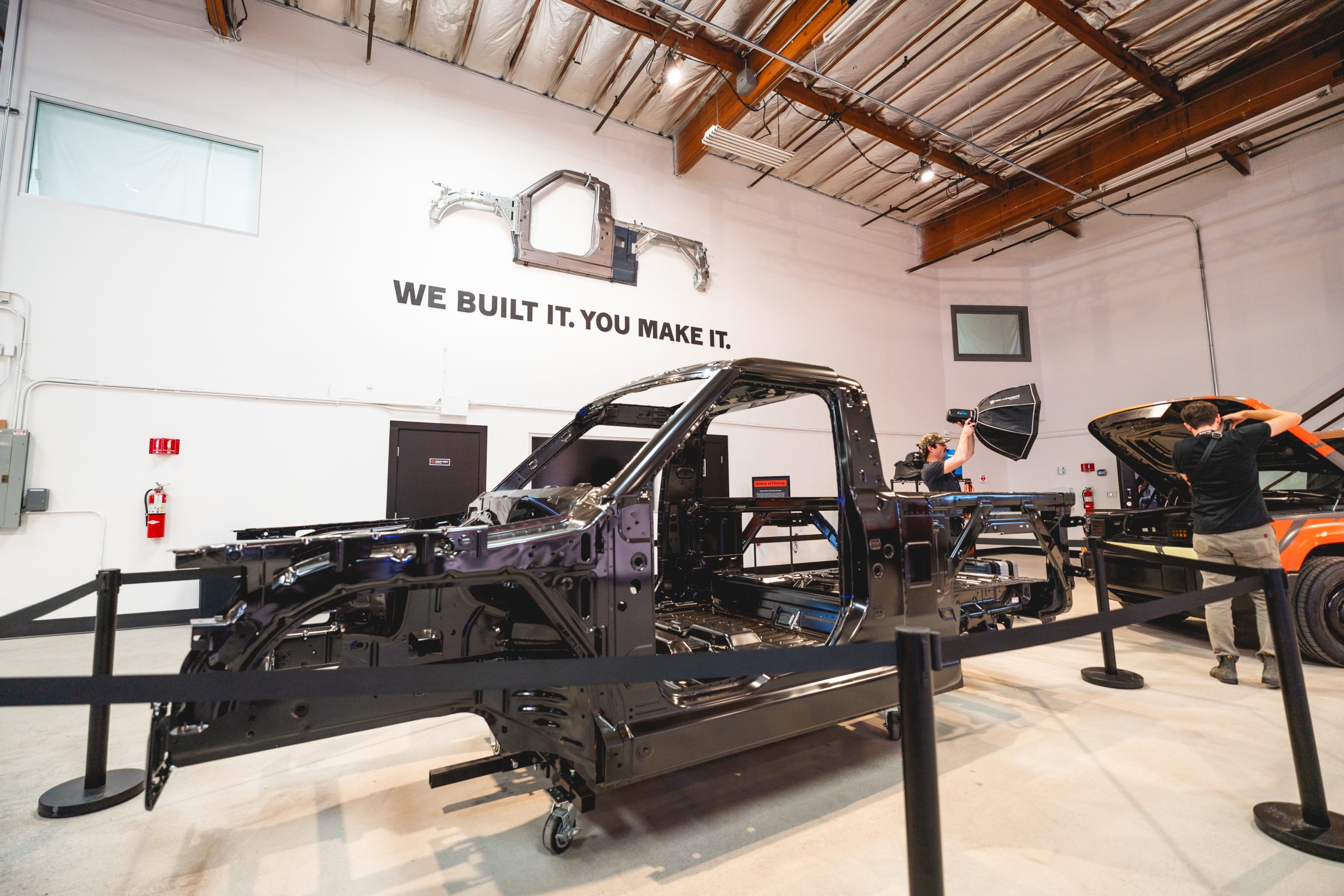
Also on display was the Slate’s Body-In-White. Aside from emphasizing safety (Slate says a 5 STAR NHTSA rating and an IIHS Top Safety Pick were requirements), Slate wasn’t trying to convince anyone that the chassis was anything exotic. It’s all steel, it’s built using conventional methods, and the truth is, even Slate knows it’s not the most efficient design as it’s made up of 250 separate pieces welded together (with some adhesive, as well). “[It takes] a lot of investment to get a casting going,” a Slate engineer told me, saying it was challenging to find a casting company interested in working with a startup. This engineer implied to me that further optimizations could be a possibility in the future.
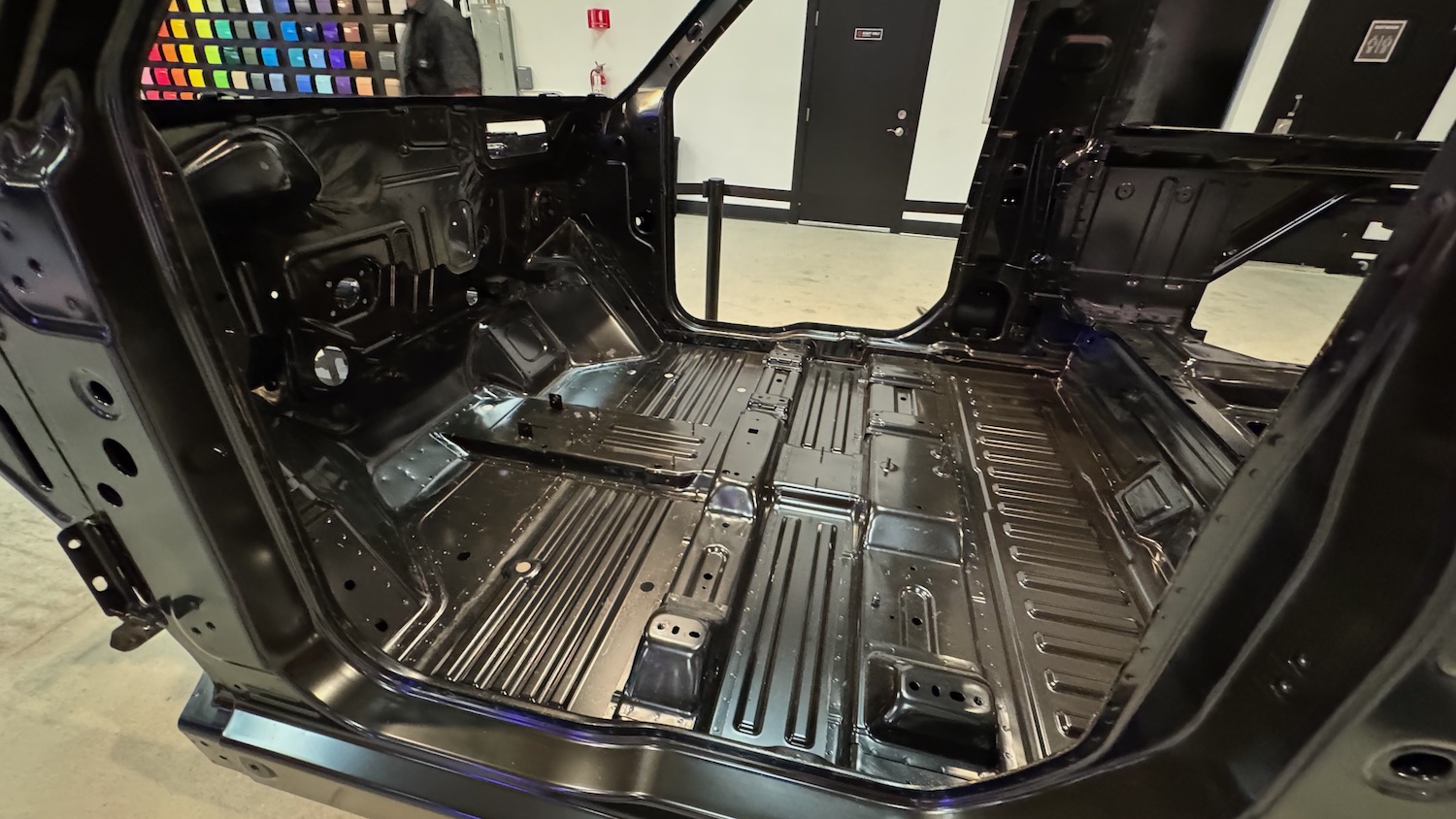
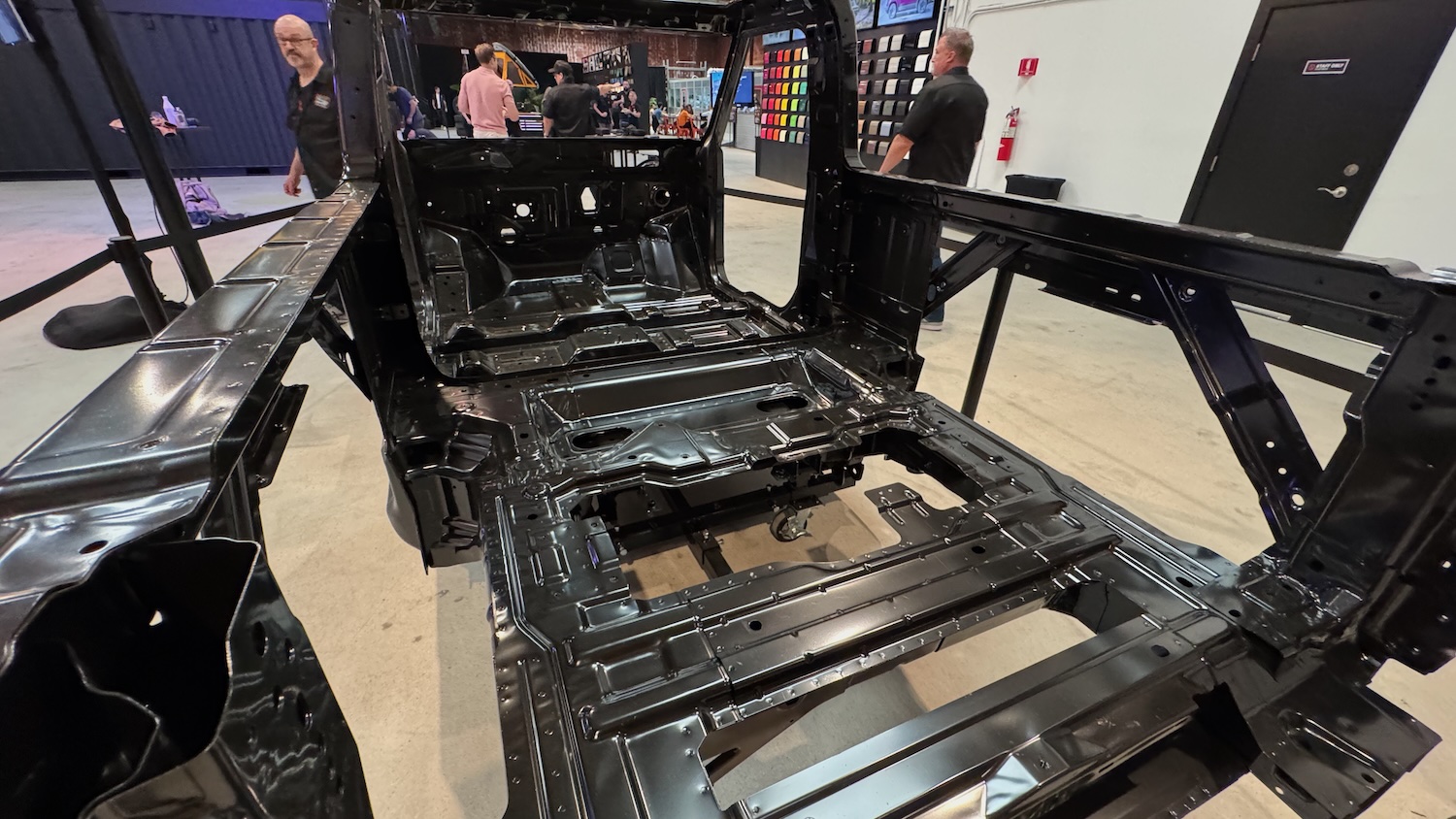
The stampings making up these 250 components come from multiple suppliers and are not made from any particularly surprising materials. There’s cold rolled steel for the outer parts and the floor; this provides a nice surface finish. There’s a dual phase advanced high strength Steel for the front crash structure. There’s hot stamped boron steel for beefing up the door ring that’s subjected to side crash tests, and the rest of the truck is high strength, low alloy steel, as it’s cheap and easy to stamp, giving flexibility to Slate’s stamping suppliers.


A few little things I noticed on the body: At the very rear of the bed are standoff brackets for mounting the back of the outer bedside panel. Those brackets feature floating cage nuts that allow for quite a bit of adjustment so a line worker can get the panel installed just right: 
Here’s a look at where the battery pack mounts to the body (Slate says it is not structural, though it acts as a shear plane). It’s a wide battery pack, but it is short because it has to mount behind the front subframe and ahead of the rear drive unit, which isn’t far behind the back of the cab:
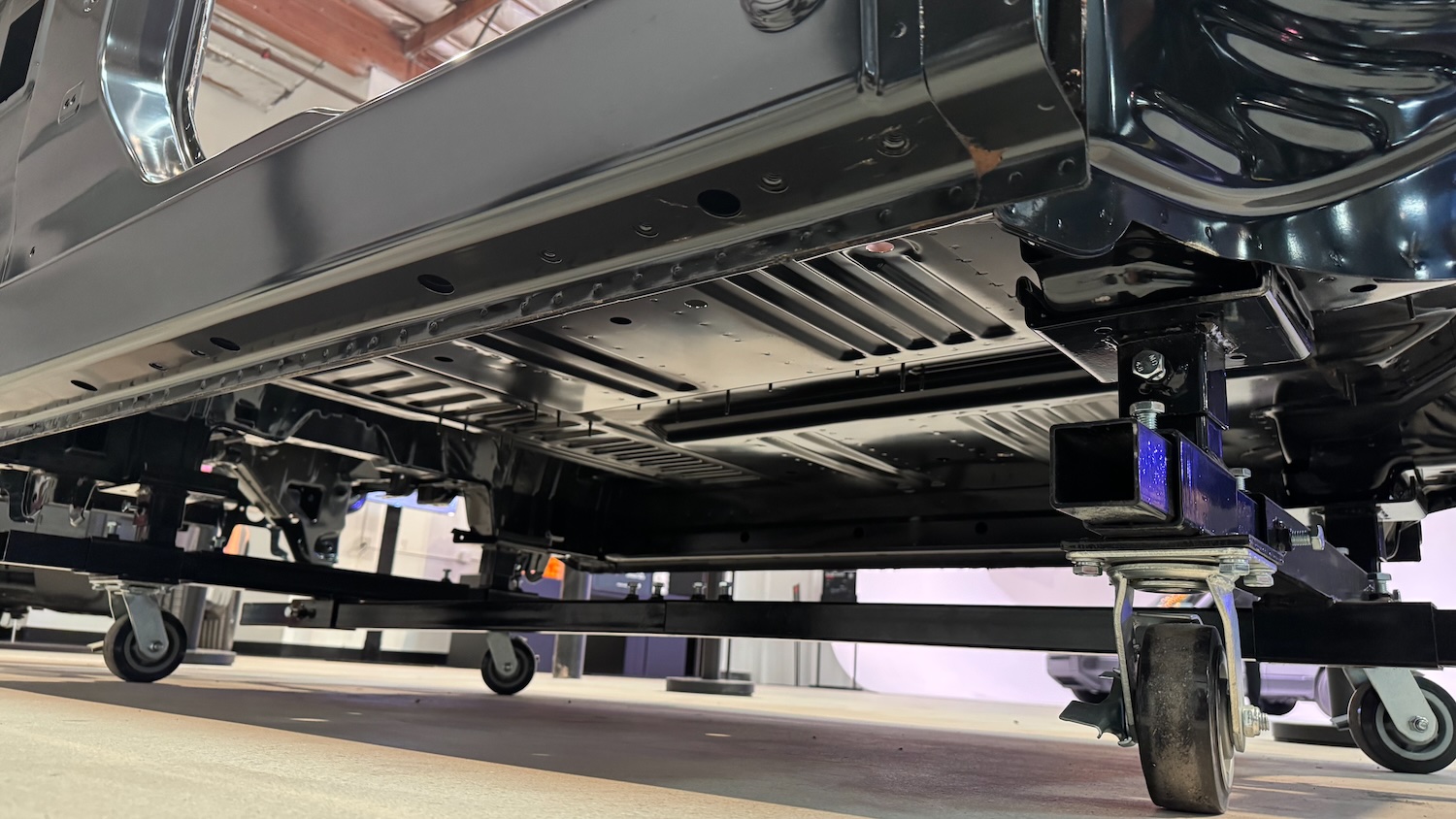
Speaking of the drive unit, I’m fairly sure the second box from the bottom here is pointing to its front mounting brackets:

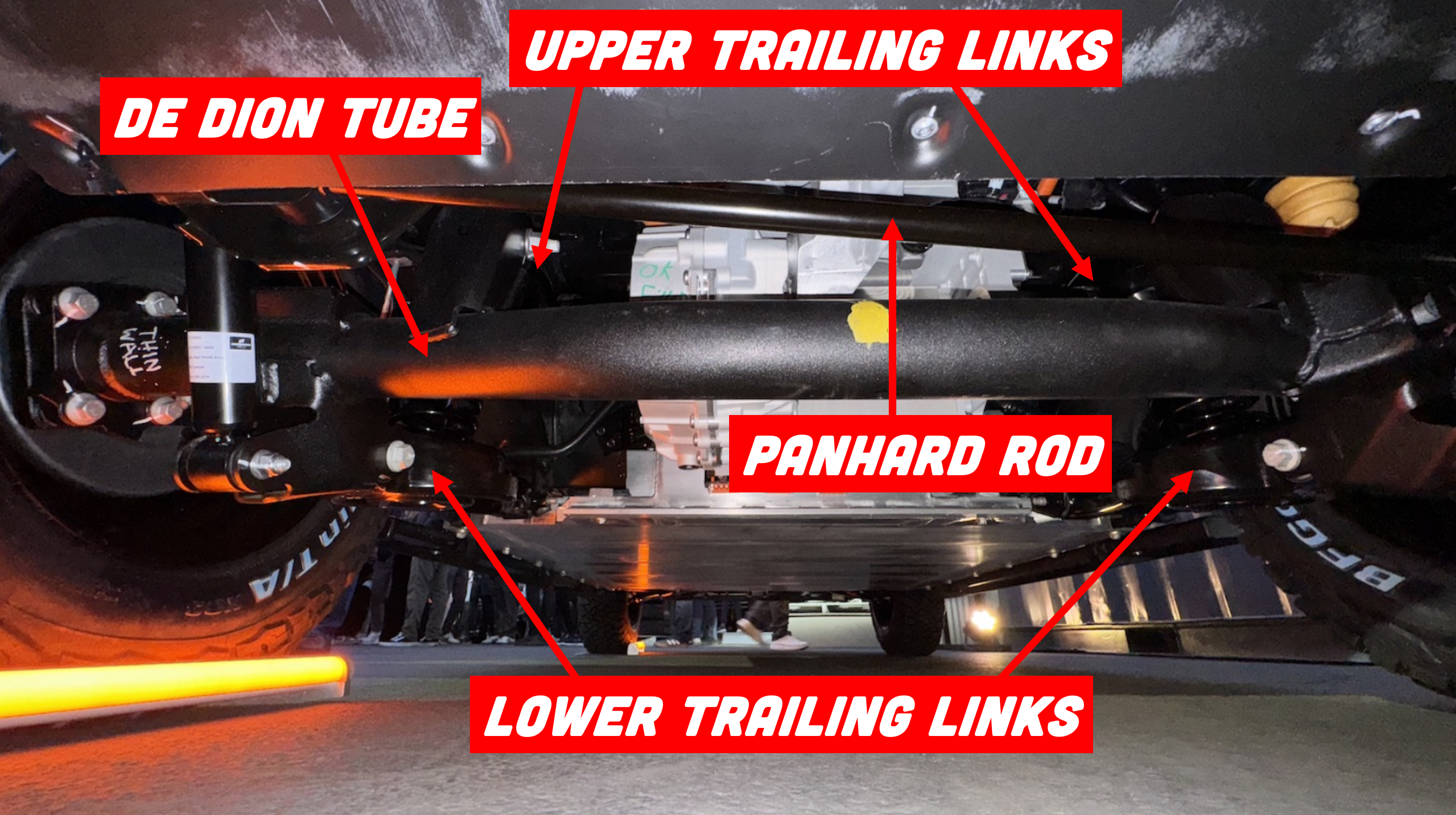
The other boxes are pointing to the mounts for the five-link DeDion Tube rear suspension. It’s a great setup for an EV, as our in-house suspension engineer Huibert Mees explained in his article. “A De Dion makes perfect sense for a low-cost truck-like EV,” he mentions in that piece. “It’s relatively cheap, easy to make and due to lower un-sprung mass, will work better than a live axle or e-beam.”
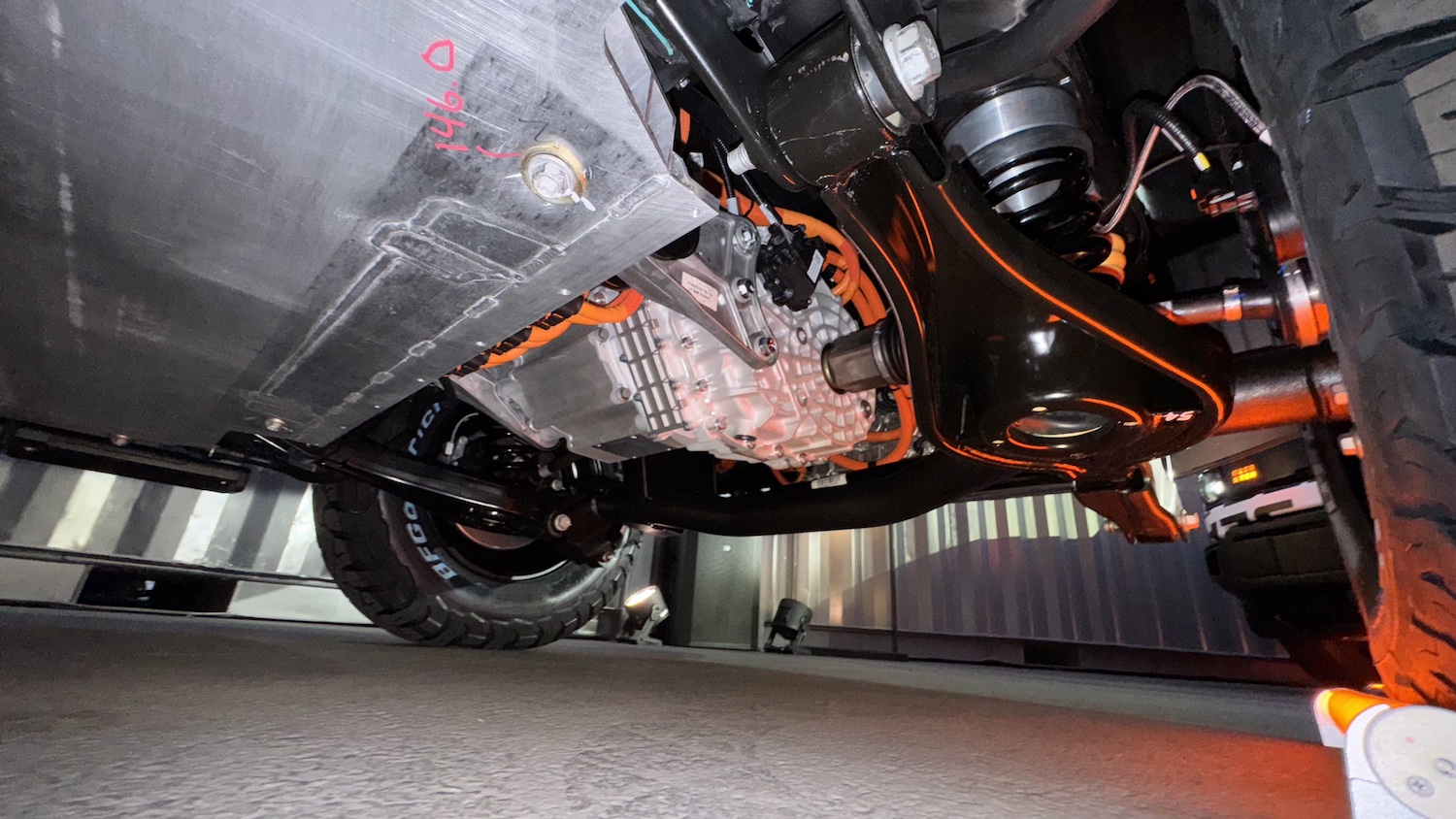
Here’s a peek at the drive unit and its mounts; notice that there is no rear subframe. There’s just the axle and the control arms, while the motor is held there in the center, mounted to the body at the locations shown above. The motor’s halfshafts reach between the control arms to the center of the rear wheel hubs. You’ll also notice an absence of a sway bar; Slate says it didn’t need one due to the combination of a low center of gravity and the DeDion tube’s naturally low roll center:
One question numerous journalists have asked is: Will there be an all-wheel drive option? Slate would not answer, but I slid under the truck to see if I could tell whether the company “package protected” for a front drive unit. And I think the answer is: probably. Check out the shape of the sway bar links: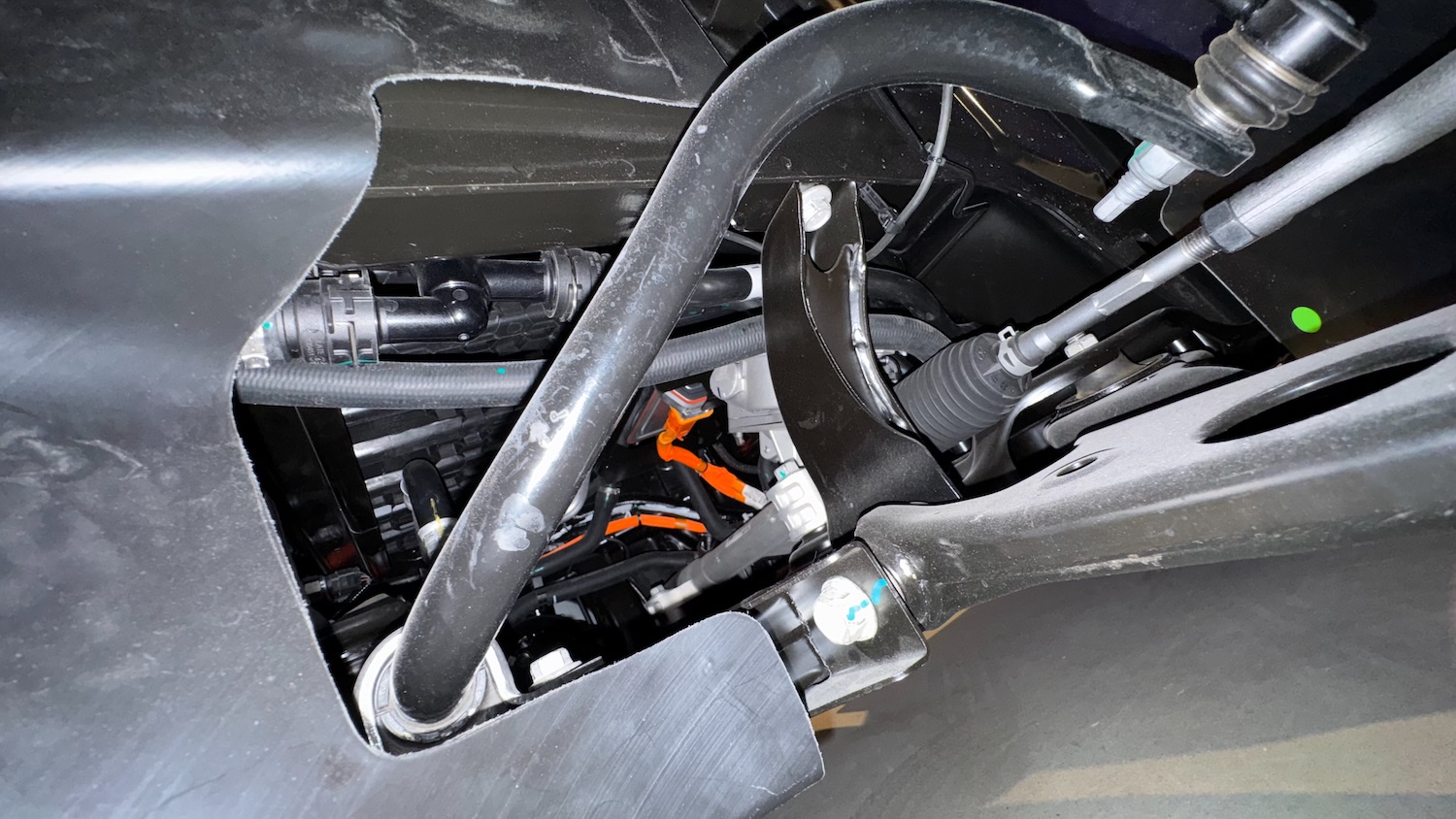
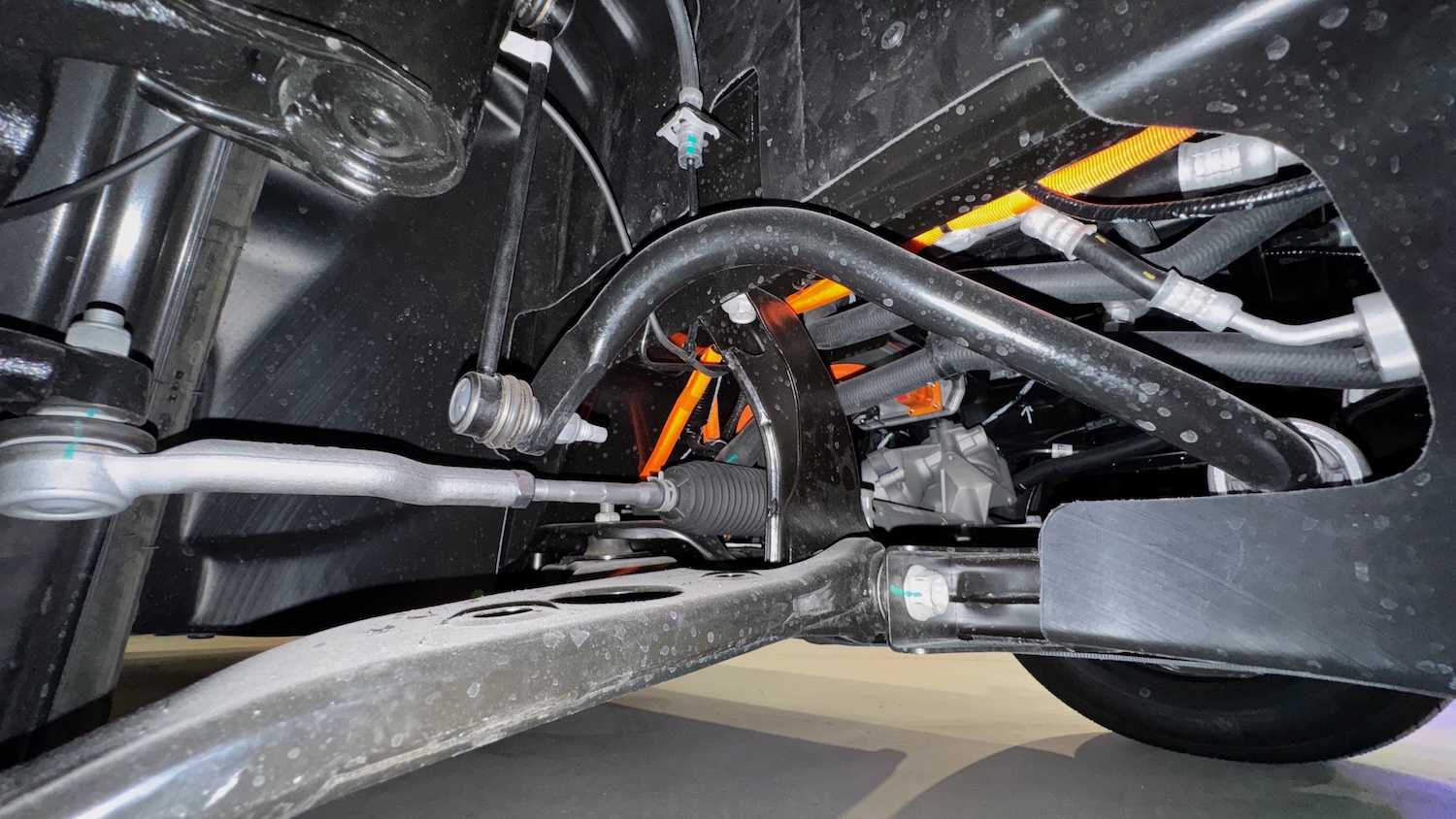
There appears to be a clear path from the center of the front hubs inboard to the front subframe. Have a look at the open space just inboard of the front hub centers — there’s a nice look at the AC compressor, too: 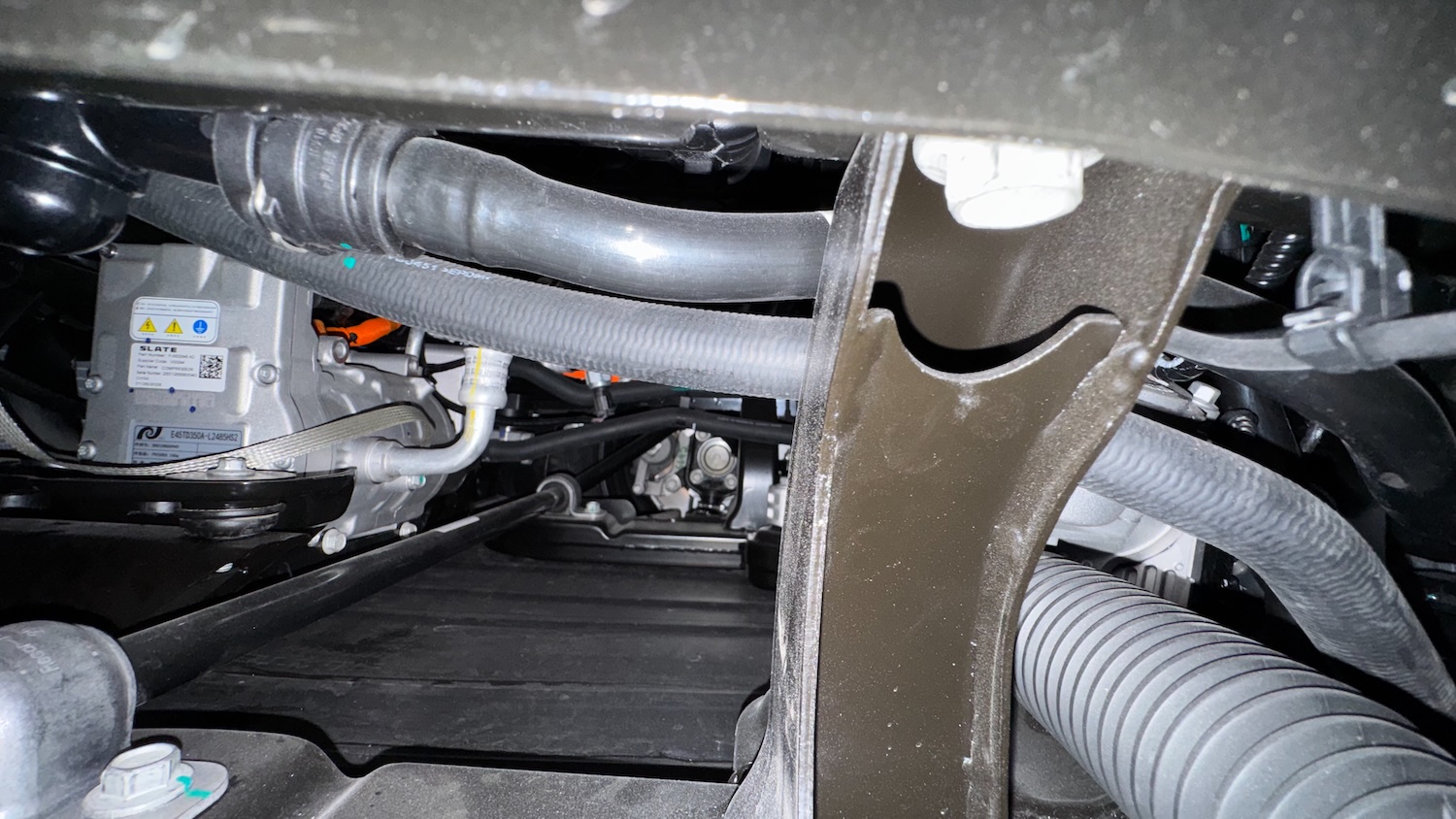
I don’t know that I see an obvious place to mount a drive unit, but I’d say an AWD variant seems possible.

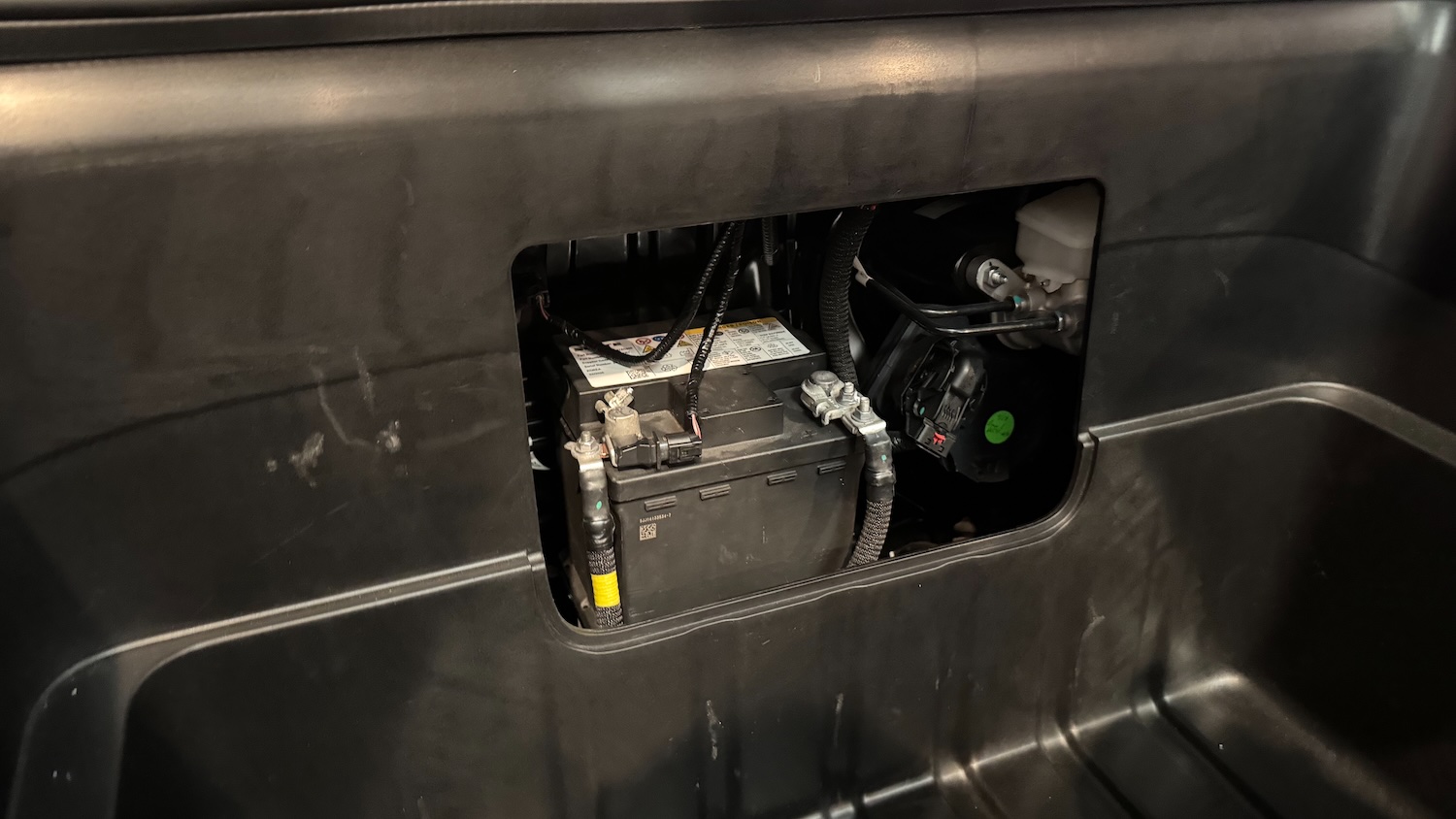
Since we’re in the front, I’ll point out the 12-volt battery tray mounted to the front firewall/bulkhead. It looks like swapping the 12-volt battery is going to be an easy job for Slate owners, as there’s a removable cover in the frunk:
Also up front is the MacPherson strut suspension, which we may as well look at:
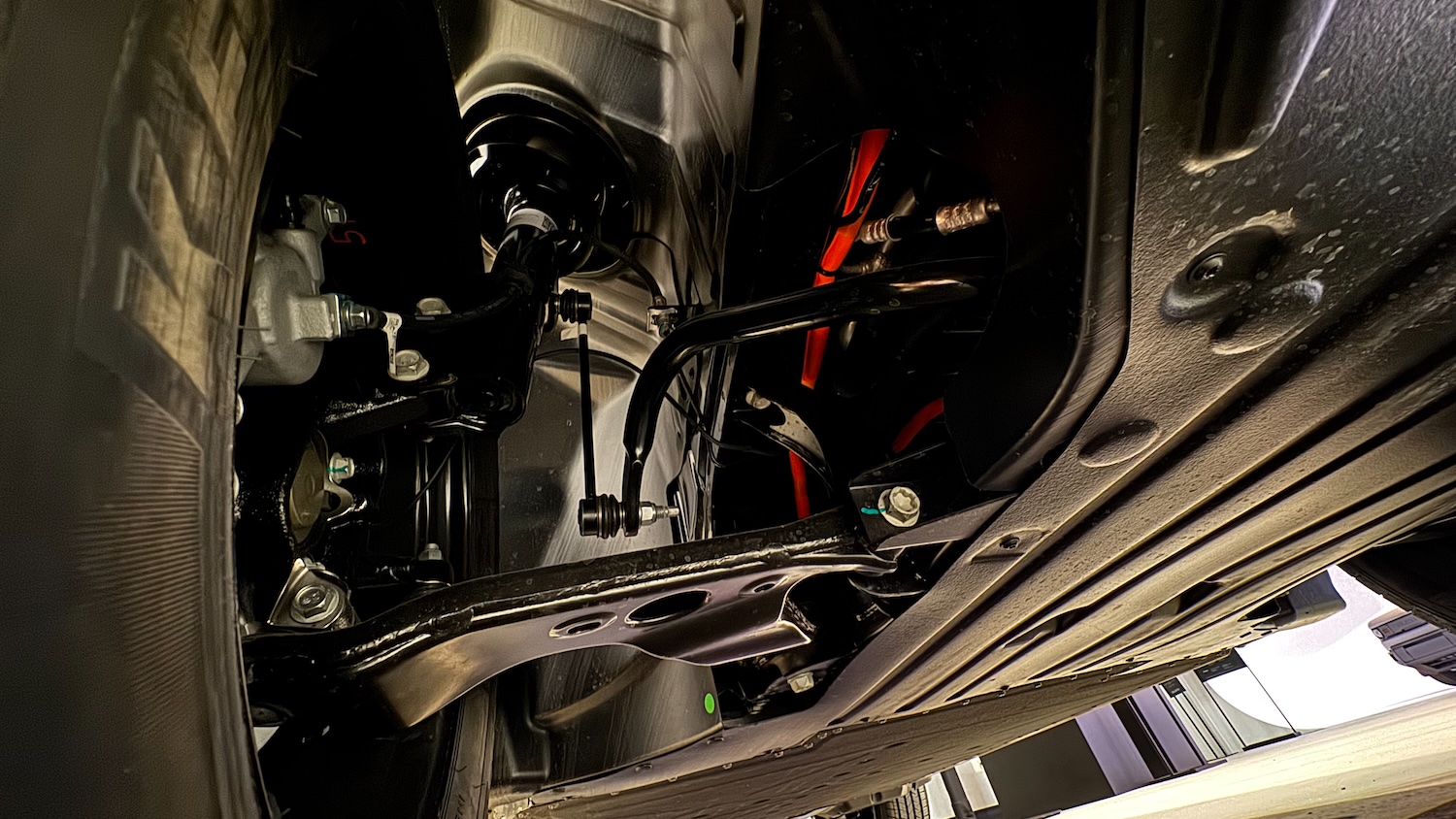
There are parts of that body-in-white that are obviously designed around the IIHS Small Overlap Rigid Barrier test — things like the front rail and that SORB enabler at the bottom rear of the wheel well:
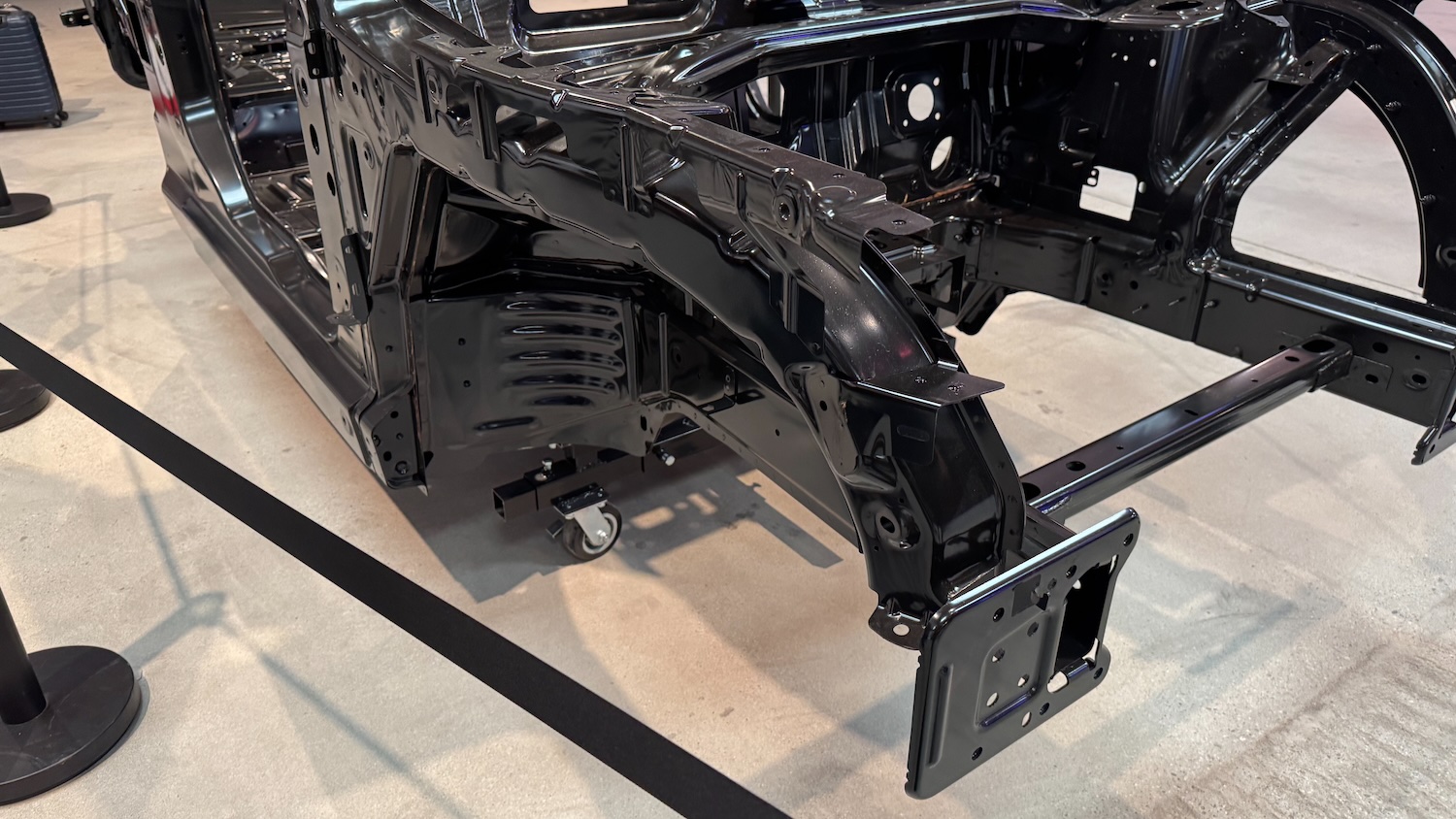
It’s an 860 pound body-in-white, and its construction is not supposed to blow anyone’s mind. It’s supposed to be simple, affordable and fun. And that last point you can’t really test unless you actually drive the thing. So I did just that.
What’s It Like To Drive The Slate Truck

Slate gave me the chance to drive its truck around the company’s new design headquarters in southwest LA. Though the vehicle I drove was built in Slate’s Warsaw, Indiana factory (annual production capacity: 150,000), it was a Design Validation vehicle built using early tooling. This is worth mentioning because, even before entering the vehicle there were some obvious fitment/trim imperfections (for example, the fasteners holding on the front fenders were loose, one display vehicle had a center console that popped off with little more than a light push, some weather stripping was loose, etc). This is not at all unexpected for a development vehicle, especially one so early that it has cloth covering up the whole dash:
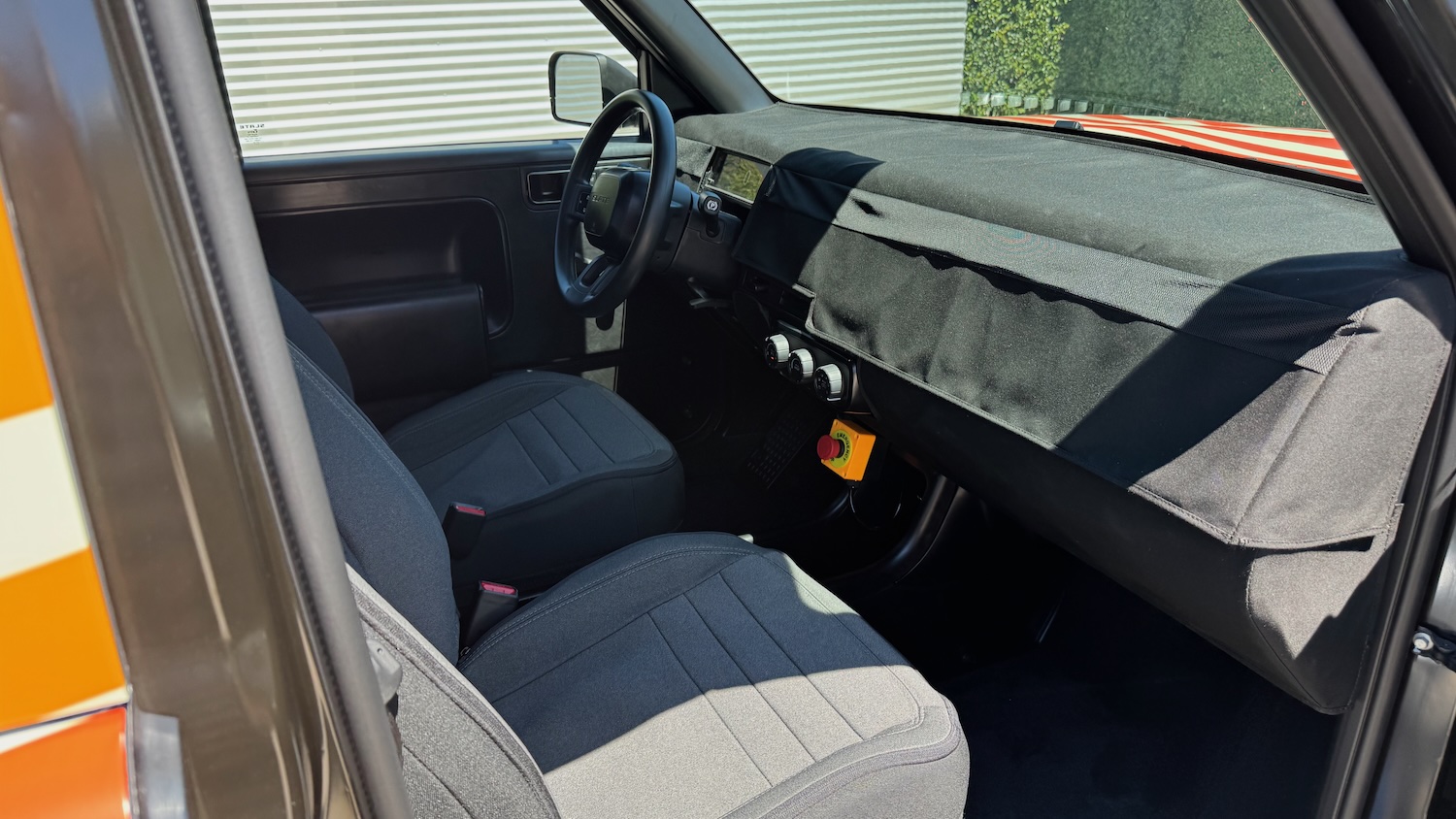
Showing me the loop and introducing me to her team’s pride-and-joy was President of Vehicles, Chris Barman. She encouraged me to hammer down the accelerator pedal and keep up speed through rough patches in the road. So that’s what I did.

After pulling down on the beautifully-executed column shifter that makes the most of the truck’s interior volume by not wasting useful space, I was off, and right away one thing became obvious: An electric car’s power-to-weight ratio just doesn’t mean the same thing as a gas car’s. I say this because my dad used to drive a 2010 Chevrolet Equinox; it weighed just under 4,000 pounds and its 2.4-liter inline-four made 182 horsepower. The base Slate truck weighs 4,048 pounds, and its single rear electric motor produces 181 horsepower. The Slate is not only quicker from 0-60 mph by at least a half a second, but it feels about 5 million times quicker around town, especially between about 30 mph and 60 mph. The Equinox feels like a dog, but the Slate feels legitimately eager to move — maybe not right off the line, as it does take a bit to get going, but certainly once you’ve gotten moving above about 20 MPH. The vehicle’s ~12:1 gearing helps make the most of that motor’s power output in town, which is the environment for which Slate optimized the truck’s performance.
You may wonder why the company didn’t just shove a more powerful electric motor in the truck given that the EV revolution has given the world cheap horsepower (seriously, you can buy a lightly used Tesla with 1000+ horsepower for 50 grand these days). Slate says it just wasn’t worth the expense. A higher power electric motor would take up valuable packaging space and cost more (in part because of the extra copper in the motor, and at a certain power level you’ll add cost beefing up the driveline). Based on my drive around LA, I feel Slate made a smart call, here, though I am curious if I’ll feel the same while hauling the truck’s 1,550 pound max payload or towing at its 2,000 pound limit.

Especially when in a densely populated city, it often takes me a little while to become acquainted with the vehicles I review, as I don’t know how they respond to inputs, I don’t know their dimensions, and I’m not used to their sightlines. I felt at home in the Slate almost right away, and that’s largely because of its compact size (it’s only 6 inches longer than a VW Golf!), its great forward and rearward visibility (though over-shoulder blind spot visibility isn’t amazing due to the thick B-pillar; smart use of the mirror helps here), and its responsiveness. Not to mention the tilting and telescoping steering wheel, the supportive seats, and the roomy cabin (if you’re over 6’2″, it might be worth sitting in the truck and assessing long-distance leg comfort, as there is a wheel hump), which together made the truck quickly feel like an old friend.

Helping aid in that comfort is the truck’s ride and handling. I won’t pretend that I took the thing through tight turns at triple-digit speeds; I’m not trying to get anyone killed, and these are public roads. So while I can only say that the handling seemed totally acceptable for around-town driving, I can say more about the truck’s ride; it seems really solid.

The course I drove the truck on was a true indictment of America’s infrastructure. One road specifically, MLK Jr. St., looked like the aftermath of a severe earthquake, with massive buckles, deep potholes, and cracks everywhere. A white sedan ahead of me had no clue what to do, slowing down and speeding up as it tried avoiding the minefield that was this public road.
The Slate didn’t care. That MacPherson strut front suspension, with its 8.25 inches of travel, and that wacky five-link DeDion tube coil sprung rear axle offering 8.7 inches of wheel travel both handled the course with confidence. The damping felt on point, never soft enough that I worried about bottoming out or feeling like I was in a boat, and never overly stiff to where I worried about my teeth falling out of my skull or about lifting a tire off the ground and potentially losing control. The truck’s standard Kenda tires remained planted on that terrible road, and it was clear to me that the thing is ready to take on all the crumbling asphalt America’s cities can throw at it.
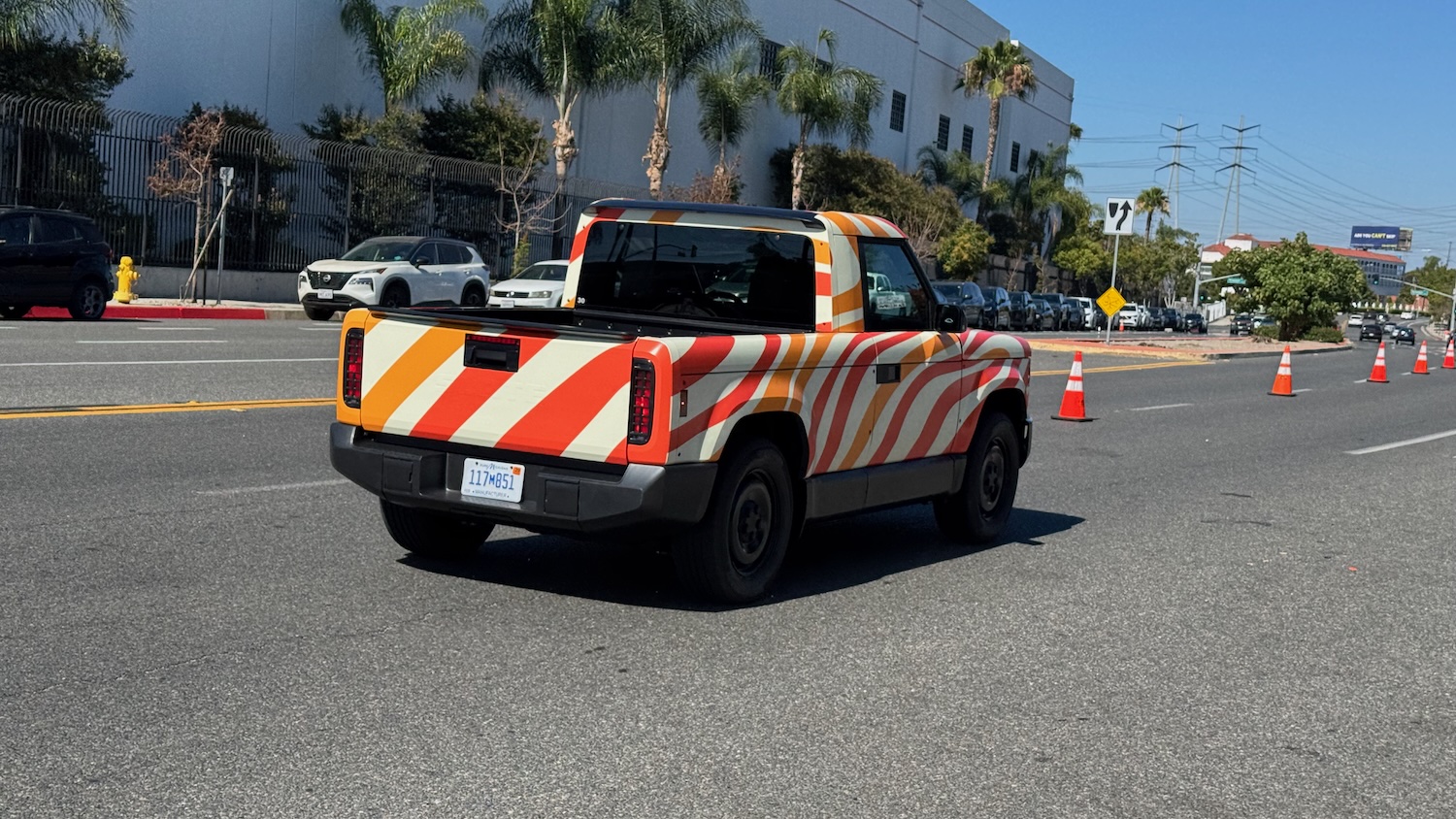
Road noise felt reasonable to me, and I will admit I did break an occasional speed limit to get an idea of how well the truck kept wind noise out. The cab has a very upright profile, and while that helps give the truck its handsome styling, it also risks both efficiency and NVH. The A-pillar red spot on this CFD image illustrates the area I was most concerned about:

During the drive, I did hear some aero noise going about 55 mph. My test was short, and the road was one I hadn’t traveled before, so it’s hard for me to quantify anything, though wind noise does seem like something Slate is working on. After hearing me mention it, Chris Barman chimed in, saying, “You commented earlier on the wind noise. There’s still more refinement that we have to do to make sure that we get the dimensionals tuned in on the roof of the vehicle. So the next one you drive should sound better.”
When I was in the passenger’s seat, I asked about wind noise as well and how Slate balanced the upright profile with NVH. “We know that it is an EV, which means that when [ICE noise] goes away you can hear a lot of other things,” Barman replied. “The team has really been working on a very good balance of a Noise, Vibration and Harshness package…But there will be some noise that the vehicle has. It all comes down to a tradeoff of cost and benefit, and we’re going to work to find what we think is the best balance for our consumer.”
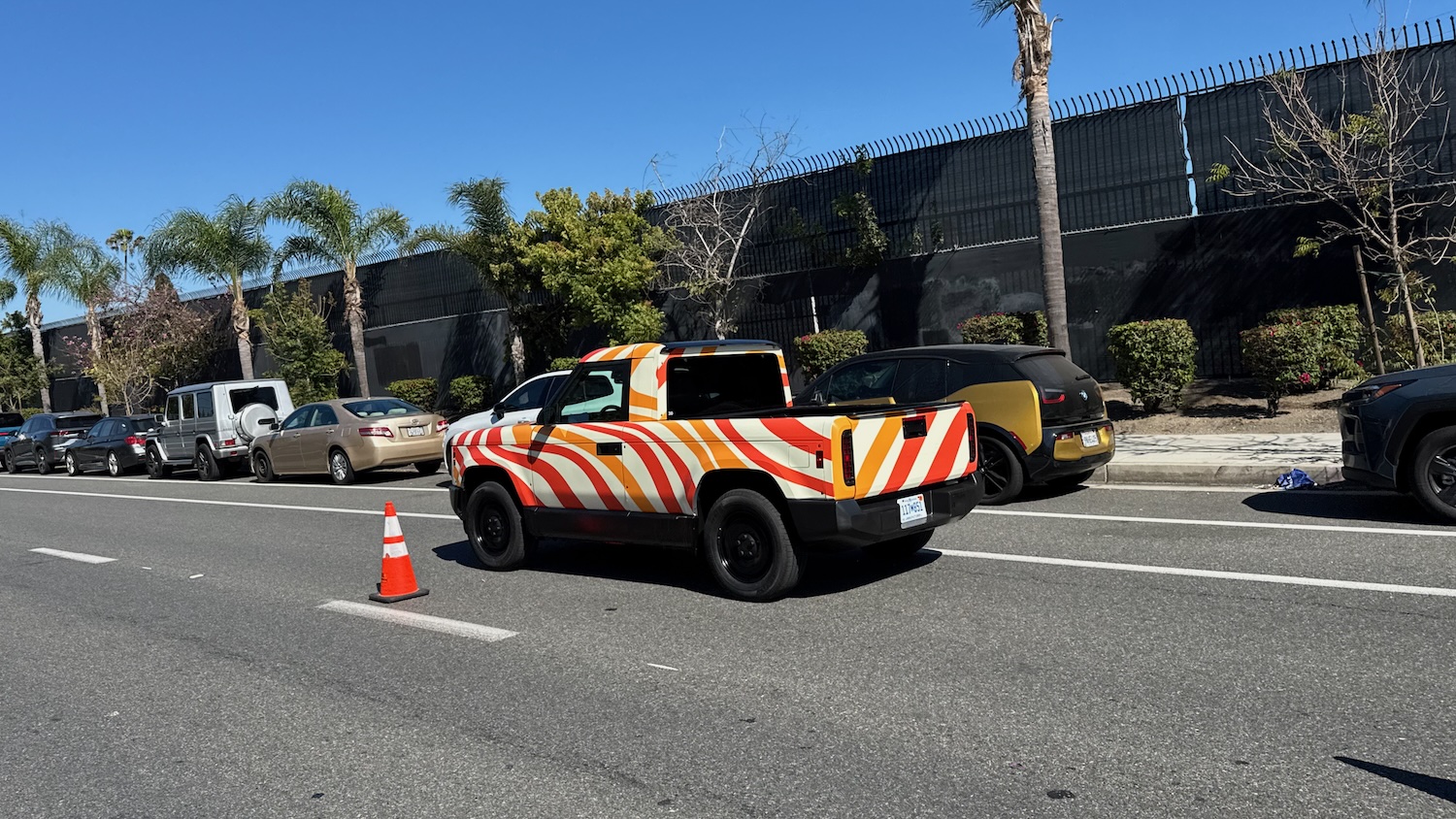
Steering was well assisted, and the 37-foot turning circle is tight. Regenerative braking is strong, slowing my truck down with vigor as soon as my right foot lifted off the accelerator. Strong regen is the only option; Slate does not plan to offer adjustability. I personally am all for it, as one-pedal driving is fun and efficient, though there’s something about Slate’s setup that needed to bake in the oven a bit longer.
When I touched the brake pedal lightly, there were times when the pedal just sucked itself down towards the floor; Slate tells me it’s still working on tuning the regen/friction brake blend, and that consumers should not expect the pedal to move on its own without driver input.
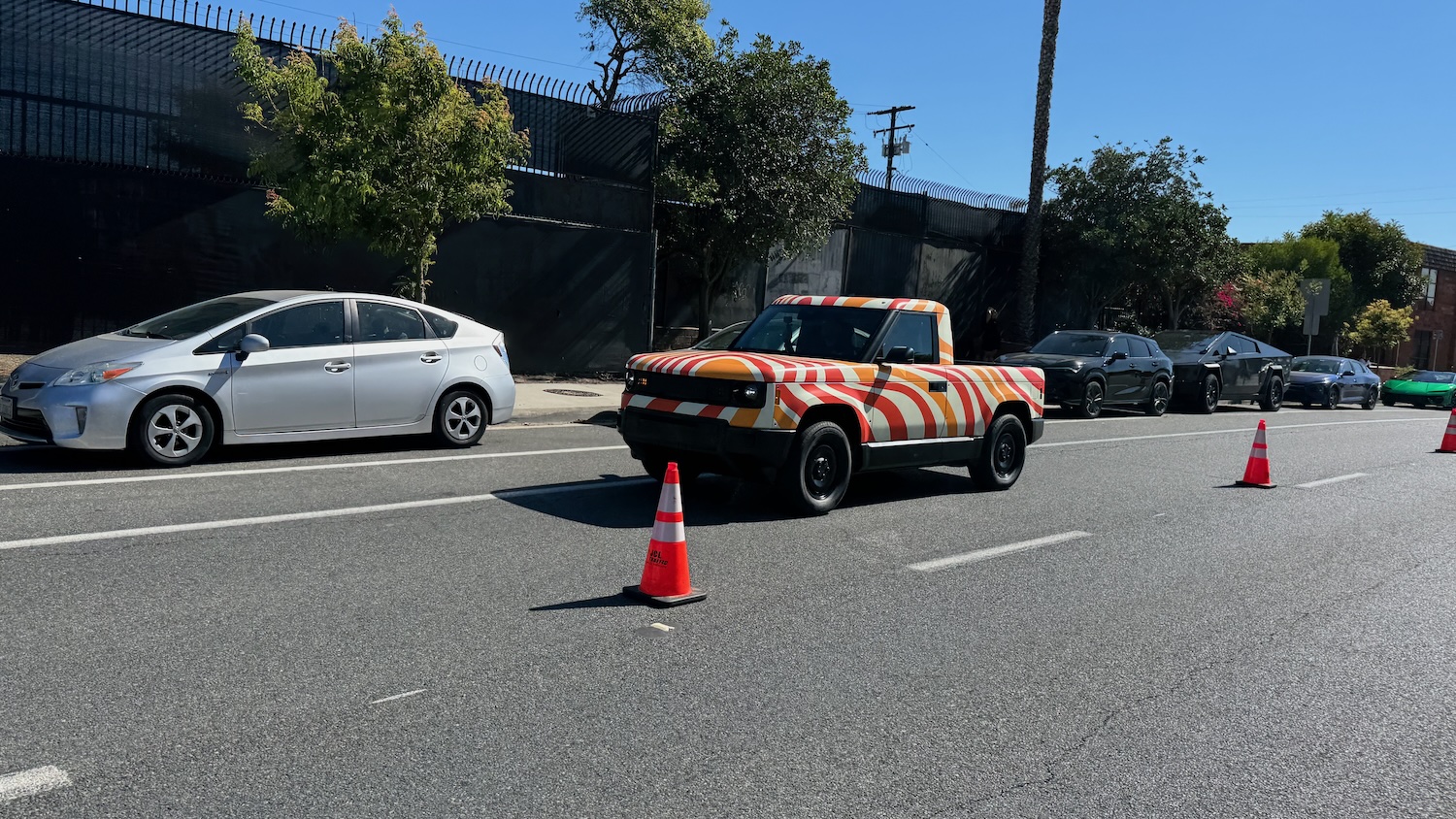
As I pulled the truck back into Slate’s headquarters, I couldn’t help but feel a bit surprised. Especially after seeing the Ford $30,000 EV prototype in the flesh, I had spent a lot of time thinking about the Slate’s vulnerabilities in the marketplace — the fact that it has two doors, the fact that it costs more than significantly better equipped cars, the fact that its range is relatively modest — and I had let this put a damper on a product that, in many ways, I think we should be celebrating.
It’s a simple pickup truck, and it’s reasonably cheap. Is it the cheapest? No. Is it the most practical for families? No. But what the Slate has going for it is this: It is, by far, the most soulful new vehicle an American consumer will be able to buy for $25,000. And it won’t even be close.
It’s All About Customization
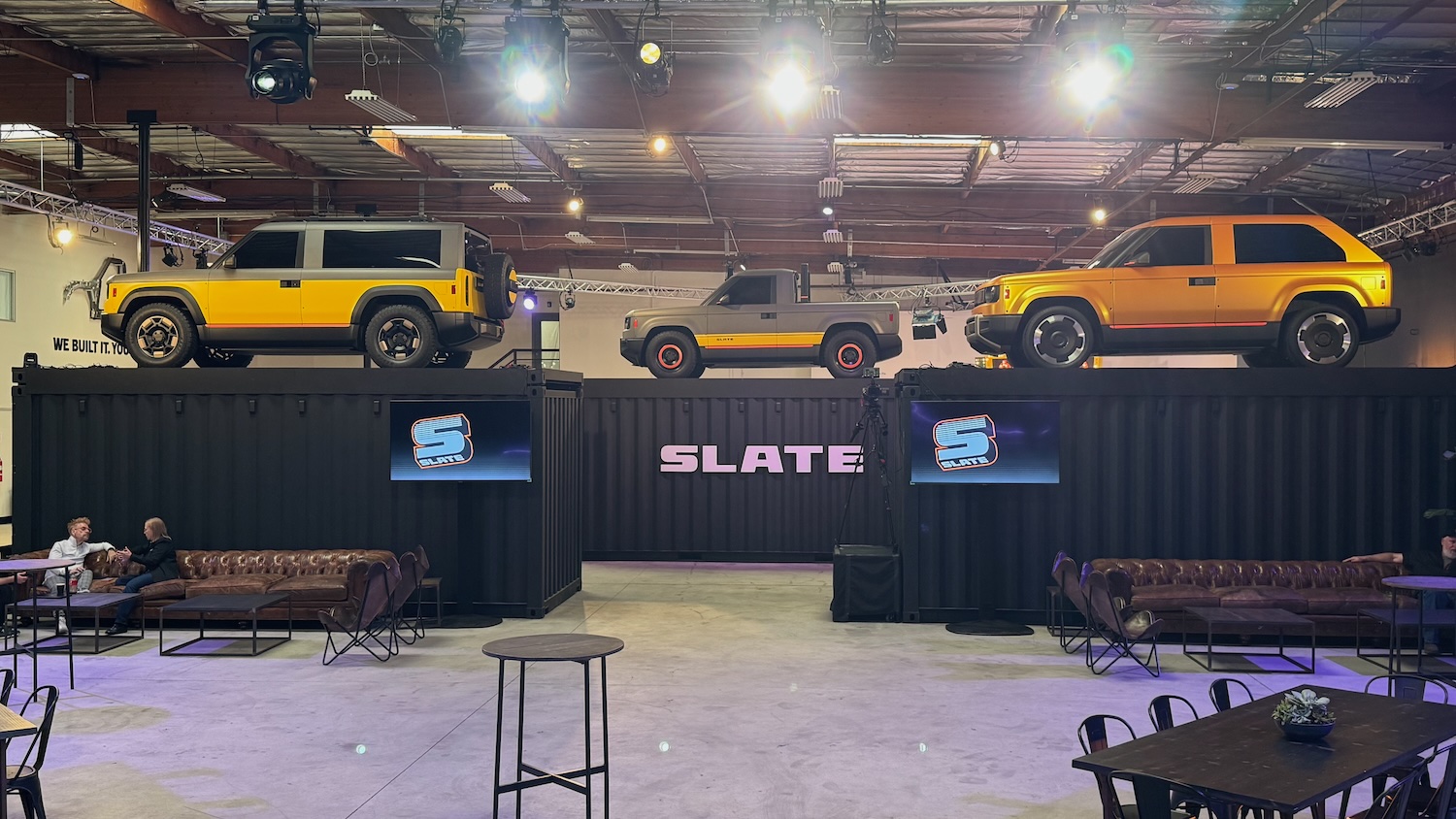
I asked Chris Barman what it is about the Slate that she thinks will compel people to buy this truck over a competitor (I was alluding to the new Ford truck), and her response was quick: “I think the customization.”
It became clear during this media event that Slate knows it cannot succeed by simply marketing its vehicle as an inexpensive EV. The Slate has to be a cool car that just so happens to be an affordable electric vehicle. And though some of the truck’s coolness is a product of its size, its quickness, its ride, and of course its chunky, squared-off design, it’s the customization element that has the potential to really allow the Slate to stand out.
Just look at the three vehicles above. There’s a squared off SUV, a fastback SUV, and a truck, all with unique liveries. And yet, all three of those are built on the same Blank Slate. It’s one vehicle that can transform into three different models, and within each model the number of potential customizations is enormous.
For example, let’s talk about the wraps, which start around $500 for a full-body applications (accents can be had at $100, partial wraps start around $300, and custom graphics can reach up to $2000 — Slate says it’s working to ensure than, even if people don’t want to DIY it, they have an option to have a full wrap done for under $1000 all-in), and are expected to last between three and five years. Slate says it plans to offer over 100 wrap colors at launch, as well as the option to provide owners with infinite choices in the form of a custom color of their own:
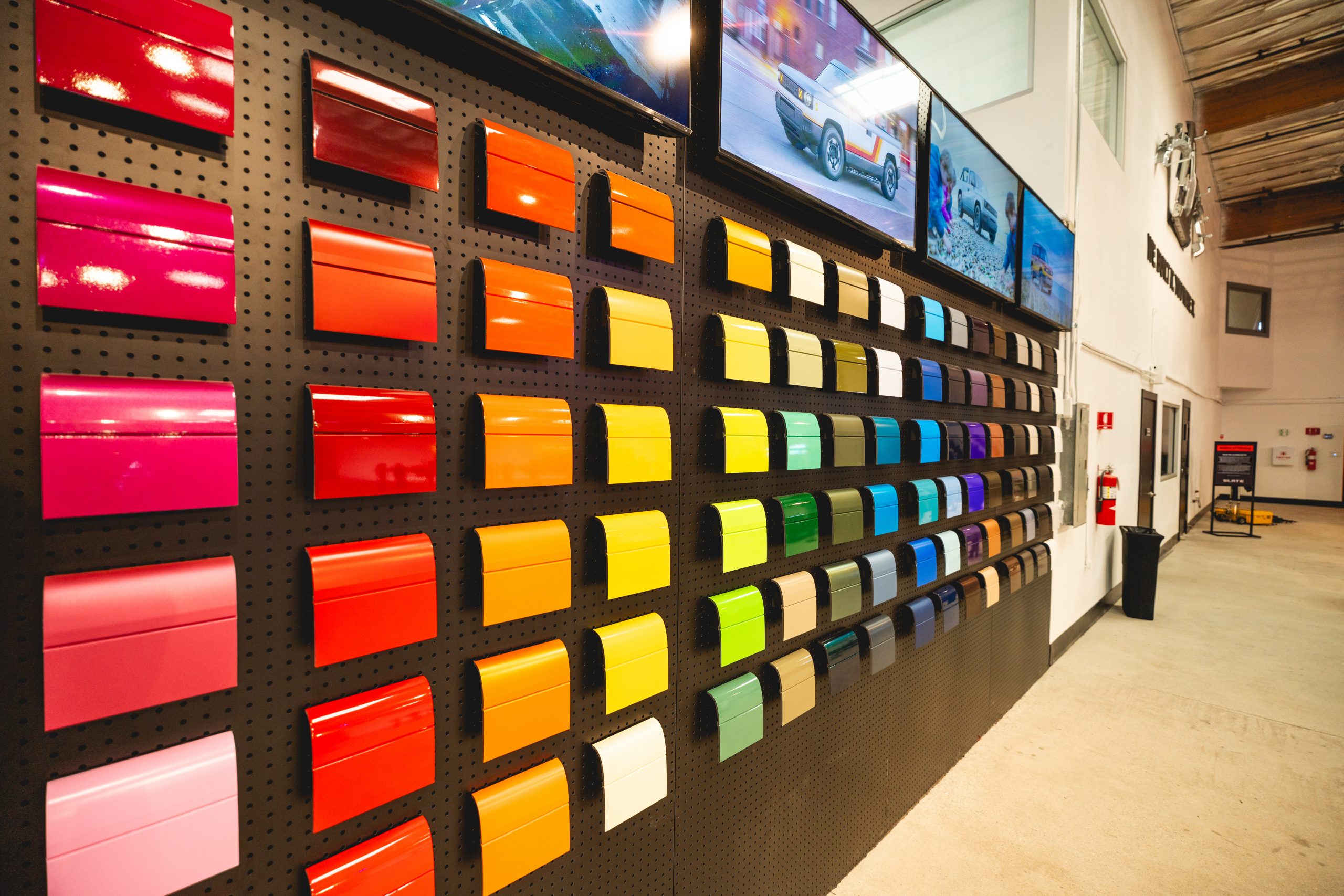
Slate spent lots of time at this event talking about how it designed the vehicle to be wrapped, pointing to something called the “Coach Line,” which they say was specifically added to the vehicle’s side to split up the large panels so that people wouldn’t have to try to manipulate a large piece of vinyl, and could instead use two that meet at the seam molded into the plastic body panel (I’m not convinced this is the only reason for that seam, since this lines up perfectly with the clamshell hood’s edge). Slate also says it had to develop its own adhesive to make laying the wrap on the plastic body panels easy and durable:

Slate says it is creating something called “Slate University” to help people — via video and paper instructions — with DIY’ing not just wraps, but all of the brand’s over-175 accessories. Among those accessories is the SUV top, in standard and fastback form. Those will cost you $5000, so if you’re among the 60 percent of buyers whom Slate expects to opt for the SUV, you’ll be dropping at least $29,950.
The customization options for the Slate are immense. You can, for example, change your whole dashboard color for around $60. And if you want to change your whole interior color it’s around $500.
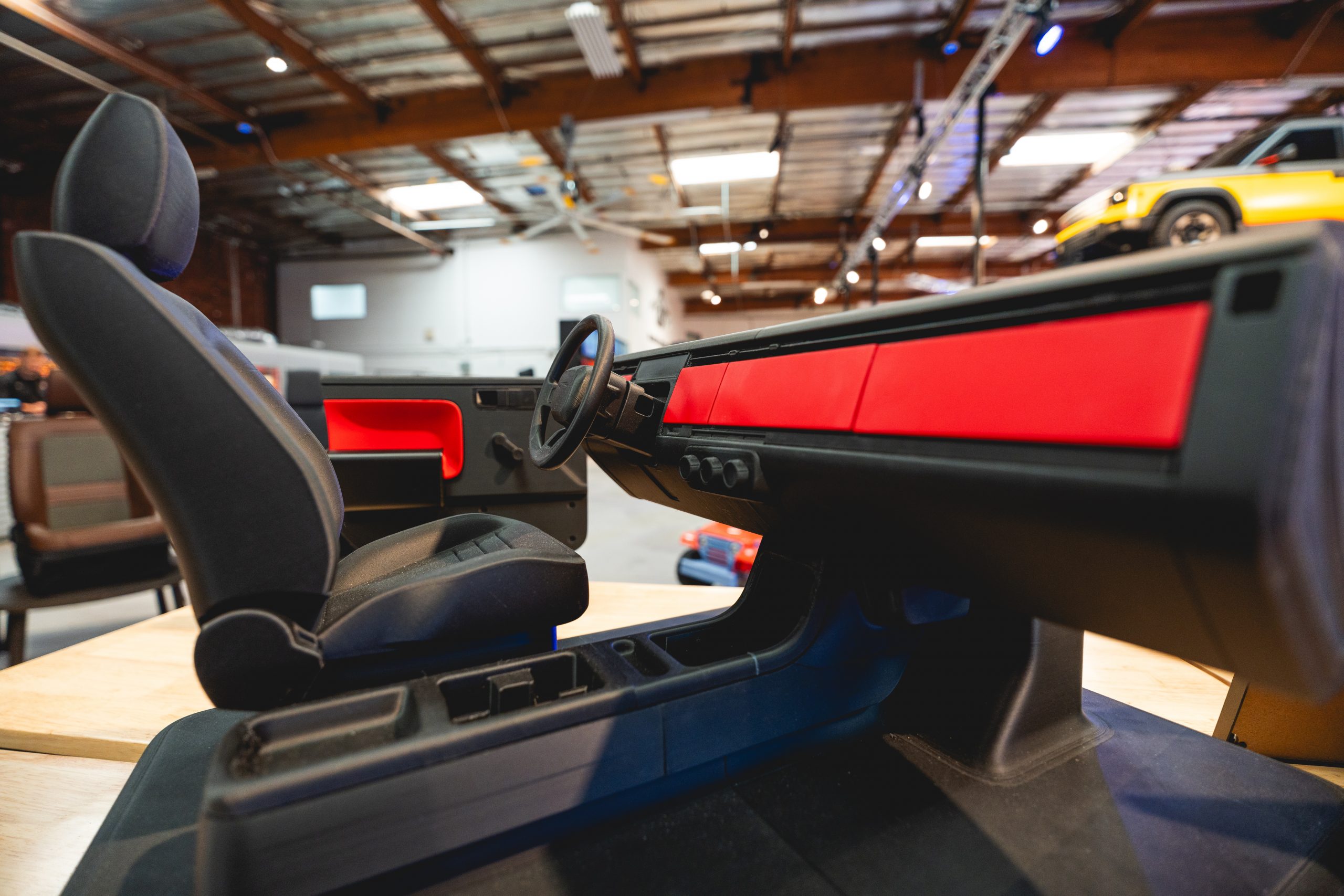
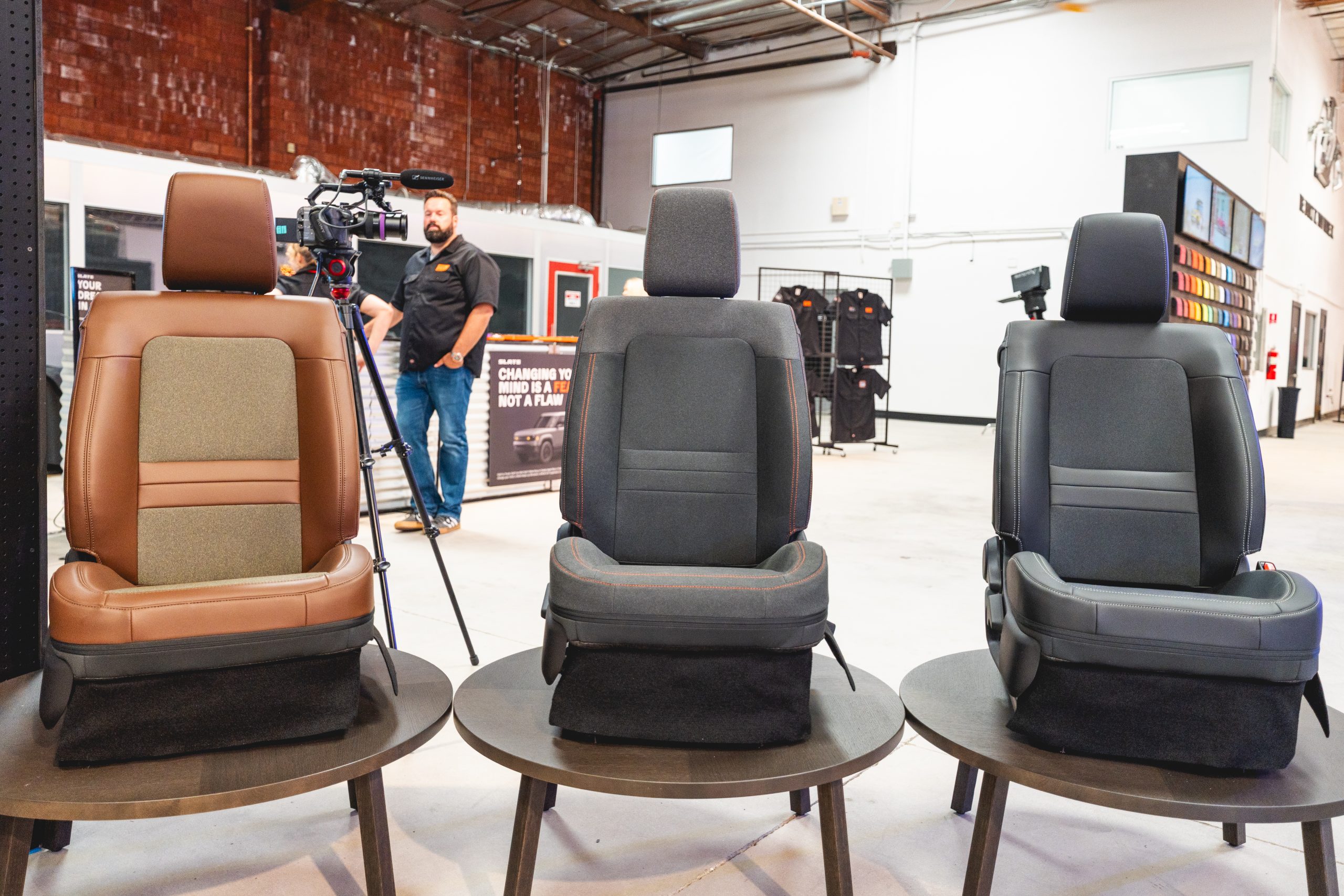
The personalization options for the vehicle’ interior include new seat covers (the stock covers are zip-offs):
The center console and door card colors can also be changed out:

And so can the rear side trim panels when in SUV mode:

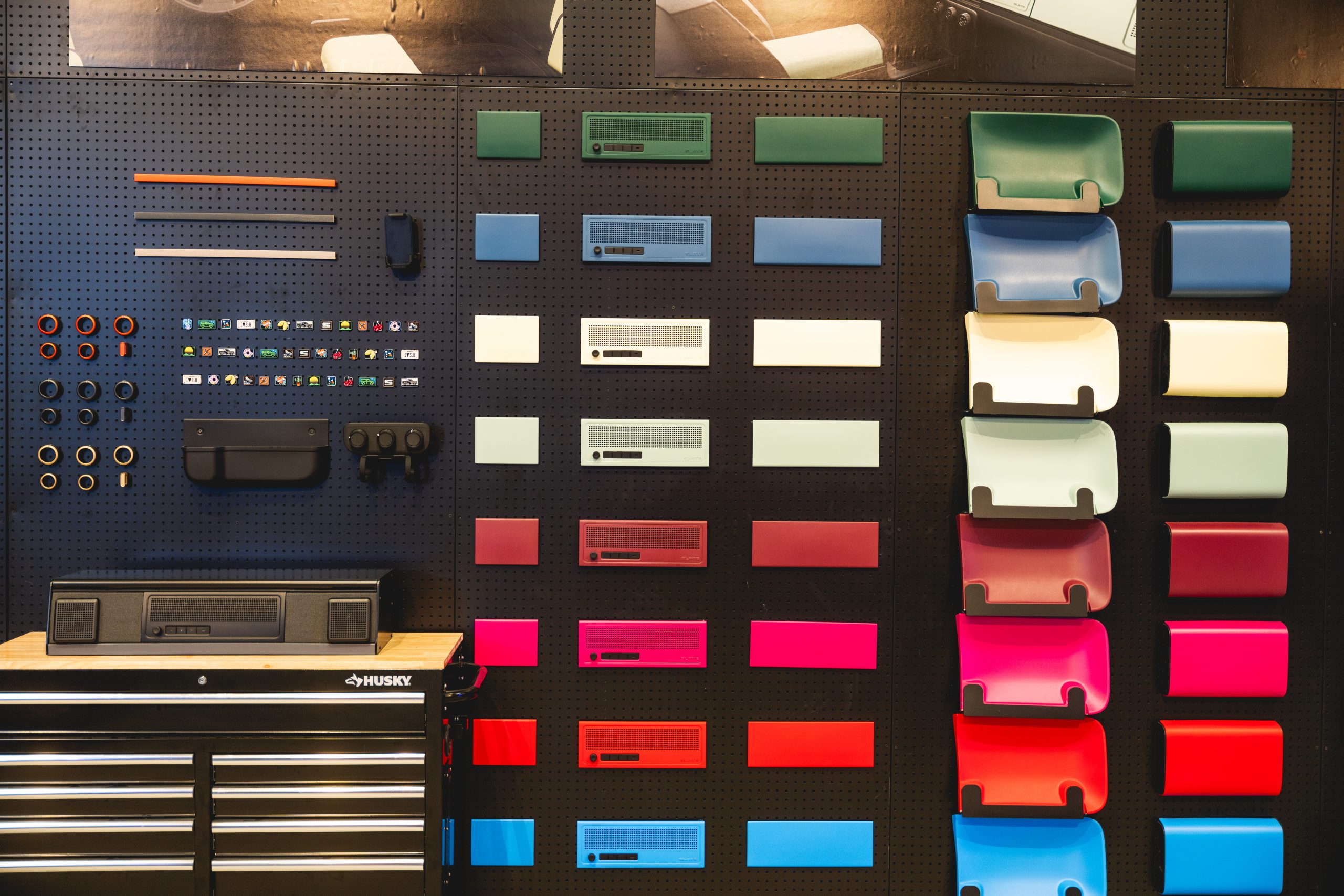
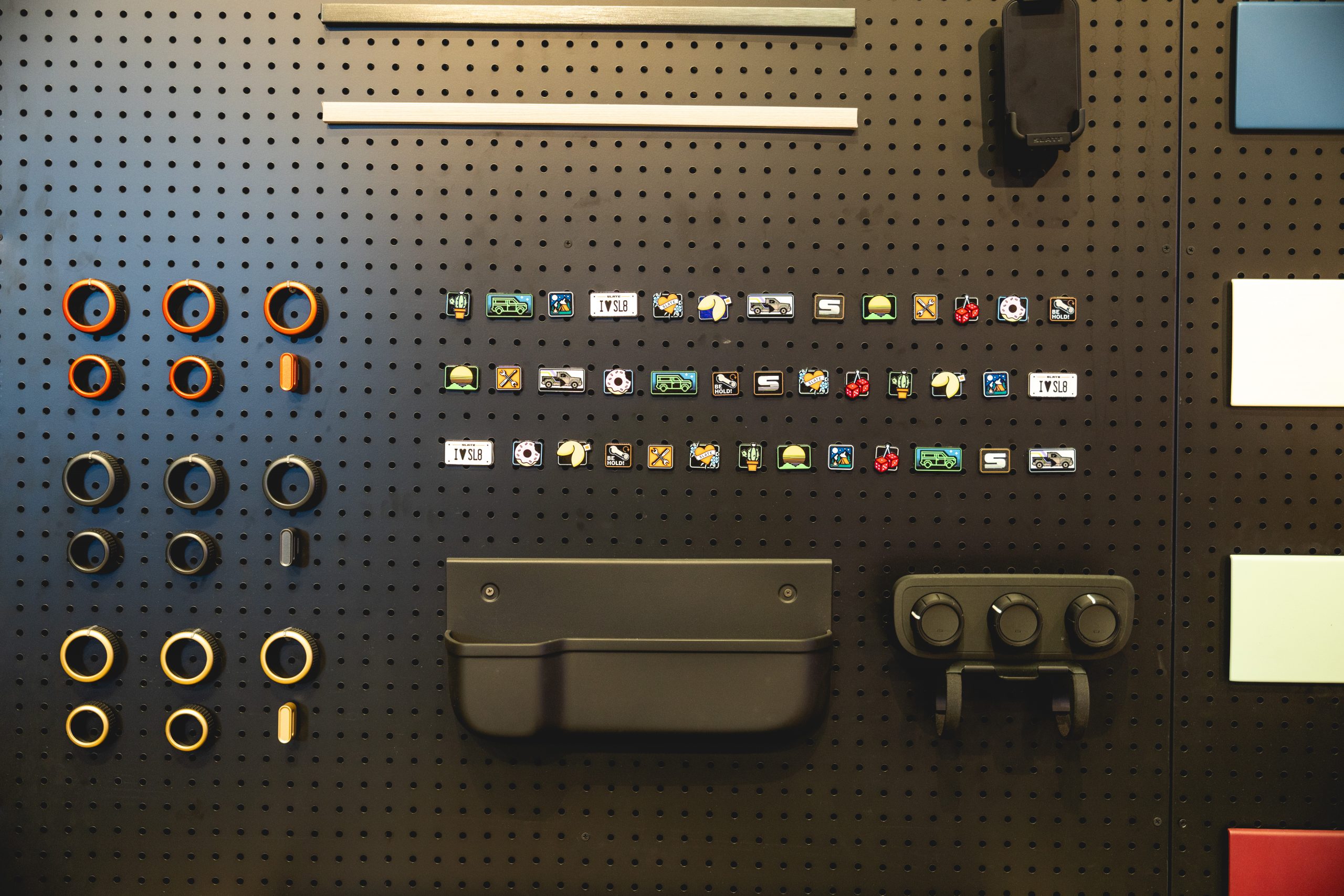
The image below shows colorful round bezels for the window crank and HVAC dials, plus little trinkets for the dash vents, and what appears to be a door pocket.
In the center you can see radio faceplates in different colors, with a demo radio on the bottom left of the photo — the center speaker is $250, the outer speakers are $150 for the pair. On the right side are door panels and on the far right are center console lids, which are the exact same part as the door armrests — a clever bit of parts-sharing.
The steel wheels can be “wrapped” with nice, colorful vinyl donuts:
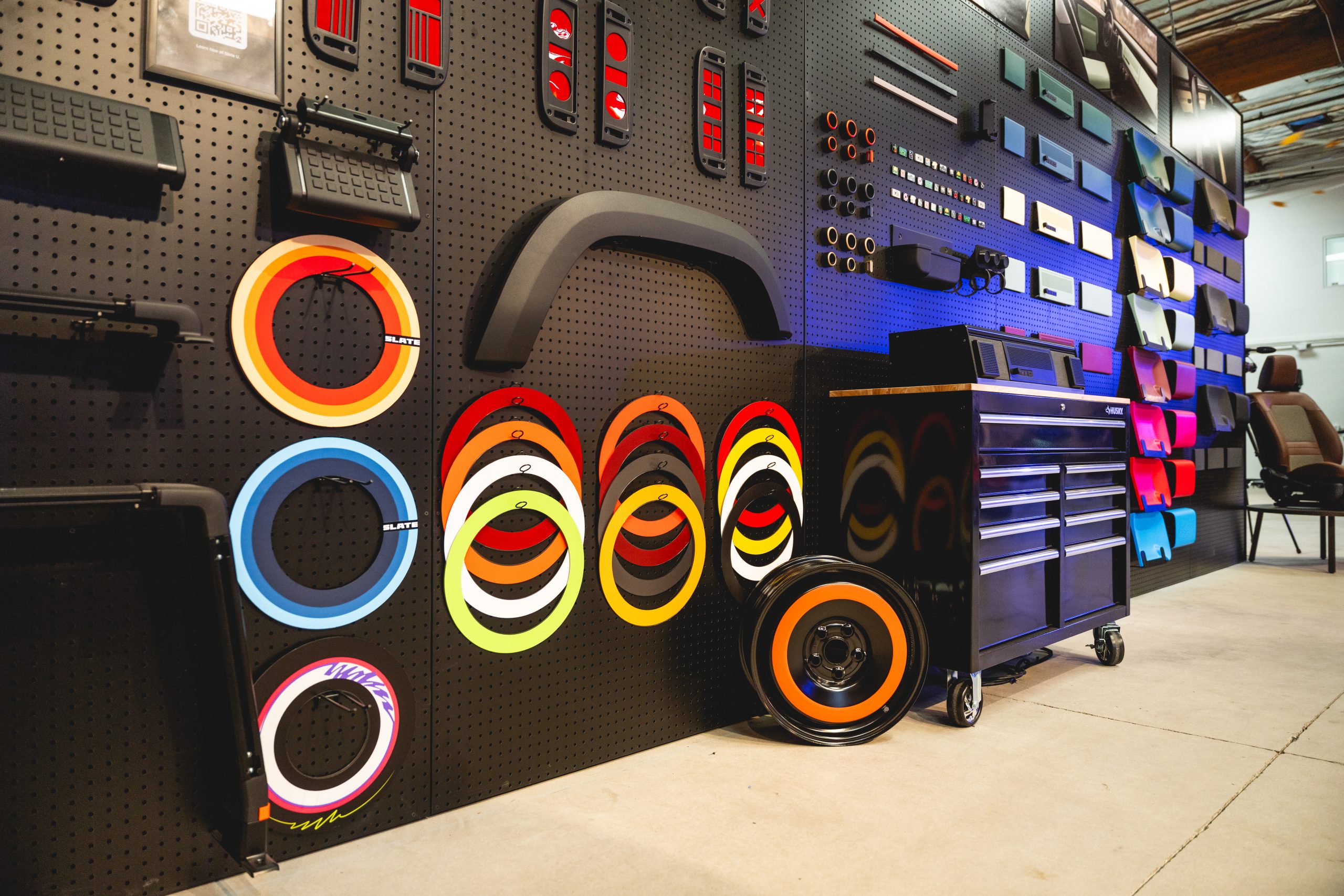
There are multiple grille options and turn signal/taillight bezel options:
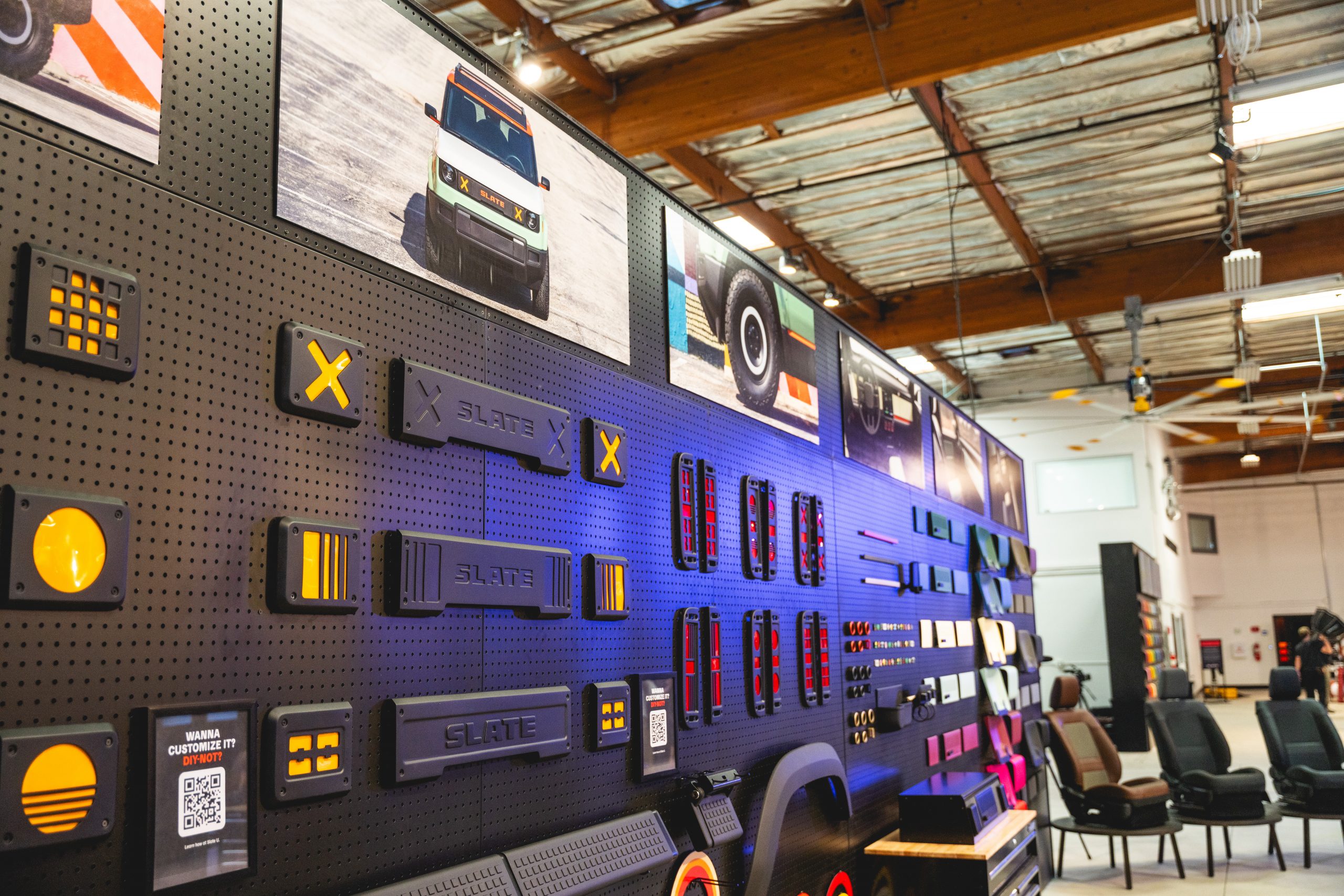
Slate has even worked with Diode Dynamics to offer multiple turn signal patterns — something that seems fairly complex from a regulatory standpoint, though Slate says they were able to self-certify fairly easily:
On top of all this, Slate plans to open-source a lot of its designs to encourage new ideas from others, who can sell their products on something called the Slate Marketplace.
I Don’t Know If It Will Succeed, But I Do Know It’s Cool

It’s a two-door, regular cab pickup truck with crank windows and no radio. On paper, selling this thing could be challenging, but I don’t want to focus on predictions about the Slate’s marketplace success, I just want to tell you what I think about the truck. It is really cool.
It looks fantastic, it’s small on the outside and roomy enough on the inside. The power is perfect (at least when unladen), the suspension seems comfortable, and the customization options are absurd and fun.
It’s not perfect, and believe me, I have done all the value-comparisons one can imagine. Yes, a Chevy Trax costs about the same and has way more amenities. Entry-level Nissans and Hyundai economy cars are in a similar boat. And as far as EVs go, the Bolt offers a lot for only a few grand more. And maybe Ford will have something competitive for not much more. I can go on and on, but there’s one thing that seems almost certain:
At the end of this year when it hits the market, the Slate will be the most soul you can get in a new car — gas or electric — for $25,000. And that has to count for something.


I increasingly think that this is the perfect vehicle for large municipal city fleets and I hope they have a sales/support channel for it. I am not sure there’s enough folks out there who are into the pretty narrow intersection of price, customization, and features to make this work otherwise.
I agree on paper, but it’s a big risk for a fleet manager to take.
Nobody is going to get fired for buying Mavericks, even if they go wrong.
The fleet manager who took a chance on a brand new startup? They’re in trouble if this goes south.
I like the fastback SUV.
Offering a single regen level is wrong though. At least two should be offered, “freewheel-like” for the motorway and then one-pedal for city. Maybe even an intermediate level. This will help efficiency (make driving more engaging as a bonus).
Once someone has driven an EV for awhile there is not need for a freewheeling coasting option. That is handled just buy lifting the accelerator pedal a bit. One pedal driving really does seem natural after a bit.
In all electrified vehicles I have driven it is impossible to know in which throttle position regenerative breaking starts applying.
Also in steep downhills being to gain speed will increase efficiency.
So a freewheeling option would help efficiency.
It isn’t impossible with a bit of practice – I have no trouble coasting in my Bolt with 0 regn. (The regen kW is right there on the screen in large numbers)
Same with going downhill – you can coast and pick up speed with no regen just by adjusting pedal position.
I agree with this. I recently rented an EV with different regen levels. I only used the most aggressive that enabled one pedal driving. Anything less than that didn’t feel natural. However, the different levels would help someone who isn’t familiar with one pedal driving adapt to it.
Especially since this is all just software. It wouldn’t increase the cost of anything, which seems to be the big issue with Slate.
Software costs money to design and test.
Slate is very smart to lean into the fun of these. I get that there are powertrain limitations but lets get real, 50% of the Jeep market has nothing to do with capability, and everything to do with fun colors, customizability and outright good vibes. I wouldn’t be shocked if they converted a number of Wrangler customers, as unlikely as that would seem.
There’s basically… nothing fun and cheap on the market right now? As much as the Ford may theoretically compete with this, it also might be boring as shit (and 35k-40k out the door).
My only issue (and the reason I likely will never buy one) is that I live in the Northeast. It gets fucking cold here, and that 200 mile range is gonna be farrrrr less without a heat pump involved. I get the vibe that they’re just sort of punting on cold climate regions which to be fair, seems like basically everyone has. Which sucks because the plastic panels would be fucking AWESOME up here (RIP Saturn).
I am all for Wrangler owners switching over. I would love the used market flooded with Rubicons that have never seen dirt.
It has the potential. Never really take your Wrangler off-road? Sick of paying 4+$ a gallon for a vehicle that gets 15mpg? Really just here for the vibes and the convertible nature of the vehicle? Here you go.
And in squareback form and the rear seats removed probably more storage than a 2 door Wrangler or 2 door Bronco.
And a frunk to lock stuff away when the roof is off!
Exactly. That Ford David spotted will probably 100x more rational a decision, but the spy shots didn’t elicit any tingling in my loins.
Plastic panels, but the unibody is still steel so in a decade of salt it could still be a write-off based on rust.
The people of the rural Northeast only care that the body panels don’t slice their kids legs open when they’re getting in and out of the car.
There’s still plenty of Saturns around here that are probably less than structurally sound but hey, they look great.
I’m also concerned about the range but for the opposite reason. Here in S FL, the heat (95°F today) will likewise reduce the range especially with the obligatory A/C running.
Wait, hang on.
Could I in theory buy the truck, and then later on if I need more seats, “upgrade” to the SUV setup on the same vehicle? So I don’t have to trade it in for a RAV4?
That seems like something that could be super handy. “It can grow with your family”, or something.
Yeah – everything is bolt on, as I understood from the initial release details. Meaning also bolt-off. I was looking forward to being able to remove the back seats and topper for example, if needed to move some bulky stuff at some point.
But I’m not sure how easy it is to remove those things. I suppose we’ll find out soon enough when people get them in their hands.
Yes and they even show you how to do it. I think the issue becomes a question of cost:
Are you really going to drive this for a few years and see it depreciate to… $12-15K in value and pay $5K for a new roof? Not sure if that quoted price includes the seats or not but that seems unlikely. Perhaps there might be buyers that got the roof new and want a truck and you could buy used from them. Overall seems unlikely but perhaps there will be an aftermarket solution if they sell enough of these. It could happen.
To be fair, in a few years you will also find people reselling the conversion bits for any one of a number of reasons. So you won’t have to pay $5K to slate necessarily. It might be $1500 if you don’t care the color is weird or the back seat is dirty.
The configurator lists the conversions as being complete factory swaps with the seats, cage and airbags. I would imagine the cage and roof would be cheaper if the rails were available without the airbags.
In theory it could grow with a family but anyone trying to put a kid in a rear facing child seat in a 2 door vehicle is going to hate life pretty quick.
This isn’t the days of my youth when it was perfectly legal to put 6 kids in the back of a truck under a topper with no seat belts or hold a baby on your lap in the front seat.
Ways to install a child seat, ranked:
1. Load from top (convertible)
2. Load from back (wagon, SUV conversion)
3. Load from side (4-door)
4. Load from middle (van)
37. Load from portal through space and time (coupe)
That “We are crank windows” crap is pure coquetry.
The passenger window has to be electric. It’s a safety issue. Not everyone has monkey-long arms to close the passenger window while driving, yet everyone has had a passenger stepping out and leaving the window open in the rain, at one point or the other.
Driver window – sure, make it crank if you need to brag about it.
1) Put vehicle in park
2) Lean over
3) Crank window
4) Sit upright (Use your core!)
5) Put vehicle in “Drive”
6) Go
No added cost.
Or:
“Hey, it’s raining. Close the window.”
He told himself.
“Hey, close my windows, man! Its raining!” For some reason I hear this in Cheech Marin’s voice
“Come around here,” said the boy.
“Now you see that-there? That’s the ignition key. When you turn that-there you’re ready to go ahead. Now, you push this do-hickey to the left. That puts her on battery—see, where it says Bat. That means battery.” They craned their necks into the car. The twins were standing on the running board.
“No—wait. I got ahead of myself. First you got to retard the spark and advance the gas, else she’ll kick your goddam arm off. This here—see it?—this-here’s the spark. You push it up—get it?—up. Clear up. And this-here’s the gas—you push her down.
Now I’m going to explain it and then I’m going to do it. I want you to pay attention. You kids get off the car. You’re in my light. Get down, goddam it.” The boys reluctantly climbed down from the running board; only their eyes looked over the door.
He took a deep breath. “Now you ready? Spark retarded, gas advanced. Spark up, gas down. Now switch to battery—left, remember—left.” A buzzing sound like that of a gigantic bee sounded. “Hear that? That’s the contact in one of the coil boxes. If you don’t get that, you got to adjust the points or maybe file them.”
He noticed a look of consternation on Adam’s face. “You can study up on that in the book,” he said kindly.
He moved to the front of the car. “Now this-here is the crank and –see this little wire sticking out of the radiator?—that’s the choke. Now watch careful while I show you. You grab the crank like this and push till she catches. See how my thumb is turned down? If I grabbed her the other way with my thumb around her, and she was to kick, why, she’d knock my thumb off. Got it?”
“Now,” he said, “look careful. I push in and bring her up until I got compression, and then, why, I pull out this wire and I bring her around careful to suck gas in.
Hear that sucking sound? That’s choke. But don’t pull her too much or you’ll flood her.
Now, I let go the wire and I give her a hell of a spin, and as soon as she catches I run around and advance the spark and retard the gas and I reach over and throw the switch quick over to magneto—see where it says Mag?—and there you are.”
His listeners were limp. After all this they just got the engine started. The boy kept at them.
“I want you to say after me now so you learn it. Spark up—gas down.”
They replied in chorus, “Spark up—gas down.”
“Switch to Bat.”
“Switch to Bat.”
“Crank to compression, thumb down.”
“Crank to compression, thumb down.”
“Easy over—choke out.”
“Easy over—choke out.”
“Spin her.”
“Spin her.”
“Spark down—gas up.”
“Spark down—gas up.”
“Switch to Mag.”
“Switch to Mag.”
“Now, we’ll go over her again. Just call me Joe.”
“Just call you Joe.”
“Not that. Spark up—gas down.”
So does your story mean your point is “this is old tech and therefore bad”? I’m not sure how this story reinforces your point about danger. Not once did the boy experience danger because he was driving old tech.
Seriously? Your argument is safety? When did rain falling inside your car start causing risk of injury? Can you not holler at your passenger “hey dummy, roll up my window”?
Are you for real?
The argument is that reaching to crank up a passenger window while driving – which will happen one day, one way or the other – is a safety issue.
As for what you can do to your passenger – sweet. Because they all listen. And because you’re realize the window is down right away, not three minutes later when you’re on the highway with a truck’s exhaust farting straight into your window.
Ok. Well. Our understanding of the meaning of the word “risk” is quite different. We see very different dangers in the world.
I am of average height. In an average vehicle, if I reach out towards the passenger window crank to operate it one way or the other, my line of sight goes under the dashboard line. I no longer see the road. My head is too low. I see the glovebox in my face.
Operating the window in such conditions while driving is the prime definition of risk. There are few things riskier than that.
So to do something as simple as close a passenger window left open, I’ll have to pull over safely, stop for the time it takes me to crank the window back up, and merge back safely. Which goes from easy to absolutely impossible, depending on the places I drive. Most of the time it’s a major hassle, with the pulling over and merging back in being risks on their own.
I have no issue with crank windows on an old car, when they used to cost order of magnitude less than electric ones, which were a novelty.
But parading with manual windows as being something good and preferable to electric ones to save a few bucks and to make a useless hipster heaven statement is an idiocy I won’t support.
Note that I am saying “manual” windows. The actual cranks can be cute, and can be integrated in all sorts of design solutions – including making them switches for power windows or something.
One word of warning- “Bees!”
Forget putting the window up. I think the correct response in this situation is to pull over, jump out and run around flailing your arms while yelling “bees!” see: Tommy Boy
With your attitude, there probably won’t be any passengers.
I’m driving a vehicle today with manual windows, it isn’t that big of a deal. People dealt with it well into the 1980s before electric windows became more standard.
And back then it was fine, and the price difference was real, and it was ok, and I’m with you.
Today is today, and manual windows on a new car are an exercise in futility.
Actually, I’ll go one up – if I could spec it this way, I’d order the Slate with a driver’s not even crank window, but even simpler – a sliding window, like on an old Renault 4. But with the passenger window still electric.
The original Lotus Europa from the 60’s had power windows because Colin Chapman found them to be lighter than the manual options available at the time. Wonder if that’s still true.
I think you could attach a crank to a modern regulator and it would be lighter as there wouldn’t be a motor.
Funny, people managed to do this for decades before power windows became ubiquitous.
They also used to die, for decades, from diseases they no longer die from, before cures became ubiquitous.
Anyway. As I have said in any Slate thread before – I am not against manual windows, however I am very much against them being listed as some sort of back to the basics beautiful improvement. They are not.
I am busy enough defending the real automotive features that we are in the process of losing – buttons, knobs, round gauges, a non-distracting environment – to jump on the bandwagon of hipster happiness.
No sane person driving away from a toll booth with a manual, left hand cranking that window up, right hand shifting, good will and wishes holding the steering wheel, will ever cry after manual windows.
I can see this being popular with tradespeople – for many of them this is probably “enough” truck. Did they mention anything about V2L for charging tools etc.?
I guess all the naysayers in the comments that said crank windows were more expensive were wrong. $40 more expensive to go electric plus the loss in driving range.
Ok the claim of loss of range there is a BIT of a stretch.
Let’s handshake on a BSHIT of a stretch
From the little research I’ve done there is a. 3-.4kg weight savings per window to go manual, and the wiring weighs another. 3kg.
So just off weight you are shaving ~1kg off of the car. Plus any power used to activate the window motor. It’s a tiny amount but real.
Again – not relevant enough to move a needle one way or the other. 10-11kg less on an EV will save you you about 1.5kw over the whole year, if you drive 20000km/yr. Rolling both your windows down then up, twice per day, will add less than a Kw.
So with the crank windows you’ll be saving about 2-3kw/yr. In most places that’s less than $1/yr.
Your lifetime savings from your crank windows will be offset by driving on fresh asphalt for half an hour, or by climbing the rolling hills on the I-80 to the Delaware water gap on the New Jersey-Pennsylvania border once.
I never said how much range but it’s not zero, it’s probably somewhere in the tens of meters of range on a full charge.
I comes down to economy of scale or lack thereof. I work for a manufacturer. Looking at our costs – crank windows costs us more than power windows. It comes down to economy of scale and when you are OEM buying windows where the take rate for power is 98% and crank is 2% there simply is no scale for the crank windows so they cost a lot because you are buying thousands of crank windows and hundreds of thousands of power windows.
On the other hand Slate has no economy of scale for anything. They are searching for any tier 1 that will even sell them parts because they have no history and no scale. When you have low volumes for both options then yes, there is a savings from going with a simpler crank window.
In your response, you mention take rates. Meaning the option has to exist. so you need two parts for the same vehicle, and electric and a manual one. Development costs do have to be in the cost, so that makes a lot of sense.
Would that hold true if the only option was manual though? Even for the big guys with economies of scale?
No large company is going to offer a manual window only option because new car buyers want power windows.
Even on a new vehicle model there are economies of scale because some of the components within the assembly will be shared with other models.
So while I believe that it is possible that Slate is saving $40 by going with manual windows that is a function of them being a low volume startup. AS I mentioned above they will have to search to find suppliers that will even supply them and even then they are likely paying for parts up front are paying a bank for a Letter of Credit. At least that was what we did years ago when I worked for a Tier 1. It doesn’t take too many times getting burned by start up dreamers before you require guaranteed payment.
That said – I thought power windows were going to be an option. If they aren’t that is beyond stupid.
To be fair, we don’t know how that analysis was done. Is that just based on BOM pricing comparison where the electric window cost only included their lower volume, as optional, per part cost? Does it include additional logistics costs of 2 configurations, part management, multiple assembly configs, design compromises to offer both, etc? What about risk of having to sole source those parts from a Brazilian supplier? No doubt $40 is likely a difficult gap to close (and probably not possible to fully close), but I highly suspect that the stated $40 cost savings was given every benefit of the doubt and had the most preferential analysis possible.
Why in the world would the bean counters not do standard BOM analysis for build configurations when comparing price, especially on a vehicle that they clearly thought so much about these things. This vehicle, and everything they’ve publicly stated about it, seems pretty obvious that it would have come with electric ones standard if it saved them manufacturing costs.
The idea that they are lying about it, just seems silly without any sort of proof.
They don’t have the staff to do a real detailed analysis of every component. Some of it is simply not knowing what you don’t know.
That is the reality of a startup and the reason that their first models are usually crap.
We don’t know that…
We do. From this article:
“This is a small team of fewer than 200 engineers “
And from that you are able to know that not one industrial engineer worked with a cost accountant? Or heck, one manufacturer I worked at, this would have been taken care of entirely by the procurement department that didn’t have a single engineer on staff.
Figuring out the cost of carrying extra part numbers isn’t rocket science, and heck, if you have your ERP system set up properly, that’ll do 80% of the work.
Slate is short staffed and working on a shoe-string budget. They are going to miss things just like every other start-up.
Even established automakers that have been doing this for 100 years still miss things from time to time.
I’m not saying it isn’t a possibility. I’m simply questioning the people that act like they know what happened for a fact.
For all we know, they actually did their due diligence when it came to a proper price comparison and they are right. I’m open to the idea they aren’t. I find it less likely. Yes, they are a start up. Yes they have a small staff. But they are very focused on pricing so it seems like it would be a huge blunder if they messed it up in the way you suggest. Especially when they’ve done loads to commonize parts and thus reduce part numbers, and they are clearly proud of that work (pointing out the center console arm is the shared as the left and right arm rest as well).
For anyone needing rear seats, I think the $SUV kit option sounds good until you compare that to the upcoming FORD EV. In the real world it’s still a pain to crawl past the front seats to get into the back compared to a 4-door. The $5,000 cost increase for the SLATE rear seats, roll bar, side air bags and tops makes the 4-door FORD (and maybe upcoming Toyota, Ram, and Hyundai/Kia EV trucklets) a much better play.
IF you never need rear seats, the simple unwrapped 2-door SLATE, perhaps with just a tonneau cover or bed-cap could be a money saver, so there’s hope for SLATE, but the SUV kit cost + the inconvenience and bare-bones sacrifices are a tough sell for anyone with more than 2 passengers.
Regardless I’d wait a couple of years before I’d spend big dollars on the SLATE, just to see how it all plays out.
TBH, one of the selling points of this over the Ford is that it’s more fun with two doors.
I honestly can’t even remember if I’ve ever had adults in the back of my daily, but I need rear seats since I take my kids in it all the time. And you know what they would love? The feeling of adventure of climbing into that back seat. Add in the ability to leave the roof at home and it’s a major win as a cool dad car.
People pay crazy stupid money for Jeeps all day long because it’s fun to leave the roof at home and add custom bits – I think this will capitalize on folks who want that but can’t afford or won’t spend the money on a Jeep.
This. My kids would LOVE this thing in SUV form.
Yep generations of people raised hoards of children in 2 door cars.
I get why 2-doors fell out of favor. Car seats in a 2-door are an absolute unmitigated nightmare. Especially rear facing ones. The window for this is “kids in boosters through teen” which as standards increase, becomes smaller and smaller.
But I also keep getting told that hardly anyone has more than 2 kids anymore, and tons of people are choosing to not have kids at all, so I’m not 100% sure why everyone feels the need to have limo-space in the back. This would be adequate of my children (hypocrite here though of course, I drive a van). But honestly they’d be way way more excited to get into this everyday than the van.
My two kids are grade school age right now. This would have easily worked for the last 3-4 years and definitely for the next 5-10, then once they’re driving I let them scoot around in this and make their friends climb over the seats.
As a primary family car it probably isn’t ideal, but we have a big family mobile for trips and the like. This would be my daily.
My New Beetle had a pair of the tallest, widest doors possible, but I traded it when the kid got to Middle School.
That’s fair, the New Beetle backseat was really REALLY small. I would think that the Slate backseat is far more usable, especially in regards to headroom?
It was big enough for a car seat or two. What I liked was that the door was tall and wide.
Not with modern, large, rear-facing child seats. Hell, often without any restraints at all.
But Wranglers are well within this price range, aren’t they? There are over 900 used Wranglers within 100 miles of me on Autotrader for less than the price of a Slate with back seats and a topper.
Yes, they aren’t EVs, but if you’re buying the Slate for the adventure and customization, you’ve got a ton of options for less than 35k.
Two points on that, though:
Thanks. One of the reasons I left the old site was the constant always buy used comments. The “this new vehicle is more expensive than used cars and therefore people should never buy it’ is totally pointless and beating a dead horse at this point. Like yes a 30 year old rusty civic is less expensive than a new G-wagen. People need to chill. thanks for your comment.
I’m definitely not one of those always buy old. I do it myself because I have just never had a car payment, and never want one… so the only way to get into the kind of vehicles that interest me is by going used.
So no, I’m not saying what you’re saying I’m saying. Maybe others are. I want the Slate to succeed. I love the simplicity, the customization potential, the EV drivetrain… pretty much all of it. I even put down $50 on day one with the hope that this would be what I wanted, but that was when it was being projected as a 20k car with the (then) available incentives.
The incentives evaporated and now it is a direct competitor with other new vehicles in its class. If you want a Slate because it is an efficient small pickup, you can buy, today, a brand new PHEV Maverick with a cool color and more features and an always-available bed for the same price as a Slate with rear seats and an SUV topper. If you want it to be an open air adventure machine, you can buy, today, a brand new base Wrangler for only a few grand more than a Slate with rear seats and the open topper. Or you can get a gently used Wrangler for less.
With a base price of 5-10k higher than original expectations depending on if you want rear seats or not, it has invited comparisons that it can’t stand up to, no matter what the purpose you find in it is. It just doesn’t work without the EV incentives.
Fair enough – if you want EV + adventure machine, then the Wrangler definitely isn’t it. In that case, the Slate with rear seats and the open topper fits a really unique niche. But then you’re paying a hefty premium for the EV part.
Maybe there are enough people wanting a tiny, expensive EV Wrangler out there?
The 2 door Wrangler is actually shorter than this and still more expensive, even in its base configuration. The Slate is 170″ vs a 2 door Wrangler at 167″ and the base MSRP is $36k. I’m sure you can get it for less, but only if you can find one.
Granted, it’s still not a direct comparison since the Wrangler is far more capable off-road.
But I think the fact that there are still plenty of customers spending $40-$60k+ on new Wranglers and Broncos for driving around town indicates it’s possible to charge a premium for a “fun”, customizable vehicle even if it’s inherently compromised.
I’ve said before I think the Slate’s a bit too expensive still for me to purchase one, but I do hope that there are enough people out there that will spend an extra $10-15k over what I would in the name of fun. They seem to do it with Jeeps and Broncos, so who knows?
Excellent article, David. It’s exciting to hear in the video that you were one of the first invited – major props to the Autopian and what you’ve accomplished here!!
I’ll admit, the price discussions left me a little cold on the idea of this, but watching the video and seeing all the fun little touches on top of a very usable foundation makes me interested again.
I still think that my pricing analysis holds – I would absolutely renew my reservation if this was $18k (or the $17,450 that the tax credit would have enabled), but at $25k it’s just enough money that my practical side starts saying it costs too much to justify based on how fun it is.
Optioning it up to $34k or whatever for the SUV plus fun accessories makes that math worse, but I actually think the idea of upgrading as you go will help with that. Yes, 34k is too much, but I could see being willing to drop a few hundred bucks after a year to customize the interior or something. I’m always on the lookout for fun little DIY changes on the stuff I already own. The 5k for the SUV is tough, though.
I’ll continue watching with interest and hope they succeed.
I don’t know what your perspective is, but I pretty frequently need to enter a new car’s MSRP into an inflation calculator to see what it’s really priced at. And once you do that, the $25k lands right at $18,700 in 2018’s dollar, which seems about right.
I do try to keep in mind the inflation aspect, but back in 2018 I wouldn’t have spent 18k on a car, either.
What I’m really doing is comparing the cost of taking a chunk out of my savings and then carrying a car payment over the next 4-5 years and deciding whether that’s worth it to me compared to continuing to drive my paid-for 2014 Mazda3. The truth is that the Mazda3 still wins in a few important categories (it’s got a stick, I listen to a lot of music, I have taken it on some long distance road trips, it’s honestly more practical for how I use it).
If I was facing a scenario where I needed a new car for some reason, I’d be comparing this to a list of fun hot or warm hatches on the used market, as well as a bunch of off-lease EVs. There’s too much available at $25k right now for this to be the winner, and I’d much rather spend $15k and use the remainder on other stuff.
My hope is that since I’m not the target new car buyer that this does really well (just like any other new car that’s too expensive for me personally can do well) and in the future it competes better as either a used car or some other situation changes (cost of fuel, my personal financial situation and the “fun” value of my money, etc).
A friend recently hit a deer and totaled their car, and it got me thinking about what I would get if I needed to replace my car today. I didn’t really see anything appealing even in the $15k range. And if I bump it up to $20k, I might as well spend the extra $8k on a brand-new Civic Hybrid or something. But then I’ve almost doubled the initial price range… but you also get 50 mpg. I guess my point is that even used, the market isn’t really that great. What would you get for $15k?
I most recently was searching for family haulers in the $25k range, so tbh I haven’t looked much for a daily replacement over the last few years. But a quick search on CarGurus for under $15k with a manual shows you’ve got a point – choices are slimmer than they used to be.
There were still a handful of Mazda3’s, Civic Si’s, GTIs, and even a couple Focus ST’s in the 13k range with around 100k miles, though, so I think I could still find something workable if I had to. It does make the Slate more appealing, even if the main reaction is annoyance at how quickly prices seem to keep rising.
I dunno, the cynical part of me thinks that the reason that Slate has been so Autopian-friendly is because the peculiar sensibilities of the writers here make them predisposed to liking Slate as a concept
Have they considered making a right-hand-drive version and marketing this thing to rural mail carriers? I was just talking to one the other day, and he does about 80 miles a day. This seems like the perfect alternative to the Jeep Wranglers that so many RMCs use.
Otherwise, from my perspective, no AWD seems like the wrong call. I have no official data, but based on CarGurus, more than 50% of new Siennas nationwide are equipped with AWD. That’s a minivan. I bet a small utility truck’s AWD take rate would be even higher if the cost were in line with Toyota’s ~$2,000 premium for the option.
I desperately want this vehicle to succeed. When was the last time we had anything this cheap, fun, and cheerful? But I think its main sticking point is breaking out of the perfect 3rd-car category into the main car category.
Someone in my rural area is using a JDM Honda van to deliver mail, confused the hell out of me the first time I saw it.
The Toyota JPN Taxi would’ve made a better mail truck than whatever Oshkosh developed; I’ll die on this hill.
The purchase of US Postal Service vehicles has been so politicized that the only way this small startup could win a contract is if they were based in palm Beach, FL and closely connected with The Big Guy.
The factory customization sounds nice but I wonder how long they’ll be able to stick with it. That kind of thing becomes a huge challenge in any kind of volume production environment, especially so for a product that’s so cost conscious.
Looks lie I’m going against the grain here. My config is the square SUV, with the speakers, orange lava stripes and wheel decals, upgraded animated head and tail lights, and I’m all in at just under 32K.
Biggest draw for me, the telematics unit is OPTIONAL.
Honestly, it’s 10-20K cheaper than any other vehicle I’m interested in, and the lack of connectivity is a huge draw for me.
Range is perfect for me, on average I buy one tank of gas per month.
I would go for a similar spec, but no AWD is a no go for my needs. Fingers crossed this does well enough for that option to come along soon.
I drive Honda Civics 🙂
I’ve had AWD cars and SUVs and they are nice; but I seem to manage Michigan Winters pretty well without it. I’m fortunate that if it snows REAL bad, I just stay home.
I can see the license plates already.
Michigan
The we stay at home state
LOL
I did the 2wd 2 door small truck thing back when you could still get them new, I am confident that I want 4 driven wheels. I /can/ get around in 2wd, I just don’t want to.
I can see the telematics module being optional as a huge benefit for some folks. There are people who refuse to have any “smart devices” at home because they could be listening and tracking your every move. Just ignore the fact that their iPhones are always in their hands…
Both things can be bad, that doesn’t mean I have to give up and just accept my fate. It’s not about eliminating the data collection/surveillance; it’s about controlling how much of it is out there, and the level of oversight. Apple has never had one of their execs publicly state something like “I Could sell you the listening habit of every customer in California”
Also, I work in the sausage factory, so I have insight into how it’s being made; and I don’t want a connected vehicle.
One thing to bear in mind is that you NEED the center console tablet in order to do battery preconditioning
I can foresee DIY wraps will be horrendously bad PR.
Only if the people that would do those horrible wraps are convinced the Slate is cool enough to be seen in.
Wait till they see people with latex paint painting the panels whatever color they find at Home Depot.
A larger battery is good but 205 miles of range won’t work – especially not with a resistance heater. That is going to drop to the low 100’s at highway speeds in the winter even with very modest use of the heater to keep the windows defrosted.
For reference my 2017. Bolt with the upgraded battery for 260 miles of range will just barely make the trip to my local ski resort which is a 160 mile round trip and I keep the speeds below 60 mph.
I really appreciate what they’re trying to do here but many of their choices seem like they’re not really looking at cold climates as their target market.
I’m in the Pacific Northwest so it doesn’t even get cold here.
With cheap juice and costly gas. It’s the perfect habitat for EVs. When choosing vehicles, three thing matter: location, location and location.
It is a good market for an EV – I have a 2017 Bolt today and a Spark EV before that. I can charge off-peak for 9 cents a kWh.
That doesn’t mean it is a market for this particular EV.
if you think I’m driving my sweet little truck in the fucking salt you’re delusional. This puppy is in the garage all winter for me, the f-250 will eat the salt.
Some good ideas mixed with some bad.
David’s comment about the blind spot and the large B pillar reinforces my take that the lack of blind-side monitoring in the non-power mirrors is a major miss by SLATE. The blind spot will be even worse with the SUV kit!
Neither power mirrors nor blind side monitoring is high tech. It’s non-invasive, greatly improves safety and adds convenance. In their quest to make the SLATE simple, they made it dumb! You can’t even add them as options. The lack of those 2 features make the SLATE a non-starter for me. I am sure FORD, Toyota, RAM and Hyundai/Kia will all offer this in their next gen entry level EVs.
I think the wrap idea is going to get expensive for end users, and they’ll be plenty of ratty looking SLATEs running around after a few years. Eventually many will have to get unwrapped. I have to wonder what the non-wrapped body panels will look like after baking 2-3 years in the Albuquerque sun? Warped? Discolored? Scratched?
The single, larger battery instead of having 2 sizes, was the obvious move. They have the efficiency up a bit to 3.15 mile/kWh, which is more in line, but very curious what the real world numbers will be. The lack of a heat pump may be the weak spot for SLATE. In the cold north, anyone with a SUV kit and people in the back seats are going need a lot of heat to warm up the large open interior. No seat heaters? That 205 mile range may get cut 30%? 40%?
I’m glad I got my refund on the $50 I put down. I still like the concept, but should I ever decide I want one (if they offer power mirrors and BSM), I think the smart play is to wait 2-3 years at least and see how it all shakes out.
There are offerings of aftermarket radar blind spot systems out there for <$800.
Then there’s just turning your head for nothing.
Blind-spot monitoring is not as cheap and trivial as it seems; many cheaper cars still don’t offer it as standard, and installing/repairing it usually requires external calibration tools. Probably not very suitable for a vehicle targeting very low cost and a high degree of DIY repairability.
many people are calling it the most california coded vehicle since the manx…. (I am the many people)
I’m excitedly waiting to get one of these super cheap used as an around town car.
When this things costs more than a RAV4 optioned up, who is going to buy it?
Almost nobody. $400 for a radio is crazy.
Have you priced an aftermarket head unit? Even a cheap Chinese radio is $150-300 on Amazon. That doesn’t include speakers, wiriing, etc.
Those aftermarket head units have massive markups vs the OEM cost.
Not when you go to buy a replacement from the OEM 😀
In my mind, it’s not what the corpos pay for stuff. It’s what I would pay, and $400 for a sound system in my cheap truck will be hard to beat.
The true budget solution will be a discount bluetooth speaker tube thing connected to the phone you already have.
Yeah I sort of figured that would be the default option for most. Hell my brother already does this in the RAV4 he has with a broken infotainment system.
That works but how many people want to have to do that for a new car they just spent $25,000 or more to buy? The SUV’s are realistically in the low $30K range.
Its a fair point. The two overlaps of people who would do this and people who might buy a Slate are “cheap but new” and “love the customization opportunity”.
I don’t know if that is a big enough swath of people to matter in the larger market.
I see that as a gimmick, and while it may be satisfactory to some I would need more than that.
Just FYI – Aftermarket pricing is about 5X to 7X higher than what it should cost you as a option installed in the factory.
Scion and others tried shipping cars without a radio decades ago back when aftermarket head units were really popular. People didn’t like it and the option went away. Today the aftermarket audio section is a fraction of what it used to be so I expect it to be even less popular.
Basically it just looks REALLY cheap to most new car buyers to not include a radio (or power windows)
The problem with aftermarket radios now is cars don’t have standardized places to put them anymore. That’s why for many vehicles the choice is either a super expensive dash kit that can cost more than the radio, or a Chinese Android product that fit the dash perfectly, but is a bad radio.
My Scion absolutely came with a radio, there was an optinal upgrade that cost 3x what the Pioneer head unit I bought to replace it.
As a recovering ScionLife forum member I have never once heard of a Scion being delivered without a stereo.
I don’t care how marked up aftermarket pricing is, it’s what all customers who don’t own a parts company have to pay, so the price is fixed.
I was thinking of the wrong brand. It seems that it was GM and Hyundai/ Kia that would allow customers to buy a new car with the option of radio prep but not radio.
Fair enough 🙂
I’ve bought bluetooth/Android Auto/Car Play double din radios from reputable manufacturers for under $200.
There’s always a cheap option, but $400 is in no way an outrageous price point for a car radio.
Out of the 288 Apple Car Play radios available for sale on Crutchfield range from $59.99 to the most expensive bein $1,699.95 without getting into radios designed for specific vehicles.
Maybe not to you, but I’m not paying $400 for a couple of extra features when 200 gets me a Pioneer or JVC, and I splurged and paid 300 for an Alpine one to go into my e46. Especially since these don’t even come with any mechanical components (no cassette/CD or DVD player.) The dash kit and wiring adapter cost about $250 to put the Pioneer into my delivery car (the stock head unit was terrible to connect to your phone.)
people that don’t like these, can’t fathom doing anything, including thinking, by themselves. It’s not worth replying to them.
The Slate has interested me for a while and continues too — but I still have questions. And most probably can’t be answered until the Slate has been out in the wild for a year or two. Thins like:
Drive tire wear? EV’s, with their high torque, have the potential to be harder on tires. It sounds like Slate’s choice for what sounds like gentler launch and starting acceleration may alleviate a lot of that. But it will be interesting to find out.
How will the body panels handle constant UV and weather exposure? My trucks invariably spend their entire lives outdoors. It is even worth spending $500 + labor to do the wrap every few years if it’s a private vehicle? (If it were a company vehicle, there would be more opportunities to write off the “advertising” cost for custom logo-embellished wraps…) Can the body panels just exist, un-wrapped, in the sun an elements for years without degrading?
I, too, am curious if a front motor might become available. I don’t necessarily need a 4×4 as a runabout, but a mild AWD configuration would be attractive for foul-weather and winter use.
Battery cooling and management is also on my mind. Simple and basic is good, but if there’s any single place to really spend on good engineering and overall quality, it’s the batteries and their management. The 1st-Gen Leaf stands as a lesson — great little EV, but the simple air cooling of the batteries was never really enough to ensure optimal longevity of the pack. EV battery packs aren’t cheap — I’d rather pay upfront for a control/cooling system that will keep that considerable investment in good condition for as long as possible.
I can answer one thing, the air cooling should be fine. The leaf had a different chemistry which made it prone to degradation, this won’t.
Air cooling for an EV takes away one point of critical failure for EV’s.
The UV damage is a big point I hadn’t considered. Paint doesn’t do too well, but plastic surfaces are way worse. Discoloration and cracking.
Now with just the 1 battery option and over 200 miles and only $25k, I can see fleets eating this up, most already wrap their trucks anyways. Then 2nd hand market people getting them for under $20k and buying all the accessories, so they continue to get revenue without relying on oil changes and such like conventional auto makers.
Should I have pre-ordered before I read this article? maybe not. I am still on the fence, but as my dad said, “when else are you going to be able to buy a first of a new brand thats actually affordable?”. Well who knows with REO . . .
If they sell it in China, sooner than later all options will be available in AliExpress for way less they charge.
Also sooner than later, some youtuber will try to convert it to ICE.
If it does not succeed, at least will generate some nice content.
Won’t have to wait. They say they want to open the specs.
Note that DT (likely quoting slate) have it slightly wrong when saying “open source” as that implies outsiders can contribute to the spec beyond just accessing it.
With the frunk floor removed, it might be possible to put an engine and transaxle in the nose, making it an AWD hybrid, if someone’s crazy enough to do all that work AND program the drivetrain to work together.
Nice write up.
Random thoughts . . .
“Coach line” wrap option looks like an homage to Fruit stripe gum.
A wrap lasting only 3-5 years feels like a waste of money for a product so focused on value.
Going to one battery choice makes solid business sense. Recently watched a Business Insider video on the reboot Chili’s has gone through and one of the things they did was to slim down the menu.
I have no doubt there is a market segment that will love customizing the hell out of it but I also think there is a (sizeable) market segment that will think the sushi-menu aspect of buying/configuring is just too much work and the total price will be turnoff when everyone has the $25k number in their head at the beginning.
It may not be for me but I hope they succeed if for no other reason than to put some pressure on the competing manufactures to produce competitive vehicles in the sub $30k market.
I think the focus on wrapability makes sense because most of the cost of wrapping a traditional vehicle is the skilled labor of stretching vinyl around the compound shapes of modern vehicles and making transitions between sheets of vinyl seamless. The design of the Slate is specifically aimed at cheap DIY jobs, and enables the use of a cheaper narrower roll of material. If you’re not keen on wrapping it, then just consider it the Ford approach: They can have any color they want, as long as it’s gray.
Oof. Another 20% on top to get the SUV bits? I sure hope for that price it comes with everything needed to turn it back into a truck but I bet it doesnt.
Seems like Slate is planning to make their profit from parts sales.
100% their profit plan is accessories.
There is a subscription model waiting somewhere in this
Just wait until Temu and TikTokShop get wind of this.
and a cottage industry of Etsy-ers
100% for sure!!
I mean, the kit is being supplied as a DIY, so you’re gonna have the truck bits in the form of the base vehicle.
If you order it as the SUV, you don’t DIY the instal, it’s delivered as configured without the extra parts.
I can’t find anywhere that they explicitly state that. It’s sort of inferred, but not clarified.
That’s how I parsed this statement in the FAQ:
If I buy a Slate Truck or SUV, can I change it to the other body style later on?
Yes, you can get your Slate delivered however you like it, and switch it up later with a Conversion Kit.
Seems like the move is to order it blank and get the kit later, especially since it should be cheaper that way.
In theory, places that charge annual vehicle tax based on value would show you owning a $25K truck instead of a $30K SUV by doing it that way as well.
If it’s ordered from the factory that way it’s unlikely to actually include the base parts as stated on the configuration site
The replaceable seat covers seems awesome for freshening up an old interior. My 9 year old Outback’s interior is in pretty good shape, but the driver seat is showing wear. While I can buy an OEM cover, it’s expensive and it’s not a super user friendly process.
I helped a friend and his brother swap out the seat cushions for the drivers seat of his Crosstrek, as the foam had broken down enough to cause him significant backpain while driving. It took three of us just over an hour and a half. I’m not sure what he paid for them on eBay but it was a significant break VS buying the whole seat, especially on shipping.
I’m in the process of outfitting my ’09 Grand Cherokee with seat covers. I seem to have picked a decent brand, and they’re a surprisingly nice fit, but installation isn’t exactly easy for a first-time user.