

I’m in Phoenix, Arizona at the moment, America’s only city that’s named for both a leading brand of tissue and a mythical bird. Go on, check and see! I’m here because Toyota invited me out to the opening of their new Toyota Arizona Proving Ground, a large facility where, based on the name, I assume Toyota leaves its dough to rest, ferment, increase in volume, and develop more rich flavor. Why an automotive company requires such an extensive facility is beyond me, but I suspect they’ll explain everything.
I think tomorrow I’ll be going to some ribbon-cutting ceremony – I hope to see a pair of giant novelty scissors, or I’m going to be very cross – and I think I’ll get to drive some things off-road and on a track, including, it’s been hinted at, a hydrogen-powered truck of some kind.


Which leads me to my Secret Agenda: I’d like to ask some Toyota engineers just why the hell they still make and “sell” the Mirai, their hydrogen fuel-cell car, and what they’re doing with hydrogen in general, and, you know, why. I was told I’d be able to do this, and I’m genuinely curious.
In fact, one of Toyota’s PR people happened to see our story this week about how baffled we are that the Mirai will continue to be sold, a car that makes up 0.0008% of Toyota’s American sales and, to their credit, suggested I talk about their hydrogen strategy with their engineers and other experts.
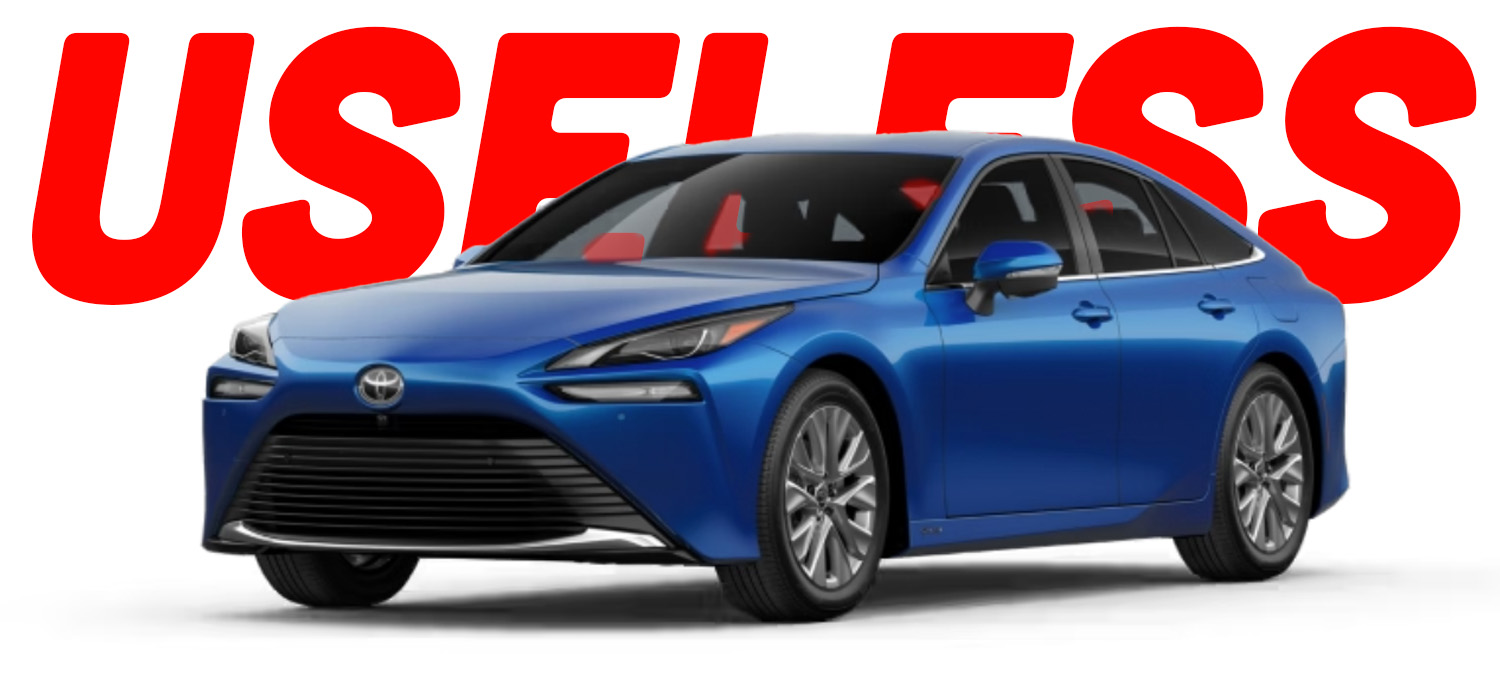
I think this is generous, since we’ve not really been kind to the Mirai in general, either, reporting on the many lawsuits owners have leveled at the company because Mirais have proven to be expensive albatrosses that can’t leave a few locations in California, because there is nowhere else to refuel them. We’ve come right out and said the car is a “fascinating waste of money,” because, let’s be honest here, it is.
I mean, it’s a car that I genuinely cannot think of any reason to buy. Would you recommend a hydrogen-powered Mirai to anyone? Sure, it’s well-engineered and built with Toyota quality, but you can only refill it in a handful of stations in the Bay Area and Southern California, and the fuel is way more expensive than you’d think, with per-mile costs being higher than battery EVs or gasoline cars. Why would anyone want one of these?
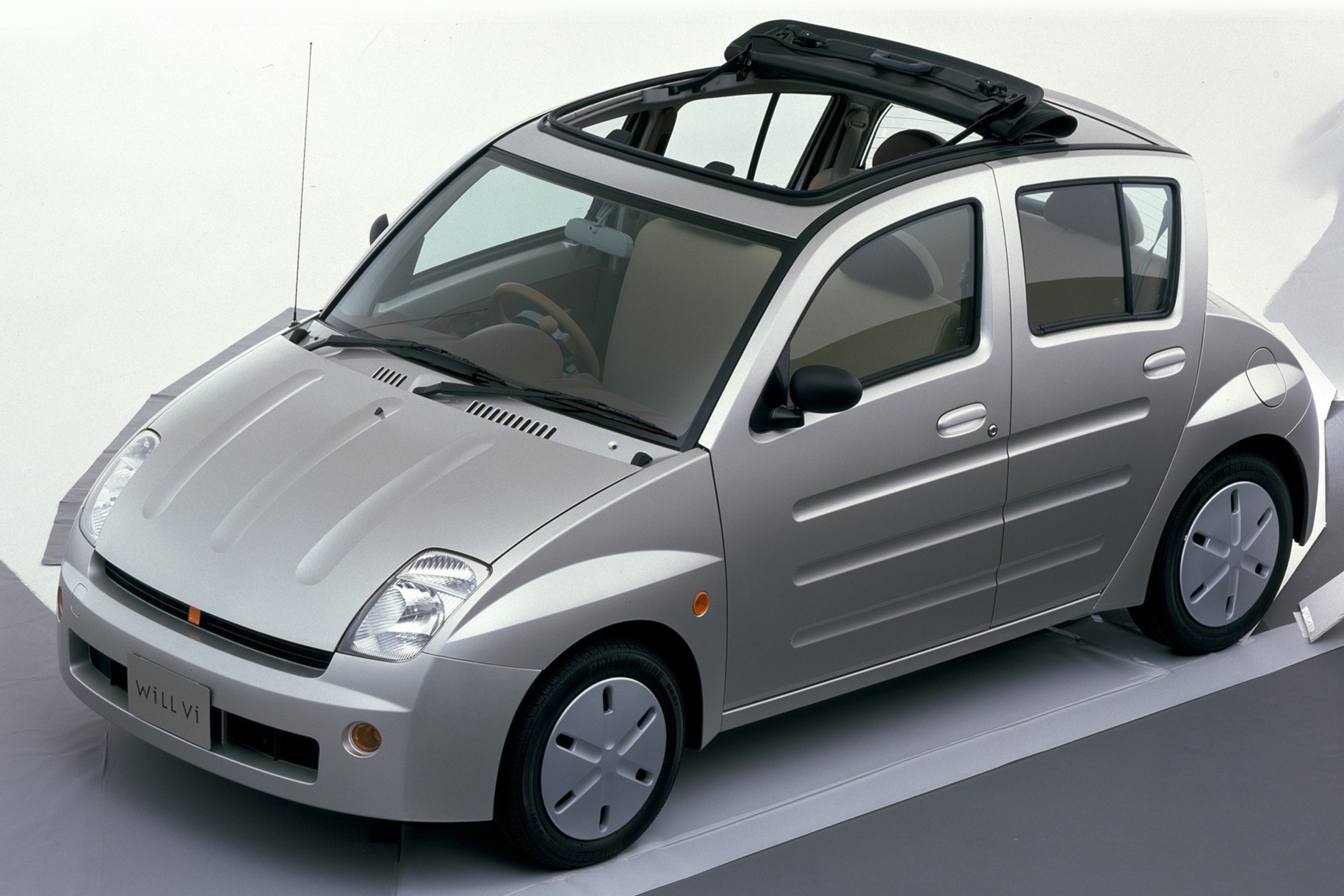
So, hopefully, I’ll get some answers to that mystery. And drive some stuff, and they say there’s a “surprise” here, too. I’m hoping it’s a new Will Vi!
Really, I’m not sure what to expect. But if there’s anything you’d like to know about what Toyota is doing or what a proving ground does or anything like that, tell me in the comments, and I’ll do my best to pass it along to the Official Toyota Officials, officially.
So, what would you like to ask Uncle Toyota?


Fueling stations at the dealerships? That seems perverse and likely a regulatory nightmare but there’d at least be a chance at fuel closer.
Actually the 2nd gen Prius killed H2 fuel cell cars.
PEM fuel cell vehicles overall thermal efficiency was in the mid-40% and so was the Prius.
Conventional ICE cars are around 25% efficient (on a good day).
Why is the most attractive Toyota vehicle the most challenging to own?
Why doesn’t Toyota build and improve their own hydrogen station?
Follow-up with, if stations are the problem, then why are you still building hydrogen cars?
We’re already in a Hydrogen economy. If we can capture Carbon in power plants, why can’t we do it in cars?
Oh! The humanity!
Ask the Toyota people about offering conversion kits to turn old Mirai into useable BEVs… and how feasible that could be.
Not the worst idea, but I’d guess it isn’t designed for enough weight to carry a reasonable-range battery. There will be a reasonable chunk of empty space in there with the tanks and fuel cell bits out, but they don’t weigh much.
A quick google says the tanks alone take up about 140L, weigh 190lbs empty, and hold about 12lbs of hydrogen. A Model 3 battery pack weighs about 1000lbs.
“Not the worst idea, but I’d guess it isn’t designed for enough weight to carry a reasonable-range battery.”
As I mentioned in my previous reply, the Mirai is actually HEAVIER than a comparable BEV like the Tesla Model 3.
If the chassis can handle the weight from the tanks, fuel cell stack and related bits, then it can handle the weight of a battery pack and would either weigh about the same or be a bit lighter depending on the type of Lithium battery used.
Hydrogen is acknowledged as difficult to store and distribute because H2 is very very small and will leak out.
what is Toyota’s perception of alternate storage/distribution technologies? e.g. zeolytic storage as CheapBastard suggested.
About 20 years ago, I worked on automotive projects for a fuel cell company. At the time, the materials inside the fuel cell (platinum, PTFE, fuel/air transport plates) alone cost more than a near-luxury car.
Also, something like 95% of the H2 was sourced from oil refineries. Not to mention H2 is very volatile.
The vehicles worked well, but they were not commercially viable without funding from the DOE and others.
Why are there currently no hydrogen stations in Arizona? We used to have locations in Scottsdale, Phoenix and Tempe, but today there are zero. Several Mirai owners still have their first-gen cars here in the valley, but they work poorly without fuel. What are Toyota’s plans to fill the gap?
My suggestion would be to convert them to BEVs.
I’m guessing they’re not built for enough weight to carry a reasonable battery. The tanks are big but light, so even if removing them gives you enough space you’re removing like 200lbs of tanks to put in 1000lbs of battery.
You are overestimating the weight of the batteries and underestimating the weight of the hydrogen-related stuff.
The weight difference will be a wash. There is more than just the hydrogen tanks. There is also the fuel cell stack and other related bits.
Compare the weight of the Tesla Model 3 to the 1st gen Mirai.
They’re the same size yet the RWD Model 3 is actually a bit lighter. Or another way to put it, the FWD Mirai weighs the same as the AWD Tesla Model 3.
And the 2nd gen Mirai is even heavier.
So in reality, you’re removing 1000lbs of tanks, fuel cell stack and related bits and then adding that weight right back.
Is the future of hydrogen a fuel cell EV or hydrogen combustion engine?
Some questions:
Thanks! And, keep up Great Work!
Hydrogen – What Is It?
I don’t see a road to profitability, but I’m glad someone is pouring in the money to do the research. Maybe one day between fusion and solar hydrogen will be a very useful fuel source. Nobody gave a damn about lizard spit, until they invented GLP-1s, and now I’m glad there was money to look at lizard spit.
We’ve had hydrogen vehicles in the market for about 25 years, yet they don’t seem to be any closer to becoming a viable option anytime soon.
What was the strategy for the last 25 years, and why did it result in such miniscule progress?
Do you think the new strategy will be more successful? Why?
JT – now that the White House has discovered Kei cars and wants them for the official presidential vehicle, let’s see if Toyota wants to jump on the waiving of rules and sneak in 70-series Land Cruisers.
Ask them why they don’t offer heated seats as a stand alone option in a Camry or Corolla LE.
Is their current strategy a hedge? Meaning, do they see next gen fuel source as an undecided battle, with electricity in the lead but by no means over yet? We are seeing limitations to the EV surge (namely cost, sourcing the rare earth needed, and perception), so perhaps they know they have a platform that does not need significant investment. They can continue to nominally “market” the tech, learn more, identify efficiencies, and finally be poised to move fast if the market does start to swing to hydrogen……
Does Japan, especially with its new right-wing prime minister Sanae Takaichi, think this is the way to an H-Bomb?
Why do all their plug-in hybrids only come with Henry Ford black interiors? Not hydrogen related? Too bad. I hate this black interior dominance in sunny CA.
Any progress on zeolytic storage media?
What is the current and projected real world water to wheel efficiency of green hydrogen?
Or how about the Borax option?
https://en.wikipedia.org/wiki/Direct_borohydride_fuel_cell
I did not expect to see the words “hydration with synthetic urine” in the borohydride fuel cell article.
Borohydride could be a good source for the TAE Technologies fusion reactor. Now they just have to shrink the reactor for vehicle applications. 😉
“the current efficiency of “boron hydride recycling” seems to be well below 1% which is unsuitable for recharging a vehicle.”
Doesn’t sound promising.
Why have they not paired Hydrogen up in a plug-in hybrid drivetrain yet? I would expect that to reduce the relience on the (currently) expensive fuel, which would make it a lot easier for typical people to adapt to.
Probably because the larger battery of a typical plug in hybrid won’t fit.
Also the point of a PHEV is to have the gas engine for long trips beyond the EV range. There is no H2 outside of a range easily covered by an EV.
You’d still get the benefit of a lot more useable miles on the car for a given fill-up
What is the point of being able to do a bunch of short trips on electricity if you can’t do long trips on H2? Just get and EV that will do the short trips and can be charged nationwide or a gas PHEV.
Either are better options than a H2 PHEV.
Bring a trailer.
Where will the GR version happen
1) Do you plan to send more Mirais to Ukraine ?
2) Do you realize the latest Mirai is one of the the best looking sedans out there, and not selling it with an ICE is a sin for which the Universe shall punish you ?
A hybrid ICE is 40% TE vs a FC at 63%. So that 400 mile/tank car would go down to about 266 miles/tank which would also have a concurrent rise in $/miles.
I was just thinking the same about the Mirai’s appearance. In the rare instances I’ve seen one, they are really good looking cars. Unfortunately I don’t see many ways to keep it with a different drivetrain.